
Essi Jämsä: In-app purchases, internet gaming disorder and impulsiveness: a look at the Mystic Messenger player base. In this master's thesis, the association between in-app purchases, Internet gaming disorder and impulsivity is studied by examining the player base of Mystic Messenger, a female-targeted free game.
INTRODUCTION
Do paying players of Mystic Messenger score higher on average on instruments measuring internet gaming disorder compared to non-paying players. Do impulsive Mystic Messenger players score higher on average on Internet Gaming Disorder measures compared to non-impulsive players.
BACKGROUND
- Free-to-play games
- Otome games
- Mystic Messenger
- Problematic gaming
- Impulsivity
Since the game industry is still largely dominated by male developers (Statista, n.d.), the mere existence of thriving, female-driven markets can probably be seen as a positive. 2015, p. 38), notes that "the field is still seriously hampered [...] by research recruitment methods that have sampling biases due to over-reliance on self-selected samples".
LITERATURE REVIEW
Free-to-play games: Who spends and why?
However, this was seen as something that was changing with the release of numerous “good” free-to-play games (Alha et al., 2018). The study by Alha et al. 2014) provides valuable insights from game industry professionals.
Internet gaming disorder, pathological gaming and impulsivity in video game players
Weisten et al, who also echo these results on Internet Gaming Disorder's similarity to other addictive disorders. 2017) looked at brain scans of patients. According to Weinstein et al. 2017), people with internet gaming disorder had changes in gray matter in their brain, which affects a person's emotional regulation, attention span and control over their actions. The symptoms of people suffering from internet gaming disorder have also been found to be similar to drug addicts (Weinstein et al., 2017).
In conjunction with research by Worth & Book (2015), Weinstein et al. 2017) also found evidence of increased levels of impulsive behavior in those with Internet Gaming Disorder. A study by Laconi et al. 2017) further supports the idea that Internet gaming disorder is associated with other psychopathological factors. They also estimated that internet gaming disorder scores were higher among action and adventure game players compared to other genres (Laconi et al., 2017).
In summary, people suffering from Internet Gaming Disorder seem more impulsive than average and prefer instant gratification.
METHODOLOGY
Research questions
People who have made large one-time purchases or spent a lot of money on Mystic Messenger score higher on average on tools that measure the internet. Impulsive players of Mystic Messenger show higher average rates of spending money on the game compared to those with lower impulsiveness scores. The survey itself was used to collect demographic information, descriptions of in-app purchasing behavior and used two standardized tools to measure the symptoms of internet gaming disorder and impulsivity.
Considering the previous research on the topic examined in Chapter 2 and Chapter 3, my hypothesis for this study was that large or frequent in-app purchases correlate positively with both the self-reported symptoms of internet gaming disorder and the self-reported impulsivity of an individual. Furthermore, I expected that high scores on the impulsivity measure would correlate positively with high scores on the tool I used to measure the symptoms of Internet gaming disorder.
Online survey as a data gathering method
- Limitations of online surveys
Since the research questions focus on a number of delicate and personal issues, mainly related to internet gaming disorder and an individual's financial situation, I deemed maintaining the respondent's anonymity of paramount importance, a feat more easily achieved in online environments as opposed to, for example, face-to-face interviews or surveys. However, as a hobbyist, I knew that other gamers have thriving online communities dedicated to discussing these games, and I knew that Mystic Messenger in particular has at least one active community of its own on the social media site Reddit. The first, r/mysticmessenger, which is dedicated to players of Mystic Messenger, was chosen because it is an active community with approximately 11,000 members as of 2020.
Since the survey leader does not personally approach anyone and does not specifically ask them to participate in the survey, it is up to the respondents themselves to invest and participate. Depending on the objective of the survey and what is being examined, online surveys naturally inhibit responses from potential respondents who do not have access to the Internet. Additionally, the majority of Reddit's user base has at least some college education, but they have a lower average income when compared to the US.
This, paired with their age demographics, may mean that a significant portion of Reddit's users are college students (Sattelberg, 2019).
The Survey
- Limitations of the Survey
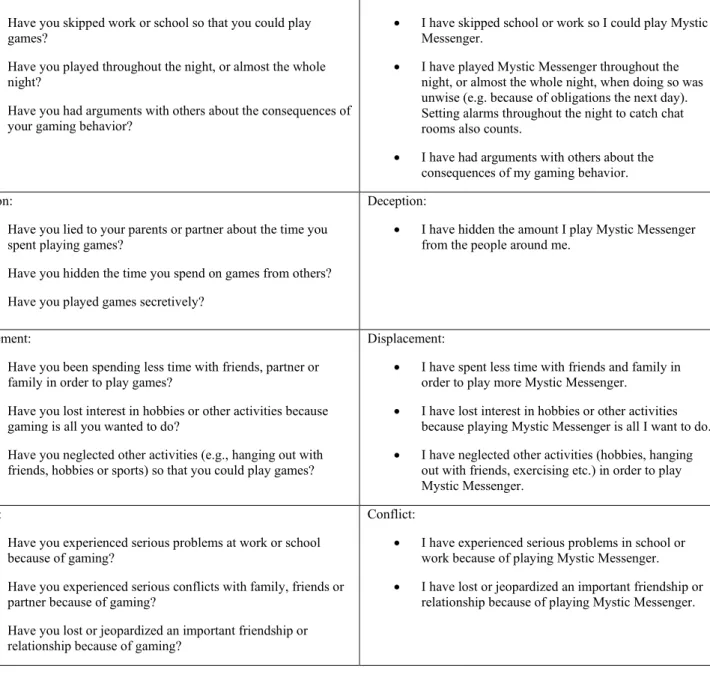
This was done to catch possible players showing symptoms of the condition, but not in Mystic Messenger. There were times when I constantly thought about Mystic Messenger at school or work. There have been times when all I can think about is the moment I was able to play Mystic Messenger again.
I spent less time with friends and family to play more Mystic Messenger. I have lost interest in hobbies or other activities because all I want to do is play Mystic Messenger. I neglected other activities (hobbies, hanging out with friends, exercise, etc.) in order to play Mystic Messenger.
For example, with the statement "I have experienced serious problems at school or work because of playing Mystic Messenger," what constitutes "serious problems" varies depending on who is asking.
RESULTS
Analysis details
Respondent demographics
According to the previous results, the most money spent at one time is between. 22.7% of respondents (n=77) partially or fully agreed with the statement "I used to worry constantly about Mystic Messenger". A few respondents also mentioned the amount of gameplay and loved ones worried that Mystic Messenger was taking up too much of their time or money.
For the statement "I have experienced serious problems at school or work because of playing Mystic Messenger", only four respondents (1.2%) somewhat agreed and none strongly agreed. A couple also mentioned that they have trouble focusing during lessons due to being preoccupied with thoughts of the game. However, there did not appear to be a significant amount of problems in school or work life.
Overall, there was still a surprising amount of respondents under 25 and college students, even knowing that Mystic Messenger is an otome game and thus heavily marketed to a young female audience.
Results
- Demographic variables
- In-game behaviour and money usage
- Impulsivity and internet gaming disorder symptoms
The total amount of money used in the game did not show any significance in terms of IGD-20 or BIS-11 scores nor did it produce any other noteworthy results. On the other hand, level of engagement and experience with the game (i.e., number of different character paths played) did not appear to have any relationship with IGD-20 or BIS-11 scores. Regarding respondents' views on their in-game spending habits, statistically significant differences were found regarding their IGD-20 scores (p=0.008) as shown in Chart 7.
The relationship between the IGD-20 score and the three dimensions (motor, attention and non-planning) of the BIS-11 tool was also measured. Overall, those who considered themselves impulsive had higher IGD-20 scores on average, and their perceived impulsivity was consistent with their BIS-11 scores. There was a weak positive correlation between IGD-20 and BIS-11 scores and a weak positive correlation between IGD-20 scores and BIS-11 attention dimension scores.
The rest of the correlation analysis between subsections of both BIS-11 and IGD-20 tools, while performed, did not correlate strongly enough to be reported.
DISCUSSION
Limitations
The changes felt necessary and warranted at the time of data collection, as I was concerned about the dropout rate if the survey was too long. A few minor typological errors in the survey were brought to my attention during early data collection with some respondents noting that I had a statement in the IGD-20 section where the descriptors (strongly disagree to strongly agree) were placed vice versa for the rest of the statements, and that I had accidentally mixed up less than (<) and greater than (>) symbols in the income question. My lack of experience with general statistical analysis shows in my survey design, and I should have familiarized myself with the tools before conducting the survey to avoid these oversights.
Due to my limited knowledge and understanding of creating surveys, I assumed that a disclaimer stating that respondents under 18 should seek permission from their legal guardians before participating would be sufficient, but after the first draft of my dissertation was completed, it was brought to my attention that I should have either prohibited responses from those under 15 or implemented a consent form that the guardians of these respondents had to fill out before the child took the survey. Some comments from the surveys also highlighted that other circumstances in their lives influenced their results. One survey taker also noted that the survey results may be biased due to the questions potentially making the survey taker feel personally attacked, as the questions are straightforward.
As such, the survey can be seen as painting the game and its players in a negative light which can influence the way the respondent answers.
Further research
Conclusion
Problematic gaming, although widely studied throughout history, was not brought under one umbrella until 2013, when the APA first suggested Internet gaming disorder as its own phenomenon. Moving on to the literature review, some evidence was found linking Internet gaming disorder with impulsivity and gambling use. Commentary on: Open researcher discussion paper on the World Health Organization ICD-11 proposal for Gaming Disorder (Aarseth et al.).
High involvement versus pathological involvement in video games: a crucial distinction to ensure the validity and utility of gambling addiction. Including a gaming disorder in the ICD has more advantages than disadvantages: Commentary on: open debate paper by scientists on the World Health Organization proposal ICD-11 Gaming Disorder (Aarseth et al.). The Conceptualization and Measurement of DSM-5 Internet Gaming Disorder: The Development of the IGD-20 Test.
Prevalence of internet gaming disorder in German adolescents: diagnostic contribution of nine DSM-5 criteria in a nationally representative sample. Retrieved from https://www.gamesindustry.biz/articles free-to-play-whales-more-rational-than-sumed. Retrieved from https://www.forbes.com/sites/danieltack the-subscription-transition-mmorpgs-and-free-to-play/#47e7bec22c35.