Trond Haavik, Synnøve Aabrekk, Segel, Henrik Tommerup, Svend Svendsen, Technical University of Denmark (DTU) ;Krushna Mahapatra. The information in this document is provided as is and no guarantee or warranty is given that the information is suitable for any particular purpose. The document reflects only the authors' views and the project consortium is not liable for any use that may be made of the information contained therein.
Executive summary
INTRODUCTION
Purpose
Methodology
The conclusions are systematized as strengths (S), weaknesses (W), opportunities (O) or threats (T) and are also summarized in the final SWOT analysis. Based on all themes, potential joint ventures are identified to create new service packages. Finally, the SWOT analysis lists all the joint strengths, weaknesses, opportunities and threats and all the strengths, weaknesses, opportunities and threats for all the different joint ventures mentioned.

Acknowledgements
STATUS
Building stock analysis
The energy statistics for single-family homes include all types of permanently used homes (detached houses and terraced/semi-detached houses). The total number of interesting single-family homes (detached houses and farms built before 1979) is approximately 1.1 million units. 450,000 detached single-family homes were built, almost half of the supply of detached single-family homes.

Regulations and voluntary standards
There is a proposal for definitions of a low-energy standard as well as a specific Norwegian standard for PHs, which take into account the special climate conditions as well as the definition of calculation methods. There are defined standards both for PH (12-14 kWh/m2/year) and Mini energy house (20-24 kWh/m2/year) for heating depending on which of the three climate zones the house is located in. The total primary energy consumption for appliances, domestic hot water and space heating and cooling is limited to 130 – 140 kWh/m2.
The total need for energy for heating and cooling the premises is limited to 20 - 30 kWh/m2 of floor area. Low energy class 2 and low energy class 1, defined as a calculated energy efficiency that is 25 and 50 percent better than the minimum energy efficiency for new buildings, respectively. In 2010, Class 2 is planned to be the new energy efficiency limit in the Building Regulations, and in 2015, Class 1 is expected to be the minimum requirement.
It is the government's target that by 2020, all new buildings use 75% less energy than today.
Subsidies/grants/marketing campaigns
It can be combined with a subsidy for replacing resistance heaters or for radon decontamination in single-family houses. This means per year for all types of renovation and other household work combined. Different types of subsidies in the Nordic countries could influence energy-efficient renovation, in some cases encouraging integrated solutions, and in other cases leading to sub-optimization.
Customers’ needs and the right timing for energy efficient renovation
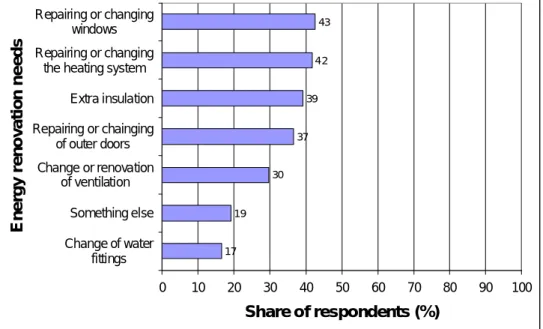
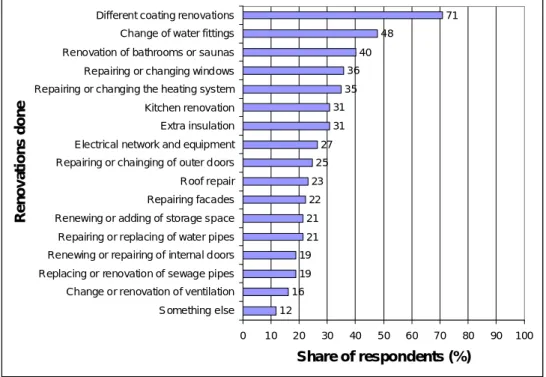
In any case, it should be possible for energy efficiency measures to compete with other types of investments and/or be carried out together with other types of investments. A survey of the realized and planned renovation of single-family houses was carried out in 2009 by VTT. Something else Change or renovation of ventilation Replacement or renovation of sewer pipes Renewal or repair of internal doors Repair or replacement of water pipes Renewal or addition of storage space Repair of facades Roof repair Repair or tightening of external doors Electrical network and equipment Extra insulation Kitchen renovation Repair or change the heating system Repair or changing winds Renovating bathrooms or saunas Changing water fixtures Different coating renovations.
The foundation for a healthy development of the advanced renovation market naturally lies in houses that are in immediate need of some kind of renovation (windows, facade, etc.). Since a sustainable holistic renewal should be considered as a new and unknown innovation, the introduction to the market should be directed towards curious and open-minded people, i.e. innovative people. It seems important to consider some demographic factors, such as the family situation of the home owner; age, how long the owner has lived in the house, if it was newly purchased, etc.
All these factors influence the extent to which the renovation will be carried out in an energy-efficient manner. Based on the experience of Rustholli in Finland, it seems that people over 50-60 years old who have paid off their mortgages are reluctant to take out a new loan for additional renovations. It is important to focus on the time window: what opportunities could be used to communicate a more energy efficient renovation.
Based on the scheme above, the best time windows and opportunities to promote energy efficient renovation appear to be: (O).
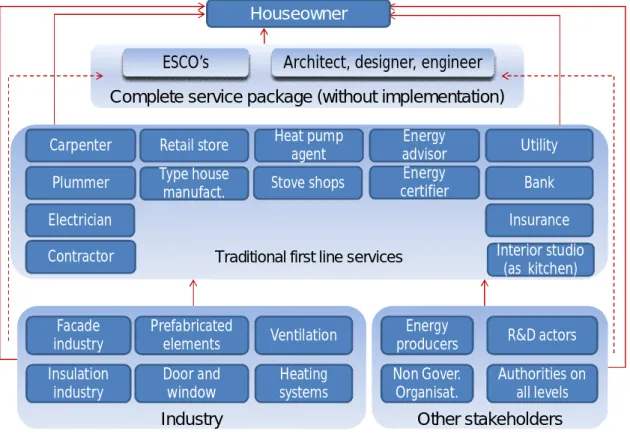
Present type of actors
Sweden: Full insurance coverage for pipes less than 10 years old; thereafter there is a 5% depreciation every year. So if the pipe system is 30 years old and there is water damage, you get nothing. The insurance premium often varies depending on the age of the pipes, but sometimes the change is only marginal.
There may be a reduction in the size of the possible compensation depending on the age of the pipe. If it can be documented that an older house has been completely renovated, this can be included in the insurance fee. Normally, there is no depreciation/reduction of the compensation amount in relation to the age of the pipeline.
Some companies operate with a modest excess/own risk fee because they have no reduction in the compensation amount in case of pipe related damage. Sweden: Full coverage for cables up to 25 years old; thereafter there is a 5 % reduction in value every year [9]. But the local representatives in the chain are more interested and today offer several additional services besides components.
The branch should be interested in energy efficient renovation because the value of the property/house is rising.
Potential actors to play important roles in one stop shop
Another very important issue to be discussed is how to ensure the reliability of the one-stop-shop system. A place for people who want to renovate - where they can get information about how they can renovate in an energy-efficient way. Customized renovation – what to do – what we can do and what you can do yourself What would be interesting questions for our customers in the future.
We must be able to provide the best advice for an energy-efficient renovation solution. We want the actors to also convince or tell their customers not only to renovate, but to renovate in a sustainable way. The one-stop shop must have the knowledge of competent companies that can offer the additional services, knowledge of prices and how to organize the work in a cost-effective manner, in the right sequence and with the desired quality.
Energy efficient renovation up to passive house level (already core business for some companies offering new houses). Public can make sure we have a proper labeling for the house = stimulate private home owners to be interested in labeling their house, and renovate in an energy efficient way. The public can give a kind of certificate to the one-stop shop that guarantees that it is a good concept, and furthermore, it can be developed according to the ISO standard system.
In addition to house types from a specific year of construction - we should segment our customers based on demographic factors such as age, education level, geographic area, etc., according to the REEP story in Canada and Chapter 3 C. Customer Needs [8] and experience from Rustholli, Finland).
![Figure 8. 6-Forces model. Source: Grove, A. [8] and [10]](https://thumb-eu.123doks.com/thumbv2/9pdfco/19334779.0/25.892.114.788.307.811/figure-8-6-forces-model-source-grove-10.webp)
Summary of conclusions of status
Depending on the age of the house or various building components, there may be restrictions on insurance coverage. The industry should be interested in energy efficient renovation as property/house values rise. We must focus not only on which player could play a key role, but also on who could be involved in the execution of the complete overhaul package.
Existing suppliers of type houses do not have knowledge of renovation, although a heat pump, ventilation system etc. This consultant can provide objective information about what needs to be done, provide quality assurance, performance testing and deliverables, including cost. Use a recognized independent public actor as ENRA has done with VTT Enova – Norway.
6-forces The one-stop shop should offer customized services for sustainable renovation of a single-family home. Banks, Property Companies, Interior Designers, Companies Offering Renewable Energy Systems – District Heating Companies, Energy Consultants, Utility Companies, Insurance Companies, Authorities. Possible cooperation between public and private actors could be: (O) Quality assurance done by independent 3rd part.
Potential piloting models
Other actors: Key component/material suppliers, energy auditors and architects/engineering firm if these capabilities do not exist in-house. Other actors: window/door supplier, insulation supplier, painters, heating system suppliers Dong Energy from Denmark is a good example here. Directly involved: Type house manufacturer for a complete package for the renovation of existing houses, including internal or external consulting engineers and architects with the necessary qualifications in relation to the existing building.
Other actors: Bank and mortgage loan institute, home owners association - impartial consultants to make plans for renovation and quality control - renovation or new house. The estate agent hires an energy/building consultant to carry out the energy audit and energy release. The consultant also inspects the physical condition of the home and the inspection report is made available to potential buyers.
Therefore, they usually contact the building inspector before signing the purchase agreement to find out more about the building inspection report. The consultant can offer full service energy efficiency renovation and specific prices through pre-contracts with installers, carpenters and others involved in the renovation of the building. The adviser could also have contact with the bank to acknowledge the energy certificate and the building inspection report in order to finance the renovation work.
Directly involved: Energy/building consultant and real estate agents Other actors: Banks, installers and carpenters.
SWOT ANALYSIS
New alliances to create a complete renovation package Smart use of government bodies to build credibility Enova (N) offers free access to experts for training. Cooperation with suppliers. Complementary companies expand their business to renovation Use existing market position to expand product range. The bank is a neutral part of this type of business. Insurance companies also have technical internal competence (LEIF) on via network. Credibility: Customers may consider that the recommended measures in the energy declaration are intended to suit the energy adviser's business interests.
CONCLUSIONS