The SPASE project began in May 1996 as a two-year effort to develop methods to reduce the risks of chemical accidents in small facilities where chemicals are handled, stored or processed. Tasks associated with all of these tasks were completed in the final period of the project. However, it is clear that the SPASE methodology cannot cover all national and company-specific aspects.
However, if the ambition to conduct a hazard study for some subjects is either very low or very high, it is possible that the SPASE method may not be the right tool to use. The validation phase revealed problems in the use of the method as well as many other weak points, and the current version of SPASE has benefited from the resulting feedback.
Background
In the left part, safety is good business - by spending money on safety, in addition to preventing injuries, the plant has less downtime and the company makes more profit. In the next area, security is bad business - the security company gets some money back. If a company continues to spend money on security, it moves into the third realm, where security is bad business but good humanity.
The money is spent so that people don't get hurt, and the company doesn't expect to get any material gain in return. Finally, in the fourth area, the company is spending so much on security that it goes out of business.
Organisation
Main Activities Undertaken
Results of the Investigation Phase
National legislators in Member States must harmonize laws and regulations to achieve common standards, at least for their entire country. European regulations represent laws that are the same in the European Union as they are in force in all countries. Therefore, different levels of workplace safety result in different conditions for using these products.
The minimum level of workplace safety must be raised until it is the same across Europe. This harmonization of social directives would support free trade by ensuring equal working and operating conditions in Europe.
Results of the Creation Phase
The SPASE user can choose how and to what extent he wants to use the different features of the methodology. To make this possible, the SPASE manual is divided into modules supported by the set of tools provided in the SPASE. In fact, one of the basic assumptions of the SPASE methodology is that no one knows the plant – and its technology – better than the people working in that specific area.
However, the developers of the SPASE methodology believe that SPASE can help the personnel of SPPs to become experts not only in their industrial sector, but also in the fields of safety and environment. In other words, the baseline achieved by the SPASE methodology is higher than simply meeting national legislation. However, it is clear that the SPASE Guide cannot cover all country and company specific aspects, i.e.
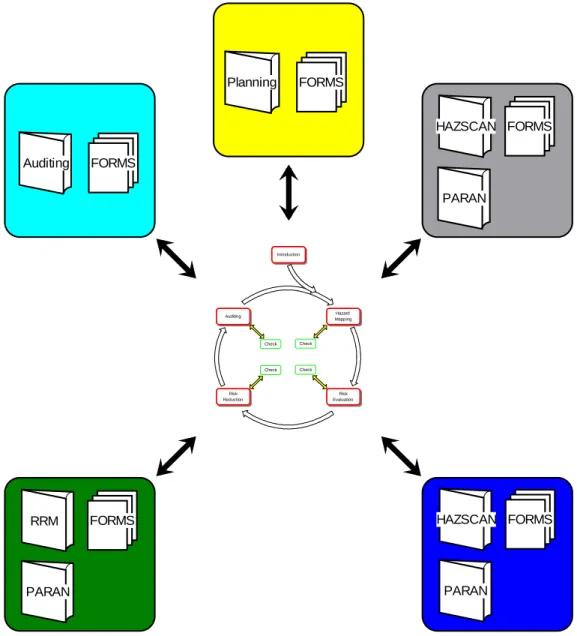
In most cases, however, it is assumed that the SPASE methodology will be suitable for the study (based on the recognition that safety checklists and tools developed for SMEs in general are inadequate for plants handling hazardous chemicals). Each of the four main modules presented in the cycle contains references to a SPASE workbook containing detailed methods and tools specifically developed for use in the tasks at hand. The relevant methods and tools are given in the SPASE workbook and are shown in Figure 4.
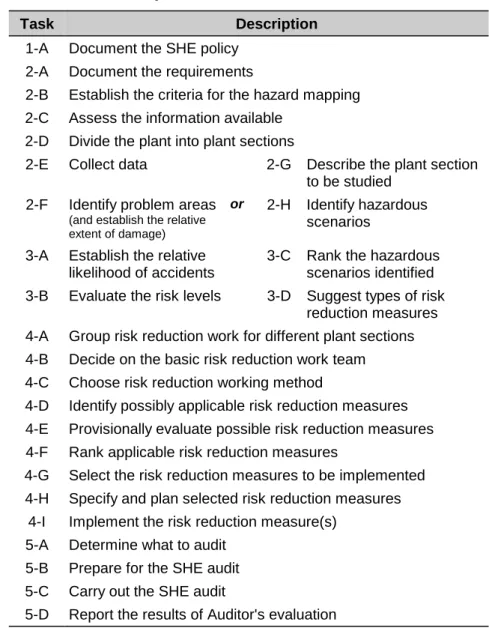
Follow the text in the SPASE guide and complete the tasks (see Table 1.). Return to the SPASE guide whenever you have completed all the steps in the SPASE workbook (or those required by any alternative method). SPPs can also use the SPASE guide without referring to the SPASE workbook, provided they already have similar tools available in their company.
And – although this is not the intention of SPASE – they can use the methods presented in the SPASE Workbook as. A glossary at the end of the SPASE manual explains many of the specialist terms used in SPASE.

Examples of the different potential applications of SPASE
The implementation of the various measures proposed to reduce the risk took from one day to 16 months. Of the two risk mapping methods given in the SPASE workbook, the HAZSCAN method was found to be more suitable than the PARAN method. For each problem, advice was sought in one or more of the sections in the SPASE workbook covering a range of potential risk reduction measures – from sealing the floor to upgrading the safety management system.
The audit proposed in the audit module of the SPASE manual was carried out one year after the implementation of the risk mitigation measures. After the distillation unit design was completed, the company used the Check sections to ensure that the requested changes were implemented in the design as planned. The effect of the new unit on the rest of the plant was assessed shortly afterwards using the SPASE Workbook Performance Guide.
A representative of the service company responsible for maintenance at the plant also participated in all the hazard mapping sessions. The hazard mapping exercise produced seven potential incident scenarios which, as a result of the risk assessment, were deemed to cause. The procedure described in the Risk Assessment module of the SPASE guide and the classification method given in the SPASE workbook were followed.
Neither the risk reduction module nor the audit module of the SPASE guidance were used in this study. The result of the audit showed that the management of the solvent handling was inadequate. As a consequence, the company's board of directors requested a hazard mapping with a focus on fire hazards.
Results of the validation phase
All raters felt that SPASE will require a little or a lot of help from an expert. One of the Swedish evaluators worked with divisions (with small factory sizes) in a larger company and thought that SPASE might also be of interest to them. The two Finnish evaluators did not find any suitable RRMs, while the German evaluator used some of the RRMs.
The Finnish evaluators identified "all significant hazards" using SPASE, and the German evaluator identified "some significant hazards". The German evaluator was able to evaluate "most of the identified hazards", but the Finnish evaluators did not evaluate any. The evaluators felt that significant risks could be addressed or reduced even without the use of SPASE.
The Finnish evaluators found the work to be "very difficult", while the German evaluator found it to be "rather difficult". All evaluators thought that SPASE would help to deal with different legislative demands "to some extent". The first evaluation showed that the experts' impressions of SPASE were quite positive and that SPASE was considered relevant for small plants.
In particular, regarding the division of the Guide and the Workbook, the interrelationship between these books needs to be reconsidered. Experts felt that SPASE was too complex, time-consuming and extensive to be of interest to small plants. These figures were supported by data from field tests, where company evaluators believed that 20-30% of small plants would be interested in using SPASE.
The business evaluators felt that SPASE was difficult to use, and two out of three evaluators thought that help from a consultant would be required. It can be concluded that the draft version of SPASE needs to be improved in many ways before any marketing can take place, but both the experts and the business evaluators thought that a large number of small factories might be interested in SPASE.
Exploitation
The estimated number of possible users makes the publication of the draft SPASE manuals in the form of books economically unattractive. This is based on the assumption that the unit price should be a few hundred euros and on the fact that none of the contractors has a sales department suitable to handle this kind of business. The availability of a software tool is considered very important if the international version of the SPASE system is to be widely used – the development of such a tool would require no less than €200,000 and more than €300,000 for a full implementation , including on-line internet interactivity.
One or more Contractors using the project deliverables in their own national implementations with possible further developments that do not involve the SPASE exploitation partners. This means that national versions will be developed in different languages and based on national legislation. It was the preferred option among the companies involved in testing the SPASE methodology and the peers who evaluated it.
One or more contractors use the project deliverables in their own IT implementations with possible further developments without involving the SPASE utilization partners. One of several contractors who carry out a direct exploitation of the project's results with royalties distributed to the other contractors who can also work on further development. A joint exploitation, where only some of the Suppliers play a role for further development and some of them as active parties in selling the product(s) and assisting the users.
Exploitation limited to the use of the methodology and acquired knowledge for the provision of services or as a basis for further ones. Any exploitation will be subject to the terms and conditions of the EC Treaty and exploitation agreement. The Exploitation Plan was developed to maximize the chances of the project being exploited with the above priority list and within technical, legal and economic constraints.
Publications