Current digital revenue models tend to be weaker than traditional revenue models (Berman et al. 2011), and the fragmentation of the online audience has created niche groups that are difficult and unprofitable to serve. Different commercial platforms for user-generated content are intensifying the competition for consumer interest and advertising revenue. Because of these reasons, there is an existing need for complementary business models, and leveraging users as content creators through revenue sharing programs is one possible addition to these models.
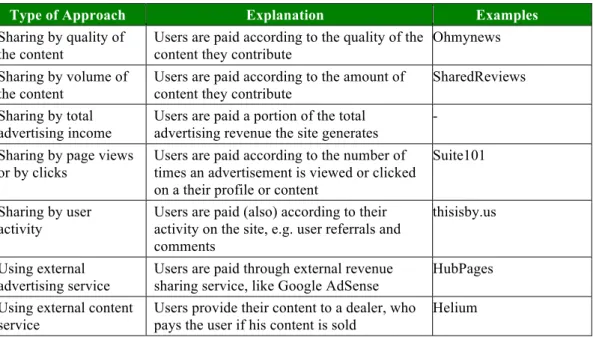
In this first part of the publication, the concept of revenue sharing is discussed based on the literature and existing examples. It is also likely that favorable topics for content will be found in local and personal spheres and that professional bloggers are unlikely to contribute. The results of the survey show that, from the users' point of view, there is a high demand for user-generated content.
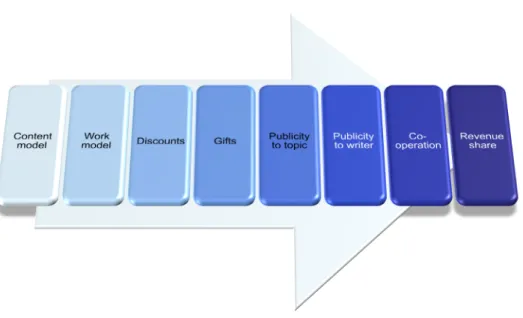
This includes local news and, for example, topics where the author has his or her own experimental knowledge. Payments to user-generated articles received almost the same support as certain product gifts or publicity to article topics or to the author.
Sharing (Advertising) Revenues in Commercial Mediaspaces
Creating the Original Content: Citizen Journalism
Creating the Original Content: Blogging
User Participation in Online Commercial Media
Measurement and Encouragement of Quality UGC
Fraud Prevention and Copyright Issues
Elements of Possible Success
Drawbacks and Benefits of Revenue Sharing
Open Issues for Future Research
Revenue Sharing of Online Communities – A Survey Study
Web Survey
The questionnaire was created and published with Digium1 software, which is a web-based tool for collecting data and making analyzes and reporting of collected data. Kaksplus3 is a popular news and map service with a focus on pregnant women and parents with young children. News and chats in Ellit4 are focused on topics such as fashion, health, interior design and food.
Respondents’ Background
The scenarios helped respondents to understand different revenue share opportunities in different contexts and to inspire ideas for new concepts. All respondents used social media and were members of various online communities (Figure 3).

Content Themes for Amateur Writers
- Topics for Amateur Writers
- Different Locations
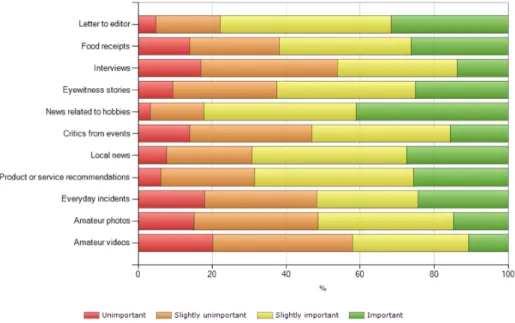
The writing style can be personal and humorous, but respondents emphasized that articles should be well written. They wanted to read stories by amateur writers about daily incidents, grocery bills and local news. Kaksplus respondents were also most interested in letters to the editor, interviews, testimonials and eyewitness accounts.
Recommendations
- Bloggers as content creators
The respondents also thought that a service offering advertisers and sponsors to blogs would be a good idea. The respondents had more confidence in user-generated content when their themes and topics were known to the author. Kaksplus respondents thought that amateur writer's food receipts, interviews, entertainment-related stories, product tests and local news were reliable.
Articles and reviews published with real name or registered nickname are reliable, but anonymous judgments and comments like "this product was totally useless" are not very reliable. Articles are always based on author's interpretation and personal preferences, but that doesn't matter to me.

Compensation to amateur writers
- Revenue share models and different ways to pay
- Financial payment as a compensation
- Revenue share methods
Respondents were mostly open and ready to the idea of being able to write to an Internet service if they were financially compensated. Compensation encourages focus on quality and research references so you can write a high-quality article. Respondents were mostly open and ready to the idea of being able to write stories for online media for a small monetary compensation.
I don't have too much extra time, so compensation would be very motivating if I write and publish articles. Compensation encourages you to focus more on quality and research topics so that you can write a high-quality article. Female, 22 years Some respondents also believed that the user-generated content should mostly be based on voluntariness.
All the different reward models received support: payment by length, payment by user time, discounts, giveaways, topic or writer publicity, and new and important contacts. Ads are only acceptable if they are related to my article and the revenue must be credited to me. It would not be a credible product review article if it has a product advertisement.
Overall View
The reason for reading amateur writings was that they were seen as independent, different and inspiring. Articles written by amateurs contain new points of view, and it is inspiring to read something that is not written by professional journalists.
Revenue share models and users
Amateur writers are very familiar with their subjects, and they tell personal and honest experiences. Respondents were also ready to write their own articles if they were paid from it. This includes local news and, for example, subjects where the writer has his own experimental knowledge.
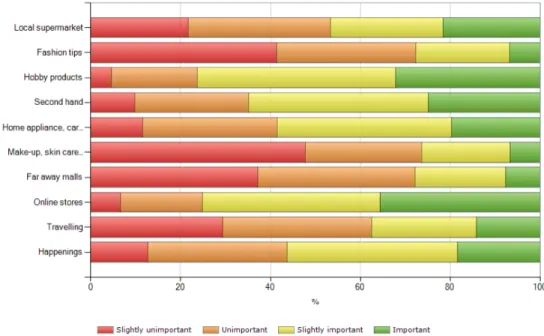
Recommendations of different products and services were also considered important subjects for amateur writing. gadgets, various tech gadgets, good babysitters, food recipes, etc. have been suggested as some topics to amateur writers. In addition, amateur writers usually have extensive knowledge and high motivation related to their topics of interest. User measurement was seen as a good option to conclude the quality of the user created article.
2008), 'Searching for high-quality content in social media', Proceedings of the International Conference on Web Search and Web Data Mining, p. 2011), 'Co-creative advertising - Exploring the scope of advertising in the participatory web', TIVIT Next Media Results D Journalism: expertise, authority and power in democratic life', The Media and Social Theory, David Hesmondhalgh and Jason Toynbee, eds. 2011), “New Business Models for Emerging Media and Entertainment Revenue Opportunities”, Strategy & Leadership Vol. NewsPreferences of Journalists and Consumers', Journal of Communication Vol. 2010), 'From Reader to Writer: Citizen Journalism as News Production', International Handbook of Internet Research 2010, p. 2007), 'A Survey of Revenue Models for Current Generation Social Software's Systems', Lecture Notes of Computer Science (LCNS) and Proceedings of the International Conference on Computer Science and Its Applications - ICCSA, 2007, p. 2008), 'A Survey of Revenue Sharing Social Software Systems', Proceedings of International, Workshop on Social Interaction and Mundane Technologies (Simtech). 2009), 'User Contribution Measurement Model for Web-based Discussion Forums', Proceedings of 3rd IEEE International Conference on Digital Ecosystems and Technologies, p. 2011), 'User Reputation in a Comment Rating Environment', Proceedings of 17th ACM SIGKDD International Conference on. Knowledge Discovery and Data Mining, pp Adaptive Reward Mechanism for Sustainable Online Learning Community', Journal of User Modeling and User-Adapted Interaction, Vol. 2008), "Mining gold in the blogosphere", British Journalism Review, Vol. 2007), "Web 2.0 and User-Generated Content: Legal Challenges at New Frontiers", Journal of Information, Law and Technology, Vol. 2009), “Social News, Citizen Journalism and Democracy”, New Media & Society Vol. 2011), 'User Production Reconsidered: From Convergence, to Autonomy and Cultural Materialism', Media, Culture & Society, 31 March, p. 2008), 'A Clash of Cultures: The Integration of User-generated Content within Professional Journalistic Frameworks at British Newspaper Websites', Journalism Practice 2.3, p. 2010), 'User-generated diversity - Some thoughts on how to improve the quality of amateur productions', Communications and Strategies, Vol. 2011), Donate for Credibility: How Contribution Incentives Can Improve Credibility, Proceedings of CHI2011, p. 2008), Blogs, the New Source for Data Analysis, Journal of Issues in Informing Science and Information Technology Vol. 2011), “Behavioral Economics and the Psychology of Incentives”, Annual Review of Economics (working paper). 2004), "Structure and Development of the Web", Communications of the ACM Vol. 2010), “Thinking about citizen journalism – the philosophical and practical challenges of user-generated content for the community.
2008), 'Blogging: self-presentation and privacy', Information &. 2009), 'Between tradition and change: a review of recent research into online news production', Journalism Vol. 2008), 'User Generated Content in the Newsroom: Professional and Organizational Constraints on Participatory Journalism', Westminster Papers in. 2008), 'Loser Generated Content: from participation to exploitation', First Monday, Volume 13, Issue Where is the business model for citizen journalism?', Australian Journalism Review, Vol. 2009), 'The Value of Online Newspapers Web 2.0 Adoption', Proceedings of IADIS International Conference WWW/Internet 2009, pp. 2009), 'Citizen Journalism', International News Reporting: Frontlines and Deadlines (edited by John Owen, Heather Purdey), Blackwell Publishing Ltd, pp. 2005), 'Motivating Content Contributions to Online Communities: Toward a More Comprehensive Theory', Proceedings of the 38th Hawaii International Conference on System Sciences. Adoption of User Generated Content Initiatives by Online News Media', New Media & Society Vol.10 No.1, pp. 2007), ‘The Normalization of the Blog in Journalism: Online Newspapers of Slovenian Traditional Media’, Mediy. Alexa Web Ranking, Finland: http://www.alexa.com/topsites/countries;0/FI Blogpulse: http://blogpulse.com/.
Heliumin käyttösopimus: http://www.helium.com/content/tos Blogjet Helsingin Sanomat: http://blogit.hs.fi/.
Web survey form (in Finnish)
1 = Täysin eri mieltä, 2 = täysin eri mieltä, 3 = hieman samaa mieltä, 4 = täysin samaa mieltä, 0 = en osaa sanoa.