The contents of electronic and/or printed versions of this document may not be changed without prior written permission from ETSI. Users of this document must be aware that the document may be subject to revision or change of status. The content of the PDF version may not be changed without written permission from ETSI.
3GPPTM and LTETM are trademarks of ETSI, registered for the benefit of its Members and the 3GPP Organizational Partners. This document focuses on the architecture and organizational dimensions of ACIFO, including user QoE.
Normative references
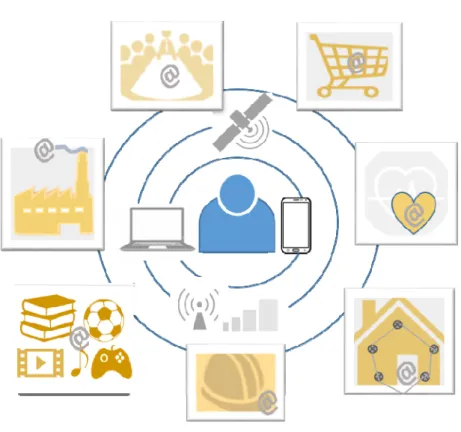
The digital ecosystem includes all sectors of activity in which the user is connected through the smartphone, and objects, that is, able, in addition to their main function, to send or receive information through a telecommunications network that allows the expansion or diversification of functions. of the smartphone and the object. Connected objects fall, for example, in the fields of transportation (connected vehicle), health (connected self-metering), industry (connected vehicles), home automation (interactive electricity meter) or even everyday life (clock connected). This is why the notion that interests us in the digital ecosystem is that of considering the user to be at the heart of the architecture.
The overall results of a survey designed to collect information about the experiences, expectations and behavior of users.
Informative references
Terms
Symbols
Abbreviations
Introduction
Evolution of the context with the concept "user centric"
To ensure all kinds of personalization, such as tracking the mobility of the user, taking into account the user's preferences according to the location, adapted to the profile, designers can no longer be satisfied with a "client/server" application architecture with options not. Having an architecture allows the user to, if they wish, do their own composition of service, with dynamic changes according to the suggestions made to them throughout the movement.
The digital ecosystem should be responsive to "anywhere, anytime, any way, any service, anyone", with transparency and automation in mind. Due to the many services, applications, networks, terminals, it is necessary that the user is the heart of the architecture, to make life easier and to offer all potential services with high quality of service, safety, security. , etc. The service must be fully adapted in order to respond to the expectations and needs of the users with the composition of the service.
Introduction
User maturity
User expectations
People want to be informed when there is a risk of entering an area with low or no coverage and may lose continuity of service. 44% of the population would appreciate a service with bandwidth on demand fixed line and 38% on mobile line. The percentage of people interested and not interested in this service is exactly the same.
Of course, security and privacy issues are at the heart of trust in the future digital ecosystem. The research shows that there is a very large majority of people who would like to be able to challenge the provider on what might be called the "essential features" of the contract, i.e.
Introduction
Overview
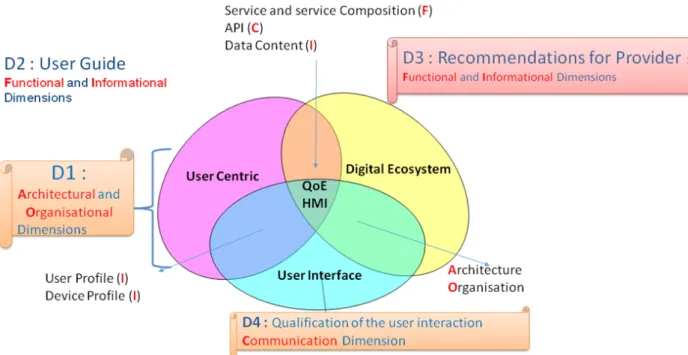
The survey shows that there is a very large majority of people who would like to be able to challenge the provider on what might be called the "core features" of the contract, ie. privacy, security, quality and price. They must be able to customize its services, access them dynamically on the move and according to the desired quality of service (QoS). 2) Digital Ecosystem: represents the new digital environment where users evolve taking into account all devices, all technologies and their interactions. Ecosystem components develop a dense network of dependencies, information exchanges to meet the evolving needs of the user.
A digital ecosystem is an open socio-technical digital environment with self-organizing capabilities, providing access to resources and supporting collaboration, knowledge sharing and development. evolutionary business models, in an open environment that can extend across different enterprise boundaries. The intersection of "usercentric" and "user interface" features different user profiles and devices to adapt to new user needs. Thus, according to the possibilities offered by devices, networks and software platforms, a customization is possible.
The intersection of "user centricity" and "digital ecosystem" defines the connections between service demand and service supply. The user must be able to construct his service according to his needs, according to his position and according to his activities. The intersection of the three areas is the user-perceived quality of services, QoE (quality of experience) and HMI (human-machine interface).
The current monolithic designs of the past have been replaced by service-oriented software components that use frameworks, operating systems, execution hosts, and networks to perform functions unknown a few years ago. Improving the quality of the experience cannot be achieved without taking into account all the needs of the user, improving the digital ecosystem and its diversification, and improving the human-machine interface. HMI can be described as a point of communication between a human user and a machine.
User-Centric approach in digital ecosystem: Guide and Reports objectives
Introduction
Digital Ecosystem Context
It should be noted that a digital ecosystem can be rich and diverse in what is included, but also bare and minimal because it changes with the user and their requirements and needs.
Use cases
- Introduction
- Use Case: Smart Meters
- Introduction
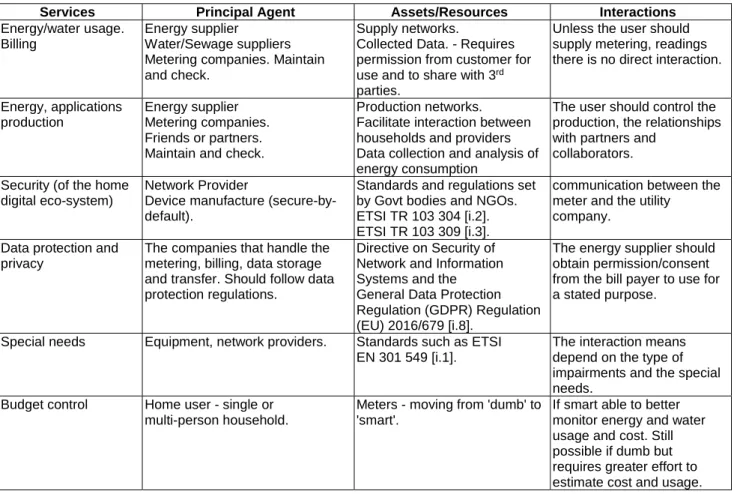
- Services for Smart Meters
- Process for Smart Meters
- Actors for Smart Meters
- User Interaction within the Smart City
- Services for User Interaction within the Smart City
- Process for User Interaction within the Smart City
- Actors for User Interaction within the Smart City
- Use Case: Travel Management
- Introduction
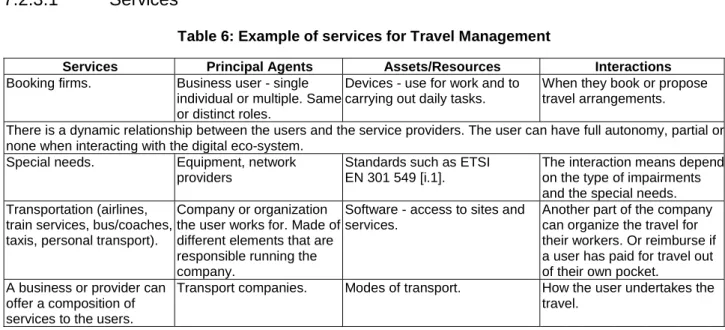
- Services
- Process for Travel management
- Actors for Travel Management
- Use Case: Video on Demand for Home monitoring
- Introduction
- Services for Video on Demand for Home monitoring
- Process for Video on Demand for Home monitoring
- Process for surveillance of pets
- Actors of surveillance of pets
Utility companies Technology companies Home service providers Application and device support providers Cloud service providers. The user interaction and access to the different services should have common UX experience between different devices and tools. The user experience and interaction across smart city services and applications should be uniform and seamless.
The end user benefits from the complexity of the smart city, as feedback on collected user data can be used by planners and organizations to improve user services and experiences. The user can have full autonomy, partial or no autonomy in interacting with the digital ecosystem. In this case, the user wants to watch at home via a connected video camera.
The user monitors the video camera and connects it to the personal network (Ethernet but more often WIFI) and supplies power to it. When the user is at home, the user's private network is used, when the user is away, the connection is made through the operator network. On the other hand, the services of the service providers where the customer data and preferences are stored.
Generic model
On the other hand, the services of the service provider in which the customer data and their preferences are stored. In addition, there is the data processing, ie the application that creates the service. The service provider may access the customer's data in the context of assisting or selling new opportunities.
The user data is both customer data and data that the service provider can use for analysis and marketing purposes for which the problem of the GDPR arises. Once this general framework is defined, how does the user compose their service and how do service providers respond to different expectations. Providers should propose process automation to make using the service as easy as possible through a simple standard HMI.
To make the use of the consumed services as simple as possible, as shown in ETSI EG 203 602 [i.5] a powerful information model with profiles that enable the maintenance of QoS and QoE is needed.
Introduction
Use Case A: eHealth Independent Living
Introduction
Daily cares and day-to-day activities
The role of the doctor is concerned with the promotion, maintenance or restoration of health through the study, diagnosis and treatment of diseases, injuries and other physical and mental disabilities. Civil society organizations must provide resources and assistance appropriate to the requirements of the user. Medical organizations evaluate whether the user needs to change the rehabilitation and/or prescriptions for the user to maintain their health, which is a key part of independent living.
Daily rituals of end user: Set reminders and reminders on devices for the next day. Smart/Virtual Assistant - a software and/or device agent that performs tasks or services for an individual.

Patient monitoring
Use Case B: User interaction within multi-device environment
Our world is developing very fast for digital services and the ecosystem reflects two different images: on the one hand, the simplification of access to many "smart" services, and on the other hand, the complexity of the platform. For the user who is at the center of the architecture of this digital ecosystem, for whom the HMI is essential and whose actions to obtain the desired services will move from pressing a button or parameterizing the application to assembling their own application or session from the service platform. To identify needs, expectations and development axes, we conducted a survey among users and analyzed several use cases.
To answer this question, new technologies have been studied with the "As a service" paradigm and APIs. In this context, where the user is at the center of the architecture, the user must be able to access any service anytime, anywhere, by any means. He/she expects perfect continuity of the personalized service, taking into account his/her preferences.
To the users, the providers need to rethink their organization to meet this demand of "fully connected" anytime, anywhere. The question is: how can this interaction be established and what is the relevant architecture for this cooperative communication. Supply development, which today is application-oriented, is becoming 'service-centric' in order to offer the required flexibility, dynamism and adaptability at Paas (Platform 'As-a-service').
The research, the results of the research and the analysis are contained in the archive tr_103438v010101p.zip that accompanies this document.

Introduction
User Interaction with IoT Devices
Services
Process model of User Interaction with IoT
Actors of User Interaction with IoT
Use Case: SmartHome Entertainment Services
Services
Process for Home Entertainment Services
Actors of Home Entertainment Services