new measures and impacts on TFP
Gilbert CETTE * Jimmy LOPEZ**
Jacques MAIRESSE***
* : Banque de France & Université d’Aix-Marseille (AMSE)
**: Université de Bourgogne Franche-Comté (LEDi) & Banque de France
* * * : CREST-ENSAE, Maastricht University (UNU-MERIT) & NBER
Séminaire Fourgeaud - 16 octobre 1018
Motivation
T w o ob j e c t i v e s
Propose new cross-country-industry measures of mark-up and workers’ 1
share of rents relaxing the usual assumption of perfect labor markets We use these measures to approxymate for
o competition (rent creation) and o workers’ bargaining power (rent sharing)
Investigate the Total Factor Productivity (TFP) impact of competition and workers’ bargaining power, and of regulations changing them
R e g u l a t i o n s i m p a c t o n p r o d u c t i v i t y : L i t e r a t u r e r e v i e w
Abundant literature on the impact of competition on productivity drawing on anti-competitive Non-Manufacturing Regulations (NMR) OECD indicators
see, for instance, Conway et al., 2006; Barone & Cingano, 2011; Cette, Lopez &
Mairesse, 2016; ...
Abundant literature also on impact of Employment Protection Legislation (EPL) OECD indicators on productivity
see, for instance, Bassanini, Nunziata & Venn, 2009; Cette, Lopez & Mairesse, 2016; ...
Blanchard & Giavazzi (2003) provides a theoretical framework Confirmed by following papers, as Askenazy, Cette and Maarek (2018)
o rent creation (/lack of competition) results from product market regulations
o workers’ share of rent (/bargaining power) is influenced by labor market regulations
This paper
o Investigates (notably) whether the impact of regulations on productivity corresponds to this framework
o Confirms Blanchard & Giavazzi (2003) and goes further
Table of contents
1) New measures of rent creation and sharing a) Definitions
b) Data
2) Regulations, competition and bargaining power a) OECD indicators of regulations
b) Estimated specifications c) Estimation results
3) Impact of competition and bargaining power on TFP a) Estimated specification
b) Estimation results c) Simulation
3
W e f i n d :
Firms’ rent differs strongly from total rent
Rent creation
o Anticompetitive NMR influence positively rent creation o EPL has no impact on rent
Rent sharing
o NMR influence positively the workers’ share of rent
o EPL has no impact on rent sharing: The positive impact of EPL on wages is offset by a negative impact on hours worked
o EPL effects are more pronounced for low skilled workers
W e f i n d :
Impact on TFP
o Lack of competition and workers’ bargaining power have negative impacts on TFP
o A switch of countries NMR to the lowest NMR values would increase TFP of 3.7% on average on the long-run
Part 1
New measures of
rent creation and sharing
Definitions of our new measures
M a i n assu mp t i o n s :
2
Product and service market imperfections, leading to:
Pi = (1 + MURi ) × Ci Where
• Pi is the relative production price of industry i,
• MURi the Mark-Up Rate
• Ci the marginal cost
Labor market imperfections:
workers may capture part of the created rent
Our measures are largely inspired by Dobbelaere & Mairesse (2013, 2015, 2017) analyses on French firms
E m p i r i c a l ass u mp t i o n s:
• Wjr is the ‘reservation wage’ per hour at skill level j
• Nij the number of hours worked, in the industry i by skill level j
• Mi the intermediate input in industry i
• Ci the total cost of industry i
• Qi the production of industry i at constant prices
Variable costs approximate the marginal costs, so:
𝐶𝑖= 𝑊𝑗 𝑗𝑟. 𝑁𝑄𝑖𝑗 +𝑀𝑖
𝑖 Where
E m p i r i c a l ass u mp t i o n s:
The ‘reservation wage’ Wr (the wage that would be observed if there were no workers’ bargaining power) is equal to or lower than the minimum wage observed for a given country, year and skill level
3 dimensions: country c, time t, skill j
Our main measures assume a reservation wage equal to 95% of the minimum observed (average industry) wage, but our results are robust to various choices
Therefore:
where WSRi is the Workers’ Share of Rent in industry i 𝑀𝑈𝑅𝑖 =𝑃𝑖 − 𝐶𝑖
𝐶𝑖 =𝑃𝑖𝑄𝑖− 𝑊𝑖𝑟𝑁𝑖+ 𝑀𝑖 𝑊𝑖𝑟𝑁𝑖+ 𝑀𝑖 𝑊𝑆𝑅𝑖 = 𝑊𝑖 − 𝑊𝑖𝑟 𝑁𝑖
𝑃𝑖𝑄𝑖 − 𝑊𝑖𝑟𝑁𝑖+ 𝑀𝑖
DATA
o We use the OECD STAN and EUKLEMS databases to calculate these measures
o The sample :
•4,988 observations
•covering 14 OECD countries
•19 industries
•over the 1985-2005 period o Unbalanced dataset
Descriptive analysis
C h a r t 1: M a r k - u p r a t e a n d workers’ s h a r e o f r e n t Kernel density estimation of the probability density function
0%
1%
2%
3%
4%
0% 10% 20% 30% 40% 50% 60% 70% 80% 90% 100%
Mark-up rate
Mark-up rate
Descriptive analysis
C h a r t 1: M a r k - u p r a t e a n d workers’ s h a r e o f r e n t Kernel density estimation of the probability density function
0%
1%
2%
3%
4%
0% 10% 20% 30% 40% 50% 60% 70% 80% 90% 100%
Mark-up rate Workers' share of rent
Part 2
Regulations impact on
competition & bargaining power
OECD indicators of regulations
A n t i c o m p e t i t i v e N o n - M a n u f a c t u r i n g R e g u l a t i o n i n d i c a t o r s ( N M R )
Measure the extent to which competition and firm choices are restricted where there are no a priori reasons for government interference, or where regulatory goals could plausibly be achieved by less coercive means
Based on information on laws, rules and market, country or industry settings
5 industries covered: Energy, transport, communication, retail services and professional services
A n t i c o m p e t i t i v e N o n - M a n u f a c t u r i n g R e g u l a t i o n i n d i c a t o r s ( N M R )
We use two sub-level indicators:
o NMR - State (NMRS ): extent of public ownership, control of strategic choices and price controls
o NMR - Entry (NMRE ): barriers to entry, vertical integration and market structure
E m p l o y m e n t P r o t e c t i o n L e g i s l a t i o n i n d i c a t o r ( E P L )
Measures the procedures and cost involved in dismissing individual workers with regular contracts and regulations on temporary contracts
Based on information on laws, rules and market, country or industry settings
Estimated specifications
Where:
Our dependant variables ‘y ’ are our MUR and WSR measures, but also the components of WSR:
o Workers’ rent per hour ((W-Wr)/PGDP)
o Number of hours worked per output unit (N/Q)
Rent per output unit ((P-C)/PGDP)
λ is the intensity of use of labour in the US
c, i, t the country, industry and time indices
𝜙 fixed effects and u the estimation residuals
𝑙𝑜𝑔 𝑦𝑐𝑖𝑡 = 𝜃1× 𝑁𝑀𝑅𝑐𝑖𝑡𝐸 + 𝜃2× 𝑁𝑀𝑅𝑐𝑖𝑡𝑆 + 𝜃3× 𝜆𝑖× 𝐸𝑃𝐿𝑐𝑡) + 𝜙𝑐𝑖+ 𝜙𝑐𝑡 + 𝑢𝑐𝑖𝑡
Estimation results
Ta b l e 1: I m p a c t o f r e g u l a t i o n i n d i c a t o r s o n m a r k - u p a n d workers’ s h a r e o f r e n t
Country*industry and country*year fixed effects included
Newey-West standard errors in brackets - ∗ ∗ ∗p < 0.01, ∗ ∗ p < 0.05, ∗p < 0.1
(1) (2)=(3)+(4)-(5) (3) (4) (5)
Dep. var. (log) Mark-up rate (𝝁)
Workers’ share of rent (𝜷)
Workers’ rent per hour (𝒘 − 𝒘𝒓 𝑷𝑮𝑫𝑷)
Hours worked per output unit
(𝑵 𝑸)
Rent per output unit (𝑷 − 𝑪 𝑷𝑮𝑫𝑷 ) NMR – Entry 0.0516*** 0.0644*** 0.0510*** 0.0744*** 0.0611***
(𝑵𝑴𝑹𝑬) [0.0107] [0.0105] [0.0111] [0.0141] [0.0116]
NMR - State 0.0229** 0.00546 -0.00696 0.0425*** 0.0301**
(𝑵𝑴𝑹𝑺) [0.0112] [0.0110] [0.0100] [0.0156] [0.0120]
EPL - impact 0.0124 -0.161 0.375*** -0.787*** -0.250***
(𝝀𝒊× 𝑬𝑷𝑳) [0.0889] [0.103] [0.0950] [0.0961] [0.0913]
Observations 4,988 4,988 4,988 4,988 4,988
R-squared 0.949 0.875 0.981 0.979 0.893
Estimation results
Ta b l e 1: I m p a c t o f r e g u l a t i o n i n d i c a t o r s o n m a r k - u p a n d workers’ s h a r e o f r e n t
Country*industry and country*year fixed effects included
Newey-West standard errors in brackets - ∗ ∗ ∗p < 0.01, ∗ ∗ p < 0.05, ∗p < 0.1
(1) (2)=(3)+(4)-(5) (3) (4) (5)
Dep. var. (log) Mark-up rate (𝝁)
Workers’ share of rent (𝜷)
Workers’ rent per hour (𝒘 − 𝒘𝒓 𝑷𝑮𝑫𝑷)
Hours worked per output unit
(𝑵 𝑸)
Rent per output unit (𝑷 − 𝑪 𝑷𝑮𝑫𝑷 ) NMR – Entry 0.0516*** 0.0644*** 0.0510*** 0.0744*** 0.0611***
(𝑵𝑴𝑹𝑬) [0.0107] [0.0105] [0.0111] [0.0141] [0.0116]
NMR - State 0.0229** 0.00546 -0.00696 0.0425*** 0.0301**
(𝑵𝑴𝑹𝑺) [0.0112] [0.0110] [0.0100] [0.0156] [0.0120]
EPL - impact 0.0124 -0.161 0.375*** -0.787*** -0.250***
(𝝀𝒊× 𝑬𝑷𝑳) [0.0889] [0.103] [0.0950] [0.0961] [0.0913]
Observations 4,988 4,988 4,988 4,988 4,988
R-squared 0.949 0.875 0.981 0.979 0.893
Estimation results
Ta b l e 1: I m p a c t o f r e g u l a t i o n i n d i c a t o r s o n m a r k - u p a n d workers’ s h a r e o f r e n t
Country*industry and country*year fixed effects included
Newey-West standard errors in brackets - ∗ ∗ ∗p < 0.01, ∗ ∗ p < 0.05, ∗p < 0.1
(1) (2)=(3)+(4)-(5) (3) (4) (5)
Dep. var. (log) Mark-up rate (𝝁)
Workers’ share of rent (𝜷)
Workers’ rent per hour (𝒘 − 𝒘𝒓 𝑷𝑮𝑫𝑷)
Hours worked per output unit
(𝑵 𝑸)
Rent per output unit (𝑷 − 𝑪 𝑷𝑮𝑫𝑷 ) NMR – Entry 0.0516*** 0.0644*** 0.0510*** 0.0744*** 0.0611***
(𝑵𝑴𝑹𝑬) [0.0107] [0.0105] [0.0111] [0.0141] [0.0116]
NMR - State 0.0229** 0.00546 -0.00696 0.0425*** 0.0301**
(𝑵𝑴𝑹𝑺) [0.0112] [0.0110] [0.0100] [0.0156] [0.0120]
EPL - impact 0.0124 -0.161 0.375*** -0.787*** -0.250***
(𝝀𝒊× 𝑬𝑷𝑳) [0.0889] [0.103] [0.0950] [0.0961] [0.0913]
Observations 4,988 4,988 4,988 4,988 4,988
R-squared 0.949 0.875 0.981 0.979 0.893
Country*industry and country*year fixed effects included
Newey-West standard errors in brackets - ∗ ∗ ∗p < 0.01, ∗ ∗ p < 0.05, ∗p < 0.1
(1) (2) (3) (4) (5) (6)
Dep. var. (log) Workers’ rent per hour Hours worked per output unit
Skills High Medium Low High Medium Low
NMR - Entry 0.0467*** 0.0476*** 0.0416** 0.0778*** 0.0796*** 0.0884***
(𝑵𝑴𝑹𝑬) [0.0157] [0.0154] [0.0167] [0.0130] [0.0146] [0.0161]
NMR - State -0.0301* -0.0197 0.00710 -0.0182 0.0344** 0.0340*
(𝑵𝑴𝑹𝑺) [0.0156] [0.0142] [0.0148] [0.0140] [0.0166] [0.0183]
EPL - impact 0.100 0.545*** 0.528*** -0.280** -0.824*** -1.293***
(𝝀𝒊× 𝑬𝑷𝑳) [0.131] [0.112] [0.152] [0.134] [0.109] [0.122]
Observations 4,988 4,988 4,988 4,988 4,988 4,988
R-squared 0.970 0.977 0.977 0.984 0.976 0.986
Country*industry and country*year fixed effects included
Newey-West standard errors in brackets - ∗ ∗ ∗p < 0.01, ∗ ∗ p < 0.05, ∗p < 0.1
(1) (2) (3) (4) (5) (6)
Dep. var. (log) Workers’ rent per hour Hours worked per output unit
Skills High Medium Low High Medium Low
NMR - Entry 0.0467*** 0.0476*** 0.0416** 0.0778*** 0.0796*** 0.0884***
(𝑵𝑴𝑹𝑬) [0.0157] [0.0154] [0.0167] [0.0130] [0.0146] [0.0161]
NMR - State -0.0301* -0.0197 0.00710 -0.0182 0.0344** 0.0340*
(𝑵𝑴𝑹𝑺) [0.0156] [0.0142] [0.0148] [0.0140] [0.0166] [0.0183]
EPL - impact 0.100 0.545*** 0.528*** -0.280** -0.824*** -1.293***
(𝝀𝒊× 𝑬𝑷𝑳) [0.131] [0.112] [0.152] [0.134] [0.109] [0.122]
Observations 4,988 4,988 4,988 4,988 4,988 4,988
R-squared 0.970 0.977 0.977 0.984 0.976 0.986
Impact on TFP of
competition & bargaining power
Where ξ are fixed effects and s the estimation residuals 𝑙𝑜𝑔 𝑇𝐹𝑃𝑐𝑖𝑡 = 𝜌 × 𝑙𝑜𝑔 𝑇𝐹𝑃𝑖𝑡−1𝑈𝑆 + 𝛼 × 𝑙𝑜𝑔 𝑀𝑈𝑅𝑐𝑖𝑡−1
+ 𝛾 × 𝑙𝑜𝑔 𝑊𝑆𝑅𝑐𝑖𝑡−1 + 𝜉𝑐𝑖+ 𝜉𝑐𝑡+ 𝜖𝑐𝑖𝑡
(we may provide more details on our TFP computation if needed)
Estimation results
Country*industry and country*year fixed effects included - Leads and lags of US TFP first defferences included Newey-West standard errors in brackets - ∗∗ ∗p < 0.01, ∗∗ p < 0.05, ∗p < 0.1
Instruments: NMR-Entry, NMR-State and NMR-Entry × NMR-States
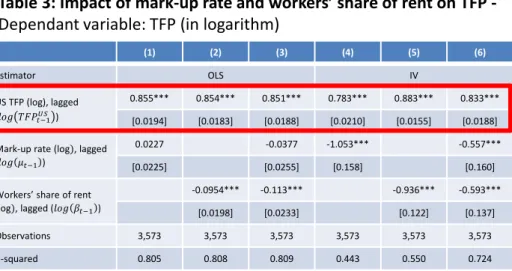
Table 3: Impact of mark-up rate and workers’ share of rent on TFP - Dependant variable: TFP (in logarithm)
(1) (2) (3) (4) (5) (6)
Estimator OLS IV
US TFP (log), lagged (𝑙𝑜𝑔 𝑇𝐹𝑃𝑡−1𝑈𝑆 )
0.855*** 0.854*** 0.851*** 0.783*** 0.883*** 0.833***
[0.0194] [0.0183] [0.0188] [0.0210] [0.0155] [0.0188]
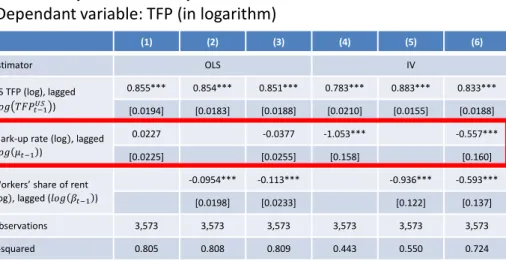
Mark-up rate (log), lagged (𝑙𝑜𝑔 𝜇𝑡−1)
0.0227 -0.0377 -1.053*** -0.557***
[0.0225] [0.0255] [0.158] [0.160]
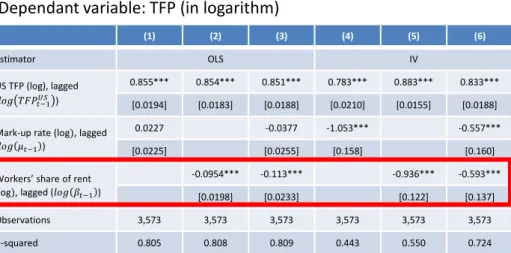
Workers’ share of rent (log), lagged (𝑙𝑜𝑔 𝛽𝑡−1)
-0.0954*** -0.113*** -0.936*** -0.593***
[0.0198] [0.0233] [0.122] [0.137]
Observations 3,573 3,573 3,573 3,573 3,573 3,573
R-squared 0.805 0.808 0.809 0.443 0.550 0.724
Estimation results
Country*industry and country*year fixed effects included - Leads and lags of US TFP first defferences included Newey-West standard errors in brackets - ∗∗ ∗p < 0.01, ∗∗ p < 0.05, ∗p < 0.1
Instruments: NMR-Entry, NMR-State and NMR-Entry × NMR-States
Table 3: Impact of mark-up rate and workers’ share of rent on TFP - Dependant variable: TFP (in logarithm)
(1) (2) (3) (4) (5) (6)
Estimator OLS IV
US TFP (log), lagged (𝑙𝑜𝑔 𝑇𝐹𝑃𝑡−1𝑈𝑆 )
0.855*** 0.854*** 0.851*** 0.783*** 0.883*** 0.833***
[0.0194] [0.0183] [0.0188] [0.0210] [0.0155] [0.0188]
Mark-up rate (log), lagged (𝑙𝑜𝑔 𝜇𝑡−1)
0.0227 -0.0377 -1.053*** -0.557***
[0.0225] [0.0255] [0.158] [0.160]
Workers’ share of rent (log), lagged (𝑙𝑜𝑔 𝛽𝑡−1)
-0.0954*** -0.113*** -0.936*** -0.593***
[0.0198] [0.0233] [0.122] [0.137]
Observations 3,573 3,573 3,573 3,573 3,573 3,573
R-squared 0.805 0.808 0.809 0.443 0.550 0.724
Estimation results
Country*industry and country*year fixed effects included - Leads and lags of US TFP first defferences included Newey-West standard errors in brackets - ∗∗ ∗p < 0.01, ∗∗ p < 0.05, ∗p < 0.1
Instruments: NMR-Entry, NMR-State and NMR-Entry × NMR-States
Table 3: Impact of mark-up rate and workers’ share of rent on TFP - Dependant variable: TFP (in logarithm)
(1) (2) (3) (4) (5) (6)
Estimator OLS IV
US TFP (log), lagged (𝑙𝑜𝑔 𝑇𝐹𝑃𝑡−1𝑈𝑆 )
0.855*** 0.854*** 0.851*** 0.783*** 0.883*** 0.833***
[0.0194] [0.0183] [0.0188] [0.0210] [0.0155] [0.0188]
Mark-up rate (log), lagged (𝑙𝑜𝑔 𝜇𝑡−1)
0.0227 -0.0377 -1.053*** -0.557***
[0.0225] [0.0255] [0.158] [0.160]
Workers’ share of rent (log), lagged (𝑙𝑜𝑔 𝛽𝑡−1)
-0.0954*** -0.113*** -0.936*** -0.593***
[0.0198] [0.0233] [0.122] [0.137]
Observations 3,573 3,573 3,573 3,573 3,573 3,573
R-squared 0.805 0.808 0.809 0.443 0.550 0.724
Estimation results
Country*industry and country*year fixed effects included - Leads and lags of US TFP first defferences included Newey-West standard errors in brackets - ∗∗ ∗p < 0.01, ∗∗ p < 0.05, ∗p < 0.1
Instruments: NMR-Entry, NMR-State and NMR-Entry × NMR-States
Table 3: Impact of mark-up rate and workers’ share of rent on TFP - Dependant variable: TFP (in logarithm)
(1) (2) (3) (4) (5) (6)
Estimator OLS IV
US TFP (log), lagged (𝑙𝑜𝑔 𝑇𝐹𝑃𝑡−1𝑈𝑆 )
0.855*** 0.854*** 0.851*** 0.783*** 0.883*** 0.833***
[0.0194] [0.0183] [0.0188] [0.0210] [0.0155] [0.0188]
Mark-up rate (log), lagged (𝑙𝑜𝑔 𝜇𝑡−1)
0.0227 -0.0377 -1.053*** -0.557***
[0.0225] [0.0255] [0.158] [0.160]
Workers’ share of rent (log), lagged (𝑙𝑜𝑔 𝛽𝑡−1)
-0.0954*** -0.113*** -0.936*** -0.593***
[0.0198] [0.0233] [0.122] [0.137]
Observations 3,573 3,573 3,573 3,573 3,573 3,573
R-squared 0.805 0.808 0.809 0.443 0.550 0.724
We compute the expected impact on TFP of a NMR reform
This reform is the adoption of the lowest NMR in 2013 (the OECD NMR indicators are not available later)
This impact is calculated using Table 1 column (1) & (2) and Table 3 column (6) estimation results
l e v e l s
0%
1%
2%
3%
4%
5%
6%
NMR-Entry via mark-up rate NMR-Entry via workers' share NMR-State via mark-up rate NMR-State via workers' share
M a i n f i n d i n g s
Firms’ rent differs strongly from total rent
o Anticompetitive NMR influence positively rent creation and workers’
share of rent
o EPL boost wage per hour, but this is offset by a negative impact on hours worked per output unit
o EPL effects are more pronounced for low skilled workers
Lack of competition as well as workers’ bargaining power have substancial negative impacts on TFP: a switch to the lowest NMR values would increase TFP of 3.7% on average on the long-run
C h a r t A1: N M R - E n t r y O E C D i n d i c a t o r s Scale: 0-6, with 0 for the most pro-competitive regulations
0 5 10 15 20 25 30
1985 1985 1985 1985 1985 1985 1985 1985 1985 1985 1985 1985 1985 1985
AUS AUT CAN CZE DNK FIN FRA GER ITA NLD SPN SWE UK US Energy Retail serv. Transport Communication Prof. serv.
Scale: 0-6, with 0 for the most pro-competitive regulations
0 5 10 15 20 25 30
1985 2005 1985 2005 1985 2005 1985 2005 1985 2005 1985 2005 1985 2005 1985 2005 1985 2005 1985 2005 1985 2005 1985 2005 1985 2005 1985 2005
AUS AUT CAN CZE DNK FIN FRA GER ITA NLD SPN SWE UK USA Energy Retail serv. Transport Communication Prof. serv.
C h a r t A3: E P L O E C D i n d i c a t o r Scale: 0-6, with 0 for the most flexible regulations
0 1 2 3 4 5 6
1985 2005
Aghion, Philippe, Nicholas Bloom, Richard Blundell, Rachel Griffith, and Peter Howitt (2005): “Competition and Innovation: An Inverted U Relationship”, Quarterly Journal of Economics, 701-728.
Barone, Guglielmo and Federico Cingano (2011): “Service regulation and growth: evidence from OECD countries”, The Economic Journal, 121(555), pp. 931-957.
Bassanini, Andrea, Luca Nunziata and Danielle Venn (2009): “Job protection legislation and productivity growth in OECD countries”, Economic Policy, 24(04), pp. 349-402.
Effects of Regulation and Deregulation in Goods and Labor Markets”, The Quarterly Journal of Economics, 118(3), pp. 879-907.
Cette, Gilbert, Jimmy Lopez and Jacques Mairesse (2016): “Market Regulations, Prices, and Productivity”, American Economic Review, American Economic Association, 106(5), pp. 104-108.
Cette, Gilbert, Jimmy Lopez and Jacques Mairesse (2016): “Product and Labour Market Regulations, Production Prices, Wages and Productivity”, Review of Economics and Institutions, 7(2).
Conway, Paul, Donato de Rosa, Giuseppe Nicoletti and Faye Steiner (2006):
“Product Market Regulation and Productivity Convergence”, OECD Economic Studies, 43, pp. 39-76.
Data Estimates of the Production Function and Product and Labor Market Imperfections”, Journal of Applied Econometrics, 28(1), pp. 1-46.
Dobbelaere, Sabien and Jacques Mairesse (2015):
“Comparing micro-evidence on rent sharing from three different approaches”, MERIT Working Papers 029, United Nations University - Maastricht Economic and Social Research Institute on Innovation and Technology (MERIT).
Dobbelaere, Sabien and Jacques Mairesse (2018):
“Comparing micro-evidence on rent sharing from two different econometric models”, forthcoming in Labor Economics.