An air capture system (as we define it) removes CO2 from the air and delivers a pure CO2 stream for sequestration. It is therefore informative to compare the cost of aerial capture with the cost of capture from these sources. It is plausible that the reduction of these barriers is one of the most important features of air capture.
In this section, we argued that the long-term cost of air capture can be quite close to the cost of power plant capture.
3 Two examples
Biomass with capture and sequestration
For simplicity, values have been adjusted to equalize the cost of electricity for coal and natural gas at a carbon price of zero. Unlike fossil-based technologies, the cost of electricity from biomass with capture decreases when the carbon price rises.
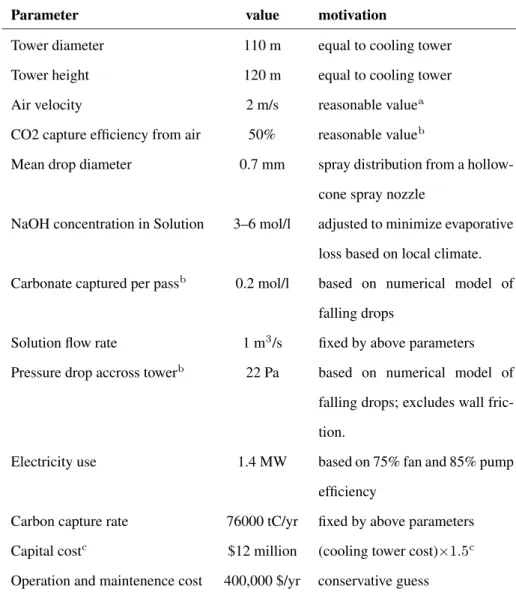
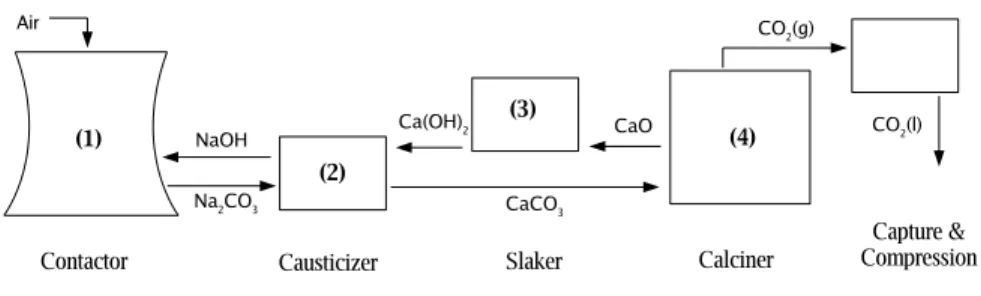
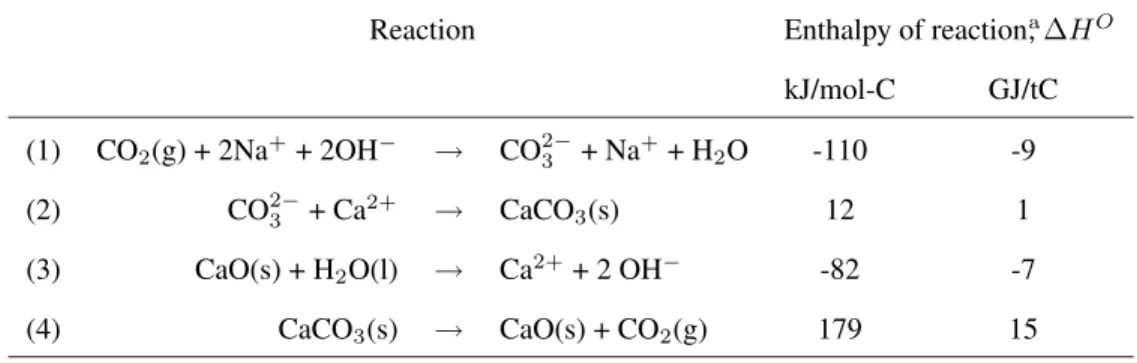
Air capture with sodium hydroxide
4 Air capture changes optimal climate policy
Climate change impacts
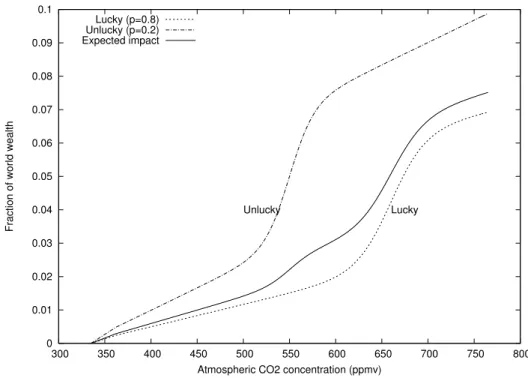
DIAM represents the uncertainty in the benefits of avoiding climate change, or alternatively the costs of climate impact, using one of two non-linear damage functions. The stochastic impact function represents several characteristic features of the climate problem: uncertainty regarding climate and ecosystem sensitivity; non-linearities in the physical and political system; and expected growth in the degree of environmental concern with increasing wealth. Due to the inertia found in ecosystems and climate systems, the impact at datet depends on the lagged concentration, so (mitigation costs omitted) wealth at date in the model is W(t) = Wref(t)(1−f(pCO2 (t−−) 20))).
The order of magnitude of the effect is comparable to several years of economic stagnation, as the effect costs 4-8%. Although measured in monetary units, it represents the global willingness to pay to avoid a given level of climate change, including non-market values. Because impacts are expressed as a function of CO2 concentrations, they implicitly include uncertainty in the climate's response to radiative forcing and uncertainty in the impacts of climate change.
The expected impact, the weighted average of the two cases, is shown in Figure 2 as a solid line. As shown in the figure, the main difference is that the step starts at about 600 ppmv in the Lucky case, and 500 ppmv in the Unlucky case. But the dead-end in the damage function serves as a soft concentration ceiling, and therefore the location of the bend is a critical parameter.
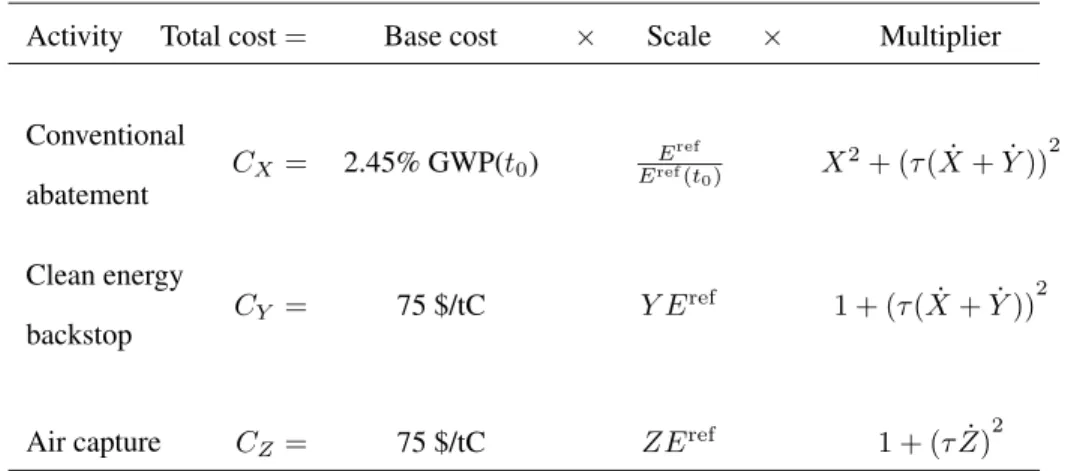
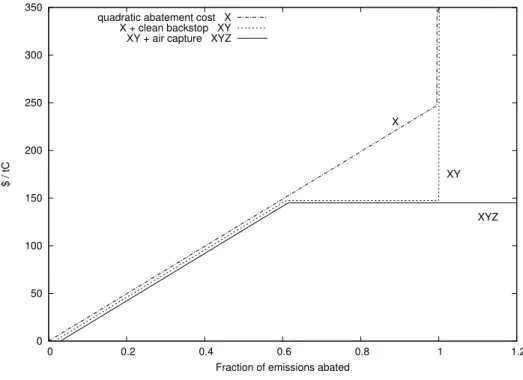
Abatement cost
Using quadratic adaptation costs to represent the dynamics of inertia and adaptability is the hallmark of DIAM. This is why adjustment costs for Z depend only on Z, while adjustment costs for the other two activities depend on their joint growth rate X˙ + ˙Y. The scale of adjustment costs in the model is determined by the characteristic time constant of change in the global energy system.
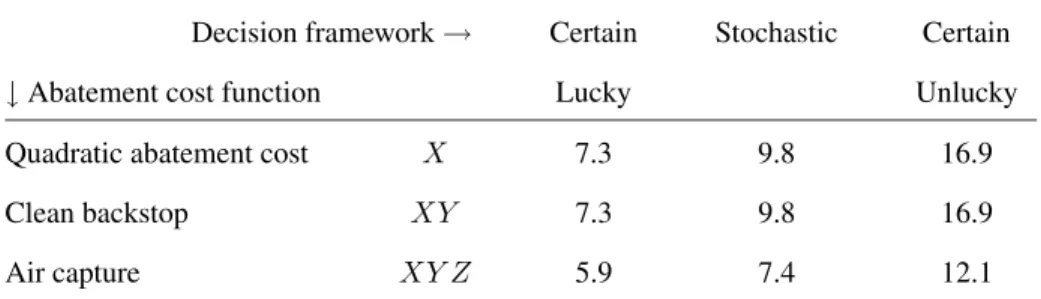
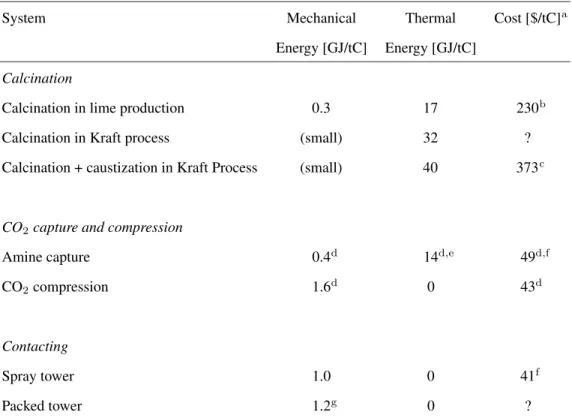
This leads to the plausible result that on typical optimal trajectories the rate-dependent and rate-independent terms in the cost function are comparable. The previous section provided rough engineering estimates of short-term air capture costs and suggested values in the range of $200-500/tC. These estimates cannot be easily compared to the costs of various mitigation activities in DIAM for three reasons: (1) because of the use of adjustment costs in DIAM, (2) because of the well-known incompatibilities between bottom-up and top-down engineering estimates. -lower economic estimates against which the DIAM is calibrated [IPCC, 2001], and (3) because, as we will see below, the air capture model is not used until the middle of this century and the long-term costs of air capture probably fall under short-term cost estimates, described in Section 3, and long-term limitations described in Section 2.
As a starting point, we assume that air capture costs $150/tC in the model if implemented over 50 years (the adaptation time constant). Theτ = 50 yinertia parameter in adjustment costs is the characteristic time of the world energy system. The costs are scaled in time by the scale of the future energy demand Eref(t), shown in Figure 4, top panel.
5 Optimal climate strategies with air capture
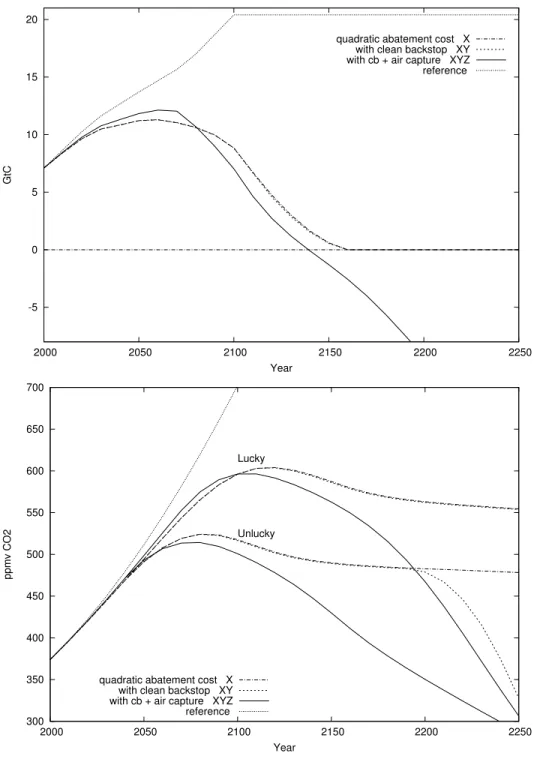
When available, air capture will begin after 2060 and become large enough to make net emissions negative around 2140. Even if the cost of air capture is doubled to $300/tC (including the 50-year adaptation cost), the optimal concentration ranges are qualitatively similar to those shown here (Appendix A). The third result builds on the previous one: when air capture is available, the concentration drops rapidly to pre-industrial levels.
Without air trapping, the dynamics that dictate a return to a low concentration target remain as described above, but the rate of CO2 concentration decline is determined by natural removal. We speculate that, if reasonable estimates of long-term adaptation were included in the model's climate damage function, we would see an apparent concentration peak and subsequent decline (i.e., the Kuznets curve), but that the decline would to be slower and, depending on the Assumptions about adaptation, concentrations may not return to pre-industrial levels. This effect arises even though air capture does not last long after 2030 and is due to the possibility of future mitigation of impacts in the case of 'Unlucky'.
This fourth result suggests that air trapping reduces an important irreversibility of the decision problem. While air uptake can reduce our vulnerability to extreme climate responses, it does not necessarily allow us to eliminate consequences. More generally, air capture only eliminates the irreversibility of atmospheric carbon dioxide accumulation in the long term.
6 Conclusion
In the absence of air capture or the possibility of unlimited biological sequestration, the leakage of sequestered carbon presents new problems regarding the intertemporal distribution of the costs and benefits of abatement. Air capture or any similar way of engineering a near-permanent carbon sink reduces the leakage problem to a relatively small disturbance in the distribution of abatement costs over time. Our simulations show that air trapping can fundamentally change the temporal dynamics of global warming mitigation.
Air trapping is a form of geoengineering because it directly modifies the biosphere and will be implemented with the aim of counteracting other human actions [Keith, 2000]. In an optimal sequential decision framework, we have shown that the consequence is a decrease in the need for preventive short-term reduction. Because air capture can provide some insurance against climate damage, it poses a risk to public policy: the mere expectation that air capture or similar technologies can be achieved reduces the incentive to invest in mitigation.
Yet, while air trapping removes irreversibility in CO2 concentration increase, it does not protect against irreversibilities in the climate system's response to forcing. Although air trapping can reduce the amount of mitigation in the short term, it can increase it on longer time scales. If air capture is possible, even at relatively high cost, and if the willingness to pay for climate change mitigation grows with the economy, then the optimal trajectory follows an environmental Kuznets curve.
Acknowledgments
But this irreversibility of the stock is less important when aerial capture is possible. At some point the optimal objective will be to return the concentration of atmospheric greenhouse gases to lower levels. the National Science Foundation (SBR-9521914) and Carnegie Mellon University, and has been generously supported by additional grants from the Electric Power Research Institute, ExxonMobil Corporation, and the American Petroleum Institute.
The applicability of the results of small-scale experiments to the design of technical devices for gas absorption. Transactions from the Institution of Chemical Engineers, Supplement (Proceedings of the Symposium on Gas Absorption, 32:S60–S67, 1954. Stabilization of Atmospheric Greenhouse Gases: Physical, Biological and Socio-economic Implications (IPCC Technical Paper III).
Sinks, energy crops and land use: coherent climate policy calls for an integrated analysis of biomass.Climate change. Potential market niches for biomass energy with CO2 capture and storage - opportunities for energy supply with negative CO2 emissions. Biomass and Bioenergy. A technical, economic and environmental assessment of amine-based CO2 capture technology for greenhouse gas control in power plants.
Engineering economic analysis of IGCC biomass with carbon capture and storage. Biomass and Bioenergy, (submitted), 2005. Smith, editors. Greenhouse Gas Control Technologies: Proceedings of the 5th International Conference on Greenhouse Gas Control Technologies, Collingwood, Australia, 2001.
A Sensitivity analysis
B Example direct air capture scheme
- Overview
- Contacting
- Causticization
- Sulfur content
- Temperature
- Solids content
- Calcination
- Integrated system
The characteristics of this type of design are probably determined by "edge effects" - the nature of the system at the top and bottom of the bed - and by the engineering of the distribution mechanism for air and water. An almost perfect analogy can be drawn between this and the caustic step in the kraft recycling process used in the pulp and paper industry. However, the process has been tested without the addition of Na2S, and the primary result is an improvement in the conversion efficiency.
However, the solution entering this step in the proposed system will be at ambient temperature or cooler. The source of pollution most analogous to the droplets in the proposed system are fine particles that are captured from the air along with the CO2. It is practiced on a very large scale in the production of lime, cement and in pulp and paper mills.
Calciners in the pulp and paper industry require more energy because they start with muddy CaCO3 instead of dry CaCO3 and must remove water. It is of course possible to remove more water in the CaCO3 slurry prior to calcination. Preliminary analysis suggests that there is sufficient steam to supply most of the required regeneration heat to the amine capture unit [Rao and Rubin, 2002, Rao, 2004].