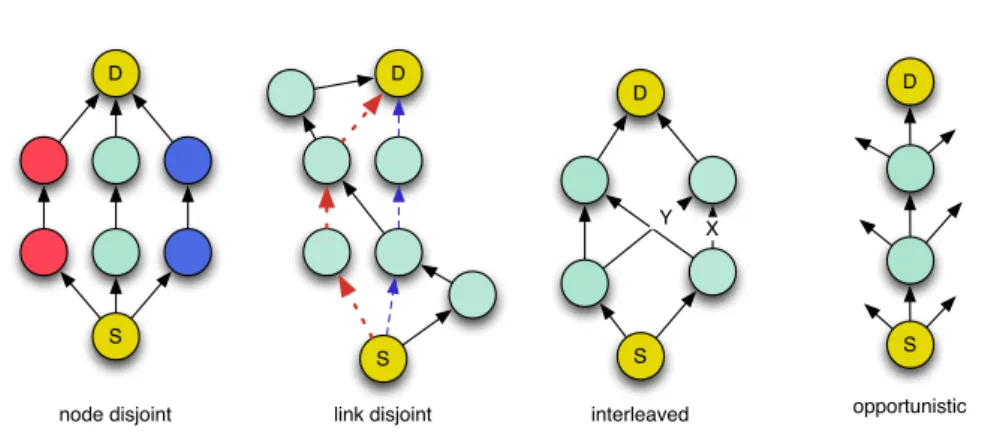
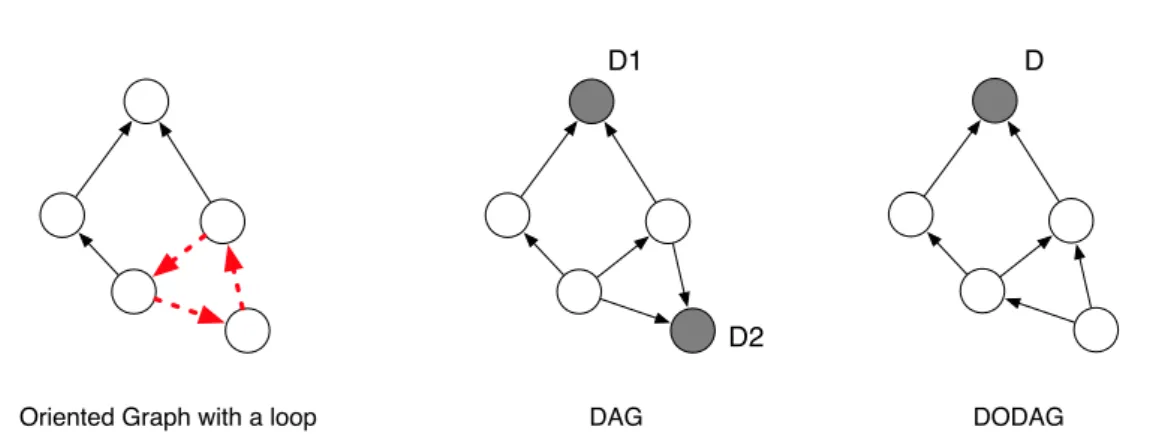
The joint operation of IEEE 802.15.4 and RPL standards is being considered by accommodating the original topological structure of clustering trees. We will discuss some of the unanswered questions and challenges in light of the IEEE 802.15.4 standard that this thesis addresses.
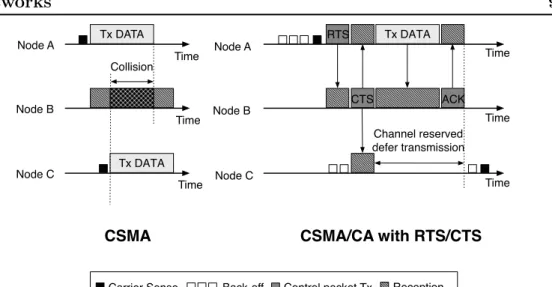
Classes of MAC methods
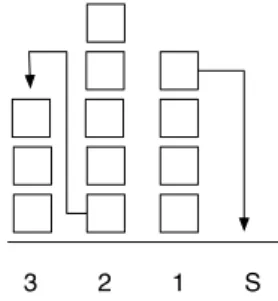
Instead of collecting the global information, cluster heads perform a timeslot coordination in a 1-hop neighborhood. BMA (Bit-Map Assisted) [73] offers a similar approach where, as the title suggests, the schedule is conveyed in the form of bitmaps.
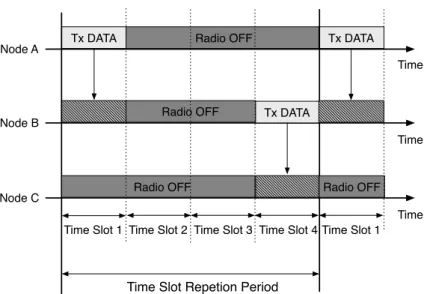
Standardization of the ieee 802.15.4
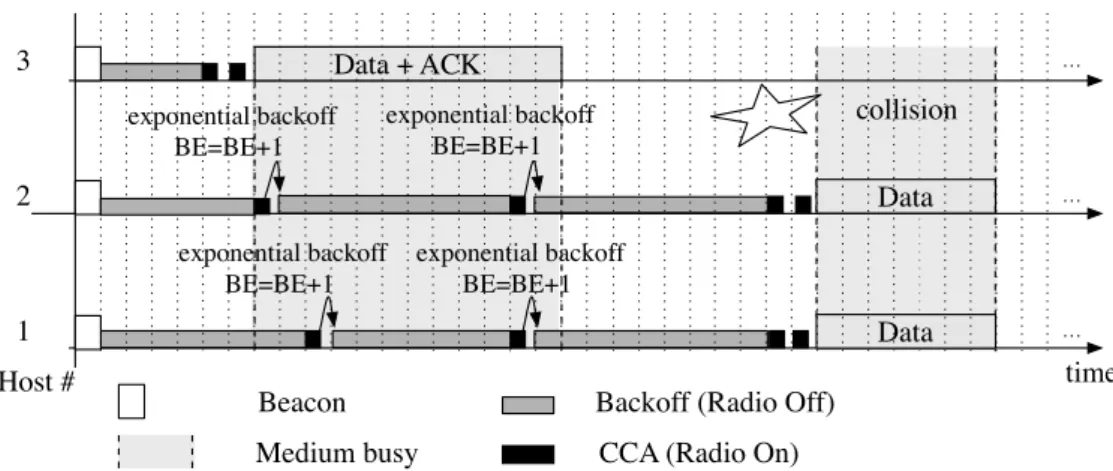
Each node distributively solves a simplified approximation of the optimization problem and sets the ieee 802.15.4 MAC parameters accordingly. Fragmentation: The IPv6 data payload exceeding the available size of the ieee 802.15.4 payload results in fragmentation.
Basic concepts
Practically, only network nodes that perceive the data matching the required criteria start packet generation and routing. Authors combine the data-centric approach and data aggregation along the paths leading from the sources of similar information.
General families
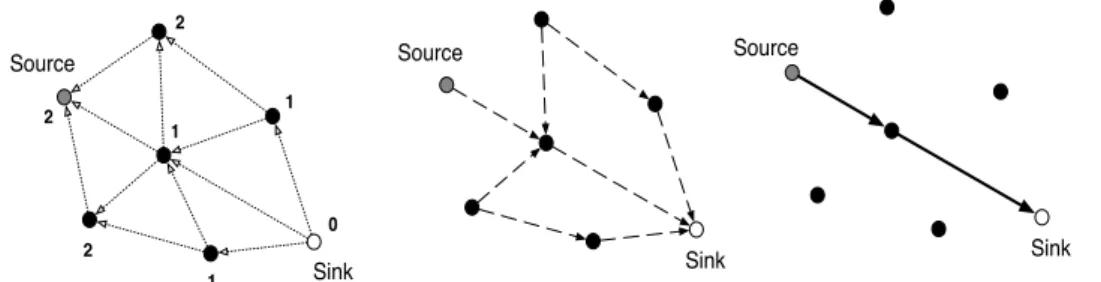
Whatever the nature of the gradients may be, a special care must be taken in the case of dynamic networks. In the case of multi-path routing, the time to repair a broken route is zero.
Emerging IPv6 routing standards for WSN
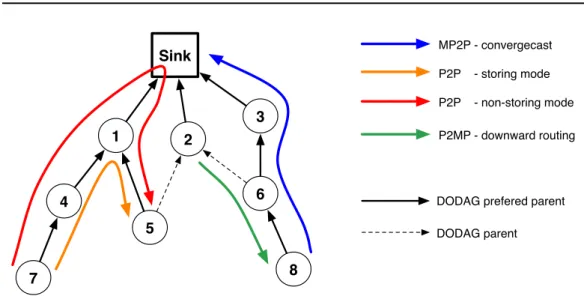
The RPL choice of DODAG stems from the observation that a majority of the supported traffic patterns belong to the MP2P class. A node announces its new rank to the sum of the preferred overall rank and the cost to reach it.
Classical layered paradigm in WSN in the light of IoT
Idea of cross-layer in WSN
Cross-layer approaches
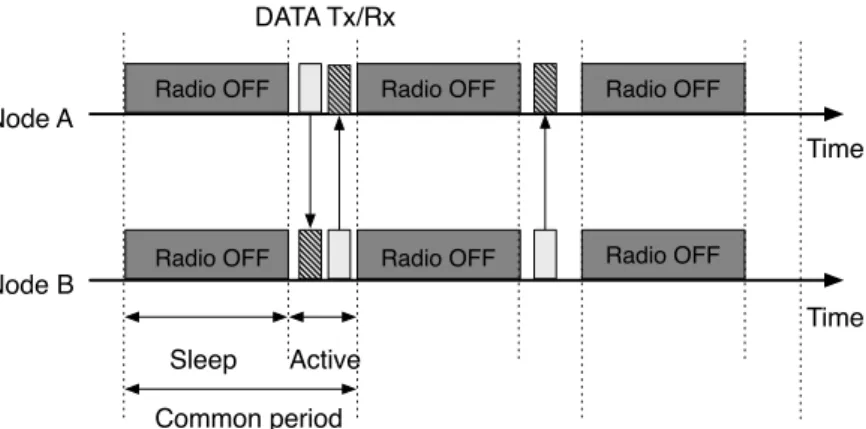
Each node collects WiseMAC scheduling information about the wake-up time of n-hop neighbors. The main purpose of this chapter is to provide an overview of real-world environment characteristics that are often overlooked when setting up an experimental testbed. For example, they do not consider many important aspects such as: What are the characteristics of the WSN radio topology.
Testbed description
Nodes are deployed across the territory of the technical park of Orange Labs in Meylan, France, both indoors and outdoors. This packet is sent in anycast: any sink can be used to reach the wired part of the network. The routed packets, apart from the control fields (source and destination ID, sequence number, etc.), contain debugging information consisting of complete neighborhood tables (the neighbor ID and the received RSSI value: 32 possible levels between -108 dBm and -60 dBm in 1.5 dBm increments) and the application payload consisting of measurements of the temperature, humidity and light sensors at the moment just before sending the package.
Database description
The testbed was mainly used to validate a routing protocol based on virtual coordinates: each node maintains a metric related to its virtual distance to the sink [123]. The next hop is chosen as the neighbor that is roughly closest to the sink. Thus, we have removed all the data samples that count less than 1% of the maximum size (i.e. 15 records).
Bidirectional and unidirectional links
To perform accurate statistical analysis, we must discard received data samples with insufficient cardinality. As a result, we can conclude that Coronis nodes are robust and that the hardware is well designed and built (i.e. different nodes have the same characteristics).
Filtering data
Link quality
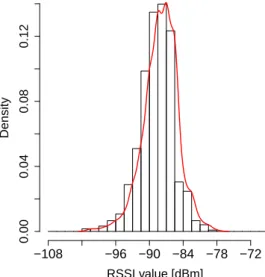
We aim here to verify whether the RSSI measured for each of the existing links follows this distribution. Since they do not follow the normal distribution, we have chosen one of the most well-known non-parametric tests - the Wilcoxon-Mann-Whitney test [48]. We determined that the difference between the RSSI levels was less than 10% in 97% of the link cases.
Network dynamics
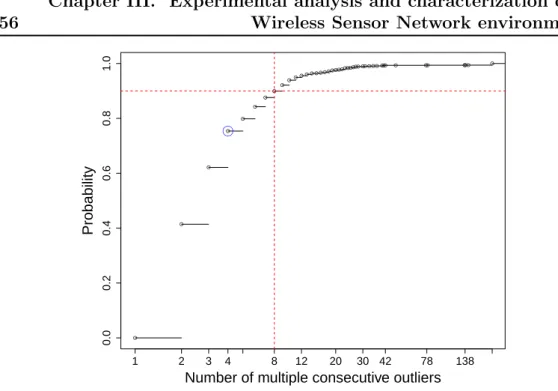
Thus, we extracted the cumulative distribution function (CDF) of the number of consecutive outliers. Similarly, for 90% of the cases we have 8 or fewer consecutive outliers (dashed line in the figure). Furthermore, we have calculated the cumulative distribution function of the number of outliers per sliding window (Figure 3.10) to justify our choice.
Necessary neighborhood information
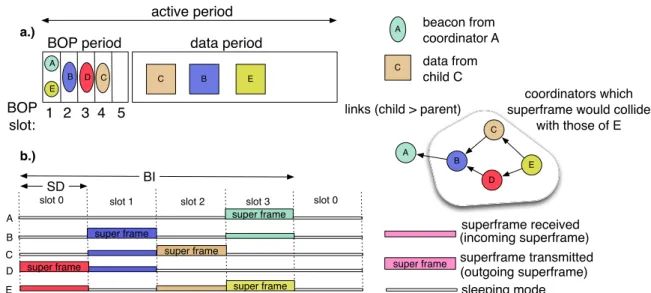
We aim to allocate BOP and superframe slots in a distributed manner while avoiding collisions. If the list of 1-neighbors does not fit in the beacon payload (maximum 116 B when other optional fields are not used), a node creates a separate hello packet sent under CAP. We consider the network to be stable when the neighborhood information changes with a periodicity that is several times higher than the beacon interval (BI).
BOP slot assignment
We can follow an approach similar to the trickle timer [72] or TAP [52], with the aim of adapting the period of control packets to the dynamics of the network.
Superframe slot assignment
We suggest building and maintaining a new cluster DAG structure only at the MAC layer. We can notice that the cluster DAG structure allows introducing more redundancy even in such a simple topology with a low node degree. Finally, unlike a DODAG, a node belonging to a cluster DAG can forward its traffic to any of the available parents.
Multiple parent association
When a node transmits its connection request, it does not enter the sleep state as specified in the IEEE 802.15.4 standard. 802.15.4 BOP: The superframe slot used by the coordinator directly follows the superframe slot of its parent;. A loop-free DAG cluster structure is obtained by adopting a simple hop count as a measure of depth.
Traffic model and routing
Also, a coordinator that has less depth in the cluster tree often sends its beacons first. A packet is pulled from the buffer when the node is in the idle state, during the CAP of the superframe of its parent. A procedure periodically drops packets that exceeded their timeout (macTransactionPersistenceTime as defined in the ieee 802.15.4 standard).
Cluster-DAG properties
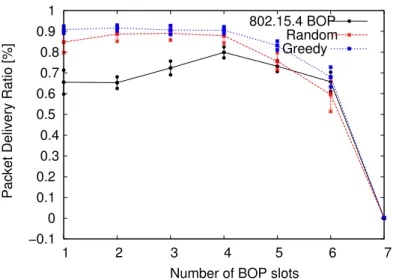
The association time grows with the number of nodes, since we keep the density constant. As a result, the association time increases with the increase of the total number of nodes (cf. Figure 4.4). While random and greedy strategies are unaffected by the number of BOP slots, 802.15.4 BOP requires at least 4 BOP slots to increase PDR performance.
Impact of the BO/SO values
The surface of the deployed topology increases accordingly and thus the maximum number of radio hops. We measured the impact of the BO/SO values on the resulting PDR (cf. Figure 4.6a). However, once we increase the number of available superframe slots, greedy and random perform better.
Scalability
Increasing the number of deployed nodes has the least effect on the PDR performance of our greedy slot allocation algorithm: it remains above the 80% level. Our slot allocation algorithm obtains the lowest percentage of colliding slots regardless of the increase of nodes in the observed topology. Energy consumption along the path can be estimated by the total number of packet retransmissions required to deliver a data packet to the sink.

Race against the time: beat the deadline
The budget is extended up to three times from the initial value in small steps (a constant ST EP (0,1)).
Multi-path opportunistic forwarding algorithm
Urgency affects the next forwarder decision: a node chooses the next available parent (first signal reception), regardless of its ETX metric. The protocol achieves a short packet delay at the expense of a potentially larger number of retransmissions over lower-quality links (see an N2 parent node in Figure 5.1). From this list, the protocol selects a parent that offers the lowest delay to forward the packet (see an N1 parent node in Figure 5.1).
Simulation setup
Deadline Finally, when a node is dealing with the deadline type of traffic, both delay and cumulative ETX must be considered together. We change the SO parameter from 3 to 5 and choose the BO parameter so that the number of superframe slots is sufficient to avoid superframe collisions. We assume that 2-hop neighbors interfere, so the number of slots must be higher than the largest size of 2-hop neighborhood in the network.
Result analysis
Fewer packets are dropped due to the short packet deadline – a missed beacon from the preferred parent is caught up by the beacon reception from some of the alternate parents. In the same situation, the original (unicast) rpl must wait for the entire inter-beacon period (BI), thus risking more packet drops due to the short packet deadline. In terms of PDR performance, our opportunistic plan provides a real gain when dealing with harsh deadline constraints.

Global recommendations for convergecast tree
With this example, we do not seek to exclude the link quality metric from observation, but rather argue that it should be considered along with other metrics. Link quality considerations: Of course, a node must choose a parent with a stable and efficient radio link. For example, a node should monitor link quality and change its parent selection if it changes significantly.
Parent selection metrics
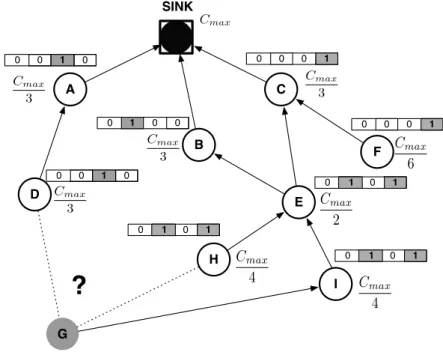
We chose to represent the diversity metric as the number of distinct first-rank nodes in the set of paths to the PAN coordinator. It is clear that diversity is minimal for children of the PAN coordinator: we prohibit the creation of any loop. The diversity metric will help choose a parent that maximizes the diversity of paths to the PAN coordinator.
Modified ieee 802.15.4 beacon format
BI ∗(EBXlinkN→Pj −1) (6.5) Intuitively, the delay depends on the number of superframes a node has to wait before receiving the beacon correctly (second part of the equation) and the time its superframe and one of its parent separates (part one). To reduce the delay while maintaining the same duty cycle, we need to decrease both SD and BI values in Equation 6.5 in the same proportion. Thus, the ability of a cluster DAG to minimize the delay should be expressed independently of the actual BO and SO values.
Hierarchical succession
We believe that the biggest challenge in efficient convergecast construction is to find a single (locally measured) measure (metric) for parent selection. This is a non-trivial task, especially if we consider the list of global recommendations for efficient convergecast tree (cf. Subsection 1.1). We present an overview of available methods to combine multiple criteria to generate a single output decision value to be used for parent selection.
Linear combination
Fuzzy logic
We can imagine an example parent selection rule: IF the PDR is connected AND throughput is high, THEN connect to that parent. Fuzzy logic provides a precise mathematical solution for combining the facing input variables used for decision making to produce a single output value. We will show how expertise and insights from the WSN domain can be used to exploit the positive properties of fuzzy logic in parent selection.

Fuzzy decision rule
Fuzzification of the input variables
For each of the input variables (parent metrics) we define only one language variable (high signal PDR, high capacity, high diversity enhancement and low signal reception delay) and the corresponding membership function (denoted by µbcnP DR, µcapa, µdiv−impr and µdelaybcn) (cf. Figure 6.3). We can adapt the shape of the membership function according to a different environment or empirical measures. Finally, we provide an analysis of parental selection performance when different bootstrap strategies are used.

Simulation setup
Simulated time 1200 s SO, BO, BOP slots 2, 8, 4 Table 6.1: Cluster-DAG topology construction: General simulation parameters. We examine the cost of energy required to build a cluster-DAG and the reasons for energy consumption. Node bootstrap strategy all, random circle, random chain Table 6.2: Cluster-DAG Topology Construction: Various parameters, highlighted in bold by default.
Structural properties
The other approaches (First Pick, Random, and EBX) are unable to limit the number of adversarial children. Thus, none of the parent selection metrics are able to limit the number of parents. Maximizing the number of leaf nodes can be beneficial to the overall energy consumption of the network.

Convergence and stability
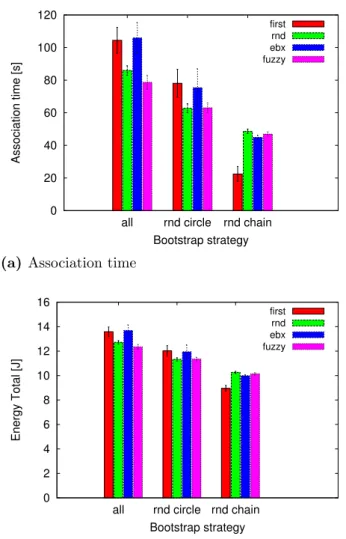
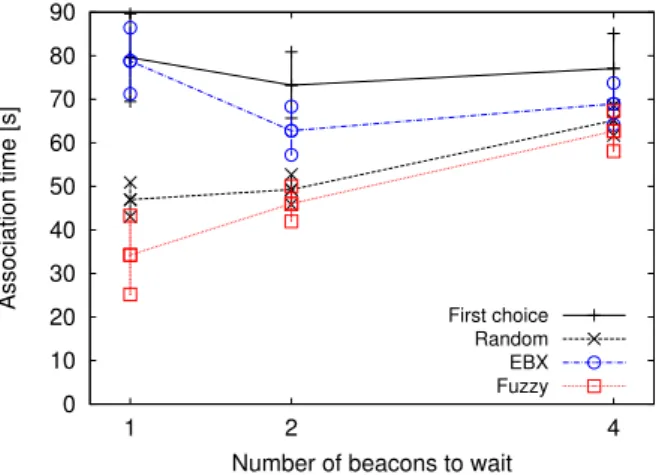
We can see that the Fuzzy scheme constantly keeps the lowest percentage of the coordinators with children (highest number of leaf nodes). Number of beacons to wait First choice. a) Impact of the number of beacons on the association time. In Figure 6.7b we can observe the impact of the topology density (number of nodes) on the association time.
Energy concerns
Impact of the bootstrap strategy
In Proceedings of the 4th international conference on Embedded networked sensor systems, SenSys '06, pages 307–320, New York, NY, USA, 2006. A critical review of the ipv6 routing protocol for low-power and lossy networks (rpl) . In Proceedings of the workshop on Extending the Internet to Low power and Lossy Networks (IPSN 2011), Chicago, IL, USA, April 2011.
On the feasibility of link abstraction in wireless networks. IEEE Transactions on Networking April 2009. In Proceedings of the 2009 International Conference on Information Processing in Sensor Networks, IPSN ’09, pages 37–48, Washington, DC, USA, 2009.