
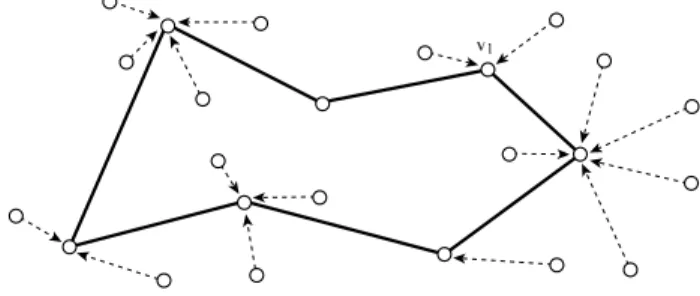
The first objective is to minimize a ring cost related to the length of the cycle. But it is usually impossible to generate the entire set of Pareto-optimal solutions due to the complexity of the underlying problem or the large number of optima. An example solution is given in Figure 1, where solid lines represent edges belonging to the ring and dashed lines represent arcs of the assignments.
Finally, one or both versions of the problem have been addressed heuristically using a variable neighborhood tabu search [14], an evolutionary algorithm [15], a multi-start greedy add heuristic [15], and a variable neighborhood tabu tabu search hybridized with a greedy randomized adaptive search procedure [16]. IBMOLS and IBEA are both recent indicator-based metaheuristics, while NSGA-II can be considered a state-of-the-art multi-objective solution approach. As proposed in [6], the optimization objective is assumed to be given in terms of a binary quality indicatorI[29] which can be regarded as an extension of the Pareto dominance relation.
As noted in [6], R does not need to be known in advance, it is simply required in the formalization of the optimization objective. One of the main advantages of indicator-based optimization is that there is generally no need for additional diversity conservation, depending on the indicator used. As pointed out in [31], this is known to be one of the drawbacks of the ǫ dominance relation, apparently due to the high convexity of the front.
The first two multi-objective evolutionary algorithms designed to handle bi-objective RSP are slight variations of two more recent research methods, namely IBEA [6] and NSGA-II [7].
IBEA
Random restart is the simplest possibility, and a well-designed perturbation technique generally achieves better results. As proposed in [5], we decide to perturb a set of solutions from the archive to obtain the restart population. The choice of such a strategy was motivated by preliminary experiments as well as conclusive results obtained in [5] for another problem.
Then, the population reinitialization scheme is based on random noise, such as in a basic simulated annealing [26]. If the size of the archive is less than N, the population is filled with random solutions, just like with random restart. More details on IBMOLS and I-IBMOLS as well as algorithm pseudocodes can be found in [5].
Finally, this paper proposes and presents in detail for the first time a general approach for solving MOPs, called SEEA. As with the IBMOLS algorithm, the indicator used in the IBEA framework is an additive ǫ-indicator; and the same mechanism was used to prevent the loss of extreme points on the compromise surface.
NSGA-II
SEEA
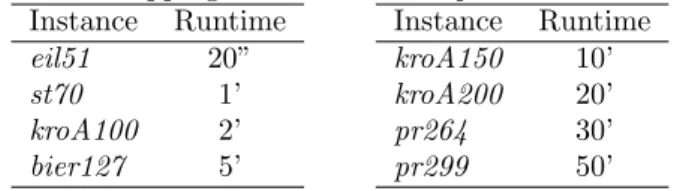
If the non-dominated solutions are relatively close to each other in the decision space and if the archive is not too small compared to the main population, we believe that SEEA can converge to a good approximation of the efficient set in a very short running time. Thus, the ring path associated with the solution corresponds to the nodes read according to their random keys in ascending order; However, since presumably small instances are easier to solve than large ones, this stopping criterion was arbitrarily set based on the size of the instance considered, as shown in Table 1 .
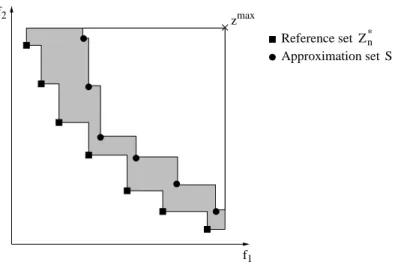
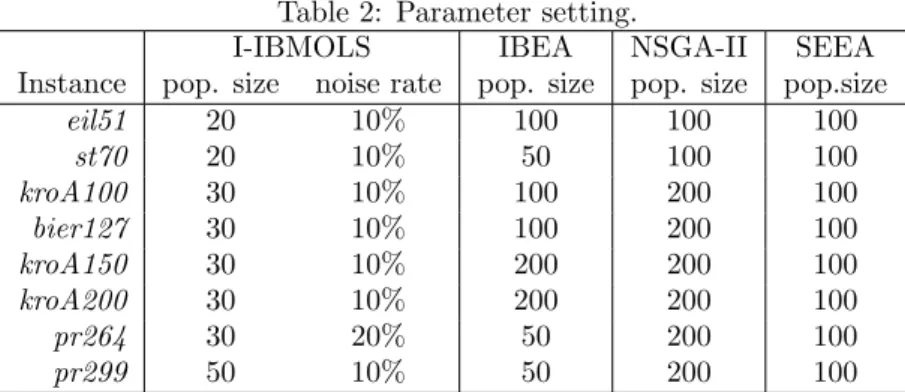
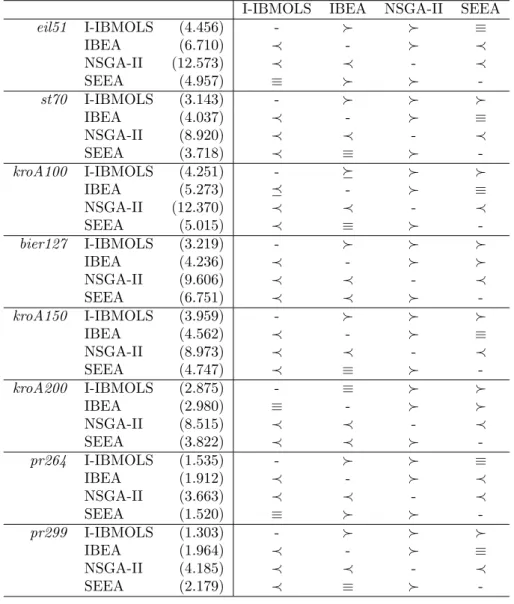
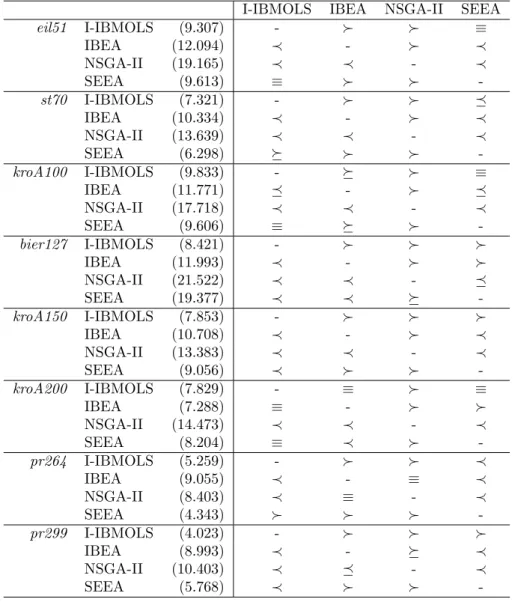
Unlike the one proposed in equation 5, this indicator is used to compare the non-dominant. The noise level for I-IBMOLS is set to a fixed percentage of the number of nodes involved in the problem at hand. According to the experimental protocol used in the paper, I-IBMOLS is never statistically better than any other algorithm with respect to both metrics.
The only exceptions are for instances st70 and thepr264, where SEEA obtained better results with respect to the I1ǫ+ metric. Indeed, since the same fitness value is assigned to most of the population, only the clustering distance is used to compare solutions. One possibility is to measure the quality of the current At archive compared to that of the previous At−1 step.
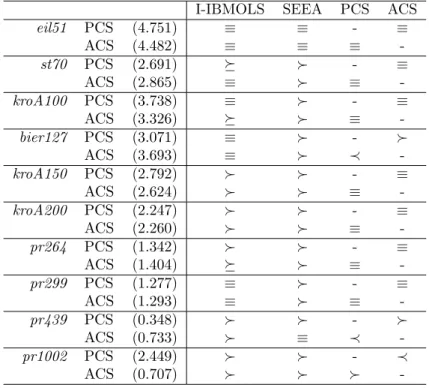
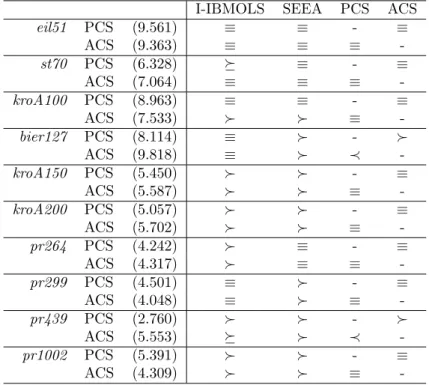
According to the taxonomy proposed in [44], the hybrid metaheuristics investigated in this paper can be classified into the high-level hybrid teamwork (HTH) class and then denoted by HTH(SEEA+IBMOLS). In addition, one of the versions we propose, adaptive, automatically detects when to start a local search based on the optimization scenario. To test the effectiveness of our two cooperative approaches, we compare them with SEEA and an iterative version of IBMOLS using
Finally, we give an idea of the behavior of our approaches compared to the state-of-art single-objective approach proposed in [1] for the problem under study. The step t of the hybrid algorithms is set to 0.5% of the maximum running time available for the case under consideration. These two aspects result in the number of times IBMOLS is launched being more or less balanced between both cooperative methods in the end.
To give a rough idea of the results we obtained, we compare the best found scalar value as described above with the optimal7 found in [1]. To summarize, compared to single-objective optimal or near-optimal results, the search methods we propose in this paper to solve B-RSP are quite promising in terms of the relatively small available computational time and the size of the problem instances. be solved. This is not the case in the framework of PCS, so the latter devotes all its computational time to the search process.
The same observation can also be made regarding the cooperative approaches proposed in this paper.

![Table 8: Error ratio between the cost value of the best known TSP solution and the best single-objective ring cost value found in [1] in comparison to the best value found during our experiments.](https://thumb-eu.123doks.com/thumbv2/1bibliocom/466436.71181/31.892.213.699.251.472/table-error-ratio-solution-single-objective-comparison-experiments.webp)