One can consider a specific layer in the protocol stack, such as the access protocol to the communication channels, or focus on the application layer and study overlay networks or cache networks. I contributed to a study on the active management of flows in the core of the network (project with the former Alcatel-Lucent Bell Labs, now Nokia) and to the performance evaluation of urban train control based on wireless communication (project with Alstom Transportation).
Medium access control in wireless networks
Next, I considered on the one hand the energy-saving mode of mobile devices and on the other hand the evolutionary routing problem in connectivity-reduced networks. After studying energy savings in mobile terminals, I focused on the energy consumption of base stations in mobile networks and the use of renewable energy sources for their power supply.
Power saving mode in mobile devices
The queue of incoming frames can still be modeled as a queue with heterogeneous holidays, but in addition the timeslot operation of the server must be taken into account. The evaluation of the energy savings achieved with a mobile device with power saving mode turned on was performed for Poisson traffic [52] and for web traffic [54].
Green base stations
An important result of our work is to have shown that the power saving mode algorithms proposed by current standards are not optimal. With Vincenzo Mancuso (postdoctoral student funded by ANR), we studied the energy saving mode in 3.5G or 4G compatible devices.
Evolutionary epidemic routing
Peer-to-peer storage systems
Each document of the system is fragmented and a number of redundant fragments, indicated, are added to the initial number of fragments, indicated. Newly created fragments are stored on peers that do not have fragments of the same document.
Expiration-based caching networks
To reconstitute a document, it will be necessary to collect at least from the total of its fragments, which are stored on so many different peers. For the data download and recovery processes, we developed a realistic simulation model and implemented it on top of the ns-2 network simulator [36].
Research partnerships with private companies
Active flow management
Urban train control through wireless communication
We quantified the rate of false emergency brakes (those due to communication errors/errors and not to a real risk of collision) and obtained an exact formula when the packet losses are homogeneous and independent [56]. We exploited this formula to design a Monte-Carlo method to calculate the rate of false emergency brakes when packet losses are also due to handover phases in the wireless communication [57].
Manuscript structure
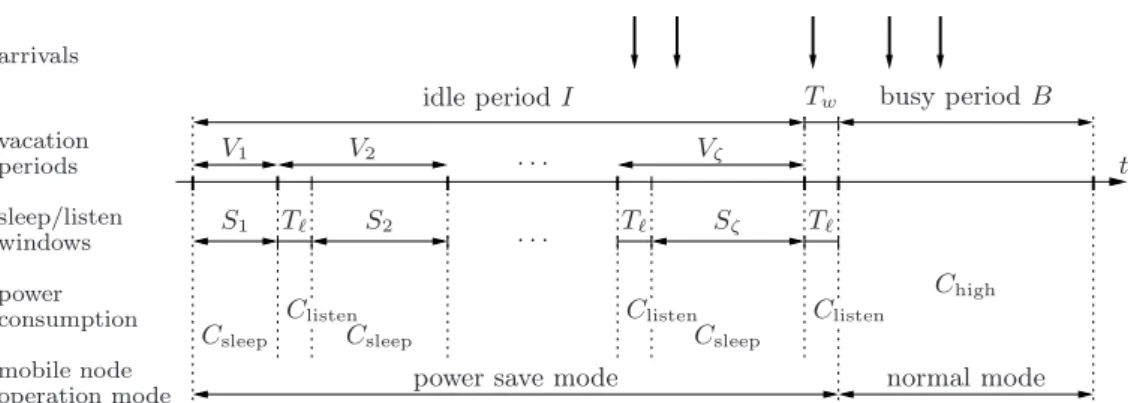
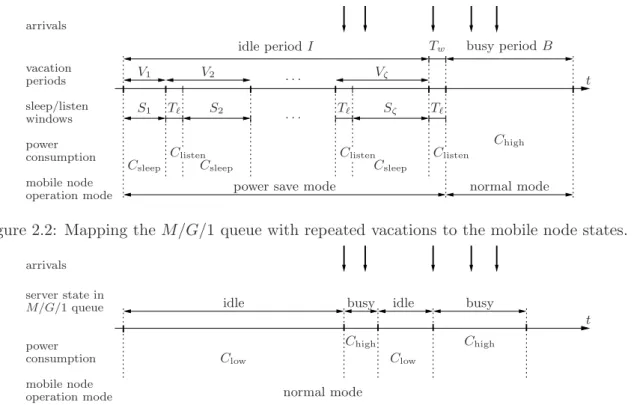
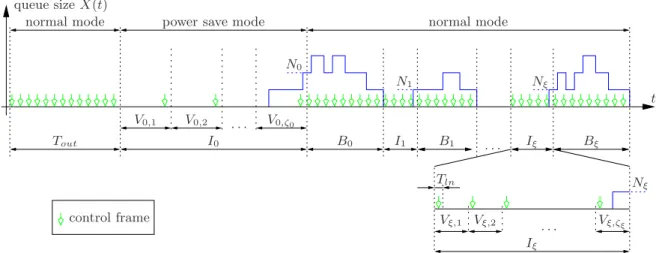
Since the radio link between the device and the base station/access point must be maintained, sleep mode consists of successive sleep periods separated by brief periods during which the device is notified of any waiting traffic, in which case normal mode is resumed. This behavior in sleep mode can be thought of as that of a queuing system in which the server repeatedly goes on vacation.
Continuous-time server operation (use case: IEEE 802.16e power saving)
Inclusion of a vacation trigger time
If an arrival occurs before the vacation trigger time Ttex expires (ie, no timeout), the current regeneration cycle is the same as that for the M/G/1 queue without vacations. If the vacation trigger time is infinite, the server will never go on vacation, and these results match those of the standard M/G/1 queue with no vacation.
Slotted-time server operation (use case: continuous connectivity)
Poisson traffic
We can also calculate the probability generating function for the initial lag in power save mode and in normal mode. The basic power consumption rate of the UE is con in normal mode and csl < con in power saving mode.
Web traffic
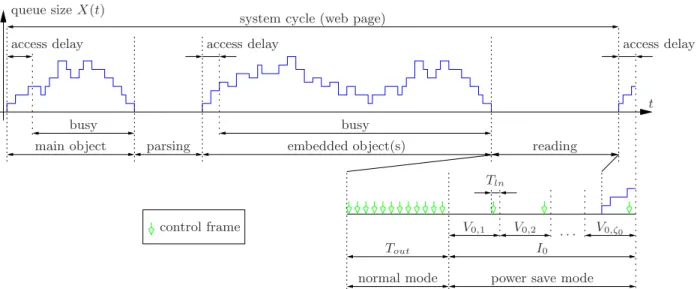
Term(m) is a cost reduction factor that depends on the length of the energy saving subcycle m. The energy saving gain is a decreasing function of the arrival rate λ, an increasing function of the size of breaks (through) and a decreasing function of the inactivity timer (through M).
Optimal sleep periods for wireless terminals
Parametric optimization
Generic Discrete Policy: Shas a discrete distribution with known possible values; we can control the probability mass function ppp. In the exponential policy, we analytically derive the optimal control as a function of the expected period of inactivity.
Dynamic programming
Comparing the exponential and constant policies with the IEEE 802.16e standard under Poisson traffic, we find that the constant policy always outperforms the cost of the other two policies, and the exponential policy outperforms the standard policy for a wide range of traffic rates. From now on, there is a one-to-one relationship between the stage and the current probability distribution of the remaining period of inactivity.
Concluding remarks
Poisson traffic
Here, CUEnps(λ) is the energy consumption in the eNB caused by data transmission to a single UE with traffic intensity λ, without energy saving. Therefore, the cost reduction at the eNB is a factorαtx/α of the cost reduction at all users together.
Web traffic
When arrivals are homogeneous, the power saving gain increases with the number of users Nu. We maximize this cost reduction at the eNB under QoS constraints [54] and find that relying only on users' power saving mode to reduce the power consumption at the eNB is only attractive if the number of users is not low.
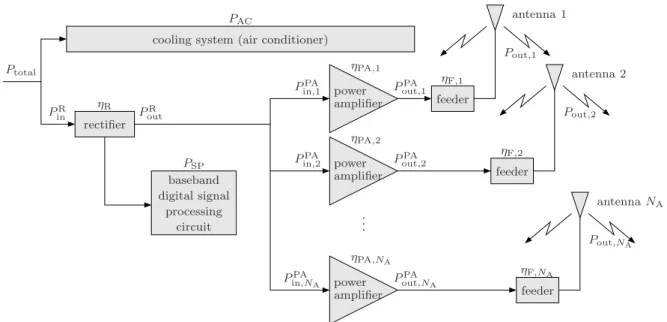
Using on/off power amplifiers
If the power amplifier is never switched off, all periods of inactivity are spent in the idle state. In the opposite case, the optimal policy is never to switch off the power amplifier (fopt= 0).
Using renewable energy sources
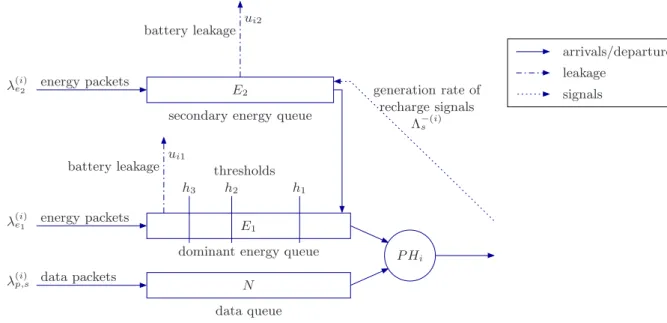
Furthermore, various optimization problems can be formulated, such as finding an optimal value for the next dominant energy storage capacity E1 which minimizes the depletion probability. We demonstrate the feasibility of the developed algorithm through a numerical example, focusing on depletion probability.
Concluding remarks
Over a decade ago, peer-to-peer storage systems proved to be an economically attractive storage solution compared to traditional approaches. As a result, P2P storage systems must compensate for data loss by continuously storing additional redundant data on new hosts.
Centralized repair systems
- Systems with exponential peer on-times: recovery process as a whole
- Simulations of the recovery process
- Systems with exponential peer on-times: refining the recovery process
- Systems with hyper-exponential peer on-times
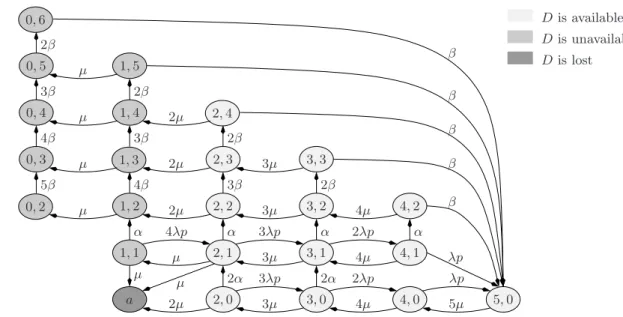
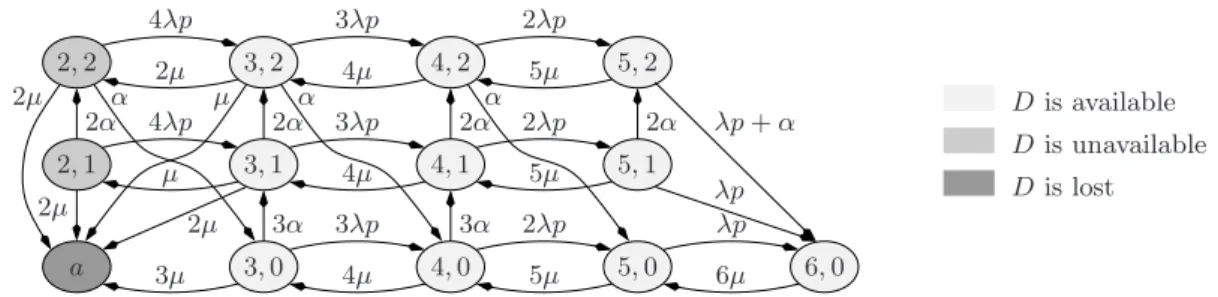
To represent the state of the data blockD, the number of fragments in the system and the state of the recovery process must be tracked. In order to keep track of the state of data block D, we must again consider the number of fragments in the system and the state of the recovery process.

Distributed repair systems
- Systems with exponential peer on-times: recovery process as a whole
- Simulations of the recovery process
- Systems with exponential peer on-times: refining the recovery process
- Systems with hyper-exponential peer on-times
To have a Markovian model for the state of Dwe, consider again the number of fragments at time and the state of the repair process. The generalization of the distribution of peers' on-times increases the complexity of the model.
Concluding remarks
In the DNS use case, this assumption naturally stems from the fact that the cache entities - the DNS records - have a small size compared to the storage capacity available at a DNS server. A cache makes the contents available in the respective cache for a duration T as illustrated in Figure 5.1.
Analysis of a single cache
The loss process (that is, from a cache to a higher-level server) must be characterized. If the renewal function M of the request process in a cache is concave, then the hit probability is maximized, and both the miss rate and occupancy are minimized.
Analysis of a network of caches
If the recovery function M of a cache request process is linear, then the miss rate, hit probability, and occupancy are insensitive to the cache duration distribution T. Cℓ,nℓ are independent and further independent of the exogenous request. process in cache C (see Figure 5.2).

Validation
Concluding remarks
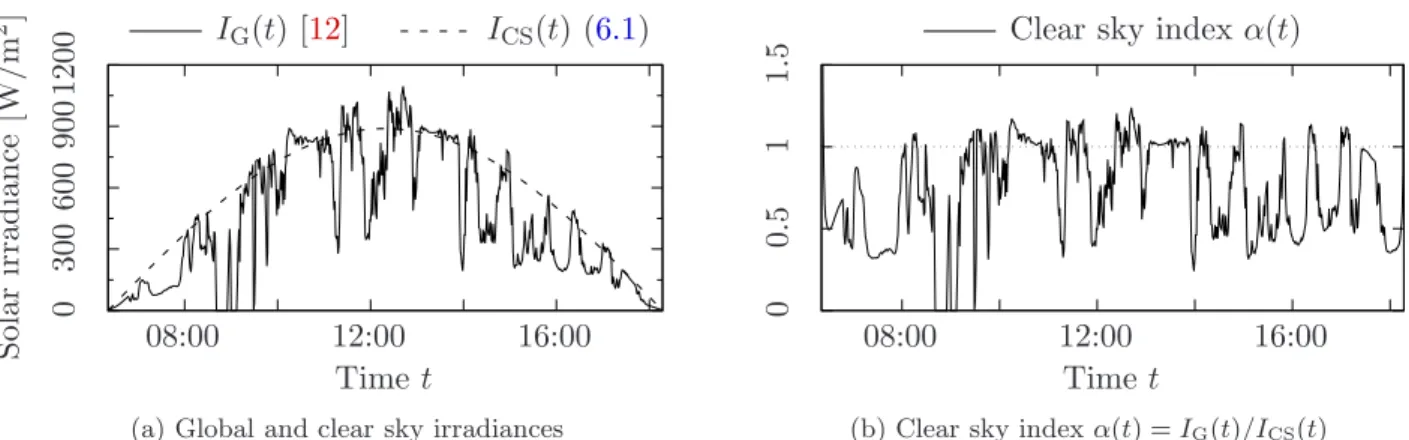
The induced disturbances can be captured by a multiplicative noise denoted α(t) and called clear sky index in the literature. The irradiance model is able to capture the multiscale correlations inherently present in the solar irradiance.
Modeling data centers
Abdulhalim Dandoush, Sara Alouf, Philippe Nain, Simulation analysis of download and recovery processes in P2P storage systems. Abdulhalim Dandoush, Sara Alouf, Philippe Nain, Performance analysis of centralized versus distributed recovery schemes in P2P storage systems.
Main assignments
Member of the admissions jury for 1st and 2nd class charg´es de recherche at Inria in 2016.
Awards
Projects and collaborations
- Industrial partnerships
- National and international projects
Maestro's partners in this project were: Motorola (coordinator until 2008), France Telecom R&D (coordinator after 2009), GET (ENST Bretagne and INT), Armor project group (Inria), Eurecom Institute and LIA (University of Avignon). ). Maestro's partners in this project were: Create-Net (coordinator), CNR Pisa, University of Trento, Technion, University of Basel, TUB, University of Passau, BUTE, Nokia, VTT, NKUA, Telecom Italia, LSE, Techideas and project the Oasis group (I3S-Inria-CNRS).
Tutoring (by decreasing chronological order)
- Post-doctoral fellows
- PhD candidates
- Master 2/Bac+5 internships
- Master 2 final-term projects
- Master 1/Bac+4 internships/projects
Angelos continued his studies as a PhD candidate with Vincenzo Mancuso at IMDEA Networks Institute in October 2011. Alvaro continued his studies as a PhD candidate at the Microsoft Research - Inria joint laboratory in October 2007.
Dissemination activities (since PhD defense)
- Invited talks
- Presentations
- Scientific popularization and public outreach
Conducting conferences: (i) in six different high schools (conference titles: “Comment marche le Web?” and “Internet et le Web”): High School Pierre et Marie Curie in Menton on 25 November 2016, Lyc´ee General et Technologique du Rempart in Marseille on March 20, 2015, Aix-Valabre High School in Gardan on December 13, 2012, Henri Matisse High School in Vence on December 6, 2012, Jean Cocteau High School in Miramas on November 24, 2011 and Manosque International High School on 7 November 2011;. ii) at the Albert Camus Public Library in Antibes on 20 May 2011; conference title: "Le r´eseau des r´eseaux Internet: comment ´etudier cet objet qui nous d´epasse en taille.". I present: (i) my research activities during "La Fˆete de la Science" in 2009 to three groups of high school students (1 hour per group) at the Collège Leonard de Vinci in Antibes and (ii) my scientific background at "Les Doctoriales", which jointly organized by ´Ecole Polytechnique, DGA and ParisTech, on September 24, 2009 in Fr´ejus.
Community service
- Edition of scientific work
- Review of scientific work
- Scientific events
The organization involved selecting the venue, selecting the organizing committee, setting and managing the budget, obtaining sponsorships, organizing a trade fair, inviting keynote speakers, editing the main issue and coordinating the local organization. The task was to invite program managers to each of the five associated workshops, coordinate the workshops in relation to the main conference (choice of room/date, follow-up on registration numbers).
Academic assignments and teaching
Sara Alouf, Nicaise Choungmo Fofack, Nedko Nedkov, Performance Models for Hierarchy of Caches: Application to Modern DNS Caches. Sara Alouf, Vincenzo Mancuso, Nicaise Choungmo Fofack, Analysis of Power Saving and Its Impact on Web Traffic in Continuously Connected Cellular Networks.
Book chapters
International conferences (regular papers)
Amar Azad, Sara Alouf, Eitan Altman, Vivek Borkar, Georgios Paschos, Vacation Policy Optimization with Application to IEEE 802.16e Power Saving Mechanism. Sara Alouf, Eitan Altman, Amar Azad, Analysis of an M/G/1 Queue with Repeated Inhomogeneous Holidays with Application to IEEE 802.16e Power Saving Mechanism.
International conferences (short papers)
Mouhamad Ibrahim, Sara Alouf, Design and analysis of an adaptive backoff algorithm for IEEE 802.11 DCF mechanism. Sara Alouf, Eitan Altman, J´erˆome Galtier, Jean-Fran¸cois Lalande, Corinne Touati, Quasi-optimal bandwidth allocation for multi-spot MFTDMA satellites.
International workshops
Invited papers
Patents
Research reports (16 since PhD defense, list of those differing from publications)