Une approche pour l'évaluation des systèmes mobiles d'aide à la décision basée sur le processus d'extraction de connaissances. À tous mes proches, qui me soutiennent dans la prière dans ce travail, je vous dois beaucoup à tous.
General context
In this process (KDD) there are several important stages such as the decision makers' needs analysis, preparation and manipulation of the relevant data as well as integration of knowledge for the decision support. Advances in mobile technology and the wide availability of personal mobile devices create a new class of DSS known as mobile DSS (MDSS), which allows users to make appropriate decisions at any time via their mobile devices, regardless of location.
Motivations
Our work is not only concerned with the evaluation of these systems, but also with the evaluation in the KDD process itself. These works are limited to the DSS which are not mobile and still focus only on the evaluation of the data mining phase.
Problem statement
Although there has been an increasing interest in the evaluation of interactive systems within the research community in recent years, MDSS has received insufficient attention. Few researchers have underlined this gap and defined the criteria to be measured and optimized to obtain better quality of DSS.
Objectives
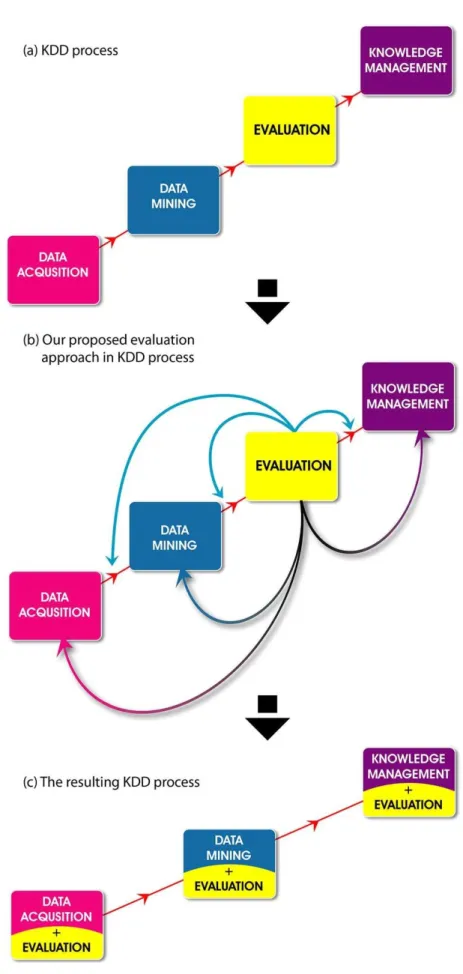
In addition, although previous research works related to the KDD process have clearly shown that each module in KDD needs to be designed, implemented and evaluated [32], their proposed evaluation is incomplete from our point of view because it neglects several quality factors such as . quality of use, quality of data, etc. The proposed supporting evaluation modules enable the evaluation not only of the quality of use of the individual module that makes up the KDD process, but also other criteria that reflect the goal(s) of the individual KDD module.
The outline
Introduction
The field of decision support is an important area of the discipline of information systems (IS) [14]. The focus will then be on Mobile Decision Support Systems (MDSS) only as it is an emerging research area.
Decision support
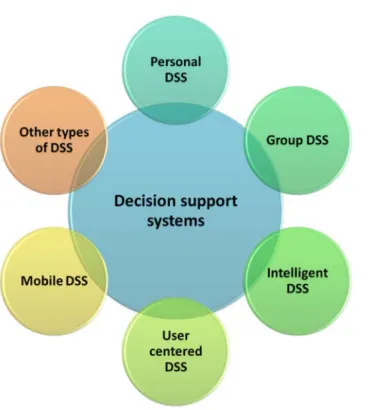
- Decision support systems
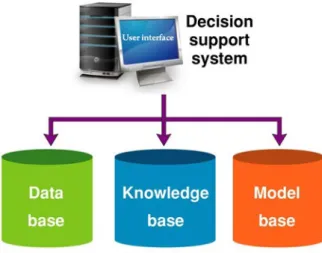
- Decision support systems composition
It can use models to support the different phases of decision-making and include a knowledge base”. A human-machine interaction must allow the presentation of the information in different forms (2D or 3D graphs, texts, video or other).
Mobile Decision Support Systems
- Mobile devices
- Mobile devices and mobile decision support systems
- Possible architectures of mobile decision support sys- tems
Although mobile devices have superior mobility and multifunctional capabilities, there are a number of associated inferior aspects, including rela-. However, the particular characteristics of mobile devices must always be taken into account when designing, implementing and evaluating applications for mobile devices.
Knowledge Discovery from Data processes
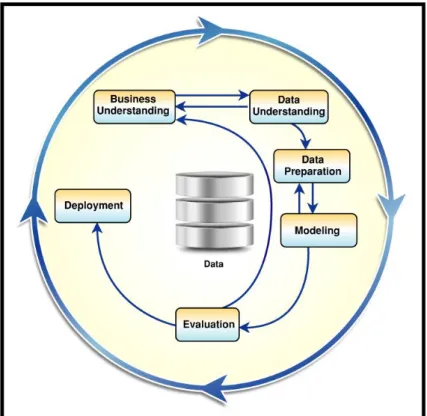
- CRISP-DM
- Fayyad’s KDD process
- The derived Fayyad’s process
- Decision Support Systems based on KDD process
Interest measures are thus important in the context of DM, regardless of sample form. Software evaluation against functional and HCI requirements as shown in Figure 1.11.
The context of use
- State of the art
- Contextual data collection
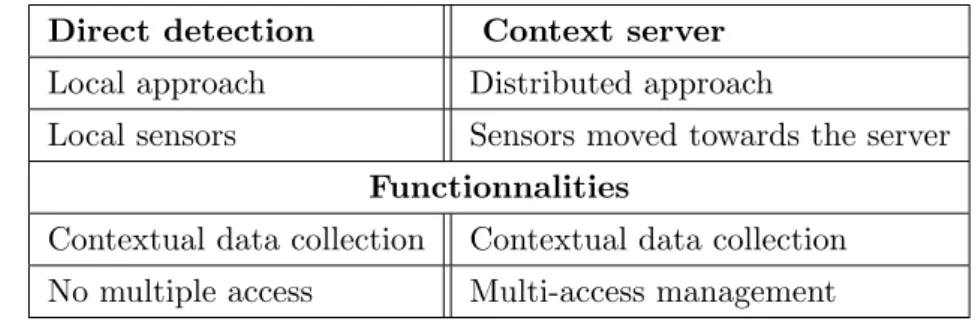
The development of the latter requires a real knowledge of the application domain, which refers to the Knowledge Discovery in Databases (KDD) approach. Abowd defines context awareness as the system's ability to use context to provide relevant services to users, where relevance depends on the user's task [4].
Conclusion
INTERACTIVE SYSTEMS
Introduction
In this chapter, we present the most famous works in the field of evaluation of interactive systems. In the first chapter, we present the most well-known development processes in software engineering with an emphasis on evaluation in these processes.
Evaluation in development processes in soft- ware engineeringware engineering
- Development processes in Software engineering
- Quality models in the field of software engineering
Most traditional models are too often oriented towards the technical aspects of the system (eg code) and not enough towards the needs of the users. None of these three models provides a rationale for the selection of characteristics to be included in a quality model, and it is not possible to determine whether the model represents a complete or consistent definition of quality.
![Figure 2.1: ISO 9126 quality factors the perspectives of quality [59].](https://thumb-eu.123doks.com/thumbv2/1bibliocom/460828.67582/52.892.198.671.191.542/figure-iso-quality-factors-perspectives-quality.webp)
Evaluation in the field of Human-Computer InteractionInteraction
- Development models enriched under the angle of HCI
- Quality models in the field of HCI
- Usability evaluation types
- From the usability to the quality in use
- Evaluation approaches and methods
- Evaluation techniques within the user-based testing methodsmethods
- Evaluation processes
This data is useful for improving the user interface to receive future versions. It was found that questionnaires can be applied to the evaluation of all types of interfaces (such as WIMP 1, Web and Mobile interfaces).
![Figure 2.2: Acceptability of systems, as documented in [157]](https://thumb-eu.123doks.com/thumbv2/1bibliocom/460828.67582/55.892.194.697.204.484/figure-acceptability-systems-documented.webp)
Software product evaluation processes from the perspective of standards
It does not facilitate the evaluation of many non-functional properties of the system, such as response time, reliability, and so on. Design the evaluation: The purpose of this step is to specify an evaluation plan that is described in a specification of the evaluation.
Usability evaluation processes proposed in the context of HCI
- Usability evaluations of mobile applications
- Discussion
- Quality measurement
- Basics of software metrics
- Aggregation Theory
- The measurement reference model: ISO/IEC 25020
- Single Usability Metric
- Summary
- Evaluation of decision support systems
- Conclusion
The choice of the method or methods to be used, based on the specification of the evaluation objectives. Such a method can be considered important for measuring the usability of interactive systems.
![Figure 2.4: The general concepts of measurement and statistics, as presented in [215]](https://thumb-eu.123doks.com/thumbv2/1bibliocom/460828.67582/71.892.183.681.185.397/figure-general-concepts-measurement-statistics-presented.webp)
THE EVALUATION OF MDSS BASED ON THE
Introduction
We remind that we are concerned with the evaluation of MDSS/KDD process which can be defined as KDD-based systems that can support users to make decisions, through their mobile devices. After that, we present our first contribution for the evaluation in the KDD process, which may be appropriate to improve the evaluation task within the process on which some developers are based to develop DSS.
Raising the issue of MDSS/KDD evaluation
Furthermore, as for DSS, the evaluation of MDSS needs the support of the user to ensure a better quality. The choice of the criteria used for the evaluation of each module will also be discussed.
Enhanced evaluation in the KDD process
- Evaluation support of the Data acquisition and storage modulemodule
- Evaluation support of the Data Mining module
- Evaluation support of the Knowledge Management module
- Global evaluation
- Discussion
Furthermore, a global evaluation of the entire DSS/KDD process allows the evaluator to get a general idea of the quality of such a complex system. The second quality model allows an evaluation of the second module of KDD (Data Mining).
Our proposition for the evaluation of MDSS based on KDDbased on KDD
- Context modelling
- Context-based evaluation of MDSS/KDD
- Quality in use evaluation
- Conclusion
This method, shown in Figure 3.8, takes into account the change of the context of use. This vision presents our methodology for the evaluation of the MDSS/KDD process, taking into account the continuous changes of the context of use.
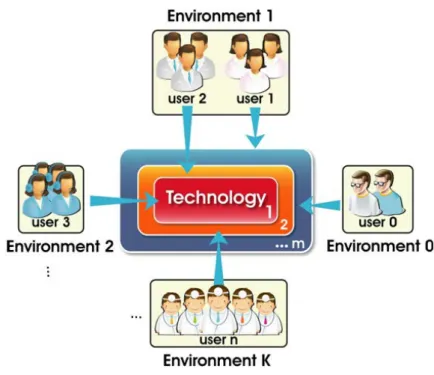
Our Evaluation Support System
A pop-up form appears in the user interface, allowing the evaluator to enter all the required information. When the testee completes the required task, the ESS will perform a comparison (comparison) between the user's activity model and the reference model determined by the evaluator.
Synthesis and conclusion
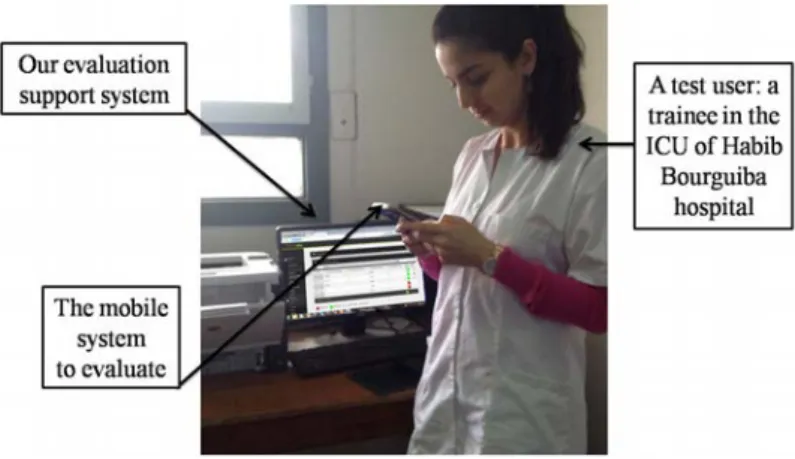
In addition, to facilitate the evaluators' task, we have proposed an evaluation support system that monitors and measures all criteria presented in this chapter. The purpose of our case study is to evaluate the MDSS/KDD used in the intensive care unit of the Habib Bourguiba Hospital in Sfax, Tunisia.
Introduction
This chapter presents the set of realized developments to put the proposed solution into practice. Then we describe our evaluation process, which is taken over from the standard ISO/IEC 25040, as well as developments that make the creation of CEVASM possible.
Presentation of the developed evaluation sup- port systemport system
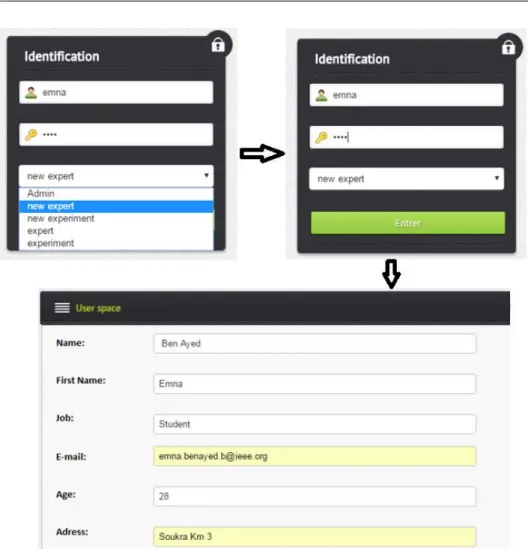
Assessment results presentation module, which serves to provide the obtained results. In addition, CEVASM offers a fourth module that enables the preparation of questionnaires and the so-called reference module, as explained in Chapter 3.
The evaluation process
- Stage 1: The specification of the evaluation require- mentsments
- Stage 2: The specification of the evaluation
- Stage 3: The evaluation design
- Stage 4: The execution of the evaluation
According to Senach [196], the evaluation is based on a comparison of the reference model (realized by the evaluator) and a model of the evaluated object (realized by the users who participated in the evaluation tests) in order to draw conclusions about the quality of the evaluated object. F2: allows sending the data describing the platform used at the time of the evaluation.
Make measurement
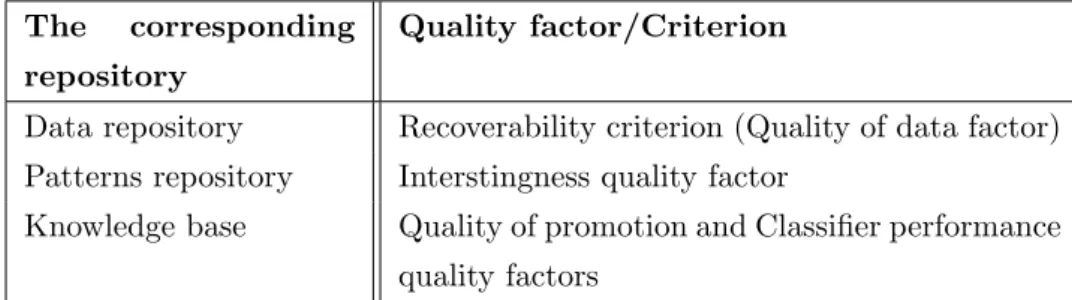
Table 4.2: Classification of the criteria KDD module Quality factor Criterion Type Measured from all modules Effectiveness Objective Interaction data Effectiveness Objective Interaction data Quality dissatisfaction Subjective Questionnaire (Q.Use) Freedom from risks Subjective Question Questionnaire (question question) Use) GlobalevaluationAllcriteriaSubjectiveQuestionnaire(Q.G) Dataacquisitionand storageQualityofDataAllcriteriaSubjectiveQuestionnaire(Q.Data) ), and the databaseDataMiningSupportObjectivepatternsrepository ConfidenceObjectivepatternsrepository LiftnessRepositoryObjectiveInnvelpatterns tySubjectiveQuestionnaire(Q.Interest) SurprisingnessSubjectiveQuestionnaire (Q.Interest) ComprehensibilitySubjectiveQuestionnaire(Q.Interest)Knowledge managementClassifierperformanceAll criteriaObjectiveKnowledge basePromotion qualityAllcriteriaSubjectivequestionnaire(Q.Promo).
Apply decision criteria for quality measures
Apply decision criteria for evaluation
- Stage 5: Conclude the evaluation
- Conclusion
This comparison is established based on the change of occupation of the user profile. We started with the presentation of the proposed system, its objectives and then the process followed for the evaluation.

PROPOSED APPROACH FOR THE EVALUATION
Introduction
The latter concerns the evaluation of a Mobile Decision Support System based on a KDD process used in the Medical field (MDSSM/KDD). Then, in the last section, we discuss the risks of validity of our undertaken work.
General context in medical field
- Nosocomial infections
- Previous works
In the previous chapter, we presented the developments achieved that enabled the total realization of the context-based evaluation support system for the evaluation of the MDSS/KDD process. In the first part, we introduce the general context of the work by introducing the nosocomial infections and previously proposed systems for this problem.
MDSSM/KDD: Mobile Decision Support Sys- tem based on KDD process and used in the
In Appendix C, we present the implementation activity used for each module of the MDSSM/KDD process. In the following paragraphs, we successively present the mentioned KDD process, as discussed in Chapter 3.
Data acquisition and storage
However, these phases are necessary to obtain an MDSS that, after its evaluation, can be based on our proposed approach, which is used in the ICU of the Habib Bourguiba Hospital. As presented in our first contribution, KDD process can be composed of only three modules (Data Acquisition and Storage, Data Mining and Knowledge Management) instead of four (Data Acquisition and Storage, Data Mining, Evaluation and Knowledge Management) ).
Data Mining
At this level, our task was to offer the doctors free access to the discovered rules stored in the knowledge base using their mobile devices (see Figure 5.1).
Knowledge Management
- Case study: Evaluation of the MDSSM/KDD
- Definition of the different contexts of use
Characteristics of the user profiles
Characteristics of the environments
Characteristics of the used platforms
- The achieved evaluation tests using CEVASM
As shown in Figure 5.3, the evaluator must introduce the prototype and the purpose of the evaluation to the participant before starting the evaluation tests. After performing the required tasks, the participants were invited to give answers to the questionnaires to express their subjective opinions [15].
Data mining
We have defined three tasks for this first prototype, which refers to the data acquisition and storage module. Try changing his/her temperature value and save the new value to the database.
Knowledge management
Global evaluation
- The obtained results
- The obtained results: Prototype 1
- The obtained results: Prototype 2
- The obtained results: Prototype 3
- The obtained results: Global evaluation
- Discussion about the obtained results
- Discussion
- Synthesis
- Discussion about the possible bias in the evaluation of the quality in usethe quality in use
- Risks of validity
- Future research works
- The context data acquisition
- Objective evaluation of the quality of data
- Proposition of an intelligent evaluation support system for the evaluation of MDSS/KDD processfor the evaluation of MDSS/KDD process
- Conclusion
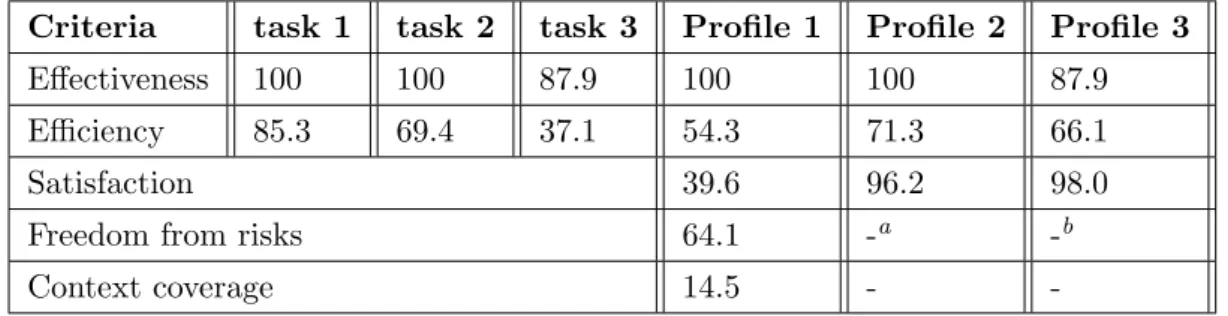
However, changing the user profile has a significant impact on the quality of use. However, no dependence is reported between data quality and changing context of use.
![Figure 1.4: Operation client/server structure of prototype of MDSS daily activities and can be everywhere around them [42]](https://thumb-eu.123doks.com/thumbv2/1bibliocom/460828.67582/28.892.200.695.170.534/figure-operation-client-server-structure-prototype-mdss-activities.webp)
![Figure 1.10: Categorization of Interestingness measures for Association Rules according to [79]](https://thumb-eu.123doks.com/thumbv2/1bibliocom/460828.67582/38.892.180.711.190.375/figure-categorization-interestingness-measures-association-rules-according.webp)
![Figure 1.11: Evaluation in KDD process as proposed by Ltifi et al. in [136]](https://thumb-eu.123doks.com/thumbv2/1bibliocom/460828.67582/39.892.185.703.249.964/figure-evaluation-kdd-process-proposed-ltifi-et-al.webp)
![Figure 2.5: Quality Measure Elements Concept in the Software Product Quality Measurement, as defined in ISO/IEC FDIS 25020 [96]](https://thumb-eu.123doks.com/thumbv2/1bibliocom/460828.67582/75.892.239.659.197.393/quality-measure-elements-concept-software-product-quality-measurement.webp)