
Specifically, a crucial issue in the discussion is the way in which the members of the educational community could adopt and use modern techniques and methods introduced by the new era in education in general on the one hand and by the innovative technological achievements on the other hand that could not leave the field of education without a decisive influence. A basic prerequisite for a normal adaptation under such demanding conditions is the cooperation between the educational parties (teachers and learners), which proved to be invaluable at the end of the day. In fact and as a conclusion, it is undoubtedly considered to be of great importance that the parties involved in the educational process must be willing to move forward, follow the pace of the times and try to meet the contemporary challenges that arose due to the extremely difficult condition of a pandemic -with full support from the government- within an unknown context and of course without losing the main structure, the basic goals and the basic philosophy of the education itself.
List of Abbreviations & Acronyms
List of tables
I expressly declare that, according to Article 8 of the law, this work is only the product of my personal work, does not violate any intellectual property rights, personality and personal data of third parties, does not contain works/contributions from third parties to which the permission of the authors/beneficiaries is required, is not the product of partial or total plagiarism and that the sources used are limited only to literature references and meet the rules of scientific citations.
Introduction
Methodology
- ClariPication of Pield problem to be addressed
- Literature-based exploratory research
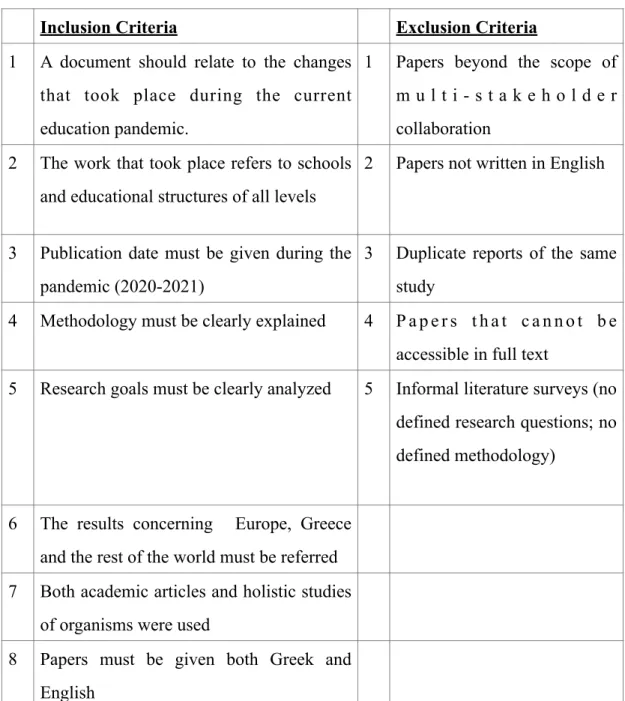
The scientific opinions presented in the previous works emerged while applying the Design Science Research (DSR) methodology to address the stated need in education: The rapid growth of distance education with the development of the Internet and special applications. Aligning with the principles underlying DSR (Vaishnavi V and Kuechler W, 2015) (van Aken J and Romme G, 2009), the authors undertook a detailed exploration and refinement of the aforementioned research objectives. 6 The results for Europe, Greece and the rest of the world should be reported. 7 Both academic articles and comprehensive studies.
Literature Review
- Education Models
- New Technologies
- Interaction of distance learning and the teaching process
Distance learning is by definition an innovative process because it differs from conventional teaching methods. However, distance education differs significantly when compared to traditional education systems due to the physical distance that separates the teacher from the learner (Polidoros G, 2013). Specifically, compared to traditional education, distance education requires more organization, preparation, and collaboration among all the stakeholders involved in its implementation.
Education in the Modern Period 1. Covid -19 and schools
- The impact of Covid-19 on education
- The reality of lockdown for teachers in schools
- Formal Education Systems
- Distance Learning
- Forms of Distance Education
- A new educational environment
- How distance learning is implemented
- The new teaching model
- Greek educational system and skills in the 21st century
Equally important, covering lost learning time after the end of the pandemic supports the national program. An important factor in the success of the educational process is the appropriate training of teachers for improvement. Within the framework of the new learning system, personal teaching remains essential and irreplaceable, as each teacher and class (group of students) is unique.
The dynamic of the learning group is different each time the lesson is taught, even if it is taught to the same students (Sofos A et al, 2015). In general, he is an advocate of the theory of empathy and fostering personal relationships during the distance learning process. To proceed, an attempt is made to summarize the main characteristics of a distance learning course material, as the objectives should be clearly established, while the students should be well informed about the aims of the learning material.
Therefore, new methods should be incorporated into the context of teaching methodology, such as distance learning. This last parameter highlights the purely exam-driven nature of the country's education system, as well as the overall dominant view, which should be changed (Glezou K, 2020). Therefore, from the beginning of the process, it was believed that it was an imperative need for teachers to jointly establish a new pedagogical and educational contract with male and female students, as well as a new cooperation agreement between teachers themselves, in the context of relevant online further training activities, in accordance with the terms of those agreements.
In the context of the Greek education system, programs and initiatives in terms of providing additional distance learning in primary and secondary education and continuing teacher training have started very slowly. A key factor that determines the quality of the pedagogical process is the opportunity for feedback and self-evaluation provided to students. Distance learning should always be aimed at ensuring that students have access to the learning process and are not excluded from it, as well as ensuring the continuous improvement of the quality of the learning process (Papalamprakopoulos P, 2020).
New Technologies in Education 1. Education and innovation
- Teaching and learning in distance education
- The teacher's role in distance learning
- Digital revolution and distance learning: Problems and challenges
- Resources for incorporating innovation into distance learning
- Approaches to incorporating innovation into distance learning
- Technology: its role and challenges
The field of distance learning is mostly characterized by dramatic changes in teaching and communication issues. However, distance education differs significantly when compared to traditional education systems due to the physical distance that separates the teacher from the learner and the fact that the learning process depends more on the learner. Another key characteristic of distance learning teaching is that the orientation of the didactics changes, as there is a shift from the responsibility of the teacher to the value of the teaching material, regardless of its form.
As a result, it can be concluded that, when it comes to success in distance education - both for the learner and the teacher - interaction is key. Consequently, there is a shift from the traditional and now outdated teacher-centered model to the student-centered model of distance education (Tsitslakidou E, Manousou E, 2013). The teacher's communication with each learner, to provide help, guidance, support and encouragement, are essential parameters for the implementation of effective distance education programs.
Due to a lack of personal communication with the teacher, distance learning students need more support. What is attempted through the communication between the teacher and the student is to promote personal contact, which is difficult to achieve in distance learning (Papalamprakopoulos P, 2020). The teacher's role in distance learning is also to serve as a mentor. In other words, a distance learning teacher takes on the core task of supporting the participants in education.
The role of the teacher in the distance learning program is not so much teaching, as this is achieved through the teaching material, but providing mentoring. The role of the teacher in distance learning is multifaceted, as can be seen from the literature review above. Another dimension of distance learning is the distinction between core technologies and peripheral learning activities.
Conclusions
Distance learning overcomes space and time limitations because the teacher can talk to the group coordinator at an academic level and students can ask questions and get answers to those questions, even on holidays or weekends. The second research question concerned the reform of educational processes and especially the adoption of the new framework by people associated with it. The main conclusions drawn referred to the opportunity offered by digital tools for the implementation of more effective and interesting education for students/pupils with disabilities and/or special learning needs, ensuring greater motivation and autonomy in learning, even in emergency situations . , such as the period of the coronavirus pandemic.
Several limitations are recognized that apply to students with severe disabilities and that hinder the use of digital tools in distance learning. Such a system can provide learning cycles of different stages, which can lead to the awarding of qualifications at different levels, making students' informal learning formal. The new circumstances are difficult for teachers and schools as well as for the families of the students, who have to adapt to the new circumstances.
Thus, the gap and inequality in education may be related both to unequal access to resources and to the ability of parents to support students in the new educational conditions. The change in learning conditions due to the coronavirus has therefore led to even greater demands on the part of parents. The demands at an academic level and to support distance learning have increased.
It provides the greatest sense of ownership and increases student and family involvement in the educational process.
Bibliography
Collaborating with ICT in primary school and socialization of students with learning difficulties. How new internet technologies will shape open and distance education in the near future. Athens: Hellenic Network of Open and Distance Education (EDEA) and Regional Center for Educational Planning of Western Greece.
We must avoid swinging the curve in education about possible learning loss scenarios during school closures. The importance of learning theories in the context of information and communication technologies in education. Open and distance learning: Information and communication technology tools for effective learning.
DAPHNE: Educational software that promotes the development of metacognitive strategies and written production skills. Thessaloniki: Proceedings of the 5th Panhellenic Conference with the InternaFonal ParFcipaFon "CommunicaFon and InformaFon Technologies in EducaFon". Production of interactive educational material using the distance education method.
Athens: Hellenic Network of Open and Distance EducaFon - Minutes of that TV conference "Distance educaFon and school reality".