CHAPTER 1: EMERGING CONTAMINANTS
Description and Definitions of Emerging Contaminants
A pollutant can also "emerge" due to the discovery of a new source or technology, a new route for humans, or a new detection method [36]. The term "emergence" is also used to describe not the pollutant itself, but a new one.
Environmental issues of emerging contaminants
- Determination at trace level
- Issues on sources and occurrence
- Issues on fate and transport
- Issues on ecotoxicology
Fawell and Ong even suggested that a better description of these compounds would be 'contaminants of emerging concern' [23]. Therefore, the study of the occurrence and fate of emerging contaminants in wastewater treatment plants (WWTP) is important [20].
Groups of Emerging contaminants
- Pharmaceuticals and personal care products (PPCPs)
- Illicit drugs
- Perfluorinated Compounds
- Artificial Sweeteners
- Brominated Flame Retardants
- Nanomaterials
- Benzotriazoles, benzothiazoles and benzosulfonamides
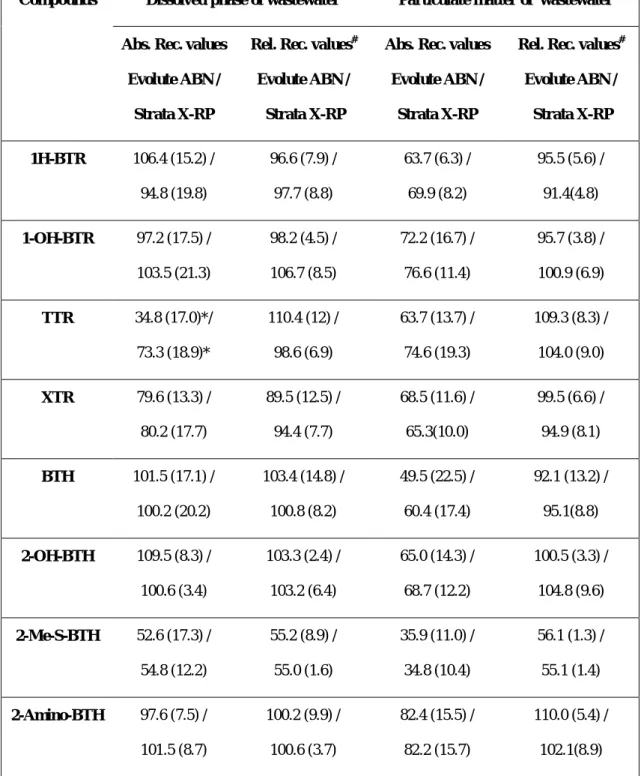
The separation chromatograms of the compounds (four benzotriazoles and four benzothiazoles) are shown in Fig. 7.1. Extraction of target compounds (BTRs and BTHs) from solid samples (wastewater particles and sewage sludge) was performed by ultrasound.
CHAPTER 2: ANALYSIS OF EMERGING CONTAMINANTS IN THE AQUATIC
Sampling Strategies
The main objective in any sampling strategy is to obtain a representative portion of the sample. In deeper water such as lakes and reservoirs, samples are often taken using delivery handlers or thief samplers.
Sample Preparation
- Liquid-Liquid Extraction
- Solid Phase Extraction
- Other Extraction techniques
A review of the organic group interactions that can be used to identify the desired functional group(s) in a solvent for any given solute and screen potentially suitable solvents was performed by Robbins [163]. An excellent review on the use of SPE was written by Liska and co-workers [168].
Detection techniques
Based on product ion spectra, structure elucidation of unknown compounds as well as identification of target compounds can be obtained with a much higher degree of certainty [132,175]. Using liquid chromatography combined with mass spectrometry, a large number of reliable analytical methods have been developed for the determination of emerging pollutants and studies of their occurrence in the environment.
High Performance Liquid Chromatography
- Separation Mechanisms in Liquid Chromatography
- Normal Phase HPLC
- Reversed Phase HPLC
- Tandem Mass Spectrometry
- MS/MS Techniques
- Precursor- Ion Scan
- Product-Ion Scan
- Selected Reaction Monitoring
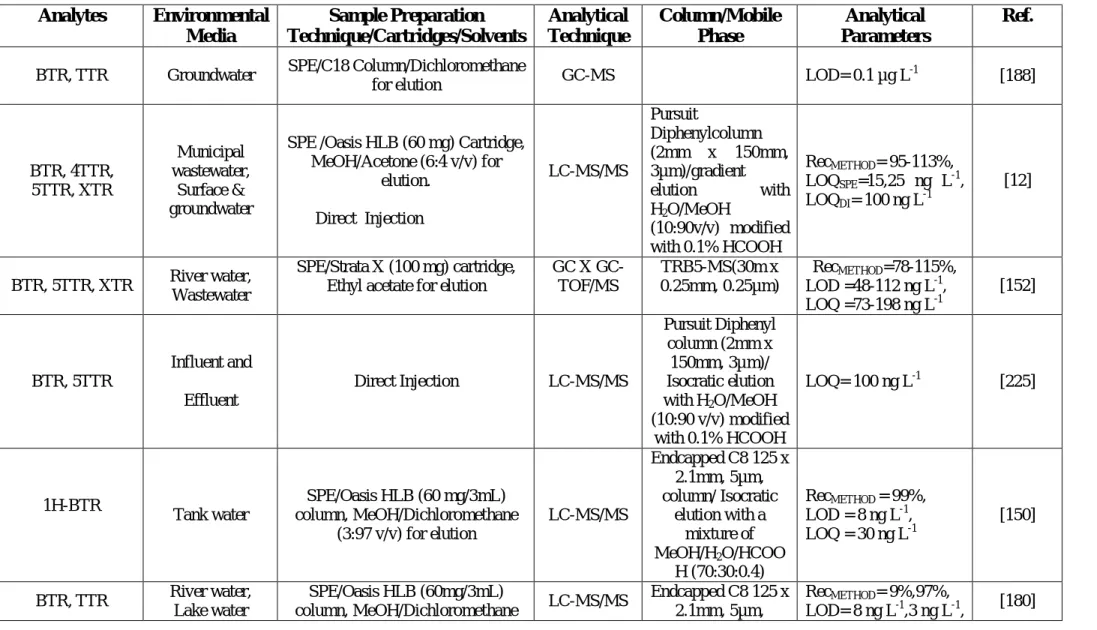
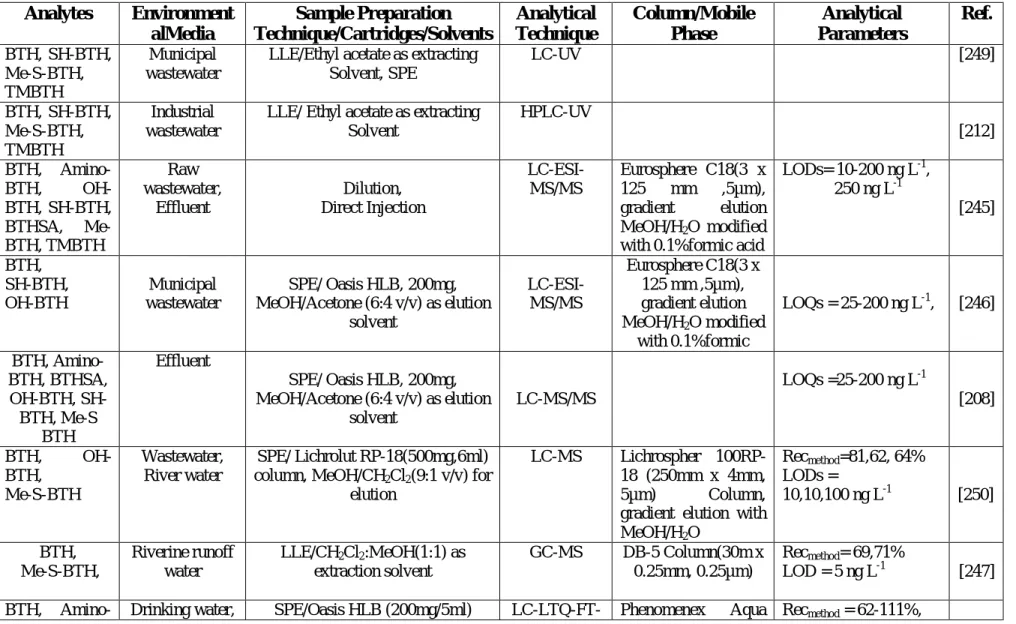
The overview of analytical methods developed for the determination of benzothiazoles in the environment is presented in table 4.3. The Atlantis T3 column was finally selected for the determination of compounds in the wastewater and sludge samples.
CHAPTER 3:BENZOTRIAZOLES, BENZOTHIAZOLES AND
Benzotriazoles: Structures, Properties, uses and toxicity
- Structures of benzotriazoles
- Properties of benzotriazoles
- Uses of Benzotriazoles
- Toxicity of benzotriazoles
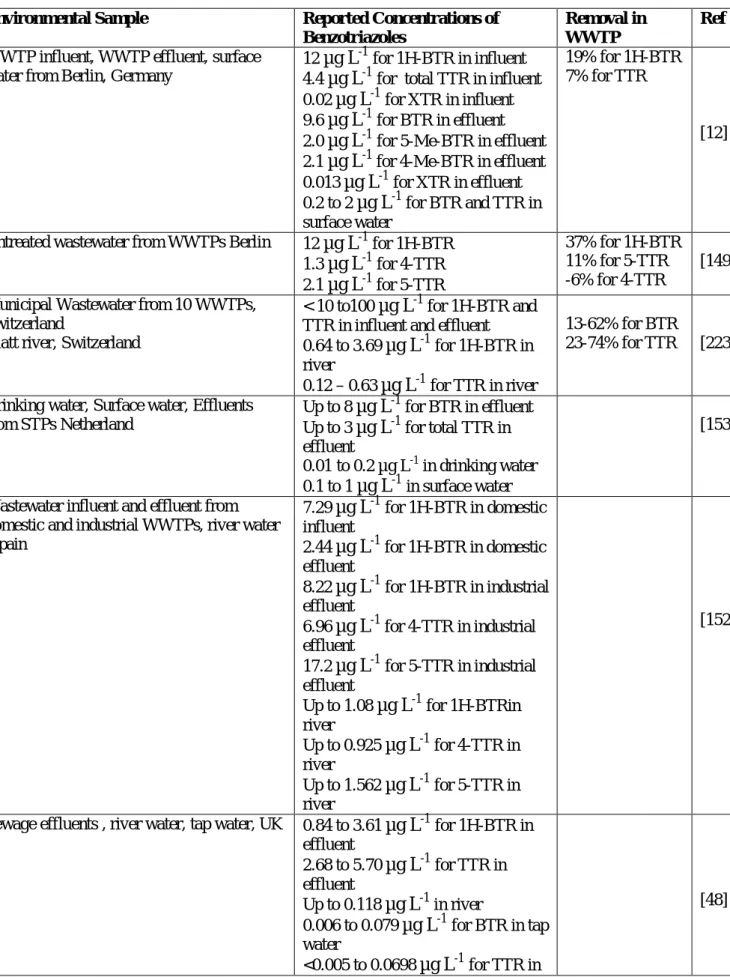
An overview of the occurrence of benzothiazoles in the aquatic environment is presented in table 4.4. An overview of the available analytical methods for determining benzosulfonamides in the aquatic environment is shown in table 4.5.
Benzothiazoles: Structures, Properties, uses and toxicity
- Structures of benzothiazoles
- Properties of benzothiazoles
- Uses of Benzothiazoles
- Toxicity of benzothiazoles
Benzosulfonamides: Structures, Properties, uses and toxicity
- Structures of benzosulfonamides
- Properties of benzosulfonamides
- Uses of Benzosulfonamides
- Toxicity of benzosulfonamides
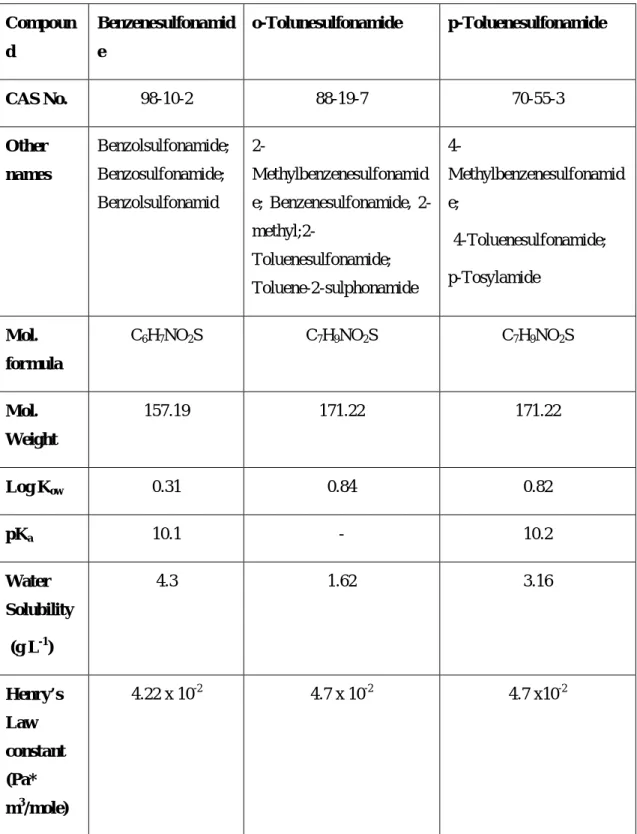
The scope of the research work includes: (a) sampling and pretreatment of sewage and sewage sludge samples from the treatment plant, (b) optimization of solid-phase extraction procedures for the extraction and preconcentration of benzotriazoles, benzothiazoles and benzosulfonamides in terms of sorbents, elution solvents and amount of elution solvent (c) extraction from biosolids (sludge and particle phase) by liquid-solid extraction assisted by sonication followed by purification and preconcentration by SPE, (d) development of a preliminary liquid chromatography-UV method for the determination of benzotriazoles, benzothiazoles and benzosulfonamides in environmental aquatic matrices, e) development and validation of new analytical methods by liquid chromatography-tandem mass spectrometry for the simultaneous determination of eight compounds: four benzotriazoles [1H-benzotriazole (1H-BTRazol), 5-methylbenzotriazole (5-Me-BTR), 1-hydroxybenzotriazole (1-OH-BTR ), 5,6-dimethylbenzotriazole (XTR)] and four benzothiazoles [benzothiazole (BTH), 2-hydroxybenzothiazole (2-OH-BTH) ), 2-aminobenzothiazole (2-Amino-BTH) and 2-methylthiobenzothiazole (2-Me -S-BTH)] in wastewater and sewage sludge, (f) development and validation of a sensitive analytical method for the determination of three benzosulfonamides [ Benzenesulfonamide (BSA), o-Toluenesulfonamide (o-TSA) and p-. The degradation curves for the tube lens optimization for the compounds in the SRM method are given in Figures 8.4-8.6.
CHAPTER 4: REVIEWS OF ANALYTICAL METHODOLOGIES FOR THE
Introduction
Today, the biggest challenge is the analysis of highly polar compounds in trace concentration levels in the aqueous environmental samples. Due to widespread occurrence of benzotriazoles, benzothiazoles and benzosulfonamides in the aquatic environment, they have been considered as new pollutants.
Analytical methodologies for the determination of benzotriazoles in the aquatic
- Extraction of Benzotriazoles from Aqueous Samples
- Extraction of Benzotriazoles from Solid Samples
- Instrumental methods of analysis for benzotriazoles
A sample pH of 2 was finally selected for the subsequent extraction of the analytes from the river water. The extraction yield suffered a significant reduction with increasing sample complexity. However, incomplete extraction of benzotriazole as N-acetylbenzotriazole was taken into account for the calculation.
Occurrence of benzotriazoles in the aquatic
The concentrations of the benzotriazoles in the effluent samples from the Bolivar Wastewater Treatment Plant, South Australia ranged from 77.2 to 2206 ng L-1 [228]. Concentrations of benzotriazole and tolyltriazole in surface water, affected by waste water from sewage treatment plants in Berlin, were found to be in the range of 0.2-2 µg L-1 [12] and the concentrations of benzotriazole, 4-tolyltriazole and 5-tolyltriazole in a river water (Spain) were found to be 1080 ng L-1, 925 ng L-1 and 1561 ng L-1, respectively [152]. The total concentrations of benzotriazoles varied from 1.7 ng L-1 to 40 ng L-1 in the North Sea in coastal areas.
Removal efficiency and fate of benzotriazoles in wastewater treatment plants
Of the two tolyltriazole isomers, 5-tolyltriazole was more amenable to biodegradation [149] and was removed by 11% in the conventional activated sludge (CAS) system and by 61% in the MBR. In the cases of benzotriazole and 5-tolyltriazole, the quality of the MBR effluent was significantly better than the CAS effluent. It was concluded that biological degradation played an important role in the removal of benzotriazoles.
Analytical methodologies for the determination of benzothiazoles in the aquatic
- Sample preparation and Extraction Procedures of benzothiazoles from aqueous
- Instrumental methods of analysis for benzothiazoles
Céspedes et al also used SPE for the extraction of benzothiazoles from surface water, influent and effluent samples [250]. Bayona and co-workers also demonstrated the effectiveness of polymeric absorbents in SPE for the extraction of benzothiazoles as described in section 4.2.1 for the extraction of benzotriazoles. Pena and co-researchers also demonstrated the simplicity and efficiency of dispersive liquid-liquid microextraction for the simultaneous extraction of benzothiazoles and.
Occurrence of benzothiazoles in the aquatic environment
OCCURRENCE OF BENZOTHIAZOLES IN THE AQUATIC ENVIRONMENT Due to their wide use, persistence and toxicity, benzothiazole derivatives have The occurrence of benzothiazoles in tannery wastewater and their behavior during biological treatment was studied by Reemtsma et al. Concentrations of total benzothiazoles in municipal wastewater treatment plant effluents ranged from 1.9 µg L-1 to 6.7 µg L-1 on average, reported by Kloepfer et al.

Removal efficiency and fate of benzothiazoles in wastewater treatment plants
Analytical methodologies for the determination of benzosulfonamides in the aquatic
- Sample preparation and Extraction Procedures for benzosulfonamides from aqueous
- Instrumental methods of analysis for benzosulfonamides
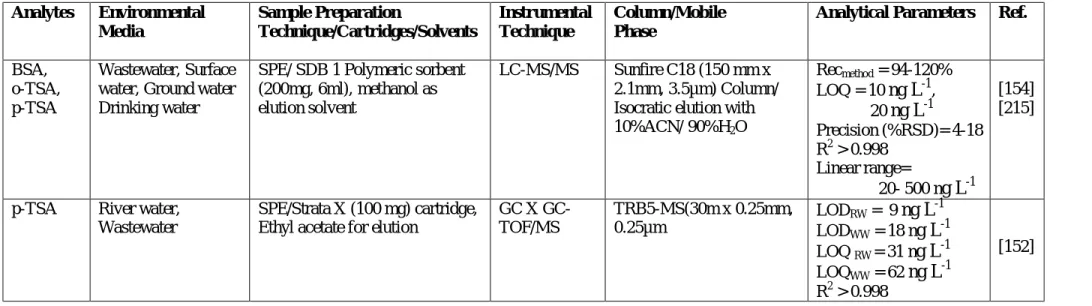
At the optimal SPE conditions used for simultaneous extraction of the three classes of compounds, the recoveries for benzosulfonamides were 92% and 71% in river water and wastewater, respectively. Limits of quantification in surface water and in influent and waste water samples of the treatment plants could not be determined for all substances due to their ubiquitous occurrence in these matrices. The LODs for the analytical method in river water and wastewater were 9 ng L-1 and 18 ng L-1, respectively, while the LOQs in river water and wastewater were 31 and 62 ng L-1, respectively.
Occurrence of benzosulfonamides in the aquatic environment
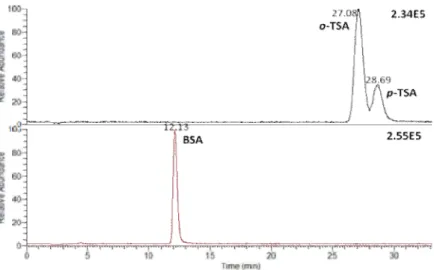
Standard solutions at different concentrations ranging from 50 µg L-1 to 5 mg/L of compounds were used for optimization. Collision energy and tube lens were optimized for each of the compounds (BSA, o-TSA and p-TSA). In Figure 8.2-8.4.

Removal efficiency and fate of benzosulfonamides in wastewater treatment plants….118
CHAPTER 5: SCOPE AND OBJECTIVES
Problems Statement
Benzotriazoles, benzothiazoles and benzosulfonamides are three classes of organic compounds that have been considered as emerging pollutants in the aquatic environment. Moreover, most studies of these compounds in the aquatic environment focused on the determination of only a few homologous members of each class of the compounds either independently or in parallel with determination together with other organic micropollutants. It is therefore desirable to include several members of each class of compounds in a simultaneous determination of both classes of compounds in the aquatic environment.
Research Objectives and Scope
To achieve this, appropriate amounts of target compounds were added to wastewater (50 mL) and sludge (approximately 100 mg) samples. Data on the accuracy of the method at three different levels of solidification for two matrices (wastewater and sludge) are presented in Table 7.11. For optimization, standard solutions were used in different concentrations from 100 µg L-1 to 50 mg L-1 of the compounds.
CHAPTER 6: INSTRUMENTATION AND MATERIALS
Instrumentation
The system was controlled and data analyzed on a computer equipped with LC solution software (Chemstation). The LC-MS/MS system is equipped with UHPLC Accela pump containing a column thermostat, a degasser and autosampler (San Jose, USA). The tandem mass spectrometer system was a Thermo TSQ Quantum Access triple quadrupole mass analyzer, the instrument is connected to an electronic computer with Xcalibur software for data processing.
Laboratory Apparatus and materials
Chemical Reagents
Analytical Standards
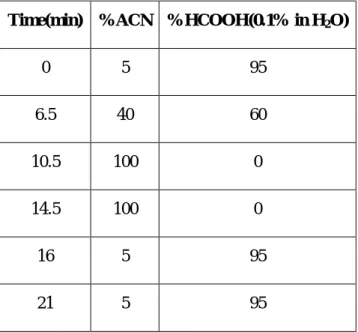
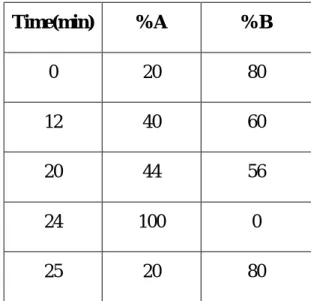
We tested several columns of different stationary phases for their efficiency in separating compounds. The composition of the mobile phase was optimized for the separation of compounds taking into account the effects on their ionization in mass spectrometry. Liquid chromatography with tandem mass spectrometry (Thermo Electron TSQ Quantum Access, equipped with ESI and APCI sources and a Thermo Accela U-HPLC pump and autosampler) was used in all experiments for mass spectrometric determination of compounds.
Application to environmental samples
- Sampling and Handling of Environmental Samples
- Extraction and Preconcentration from wastewater (dissolved phase) samples
- Extraction and Preconcentration from Sludge (and particulate matter) samples
- LC-MS/MS measurements of Benzotriazoles and Benzothiazoles
The spiked matrix and QC samples were spiked with the same constant amount of IS and the corresponding amount of target compounds. Methanolic solution of IS and target compounds were added to the dried sludge samples (null matrix, analyzed and spiked matrix or QC samples) as needed and left overnight or in a fume hood for 1 hour to remove the organic solvent. The probe was attached to the 0.5 inch micrometer position (for Y-distance) and to the probe position between positions B and C (for V-distance).
Results and discussions
- Optimization of SPE Protocol
- Extraction from sludge matrix
- Selection of Analytical Column
- Analytical Method Performance
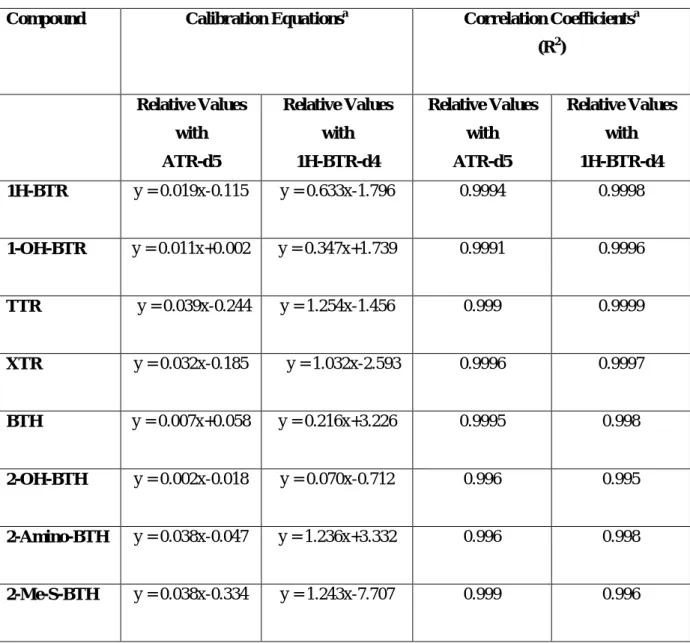
- Linearity
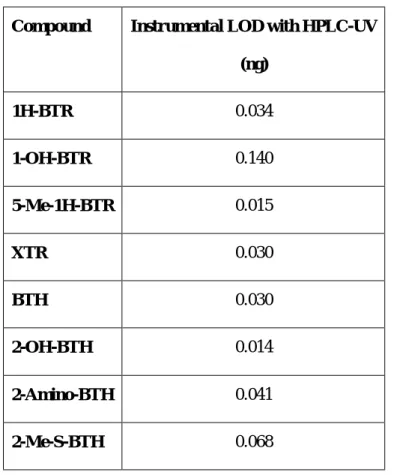
- Limits of detection (LODs) and Limits of quantification (LOQs)
- Method Recovery
- Method Precision
- Choice of Internal standard for quantification
- Matrix Effects
- Identification and Confirmation of target compounds
- Environmental levels
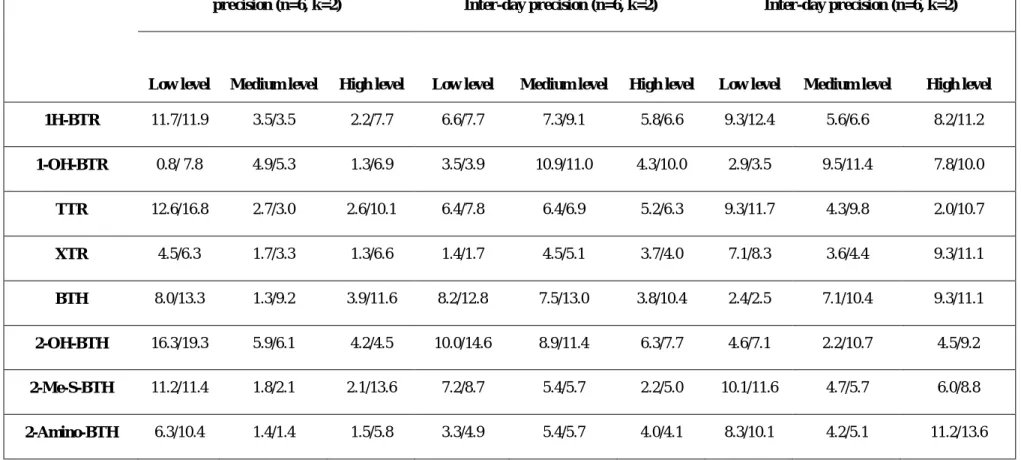
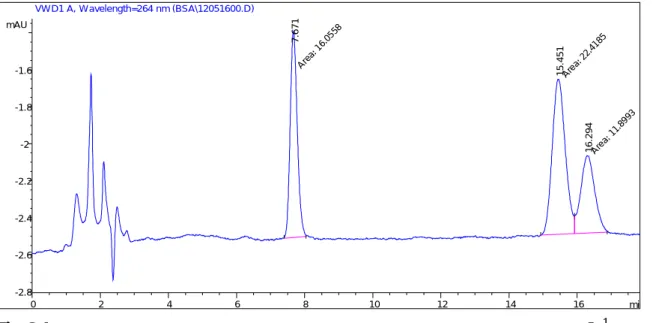
The relative recoveries of the compounds were similar to those obtained by van Leerdam et al. The LC-UV chromatograms of the compounds in spiked tap water samples before and after extraction are presented in Figures 8.2 and 8.3. According to the results, three of the compounds showed high removal (> 70%), three partially removed (30 -70%) while one was slightly removed.
CHAPTER 8: DETERMINATION OF BENZOSULFONAMIDES IN WASTEWATER
HPLC-UV Method development for benzosulfonamides
- Preparation of Standard Solutions of Benzosulfonamides
- Optimization of UV absorbance wavelength for Benzosulfonamides
- Optimization of Chromatographic Parameters
Some initial experiments were carried out to determine the optimal absorption wavelength for each of the compounds (BSA, o-TSA and p-TSA) by UV/Visible spectrophotometer. The performance parameters of the chromatographic separation with the Symmetri column were investigated using different mobile phase composition percentages (acetonitrile and water) and at different column oven temperature values. Motivated by this observation, we continued to test higher values of column oven temperature, but the results were worse than at 30°C, indicating the optimal oven temperature for the performance of the column (Symmetri C18) in the separation of the compounds.
Development and optimization of SPE protocol for extraction and preconcentration of
- Sample Pretreatment for wastewater
- Extraction and Preconcentration from wastewater (dissolved phase) by SPE
- Chromatographic Separation of Benzosulfonamides in wastewater (dissolved phase)
- Selection of Mobile Phase and Modifier
- Optimization of ESI/MS/MS Parameters for Benzosulfonamides
- Selected Reaction Monitoring Method
- Pseudo-Selected Reaction Monitoring Method
We successfully applied the developed Pseudo-SRM method for the determination of three benzosulfonamides in wastewater (dissolved phase). The linearity of the method for the compounds was determined as described in section 8.4.1 within a concentration range of 5 µg L-1 and 250 µg L-1. The removal efficiency of the constituents during wastewater treatment and their fate at STP were investigated using Equations 9.1 and 9.2, respectively.

Method validation for the determination for the determination of benzosulfonamides in
Application to Environmental samples
- Sampling and Handling of Environmental Samples
- Extraction and Preconcentration from wastewater (dissolved phase) samples
- LC-MS/MS measurements of Benzosulfonamides
Wastewater samples (treated and untreated) were collected from the Psittalia Wastewater Treatment Plant, Athens, Greece. Isolation of compounds from spiked wastewater samples was performed using Polyclean polymeric cartridges (200 mg/6mL, 30 µm) placed in the vacuum apparatus. Milli-Q grade water as mobile binary phase mixture at a flow rate of 400 μL min-1. ESI was applied at a potential of -3.2 kV.
Results and Discussion
- Extraction from wastewater
- Analytical Method Performance
- Linearity
- Limits of detection (LODs) and Limits of quantification (LOQs)
- Method Recovery
- Method Precision
- Matrix Effects
The LOD and LOQ of the method in wastewater were determined as described in Section 8.4.2 and the values given in Table 8.11. Considering the ubiquitous presence of these compounds (BSA) in wastewater samples, the LOD and LOQ values obtained in this study are low enough to adequately and accurately quantify the compounds in the matrix. The validity of the method was evaluated through recovery experiments at three fortification levels of the target compounds.

Environmental Levels of benzosulfonamides
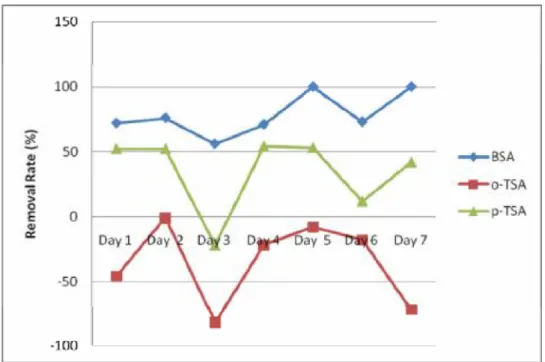
Investigation of the distribution of the compounds between the dissolved phase and the particulate phase of influent wastewater showed that the majority of BTRs and BTHs were in the dissolved phase (Fig 9.2). However, the existing knowledge about the biotransformation pathways of the compounds is limited, requiring more studies in the future. The trends of compound removal rates during wastewater treatment over the week of sampling are shown in Fig.
CHAPTER 9: OCCURRENCE AND FATE OF BENZOTRIAZOLES,
Occurrence and fate of benzotriazoles and benzothiazoles in Athens STP
- Sampling and Analysis of benzotriazoles and benzothiazoles
- Calculations of removal efficiency, distribution coefficients and mass balances…
- Occurrence of benzotriazoles and benzothiazoles in wastewater
- Occurrence of benzotriazoles and benzothiazoles in sewage sludge
- Removal of benzotriazoles and benzothiazoles during wastewater treatment
- Fate of BTRs and BTHs during primary and secondary wastewater treatment
Mass balances were applied to investigate the role of sorption and biotransformation on the removal of the compounds and to quantify the contribution of primary and secondary sedimentation to their elimination. For the calculation of (Kd values), samples of primary sludge and secondary sludge were taken during the second sampling campaign for 5 consecutive days and concentrations of the target substances in the dissolved phase and in the particulate phase were analysed. Due to the fact that none of the compounds are very volatile and photodegradation seems unlikely.

Occurrence and Removal of benzosulfonamides in wastewater from Athens STP
This same phenomenon of o-TSA formation during treatment processes was also observed by Richter et al [154,215] and suggested that a site-specific process could be responsible for o-TSA formation during wastewater treatment. In their study, Richter and colleagues assumed that BSA is a metabolite of a sulfonamide because it was formed during wastewater treatment and suggested that its formation was due to biodegradation or bioconversion of a higher molecular weight sulfonamide. In addition, more studies need to be conducted to investigate the fate of these compounds (BSAs) during wastewater treatment.
CHAPTER 10: CONCLUSIONS
ABBREVIATIONS AND ACRONYMS
APPENDIX 1