Ελεύθερνα, Τεύχος 7, 2015 27
Infant Common Sense:
Natural Science of Human Concerns and Cultural Knowledge
Colwyn Trevarthen
“Human sense is understanding how to live in the human and physical worlds that children normally develop in the first few years of life. It is learned spontaneously in direct encounters with these worlds that arise unavoidably everywhere, transcending cultural differences. The learning is always informed and guided by emotion - that is, by feelings of significance, of value, of what matters. And it is highly stable and enduring, once established. It is the foundation on which all that follows must build.”
(Margaret Donaldson, personal communication. See Donaldson, Children’s Minds, 1978).
“The devising of novel purposes comes readily to us because we have brains that are good at thinking of possible future states - at considering not merely what is but what might be. We exist in a world of 'hard fact', but we can imagine it as changed; and from a very early age we know that, within certain limits, we are able to change it. It matters very much to us to find out how these limits are set, an activity closely related to the general purpose of understanding what the world is like. In this context 'the world' includes other people as a most important component. And, if we have any wisdom, it also includes ourselves.”
(Donaldson, Human Minds: An Exploration, 1992, p. 9).
Abstract
A newborn knows no truths or conventional facts -- there is much to learn. But the baby has ‘self- awareness’ of a sensitive and inquisitive body, and is ready to share human interests, goals and feelings. Moving coherently and rhythmically, he or she knows intentions of ‘subjectivity’ in relation to outside events, and ‘other awareness’, or ‘intersubjectivity’, with the sympathetically-timed movements and interests of other persons.
Primary motives are formed before birth. They grow by sharing adventures of life with familiar companions who become friends, making discoveries in playful experiments. Human cultural learning grows from this inborn state of mind and becomes a creative developmental project with age-related changes. It is supported by ‘affective appraisals’, or feelings of value and importance, both aesthetic and moral. Life in the moment with others reaches out to make a story of important events to be imagined and remembered for other times. This is how the physical and social world make common sense, a collective consciousness of meaning.
I review descriptive research of communication before speech, when a child’s thinking is shared without conventional symbols that label non-present persons, objects, facts and actions, or that define their causes or reasons. Human communication begins as acting ‘in tune’ with thoughts of affectionate company.
Keywords: infant self-awareness, Ιnnate Ιntersubjectivity, parental affections and support, attachment and companionship, play and communicative musicality, age-related changes, cultural learning, teaching and therapy.
Ελεύθερνα, Τεύχος 7, 2015 29
Innate subjectivity and Intersubjectivity: The rhythmic awareness of self, and of dialogue before speech
Discoveries of the early development of ‘human common sense’ have been made by recording and analysing what infants and their parents do together when they are free to act as they wish (Trevarthen, 1977, 1979a, b; Reddy, Hay, Murray and Trevarthen, 1997; Stern, 2000, 2010; Reddy, 2008). This research has benefitted in the past 50 years from recordings of film and television, which can be replayed for micro-analysis of expressive and receptive movements. It has been made clear that learning of symbolic communication and language grows from innate motives for rhythmic moving of the exceptionally complex human body in coordinated performances, and from a special sensitivity for responses in affectionate relations with human companions (Trevarthen, 2012a, b; Trevarthen, Gratier and Osborne, 2014). These human talents constitute the only natural ‘language acquisition device’.
Newborn infants show signs of taking pleasure from imitating and provoking another’s actions, and soon they are learning from discoveries made and shared in creative playful ways (Kugiumutzakis et al., 2005; Kugiumutzakis and Trevarthen, 2015). This descriptive natural history of early childhood has exposed a blind spot in rational discussions of the nature of the human mind and the source of its consciousness. It shows that thinking about possible experiences begins, not with language, but with initiatives of the body in movement, and that these are guided by feelings for what might happen that are communicated by eyes, hands, face and voice. We are born to make rhythmic projects of intended moving into stories of imagination and recollection, and these inventions always seek gratification from others’
approval by the performances inspired by what Jon-Roar Bjørkvold names as The Muse Within (1992). The emotional human animal is naturally musical (Panksepp and Trevarthen, 2009; Trevarthen, 2016, in press).
And yet, as Vasudevi Reddy eloquently demonstrates in How Infants Know Minds (Reddy, 2008), it has been difficult for sophisticated arguments of philosophers or the factual explanations of expert practitioners in medical or psychological science to comprehend that a newborn infant has any sociable consciousness or “human sense”, even in rudimentary form.
A baby may be attributed spiritual power as a symbol of innocence and purity, but lacking language has, the experts have believed, no intelligence to know or think with us.
Modern medical science of infancy, inspired by Freud’s theory of unconscious emotional factors of mental illness and their fragility in early development, found evidence from the effects of early loss of maternal care and poor institutional attention that the infant cannot be treated just as an organism with a needful body. The infant depends on intimate and consistent emotional attachment with a mother or equally devoted care person (Spitz, on
‘hospitalism’ in the first volume of Psychoanalytic Study of the Child, 1947; Bowlby, Maternal Care and Mental Health, 1951). Attachment theory recognizes an innate need for sensitive, loving personal care for nourishment, protection and support of vitality. But the theory does not address the infant’s readiness and need from birth for the fun of imaginative play with a parent companion (Reddy et al., 1997; Trevarthen, 2005, 2016, in press). It does not attend to the friendship that a baby learns to enjoy with persons of any age who want to be playmates (Figure 1).
In contrast to philosophical reservations about infant intelligence, and reductive scientific accounts (Bradley, 1989), anthropologists find that, in every culture, from the most
‘primitive’ in terms of technology and material culture to the most ‘advanced’, parents and grandparents delight in responding to the vitality and imaginative discoveries of young children. We all love how infants and toddlers excite affectionate company and enjoy adventurous play. They test their individual experience of being alive and curious, as Piaget
Ελεύθερνα, Τεύχος 7, 2015 31
meticulously described in Play, Dreams and Imitation in Childhood (1962), and they demonstrate and imitate these actions and understandings to share them in convivial games that build friendships. They display an emotional and intersubjective intelligence which Piaget underestimated (Kugiumutzakis and Trevarthen, 2015).
Figure 1:
Top: Ava, 57 minutes after her birth on July 10, 2013. With her intense expression of engagement, she challenges abstract concepts of our mental life and its sharing. Does this photograph of an interested young human being demonstrate how we ‘mentalize’ or have a
‘theory of mind’? How does her thinking ‘Self’ differ from that of Descartes, Kant or Husserl.
How does her sympathy of expression directed to an ‘Other’ relate to the theories of Buber, Merleau-Ponty or Reddy? Could she know much our cognitive science cannot understand?
What is it that coordinates her eyes, her lips and the fingers of her hand to express her interest?
Below Left: The same day Ava meets her brother
Below Right: On day four Ava expresses her thoughts eloquently to her attentive grandmother, with intent regard and a right hand gesture.
Adults everywhere share the childish feeling for what Victor Turner in From Ritual To Theatre (1982) calls “the human seriousness of play”, which gives essential pleasure and creativity to cooperative practical work. Turner distinguishes ‘communitas’ the natural feeling of living emotionally and habitually with known other persons, and ‘societas’ the rules and structures of regulated society with its productions, roles and ranks. The pleasure a newborn infant can show in an imitative exchange of expressions (Kugiumutzakis and Trevarthen, 2015), is a bridge to shared understanding for all ages (Nadel, 2014).
Comparisons between surviving hunter-gatherer communities and much larger national societies with different degrees of sedentary, agricultural, urbanised and technologically elaborated ways of life, indicate that the biological roots of every kind of imaginative culture or conventional system of social life are to be found in mother-infant communication, in community support for families, and in children’s play with parents and with other children (Ellen Dissanayake, Art and Intimacy: How the Arts Began, 2000; Barry Hewlett and Michael Lamb, Hunter-Gatherer Childhoods, 2005; Sarah Blaffer Hrdy, Mother Nature, 2009; and Peter Gray, 2012). However, cultures find different ways of “story-telling” about the conventions of “how we do things” (Bruner, 1990). Their customs can favour inclusion of a young person from infancy to adolescence in a rewarding life; or they can lead to exclusion (Frank and Trevarthen, 2012).
Ελεύθερνα, Τεύχος 7, 2015 33
Communication by sharing intrinsic dynamics of movement
“ [...] one of the most ubiquitous and powerful discourse forms in human communication is narrative. Narrative structure is even inherent in the praxis of social interaction before it achieves linguistic expression.” (Bruner, 1990, p. 77).
Infants show that they know from the start how to move in company and make friendships. They are talented in communicating interests and feelings by direct means, without words. Daniel Stern, after criticism from social constructionists of his theory of The Interpersonal World of the Infant makes this response, “There is not an infinite number of variables through which any culture can be enacted early in life such that they will be perceivable by an infant. The repertoire comprises facial expressions, or lack there of; visual regards, or their avoidance; vocalizations, or silences; body orientations; physical distances;
gestures; ways of being held; the rhythms, timing and duration of acts and activities; and so on. No other alphabet for sociocultural contextualization exists.” (Stern, 2000, p. xxvii). The learning of a vocabulary of language grows out of an ability to share mind work with other persons by ‘mirroring’ the motives in their movements -- by dynamic ‘altero-ception’
(Bråten, 2009; Stern, 2010). A conventional vocabulary comes by elaboration of significant descriptions to satisfy what is known with shared curiosity in mutual awareness of vitality (Langer, Philosophy in a New Key, 1942).
I have defined three essential features of this universal alphabet of “intersubjective motor control”, for regulating and communicating intentions ideas and feelings in body movements: kinematics or rhythms; energetics or economy of effort; and physiognomics or anatomical form (Trevarthen, 1986, 2008).
Figure 2:
A: An 8 week human foetus has the special organs of sight, of hearing, oral organs for speaking and hands and feet for gesturing, all of which move to express interests, intentions and feelings to other persons, and which may sense their expressions.
B: Actions and awareness of the Self (S) engage with the Body (B), with physical Objects in the environment (O), and in communication with other persons (P). The emotional systems of Panksepp (2009) are labeled in italics and placed to indicate how they mediate in the regulation between the different engagements of the Self (Panksepp and Trevarthen, 2009).
C: In a proto-conversational dialogue between a mother and her infant each watches the eyes, face, mouth and hands, and listens to the voice, of the other, across a ‘synrhythmic frontier’ of communication, transferring emotions. (Trevarthen et al., 2006; Trevarthen, 2011a).
Ελεύθερνα, Τεύχος 7, 2015 35
The neurobiological foundations of these ‘dramatic’, ‘poetic’ and ‘musical’ dimensions of human vitality felt in the self, and the organs adapted for their expression to others, are laid down in body and brain before birth (Trevarthen and Aitken, 1994, 2003; Trevarthen, 2001, 2009, 2011a; Panksepp and Trevarthen, 2009; Trevarthen and Delafield-Butt, 2013;
Ammaniti and Gallese, 2014). The primal core of their regulation in timing of body actions is sub-cortical (Merker, 2007; Solms and Panksepp, 2012; Trevarthen, 2016). (Figure 2)
To the expressive forms that live ‘in the present moment’ of consciousness we must add another slower level of neurobiological regulation for life dynamics, also sub-cortical in origin -- that of narration, or making serially ordered episodes of felt experience in movement (Lashley, 1951), which are presented for others’ interest (Trevarthen and Delafield-Butt, 2013, 2015; Trevarthen, 2016, in press). This level of inner time sense in the sensuous ‘flow’ of communication (Csikszentmihalyi, 1990) has been made clear from study of the ‘communicative musicality’ of dialogues and entertaining games of song and dance with young infants; the combining of expressive acts in ‘telling’ sequences or presentations formed of ‘introduction’, ‘development’, ‘climax’ and ‘resolution (Malloch, 1999;
Trevarthen, 1999; Malloch and Trevarthen, 2009). (Figure 3)
Figure 3:
Acoustic analysis of the proto-conversation between a 6-week-old girl and her mother shown above. The pitch plot, each dot of which represents a quarter-tone, shows that the narrative of their dialogue has four parts: Introduction, Development, Climax and Resolution. Finally, after the excited climax, the mother is no longer speaking, just making affectionate sounds, which bring this small shared experience to a close.
Utterance numbers appear immediately above the time axis and in the table.
(From Malloch and Trevarthen, 2009; adapted from Malloch 1999).
Ελεύθερνα, Τεύχος 7, 2015 37
How the Descriptive Science of infants’ intentions in time began
Fifty years ago, at the same time as unexpected powers of visual and auditory perception were demonstrated by experimental tests with young infants with methods that allowed their natural curiosity to make active choice of experience of ‘things’ (Papoušek, 1967; Bruner, 1968), studies were undertaken to explore the communicative talents of young infants.
Authors who reported observations of infants’ active contribution to games and dialogues with playful mothers all emphasised the importance of shared interpersonal timing in sensitive exchanges of movement. Mary Catherine Bateson (1979) described the delicate
‘ritual courtesy’ of vocal engagements in ‘proto-conversation’ with a two-month-old; Daniel Stern found games between a mother and three-month old twins were rhythmically patterned with coordination of expressive movements by sight, sound and touch mediating “affective attunement” (Stern, 1971, 1974; Stern et al., 1977); with Martin Richards in Bruner’s laboratory at Harvard, I found evidence in 1967 that two- to four-month-olds conceived objects and persons in different ways, and that they acted adaptively to use them in exploratory actions or in mutually controlled narrative patterns, which were always rhythmic (Trevarthen, 1977, 1979b). The active role of newborn infants in setting up dynamic co- regulation of states of intention-with-awareness immediately after a normal birth were brought out by the sensitive observations of paediatricians Sander (1964, 1977) and Brazelton (1979). Their descriptions lead to advances in care for infants at birth, and for their parents, and they enabled better identification and treatment of neonatal illness. They also added support for the theory of ‘innate intersubjectivity’.
The discoveries of that decade, which transformed scientific understanding of the initial state of human consciousness, and the origins of language, were reported in three books with many contributors: Studies of Mother-Infant Interaction edited by Rudolph Schaffer (1977);
Action, Gesture and Symbol: The Emergence of Language, edited by Andrew Lock (1978);
and Before Speech: The Beginning of Human Communication edited by Margaret Bullowa (1979).
The developing person-in-relations
We now have abundant proof from detailed observation of movements and attentions of newborn infants that a human child comes to the world with an embodied sense of Self as an active and aware agent in touch with the world by several senses, and that we may be immediately conscious of, and attracted to, other persons’ movements. These aspects of humanness had been clearly conceived by the Scottish philosopher John Macmurray in two books, The Self as Agent (1959), and Persons in Relation (1961), though he did not have the evidence from early childhood. They were anticipated also by the European phenomenologists Husserl and Merleau-Ponty. A baby perceives human movements as expressions animated by intentions and feelings that can be imitated and engaged with by
‘mirroring’, responding to the impulses they express (Aitken and Trevarthen, 1997; Reddy et al., 1997; Meltzoff, 2002; Kugiumutzakis, et al., 2005; Reddy, 2008; Bråten, 2009; Ammaniti and Gallese, 2014; Nadel, 2014; Kugiumutzakis and Trevarthen, 2015).
By tracing the development of a child’s active demonstrations of mental life in the first two years, before mastery of the contrived code for the language of a particular community, descriptive research confirms not only an initial state of readiness act with curiosity and to share human consciousness (Trevarthen, 1977; Brazelton, 1979), but a developmental program or strategy of age-related advances in the functions of body and brain (Reddy et al., 1997; Trevarthen and Aitken, 2003) (See Figure 4). These developmental steps, by creative
Ελεύθερνα, Τεύχος 7, 2015 39
transformation of the initial motives, guide both the child and parents toward invention and mastery of a ‘proto-habitus’ of understanding, in which the agreed ‘meanings’ of interesting actions and objects of value become increasingly conventional (Gratier and Apter-Danon, 2009). At the same time, the self-conscious identity of the child, who recognises their name, and the personality they acquire with the recognition of close acquaintances, are elaborated (Reddy, 2008). This evolution of the shared and agreed understanding or ‘being’ of a social
‘Me’ (James, The Principles of Psychology, 1890; Mead, Mind, Self, and Society, 1934) has an innate cause in the initiatives of the human person, who needs to identify other persons as
‘known’, and to intimately relate with them with the immediate intimacy Martin Buber identified as, I and Thou (1958) (Reddy, 2008; Bråten, 2009; Trevarthen and Delafield-Butt, 2013).
Advances in the Brain Science of shared intelligence: Generation of moving with awareness, and with feelings for identified others
Our knowledge of how the human brain works by integrated activity among assemblies of millions of cells is, and always will be, incomplete. But there have been important discoveries in the past 200 years of how the sensory and motor agencies of the living body are mapped in the brain, with especially remarkable advances in the last two decades in methods for tracking and localizing neural activities that correlate with intentions to move and their emotions, and with how these are communicated. Special adaptations in neural circuits for shared imaginative and emotional life and learning of cultural meaning (Trevarthen, 2004) have become increasingly clear (Allan Schore, Affect Regulation and the Origin of the Self, 1994; Dan Siegel, The Developing Mind, 1999).
Medical science exploring parts of the intricate biology of the human body and brain, more complex than the brains of other species, makes advances by new ways of recording integrative neural activity to discover correlations with important mental events. It gathers evidence of intricate structures and processes. But it can lose sight of the essential whole impulsive and emotional Self, who seeks to share moving, knowing and feeling, “in the moment of acting with awareness”. The science of thinking as a cause of behavior may ignore motivating and evaluating principles that ‘matter’ for the intelligent actor doing and knowing. Some brain scientists are applying brain activity imaging techniques to study human ‘mirroring’ of actions and awareness for Self and with Others, seeking understanding of the integrated ‘self-as-agent’ and its time-regulated purposes, and the ways a human person relates with others in action (Goodrich, 2010; Ammaniti and Gallese, 2014).
The brain of an animal is not, as has often been assumed by those who place their trust in education of the ignorant, an organ for learning how to coordinate reflex responses to certain stimuli that are found to either support, or harm, vital functions. Charles Sherrington, the creator of modern neurophysiology with his The Integrative Action of the Nervous System (1906), and the discoverer of the neural mechanism of proprioception that senses the body’s motor actions, found evidence for a natural philosophy of the mind from his studies of the nervous mechanisms for an animal’s awareness of self-made ‘imaginative’ movement. He relates human intelligence, and its rich appreciation of the world in a cultural life with other humans, to the natural creative vitality of all organisms, and especially to the practical and social abilities of self-awareness shown by animals, even those with much smaller brains than we have. His Gifford Lectures of 1937-1938, published as Man on His Nature (1955), present the human being as gifted with unique foresight in appreciation of reality as something our actions and desires expect by using clever hands and eyes, but with the same impulse to
Ελεύθερνα, Τεύχος 7, 2015 41
discover by moving as conscious selves that even humble invertebrates possess. He also claimed we share with all animals the function of emotions as drivers of the evolution and development of intelligence in behavior, as Darwin had discovered, and as the work of neuroscientist Jaak Panksepp richly demonstrates with his studies of homologous chemistries of emotion in different mammals (Panksepp, 2009) (Figure 2).
In the last 50 years a new appreciation of the motor and affective intelligence of a newborn infant confirms the insights of these biologists, and requires a revision of theories that attribute the origin of human self-awareness and intelligence to ‘teaching’ about reality.
Detailed analysis of the movements, affective responses and imitations of an alert baby within hours of birth, and of fetuses months before term, as well as accounts of how development of body and brain proceeds in age-related stages, proves that the individual person begins with brain activities that are adapted to building shared understanding (Trevarthen et al., 1999; Nagy, 2011; Trevarthen and Delafield-Butt, 2013; Ammoniti and Gallese, 2014). We are aware and sociable in human ways from the start, and our initial motives to know more require joyful companionship, not only attachment for mother’s love and care (Reddy et al., 1997; Trevarthen et al., 2006).
Recent research by Robin Dunbar and others has demonstrated a correlation between the size of the cerebral neocortex in different primates in proportion to body size and the ability of each species to sense and respond to a limited number of identified ‘friends’ in a cooperative social group. This finding has led to the ‘social brain hypothesis’ (Dunbar, 2013).
Primates -- monkeys, apes and humans – in addition to being uniquely clever with hands and eyes, are able to be cooperative in progressively larger communities, proving they are more socially intelligent than other species of mammal. They also have proportionally larger brains relative to body size, which are designed for the special cognitive abilities required to
appreciate how to be a valued member of a group of particular individuals with different
‘manners’ and knowledge, and different rank in the group. This is the intersubjective world for which a child is adapted.
First awareness in the self and with others
A newborn is alive as an intelligent and sociable human being, with integrated and measured ways of acting and responding, moving a complex body in coordinated, intentional, ways, seeking guidance from senses with prospective awareness (Nagy, 2011). He or she is using imagination to composing dynamic motor images into controlled projects that reach out through rhythmic patterns of time in a consciousness of Sherrington’s self-monitoring,
‘proprio-ceptive’ and ‘viscero-ceptive’ senses, generating, retaining and reusing forms of creative inner experience of moving. This is how a human individual intelligence begins to experience the uses of the world by ‘extero-ception’, with what Sherrington called ‘distance receptors’, to grasp what is outside and distant from the body, with imaginative subjectivity.
And this actively conscious human being is also an inherently social person, eager to appreciate, by ‘altero-ception’, the intentions of human others as equivalent to those of the self, an actor who imitates, and who can share narratives of experience – making stories with enjoyment of playful experiments in moving-with-feeling with sympathetic and inventive companions (Nagy, 2006; Bråten, 2009).
Primary human intelligence has, at first, no reference to agreed items of a reality, but is quick to notice some events that arise in a shared present moment. The infant is thinking ‘by doing’, and ‘about doing’ ‘now’, without knowing ‘how’ or ‘why’, or with ‘what’, in any articulate, symbolic way that may be conceived as detached from doing in the present
Ελεύθερνα, Τεύχος 7, 2015 43
moment of agency with its intrinsic ‘vitality dynamics’ (Stern, 2010). This is the essential biology of human intelligence, and of its motives for growth and development in a culture.
The first studies of films to accurately trace the process of human movement, made more than 150 years ago by Etienne-Jules Marey, revealed that the motor activity of an animal is organized with great efficiency (Marey, La Machine Animale. Locomotion Terrestre et Aérienne, 1873). Animal actions are directed to anticipate and learn from sensory feedback from within the body and from objects chosen in the environment (Paillard, 1960). We start conscious life with a measured sensory-motor intelligence, which is first active in a foetus, five months before birth, with remarkable coherence and sensibility (Ammaniti and Gallese, 2014).
The innate rhythms of experience imagined in the time of action
The existence of a ‘motor image’ formed in the mind for any action, a brain activity that anticipates and organises bio-mechanical effects of moving, in the body and in engagement with objects, was firmly established in the 1920s by a Russian neurophysiologist, Nikolai Bernstein (Coordination and Regulation of Movements, 1967), who used examination of film to accurately trace the regulation of forces in the moving body of a tool-user, a runner, or a child learning to walk. He analysed how the many motor components of any body action are assembled by the dynamic motor image formed in the brain into a coherent, intended movement, which is highly efficient, wasting almost no energy. Bernstein noted that well- done movements are always rhythmic, smoothing out through planned steps of time the irregular inertial forces they intend to master. This power of the brain to integrate its activities predictively in coherent rhythmic patterns is recognised in the philosophy of phenomenology
(Merleau-Ponty, The Visible and the Invisible, 1962), which accepts that motility and consciousness express the brain-generated ‘subjective’ time of intentional doing and thinking (Goodrich, 2010). We share an inborn sense of time, and this makes shared doing and thinking or shared meaning possible (Mazokopaki and Kugiumutzakis, 2009; Osborne, 2009;
Trevarthen and Delafield-Butt, 2013) (Figures 3 and 5).
Growing awareness of objects of interest, and sharing projects for their use
Figure 4:
Age-related transitions in development of activities, intelligence and communication through the 18 months of infancy. Table 1 provides more information of the changes.
Ελεύθερνα, Τεύχος 7, 2015 45
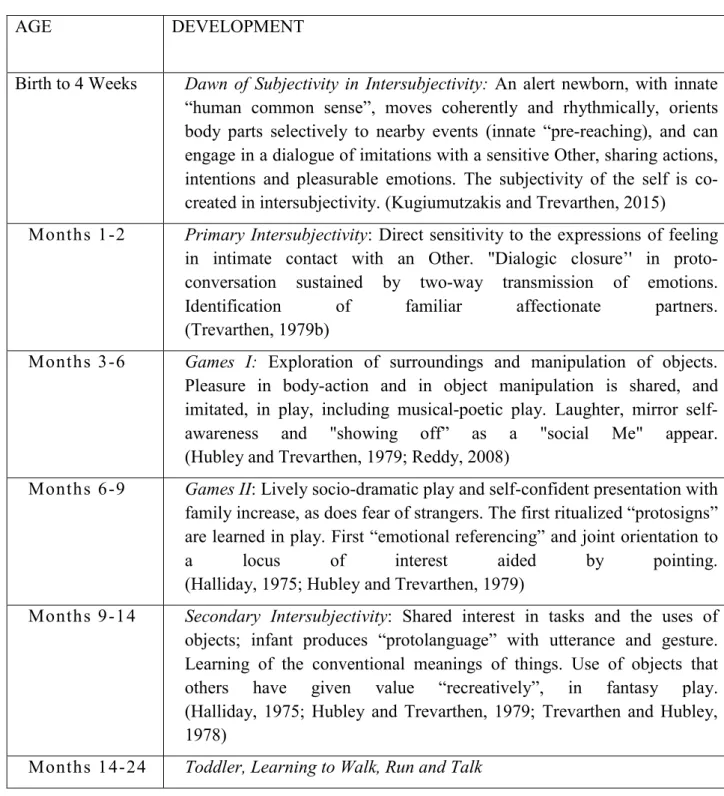
Descriptive research that has traced infant behaviour systematically through the first two years reveals that the infant’s initiatives to engage movements with what the world offers change with age (Aitken and Trevarthen, 1997; Reddy et al., 1997; Trevarthen and Aitken, 2003) (Figure 4, and Tables 1 and 2).
Table 2 - Age-related stages in development of actions-with-awareness, and of communication, in infants and young toddlers.
AGE DEVELOPMENT
Birth to 4 Weeks Dawn of Subjectivity in Intersubjectivity: An alert newborn, with innate
“human common sense”, moves coherently and rhythmically, orients body parts selectively to nearby events (innate “pre-reaching), and can engage in a dialogue of imitations with a sensitive Other, sharing actions, intentions and pleasurable emotions. The subjectivity of the self is co- created in intersubjectivity. (Kugiumutzakis and Trevarthen, 2015)
Months 1-2 Primary Intersubjectivity: Direct sensitivity to the expressions of feeling in intimate contact with an Other. "Dialogic closure’' in proto- conversation sustained by two-way transmission of emotions.
Identification of familiar affectionate partners.
(Trevarthen, 1979b)
Months 3-6 Games I: Exploration of surroundings and manipulation of objects.
Pleasure in body-action and in object manipulation is shared, and imitated, in play, including musical-poetic play. Laughter, mirror self- awareness and "showing off” as a "social Me" appear.
(Hubley and Trevarthen, 1979; Reddy, 2008)
Months 6-9 Games II: Lively socio-dramatic play and self-confident presentation with family increase, as does fear of strangers. The first ritualized “protosigns”
are learned in play. First “emotional referencing” and joint orientation to
a locus of interest aided by pointing.
(Halliday, 1975; Hubley and Trevarthen, 1979)
Months 9-14 Secondary Intersubjectivity: Shared interest in tasks and the uses of objects; infant produces “protolanguage” with utterance and gesture.
Learning of the conventional meanings of things. Use of objects that others have given value “recreatively”, in fantasy play.
(Halliday, 1975; Hubley and Trevarthen, 1979; Trevarthen and Hubley, 1978)
Months 14-24 Toddler, Learning to Walk, Run and Talk
The neonate is alert, can orient selectively to nearby events, and can engage in a dialogue of imitations. By the second month the baby is strongly attracted to conversation
Ελεύθερνα, Τεύχος 7, 2015 47
with a person who offers affectionate attention to his or her expressions of interest with emotions of delight in contact, or distress if the contact is insensitive or unresponsive. This has become known as the period of ‘primary intersubjectivity’.
Figure 5:
The Narrative Form of Baby Songs:
Above: A pitch plot of “Rock a bye baby” showing the classic 4-line stanza, with the melody in the octave above Middle C (C4), and rhyming words on the ends of lines 1 and 2, and 2 and 4.
The lines form the sections Introduction, Development, Climax (C), and Resolution (falling arrow)
Below: Action songs “Clappa clappa handies” and “Round and round the garden” with 6- month-old infants, showing the 4 line stanzas and iambic feet of the poetic.
Interest in what can be done with life in movement changes in months 3 to 6 with increased concentration on objects that are nearby and might be touched by hand, and this leads to a loss of fascination for face-to-face proto-conversation. To regain the infant’s attention a partner must become more playful. In these months games that tease test the pleasure of anticipation, or that use rituals of rhythmic action and musical vocalization, as in baby-songs, to entice the infant’s interest in a narrative of feelings in movement (Trevarthen, 1999, 2008, 2016, in press) (Figure 5). The infant displays a growing sense of fun with self- consciousness of a performer who is sensitive to appreciation from known friends, and increasingly troubled by the uncomprehending reactions of strangers who ‘do not know the rules’ of favorite games (Reddy, 2008).
After 6 months a stronger and more adventurous body can sit up and reach out with inquisitive eyes and hands. This leads to games that explore or tease to uses of objects, which become ‘toys’. Around 9 months after birth, within a couple of weeks, there is a marked change in the infant’s willingness to follow invitations or instructions that offer new initiatives in what to do or how to select and use objects. Discovery of this change in the development of a baby girl by Penelope Hubley led to the definition of a ‘secondary intersubjectivity’ or cooperative awareness, which opens the way for learning cultural practices to use objects, and instruments or tools, and it makes learning of words interesting and useful (Trevarthen and Hubley, 1978; Hubley and Trevarthen, 1979). A one-year old is exploiting all this growth of experience in common sense with generous family support to start giving messages of gesture and vocalization that have conventional form, and to accept true words as symbols to share familiar understandings. By the end of the second year the child begins to learn new words every day, to ‘tell’ about interesting life events with close acquaintances, remembering special experiences and making up fantastic new stories of what
Ελεύθερνα, Τεύχος 7, 2015 49
might be. The vocabulary of this human mental skill of ‘languaging’ (Maturana, Mpodozis and Letelier, 1995) ‘explodes’ through the years 2 to 5 (Locke. 1993) as the toddler becomes both an agile gymnast exploring with peers and indulgent adults everything a freely mobile human body can do, and exercises the talents of what the Russian poet Kornei Chukovsky calls a brilliantly creative ‘linguistic genius’ (Chukovsky, 1968).
These steps of intelligence and its sharing, which correlate with important developments in the human body and brain, are summarized in Table 2.
Infant common sense leads to mastery of tools of culture, and to planned education in artful and practical skills
“It is surely the case that schooling is only one small part of how a culture inducts the young into its canonical ways. Indeed, schooling may even be at odds with a culture's other ways of inducting the young into the requirements of communal living. ... What we resolve to do in school only makes sense when considered in the broader context of what the society intends to accomplish through its educational investment in the young. … how one conceives of culture and its aims, professed and otherwise.
(Bruner 1996, pp. ix-x)
A young child’s motives are adapted to bring them into meaningful experience with a culture and its customs, language and knowledge, all of which are alive in the social world the child comes into, a world with regulations that are perpetually changing (Trevarthen, 2011b, 2012c; Trevarthen, Gratier, and Osborne, 2014; Trevarthen and Delafield-Butt, 2015).
The learning begins as a story created with the child as co-author. Beyond infancy the child’s
grasp of meaning benefits from the help of teachers – people trained to give instruction in conventions that may not be spelled out in practical and playful life with parents, grandparents, neighbours and peers at home. Schools provide lessons for skills to use languaging -- speaking, reading and writing -- and for calculating, tools intended for future cooperation in the work of society. Teachers also guide acceptable manners in a law- governed society, sometimes ‘correcting’ standards and habits, or survival strategies, that a child learned in the home and local community. But all these ‘lessons’ must, as educators John Dewey and Jerome Bruner say, accept that every child wants to be an active partner in acquiring cultural knowledge and skills, free to show in intimate and sympathetic relationships, what Alfred North Whitehead (The Aims of Education and Other Essays, 1929) called a ‘zest for learning’ led by intuitive aesthetic and moral sensibilities of the playful young human genius.
References
Aitken, K. J., & Trevarthen, C. (1997). Self-other organization in human psychological development. Development and Psychopathology, 9, 651-675.
Ammaniti, M., & Gallese, V., Eds. (2014). The Birth of Intersubjectivity: Psychodynamics, Neurobiology, and the Self. New York: Norton.
Bateson, M. C. (1979). The epigenesis of conversational interaction: A personal account of research development. In M. Bullowa (Ed.), Before Speech: The Beginning of Human Communication (pp. 63-77). London: Cambridge University Press.
Bradley, B. S. (1989). Visions of Infancy: A Critical Introduction to Child Psychology.
Cambridge: Polity Press.
Ελεύθερνα, Τεύχος 7, 2015 51
Bråten, S. (2009). The Intersubjective Mirror in Infant Learning and Evolution of Speech.
Amsterdam/Philadelphia: John Benjamins.
Brazelton, T. B. (1979). Evidence of communication during neonatal behavioural assessment.
In M. Bullowa (Ed.), Before Speech: The Beginning of Human Communication (pp. 79- 88). London: Cambridge University Press.
Bruner, J. S. (1968). Processes of Cognitive Growth: Infancy. (Heinz Werner Lectures, 1968). Worcester, MA: Clark University Press/Barri Publishers
Bruner, J. S. (1990). Acts of Meaning. Cambridge, Mass.: Harvard University Press.
Bruner, J. S. (1996). The Culture of Education. Cambridge, MA: Harvard University Press.
Chukovsky, K. (1968). From Two to Five. Berkley and Los Angeles: University of California Press.
Csikszentmihalyi, M. (1990). Flow: The Psychology of Optimal Experience. New York:
Harper and Row.
Donaldson, M. (1978). Children's Minds. Glasgow: Fontana/Collins.
Donaldson, M. (1992). Human Minds: An Exploration. London: Allen Lane/Penguin Books.
Dunbar, R. (2013). An evolutionary basis for social cognition. In M. Legerstee, D. Haley &
M. Bornstein, M. (Eds.), The Infant Mind: Origins of the Social Brain (pp. 3-18). New York: Guildford Press.
Frank, B., & Trevarthen, C. (2012). Intuitive meaning: Supporting impulses for interpersonal life in the sociosphere of human knowledge, practice and language. In A. Foolen, U.
Lüdtke, J. Zlatev & T. Racine (Eds.), Moving Ourselves, Moving Others: The Role of (E)Motion For Intersubjectivity, Consciousness and Language (pp. 261-303).
Amsterdam: John Benjamins.
Goodrich, B. G. (2010). We do, therefore we think: time, motility, and consciousness.
Reviews in the Neurosciences, 21(5), 331-361
Gratier, M., & Apter-Danon, G. (2009). The improvised musicality of belonging: Repetition and variation in mother–infant vocal interaction. In S. Malloch & C. Trevarthen, C.
(Eds.), Communicative Musicality: Exploring the Basis of Human Companionship (pp.
301-327). Oxford: Oxford University Press.
Gray, P. (2012). The value of a play-filled childhood in development of the hunter-gatherer individual. In D. Narvaez, J. Panksepp, A. Schore & T. Gleason (Eds.), Evolution, Early Experience and Human Development: From Research to Practice and Policy (pp. 352-370). New York: Oxford University Press.
Halliday, M. A. K. (1975). Learning How to Mean: Explorations in the Development of Language. London: Edward Arnold.
Hubley, P. & Trevarthen, C. (1979). Sharing a task in infancy. In I. Uzgiris (Ed.) Social Interaction During Infancy: New Directions for Child Development, 4 (pp. 57-80). San Francisco: Jossey-Bass.
Kugiumutzakis, G., & Trevarthen, C. (2015). Neonatal Imitation. In J. D. Wright (Editor-in- chief), International Encyclopedia of the Social & Behavioral Sciences, 2nd edition, Vol 16 (pp. 481-488). Oxford: Elsevier.
Kugiumutzakis, G., Kokkinaki, T., Markodimitraki, M., & Vitalaki, E. (2005). Emotions in early mimesis. In J. Nadel & D. Muir (Eds.), Emotional Development (pp. 161-182).
Oxford: Oxford University Press.
Lashley, K. S. (1951). The problems of serial order in behavior. In L. A. Jeffress (Ed.), Cerebral Mechanisms in Behavior (pp. 112-136). New York: Wiley.
Ελεύθερνα, Τεύχος 7, 2015 53
Locke, J. L. (1993). The Child's Path to Spoken Language. Cambridge MA and London:
Harvard U. Press
Malloch, S. (1999). Mother and infants and communicative musicality. In I. Deliège (Ed.), Rhythms, Musical Narrative, and the Origins of Human Communication. Musicae Scientiae, Special Issue, 1999-2000 (pp. 29-57). Liège, Belgium: European Society for the Cognitive Sciences of Music.
Malloch, S., & Trevarthen, C. (eds.) (2009). Communicative Musicality: Exploring the Basis of Human Companionship, Oxford: Oxford University Press
Maturana, H., Mpodozis, J., & Letelier, J. C. (1995). Brain, language and the origin of human mental functions. Biological Research, 28, 15-26.
Mazokopaki, M., & Kugiumutzakis, G. (2009). Infant rhythms: Expressions of musical companionship. In S. Malloch & C. Trevarthen (Eds.), Communicative Musicality:
Exploring the Basis of Human Companionship (pp. 185-208). Oxford: Oxford University Press.
Meltzoff, A. N. (2002). Elements of a developmental theory of imitation. In A. N. Meltzoff &
W. Prinz (Eds.), The Imitative Mind: Development, Evolution, and Brain Bases (pp. 19- 41). Cambridge: Cambridge University Press.
Merker, B. (2007). Consciousness without a cerebral cortex: A challenge for neuroscience and medicine. Behavioral and Brain Sciences, 30, 63–134.
Murray, L., & Trevarthen, C. (1985). Emotional regulation of interactions between two- month-olds and their mothers. In T. M. Field & N. A. Fox (Eds.), Social Perception in Infants (pp. 177-197). Norwood, N J: Ablex.
Nadel, J. (2014). How Imitation Boosts Development, In Young Infants and In Children With Autism Spectrum Disorders. Oxford: Oxford University Press.
Nagy, E. (2006). From imitation to conversation: The first dialogues with human neonates.
Infant and Child Development 15, 223-232.
Nagy, E. (2011). The newborn infant: A missing stage in developmental psychology. Infant and Child Development, 20, 3–19.
Narvaez, D., Panksepp, J., Schore, A., & Gleason, T. (Eds.) (2013). Evolution, Early Experience and Human Development: From Research to Practice and Policy. New York: Oxford University Press.
Osborne, N. (2009). Towards a chronobiology of musical rhythm. In S. Malloch & C.
Trevarthen (Eds.), Communicative Musicality: Exploring the Basis of Human Companionship (pp. 545-564). Oxford: Oxford University Press.
Paillard, J. (1960). The patterning of skilled movements. In J. Field, H. W. Magoun & V. E.
Hall (Eds.), Handbook of Physiology, Neurophysiology, Vol. III (pp. 1679-1708).
Bethesda MD: American Physiological Society.
Panksepp, J. (2009). Brain emotional systems and qualities of mental life: From animal models of affect to implications for psychotherapeutics. In D. Fosha, D. J. Siegel, & M.
F. Solomon (Eds.), The Healing Power of Emotion: Affective Neuroscience, Development, and Clinical Practice (pp. 1-26). New York: Norton.
Panksepp, J., & Trevarthen, C. (2009). The neuroscience of emotion in music. In S. Malloch
& C. Trevarthen (Eds.), Communicative Musicality: Exploring the Basis of Human Companionship (pp. 105-146). Oxford: Oxford University Press.
Papoušek, H. (1967). Experimental studies of appetitional behaviour in human newborns and infants. In H. W. Stevenson, E. H. Hess & H. L. Rheingold (Eds.), Early Behaviour:
Comparative and Developmental Approaches (pp. 249-277). New York: John Wiley.
Reddy, V. (2008). How Infants Know Minds. Cambridge MA: Harvard University Press.
Ελεύθερνα, Τεύχος 7, 2015 55
Reddy, V., Hay, D., Murray, L., & Trevarthen, C. (1997). Communication in infancy: Mutual regulation of affect and attention. In G. Bremner, A. Slater & G. Butterworth (Eds.), Infant Development: Recent Advances (pp. 247-273). Hillsdale, N.J.: Erlbaum.
Sander, L. W. (1964). Adaptive relationships in early mother-child interaction. Journal of the American Academy of Child Psychiatry, 3, 231-264.
Sander, L. W. (1977). Regulation of exchange in the infant-caretaker system and some aspects of context-content relationship. In M. Lewis & L. A. Rosenblum (Eds.), Interaction, Conversation and the Development of Language: The Origins of Behavior, Vol. V (pp. 133-156). New York: Wiley.
Solms, M., & Panksepp, J. (2012). The “Id” knows more than the “Ego” admits:
Neuropsychoanalytic and primal consciousness perspectives on the interface between affective and cognitive neuroscience. Brain Sciences, 2, 147-175
Stern, D. N. (1971). A micro-analysis of mother-infant interaction: Behaviors regulating social contact between a mother and her three-and-a-half-month-old twins. Journal of the American Academy of Child Psychiatry, 10, 501-517.
Stern, D. N. (1974). The goal and structure of mother-infant play. Journal of the American Academy of Child Psychiatry, 13, 402-421
Stern, D. N. (2000). The Interpersonal World of the Infant: A View from Psychoanalysis and Development Psychology - Second Edition. New York: Basic Books.
Stern, D. N. (2010). Forms of Vitality: Exploring Dynamic Experience in Psychology, the Arts, Psychotherapy and Development. Oxford: Oxford University Press.
Stern, D. N., Beebe, B., Jaffe, J., & Bennett, S. L. (1977). The infant's stimulus world during social interaction: a study of caregiver behaviors with particular reference to repetition and timing. In H. R. Schaffer (Ed.), Studies in Mother-Infant Interaction (pp. 177-202).
New York: Academic Press.
Trevarthen, C. (1977). Descriptive analyses of infant communication behavior. In H. R.
Schaffer (Ed.), Studies in Mother-Infant Interaction: The Loch Lomond Symposium (pp.
227-270). London: Academic Press.
Trevarthen, C. (1979a). Instincts for human understanding and for cultural cooperation: their development in infancy. In M. von Cranach, K. Foppa, W. Lepenies & D. Ploog (Eds.), Human Ethology: Claims and Limits of a New Discipline (pp. 530-571).
Cambridge: Cambridge University Press.
Trevarthen, C. (1979b). Communication and cooperation in early infancy. A description of primary intersubjectivity. In M. Bullowa (Ed.), Before Speech: The Beginning of Human Communication (pp. 321-347). London: Cambridge University Press.
Trevarthen, C. (1986). Development of intersubjective motor control in infants. In M. G.
Wade & H. T. A. Whiting (Eds.), Motor Development in Children: Aspects of Coordination and Control (pp. 227-270). Dordrecht: Martinus Nijhof.
Trevarthen, C. (1998) The nature of motives for human consciousness. Psychology: The Journal of the Hellenic Psychological Society (Special Issue: "The Place of Psychology in Contemporary Sciences", Part 2. Guest Editor, T. Velli), 4(3), 187-221.
Trevarthen, C. (1999). Musicality and the Intrinsic Motive Pulse: Evidence from human psychobiology and infant communication. In Rhythms, Musical Narrative, and the Origins of Human Communication, Musicae Scientiae, Special Issue, 1999-2000 (pp.
157-213). Liège, Belgium: European Society for the Cognitive Sciences of Music.
Ελεύθερνα, Τεύχος 7, 2015 57
Trevarthen, C. (2001). The neurobiology of early communication: Intersubjective regulations in human brain development. In A. F. Kalverboer & A. Gramsbergen (Eds.), Handbook on Brain and Behavior in Human Development (pp. 841-882). Dordrecht, The Netherlands: Kluwer.
Trevarthen, C. (2004). Brain development. In R. L. Gregory (Ed.), Oxford Companion to the Mind (Second Edition) (pp. 116-127). Oxford, New York: Oxford University Press.
Trevarthen, C. (2005). Stepping away from the mirror: Pride and shame in adventures of companionship. Reflections on the nature and emotional needs of infant intersubjectivity. In C. S. Carter, L. Ahnert, K. E. Grossman, S. B. Hrdy, M. E.
Lamb, S. W. Porges & N. Sachser (Eds.), Attachment and Bonding: A New Synthesis (pp. 55-84). Dahlem Workshop Report 92. Cambridge, MA: The MIT Press.
Trevarthen, C. (2008). The musical art of infant conversation: Narrating in the time of sympathetic experience, without rational interpretation, before words. In Musicae Scientiae, Special Issue, 2008, 11-37.
Trevarthen, C. (2009). The functions of emotion in infancy: The regulation and communication of rhythm, sympathy, and meaning in human development. In D.
Fosha, D. J. Siegel & M. F. Solomon (Eds.), The Healing Power of Emotion: Affective Neuroscience, Development, and Clinical Practice (pp. 55-85). New York: Norton.
Trevarthen, C. (2011a). What is it like to be a person who knows nothing? Defining the active intersubjective mind of a newborn human being. Infant and Child Development, 20(1), 119-135.
Trevarthen, C. (2011b). What young children give to their learning, making education work to sustain a community and its culture. European Early Childhood Education Research Journal (Special Issue, "Birth to Three", Edited by S. Rayna, and F. Laevers), 19 (2), 173-193.
Trevarthen, C. (2012a). Born for art, and the joyful companionship of fiction. In D. Narvaez, J. Panksepp, A. Schore & T. Gleason (Eds.), Human Nature, Early Experience and the Environment of Evolutionary Adaptedness (pp. 202-218). New York: Oxford University Press.
Trevarthen, C. (2012b). Embodied human intersubjectivity: Imaginative agency, to share meaning. Cognitive Semiotics, 4(1), The Intersubjectivity of Embodiment, 6-56.
Trevarthen, C. (2012c). Finding a place with meaning in a busy human world: how does the story begin, and who helps? European Early Childhood Education Research Journal, 20(3), September, 2012, 303-312.
Trevarthen, C. (2016). From the Intrinsic Motive Pulse of infant actions, to the Life Time of cultural meanings. In B. Mölder, V. Arstila & P. Ohrstrom (Eds.), Philosophy and Psychology of Time Springer Studies in Brain and Mind, Vol. 9 (pp. 225-265).
Dordrecht: Springer.
Trevarthen, C. (2016, in press). Stories of truth and beauty in the sound of moving. In P. A.
Brandt (Ed.), “Music and Meaning”, Special Issue of Signata: Annals of Semiotics, University of Liège.
Trevarthen, C., & Aitken K. J. (1994) Brain development, infant communication, and empathy disorders: Intrinsic factors in child mental health. Development and Psychopathology, 6, 599-635.
Ελεύθερνα, Τεύχος 7, 2015 59
Trevarthen, C., & Aitken, K. J. (2003) Regulation of brain development and age-related changes in infants’ motives: The developmental function of “regressive” periods. In M.
Heimann (Ed.), Regression Periods in Human Infancy (pp. 107-184). Mahwah, NJ:
Erlbaum.
Trevarthen, C., & Delafield-Butt, J. (2013). Biology of shared experience and language development: Regulations for the inter-subjective life of narratives. In M. Legerstee, D.
Haley & M. Bornstein (Eds.), The Infant Mind: Origins of the Social Brain (pp. 167- 199). New York: Guildford Press.
Trevarthen, C., & Delafield-Butt, J. (2015). The infant’s creative vitality, in projects of self- discovery and shared meaning: How they anticipate school, and make it fruitful. In S.
Robson & S. F. Quinn (Eds.), The Routledge International Handbook of Young Children’s Thinking and Understanding (pp. 3-18). New York: Routledge.
Trevarthen, C., & Hubley, P. (1978). Secondary intersubjectivity: confidence, confiding and acts of meaning in the first year. In A. Lock (Ed.), Action, Gesture and Symbol: The Emergence of Language (pp. 183-229). London: Academic Press.
Trevarthen, C., Gratier, M., & Osborne, N. (2014). The human nature of culture and education. Wiley Interdisciplinary Reviews: Cognitive Science, vol. 5, March/April 2014, 173-192.
Trevarthen, C., Kokkinaki, T., & Fiamenghi, G. A. Jr. (1999). What infants' imitations communicate: With mothers, with fathers and with peers. In J. Nadel & G. Butterworth (Eds.), Imitation in Infancy (pp. 127-185). Cambridge: Cambridge University Press.
Trevarthen, C., Murray, L., & Hubley, P. (1981). Psychology of infants. In J. Davis & J.
Dobbing (Eds.), Scientific Foundations of Clinical Paediatrics (pp. 235-250). London:
W Heinemann Medical Books (2nd edition).
Trevarthen, C., Aitken, K. J., Vandekerckhove, M., Delafield-Butt, J., & Nagy, E. (2006).
Collaborative regulations of vitality in early childhood: Stress in intimate relationships and postnatal psychopathology. In D. Cicchetti & D. J. Cohen (Eds.), Developmental Psychopathology, Volume 2, Developmental Neuroscience, Second Edition (pp. 65- 126). New York: Wileys.
Turner, V.W. (1982). From Ritual to Theatre: The Human Seriousness of Play. New York:
PAJ Publications.
Ελεύθερνα, Τεύχος 7, 2015 61
Ο βρεφικός κοινός νους:
Η Επιστήμη της Φύσης της ανθρώπινης φροντίδας και της πολιτισμικής γνώσης
Colwyn Trevarthen Περίληψη
Ένα νεογνό δεν έχει την επίγνωση της αλήθειας ή των συμβατικών γεγονότων – πρόκειται να μάθει πολλά. Ωστόσο, το βρέφος έχει αυτο-επίγνωση ενός ευαίσθητου και αδιάκριτου σώματος και είναι έτοιμο να μοιραστεί ανθρώπινα ενδιαφέροντα, σκοπούς και συγκινήσεις. Κινούμενο με συνοχή και ρυθμικότητα, το βρέφος γνωρίζει τις προθέσεις του ως υποκειμένου σε σχέση με τον εξωτερικό κόσμο και αποκτά επίγνωση του άλλου ή της διυποκειμενικότητας μέσα απο τον ενσυναισθηματικό συγχρονισμό του με τις κινήσεις και τα ενδιαφέροντα των άλλων.
Τα πρωταρχικά κίνητρα, τα οποία διαμορφώνονται πριν την γέννηση, αναπτύσσονται μέσα απο το μοίρασμα των διαπροσωπικών περιπετειών, των βιωμάτων με τους οικείους συντρόφους οι οποίοι γίνονται φίλοι και συν-οδοιπόροι στις ανακαλύψεις μέσα από τους παιγνιώδεις πειραματισμούς. Η γνώση του ανθρώπινου πολιτισμού προέρχεται απο αυτήν την έμφυτη κατάσταση του νου, η οποία αλλάζει στον οντογενετικό χρόνο. Ενισχύεται δε από συγκινησιακές εκτιμήσεις ή από αισθήματα αξίας και σημαντικότητας, τόσο αισθητικής όσο και ηθικής. Οι στιγμές μοιράσματος με τους ευαίσθητους άλλους συνθέτουν μια ιστορία σημαντικών γεγονότων που παραμένουν στη φαντασία και στη μνήμη σε άλλες χρονικές στιγμές. Μέσα απο αυτές τις συγκινησιακές διαδρομές ο φυσικός αλλά και ο κοινωνικός κόσμος αποκτά κοινό νου, δηλαδή συλλογική συνείδηση νοήματος.
Στην παρούσα εργασία θα γίνει ανασκόπηση της περιγραφικής έρευνας της επικοινωνίας του νεογνού και του βρέφους με τους Σημαντικούς Άλλους, πριν την έναρξη της ομιλίας, όταν στο μοίρασμα ανάμεσα στη σκέψη του παιδιού και του συντρόφου του απουσιάζουν τα συμβατικά σύμβολα τα οποία κατονομάζουν απόντα πρόσωπα, αντικείμενα, γεγονότα και δράσεις, ή εκείνα που ορίζουν τα αίτια ή τους σκοπούς τους. Η ανθρώπινη επικοινωνία λαμβάνει χώρα αρχικά ως συντονισμένη δράση με σκέψεις αμοιβαίας συντροφικότητας.
Λέξεις Κλειδιά: βρεφική αυτο-επίγνωση, γονεϊκά συναισθήματα και υποστήριξη, προσκόλληση και συντροφικότητα, παιχνίδι και επικοινωνιακή μουσικότητα, ηλικιακές αλλαγές, πολιτισμική μάθηση, διδασκαλία και θεραπεία, Έμφυτη Διυποκειμενικότητα.