Every year since the passage of the Access to Public Information Act in 2000, we have analyzed freedom of information developments in the previous year. Establishment of an explicit obligation for the implementation of the law by the Minister of State Administration and Administrative Reforms.
CHANGES IN THE REGULATION OF FREEDOM OF INFORMA- TION IN BULGARIA
14 and 15 of the APIA can be created with only a minimal amendment to the Access to Public Information Act. Without a doubt, this is a positive practice that must be continued by public authorities to fulfill the purpose of the law.
CHANGES OF THE REGULATION OF PERSONAL DATA PROTECTION
It is worth noting that even with the existence of the aforementioned provision, we found quite a few refusals to view public documents because they contained personal data. Article 35 of the law states that access to public documents containing personal data is increasingly being denied.
INFORMATION PUBLISHED BY BULGARIAN INSTITUTIONS ON THEIR OWN INITIATIVE
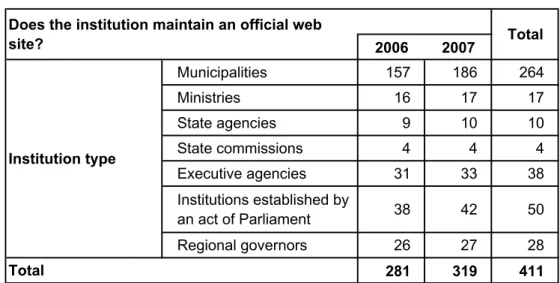
See the report Current state of access to public information in Bulgaria 2000 - report, AIP, Sofia 2001. Even more unsatisfactory are the results on the working hours of the information department (PR). By establishing the "access to information" subsection on the official website, public institutions can most easily fulfill the purpose of the law on access to information of a public nature, i.e.
Only thirty of the public institutions reviewed have established access to information subsections on their official websites. The Law on Access to Public Information requires public authorities to prepare annual reports on the implementation of the law and submit them to the Minister of State Administration and Administrative Reform. Such request forms must be brought in accordance with the legal norms and must correspond to the main principle of the Act on Access to Public Information.
CASES
Access to public information is limited to private company names and a brief summary of contract terms. Most of the obstacles faced by people seeking such information were caused by the lack of a uniform regulation for access to archives. For example, access to the archives of the Ministry of the Interior was regulated by an internal Order I-113 by establishing procedures for access to information contained in the archives of the Ministry.
Therefore, the requirement that applicants digitally sign their electronic requests is in clear contradiction to the provisions of the Act on Access to Public Information.
APPENDIX
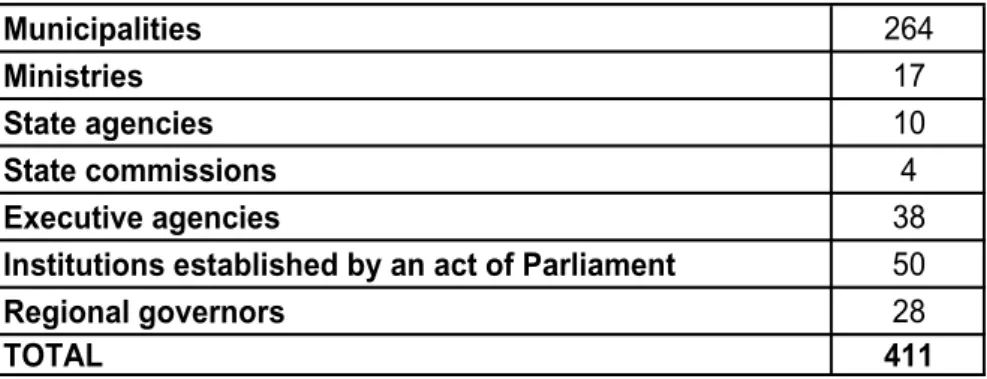
Statistics from the electronic database Access to Information Programme, 2006
LITIGATION
According to the judges, access to a copy of a final audit report is free and should not be restricted under the pretext of protecting preparatory documents (art. In the four decisions taken on cases concerning the protection of personal data and six concerning to protect commercial interests, the courts have relied on different interpretations of the various provisions. The frequent changes to the Personal Data Protection Act are evidence that misinterpretation of its provisions by those introducing the legislation causes confusion in the implementation of the law.
From this annual process overview we can conclude that there is generally a tendency towards narrow interpretations of the exceptions to the right to information.
LITIGATION - CASE NOTES
Alexenia Dimitrova (24 Hours Newspaper) vs. the Council of Ministers
In a letter dated May 30, 2006, the Director of the Government Information Service (GIS) refused access to the requested information. In the letter, it was confirmed that the requested information exists, as GIS noted that the topic was discussed in closed meetings of the Council of Ministers. The number of the decision of the Council of Ministers, which contains the requested information, was not even mentioned in the refusal.
The court panel meanwhile revoked their decision to proceed with the case and required the defendant, GIS, to present evidence on the classification of the requested information.
Bogdana Lazarova (Darik Radio) vs. The National Intelligence Services
4991, on May 11, 2006, a panel of the SAC vacated the SCC's ruling and remanded the case to the first instance for further legal proceedings. The judges stated in their judgment that the SCC had wrongly ruled that the complainant had not proven the contents of the parcel post (the complaint). In a decision dated February 5, 2007, an SCC panel annulled the Director of National Intelligence's denial.
The judges stated in their ruling that the refusal was signed with a comma and that evidence about the authority of the person who signed the refusal instead of the director was lacking.
Trud Daily vs. the Ministry of Agriculture and Forestry
In the October 2006 court session, the representative of the Minister of Agriculture and Forestry objected that the appeal was delayed, despite the fact that the obligation to collect and submit administrative documents for the case fell on the administrative body. 2845, dated 19.03.2007, the judicial body of the KSA declared invalid the rejection of the Minister of Agriculture and Forestry and reconsidered the request for reconsideration in accordance with the instructions given by the court. The purpose of the submitted request was to provide access to the primary documents related to the return of Mr.
By his actions, the Minister of Agriculture and Forestry, despite his superior position in the administrative structure, had unlawfully usurped the authority of the Municipal Department of Agriculture and Forestry in Samokov and issued a refusal.
Genka Shikerova (bTV) vs. the Municipality of Nessebar
The request was submitted as part of the reporter's investigation into cases of illegal construction in the municipality of Nessebar. A complaint was filed against the tacit refusal of the mayor of the municipality of Nessebar at the Regional Court of Burgas. It was stated that the information contained in the decisions of the mayor of the municipality of Nessebar was mainly public information.
The decision of the regional court of Burgas was appealed by the mayor of the Municipality of Nessebar before the Supreme Administrative Court.
The Bankia Civil Association vs. the Mayor of the Bankia District Administration - Municipality of Sofia
If the body was of the opinion that the disclosure would have affected the rights of the subcontractors by disseminating commercial secrets, then the provision in art. In this case, the mayor of the Bankia district administration was obliged, in terms of art. 2 of the APIA, to seek the consent of the third party to whom the information relates.
No data showed that such actions had been taken, proving that the refusal was illegal.
Dimitar Dimitrov and Plamen Simeonov vs. The Chief Prosecutor's Office of the Republic of Bulgaria
This made it necessary to send a letter with the attached request, the complaint and the refusal of the Public Prosecution Service to send the file to the court. The court panel assumed that the information requested on four of the points specified in the request (which asked when the Chief Prosecutor received the proposal for his dismissal from the Supreme Judicial Council and the citizens' request and what his response to these proposals was) was incorrect. do not constitute public information under the APIA and instead relate to personal data, which falls within the scope of the Personal Data Protection Act (PDPA). With regard to the request for rules for the organization and activities of the Public Prosecution Service, the decision stated that the provision of Art.
Consequently, the complainant had the right to receive a copy of the rules for the activities of the Prosecutor's office at the time of the request's submission.
The Environmental Association For the Earth vs. The Ministry of Environment and Waters
A written decision issued by the Head of Administration of the Ministry of Education and Culture granted partial access to the requested information. Copies of opinion statements submitted by participants in public discussions were also rejected based on Art. 1, point 2 of the APIA (information affecting the interests of a third party; therefore their consent was required for the provision of information).
The part of the MOEW's decision which refused access to the requested information was challenged.
The Environmental Association For the Earth vs. The Mayor of the Municipality of Sapareva Bania
Public discussions, held under the provisions of the Environmental Protection Act (EPA), constituted an independent stage in the procedure for the adoption of EIA decisions by the competent authority. That was why the reports of these discussions did not have the characteristics of preparatory documents prepared by a subordinate body and as part of the procedure for the adoption of the Final Act. Access to that type of information was granted according to the procedure laid down in Section II “Environmental Information” of the EPA and the Access to Public Information Act (in accordance with art.
The mayor of Sapareva Bania appealed to the Supreme Administrative Court against the decision of the district court in Kyustendil.
Non-Governmental Organizations Center Razgrad vs. the Municipality of Razgrad (Advertisement in Duma newspaper)
During the court hearing, the complainant's lawyer presented the Duma newspaper's advertising price offer as evidence that the requested information about a particular payment was not a secret of any kind when the pricing was public - it was found on the newspaper's website. 1299 of February 2006, a panel of the Supreme Administrative Court confirmed the decision of the Razgrad Regional Court. However, the refusal was lawful because the evidence applied clearly showed that the third party – the subcontractor – had expressly dissented from providing the requested information about the amount of money paid for the advertisement.
The SAC Trial Chamber also pointed out that the applicant, who had an advertisement price quote (which is publicly available) for the relevant print media and was aware of the advertisement published in the Duma newspaper, could calculate the amount of money paid by the advertiser with a simple arithmetic operation that would satisfy the appellant's interest.
The Non-Governmental Organizations Center Razgrad vs. the Municipality of Razgrad (Waste Management Concession)
191 of January 10, 2006, a panel of the Regional Court of Razgrad rejected the appeal, concluding that the contractor was not a body bound under Art. 2 of the KPCSH, that is, the public body had legally implemented the procedure provided by Art. Since the submitted request required information about the money paid from the Razgrad Municipality budget, the requested information was public and therefore had to be provided without the consent of the third party.
The judicial panel came to the conclusion that the municipality's mayor had unlawfully taken the requirement to look after the company's interests as the guiding principle.
The Non-Governmental Organizations Center Razgrad vs. the Municipality of Razgrad (Mayor's Per Diems)
9097 of September 21, 2006, the VAS Senate overturned the decision of the RČR and returned the case to the mayor with an instruction to provide access to the requested information in accordance with the documents available at the municipality. In their verdict, the judges stated that the district court wrongly and contrary to the law assumed that the applicant requested access to information that is not public according to Article 1.1 of the Civil Code, because it did not refer to the physical person Venelin Uzunov and would not be identified as such by their disclosures.
The particular case concerned Uzunov's performance of official duties as mayor of Razgrad municipality.
The Non-Governmental Organizations Center Razgrad vs. the Municipality of Razgrad (Information about Members of the Municipal Council)
Therefore, such reasons for the formulation of the contested refusal could not prove its legality. The silent refusal of the mayor of Razgrad Municipality was contested in the Razgrad Regional Court (RCR). 2 of the PDSH, as these data are not related to any physical person, but to the performance of official duties by members of the municipal council.
In practice, this would lead to the identification of natural persons - members of the municipal council - from the disclosure of personal data about them.
Silvya Yotova (Novinar Newspaper) vs. the Ministry of Regional Development and Public Works (MRDPW)
The Minister for Regional Development and Public Works' justification was too far-reaching and could not be defined as justified justification for issuing the Public Administration Act. The SAC's decision was appealed by the Minister for Regional Development and Public Works before a five-person panel at the same court. Given the lack of data to support the Minister's statement that the information was classified under the provision of Art.
1, of the APIA only stated that the information belonged to a certain category according to art.
Hristo Hristov vs. The National Intelligence Services
In a decision on March 14, 2006, a panel of the Sofia City Court (SCC) annulled the silent refusal of the Director of the NIS to provide the requested information as illegal and obliged the Director of the NIS to access the requested information to provide after applying the mandatory procedure for declassifying the information under the Protection of Classified Information Act (PCIA). The court found the objection of the defendant that he is not a mandatory body in terms of the provision of art. 41, Para 4 of the APIA, the court was entitled to exercise control over the security stamp marks.
The SCC's decision was appealed to the SAC by the director of the NIS.