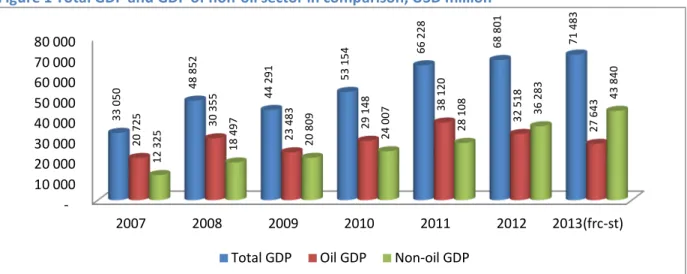
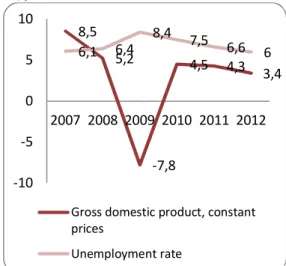
This article analyzes the implications of the possible accession of the Republic of Azerbaijan to the Customs Union of Belarus, Kazakhstan and Russia, combining qualitative and quantitative approaches. Estimating the consequences of the global financial crisis for the economies of Azerbaijan, Armenia and Georgia;
The Researcher
The Customs Union of Belarus, Kazakhstan and Russia (“CU”, the “Union” or “ECU”) is a hot topic in almost all post-Soviet and allied countries, which should keep Russia's integration plans in mind when making economic decisions. and political decisions. There are strong parties interested in Azerbaijan's accession to the Union, whose objectives often contradict those of other powerful stakeholders.
Research Questions
As a post-Soviet country with significant oil reserves and a strategic location, Azerbaijan is important for both existing Customs Union members and non-Customs Union members. The Center for Economic and Social Development is honored to take a pioneering position on this topic and contribute this paper to the discussion among Customs Union stakeholders, policy makers, academics and all other parties interested in subject.
Research Objectives
Russia's ambitious plans to form a Eurasian Economic Union by 2015 further complicate political and economic decision-making. Accordingly, researchers felt the need for an in-depth study of the Customs Union, its policies and its implications for member states and potential members.
Structure of the paper
However, other sectors of the economy are highly dependent on the oil and gas sector. To realize the intended goals, a number of presidential decrees and legislations were adopted ("State Program of Socio-Economic Development of the Regions of Azerbaijan State Program of Poverty Reduction and Economic Development in the Republic of Azerbaijan.
Strategic Partnership with neighboring countries
Turkey
Located in the Caucasus region along the western coast of the Caspian Sea between Russia and Iran and bordered by Georgia, Armenia and Turkey, Azerbaijan is a country rich in natural resources and fertile agricultural land. The primary objective of the government in 1992 was to preserve the established state structure to avoid the misuse of state property and to re-establish lost economic relations with the international community.
Russia
Additionally, Azerbaijan and Turkey are working together to modernize Azerbaijan's military and bring it up to the level of NATO nations. In the future, energy partnership will increase further after the Baku-Tbilisi-Erzurum gas pipeline is launched.
Central Asian countries
Both Azerbaijan and Turkey are determined to further develop their strategic alliance and look for new opportunities to increase economic cooperation.
Relations with International Organizations
CIS
EU
Customs Union of Russia, Kazakhstan and Belarus
- Customs Changes
- Expansion of the Customs Union
3 For more information on the economic impact of Tajikistan's accession, please refer to the Eurasian Development Bank's report (Eurasian Development Bank, 2013). 4 For more information on Kyrgyzstan's accession to the customs union, please refer to the essay by Alexander Pavlov.
Migrant workers in Russia
Note: Total taxes (including taxes from the oil sector) are classified as non-oil sector under the SSC. The goal of the 2010 budget is to reduce the non-oil deficit, while at the same time allowing for the reduction of taxes on profits and income.
Foreign trade of Azerbaijan
- Trade with European Union
- Trade with Customs Union
- Trade with Turkey
- Ease of Trade
- Foreign Trade Regulation of Azerbaijan
In 2011, the EU 27 received almost 46.85 percent of Azerbaijan's total exports and supplied 32 percent of the goods imported to Azerbaijan. In comparison, Georgia, Azerbaijan's neighbor, ranks 38th (down from 47th in 2012) in the "Trading Over Borders" category in Doing Business' 2012 report.
Russian Federation
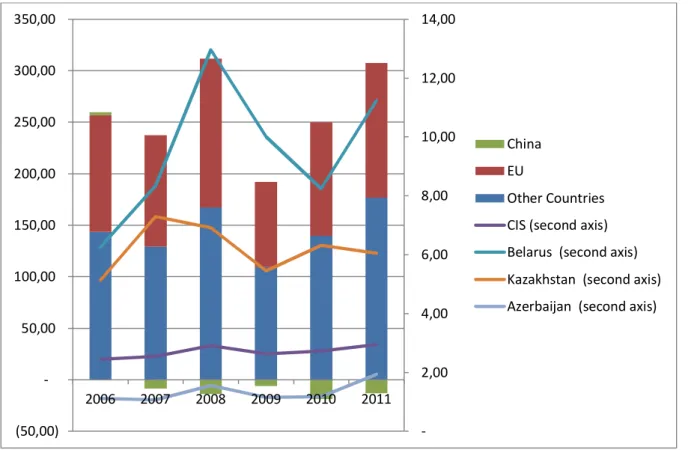
As Figure 3 shows, Russia exports more than it imports, which is reflected in a positive total trade balance. However, trade balance figures for only Kazakhstan, Belarus and Azerbaijan are provided here for the purpose of this analysis. In recent years, Russia has had a negative trade balance against China because its imports from China were more than its exports.
In particular, the trade balance with Kazakhstan worsened, despite the increase in total trade turnover.
Republic of Kazakhstan
Growth in the trade balance comes mainly from the EU and other countries such as China. During the same period, exports to the CIS changed little, and the share of CIS exports in total exports fell to 13.61 percent from 14.57 percent, after peaking in 2007 at 16.68 percent. As mentioned, the creation of the CU is also not a change in the trade structure: the export and import shares of the customs union members in total exports and imports remained almost the same, regardless of some minor fluctuations between 2006-2012.
Interestingly, there was an increase in China's share of total exports and imports from Kazakhstan.

Republic of Belarus
An interesting point that can be drawn from the two figures is the ineffectiveness of the establishment of the MU in increasing the trade turnover of Belarus. Only imports from the IU increased their share in total imports, after the establishment of the IU in 2010. Thus, it is difficult to ascertain the particular impact of the establishment of the IU on Belarusian trade.
The model includes the characteristics of the impact of existing accession cases (such as Kazakhstan and Belarus) on the economy of Azerbaijan and approximates the expected effect in various ratios.

Assumptions of the models
When you need a lot of assumptions to develop forecasts, the hedonic valuation model is useful because it requires a minimal amount of assumptions. Simply put, if a country with Kazakhstan's economic parameters experiences a certain GDP growth, increase in turnover and stabilization of inflation as a result of accession, the hedonic evaluation model allows us to predict similar effects on these indicators in the economy with Azerbaijan's parameters. For example, if we want to estimate the impact of accession on Azerbaijan's GDP, the HEM should include as many other examples of impacts on GDP due to accession to the Customs Union as possible.
By analyzing these accession cases and generating regression coefficients, HEM allows researchers to calculate the expected changes to Azerbaijan's economy.
Limitations of the models
The variance of the error term is the same for all observations, so there is no serial correlation and it is normally distributed.
Data Sources
Stakeholder analysis
Businesses
Citizens
International partners of Azerbaijan
Sectorial analysis
Energy industry
- Energy industry after accession to Customs Union
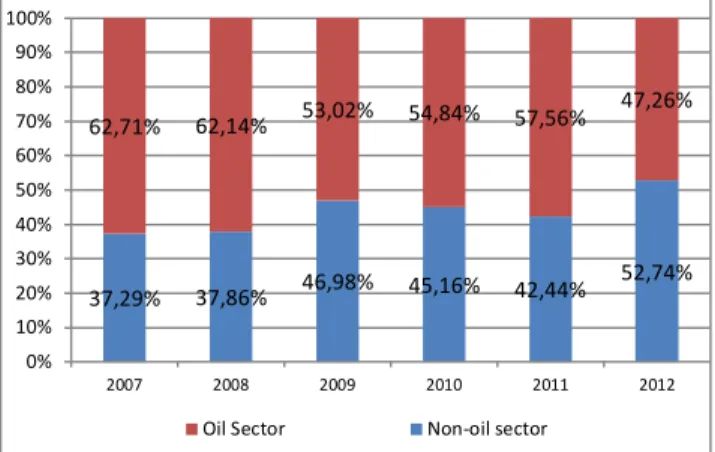
In comparison, the growth rate in this sector seems to lead the overall development due to the extremely fast growth rate of the energy sector from 2006 to 2010. The importance of Azerbaijan to the energy security of the world, especially the European Union, is undeniable. It is interesting that according to the exchange rate on June 27, 2013, gas prices for Russian and Azerbaijani households are at the same level according to our calculations.
In any case, Azerbaijan's accession to the Customs Union would subordinate its energy policy to that of the CU, which would be economic and political suicide because the country's international and economic relations are inextricably linked to its oil and gas policy.
Trade and services sector
- The sector after the accession to CU
In addition, gas prices for households will correspond to Russia's indicator, as required by the current energy policy of the Eurasian Economic Commission. While there will be no need to shift gas prices for Azerbaijani households in the short term, no one can guarantee against future shifts, as necessitated by changes in Russia's gas prices and other policy measures. On the other hand, there is no need for corresponding electricity and oil prices to match those of Russia under the rules and regulations of the Eurasian Economic Commission.
Azerbaijan's energy resources and policies also enable it to be a major regional actor in the near future (see, e.g., Interview with Richard Morningstar, US Ambassador to Azerbaijan, The Politic, the Yale Undergraduate Journal of Politics, August , but entering the Union would essentially rule out this opportunity.
Construction, Telecommunications and Transport sectors
- Construction sector
- Telecommunications and IT sector
- Transport
- The sectors after accession
- Agriculture
- Agriculture sector after accession
- Non-oil industry
- Sector after accession to the Customs Union
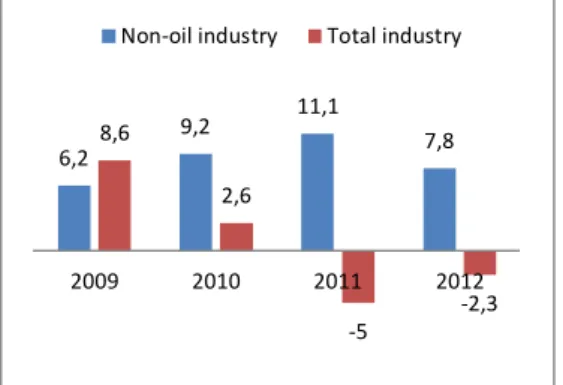
State-supported projects have had positive effects: the number of residents with access to the Internet increased from 2 percent in 1995 to 10 percent in 2006 and 65 percent in 201116, along with a sixfold reduction in prices. Currently, the main policy of the country is the development of the rural economy and the protection of the goods of this sector from imported goods. Among the main drivers of non-oil production, the production of machinery, electrical appliances, light industry and food grew faster than other non-oil sectors.
18 Although the rapid growth of the oil sector and its significant contribution to GDP goes some way to explaining the declining share of agriculture, the sector grew remarkably slowly, employing almost 37.9 percent of Azerbaijani labor force (SSC, 2013).
Quantitative analysis of the accession to the Customs Union
Tests for normality
However, the main emphasis in this area is also in the oil and gas sector. But on the other hand, the domestic availability of oil in Russia and Kazakhstan reduces the potential for exports from Azerbaijan to those markets. Belarus would be a potential market, and trade turnover with Belarus and the amount of its current composition suggest that membership of the Customs Union could improve exports to this country.
Thus, many foreign investors looking for cheap labor, cheap energy costs and unhindered access to the markets of CU member countries can produce goods in Azerbaijan.
Regression: Did the accession benefit exiting CU members?
- Shifts in Russia’s trade, GDP and inflation figures
- Shifts in Kazakhstan’s trade, GDP and inflation figures
- Shifts in Belarus’s trade, GDP and inflation figures
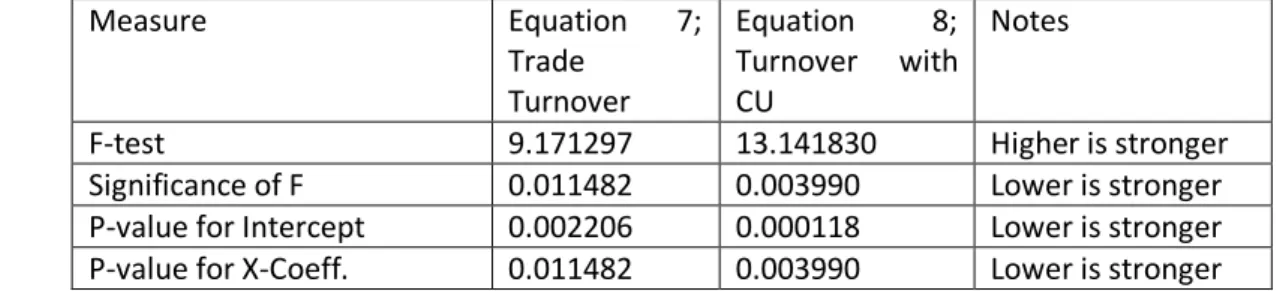
Further examination of the two regression equations reveals that the equation for trade with CU members is stronger than the equation for total trade turnover. One must therefore note possible large deviations from the connection's contribution of 159 per cent. to the total trade turnover. The higher the R-squared value, the better the explanation of the dependent variable with the independent variable.
In none of our regression equations did the independent variable (the accession dummy variable) explain more than 55–60 percent of the dependent variables.
Hedonic Estimation Model: Will Azerbaijan’s economy gain from the accession?
However, considering the aforementioned analysis and overall net effects, Azerbaijan's CU membership would not be beneficial in the long run. More importantly, CU membership would remove Azerbaijan's long-term ability to independently manage its natural resources. On the other hand, in the short term, membership in the MU would positively affect some stakeholders in Azerbaijan.
Given the current social and political realities, in the event that Azerbaijan were to join the customs union anyway, the CESD recommends the "UK accession model".
Distribution Identification for Total Trade Turnover of KZ
Distribution Identification for Total Trade Turnover of RF
Distribution Identification for Total Trade Turnover of BLR
Distribution Identification for CU Trade of KZ
Distribution Identification for CU Trade of RF
Distribution Identification for CU Trade of BLR
Distribution Identification for GDP Growth rate, KZ
Distribution Identification for GDP Growth rate, RF
Distribution Identification for GDP Growth Rt BLR
Distribution Identification for Inflation KZ
Distribution Identification for Inflation RF
Distribution Identification for Inflation Belarus
Available at: https://www.cia.gov/library/publications/the-world-factbook/geos/rs.html and https://www.cia.gov/library/publications/the-world-factbook/geos /kz.html and. Available at: http://www.satrapia.com/news/article/tajikistan-expresses-readiness-to-become-customs-union-member/. Available at: http://www.ebrdblog.com/wordpress/2012/07/trade-within-the-russia-kazakhstan-belarus-customs-union-early-evidence/.
The customs union of Belarus, Kazakhstan and Russia: a way to strengthen Moscow's position in the region.