
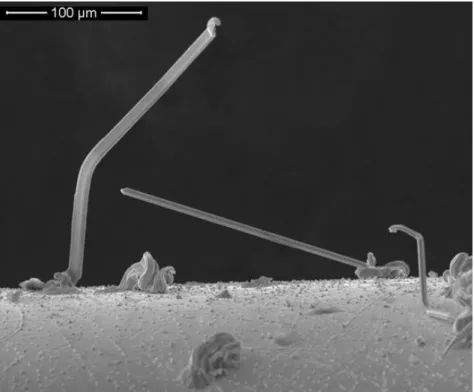
In recent years, the European Union has adopted a directive on the restriction of the use of certain hazardous substances in electrical and electronic equipment. The diameter usually ranges from 2 to 6 µm, depending on the grain size in the tin layer, and the length rarely exceeds 0.2 mm and has a striated surface.
Applied Methods for the Inspection of Whiskers
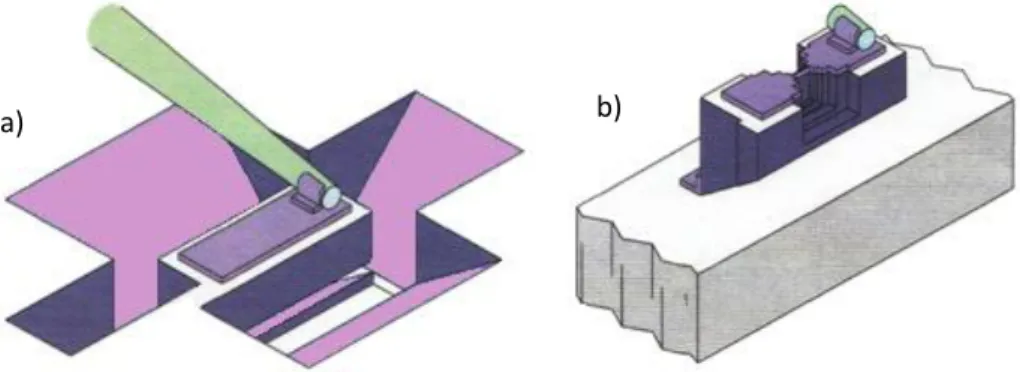
But for the analysis of the elements on the cross-section of the sample after FIB etching, this site size is too large. After attaching the FIB probe by depositing tungsten on top of the sample, a bridge between the sample and the die can be etched.
L ITERATURE R EVIEW
Whisker Growth Models
Atoms originally in whisker grains Atoms originally in grain boundaries Atoms originally in grain boundaries that moved to whisker grains. Atoms that diffuse into the grain boundary fill openings left by atoms that moved into the whisker grain.
![Figure 3.2. a) Tin atomic diffusion evenly by the grain boundary [3.3]. b) Tin whisker shape if one grain boundary is pinned [3.3]](https://thumb-eu.123doks.com/thumbv2/9dokorg/2496684.294078/14.892.126.754.322.793/figure-atomic-diffusion-evenly-boundary-whisker-boundary-pinned.webp)
Reported Whisker Characteristics
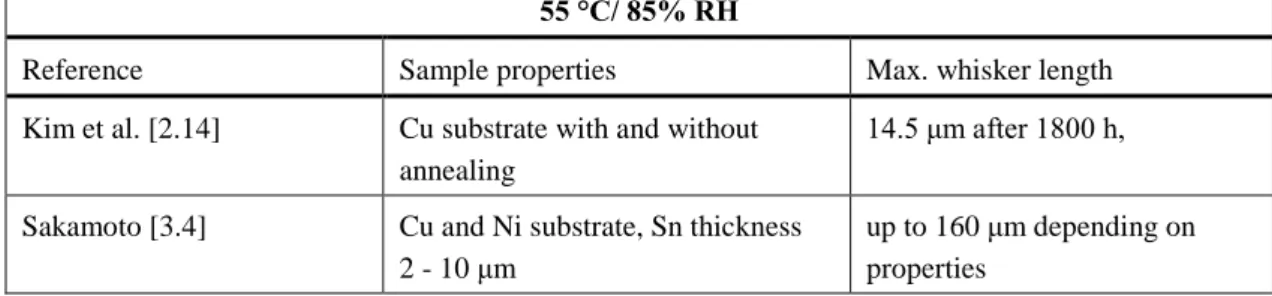
Depending on the properties of the tin layer, whisker formation has an incubation time that can mean the first appearance can be delayed from days to years. Furthermore, the rate of growth is not constant and whisker growth can become saturated after reaching a certain length.
Intermetallic layers
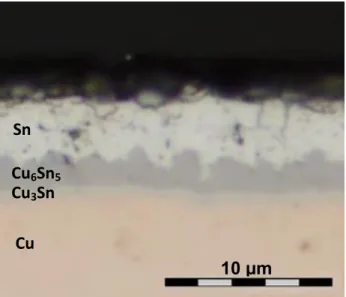
For this reason, the growth direction of the intermetallic layer depends on in which component the diffusion occurs faster. Here both the tin and the intermetallic are compressed due to the expansive action of the intermetallic formation.
![Figure 3.4. The structure of intermetallic compound compared to standard alloys [3.6]](https://thumb-eu.123doks.com/thumbv2/9dokorg/2496684.294078/18.892.199.700.686.969/figure-structure-intermetallic-compound-compared-standard-alloys.webp)
The Effect of Underlayers on Whisker Growth
Also, in the case of using a nickel underlayer, the free Kirkendall zone is formed inside the tin layer instead of the copper substrate, as it would be in the case of Sn/Cu pairs. If the internal stress-generating mechanisms fail, its stress state will be compressive due to the contraction of the Kirkendall zone.
![Figure 3.7. Stress development in Sn/Ni/Cu structured layers [3.14]](https://thumb-eu.123doks.com/thumbv2/9dokorg/2496684.294078/22.892.202.689.652.905/figure-stress-development-sn-structured-layers.webp)
The Effect of Tin-Oxides and Corrosion on Whisker Growth
With an SnOx layer, the internal compressive stress in the Sn layer can be relieved at some weak points of the SnOx layer, in which tin whiskers can initiate and grow [2.3]. Higher humidity affects the thickness of the oxidation in the tin layer leading to higher compressive stress [3.28].
![Figure 3.8. Ball-and-stick model of the litharge structure of SnO [3.22]](https://thumb-eu.123doks.com/thumbv2/9dokorg/2496684.294078/24.892.241.663.117.381/figure-ball-stick-model-litharge-structure-sno.webp)
The Effect of Grain Properties of the Tin Layer on Whisker Growth
- Recrystallization
Further reduction of the internal energy can only be achieved by grain growth that reduces the total area of the grain boundary. In reviewing the existing literature, I noticed that the effect of the recrystallization process on whisker growth has not yet been investigated.
![Figure 3.12. Columnar type grain structure of the tin layer [3.33]](https://thumb-eu.123doks.com/thumbv2/9dokorg/2496684.294078/29.892.138.755.618.855/figure-columnar-type-grain-structure-tin-layer.webp)
Whiskering of Copper and Lead Alloys
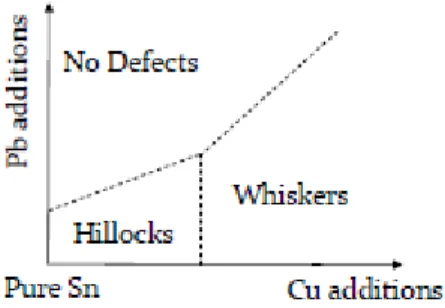
Schematic defect phase diagram showing defect type for Sn films as a function of Pb and Cu concentration. Defect phase diagram as a function of Cu and Pb concentrations in the Sn films stored in room temperature for 240 days after deposition.
Conclusions Drawn from the Literature
The physical process of tin oxide formation and its growth parameters are not yet fully understood. In addition, the role of layer corrosion formed on tin layers is not entirely clear. All observations on the effect of moisture, corrosion and the development of tin oxides are in the aspect of their effect on the tin layer, but there are no observations on the effect on already developed whiskers.
To minimize the occurrence of this error, a better understanding of the physical background of the phenomenon is necessary. Investigation of the whisker resistance of tin layers equipped with silver and nickel substrates during accelerated lifetime tests. Analysis of tin-silver and tin-nickel intermetallic layers and their performance properties, Investigation of the effect of tin oxide growth and tin corrosion on whisker formation Observation of the effect of grain deformation due to recrystallization on whisker formation.
Study of the increasing proportion of copper in tin-copper alloys and their influence on the formation of hairs under conditions of high humidity.
W HISKERING P ROPERTIES OF S TRUCTURES WITH
- Sample Preparation and Test Circumstances
- Results of Aging on Whisker Growth
- Statistical Evaluation of the Results
- Discussing the Role of Oxidation
- Examining the Effect of Underlayers
- Conclusion
The surface of the tin layer showed moderate signs of oxidation, and areas of thicker oxidation contained more whiskers on the surface. Whisker growth at elevated temperature and humidity conditions can be induced by corrosion of the tin finish. Therefore, a compressive stress is generated by corrosion of the tin layer; that drives the nucleation and growth of whiskers.
In the case of 40 °C/95% RH, the surface corrosion was not as severe, but most of the hairs were still found in the corroded areas. No high intensity hair wrinkling was observed and no shrinkage of the tin coating occurred in samples with a nickel underlayer. In the case of the silver base samples, they were only whisker resistant for up to 3,800 hours.
The Ni3Sn4 intermetallics expand to the tin layer instead of the nickel layer, creating stresses in the tin layer.
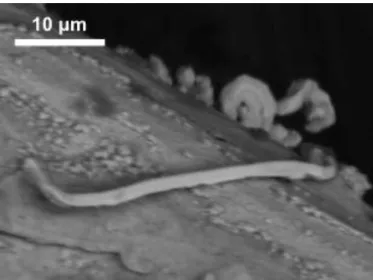
- Sample Preparation and Test Circumstances
- The Effect of Aging on Whisker Growth
- Examination of the Grain Structure
- Examination of the Developed Formation Shapes
- Conclusion
On the other hand, in the case of the reference samples, the whisker density grew almost linearly with time. A slight length reducing effect can be seen in the case of the 10 µm plate thickness samples. The better results in the early stage (0-500 cycle) are due to the delay effect of the first whisker appearance.
In the case of constant temperature aging, the layer thickness changed after 1600 hours compared to the initial thickness. The grain formation in the experiments is consistent with the amount of whiskers found on the surface. In the case of samples with a tin coating thickness of 20 µm, the filament whiskers were much rarer compared to the 10 µm samples.
Consistency between treatment methods and developed whisker shapes was found only in the case of samples with a thickness of 20 μm.
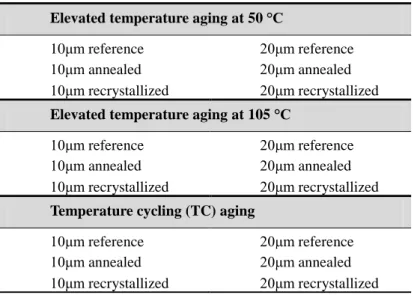
- Sample Preparation and Test Circumstances
- Results of the 85 °C/ 85% RH Aging Condition
- Results of the 105 °C/100% RH Aging Condition
- Theory Explaining the Growth of Copper-Oxide Whiskers at 105°C/ 100% RH
- Conclusion of the Differences between the Two Test Conditions
In this case, the differences were more significant than in the case of density. Therefore, the higher the copper content of an alloy, the more stress will develop in the coating due to corrosion of the alloy coating. The material of the developed whiskers was mainly copper oxide instead of tin as can be seen in the EDS elemental map (Figure 6.5).
The two main factors influencing whisker growth were the oxidation and copper content of the alloys. During the localized corrosion of the tin (and tin-copper alloy) coating, water and oxygen easily reach the intermetallic Cu6Sn5. As shown in Figure 6-9, there is a low SnOx residue at the tip of the whisker.
The greater the copper content in an alloy, the more stress will develop in the as a result of the corrosion of the alloy plate.
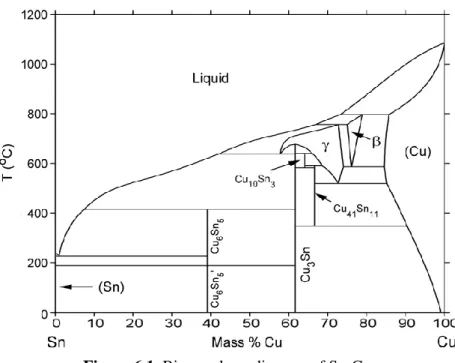
C ONCLUSIONS
I have proved that tin layers are more whisker resistant in the early stage with silver underlayers than layers with nickel underlayers, until the point
This is the reason why the curling ability of the silver-substrate samples increased rapidly after 4200 hours compared to the nickel samples. In the case of storage at 105 °C/100% RH, I noticed that the samples with the silver sublayer developed longer hairs compared to the samples with the nickel sublayer. The property of longer hairs of the lower silver layer samples is due to the following: the moment when copper diffused through the lower silver layer and formed an intermetal with tin was earlier at a high temperature (105 °C) than at a lower temperature (40 °C). the rate of diffusion is strongly dependent on temperature.
However, the growth rate of Ni3Sn4 is much lower than the growth rate of Cu6Sn5 (as in the case of the penetrated silver layer), and the material transport caused by the slowly generated stress can be blocked by the rapid oxidation in the case of high temperature and high humidity (see thesis 1.2). I have experimentally found that on the samples aged at 105 °C/100% RH, the tin coating does not follow the known whisker formation process known in the literature [1.3], a new mechanism of whisker growth occurs due to the thick oxide layer formed. Additional tension in the layer does not cause the whisker to grow any further; instead, new whiskers grow out at the cracks.
In the event that there is a crack in the oxide layer of the whisker and the additional stress on the tin layer causes the tin atoms to disperse into the whisker, I have observed that a new whisker can grow from the existing whisker, which will grow up to The appearance of an oxide layer on its surface causes it to stop.
In this case, the developed whiskers do not follow the usual whisker appearance, the developed whiskers are thicker (>10 μm), and can grow in bundles (which are 30-40 μm in size). I proved that the reason for this is that the tin diffuses out of the grains into the big hill or nodule, and the large amount of mass transport gap is formed at the bottom of the columnar grain.
Since the melting points of alloys with higher copper content increase rapidly, grain growth due to recrystallization in these alloys cannot be as efficient and develops more slowly. However, since high copper content has a higher corrosion rate, additional stresses from the tin and copper oxides accelerate hair growth after the first appearance.
The Application of the Results
L IST OF P UBLICATIONS
Thesis Related Publications
Further Scientific Publications
R EFERENCES
Lee, “The Sn Whisker Growth Evolution of IC Packaging on the PC Board Assembly”, Proceedings of Electronic Components and Technology Conference, Reno, VS (2007) pp. Sn Corrosion and Its Influence on Whisker Growth”, IEEE Transactions on Electronics Packaging Manufacturing pp. Chopin, “Whisker Formation on Matte Sn Influencing of High Humidity”, Proceedings of Electronic Components and Technology Conference, Lake Buena Vista, VS (2005) pp.
Pecht, "Observations of the Spontaneous Growth of Tin Whiskers in Various Reliability Conditions", Proceedings of Electronic Components and Technology Conference, Lake Buena Vista, VS (2008) pp. Chopin, "Effects of Trim and Form on the Microstructure and Whisker Growth Propensity of Sn Finish", Proceedings of Electronic Components and Technology Conference, Lake Buena Vista, VS (2005) pp. Ho, "Microstructure-Based Stress Modeling of Tin Whisker Growth", IEEE Transactions on Electronics Packaging Manufacturing pp.
Smetana, “Theory of Tin Whisker Growth: The End Game”, IEEE Transactions on Electronics Packaging Manufacturing pp.
A CKNOWLEDGEMENT
![Figure 3.1. a) Simplified representation of matte tin after recrystallization [3.3], b) whisker growing on top of the grain boundary of two Sn grains [3.2]](https://thumb-eu.123doks.com/thumbv2/9dokorg/2496684.294078/13.892.150.754.775.1000/figure-simplified-representation-recrystallization-whisker-growing-boundary-grains.webp)
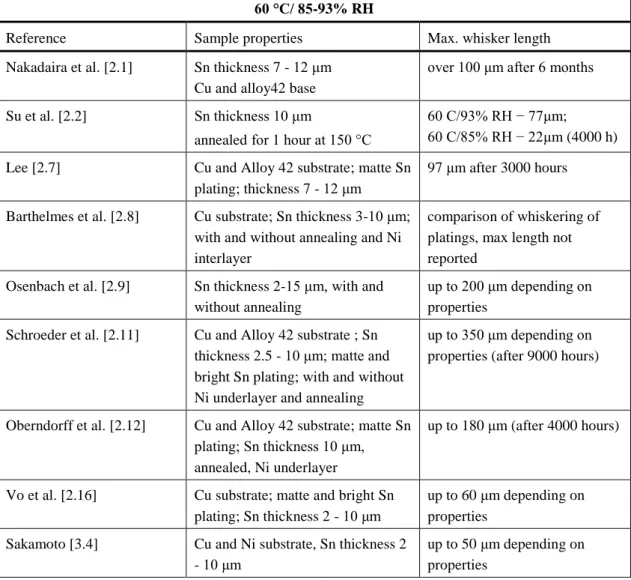
![Figure 3.9. Ball-and-stick model of the structure of SnO 2 [3.22]](https://thumb-eu.123doks.com/thumbv2/9dokorg/2496684.294078/24.892.188.695.673.910/figure-ball-stick-model-structure-sno.webp)
![Figure 3.17. Grain structure of a) Sn–Cu electrodeposit: with a filamentary whisker [3.45]; b) Sn–Pb electrodeposit [3.45]](https://thumb-eu.123doks.com/thumbv2/9dokorg/2496684.294078/34.892.141.760.501.760/figure-grain-structure-sn-electrodeposit-filamentary-whisker-electrodeposit.webp)
