W O R K I N G P A P E R S E R I E S
2016/8
Mapping Backsliding
in the European Union
1
Contents
BACKSLIDING ON LIBREAL DEMOCRACY IN THE EUROPEAN UNION ... 3
BACKSLIDING AND THE RULE OF LAW ... 11
European Union Institutions ... 12
Venice Commission ... 14
Helsinki Committee ... 16
Trends ... 17
BACKSLIDING AND CORRUPTION ... 17
Mapping Corruption... 18
Trends ... 19
The (direct) impact of the economic crisis ... 19
Country specific factors: politics (indirect impact of the crisis) ... 20
Pre-accession vs post-accession dynamics ... 20
BACKSLIDING AND EQUALITY... 21
Mapping Equality: Gender, Race, Disability ... 22
Gender ... 22
Race ... 24
Disability ... 25
Comprehensive assessment ... 27
Trends ... 27
CONCLUSIONS ... 28
Annex 1 (Rule of Law) ... 30
Annex 2 (Corruption) ... 38
Annex 3 (Equality) ... 50
2
Mapping Backsliding in the European Union
When the European Union took on ten new member states in 2004, it went through an unprecedented enlargement that raised a number of questions about the future of the EU.
The previous enlargements, from the original six member states to nine, then ten, twelve and fifteen states never admitted more than three new members at a time and the new member states had long track records of liberal democracy and market economies – or, in the case of the new Mediterranean member states in the 1980s, at least the latter. The debate about enlargement to formerly communist regimes began as soon as the Berlin Wall fell, and even in its earliest version it centred on the potential effects of a big round of enlargement on the EU’s capacity for governance and further integration.1 This coincided with a debate on the prospects for liberal democracy in terms of both party politics and public policy in the Europe’s new democracies.2 Apart from the questions about whether a wider Europe might mean more or less deepening in terms of supranational governance and increasing the scope of the EU’s competence, this debate also touched on the administrative capacity of the formerly communist states and their political will. The team put together by Paul Taggart and Alexs Szczerbiak focused on the latter question in particular, by examining the sources and consequences of popular and party-based Euroscepticism in both the old and new member states.3 The present policy brief takes the question debated by the Taggart and Szczerbiak team as a starting point: a dozen years after the first round of eastern enlargement, as Eurosceptic parties have come to power in some of the new member states, has there been
"backsliding” in the EU in terms of the states’ commitments to liberal democracy?
This is the first of five policy papers in a series for the EU-funded TransCrisis Horizon 2020 research project that directly address backsliding as a possible crisis for the EU. Taken together, the five papers investigate and analyse the causal links between transboundary
1 Helen Wallace, “Widening and deepening: the European Community and the new European agenda”, RIIA Discussion Paper No 23, 1989; Christopher Preston, Enlargement and Integration in the European Union (London: Routledge, 1997; Karen Henderson (ed.), Back to Europe: Central and Eastern Europe and the European Union, London, UCL Press, 1999; Ulrich Sedelmeier and Helen Wallace, “Eastern Enlargement:
Strategy or Second Thoughts?”, in Helen Wallace and William Wallace (eds), Policy-Making in the European Union, Oxford: Oxford University Press, 2000; Urich Sedelmeier and Frank Schimmelfennig, “'Theorising EU Enlargement: Research Focus, Hypotheses, and the State of Research”, Journal of European Public Policy, 9:4 (2002): 500-528.
2 Gordon Smith, “Transitions to Liberal Democracy”, in Stephen Whitefield (ed.), The New Institutional Architecture of Eastern Europe, Basingstoke: Macmillan, 1993; Peter Mair, “What is Different about Post- Communist Party Systems?”, Studies in Public Policy No. 259, University of Strathclyde, 1996; Klaus Goetz,
“Making Sense of Post-Communist Central Administration: Modernization, Europeanization ofLatinization?”, Journal of European Public Policy, 8:6 (2001), 1032-1051.
3 Paul Taggart and Aleks Szczerbiak (eds), The Comparative Party Politics of Euroscepticism, Oxford: Oxford University Press, two volumes 2008.
3
crisis management and backsliding in EU member states. The first paper defines backsliding and explores empirical patterns of backsliding across the EU. The second, third and fourth papers analyse three forms of backsliding that are particularly contentious and involve potential problems for the EU: the rule of law (constitutional safeguards and independent institutions), corruption (including corruption control) and equality (gender, race and disability).
Each of the three papers assess the extent of and causes of backsliding, and consider far it might be a problem for the EU. The fifth paper asks whether backsliding as such represent a crisis for the EU, and what policy options and tools the EU has for managing backsliding.
BACKSLIDING ON LIBREAL DEMOCRACY IN THE EUROPEAN UNION
Samuel Huntington famously argued that democratization comes in waves, and that the process of democratisation that started in Southern European and Latin American in the 1970s and included the collapse of communism in Europe was the third wave – after first and second waves after each of the two world wars.4 Whether post-communist democratization should be considered a fourth wave or an extension of the third wave is itself debatable, but in either case post-communist democratization in Europe and Eurasia has been less of an unequivocal success than democratization in post-authoritarian Portugal, Spain and Greece.5 Most of the former Soviet States (the exceptions are the three Baltic republics) have justifiably been described as hybrid regimes or as regimes that have reversed the commitment to democratization. Tayyip Erdogan’s Turkey has been subject to the same kind of criticism, long before the crack-down after the failed military coup of July 2016. But even the EU member states have not been immune to accusations of democratic backsliding. Slovakia was sent to the back of the queue for EU membership under Vladimír Mečiar’s premiership – the only country to be relegated in this was on the grounds of limited progress toward liberal democracy (as opposed to relegation on the grounds of limited institutional or administrative capacity). Then in 2014 Hungarian prime minister Viktor Orbán declared for “illiberal democracy”, and cited Vladimir Putin’s regime in Russia as a role model. During the previous four years he had used the sweeping powers that a two-thirds parliamentary majority afforded his government to re-write the constitutional order. In the meantime Romania had been shocked by the 2012 clash between president Traian Băsescu and prime minister Victor Ponta, even if the prime minister eventually had to back down from his effort to impeach the president. Then the victory of the Polish Law and Justice party in the 2015 elections and the party’s immediate campaign to change the constitutional order rammed home the message that the road to liberal democracy might not be a one-way street, even for EU member states.
4 Samuel P. Huntington, The Third Wave: Democratization in the Late Twentieth Century, (Norman: University of Oklahoma Press: 1991); “Democracy’s Third Wave” Journal of Democracy, 2, no. 2 (1991), 12-34.
5 Marc F. Plattner and Larry J. Diamond, “Is East-Central Europe Backsliding?”, Journal of Democracy, 18:4 (2007), 5-6.
4
The literature on backsliding comes in three main varieties: i) the study of democratic backsliding as a trend that involves a reversal of democratization, ii) the study of hybrid regimes in the context of development, and iii) the study of individual countries that have steered away from liberal democracy in one way or another, including some EU member states. This literature does not offer an unambiguous definition of backsliding, let alone one that can be operationalised in a study of backsliding in the EU. Common elements in definitions include reversal of democratization and the weakening of democratic institutions;
decline of good governance, transparency and the rule of law; poor governance performance and/of reversal of reforms; weakening of human rights and treatment of minorities; rising populism, nationalism and anti-liberal public opinion; increasing corruption and state capture; and even – for the EU member states – compliance with EU rules and norms and even the danger of a new type of democratic deficit.
The literature that approaches backsliding as a trend away from democratisation focuses more on the question as to whether this is a trend and what causes it than on the definition of the concept. Indeed, like much of the literature on democratisation itself, it does not really need a clear definition of democratisation or reversal of democratisation since liberal democracy is a well-established concept.6 The editors of a special issue of Journal of Democracy on backsliding in East Central Europe, Marc Plattner and Larry Diamond, asked contributors to the issue to examine sharp political conflicts as a source of concern for the solidity of these countries’ democracies. They did not define backsliding, but pointed to concerns about lack of democratic consolidation and the danger of countries reverting to authoritarianism. However, they made direct reference to the assessments carried out by Freedom House, and asked questions about the precariousness of democracy, weakness of democratic institutions and the sources of dangers to democracy.7 Indeed the Freedom House data is widely used in the debates about democratisation and its possible reversal, and are used in this paper as well.8 Perhaps the clearest and most precise definition of backsliding linked to the concept of democratization is that offered by Lars Svåsand in his study of Malawi:
Democratization involves a steady improvement in democratic governance, being stuck in transition involves lack of improvement, and backsliding – simply enough – involves the last alternative, namely a decline in good governance.9 Ulrich Sedelmeier offers an equally straightforward definition of backsliding, based on breaches of liberal democratic principles.10
6 Jacques Rupnik, “Is Central Europe Backsliding: From Democracy Fatigue to Populist Backlash”, Journal of Democracy, 18:4 (2007), 17-25.
7 Plattner and Diamond, “Is East-Central Europe Backsliding?”, p. 5-6.
8 James Dawson and Seán Hanley, “East Central Europe: The Fading Mirage of the ‘Liberal Consensus’”, Journal of Democracy, 27:1 (2016), 20-34, p.23.
9 Lars Svåsand, ”Democratization in Malawi: Moving Forward, Stuck in Transition or backsliding?”, Forum for Development Studies, 38:1 (2011) 1-24.
10 Ulrich Sedelmeier, “Anchoring Democracy from Above? The European Union and Democratic Backsliding in Hungary and Romania after Accession”, Journal of Common Market Studies, 52:1 (2014), 105-121.
5
The most common theme in the literature on democratization and its reversals is democratic norms and commitments to basic democratic principles and the rule of law. This is directly linked to the strengthening, maintenance or weakening of liberal democratic institutions, and ultimately, of the rule of law.11 It involves a reversal of democratization leading to a hollowing out of liberal democracy both in form and in practice.12 Bela Greskovits thus defines backsliding as “destabilization and reverting to semi-authoritarian politics” or even a “reversal in the direction of democratic development”; Atila Ágh focuses on both formal institutions and democratic performance.13
Much of the work on reversal of democratization also focuses on the consequent decline in the quality of democracy, including low transparency and state capture by elites. This is in effect a decline in good governance, or what Thomas Carothers calls “bad governance”and Ulrich Sedelmeier documents as “drops in democratic quality”.14 This kind of decline in democratic performance is often linked to political contestation of European integration and the core values of the EU, including different aspects of economic and social performance (including equality and discrimination).15 Writing in 2007, Charles Gati explicitly linked the term “backsliding” to “resistance to new and necessary political and economic reforms.”16 Others include performance in terms of protection of human rights.17
Oligarchy and low performance is in turn sometimes linked to the decline in popular support for democracy and the rule of law. A common theme here has been the rise of support for parties that advocate alternative forms of government that play down individual liberty and the rule of law, including support for nationalism, populism.18 Ivan Krastnev linked backsliding
11 Plattner and Diamond, “Is East-Central Europe Backsliding?”; Dawson and Hanley, “East Central Europe: The Fading Mirage of the ‘Liberal Consensus’”; Douglas M. Gibler and Kirk A. Randazzo, “Testing the Effects of Independent Judiciaries on the Likelihood of Democratic Backsliding”, American Journal of Political Science, 35:3 (2011), 696-709; Jan-Werner Müller, “Should the EU Protect Democracy and the Rule of Law in Member States?” European Law Journal, 21:2 (2015) 141-160.
12 Dawson and Hanley, “East Central Europe: The Fading Mirage of the ‘Liberal Consensus’”; Bela Greskovits,
“The Hollowing and Backsliding of Democracy in Central Europe”, paper presented at Central European University, 9 April 2015.
13 Greskovits, “The Hollowing and Backsliding of Democracy in Central Europe”; Attila Ágh, “The Triple Crisis in Hungary: The “Backsliding” of Hungarian Democracy after Twenty Years”, Romanian Journal of Political Science, 13:1 (2013).
14 Thomas Carothers, “A Quarter Century of Promoting Democracy”, Journal of Democracy, 18:4 (2007), 113- 123, p.119; Ulrich Sedelmeier, “Europe after the Eastern Enlargement of the European Union: 2004-2014, Heinrich Böll Stiftung, 10/5/2014, p.4; Plattner and Diamond, “Is East-Central Europe Backsliding?”; Müller,
“Should the EU Protect Democracy and the Rule of Law in Member States?”.
15 Ivan Krastev, “The Strange Death of the Liberal Consensus”, Journal of Democracy, 18:4 (2007), 56-63; Philip Levitz and Grigore Pop-Eleches, “Monitoring, Money and Migrants: countering Post-Accession Backsliding in Bulgaria and Romania”, Europe-Asia Studies, 62:3 (2010), 461-479.
16 Charles Gati, “Backsliding in Central and Eastern Europe!, The Quarterly Journal, Fall 2007, 107-120.
17 Andrew T. Guzman and Katerina Linos, “Human Rights Backsliding”, California Law Review, 102 (2014), 603- 654.
18 Plattner and Diamond, “Is East-Central Europe Backsliding?”, p. 6; Elisabeth Bakke and Nick Sitter, ““Patterns of Stability: Party Competition and Strategy in Central Europe since 1989”, Party Politics 11:2 (2005), 243- 263”; Agnes Batory and Nick Sitter, “Cleavages, Competition, and Coalition-building: Agrarian Parties and the
6
to the end of the kind of “liberal consensus” that membership of the EU is based on and which the EU to some extent requires in order to funciton.19 However, others, like Greskovits, separate “hollowing out” of democracy in the sense of loss of popular support for democracy from backsliding as such.20
In the EU context, the notion of backsliding can be related to the well-established literature on differentiated integration, and the question of why some states do not comply with EU law when the governing parties or elites decide that it is not the interest of the government to do so.21 Europeanisation and the effect of EU membership on democratic consolidation and good governance has been much debated, and increasingly this literature has turned to investigate the possibility that Europeanisation might be reversed.22 Most structural explanations of declining compliance focus on long-term economic performance or social integration, or the way the global financial crisis posed a disruptive challenge for fragile democracies.23 In any case, the financial crisis too some of the new member states to cross road between continued consolidation of democracy and departure from the liberal democratic model.24 But the direct cause of deliberate non-compliance and wilful defiance of inconvenient EU rules has tended to be populist parties’ rise to power.25
Most of the literature on the study of hybrid regimes in the context of development likewise does not seek to conceptualise backsliding, but rather focuses on the different ways
European Question in Western and Eastern Europe”, The European Journal of Political Research, 43:3 (2004).
521-544; Sean Hanley, “The New Right in Europe? Unravelling the Ideology of ‘Czech Thatcherism’”, Journal of Political Ideologies, 4:2 (1999), 169-178; Paul Taggart, New Populist Parties in Western Europe, West European Politics, 18:1 (1998), 34–51
19 Carothers, “A Quarter Century of Promoting Democracy”, p.119; Krastev, “The Strange Death of the Liberal Consensus”, p. 58-59.
20 Greskovits, “The Hollowing and Backsliding of Democracy in Central Europe”, p.1 ; Greskovits draws on Peter Mair, “Ruling the Void: The Hollowing of Western Democracy”, New Left Review, 42 (Nov-Dec), 25-51.
21 Alexander C-G. Stubb, “A Categorization of Differentiated Integration”, Journal of Common Market Studies, 34:2 (1996) 283-295; Alkuin Kölliker, “Bringing Together of Driving Apart the Union? Toward a Theory of Differentiated Integration”, West European Politics, 24:4 (2001) 125-151; Svein S. Andersen and Nick Sitter,
“Differentiated Integration: What Is It and How Much Can the EU Accommodate?”, Journal of European Integration, 28:4 (2006), 313-330; Katharina Holzinger and Frank Schimmelfennig, “Differentiated Integration in the European Union: Many Concepts, Sparse Theory, Few Data”, Journal of European Public Policy, 19:2 (2012), 292–305; Jack Hayward and Rudiger Würzel, European Disunion, London: Palgrave, 2012.
22 Sedelmeier, “Anchoring Democracy from Above? The European Union and Democratic Backsliding in Hungary and Romania after Accession”; Sedelmeier, “Europe after the Eastern Enlargement of the European Union:
2004-2014”; Ágh, “De-Europeanization and De-democratization Trends in ECE “; Johan P. Olsen “The Many Faces of Europeanization” Journal of Common Market Studies, 40:5, (2002), 921–952; Claudio Radaelli
“Whither Europeanization: Concept Stretching and substantive Change” European Integration online Papers, 4:8 (200); Plattner and Diamond, “Is East-Central Europe Backsliding?”; Philip Levitz and Grigore Pop-Eleches,
“Why No Backsliding? The European Union’s Impact on Democracy and Governance Before and After Accession” Comparative Political Studies, 43:2 (2010). 457-485.
23 Greskovits, “The Hollowing and Backsliding of Democracy in Central Europe”.
24 Attila Ágh, “Post-Accession Crisis in the New Member States: Progressing or Backsliding in the EU”, Studies of Transition States and Societies, 2:1 (2010), 74-95.
25 Agnes Batory, “Populists in government? Hungary's “system of national cooperation””, Democratization, 23:2 (2016), 283-303.
7
democratization might be halted, be incomplete or be combined with institutions or practices that limit transitions to liberal democracy.26 Hybrid regimes that are in effect “façade democracy”, where illiberal practices are carried out behind seemingly democratic institutions and in practice amount to oligarchy where the state is captured by elites based on non-transparent rule and corruption.27 In hybrid regimes authoritarian practices override democratic institutions and make for considerable differences between formal institutions and the informal exercise of power.28 In most cases hybrid regimes amount to a form of oligarchy, where elections serve to confirm the dominant role of the leading party party and the ruling group uses a wide range of economic and political resources to maintain its grip on power. The question is whether this amounts to alternative models of democracy, such as
“guided”, “less liberal” or even “illiberal” democracy. In any case, as in the literature on the reversal of democratization, the literature on hybrid regimes take backsliding to mean a reversal, or even just stalling, of a process. Backsliding means less or weaker liberal democracy in terms of the rule of law, transparent governance and pluralist governance.
In the EU context the possibility that a member state might backslide to the extent that it becomes a kind of hybrid regime or the government is oriented towards an alternative to liberal democracy – and Orbán’s 2014 speech on illiberal democracy was a wake-up call for politicians and journalists alike in this respect – raises two questions that inform the debate on backsliding in the EU: how does the oligarchic elite maintain its position and does backsliding matter for the EU? The first question has prompted some research into EU funding as a source of economic rent, which can be distributed among the oligarchs and their supporters.29 Backsliding is thus linked to public procurement and corruption as a resource for funding. Second, others have noted that the EU might have reached a point where the main problem of limited democratic governance in the EU is not the so-called democratic deficit due to the weak powers of the European Parliament, but rather a new “second democratic deficit” that can be found in some of its member states that are backsliding away from democracy.30 The obvious question is whether this is a threat to the EU as a political system?
Finally most studies of individual countries that have steered away from liberal democracy – and this includes several EU member states – focus more on the causes and dynamics of
26 Thomas Carothers, “A Quarter Century of Promoting Democracy”, p. 119-120; Dawson and Hanley, “East Central Europe: The Fading Mirage of the ‘Liberal Consensus’”.
27 Atila Ágh, “De-Europeanization and De-democratization Trends in ECE: From the Potemkin Democracy to the Elected Autocracy in Hungary”, Journal of Comparative Politics, 8:2 (2015), 4-26.
28 Sedelmeier, “Europe after the Eastern Enlargement of the European Union: 2004-2014”; Jacques Rupnik and Jan Zielonka, “The State of Democracy 20 Years On: Domestic and External Factors”, East European Politics and Societies, 27:3 (2013), 1-25.
29 Ágh, “De-Europeanization and De-democratization Trends in ECE”, p. 12-13
30 R. Daniel Kelemen, “Europe’s other Democratic Deficit: National Authoritarianism in a Democratic Union”, paper presented at the Council for European Studies, 8-10 July, 2015, Sciences Po; Müller, “Should the EU Protect Democracy and the Rule of Law in Member States?”.
8
backsliding than on defining backsliding in a way that encourages comparative analysis.31 As early as 2007 Charles Gati identified problems related to backsliding in all four Central European cases, and expressed concern that this was a trend. In Poland, he argued, the Kaczynski twins as president and prime minister showed “immense hostility” to the forces that had guided the country’s transition since 1989. In the Czech Republic president Vaclav Klaus’ scepticism to politics and caused a political standoff that prevented reforms. Slovakia saw a populist backlash against the government that had “engineered Slovakia’s economic miracle”, and in Hungary the then opposition party Fidesz, having lost two elections, “tried to seize power in the fall of 2006 via a series of demonstrations, some violent and some peaceful”.32
Most of the case studies of Central Europe states focus on the role of populism and illiberal politics, and the various reasons for popular disenchantment with economic reforms and liberal democracy as the driving forces, and constitutional change and centralization of political power as the central problem with backsliding.33 Zsolt Enyedi and others have used Hungary to illustrate a broader trend, but Enyedi emphasises that backsliding is driven by actors that make idiosyncratic strategic decisions. He thus reject broader structural explanations.34 Likewise a series of domestic political factors including poorly calculated gambles lay behind the Romanian crisis of 2012. In that case, however, the EU had stronger leverage and could combine social pressure with the EU’s ability to exercise material pressure thorough the Co-operation and Verification Mechanism that still operated for Bulgaria and Romania at the time.35
31 Dawson and Hanley, “East Central Europe: The Fading Mirage of the ‘Liberal Consensus’”.
32 Gati, “Backsliding in Central and Eastern Europe”, p. 107-108; Charles Gati and Heather Conley, “Backsliding in Central Europe”, International Herald Tribune, 3 April 2007.
33 Sedelmeier, “Anchoring Democracy from Above? The European Union and Democratic Backsliding in Hungary and Romania after Accession”.
34 Zsolt Enyedi, “Populist Polarization and Party System Institutionalisation: The Role of Party Politics in De- Democratization”, Problems of Post-Communism (published on-line 14/1/2016) doi:10.1080/10758216.2015.1113883; Nick Sitter, “Absolute Power? Hungary Twenty Years after the Fall of Communism” in Elisabeth Bakke and Ingo Peters (eds) Twenty Years after the Fall of the Berlin Wall, Berlin:
Berliner Wissenschafts-Verlag, 2011; Marton Varju and Nora Chronowski, “Constitutional Backsliding in Hungary”, Tijdschrift voor Constitutioneel Recht, 3 (2015), 296-310. For more structural explanations that emphasis the nature of the economy under communism and the nature of the economic transition, see e.g.
Zoltán Pogátsa, “Hungary: From Star Transition Student to Backsliding Member State”, Journal of Contemporary European Research, 4:5 (2009), 597-613; Greskovits, “The Hollowing and Backsliding of Democracy in Central Europe”.
35 Agnes Batory, “Defying the Commission: Creative Compliance and Respect for the Rule of Law in the EU”, Public Administration, 2016 (published on-line 22/2/2016) doi: 10.1111/padm.12254; Ingi Iusmen, “EU Leverage and Democratic Backsliding in Central and Eastern Europe: The Case of Romania”, in Journal of Common Market Studies, 53:5 (2015), 593-608.
9
In the EU context there is a well-established literature on implementation, compliance and infringement, or what Kristina Mikulova dubbed “Potemkin Europeanization”.36 I the context of backsliding, this has been supplemented by analyses of what happens when centralisation of power at the state level results in clashes with EU law.37 Backsliding also raises questions about the meaning of the commitments to fundamental values laid down in Article 2 and the procedures for dealing with a member states that is in breach of these values as laid down in Article 7. In practice, the high thresholds for action under Article 7 means that it is likely to have more moral than practical value.38 Some national parties (represented through their governments in the Council of Ministers and European parties (in the European Parliament) are reluctant to use Article 7 at all, and some are reluctant to use it against governments run by political allies.39 Backsliding therefore points to open questions about the EU’s policy tools to cope with this kind of threat, if indeed it is a threat.
Drawing on these three sets of literature, a relatively simple definition of backsliding can be put forward for the purpose of comparative analysis of backsliding in the EU: Backsliding is defined as unilateral and systematic acts by a member state government that violates the laws and/or the norms of the EU. This does not cover unilateral policy changes that are compatible with EU laws or guidelines (such as the British decision to leave the EU), or regimes that are established as an exception in the form of derogations or opt-outs (this could conceivable be the case if a state were permitted to relax its efforts e.g. to combat corruption). And it does not cover formal changes to the EU rules, whichever direction they might go in.
Response to Crises Unilateral measures Formal changes to EU rules
Compatible with present EU norms and rules
Joint/coordinated crisis management
New EU tools Treaty Change Incompatible with
present EU norms and rules
BACKSLIDING: Member state policy that involves going back
on EU commitments
Derogations and opt-outs
36 Sedelmeier, “Europe after the Eastern Enlargement of the European Union: 2004-2014”; Kristina Mikulova,
“”Potemkin Europeanization”: Dynamics of Party Competition in Poland and Hungary 1998-2004”, East European Politics, Societies and Cultures, 28:1 (2014) 163-186.
37 Batory, “Defying the Commission: Creative Compliance and Respect for the Rule of Law in the EU”.
38 Müller, “Should the EU Protect Democracy and the Rule of Law in Member States?”.
39 Sedelmeier, “Anchoring Democracy from Above? The European Union and Democratic Backsliding in Hungary and Romania after Accession”,
10
Based on this definition, a further distinction can be made between backsliding that violate EU norms and the EU laws that enshrine those norms in law, and backsliding that violates EU norms but for one reason or another does not violate the relevant aspects of EU law.
Hard Backsliding can be defined as acts or policies that involve direct violation of EU primary or secondary law (the acquis) and violates the fundamental norms and values of the EU linked to liberal democratic governance. This leaves a member state open to intervention by the Commission in the form of infringement procedures, and ultimately to action under Article 7.
Soft Backsliding can be defined as acts or policies that involve violation of a member states’ major commitments to the EU, but without directly violating the acquis, or at least the relevant part of the acquis. In fact soft backsliding with respect to e.g. media freedom can of course turn out also to violate Single Market rules on cross-border trade, or forced early retirement of judges can turn out to violate rules on age discrimination even if it does not necessarily contravene rules in the protection of judicial independence.40
Violates Acquis?
Violates Norms?
Yes No
Yes Hard Backsliding Soft Backsliding
No Ordinary infringement Ordinary
Politics
The next three sections of this policy paper explores backsliding across the three central areas that come up again and again in much of the literature on backsliding: first, the rule of law;
second, corruption; and third equality. The three areas of investigation reflect three of the four main types of concern in the literature on backsliding. Fist, the investigation of backsliding in terms of the rule of law explores patterns of change with respect to the fundamental institutions of liberal democracy, with a focus on the core institution (at the expense of other, related matters such as media freedom). The second aspect, corruption and corruption control, is a key element of good governance (and is chosen as an alternative to more ambiguous indicators such as economic reform) and can also serve as an indicator of the problem of state capture by oligarchic elites. The third subject, social equability, is chosen as an indicator of backsliding against rules designed to protect minorities, as an element of the human rights and individual rights dimension of liberal democracy. The main theme touched upon in some of the literature of backsliding that is not covered in this policy paper
40 Batory, “Defying the Commission: Creative Compliance and Respect for the Rule of Law in the EU”.
11
is public opinion on democracy, human rights, nationalism and other matters in the liberal – populist divide that many authors see as a integral part of backsliding. This is because public opinion can be a driver of backsliding (public opinion as the demands side) and/or a consequence of backsliding (public approval of government’s supply side backsliding), but does not in itself serve us well as an indicator of backsliding.
Operationally, for the purpose of this paper, hard backsliding involves a) measures that are contrary to EU law, and b) the Commission might choose to investigate or start infringement procedures over, and c) the Court might eventually rule on. Measures that satisfy only a) or only a) and b) are also counted. Soft backsliding is operationalised as measures that violate the principal norms of EU as set out in the Treaties, international law and non-binding aspects of EU law, policy strategies and standards. However, since the question of whether the Acquis is violated or not is ultimately a matter for the Commission (starting infringement procedures) and the Court of Justice, in most cases distinguishing between the two forms require closer investigation of each case than is the remit of this policy paper (the next three papers in the series return to this issue). The remainder of this policy paper provides an overview of the extent of backsliding that can be ascertained from a range of open sources and reports. It covers both soft and hard forms of backsliding, and does not necessarily distinguish between the two in the cross-country comparison in each of the three areas investigated.
BACKSLIDING AND THE RULE OF LAW
The rule of law is a fundamental building block of liberal democracy, in the sense of the rule of the majority within legal and constitutional limits and constraints. To the extent that leaders of national governments invoke a crisis (such as the financial crisis, refugee crisis or threat of terrorism) to limit media freedom, restrict the power of independent regulators and politicise the judiciary or central banks, this may constitute backsliding in terms of the broader constitutional safeguards of democracy that all EU member states are committed to as a prerequisite for membership. A range of national measures on all three counts have drawn criticism from the Commission and the European Parliament. In what follows, the focus is on the rule of law as such, including the safeguarding of independent institutions.
The EU treaties laid down clear responsibilities to protect and adhere to the rule of law for all member states. At Copenhagen, the European Council specifically defined the rule of law as one of the obligations of membership and the political conditions that need to be satisfied.
The “Copenhagen Criteria” require that the candidate country much achieve, among other things, stability of institutions guaranteeing democracy, the rule of law, human rights and respect for and protection of minorities.41 That notwithstanding, no similar method or instrument exists to supervise the respect of these same principles after accession. While the treaties stipulate commitment to democracy and the rule of law, and provide a basis for
41 European Council in Copenhagen, Conclusions of the Presidency, (21-22 June 1993, SN 180/1/93)12.
12
suspending the membership of states that violate these fundamental values, this remains very much a “nuclear option”. There are therefore relatively few cases of EU institutions even investigating states for direct breach of EU law in terms of their commitments to democracy, the rule of law and the maintenance of independent judiciary institutions. Most of the well- known cases are a matter of soft backsliding – violations of EU norms that fall short of direct violation of the acquis.
The data on backsliding and the rule of law used in this paper is drawn primarily from reports by Freedom House.42 This provides times series that covers all the member states, on a relatively reliable comparable basis. In addition a range of reports from the EU institutions, the Venice Commission, the Helsinki Commissions and investigative journalism are used to compile an overview of cases in which member states stand accused by authoritative independent sources of violation of basic EU norms with respect to the rule of law.
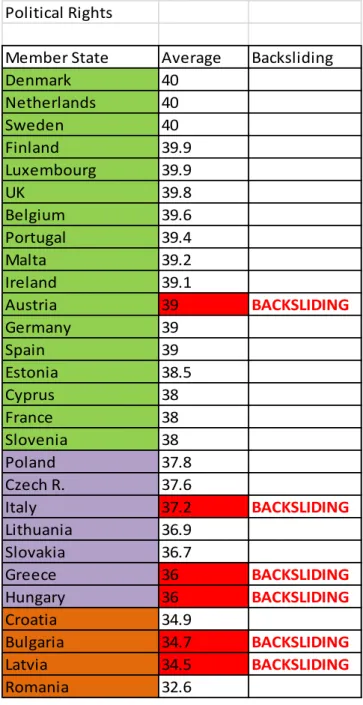
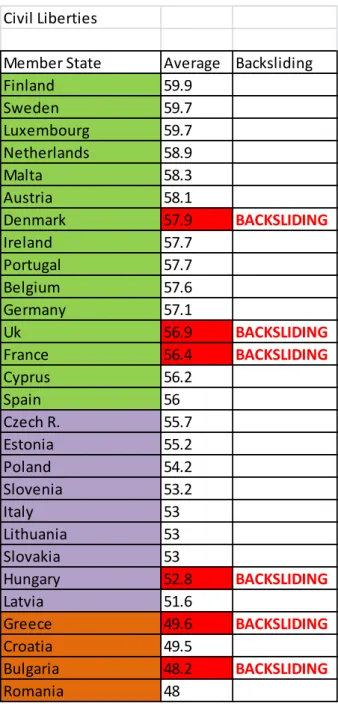
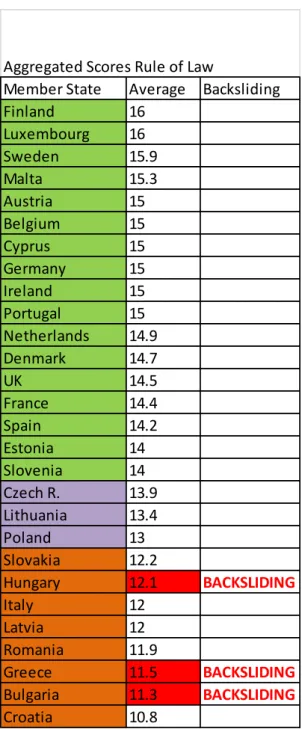
Freedom House’s Freedom in the World annual report provides assessments of developments in political rights and civil liberties, composed of numerical ratings and descriptive texts for each country and a select group of related and disputed territories. The data is designed to be comparable over time and across countries. Political Rights are scored based on data from three subcategories (with a maximum of 40 points in total): Electoral Process, Political Pluralism and Participation, and Functioning of Government. Civil Liberties are scored based on four subcategories (to a total of 60 points): Freedom of Expression and Belief, Associational and Organizational Rights, Rule of Law, and Personal Autonomy and Individual Right. The Rule of Law is a subcategory for Civil Liberties, based on questions about the independence of the judiciary and the workings of the police, courts and due process. Of the 28 EU states three countries – Bulgaria, Hungary, and Greece – have scores that indicated backsliding both of the domains used here, Political Rights and Civil Liberties. In terms of the rule of law, they drop from 13-14 points to 10-11 points over the decade up to 2016. The data is reported in Annex 1.
European Union Institutions
The rule of law is one of the fundamental values on which the EU is based according to Article 2 of the Treaty on European Union. The article explicitly states that “[t]he Union is founded on the values of respect for human dignity, liberty, democracy, equality, the rule of law and respect for human rights, including the rights of persons belonging to minorities. (…) [F]ailure by a Member State to respect these values may lead to the suspension of that Member State's rights deriving from membership of the Union (Article I-59)” 43. Nevertheless, it has been
42 See Annex 1.
43 Treaty on European Union, Official Journal C 326 , 26/10/2012 P. 0001 – 0390. Available at: http://eur- lex.europa.eu/legal-content/EN/ALL/?uri=celex:12012M/TXT
13
pointed out that the current EU legal framework is ill designed when it comes to addressing internal, systemic threats to the rule of law. This has become a significant issue to the extent that rule of law related crises appear to have gained both on intensity and regularity in the past decade44.
In a well-noted speech on 4 September 2013, Viviane Reding, former EU Justice Commissioner, drew an interesting parallel between Europe’s economic and financial crisis and what she viewed as an increasing number of ‘rule of law crises’ revealing problems of a systemic nature.45 Three concrete examples were mentioned in her speech:
The French government’s attempt in summer 2010 to secretly implement a collective deportation policy aimed at EU citizens of Romani ethnicity despite contrary assurances given to the Commission that Roma people were not being singled out;
The Hungarian government’s attempt in 2011 to undermine the independence of the judiciary by implementing an early mandatory retirement policy; and
The Romanian government’s failure to comply with key judgments of the national constitutional court in 2012.
Taken together, these episodes have been often understood as demonstrating the increasing number of instances where national authorities were undermining key EU values such as the rule of law. In his 2012 State of the Union address, José Manuel Barroso, then the President of the European Commission, spoke of worrying ‘threats to the legal and democratic fabric in some of our European states’ which need to be brought into check.46 The EC has expressed particular concern over developments taking place in Hungary. Recently Hungary’s Prime Minister has advocated the establishment of an ‘illiberal state’ and referred to Putin’s Russia and Communist China as two possible models to follow.47 The EU considers that the call for an illiberal regime starkly contradicts Article 2 TEU. The issuing of Tavares Report48 by the European Parliament in 2012 signalled a change in the approach to Hungary from treating it as a state with a few isolated problems to a systemic problem.
44 Dimitry Kochenov and Laurent Pech, “Upholding the Rule of Law in the EU: On the Commission’s ‘Pre-Article 7 Procedure’ as a Timid Step in the Right Direction.” EUI Working Papers, Robert Schuman Centre for Advanced Studies Global Governance Programme 2015, 164.
45 Viviane Reding, “The EU and the Rule of Law – What’s Next?”, 2013, Press Release Database, available at:
http://europa.eu/rapid/press-release_SPEECH-13-677_en.htm
46 José Manuel Barroso, State of the Union 2012 Address, 2012, Press Release Database, available at:
http://europa.eu/rapid/press-release_SPEECH-12-596_en.htm
47 EUObserver, Brussels, 28 July 2014 ‘Orban Wants to Build an Illiberal State’, available at:
https://euobserver.com/political/125128
48 European Parliament Motion for a European Parliament Resolution on the situation of fundamental rights:
standards and practices in Hungary (pursuant to the European Parliament resolution of 16 February 2012) (2012/2130(INI)), available at:
http://www.europarl.europa.eu/sides/getDoc.do?type=REPORT&reference=A7-2013-0229&language=EN
14
The landslide victory of nationalist Law and Justice Party in Polish 2015 elections was marked by fast paced developments, including replacement of previous judicial appointees to the country’s constitutional court and passing changes to the rules regulating the court that would make it harder for it to block legislation. On January 13, 2016 The European Union’s executive branch reprimanded Poland after determining that it had failed to uphold the rule of law. On April 13, 2016 MEPs passed a non-binding resolution calling on the Polish authorities to restore the ability of Poland’s Constitutional Tribunal to uphold its Constitution and guarantee respect for the rule of law49.
The vice-president of the Commission, Frans Timmermans, and his lawyers accuse the Polish government of "systematically endangering" the rule of law in Poland. They said that changes in the composition of Poland's constitutional court and the circumvention of its modus operandi restrict the independence of the judiciary in a manner that contravenes European principles of the rule of law50. These basic principles are laid down in the Lisbon Treaty, to which of course Poland, as a member state, is of course also a signatory. The situation has been aggravated by the government's refusal to publish and recognize the court's judgments.
The proceedings against Poland constitute a rare intervention that reflects increasing alarm in the West about the government’s commitment to democratic norms.
Venice Commission
The concept of the “Rule of Law”, along with democracy and human rights, makes up the three pillars of the Council of Europe51 and is endorsed in the Preamble to the European Convention on Human Rights52. A democracy watchdog, the Venice Commission closely monitors developments in the field of constitutional law. Since 2008 the Commission issued 16 negative opinions, which clearly demonstrate backsliding tendencies countries including Bulgaria, Hungary, Romania and Poland. The state of the rule of in Hungary received particularly critical attention, resulting in an unprecedented number of opinions issued between 2011 and 2015. The Commission has criticized the far reaching Constitutional reforms and systematic curbing of media freedom by Prime Minister Viktor Orbán’s government.
49 European Parliament resolution of 13 April 2016 on the situation in Poland (2015/3031(RSP)). Available at:
http://www.europarl.europa.eu/sides/getDoc.do?pubRef=-//EP//TEXT+TA+P8-TA-2016- 0123+0+DOC+XML+V0//EN
50 European Commission, “Commission adopts Rule of Law Opinion on the situation in Poland”, 2016, Press Release Database, available at: http://europa.eu/rapid/press-release_IP-16-2015_en.htm
51 Statute of the Council of Europe, London, 5.V.1949, Article 3, available at:
https://www.coe.int/en/web/conventions/full-list/-/conventions/rms/0900001680306052
52 European Convention on Human Rights, Rome, 4.XI.1950, Preamble, available at:
http://www.echr.coe.int/Documents/Convention_ENG.pdf
15 Table 1 Bulgaria
Opinion on the Constitution of Bulgaria adopted by the Venice Commission at its 74th Plenary Session (Venice, 14-15 March 2008)
Opinion on the draft Act to amend and supplement the Constitution (in the field of the Judiciary) of the Republic of Bulgaria, adopted by the Venice Commission at its 104th Plenary Session (Venice, 23-24 October 2015)
Table 2 Hungary
Opinion on three legal questions arising in the process of drafting the New Constitution of Hungary - Adopted by the Venice Commission at its 86th Plenary Session ( Venice, 25-26 March 2011)
Opinion on the new Constitution of Hungary adopted by the Venice Commission at its 87th Plenary Session (Venice, 17- 18 June 2011)
Opinion on Act CLXII of 2011 on the Legal Status and Remuneration of Judges and Act CLXI of 2011 on the Organisation and Administration of Courts of Hungary, adopted by the Venice Commission at its 90th Plenary Session (Venice, 16-17 March 2012)
Opinion on Act CCVI of 2011 on the right to freedom of conscience and religion and the legal status of churches, denominations and religious communities of Hungary adopted by the Venice Commission at its 90th Plenary Session (Venice, 16-17 March 2012)
Opinion on Act CLI of 2011 on the Constitutional Court of Hungary adopted by the Venice Commission at its 91st Plenary Session (Venice, 15-16 June 2012)
Opinion on Act CLXIII of 2011 on the Prosecution Service and Act CLXIV of 2011 on the Status of the Prosecutor General, Prosecutors and other Prosecution Employees and the Prosecution Career of Hungary, adopted by the Venice Commission at its 91st Plenary Session (Venice, 15-16 June 2012)
Opinion on the Act on the Rights of Nationalities of Hungary adopted by the Venice Commission at its 91st Plenary Session (Venice, 15-16 June 2012)
Opinion on Act CXII of 2011 on informational Self-determination and Freedom of Information of Hungary, adopted by the Venice Commission at its 92nd Plenary Session (Venice, 12-13 October 2012)
Opinion on the Cardinal Acts on the Judiciary that were amended following the adoption of Opinion CDL-AD(2012)001 on Hungary, adopted by the Venice Commission at its 92nd Plenary Session (Venice, 12-13 October 2012)
Opinion on the Fourth Amendment to the Fundamental Law of Hungary Adopted by the Venice Commission at its 95th Plenary Session, Venice, 14-15 June 2013
Opinion on Media Legislation (ACT CLXXXV on Media Services and on the Mass Media, Act CIV on the Freedom of the Press, and the Legislation on Taxation of Advertisement Revenues of Mass Media) of Hungary, adopted by the Venice Commission at its 103rd Plenary Session (Venice, 19-20 June 2015)
Table 3 Poland
Opinion on amendments to the Act of 25 June 2015 on the Constitutional Tribunal of Poland, adopted by the Venice Commission at its 106th Plenary Session, (Venice , 11-12 March 2015)
Table 4 Romania
Opinion on the compatibility with Constitutional principles and the Rule of Law of actions taken by the Government and the Parliament of Romania in respect of other State institutions and on the Government emergency ordinance on amendment to the Law N° 47/1992 regarding the organisation and functioning of the Constitutional Court and on the Government emergency ordinance on amending and completing the Law N° 3/2000 regarding the organisation of a referendum of Romania, Adopted by the Venice Commission at its 93rd Plenary Session (Venice, 14-15 December 2012) Opinion on the Draft Law on the Review of the Constitution of Romania, adopted by the Venice Commission at its 98th Plenary Session, (Venice, 21-22 March 2014)
In 2016 the attention fell on “constitutional crisis” unravelling in Poland following a landslide victory of the conservative party Law and Order (PIS). The government has effectively precluded the Court from ruling on the constitutionality of legislation. This weakens a key pillar of the democratic rule of law – and thus is highly problematic for Poland and Europe alike. The instantaneous reform to the constitutional tribunal was criticized in the Opinion on Amendments to the Act of 25 June 2015 on the Constitutional Tribunal of Poland Adopted at
16
106th Plenary Session March 11-12 2016. The released report stated that some of the changes were a threat not just to rule of law, but to democracy and human rights.53
Helsinki Committee
Backsliding in the field of the rule of law has also been documented in numerous reports issued by the Helsinki Committee. In 2009 Bulgarian legislative amendments proposed by the Justice Ministry for reform in the Meetings and Rallies Act were criticized by Bulgarian Helsinki Committee for posing seriously restrictions on the right to peaceful assembly54. The Committee also commented extensively on the ongoing violation of media freedom, deteriorating respect for judicial independence, and rampant corruption55. Similar criticisms were directed in 2009 at Croatia by the Human Rights House Foundation56. However, the strongest disparagement was once again directed at Hungary57. On numerous occasions The Hungarian Helsinki Committee expressed concerns over Constitutional amendments which undermined judicial independence, stripped the Constitutional Court of significant powers, and introduced several legal provisions previously ruled unconstitutional. The Committee also criticized media laws in particular the lack of political independence of media regulator the Media Council.
In the beginning of 2016 Helsinki Committee turned its attention to Poland. In January 2016 the Netherlands Helsinki Committee joined an appeal by the Civic Solidarity Platform NGO coalition, expressing concern about amendments in the Polish media and judiciary legislation58. In July 2016, the Management Board and the Board of Directors of the Helsinki Foundation for Human Rights and the Helsinki Committee in Poland have issued a joint statement regarding the changes in the Polish judiciary. “What is done to the Constitutional Tribunal and the personnel that forms the body is ridiculing the rule of law and the state.
53 Venice Commission, 106th Plenary Session, Opinion on Amendments to the Act of 25 June 2015 on the Constitutional Tribunal of Poland, Opinion no. 833/2015, available at:
http://www.venice.coe.int/webforms/documents/?pdf=CDL-AD(2016)001-e
54 Bulgarian Helsinki Committee, 2009, New legislative amendments proposed by the government will restrict freedom of peaceful assembly. Available at: http://www.bghelsinki.org/en/news/bg/single/new-legislative- amendments-proposed-by-the-government-will-restrict-freedom-of-peaceful-assembly/
55 Bulgarian Helsinki Committee, 2013, A Bulgarian Spring? Entrenched Protests Challenge Eastern Europe’s Status Quo. Available at: http://www.bghelsinki.org/en/news/bg/single/bulgarian-spring-entrenched- protests-challenge-eastern-europes-status-quo/
56 Human Rights House Foundation, 2009, Freedom of expression violations in Croatia. Available at:
http://humanrightshouse.org/Articles/12503.html
57 The Hungarian Helsinki Committee, 2015, Analysis of the Performance of Hungary’s “One-Party Elected”
Constitutional Court Judges Between 2011 and 2014. Available at: http://helsinki.hu/wp- content/uploads/EKINT-HCLU-HHC_Analysing_CC_judges_performances_2015.pdf
58 Netherlands Helsinki Committee, 2016, Concerns over the rule of law in Poland. Available at:
http://www.nhc.nl/news/Concerns_over_the_rule_of_law_in_Poland.html?id=716&highlight=+EU
17
Simultaneously, other bodies that are formally independent, have come under major pressure”59, wrote the signatories of the statement.
Since 2010 the committee issued more than 20 reports about Hungarian ‘illiberal’ reforms and violation of principles enshrined in the Polish Constitutions. The main message is that these two countries now jeopardize European democratic norms.
Since 1990s the Committee has not criticized any other member state.
Trends
The overall trends confirm the expectation that backsliding with respect to the rule of law is primarily a problem for the new member states (the 13 that joined in 2004 or later) – with the two old member states in trouble being Italy and Greece. Going by the Freedom House data, some 10 member states have a solid record over the eight years since 2008, 3 have a mixed record, 5 are somewhat problematic on more than one count (Slovakia, Latvia, Romania, Croatia and Italy) and 3 show serious and persistent problems (Hungary, Bulgaria and Greece). When this is combined with data and report from the EU, Venice Commission and the Helsinki Committees, Hungary and Poland emerge as the to front runner in terms of backsliding (the Polish case is so recent that the impact on Freedom House data has yet to become manifest). Bulgaria and Romania also make an appearance on several list, but do not compare with Hungary and Poland when it comes to the substantial qualitative reports for the EU, Venice Commission and the Helsinki Committees. Of the old member states, Italy and France have on occasion raised concerns, but the most persistent case of backsliding is Greece. Again, however, none of these are comparabvle to the Polish and Hungarian case in terms of severity.
BACKSLIDING AND CORRUPTION
To the extent that the economic crisis has merited extraordinary measures, it has provided an opportunity for political actors – particularly populist parties - to advocate or claim to step up anti-corruption campaigns. These are often politically motivated. Crisis measures may also have changed opportunity structures on the national level in ways that might affect both the level and type of corruption. Likewise, the crisis may have provided an opportunity for changing anti-corruption legislation, and in some cases dampen anti-corruption efforts for instance by cutting resources for national institutions tasked with corruption control.
59 Helsinki Committee in Poland, 2016, The Constitutional Role of the Judiciary in Poland Has Been Completely Undermined. Available at: http://www.hfhr.pl/en/the-constitutional-role-of-the-judiciary-in-poland-has- been-completely-undermined/
18 Mapping Corruption
There is relatively little hard backsliding with respect to corruption, largely because this is primarily a matter for the member states in terms of legislation. It is often treated as a matter of crime, or even organized crime. The main EU laws pertinent to corruption and corruption control is related to the EU’s financial interests – notably in terms of rules on public procurement, the Structural Funds spending and the work of European Anti-Fraud Office (OLAF). Most of the information on backsliding on corruption is a matter of soft backsliding, such as the new member states’ commitment at the time of accession to curb corruption (corruption was treated as part of accession conditionality, i.e. the Copenhagen criteria, at the time of enlargement).
However, capturing patterns of soft backsliding across member states is extremely difficult.
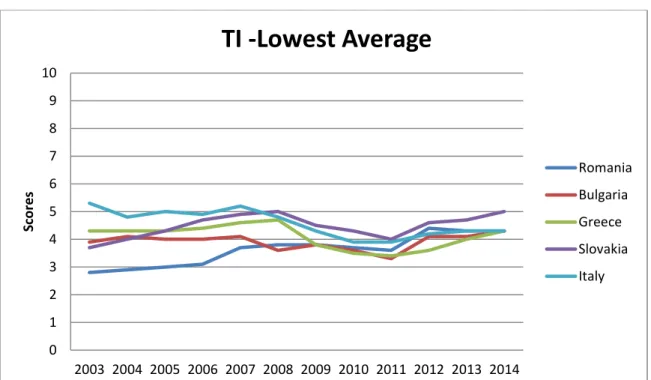
The main problem is the availability of measurement tools. To date there is no completely reliable method of indicating the overall volume or frequency of corrupt transactions in a country. The most commonly used quantitative indicators are the World Bank (WB) Governance Indicators /Control of Corruption indicator60 and Transparency International’s Corruption Perception Index (CPI).61 Both are composite indices that are limited by the reliability of the sources they draw on; and both draw on perceptions of corruption rather than ‘solid’ data on actual occurrence of corruption and therefore are relatively poor for indicating trends over time, particularly changes in relatively short periods of time. The weakness of the quantitative indicators is evident in the sense that many countries seem to follow different patterns in the CPI and WB indicator; i.e. the data contradict rather than confirm patterns shown by one or the other. An additional indicator, the Nations in Transit62 expert evaluations score, exists only for the new member states and can therefore not be used for comprehensive cross-EU comparison. Finally the Global Corruption Barometer63 survey respondents in a wide range of countries on their actual experiences of corruption as well as perceptions of how and to what extent they see various institutions affected by corruption in their country. However while the Barometer is a more reliable tool for indicating the extent of everyday forms of corruption in a country (petty corruption or bureaucratic corruption), it misses out on the much more important phenomenon of high level political corruption and state capture – which is as a potential problem for both democracy and for the EU as an organization.
60 World Bank Development Research Group, Natural Resource Governance Institute, and Brookings Institution, 1996-2014, Worldwide Governance Indicators. Available at:
http://info.worldbank.org/governance/wgi/index.aspx#home
61 Transparency International: The Global Coalition against Corruption, 1995-2015, Corruption Perceptions Index. Available at: http://www.transparency.org/research/cpi/overview
62 Freedom House: Nations in Transit, 2003-2016, Corruption Rankings. Available at:
https://freedomhouse.org/report-types/nations-transit
63Transparency International: The Global Coalition against Corruption, 2003-2015, Global Corruption Barometer.
Available at: http://www.transparency.org/research/gcb/overview
19 Trends
In the absence of better indicators that would be available for the whole time period and for the whole group of EU countries, a number of conclusions can still be drawn from the CPI and WB data about the state of corruption in EU member states. First, in terms of overall levels, the EU is characterized by great heterogeneity: among the current member states one finds both the countries perceived as ‘cleanest’ globally, notably the Scandinavian member states, and also some medium corrupt countries that do ‘worse’ than many developing countries in generally more challenging governance contexts. Among the latter Greece, Italy and a number of ‘new’ member states – Bulgaria, Romania and Slovakia - stand out, in the negative sense, as rather corrupt (CPI data). Second, it is worth pointing out that a number of new member states do well in EU comparison: for instance Estonia compares well with several long standing member states suggesting that North-South may be a relevant division in Europe. Nonetheless, the quantitative indicators confirm the commonly held opinion that corruption is a problem chiefly in the post-communist part of the EU as well as Italy and Greece.
In terms of developments over time, the methodological limitations of the data are most constraining. With this caveat, a number of observations can still be made. Most importantly, for the majority of EU countries the pattern is stagnation rather than marked upward or downward swings in perceived levels of corruption. This is not to say that individual countries’
values remained constant over the past decade or so but rather that, at least according to the quantitative data sets, only relatively minor or temporary changes can be observed for the majority of EU member states. However, with respect to a number of individual countries, some trends may nonetheless be pinpointed. First, Poland is shown in the data sets to have improved considerably over the past ten years, from one of the regional laggards to one of the cleanest countries among the new member states. A similarly positive though less marked trend can be observed with respect to Estonia, which was however in any case among the post-communist countries with a least severe corruption problem. On the other hand, at least the WB data shows Hungary and Slovenia to have declined in the rankings. Among the old member states, Greece and Italy are shown to have a negative trend in levels of perceived corruption in the last few years.
The (direct) impact of the economic crisis
The WB and TI data both show relatively little change from the early 2000s to the early 2010s, and no marked impact in the late 2000s that could be directly attributed to the financial and economic crisis. This is to some extent surprising: it would have been reasonable to expect that the crisis created fertile conditions for corruption to ‘erupt’. On the one hand, the crisis may have boosted corrupt practices in the sense that the stimulus packages – the injection of public funds into the economy as a crisis measure – impacted on supply side factors. On the