Toxicity and biocompatibility
This can take from 1-2 weeks to several months based on the degradation rate of the polymer. Spatial conformation of the polymer is important, functional groups must be available to promote adhesion.
Environmental conditions and physical properties
Crosslinking, polymer chain flexibility, and polymer concentration also have significant effects. Functional groups and sites can interact with cells thereby increasing the bioadhesion of the polymer.
Controlled degradation
In the third step, the enzyme performs a specific cleavage of the chain in the polymer, which depends on the polymer and the type of enzyme. Finally, the polymer-enzyme complex, formed in the second step, can interact with other segments of the polymer, inhibiting or promoting degradation.
Most common materials in the medical sector
- Ceramics and metals
- Biopolymers
- Natural polymers
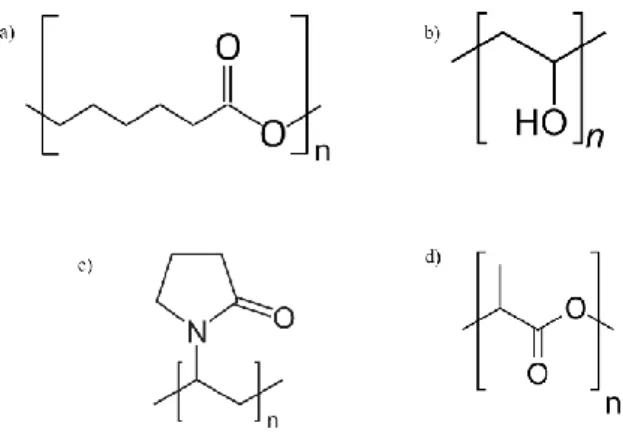
When PCL is combined with PLA or PLGA, the properties can also be compared to those of bone tissue [90,91]. The physical properties of the polymer can be tailored by changing the ratio of the two different configurations [113].
Interactions and modification
- Miscibility and compatibility – basic terms
- Compatibilization of starch containing blends
- Composites, nanocomposites
In order to improve the properties of starch, it is often mixed with other polymers. Several reinforcing agents can be added to improve the mechanical properties of biopolymers and natural polymers, including in the field of medical applications.
Functionalization for specific application areas
- Drug delivery systems
- Bioactive compounds
One is the mixture load, when a mixture of the drug and the polymer is created before processing [229]. When the interactions are stronger between the drug and the polymer, the release rate of the drug can be lower [237].
Scope
We characterized the mechanical properties and structure and evaluated the strength of the interfacial adhesion between the components. The interaction between the components determines the properties of the final device, as was shown in Chapters 2 and 3.
In this chapter, by studying the drug release at different pHs, we study the mechanism of drug release to determine how the interaction between the matrix and the drug affects the application, so that we can adjust the properties to achieve the desired result. The main purpose of this chapter is to give a brief overview of the background and achievements of our research work, while at the same time highlighting the points of the thesis that were raised along the way.
- Experimental
- Materials
- Sample preparation
- Characterization
- Results and discussion
- Structure of the reinforcements
- Interactions
- Local deformation processes
- Deformation and failure
- Discussion
- Conclusions
- References
A Ceast Resil 5.5 impact tester (Ceast spa, Pianezza, Italy) was used to determine the Charpy impact strength (ISO 179 standard at 23 °C with 2 mm indentation depth) of the samples. Chemical structure of the reinforcements used in the study; a) cellulose, b) amylopectin (the structure of amylose is the same, but without branching).

Experimental
- Materials
- Synthesis and characterization of starch acetates
- Synthesis of maleic anhydride-grafted polylactide
- Preparation and characterization of starch acetate/PLA composites
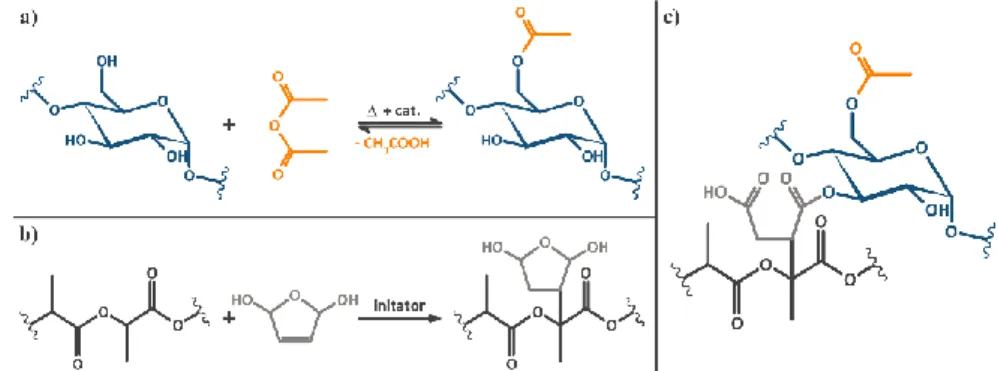
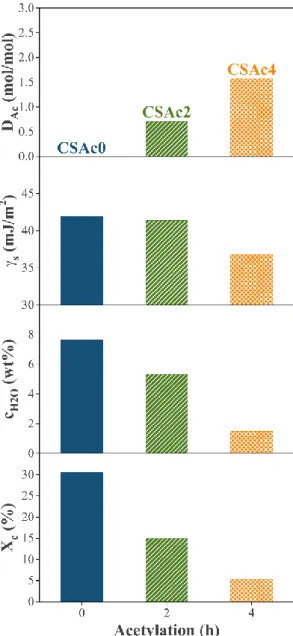
The addition of starch was considered to initiate the reaction presented in Figure 3.1a, which was then carried out for either 2 or 4 hours. The degree of acetylation was determined by saponifying the polymers and analyzing the released carboxylic acid by high-performance liquid chromatography (HPLC). Quantification of the released acetic acid was performed by HPLC (Dionex Thermo Fisher, CA, USA) coupled with a UV detector (210 nm) using a Rezex ROA-Organic acid column (300 7.8 mm; Phenomenex, Torrance, CA , USA).
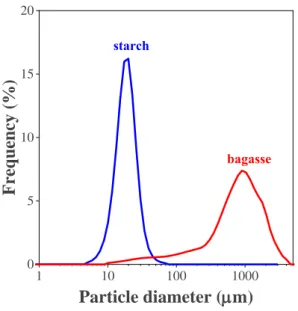
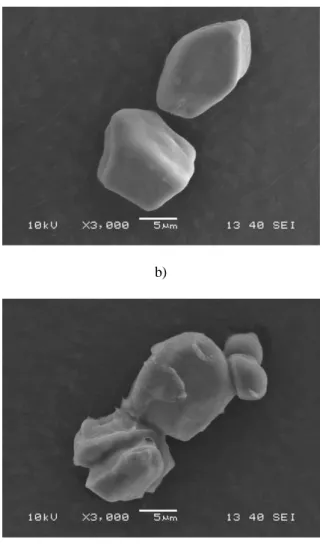
Crystalline structure was characterized by X-ray diffraction (XRD) measurements performed between 5 and 60 2ϴ angles with a Malvern PANalytical X'Pert PRO (Malvern Panalytical B.V., The Netherlands) powder diffractometer operated at 45 mA. The morphology of the starch granules was studied by digital optical microscopy (DOM; Keyence VHX5000, Keyence Corporation, Osaka, Japan) accompanied by image analysis as well as scanning electron microscopy (SEM; JEOL JSM-6380 LA, JEOL Ltd., Tokyo, Japan). The starch content of the composites, both with and without coupling agent, was varied between 0 and 40 vol% in steps of 10 vol%.
The morphology of the composites was studied by SEM (JEOL JSM-6380 LA, JEOL Ltd., Japan);
Results and discussion
- The effect of acetylation on the properties of corn starch
- The effect of acetylation on interactions, structure, and mechanical perfor-
- Local deformations and acoustic activity
- Compatibilization with maleic anhydride-grafted PLA
- The effect of moisture on mechanical behavior
- Water uptake
Therefore, acetylation is expected to have a significant effect on the thermal stability of the polysaccharide. The mechanical performance of the composites, analyzed by tensile testing, is influenced by numerous factors. As one can observe in Figure 3.10, some of the cumulative number of signal traces starts above ca.
On the other hand, the mechanical performance of composites based on fillers and natural fibers is often limited by the inherent characteristics of dispersed particles. Therefore, breakage of dispersed particles can occur in the case of strong adhesion, placing a limit on the macroscopic performance. Importantly, however, the modification also reduces the number of polysaccharide hydroxyl groups that can bind to MAPLA.
The DH2O value determined for PLA is in agreement with previous studies [24], while that of the composites decreases sharply as a function of the starch content.
Conclusions
Since coupling does not change the chemical composition and characteristics of the composites, apart from the introduction of a small number of grafted maleic anhydride groups and their maleate reaction products, its impact on equilibrium water uptake is negligible (Figure 3.13). On the other hand, the addition of MAPLA clearly facilitates the diffusion of water, indicated by the upward shift of DH2O values (Figure 3.14, right v. left). The lower molar mass of the coupling agent compared to that of the matrix is not expected to affect the diffusion rate, since molecular mobility above a critical threshold should be independent of chain length.
This effect cannot be overcome by the addition of maleic anhydride-grafted PLA as a coupling agent due to the lack of reactive functional groups on the surface of the polysaccharide granules. At the same time, esterification also results in more stable mechanical properties under different moisture conditions, as the hydrophobic modification greatly reduces the equilibrium water content in the composites. The rate of diffusion, on the other hand, increases as a result of the substitution of hydroxyl groups with less polar ones, which hinders interactions between water and starch.
This modification makes this material a good candidate for use in scaffolds, especially in the case of bone scaffolds, after its properties are adapted to meet other requirements presented by the field of application.
In other words, and contrary to previous claims, starch esterification does not improve compatibility with the less polar matrix polymer.
- Experimental
- Materials
- Sample preparation, processing
- Characterization, measurements
- Results and discussion
- Bulk properties
- Structure
- Segregation, skin formation
- Considerations, discussion
- Consequences
- Conclusions
- References
Implications for properties and practice are discussed in the last part of the article. The spectra are shown in Figure 4.6 along with those of the pure PLA and TPS for reference. The composition of the core and skin is shown in Figure 4.7 as a function of position measured from the surface.
The explanation for the segregation of the components and the formation of the skin and core structure needs further consideration. The composition of PLA/TPS47 blends as a function of position measured from the surface of the sample. Frequency dependence of the complex viscosity of PLA and TPS47 determined by oscillating rheometry in the plate-plate geometry.
Weak interactions and a large difference in the viscosity of the components lead to separation, the formation of a skin layer on the surface of the specimens.

- Experimental
- Materials
- Sample preparation
- Characterization
- Results and discussion
- Halloysite content
- Homogeneity, distribution
- Thermal analysis, crystalline structure
- Tensile properties
- Fiber spinning
- Conclusions
- References
The homogeneity and the structure of the samples were studied by scanning electron microscopy (SEM) (Jeol JSM 6380 LA, Jeol, Tokyo, Japan). The actual halloysite content of the composites prepared and the homogeneity of the filler in the polymer are discussed in the first two. Equal amounts of the two quantities are indicated by the straight line in the figure.
The melting characteristics, temperature (Tm) and heat of fusion (ΔHm) of the polymer are plotted against halloysite content in Figure 5.7. The modulus depends mainly on the composition, on the volume fraction of the filler in the polymer. Effect of electrospinning on halloysite distribution and fiber structure prepared from PCL/haloysite composite materials.
The strength and elongation of the samples are shown in Figure 5.12 as a function of halloysite content.

- Experimental
- Materials
- Solutions
- Electrospinning
- Release experiments
- Characterization
- Results and discussion
- Fiber spinning, parameters
- Fiber characteristics
- Drug morphology, location
- Drug release
- Release rates, mechanisms
- Conclusions
- References
The encapsulation of the drug in the fibers was checked by Fourier transform infrared spectroscopy (FTIR). The morphology of the fibers was studied by digital optical (DOM) and scanning electron (SEM) microscopy. Diameter distribution of electrospun fibers prepared from PVP with and without the drug.
Diameter of the fibers spun from the polymers used in the study and the effect of incorporating the drug into them. The release of the drug from the electrospun fibers was studied under the same conditions. The dissolution of the drug from the PVA matrix is large and practically independent of pH.
Effect of the pH of the dissolution medium on the dissolution rate of valsartan and that of the drug from electrospun fibers.

Heterogeneous structure is formed in the mixtures due to the weak interaction of the components. Weak interactions and the large difference in the viscosity of the components lead to the formation of a skin on the surface of the samples. The development of the skin layer can be beneficial in some applications (such as medical) because it slows down water absorption significantly.
PCL/haloysite composites were prepared to compare the effect of homogenization technology on the structure and properties of the composites in Chapter 5. The mechanical properties of the polymer deteriorate as the stacking rate increases; hardness also depends on homogeneity. The inclusion of the drug in the fibers increased its digestibility in all cases compared to that of the regular drug.
I also appreciate the financial support of the National Scientific Research Fund of Hungary (OTKA Grant No. FK129270, K 120039).
![Figure 1.2. The most common biopolymers for tissue engineering purposes: a) gelatin [164], b) cellulose, c) amylose, d) amylopectin](https://thumb-eu.123doks.com/thumbv2/9dokorg/2498195.294453/16.701.67.591.475.753/figure-biopolymers-engineering-purposes-gelatin-cellulose-amylose-amylopectin.webp)