This working paper discusses the results of a content analysis of the mainstream media's coverage of Roma in 2011. This report aims to describe the current state of the representation of Roma in the Hungarian media.
Social changes
The use of the term "Roma crime" assumes a causal relationship between Roma identity and the prevalence of criminality. However, it was not only the prejudices of the majority or the press that maintained the stereotype of "Roma criminality", as the institutional structure of criminal prosecution was also supportive of this concept for several decades.
Public discourse
They are the ones who are more willing to talk about their views regarding minorities and do so more often than others, while those who belong to the moderate anti-Roma and tolerant categories almost never express their opinion on this matter. Furthermore, since, due to school segregation, non-Roma students never meet Roma students in a significant proportion of schools in Budapest and do not have teachers of Roma origin, anti-Roma youth do not gain experiences direct that can challenge them. prejudices.
Politician talk (and its consequences)
In addition, Hungary lacks any distinctly anti-racist subculture, which could represent a point of reference in the formation of identity, at least for some young people. Partly as a result of this development, in the light of extreme right-wing rhetoric, forms of speech that were previously rejected, but not inciting, slowly became accepted.
How public policies see the Gypsies and Poors
This is what is going on regarding the meanings and interpretations of the term 'integration', aptly transcribed using prefixes.19 Let us consider a few examples: rigid integration': 'integration with regard to socio-cultural disadvantages and special educational needs, where this is essential on a personal, objective, infrastructural and budgetary level. lack of financial conditions is merely a 'rigid integration' that is harmful to everyone.” He believes more schools should be maintained by the church, where the majority of students are Roma.
Problems of access the other way round: Roma voices
Occasionally, the police are also active in shaping media representations: as happened in the case of the report26 showing the capture of a usurer in Ózd in real time. The Court of First Instance of Borsod-Abaúj-Zemplén County sentenced him for manslaughter to one year in prison, suspending the execution of the sentence with 2 years of probation. One of the pictures is about a broken window (with a caption referring to an unknown perpetrator, while in the text below Roma are accused of it), another shows the supports for the electric wire, while the picture in the middle depicts the convict posing with a pickaxe on his shoulder.
Before long, a competition began to exploit Uncle Barna's popularity: he became a candidate of the Alliance Party in the parliamentary elections.
Emphaticality, changes compared with earlier analyses
Differences were also observed between media outlets: Új Dunántúli Napló published the fewest articles (on average one every other day), while Roma-related reports were found basically every day in most newspapers.
Dominant topics
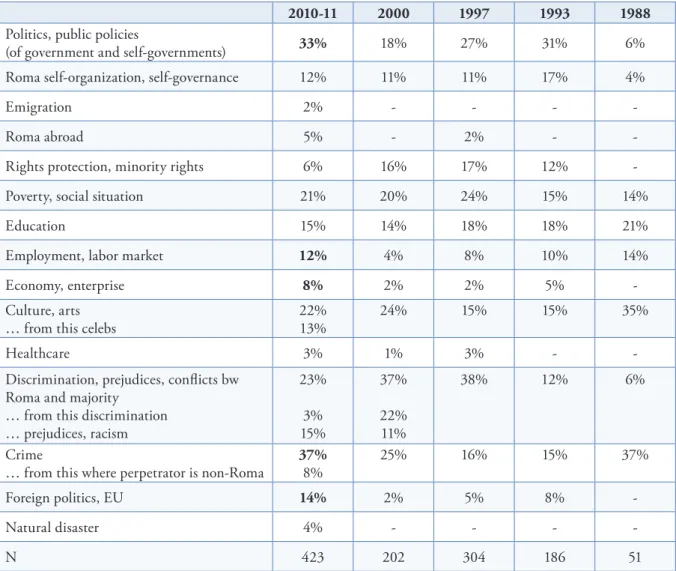
Given that, in addition, there is a low level of representation of minority self-organization (12%), and in addition, a third of these reports deal with criminal proceedings against the president of the NRS, the dominance of the government aspect of politics is particularly evident. . Therefore, most of the audience perceives a contradiction between the seemingly high expenditure on support on the one hand and persistent poverty on the other. Together, these four cases account for more than half (55%) of crime reporting, although there is considerable variation between media outlets.
Apart from the available surface, the changes are of course influenced by the assumed attitude of the audience and the views of the editors as well.
Transforming topics
Roma employment has always been covered in the media characteristically in relation to government policies and initiatives; This time, the increased attention to this field comes as a result of the transformation and expansion of the public employment system. The rare exceptions also belong to the reports that present the hopelessness of the employment situation of the Roma communities with the aim of finding a way out. An examination of the differences between media outlets reveals that the dominant majority of news on poverty was published in the two major political dailies and almost half of the articles on an online portal, while, with the exception of RTL Klub, this topic is almost entirely. neglected by television news programs as well as by origo.hu.
However, in the most recent sample, more than half of the publications in this category deal with stories about celebrities.
Kultúrával foglalkozó tudósítások továbbtagolása
At first glance, the high percentage of cultural news in media representations of Roma suggests that Roma culture appears in the publicity as a living, known and recognized culture. The majority of articles that fit into this category do not even mention Roma culture (or Roma in general): they depict individuals who, usually found through talent shows, happen to be Roma. These new talents are not even explicitly presented as Roma, because they are completely assimilated.
Further classification of reports on culture
Marginalized topics
The most important development regarding media content is the almost complete disappearance of coverage of discrimination. In contrast to this reality, in the world of news media only 15 out of 423 news items were mentioned. The rest informed about reports from international organizations and the (disapproving) reactions of the Hungarian government.
However, this increase can be attributed to the coverage of the conflict in Gyöngyöspata36 (38%) and the trial of the racist serial killers (35%).
New topics: ’Roma problem’ conceived of in European terms
In earlier research studies, we have accounted for the steadily growing media presence of rights protection agencies that thematize discrimination regarding Roma. The disappearance of discrimination from publicity has serious consequences - not only in terms of the media representation of Roma, but also regarding the integration of Roma and their cooperation with the majority. Writings about Roma communities living abroad account for another 5% of the sample, which is significant, especially compared to previous samples.
The problem of the largest minority population was transferred to an international context by the Hungarian media – that is, by certain newspapers.40.
Who are the Roma? – Roma and non-Roma roles
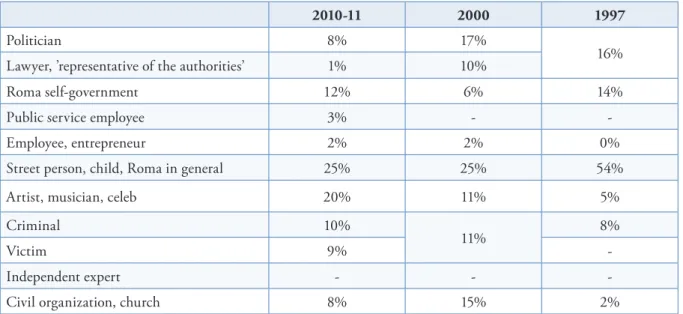
To be sure, such cases should not be printed in the media; The problem, rather, is that Roma organizations have no news value in other contexts. Another critical trend identified in the research was when the news placed Gypsy children in the context of crime. Half of the personified 'perpetrators' (it would be much more appropriate to use the term 'suspects' here) are involved in the criminal trials of the Cozma and Orbán Kolompár case.
Roma professionals or decision-makers are hardly visible in such representations: only members of the majority are interviewed as experts.43 Their absence is all the more striking in American or Western European comparisons, as professionals from minority groups give their opinions about 'non-minority groups' . Issues have also become standard media practice there.
Opportunities of access to media – Roma social roles in media representations
In Hungary, on the other hand, Roma professionals are completely absent from news coverage, and it is also exceptionally rare for Roma lawyers or employees working in public services to appear. Similarly, the weight of Roma actors undertaking advocacy work for Roma interests has been constantly decreasing since 1997. At that time, almost a quarter of Roma actors were representatives of minority self-government, while their share was halved by 2011 ( often) as a result of criminal proceedings).
Individualization
It is worth considering whether there are significant differences in this regard depending on the type of topic being addressed. Most importantly, the kind of discourse that refers to 'Roma in general' has become rare. Reports on Gyöngyöspata are exceptions, as they usually talk about Roma and 'Roma crime' in general, or at best refer to 'Gyöngyöspata Roma'.
57% of the Roma actors presented in these reports constitute a large group or population, and only 40% of them are shown as individuals.
Immediate voice – opportunities to talk
It is probably always easy in this context to let a politician or expert speak in the report. Furthermore, articles on cultural and local affairs were unlikely to adopt a generalizing discourse about Roma (5%, 15% and 6% respectively). Here too there are significant differences between the media outlets examined: every other report talks about Roma without giving them the chance to speak, or at least quote their opinions (Magyar Nemzet 51%, M1 58%, HírTv 50% ), while on the other political side these characteristics qualify media messages only in a quarter of the cases or even less often (Népszabadság 28%, RTLKlub 12%, TV2 Híradó 25%, Blikk 14%).
It is still the popular media that offer the most opportunities for cross-categorization, especially thanks to talent scouting and celebrity programs (it appears in 64% of articles published by Blikk), but 52% of news items in RTL Klub and 33% of the people from TV2 News also make it happen.
Mediatized Roma characteristics
Cross-categorization is now somewhat more frequent than it used to be: there has been an increase in the number of cases where Roma actors are defined not simply by their origin, but by reference to other characteristics. Tv2 and Új Dunántúli Napló were not as eager as the other media to convey any of these ideas. There is a remarkable scarcity of positive stereotypes emerging around 'serious' topics, or emerging in the political press (with the exception of index.hu).
By comparison, the content analysis of television news programs followed the same coding instructions as the analysis of the print press; its results can be read in the chapter on content analysis in general.

Television topics
Images of this type – especially those showing dirt roads, or dilapidated houses of Roma colonies in the background – often support the identification of Roma actors. At the time of the shooting, the perpetrators were unknown to the police; in the report, a relative of the victim makes a meaningful remark: all kinds of things are being talked about here. 57 In the case of Cozma's murder, Roma individuals were accused of murder, while in Tatárszentgyörgy Roma were shot dead (a child and his father) by a group of racist serial killers.
A Roma family of six attacked the police in the parking lot of the Tesco at Siófok."
Themes, motifs 1. Narrative motif
67 This country in the north-east of Hungary is one of the biggest crisis areas with a high level of Roma population and ghettoised settlements. However, the fact remains that in the comments that appeared in connection with the recording on three quite different portals69, comments related to the Roma and the wealth of the people depicted in the report dominated. The current discursive environment encourages the deterioration, rather than the improvement, of communication possibilities that support dignity and equality (not to mention other important goods such as solidarity), or the representation of the diversity of Roma perspectives.
Hartmann, Paul - Husband, Charles (1974): Racism and the Mass Media; a study of the role of the mass media in shaping the beliefs and attitudes of white people in Britain.