Introduction
Migration policy
The supposed losses included a sharp drop in the inflow of foreign currency, the disruption of all major bazaars, decrease in the number of jobs and general economic degradation of many sub-regions located close to the state border. Individual politicians took opposing positions, arguing about the principles (and scope) of the free movement of people in the context of the declining influx of Belarusians and Russians [eg. After a (gradual) improvement in the functioning of Polish consulates in Belarus, Russia and a few other affected countries, and more efficient work with customs services and document control at border checkpoints, the flow of foreigners became normal and the political debate subsided.
In the absence of other specific acts of migration policy (no new international agreements regarding visa-free movement, access to the labor market, readmission, etc. or accession to new international conventions), policy makers were engaged in intellectual activities related to the preparation of Poland to accession to the European Union. As regards the former, a strong desire has been expressed (among others by the Minister of Foreign Affairs) to maintain a special relationship with those two countries, which includes, among other things, a continuation of a visa-free regime in the period extending to the present of accession. Regarding the issue of labor migration, discussions are focused on the future negotiations on the length (and scope) of a transition period after accession during which Polish workers would be excluded from opportunities to take a legal job in the European market .
Transborder mobility (international movements of passengers)
In contrast, departures for Polish citizens continued to increase (by 8.7 percent compared to 1996), but despite that, their number remained much lower than the number of foreign arrivals (by 39,210.3 thousand in 1997). Interestingly, while the number of foreigners crossing Poland's western border (shared with Germany) increased significantly (by 14.5 percent), checkpoints at the southern and eastern borders (excluding those shared with six former socialist countries) recorded a decrease: 12, 2 percent in the case of the eastern border and 0.4 percent in the case of the southern border. However, this was much less than in the case of the least significant of the top seven countries (Lithuania, 1,719.3 thousand).
However, many foreigners declared a commercial purpose for their trip to Poland (7,287.6 thousand or 8.0 percent of the total), among whom the citizens of Germany clearly dominated (70.2 percent). 5 The respective ratio for the first half of 1988 for the citizens of Belarus and Ukraine (relative to the Czechs) was even higher than in 1997 and exceeded 850. In the case of the remaining (medium-sized) bazaars, the respective percentage was over 90 percent (6 units ) or just below this level (5 units).
Documented flows of migrants
- Introductory remark
- General trend
- Destination of emigrants and origin of immigrants
- Migration by sex, age and marital status
- Migrants by educational attainment
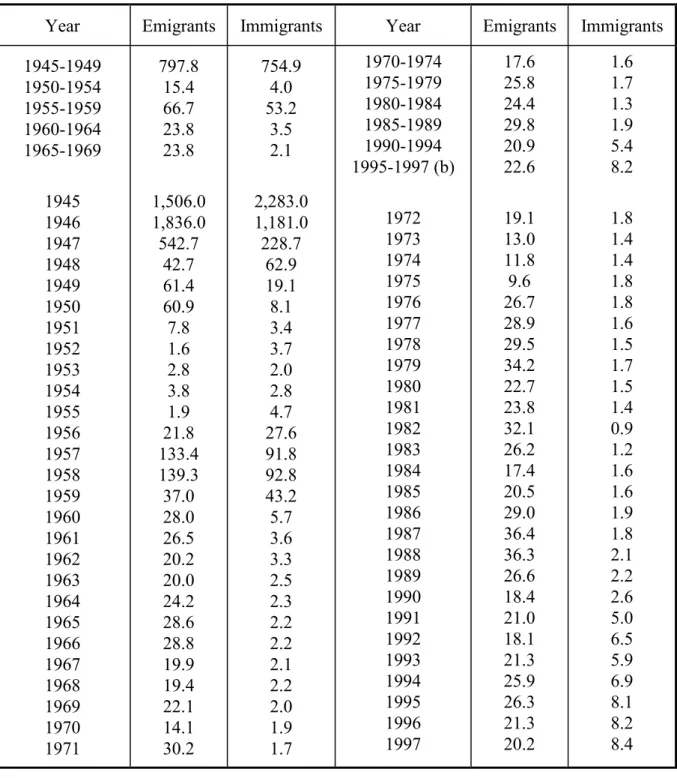
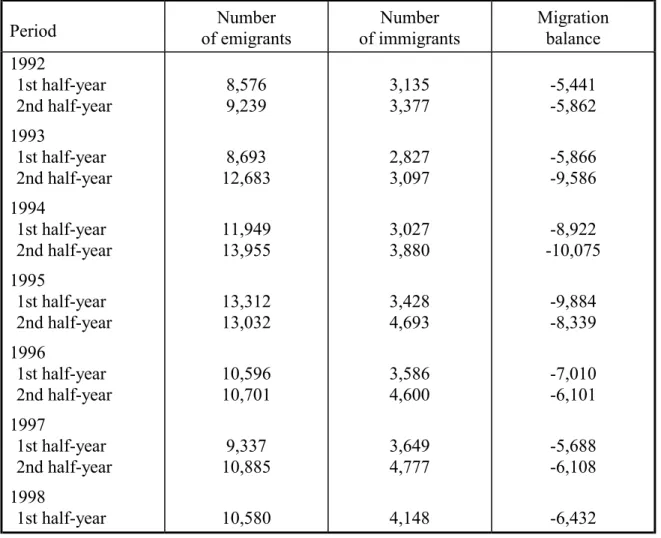
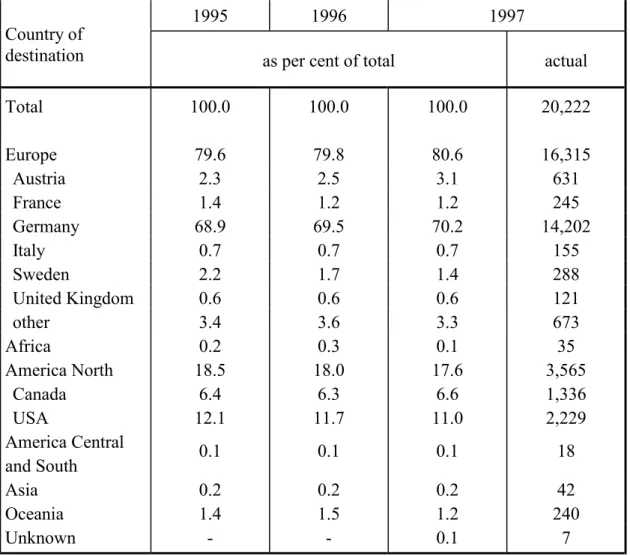
This is the result of a sharp decrease in outflows in the first half of this year. The decrease in the number of emigrants in 1997 was fairly evenly distributed among the main destination countries (Table 4). With a further increase in the number of immigrants (but at the same time a decrease in the number of emigrants destined for Germany), the absolute and relative importance of Germany (still the main country of origin) as a source country decreased.
The number of immigrants from this country decreased by 3 percent, and their share in the total number of immigrants by 1.4 percentage points (24.9 percent in 1997). However, it seemed to be more strongly supported in the case of emigration from Poland than immigration to Poland. The decrease in outflow in 1997 proved to be more pronounced for men than for women, i.e.
Stocks of migrants
Stock of immigrants/foreign citizens
Apps country Permissions granted. a) the figures for 1998 reflect a combination of two categories: 'permit to settle'. The picture of the presence of foreigners in Poland could be supplemented by some other data sources. Persons belonging to these three categories were generally not included in the statistics of permanent residence permits, so they represent another segment of (legal or legalized) foreigners in Poland.
In addition to the foreigners whose stay in Poland has been regularized, there are many foreign citizens without papers. A recent estimate attributed to the Central Bureau of Statistics speaks of 150,000 illegal foreigners working in Poland [L.Z., 1998]. In addition to people from Vietnam, large groups of irregular aliens come from Armenia, Belarus, Bulgaria, Romania, Russia and Ukraine.
Foreigners married to Polish citizens in Poland
Moreover, the number of unions stagnated among the major nationalities participating in mixed marriages with Polish women in the case of Dutch, French and Belgian women. In contrast, men from countries such as Ukraine, Vietnam or Armenia contributed to a rapid increase in the number of mixed unions with Polish citizens (Table 16). Even more important, probably largely due to Polish naturalization regulations, trends appear to be associated with intermarriage of Polish men.
No increase (but a decrease, often significant) was observed in the case of partners representing any Western nationality, and a decrease in the case of Germans was truly striking (by 86 percent. For example, the number of unions with a female partner from Ukraine (above the leading country in this respect) increased by 141 percent in and from Belarus by 126 percent. In the mid-1990s a new phenomenon of mixed marriages of Poles with Asian women began, and p. sh.
Stock of emigrants (permanent residents of Poland)
On the other hand, mixed unions increased strongly in which female partners were the citizens of many countries whose contribution to recent immigration to Poland is the greatest. The US takes the lead (with 45 percent) in the case of migrants staying abroad for more than one year.
Migrant workers
Migration for work from Poland
Other important countries here are:. of all 49 districts) included at least one relatively small, remote and underdeveloped unit, namely Suwalki District, where an increase in migration for seasonal work in 1993–1997 exceeded 80 percent. Many (albeit rather scattered) sources point to the fact that most Polish migrant workers, regardless of their legal status, find employment in an "inferior" segment of the labor market; the duration of their contracts is usually very short and the qualifications required or wages offered are relatively low.
Migration for work to Poland
A striking fact is the rapid increase in the number of permits granted to citizens of Western countries, especially the British and Germans. Of the non-Western countries, the increase in the number of permits granted to the Vietnamese is undoubtedly more spectacular. As in previous years, in 1997 the most popular branch of the economy was trade and hospitality, which received 40 percent of all permits compared to 19 percent for manufacturing and transportation and 11 percent for education (Table 23 ).
Trade and catering were flooded by Vietnamese and Chinese, who accounted for 44 percent of permits in this industry. On the other hand, education was the domain of the British, Ukrainians, Germans and Americans with 69 percent of all. The national distribution of permits in industry and transport was much less concentrated than described above; the two most important nations by far (Ukrainians and Germans) received 33 percent of the industry.
A larger sector of owners employing foreigners with work permits turned out to be private companies with pure foreign capital (50 per cent against only 39 per cent in 1996). In fact, there were small companies with little capital that mattered here (table 22). The sector was dominated by Vietnamese (often running only individual bazaar stalls or small restaurants), who received 23 percent of all sector permits.
Slightly more permits went to private firms with pure Polish capital (25 percent) than to private firms with mixed (Polish-foreign) capital (15 percent) and much more than to state-owned companies (7 percent). For a large and indeed very rapid increase occurred in the case of owners (by 71 percent relative to 1996) and managers (by 44 percent), which contrasted among other things with a decrease in the case of unskilled workers (by 12 percent) , a stabilization in case of teachers, and rather insignificant growth in case of skilled workers (18 percent) and experts/consultants (19 percent). Of interest was a single fact to increase the number of permits by 83 percent to the citizens of Vietnam who became owners or managers.
As already explained, it may have been an artificial effect caused by the change in legislation, especially the abolition of the so-called business visa.
Asylum seekers and refugees
Illegal movements by foreign citizens
In the first half of 1998, only 1,791 illegal aliens were caught in Poland, which marked a significant decrease (by 25 percent compared to the first half of 1997). However, the share of Asians, the largest regional group in the previous two years, in total increased from 41 to 49 percent. In conclusion, the first half of 1998 witnessed a decline in the incidence of illegality in the movements and other behavior of migrants in Poland.
Arrivals of foreigners and arrivals with the purpose of carrying out some economic (commercial) activity; top seven nationalities. Permanent residence permits granted by citizenship (15 major citizenships). permission for fixed time residence. a) the number of permissions granted in a given year may exceed the number of applications submitted in that year because the former also relates to applications submitted in previous years. 2 5 24 Source: Central Statistical Office, Ministry of Home Affairs and Administration, Ministry of National Education, National Labor Office, Border Guard.
Polish citizens staying abroad for more than 2 months, who at the time of each Labor Force Survey (LFS) were members of households in Poland by gender, duration of stay abroad and main activity abroad (in thousands). All migrants Duration of stay abroad (in months). migrant workers Date of LFS. a) numbers in brackets indicate annual averages based on four surveys. Polish citizens staying abroad for more than two months who at the time of the survey were the members of households in Poland by gender and age (in thousands; . rounded).
Members of households in Poland who stayed abroad for more than two months at the time of the survey (of which: migrant workers) by country of destination (in thousands). Asylum seekers (a) by country of origin. a) submitted refugee applications (including accompanying family members) (b) 1 January - 30 June 1998. d) except citizens of Armenia, Belarus, Georgia, Russia and Ukraine.