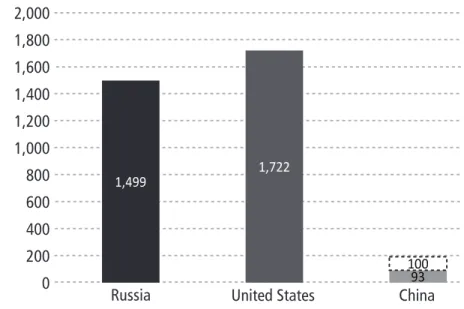
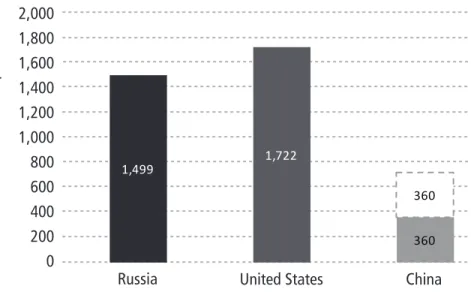
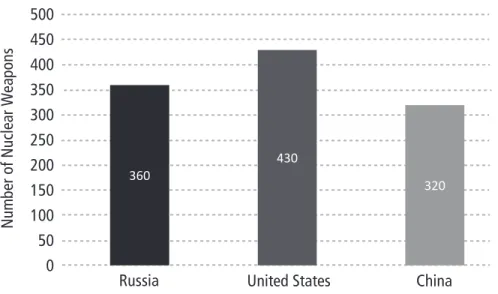
Information regarding Russian non-strategic nuclear weapons is even scarcer than information regarding those of the United States. In recent years, the United States has shifted the emphasis of its nuclear strategy to the Pacific, especially with China in mind (as noted above, eight of the fourteen Trident Ohio-class ballistic missile submarines are deployed in the Pacific). ).
Within the U.S.-China strategic balance, mutual nuclear deterrence is not only highly
As noted above, the United States has never accepted any degree of mutual nuclear deterrence or parity with China, nor has it ever acknowledged that such a situation could arise in the future. Within the US-China strategic balance, mutual nuclear deterrence is not only highly asymmetric, but also further "diluted" by regional conflict scenarios and by.
It should be noted that, like the United States, Russia has not recognized China's claim to mutual nuclear deterrence since the Soviet era. After bilateral relations improved and a "strategic partnership" was formed, the issue of mutual nuclear deterrence was shelved in the political relationship between the two powers.
Russia retains a significant
All (or at least most) of China's 60 IRBMs in the Shenyang and Lanzhou military regions could target Siberia and the Far East, as could some of China's 150 nuclear-powered tactical ballistic missiles and cruise missiles launched by the earth. At the same time, Russia maintains a significant lead over China in strategic and tactical nuclear weapons, given the state of China's deployed nuclear forces (as discussed above). The 1980s, in addition to the large conventional army deployed along the Soviet border with China and in Mongolia, the Soviet Union also sought to secure absolute nuclear superiority in offensive and defensive weapons.
In any case, given the political and strategic nuances of their relations, Russia and China have even less solid grounds for starting mutual talks on limiting nuclear weapons than the United States and China.
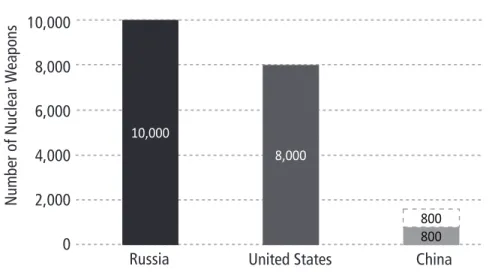
Judging from the available information, it can be assumed that this quantitative superiority — as well as the. The strategic relations between the three countries are thus very asymmetric and lack any political or strategic common ground with regard to principles such as stability and parity. The "triangle" turns out to be not only one-sided, but also not regular (Figure 1).
In addition, China is keeping quiet about the size and composition of its nuclear forces and its nuclear development program, making the possibility of any trilateral talks on reducing or limiting nuclear weapons very slim, at least in the near future.
The Role of Nuclear Weapons and the Nuclear Doctrines
In light of its superiority in more advanced conventional armaments, missile defenses, and strategic non-nuclear weapons, the United States has placed less emphasis on nuclear weapons than Russia, although the United States would like to emphasize that it will consider only the use of nuclear weapons in extreme circumstances to protect the vital interests of the United States or its allies and partners.”28 The role of nuclear weapons in preventing an attack using conventional, chemical, or biological weapons declines. For its part, Moscow initially envisages the use of nuclear weapons to counter a large-scale attack with the use of general-purpose forces, while the United States says nothing about this scenario (for understandable geostrategic reasons, is not vulnerable to such an attack) .
Third, the US has announced a greater emphasis on non-nuclear offensive and defensive systems in its deterrence strategy, while reducing the role of nuclear weapons.
China and Missile Defense Systems
However, according to information available to other countries, China's deployed nuclear forces are generally estimated to be too vulnerable and not effective enough to ensure a retaliatory capability following a hypothetical disarmament attack by the United States or Russia. The main paradox of China's nuclear doctrine is that if its nuclear forces are indeed as limited as most foreign experts seem to think, they will be unable to launch a retaliatory strike and will most likely be operationally directed at the country of ' a preemptive attack. Moreover, China's nuclear capability is apparently stronger than that of the next six nuclear states combined.
Moreover, China's economic and technical potential would allow it to rapidly build its own nuclear weapons.
The Chinese second-strike capability would be viable only if a large number of nuclear
Moreover, Chinese strategic nuclear forces would not be able to launch on a warning received from an early warning system due to the high vulnerability and insufficient effectiveness of the Chinese early warning system as well as its command and control system. Negotiations between Russia and the United States/NATO on the cooperative development of European missile defense have caused some consternation in Beijing, which has seen it as a military rapprochement between the two powers against China. Russia's proposal to develop a common "sectoral" BMD system under which each side would intercept missiles flying over its own territory in the direction of the other left several fundamental questions unanswered.
Beijing may perceive the construction of a joint or cooperative US-Russia BMD system as an "anti-Chinese plot", which could result in serious complications for military and political relations between Russia and China, lead to an accelerated escalation of China's nuclear forces. and directly harms Russian national security.
Beijing may perceive the construction of a joint or collaborative U.S.-Russia BMD
For example, should Russia intercept Chinese missiles flying over Russian territory in the direction of the United States or Western Europe. With a margin of only a few minutes to intercept BMs [ballistic missiles] between the moment they are detected and identified as targets and the detonation of the interceptor's warhead, such a "super system" requires extremely comprehensive and extraordinarily complex control software.41. In any case, although the United States has allowed the possibility of BMD cooperation with Russia, U.S.
The failure of the negotiations has temporarily allayed Chinese concerns on this issue, but the possibility that talks will resume remains an important factor in Chinese strategic planning, especially in light of the crisis.
In addition, BMD radars and interceptors are deployed within the borders and on the navies of local partners and allies of the United States. The same applies in the evaluation of the capabilities of the Russian air defense system and its ability to defend itself against a first strike or retaliatory strike launched by US nuclear forces. According to available sources55, in the first phase of its naval construction (until 2015), China plans to create naval capabilities (including coastal missiles) to effectively counter the navies of the United States, Japan and other nations in the Chinese.
However, if the United States sets its goal of continuing to impede the growth of the Chinese missile potential, the United States will be able to create such a BMD system.
Conventionally Armed Strategic Missiles
The study, conducted by Chinese experts and unique in its detail and technical calculations, shows that such a multi-layered BMD would be quite effective against Chinese SLBMs launched from shallow coastal waters, where the submarines would be under the protection of the Chinese fleet and where the system would anti-submarine warfare of the United States and Japan more difficult to detect.56. According to Eugene Miasnikov, the main drawback of the cruise missiles currently in use in the United States. Systems capable of delivering payloads virtually anywhere in the world within an hour are being developed under the Prompt Global Strike program.
The advanced hypersonic vehicles of the Prompt Global Strike program being developed by the United States can apparently penetrate the dense and multi-layered air defense system that protects China's cruise missiles.
China and Nuclear Arms Limitations
This is why transparency is so important, as it would clarify the actual size and characteristics of China's nuclear forces and their potential for build-up. Sources: Viktor Esin, "China's Nuclear Capability," Prospects of China's Participation in Nuclear Arms Limitations, edited by Alexei Arbatov, Vladimir Dvorkin, and Sergey Oznobishchev (Moscow: IMEMO RAN World Nuclear Forces," SIPRI Yearbook 2012: Disarmament Armament Security, edited by Bates Gill (Oxford: Oxford University Press. This ratio changes slightly in China's favor by adding intermediate, intermediate and short-range missiles (range 500-5,500 km), which were dismantled by the United States states and the Soviet Union under the INF Treaty.
However, China's right to expand these legs of its strategic triad would not be limited either.
Preconditions for Chinese Participation in the Arms Reduction Process
In addition, significant transparency would lead to indirect limitation of China's nuclear forces due to Beijing's long-repeated declarations of its "minimal adequacy" of its forces, its unwillingness to achieve parity with the United States or Russia, and its reluctance. to participate in the arms race. Therefore, it is unlikely that China could be persuaded to open up information about its nuclear forces as a gesture of goodwill, a first step or a minimum contribution to the transition to multilateral disarmament. At best, Beijing can be expected to be a tough negotiator on this issue, trying to offset every element of transparency for the most it can get from the other parties.
To seriously approach at least a theoretical discussion of any limitations of its nuclear
The United States and Russia should commit to China being able to participate in any cooperative BMD efforts that the two powers agree to undertake under specific projects (for example, in sharing missile launch detection data). rockets), in a way was found acceptable. The most likely format for negotiations would be to hold bilateral talks between the United States and China in parallel with the START negotiations between the United States and Russia, with regular strategic consultations between Russia and China. It should be taken into account that the United States and Russia have dismantled their medium-range and shorter-range missiles, while China will be able to remove its medium-range ballistic missiles and short-range missiles and replace them with intercontinental ballistics. rocket.
Russia and (even more) the United States would probably not welcome such a prospect, but should recognize that China could do so anyway without an agreement, or even increase the number of its intercontinental missiles. In addition to the medium and shorter range missiles.
The most likely format for negotiations would be to conduct bilateral talks
It would thus be possible to regulate the unfolding regional arms race with advanced high-precision missiles. The first, second and fourth points above would be indirect recognition by the two leading powers of mutual vulnerability and relations based on mutual nuclear deterrence with China. Although tripartite or quadripartite negotiations would be very complicated, such a format would still be possible, e.g. to cooperate in the area of BMD (missile launch data exchange).
In the longer term, tripartite agreements between the United States, Russia, and China may be possible to limit strategic and non-strategic arms, for example, setting equal total ceilings for land-based ICBMs plus long-range missiles. medium and tactical (it goes over 500 km).
Conclusion
This would mean that China's nuclear capability would likely be greater than that of the next six nuclear-weapon states combined. 6 Taking into account the new amendments to the Criminal Code of the Russian Federation adopted on November 14, 2012, which expanded the definition of "high treason" to "providing financial, material, technical, advisory or other assistance to a foreign state. 26 Military Doctrine of the Russian Federation, approved by the presidential decree of the Russian Federation on February 5, 2010, translated by Carnegie Endowment for International Peace, 6, http://carnegieendowment.org/files/2010russia_military_.
41 Mikhail Khodarenok, "The Fundamental Basis of the Concept", in Arbatov and Dvorkin, eds., Missile Defense: Confrontation and Cooperation, 29. 52 Igor Ashurbeyli thinks that the approved deadlines for the development of the S-500 SAM system are not realistic. A design project was completed in 2011 and development of the engineering design for the S-500 SAM began.