The problem of defining micro, small and medium-sized enterprises b) Involvement of the SME sector in the economy of the Federation of BiH c) Access to and use of the Internet. There is a preliminary draft law on the encouragement of the development of small enterprises in the Federation of Bosnia and Herzegovina, which meets the recommendations of the European Commission regarding the definition of micro, small and medium-sized enterprises. The Law on Incentive for the Development of Small and Medium Enterprises has been applied in Republika Srpska since 2002.
Small and medium enterprises account for 43.1% of the total gross domestic product of the Federation of BiH. At the level of the Federation of Bosnia and Herzegovina, the problems related to the development of small and medium enterprises fall within the responsibility of the Ministry for the Development of Entrepreneurship and Crafts. A very fragmented scheme of the authorities dealing with the issues of small and medium enterprises is the result of the social and legal fragmentation of Bosnia and Herzegovina.
Also the Chamber of Commerce and the Association of Employers take an official part as representatives of businesses in the activities of the Federation authorities. The law on the encouragement of the development of small enterprises is in the process of being drawn up. The set of documents required for a new limited liability company to start operating is the same as in the Federation of Bosnia and Herzegovina.
Termination of the limited liability company's business in the Republika Srpska is regulated similarly to that in the Federation of Bosnia and Herzegovina.
Access to sources of financing
The banking network in Bosnia and Herzegovina consists of 27 banks registered in the Federation of BiH and 10 banks registered in the Republika Srpska. The Federation of Bosnia and Herzegovina has 21 branches in Republika Srpska and 9 branches in Brčko District. These data indicate the ever-increasing trust of the financial sector in the institutions of the system and the positive trend of expanding activities to the entire territory of the country of Bosnia and Herzegovina.
Of the 37 banks in Bosnia and Herzegovina, 28 are qualified for membership in the deposit insurance program. with to eliminate irregularities, in accordance with the requirements of the entity's banking agencies. Of the remaining 9 banks according to Article 31 of the Act on Deposit Insurance in Banks in Bosnia and Herzegovina. The banks are predominantly privately owned, and 6 banks have concluded deposit insurance.
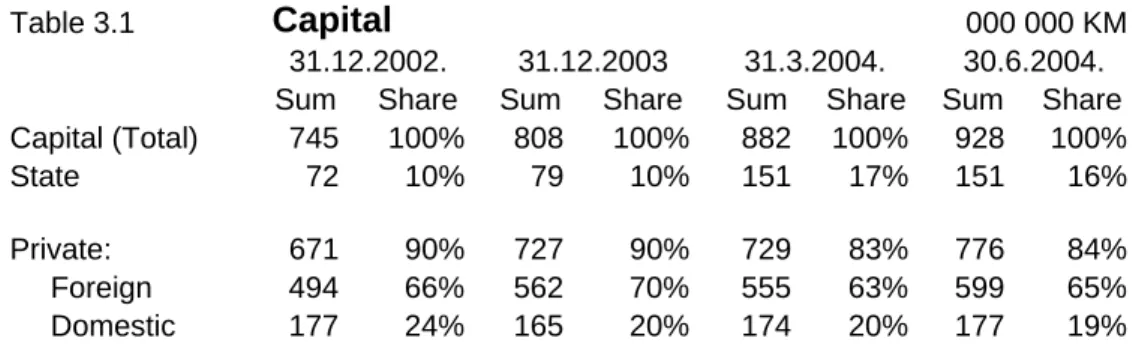
The remaining three banks entered the deposit insurance program. d) Indicators of the banking sector (June 30, 2004). The amount of approved credits in the first six months amounts to KM 4.8 billion, which is a 16% increase compared to 2003. At the beginning of 2004, less than a fifth of the cumulative amount of approved credits, amounting to around KM 20 billion, was offered to small and medium-sized companies.
In the same period, funds for the procurement of basic capital from private sources reached 69%. A large change in existing interest rates is the consequence of a market error in the absence of a reasonable assessment of risk. A large change in existing interest rates is the consequence of a market error in terms of the risk asset.
Valuation methodologies .. are on the other side, while banks are interested in using one that clearly exists and making a profit. According to the donations returned through microcredit nk and 27 other donor organizations) exceeds 100 .. absence of reasonable reception. This unfavorable circumstance limits the total amount of approved credit to the client to 3 million. Kobanke rest in approved credits in the minimum amount of KM 50,000).
Access to information and consulting
The European Commission has focused its efforts on the development of a network of regional development agencies (RDAs). This initiative differs from previous efforts in its thoughtful and long-term approach to problem solving. They also believe that counseling services are largely theoretical and that there is a serious lack of knowledge.
There is an obvious need among SMEs (small and medium-sized enterprises) for business information and advice in connection with specific problems. There is a lack of suitable solutions, especially when it comes to sophisticated and technically complex requests from companies. In light of the specific development problem, the ideas of business incubators are mainly related to specific goals such as return and return, employment of women, employment of young people, etc.
According to reports, there is a high level of sustainability of businesses after they exit the incubator. Since its establishment in 2000, several dozen businesses and several hundred beneficiaries have been assisted by business inc.
Entrepreneurial education
Another group of private individuals was a group of entrepreneurs involved in catering. They had a certain continuity in terms of social status (without the material or financial damage caused to this group by the war!). e think that they will think about the position of entrepreneurship in the future. This is why school curricula change so slowly. in Bosnia and Herzegovina it would be directly related to the concept of entrepreneurship and entrepreneurs. The situation at the level of secondary education is slightly better.
The field of entrepreneurship is introduced in all secondary schools, since it is not possible to study entrepreneurship as a main subject at the university level in the Federation of Bosnia and Herzegovina. Despite this, there are well-known university programs ... management, the content of which is related to entrepreneurship. The management of small and medium-sized enterprises is studied at the University of ..d as a separate subject at both schools of economics. W. The above historical context should be connected especially when it comes to research that includes comparative analyzes of transition countries.
The problem of entrepreneurial education should necessarily be related to family education because of the historical background. Federation, entrepreneurship is taught as a compulsory subject in secondary schools teaching under the Croatian curriculum. In the Brcko district, the subject entrepreneurship is compulsory for students in the third and fourth grades of the upper secondary school in economics.
The situation is the same in business schools where entrepreneurship is taught as a compulsory part of the curriculum: it is called economics or entrepreneurship fundamentals. It can be concluded that the young people in Bosnia and Herzegovina, between the ages of 15 and 17, begin to receive the first thematic knowledge of entrepreneurship. In Republika Srpska, a one-year specialist course was introduced in 2004 at the School of Economics in Banja Luka.
There is also a special course known as Entrepreneurship Management in postgraduate studies in Banja Luka. Non-formal education and advanced training in entrepreneurship, often referred to as business and management, is extensive.
Acknowledgements would like to thank