From this we can conclude that the concept of social economy is a European concept. 8 British work particularly influenced the development of the concept of social enterprise.
The Social Economy in Poland
A rural social enterprise is, in our opinion, a flagship product of the Polish approach to the social economy, including the "old" one. Three main types of reforms shaped the transition in the 1990s in Poland: political, economic and administrative-structural.
The “Building a New Lisków” Project
The way of regulating their relationship as a partner was deliberately left to the "natural course of events". Interviews were conducted twice with members of local partnerships (May-June 2006, November 2007), community development workers regarding their tasks (June-July 2007) and staff of social enterprises (November 2007).
The Development of the Social Economy in Poland
In essence, Lisków is an excellent illustration of an approach to the problem of social development that emphasizes the role of social capital and the social economy, among other issues. The story of interwar Lisków is the story of how a community that lacked material resources started a social enterprise by increasing the level of social capital and developing its potential, thus turning the enterprise into an engine of local development.
Case Studies
Toward a Polish Model of Social Economy?
In the second half of the 1990s, the European Union gave the social economy the green light. It prioritized the development of the social economy as a way to limit the problem of social exclusion.
Social Economy in Poland: Case Studies
Social Entrepreneurship in Poland in the 20-Year Period Between
The Notion of Rural Entrepreneurship
Expanding the scope of the concept of entrepreneurship stems from the belief, based inter alia on the readings cited below, that entrepreneurship that is endogenously motivated is feasible and therefore does not involve the destruction of the established order and the destruction of the existing mentality. The use of 'soft social engineering' weakens or even levels out the shock effect, and the new unnoticed becomes a piece of tradition and not an element that breaks continuity and violates the sense of identity.
Individual Rural Entrepreneurship
During the First World War and the post-war period, the next 5 million migrants left, the vast majority of whom were residents of the rural areas. Migration movements were by no means a new phenomenon in the traditions of the Polish countryside.
Social Entrepreneurship in the Countryside
Thus, Franciszek Magryś was a quiet but generally respected resident of the village who participated in the life of the local community. What were the characteristics of the emigration from Zabor, which played such an important role in the life of the native village.
Hypotheses
In the first half of the 20th century, they were family-run farms and their context was the rural environment. It seems that even today the resources of human capital in the Polish village are not completely destroyed (although sociologists also have their shameful share in branding and combating the cooperative mechanisms that still functioned in rural areas after the Second World War)74.
Towards a New Paradigm of Transformation
Considering the comments that have been expressed about the discipline, let's try to briefly outline the outline of the new paradigm of transformation that is emerging here. Its formulation is authorized not only by the images of the Polish village of the past mentioned above, but also by observations of what appears in a quite scattered but characteristic way in the works of outstanding contemporary Western writers.
Introduction
The fact that it has been forgotten is partly the result of the efforts of the communist government (from 1945 to 1989), which essentially wiped the village off the map of Poland for several years. Today, many Polish villages and towns, which are neglected socially, economically and culturally, have a chance for development, just like Lisków at the beginning of the 20th century.
The Lisków Project – Expanding the Capacity of the Local Community
It was the first voice that would disturb the sleepy tranquility of the peasant masses. While away from Lisków, Father Bliziński continued to support the interests of the village.
Characteristics of the Lisków Project
However, it is important to know that in the initial stages of the project (which were essential. Not all members [of the cooperative] were engaged with the idea of community. Father Bliziński noticed the need for their cooperation, e.g. the founding of the dairy cooperative in 1905.
Conclusions
It seems that the Lisków community was finally ready to continue development based on its own strength and internal networks. In the light of the above discussion, we can understand the role of the priest and the essence of the Lisków project in terms of the theory of social capital and its importance for development. In short: Father Wacław Bliziński's success in Lisków and what he gave to the community was an increasing level of social capital (both bonding and bridging).
Dolina Strugu” (“Strug Valley”) – A Partnership Laboratory 1
Galician Roots of the “Valley”
This was quite unsuccessful as Podkarpacie was a region with the highest resistance in the country. All (and also some of the councilors) appeared in one of the "Solidarity" factions - workers and peasants. However, not because it is outside the current consideration (in the "valley" there was consent to local community-based initiatives), but because the local government saw from both perspectives at the same time.
3. “Strug Valley” Local Governance Culture
In this model there is no room for intersectoral cooperation, understood as local governance, because it is based on the network of socially committed actors, for whom local government was a field and instrument of action. As a result of the transition from the potential of social involvement to the sphere of local government, the traditional definition of the third sector no longer makes sense. The history of the 'Valley', after the telephones were installed, seems to provide evidence of the collapse of the Galician model, influenced by the clashes with the demands and limitations of contemporary methods of public affairs management, and probably by strict free market rules such as Good.
The Evolution of a Model
The vision and initiative of the village mayor of Chmielnik (with some prior knowledge in the field of telecommunications); It was no longer possible to use the Galician model in its pure form due to an external change: the change of the local government statutes. The introduction of this novelty took place at the time of the reconstruction of the local political scene in the “Strug Valley”.
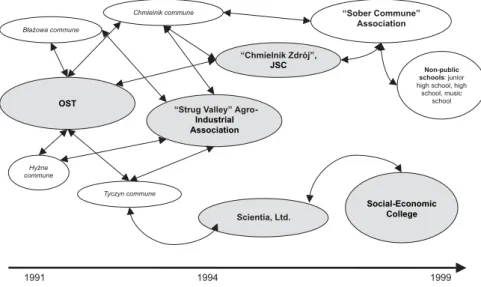
4. “Strug Valley” Economic Initiatives Aimed at Meritocratic Management
Summary
The history of the "Valley" reflects the transition from the Galician local government model to cross-sectoral cooperation. The laboratory metaphor reflects the dynamics of processes occurring within the "Valley" network of collaborators. However, it should be underlined that the institutional and social achievements of the "Valley" are quite impressive.
A Green Goose in Rodaki – The Transformation of a Successful Project into Local Community
- Social Capital
- Human Capital Power: Local Leadership
- Limitations: Cooperation with Private and Public Sectors
- Local Economic Initiative
Just after children started attending their new school, there was another major investment in the village – the construction of a new parish church. The instincts are more institutionalized now – the organic will is finished with a rational one11. 12 Periodic events organized in the village, such as: "Bread Day", "Green Goose Adventure", "The Goose in Culture, Goose on the table, Goose in the environment".

Green Goose in the Land of White Fluff”
Development Perspectives Valuation
The development of their community should be based on the famous brand - the "Green Goose". The villagers have some ideas what to do in the future and how to use the social capital of the village properly. However, this internal strength will not be enough for the economic initiative (which made the village famous) to develop on its own in the future.
Sewing the World for Children –
Foundation of the Social Cooperative in Prostki
In most social cooperatives, the chairman is hired from outside the cooperative by the cooperative manager. It was also the consultant who helped the cooperative members into the role of employees/co-owners in the company. The consultant instead focused on strengthening the position of the person whom the shareholders elected as chairman in the long term19.
Economic Effi ciency of the Social Cooperative
No less important for the economic efficiency of the cooperative is the creative contribution of the designer, who occasionally visits "Old School" and proposes new ideas for toys (which are obviously original and colorful). The consultant together with the members of the cooperative made a presentation of the products for the selected preschools, public and private. The vision for the future development of the "Old School" after the completion of the project remains to be determined.
Embedding the Enterprise in the Local Community
The location of the cooperative in the building where the school once operated was also important. News of changing attitudes towards the cooperative within the Prostki community reached the members of the Local Partnership in Ełk. Thanks to the community development worker, the consultant and the chairman of the Association "Our Prostki" as well as the members of the cooperative, the environment in which the "Old School" operated became more welcoming.
Social Effectiveness: Spheres That Were Visibly Infl uenced
The process of change in the study participants is revealed at the linguistic level. It seems that the very decision to join the cooperative was a breakthrough in the way of thinking of the cooperatives. In the case of the "old school", this process of embedding seems to take place in reality.
Social Economy in Poland: Refl ections
Community in Action – Refl ections and Hypotheses 1
The level of bridging (horizontal and vertical) social capital is the key to the effective and efficient functioning of the community. A local civil society functions in the sphere of public affairs – members of the community organize to better satisfy their needs, solve problems and develop the community. They arise from the incompatibility between the logic of the Polish model of local self-governments (gminas) and the logic of local activities in civil society12.
The Second Wave of the Social Economy in Poland and the Concept of Active Social Policy 1
- The “Old” and “New” Social Economy in Europe
- Disseminating the Concept of Active Social Policy
- The Strengths of the Concept of Active Social Policy
- Problems with Disseminating the Concept of Active Social Policy
- In the Direction of a Polish Model of the New Wave of Social Economy
The second wave of social economy in Poland and the concept of active social policy1. I will focus on the 'second wave' of the social economy, understood in the narrower sense. Towards a Polish model of the new wave of social economy.
A Model for Community Development Work with Impoverished Rural Communities 1
What Is Community Development Work and Why Should We Engage In It?
Thus, it may seem that community development is a kind of luxury or a postponement of the power of the local population. It should also be emphasized that just as community development work is not a usurpation of the power of the local population and a community development worker is not a usurper. The community development model outlined during the project "Towards the Polish model of the social economy.
The Community Development Model Outlined During the Project “Toward a Polish Model of the Social Economy
Community development is therefore a professional activity carried out within a given community in the form of a structured, methodical intervention with the aim of causing a positive change in a given time frame. The beginning of a development process and its growth requires a change in the attitudes and expectations of the community residents. The development itself may not last that long, but a time frame of several years should be assumed.
Building a New Lisków”
- Planning Community Development
- The Development Worker’s Position in and Relations with the Community
- The Phases of Community Development Work
- The Knowledge and Skills of the Community Development Worker
This means in particular that the community development worker enters the community as an outsider. In short, community development is the activity that the community development worker performs. The skills and knowledge of the community development worker are thus crucial in each phase.