This country study is part of the project entitled "Costs and Benefits of Labor Mobility between the EU and the Eastern Partnership Countries" for the European Commission (Contract No tender procedure EuropeAid/130215/C/SER/Multi). This study is part of the project entitled "Costs and Benefits of Labor Mobility between the EU and the Eastern Partnership Countries" for the European Commission1.
Introduction
The chapter also discussed the approaches to migration from the EAST countries now adopted by the Russian Federation, which is the largest recipient of labor migrants from the region. Finally, Chapter 6 presents a series of forward-looking policy recommendations for both CEE countries and the EU and its member states, aimed at maximizing the benefits of ongoing and future labor migration flows.
Macroeconomic and Labour Market Developments in the EaP Region
The Macroeconomy: Collapse and Recovery
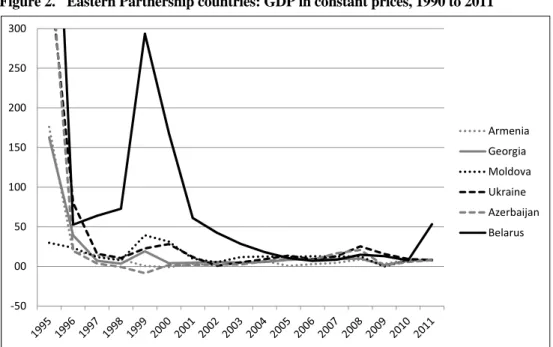
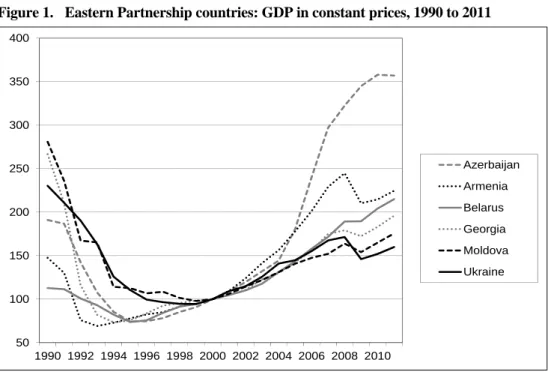
Macroeconomic stability, as measured by consumer price inflation, was established in the region in the first half of the 1990s and has been maintained since then, except in Belarus. The sharp drop in GDP in the early 1990s led to widespread, mostly hidden, unemployment in all Eastern Partnership countries.
Labour Migration – In Search of Opportunities
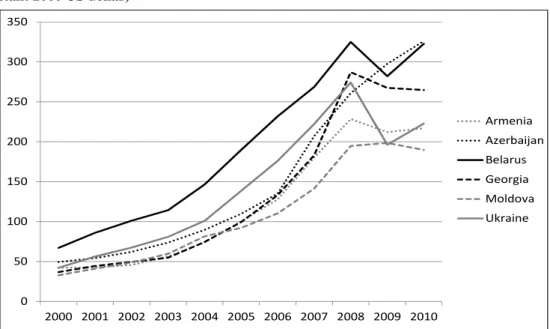
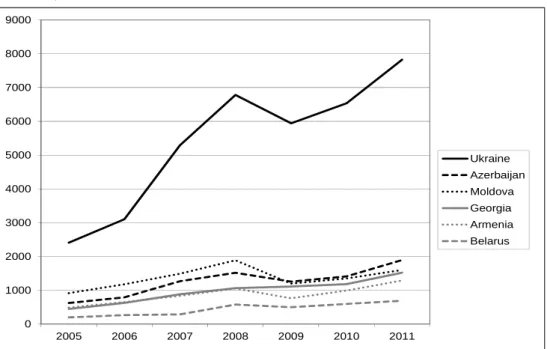
Detailed country-level analysis suggests that the differences in gender shares and countries of destination partly reflect a significant number of female migrants from Georgia, Moldova and Ukraine in the European Union. The rapid growth in the number of migrants coincided with rapid wage growth in the Eastern Partnership countries (Figure 6).
Remittances: the Emergence of a Powerful Economic Force
Due to the decline in manufacturing in the early 1990s, capacity utilization was low in many industries around 2000. The other side of the coin of higher demand for non-tradable goods and services is the risk of Dutch disease. The large increase in wages in US dollars in the Eastern Partnership countries (Figure 6) actually raises the question of whether the combination of migrant remittances with other international inflows (aid, investment, oil export revenues) has harmed the competitiveness of the exporting countries.
Real effective exchange rates are the most comprehensive measure available of the competitiveness of exports and import-competing goods. Overall, this broad overview of labor market and macroeconomic developments suggests that labor migration and migrant remittances have been crucial to the economic well-being of many households in the Eastern Partnership countries. Remittances have contributed to the rising demand for non-tradable goods and services and thus to the recovery of GDP since 2000.
Benefits and Costs of Migration and Remittances
Aggregate and macroeconomic effects
As discussed in Chapter 2, labor migration and the resulting reduction in excess labor supply and disguised unemployment were only one of the reasons for the general economic recovery in the Eastern Partnership countries. In short, by reducing the excess supply of labor, labor migration has contributed to the observed wage growth in Eastern Partnership countries, benefiting not only migrants and their families, but all workers in the countries of origin. In this case, the ratio between high-skilled and low-skilled workers in the country of origin decreases and falls.
However, immigrants in the EU tend to be better educated than those in other destination countries, especially Russia. This observation likely reflects higher entry barriers to EU labor markets: networks of EaP migrants in the EU are still thinner than in Russia. First, income taxes make up only a small part of tax revenue in the Eastern Partnership countries.

Individual and Household-Level Effects
Therefore, labor migration in Eastern Partnership countries reduces poverty among remittance-receiving households. As many migrant households in Eastern Partnership countries are poor, it is not surprising that only a small proportion of the extra income is apparently saved or invested in farms or other small businesses. To explain low business investment, our country studies show high costs of doing business in Eastern Partnership countries.
In both groups, approximately two-thirds of the migrants belonged to the same occupational category at home and abroad. There is currently little information available on how migration affects the well-being of older people in the Eastern Partnership countries. Unfortunately, there is little comprehensive evidence on how women's social status in EaP countries is affected by migration, either by family members or by themselves.
Overall Assessment: A Migration Scorecard?
This link adds a political dimension to increased mobility between the EU and the Eastern Partnership countries. There are three possible scores, L, M, H, and the total scores for benefits and costs reflect the individual components. It is quite clear that the magnitude of benefits and costs is proportional to the importance of migration relative to the size of the economy.
Thus, for example, in the case of Moldova, it is quite obvious that there have been large benefits both for the macro-economy and for individual households. On the other hand, given the scale of the phenomenon, the costs (and associated risks) were also high. At the opposite end of the spectrum, instead, are countries such as Azerbaijan and Belarus, where the scale of migration and its economic effects are relatively small, so the overall macroeconomic benefits are likely to be limited.
Labour Migration and Demographic Trends in Eastern Partnership
Introduction: Forecasting Migration Flows
Results obtained through these studies tend to find a large number of potential migrants. The second assumption is that the propensity to migrate changes with the age of the potential migrant and tends to be higher for younger migrants and decline with age as the opportunity cost of migration increases. Armed with these two assumptions, we are then able to use population projections by age cohort to calculate the amount of potential migrants over the years, taking into account the progressive aging of the population for (almost all) Eastern Partner countries.
We also provide simulations revolving around a very important parameter, namely the propensity to migrate to the Russian Federation or to the EU. We have argued in previous chapters that the visa-free policy of the Russian Federation has created a virtually unrestricted situation for potential migrants, and can therefore be considered a relatively stable equilibrium. Changes to the "propensity parameter" can then have an important influence on the total number of potential migrants going to either of the two main destinations.
Basic Scenario 1
First, we assert, based on the evidence presented in the Country Studies, that PNJ countries have currently reached a "steady state". An even larger drop of 14 million is expected to occur in the EaP working-age population (Figure 13 below). In other words, these estimates refer to migrants whose family remained in the country of origin, i.e.
In the year 2010, the total number of labor migrants from the eastern countries who resided in the EU is estimated at 817 thousand. Despite the absolute decrease in the number of migrants from the Eastern Partnership, their share of the EU population may increase if the EU population declines more. However, as shown in Table 4.3, the EU population is actually expected to increase by 11 million, and therefore the share of Eastern Partnership migrants in the total EU population will decrease from 0.16% to 0.1%.

Scenario 2: A More “Attractive” EU for EaP Migrants
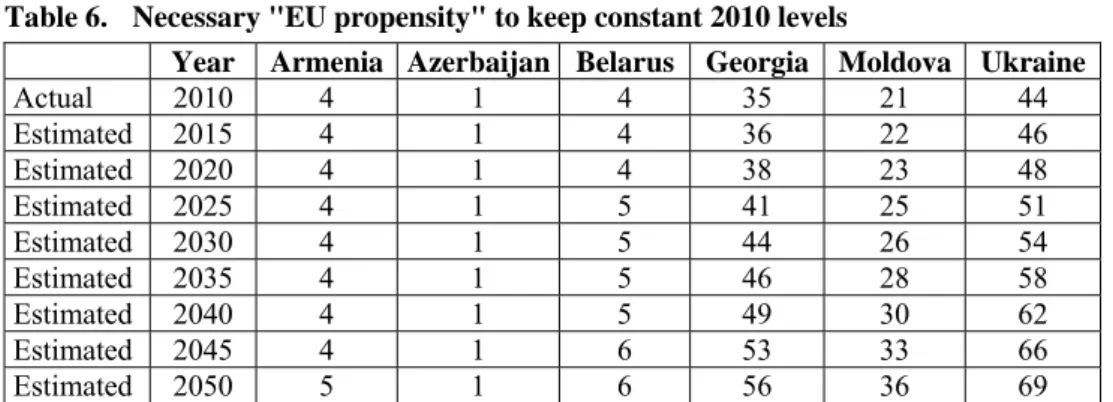
In contrast to the total EU population, the working population in the EU is expected to decrease from 330 to 287 million people. Nevertheless, the share of EU migrants in the labor force is still expected to decline from 0.25% to 0.18%. Although there are many possible combinations of migrants from each of the six EaP countries that could result in a completely unchanged number of labor migrants, we have simulated a scenario in which all countries maintain the initial level of migration to the EU.
Maintaining a steady flow of migrants from each Eastern Partnership from 2010 onwards would require major changes in the propensity to migrate to the Russian Federation. In our opinion, they show that the possibility of a large flow of migrants from the Eastern Partnership countries as a result of the EU's adoption of more liberal policies is quite unlikely. Thus, the EU's ability to shift migrants' preferences in large quantities cannot be taken for granted; In the same way, the likelihood of large migration flows to the EU from the Eastern Partnership countries can be considered very unlikely (barring, of course, the occurrence of seriously negative socio-economic developments in the Eastern Partnership countries).
Tables and Figures
Methods and formulas
Policies Affecting Labour Migration in EaP Countries
- Policies Affecting Labour Migration Outcomes – Non-Migration-
- EaP Approaches to Migration Management
- EU Approaches to Migration from EaP Countries
- Russia’s Approach to Migration Management from the EaP Countries
A clear understanding of the multi-dimensional challenges of migration, and the supporting role of government. The six country studies depict a complex picture of the effects of economic and sectoral policies on migration in the Eastern countries in the period after the break-up of the Soviet Union. Second, on the other end of the spectrum, college graduates also appear to have difficulty in the domestic labor market in finding suitable employment opportunities.
The action plan for implementing the national strategy for migration and asylum forms the legal and operational framework for the NCPD. As mentioned earlier, two of the Eastern Partner countries (Georgia and Armenia) have established ministerial agencies with a mandate to develop and promote diaspora. For the other five countries in the Eastern Partnership region, several negotiations are underway within the framework of the Eastern Partnership Initiative, which is part of the European Neighborhood Policy.
16 “The Federal Migration Service, or FMS, has already published an action plan for the implementation of the first phase of the concept. Furthermore, a number of draft laws have been actively developed as part of the migration policy concept.

Conclusions: Policy Recommendations to Improve the Outcomes of
- Lessons and Policy Recommendations for EaP Countries
- Recommendations for the European Union and its Member States
Costs and benefits of labor mobility between the EU and the Eastern Partnership partner countries: Moldova country study. Costs and benefits of labor mobility between the EU and the Eastern Partnership partner countries: Belarus country study. Costs and benefits of labor mobility between the EU and the Eastern Partnership partner countries: Ukraine country study.
Costs and benefits of labor mobility between EU and EaP partner countries: Armenia country study. Costs and benefits of labor mobility between the EU and Eastern Partnership partner countries: Georgia country study. Marchetti, Sabrina, Daniela Piazzalunga, Alessandra Venturini (2013): Costs and benefits of labor mobility between EU and Eastern Partnership countries, Country Study: ITALY.