The research includes a comprehensive analysis of the role of human rights in promoting integration processes. It aims to clarify the content of the concept of integration when used in the field of human rights, including how it relates to the concepts of inclusion and assimilation.
The Role of Human Rights in Integration Processes
This effort involves clarifying the roles of different actors (host state, majority, persons belonging to minorities) in integration processes.
The Aspect of Culture in the Social Integration of Ethnic Minorities: Towards a Politics
Introduction
5 As argued by Pierre Bourdieu, cultural capital is a key element in enabling individuals to participate in society. Therefore, cultural capital is very closely related to the ability to acquire economic capital and therefore to succeed in society.
What is Culture?
Seeing cultural diversity as a way to achieve a good society obviously has political implications in the way we organize our societies. However, if cultural diversity is seen as a positive idea of value for society, then one will also be able to see the value of cultural diversity as an improvement for society.
Political implications of Culture
6According to Will Kymlicka, seeing cultural diversity as instrumental helps the government achieve certain goals (Kymlicka, 1995). The concept of cultural diversity is interesting because it is used in several ways, both positive and negative.
From Politics to Policy
Programs to promote social integration are therefore both functional instruments for promoting social cohesion and ideological ideals for social unity. Specifically in relation to a social integration strategy, it should have a statement on social cohesion for a start.
Conclusions
Kluckhohn (1952), Culture: A Critical Review of Concepts and Definitions. 1989), Liberalism, Community and Culture, Oxford: Oxford University Press. 1995), Multicultural Citizenship: A Liberal Theory of Minority Rights, Oxford:. 2007), Multicultural Odysseys: Navigating the New International Politics of Diversity, Oxford: Oxford University Press.
Old” and “New” Minorities
9 Advisory Committee of the European Framework Convention, European Commission for Democracy through Law (EC Venice Commission), Human Rights Committee, UN Working Group on Minorities and OSCE High Commissioner for Minorities national.
The Pro and Contra of Similar Treatment
The Lessons of Experience
All Minorities have Common Characteristics and Claims
New and Old Minorities Also Have Different Charasteristics and Articulate Diverging Requests
23 In most European countries, migrant groups do not object to the requirement that they speak the official language of the host country. The reason is apparently the numerical weakness of traditional minority groups compared to the size of the Russian community and its support from Moscow.
In Search of a Reasonable Solution
The old minority groups and the majority in the same countries in Europe usually belonged to the same cultural area and their habitus was not far from that of the titular inhabitants of the country and did not 'offend' the sensibilities of the majority. The majority of the inhabitants of today's Western countries, who suffer from a 'democracy deficit', are primarily looking for equality of rights and dignity.
Conclusion
Recognizing that all minorities share a number of essential common characteristics and claims, a realistic solution could be, for example, of the following type.14. At the same time, maintain and improve the existing set of measures which relate exclusively to national minorities and which have proved useful for several years in a number of countries. Corsica, Sicily, Scotland) and extra-territorial, i.e. cultural (Estonia, Hungary, Russia) and the right to maintain an original way of life is of course central.
The Macedonian Integration Model
Zhidas Daskalovski is a senior analyst at the Center for Research and Policymaking (www.crpm.org.mk) and assistant professor of political science at the Department of Public Administration (FAMIS) at Kliment Ohridski University in Bitola.
Minorities and Affirmative Action Policies
In addition, ethnic Albanians represent a significant percentage of the population in the areas where they reside in Macedonia. Indeed, the establishment of the new state in 1991 was not fully supported by Macedonian Albanians.
Concluding Remarks Concerning
The law extends the provision on language use to local offices of state authorities and specifies that non-majority languages may not be used in the police and army. A law was passed on the promotion and protection of the rights of the smaller communities, which in particular stipulates that a specialized agency must be set up.
Once the effects of the long-term repression are mitigated, the special measures provisions would be redundant. Granting special rights along ethnic lines can actually homogenize the other ethnic communities, resulting in increased levels of inter-ethnic distrust and tension.
Social Inclusion: Was it Ever a Real Priority in Latvia’s Public Policy?
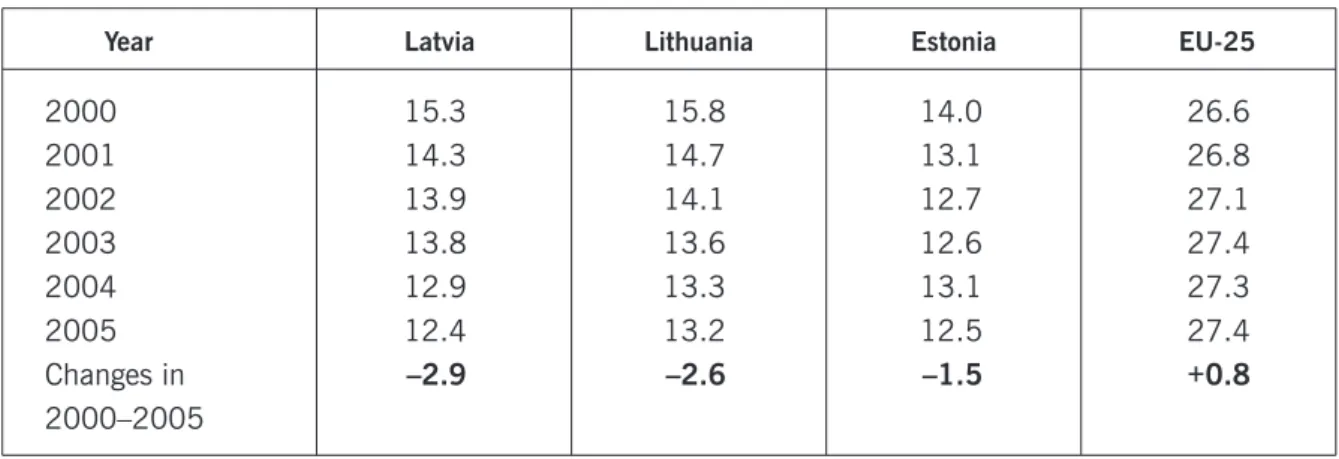
Therefore, the Latvian government in the Joint Inclusion Memorandum (2003) stated that “the reduction of poverty and social exclusion is one of the primary long-term objectives of social policy in Latvia. At the same time, single seniors experienced rapid increases in the risk of poverty.

Coordinating of Integration Policies of Estonian Society
- The head of government’s team
- Central agencies
- The government as a whole
- Government committees
- Ministers without a portfolio
- Additional portfolio for coordination
- Junior ministers
- Ministries
- Advisory committees
- Agencies with portfolios that deal with coordination
- Inter-ministerial groups
These agencies may be tasked with using their governance instruments to implement the Head of Government's priorities. 41 portfolio that lacks the support of a ministry cannot have sufficient influence among cabinet members.
Expert evaluations of the coordination of integration policies in Estonia
Another flaw in the previous system mentioned by respondents was the small size of the minister's office. Emphasizing the importance of the integration area in the political system and for the general public.
Conclusions and recommendations
This also means that the topic of integration is highly politicized in the Estonian political system and society as a whole. Creating a new system will most likely introduce some new problems that did not exist in the old system.
Public discourses
The Rhetoric of the Right on Migrants and Minorities in 2009: Banality 1 and Fear
Robert Gould is Associate Director of the Center for European Studies at Carleton University in Ottawa. Importantly, some countries in Central and Eastern Europe have minorities of the same generation, and also contain both older and much more recent immigrants.
The Banality of Fear
The visual rhetoric of the Swiss People's Party (SVP) campaign to ban the construction of minarets is also included. See, for example, Hans-Georg Betz, “The Growing Threat of the Radical Right” in Right-Wing Extremism in the Twenty-First Century, in eds.
The Banality of Topics
For Britain, see Adrian Blackledge, Discourse and Power in a Multilingual World, Benjamins: Amsterdam and NYC 2005 [on GB], in particular Chapter 4 “Political Discourse and the Rhetoric of Discrimination” or Chapter 7 “The Legitimization of Discrimination discourse. ”.
Rhetorical Strategies
15 Berichtet im Artikel über das BIP unter www.en.wikipedia.org und unter http://www.jobbik.com/jobbik-announcements/. 17Gábor Vona an Benedikt Frings, 28. März 2009 „Das ungarische Volk hat zum Beispiel große Probleme mit den einheimischen Zigeunern – hinsichtlich ihrer extrem unverhältnismäßig hohen Kriminalitätsrate und ihrer ausgeprägten Arbeitsunwilligkeit“, http://www.jobbik.com / deutsch.html Abgerufen am 15. September 2009.
Catastrophe of Subjugation/Colonisation
Europe and bring an end to thousands of years of Western civilization.”9The FPÖ speaks of “Mass migration from Turkey to Austria.”10. As the "Shrinking Citizenship" monitoring project in Latvia has shown, the rhetoric of "invasion" and "occupation", although referring to past events, also exists in Latvia where it has an ongoing impact on minority relations - and also on ideas. of cultural separation and cultural and linguistic protection.11.
Minorities
19 „FPÖ-Veto gegen Reisefreiheit für Ostkriminelle“-Plakat und „FPÖ-Veto gegen EU-Asylwahnsinn“, www.fpoe.at Abgerufen am 11. August 2009. 25 „Abendland in den Händen der Christen“ – FPÖ-Wahlplakat zur Europawahl, www . fpoe.at Abgerufen am 11. August 2009.
Christianity and Islam
30 Abschnitte „Einkommen, um über die Runden zu kommen“ und „Beste Gesundheit statt billige Medikamente“ auf www.fpoe.at Zugriff am 11. August 2009. 31 http://bnp.org.uk/tag/britain-is-being- kolonisiert von der Dritten Welt/ Zugriff am 15. September 2009.
Economic Situation
32 Merkblatt „Fünf-Punkte-Plan zur Ausländerrückführung“ der Nationaldemokratischen Partei Deutschlands unter www.npd.de; Kolumne „Bessere Gesundheit statt Billigmedizin“ auf der Website der FPÖ www.fpoe.at, abgerufen am 11. August 2009.
The Banality of Electronic Communication
Websites. The BNP is definitely the best UK political party website and far better than those on the German far right. 35Evgeny Morozov, Yahoo Fellow at the Institute for the Study of Diplomacy at Georgetown University, author of the net.effect Foreign Policy blog (http://neteffect.foreignpolicy.com) on “The Agenda,” tv Ontario, Thursday, October 15, 2009.

Some Conclusions
As computer penetration develops in the new CEE EU member states, the importance of electronic communication in the political arena is likely to increase. 2006), "Die transnationale Struktur der extremistischen Rechten", in: T. Wodak (2009), The Politics of Exclusion: Debating Migration in Austria, Transaction Publishers: New Brunswick N. February 1995), "Talking Culture: New Boundaries, New Rhetorics of Exclusion in Europe, CulturalAnthropology, 36:1, p. 2005), "Discourse Theory: Achievements, Arguments and Challenges", in: D.
Ethnic Rhetoric in Latvian Politics
Political parties and the rhetoric of ethnic mobilisation
The lack of a clear adjudication of individual guilt makes it possible to attribute collective guilt for the crimes of the Soviet regime to the entire Russian-speaking population of the country. By denying the legitimacy of the “alien” Russian-speaking part of society, MPs from “Latvian” parties reinforce the ideological assumption that it is the ethnic nation (and not a civil nation, consisting of all citizens, including recently naturalized citizens). that is the foundation of the state.
Rhetoric of ethnic closure in the media
This strategy could hardly be successful without the familiar framework already used by political parties: attributing guilt for the violations of the Soviet era to the Russian-speaking Latvians as a group. It remains to be seen whether the rhetoric of the Latvian parliament and media will change over time to enable and reflect political cooperation between different ethno-linguistic groups. 2006), "Introduction: ethnic inequalities and the public sector," in: Yusuf Bangura (ed.), Ethnic Inequalities and Public Sector Governance.
A school of democracy?
Segregated schooling and civil enculturation
Divided Education – Divided Citizens?
The Results of an International Study in Estonia
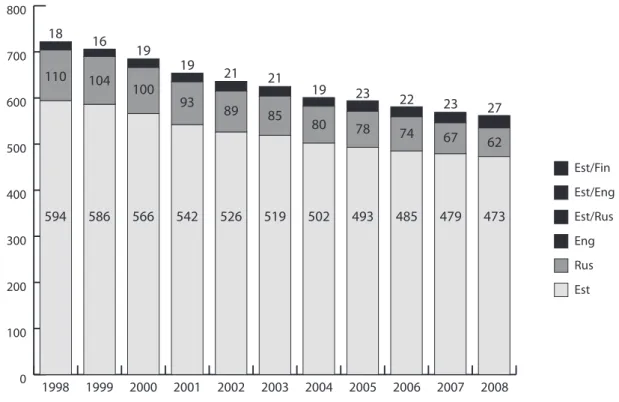
Source: Statistics Estonia, Ministry of Education and Research) Number of schools with different languages of instruction. In Estonia, the study addressed and compared majority schools (i.e. schools with Estonian language of instruction, hereafter Estonian schools) and minority schools with Russian language of instruction (hereafter Russian schools).
Majority and Minority schools in Estonia
The decline in the number of Russian schools was significantly greater than it was in Estonian schools. Furthermore, the Ministry of Education and Research predicts that the future decline in student numbers will also be more dramatic in Russian schools compared to Estonian schools.
Findings
When comparing the attitudes of majority and minority students on issues of gender equality, it can be seen that students from Russian minority schools tend to reflect somewhat more traditional views than students from majority schools. The civic culture environments of majority and minority students are very different from each other.

Civic Attitudes in Separate Schools in Latvia
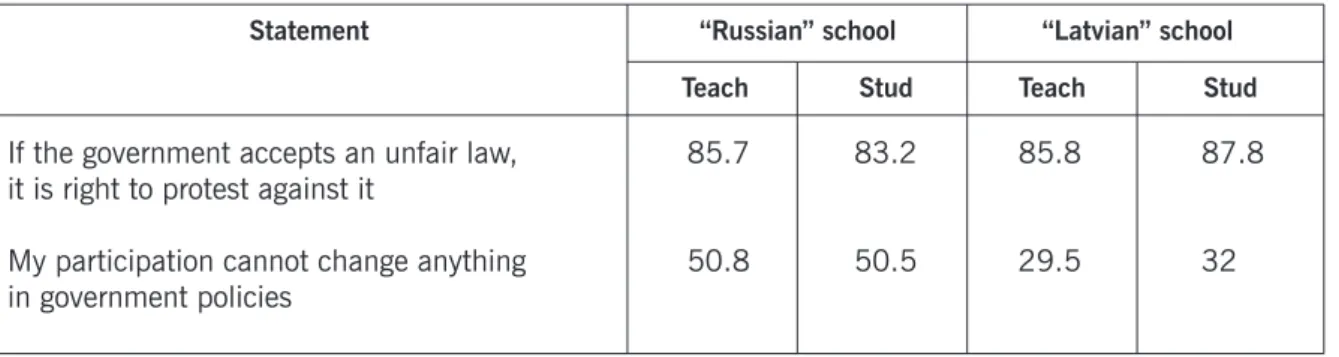
Teachers and students in "Russian" schools believe that their chances of effective political participation are lower than for Latvians and that they do not have similar career opportunities. Most teachers in "Russian" schools believe that the current system is good - and about half of "Latvian" school teachers agree.
Referātu kopsavilkumi latviešu valodā