University of Groningen
Sustainable Entrepreneurship Project (Master Thesis) M.Sc. Sustainable Entrepreneurship
Campus Fryslân
EXAMINING THE BARRIERS TO SELF-TARGETING FOR SOCIAL VENTURES ADDRESSING THE
BOTTOM OF THE PYRAMID
ALEJANDRO GIRIBÁS (s4959809) Wijbrand de Geeststraat 85 8921 AK Leeuwarden, Netherlands
Supervisor: Dr. Arianna Rotulo Co-Assessor: Dr. Emma Folmer
Friday, 10th of May 2022
TABLE OF CONTENT
1 INTRODUCTION 5
2 THEORETICAL BACKGROUND 8
2.1 BOTTOM OF THE PYRAMID 8
2.2 SOCIAL ENTREPRENEURSHIP 9
2.3 TARGETING 10
2.3.1 SELF-TARGETING 12
3 METHODOLOGY 16
3.1 RESEARCH DESIGN &METHOD 16
3.2 DATA COLLECTION 16
3.3 DATA ANALYSIS 17
3.4 RESEARCH QUALITY ÐICAL CONSIDERATIONS 18
4 FINDINGS 20
4.1 TARGETING (APART FROM SELF-TARGETING) 20
4.2 SELF-TARGETING 22
4.2.1 GENERAL FINDINGS REGARDING SELF-TARGETING 23
4.2.2 ASPECTS OF SELF-TARGETING IN THE CURRENT TARGETING STRATEGY 23
4.2.3 CONCERNS REGARDING SELF-TARGETING 24
4.2.4 POTENTIAL BENEFITS OF SELF-TARGETING 27
5 DISCUSSION 28
5.1 LACK OF AWARENESS 28
5.2 RELUCTANCE TO EXCLUDE THE ROP 28
5.3 AMBIGUITY REGARDING ORGANIZATIONAL IDENTITY 29 5.4 NEED FOR A SOPHISTICATED DESIGN AND AN ALTERNATIVE OFFER 29
6 CONCLUSION 32
6.1 LIMITATIONS 32
6.2 OUTLOOK FOR FUTURE RESEARCH 32
6.3 CONCLUDING SUMMARY 33
7 BIBLIOGRAPHY 35
8 APPENDIX 38
8.1 APPENDIX A:INTERVIEW GUIDE 38
8.2 APPENDIX B:INFORMED CONSENT 40
List of Abbreviations
BoP: Bottom of the Pyramid ODG: OneDollarGlasses RoP: Rest of the Pyramid
List of Figures
Table 1: Categorization of targeting methods according to Devereux (2021) ... 12
Table 2: Benefits and drawbacks of self-targeting ... 14
Table 3: Findings regarding targeting (apart from self-targeting) ... 20
Table 4: Findings regarding self-targeting ... 22
Table 5: Identified barriers to self-targeting... 33
Abstract
This paper examines the barriers regarding the consideration and implementation of self- targeting within the social venture OneDollarGlasses (ODG) which targets the Bottom of the Pyramid with basic optical healthcare products and services. The most relevant identified barriers were a lack of awareness regarding (self-)targeting, a reluctance to exclude people from buying the subsidized offer, and the need for an alternative offer for self-targeting to work properly. The latter barrier (need for an alternative offer) is relevant since it is widely ignored in the literature. At its core self-targeting focuses on adjusting the attractiveness of the offer in a way that less-poor people refrain from picking it up but go for a more inducing alternative offer. If no alternative offer is available, the concept breaks down. The reluctance to exclude people from buying the subsidized offer touches upon the topic of organizational identity:
Organizations need to know who/what they want to be to successfully operate at the Bottom of the Pyramid and implement a clear targeting strategy.
Acknowledgments
Many thanks to Dr. Arianna Rotulo for her great support and supervision, to Dr. Emma Folmer for her valuable feedback, and to all the participating members of ODG for their valuable insights. Special thanks to Detlef Virchow, my supervisor at ODG who supported me beyond all expectations and without whom this research would not have been possible.
Keywords: Bottom of the Pyramid, Social Entrepreneurship, Targeting, Self-Targeting, Organizational Identity, OneDollarGlasses
1 INTRODUCTION
Western societies lived for a long time in the misconception that the corporate sector is serving the rich while non-governmental organizations and governments protect and care for the poor (Prahalad & Hart, 2005). Although several multinational businesses already entered emerging markets in the Global South (Dados & Connell, 2012) in the 1980s (Prahalad & Lieberthal, 2003), they still mainly focused on the wealthier parts of the population (London & Hart, 2004).
The potential of serving the needs of the so-called Bottom of the Pyramid (BoP) was just articulated in research around the beginning of this century (Prahalad & Hart, 1999, 2005).
Since then, an increasing number of businesses shifted their focus to the world’s four billion poorest people to which the term BoP refers (Goyal, Sergi, & Jaiswal, 2015). Prahalad & Hart (2005) expressed their trust in the market and stated that merely the profit-oriented investment of multinational companies into the BoP would be enough to lift billions of people out of poverty by granting them access to the products and services of the market economy for the first time.
A more critical stream of research suggests that companies merely focusing on profit are not capable of reaching this goal since the people at the BoP are willing but unable to pay for products and services that would serve their needs (Seelos & Mair, 2005). According to the authors, businesses need to incorporate their mission to create social value into the core of their business to have a long-lasting positive impact. The resulting social ventures (addressing the BoP) often want to make their products (and services) available to the neediest1 by offering subsidized prices (McMullen & Bergman Jr, 2018). They make the poor pay what they can afford while covering the deficit through donations or purchases of wealthier customers (McMullen & Bergman Jr, 2018).
1 I use the term neediest to refer to the socially most disadvantaged people (within the BoP), living in absolute
Because their resources are limited (Rey-Martí, Mohedano-Suanes, & Simón-Moya, 2019) and their social purpose (Haugh, 2005) usually motivates them to help the people that need it the most (Barki, Comini, Cunliffe, Hart, & Rai, 2015), social ventures must find a way to select eligible customers who should benefit from their subsidized product.
To identify the neediest several targeting strategies were described and analyzed by researchers and tested by practitioners. Among them, self-targeting methods offer the possibility of a more accurate selection while reducing the costs (Alatas, Purnamasari, Wai-Poi, Banerjee, Olken, &
Hanna, 2016). According to Grosh, Del Ninno, Tesliuc, & Ouerghi (2008) self-targeting programs are theoretically open to everyone but designed in such a manner that expected take- up is higher among the neediest than the Rest of the Pyramid2 (RoP). Due to drastically reduced administrative costs (Devereux, 2021), self-targeting could be especially interesting for social organizations from the private sector (e.g., social ventures) because of their resource constraints (Rey-Martí et al., 2019). Nonetheless, examples of practical application of self-targeting are much more common in the context of governmental organizations (Alatas et al., 2016; Kozicka, Weber, & Kalkuhl, 2019; Pellissery, 2005).
Therefore, this paper aims to identify perceived barriers regarding the consideration and implementation of self-targeting in the context of social ventures addressing the BoP. I will follow a qualitative approach using semi-structured interviews within a single case study.
OneDollarGlasses (ODG) is the chosen business case for this research. The social venture was founded in 2012 in Germany. Its mission is to provide basic optical health care for people within the BoP and they operate across ten countries in the Global South (OneDollarGlasses, 2019).
According to the World Health Organization (2019), approximately 950 million people around
2 I use the term Rest of the Pyramid to refer to people outside the BoP and people within the BoP, who are less
the globe need glasses but have no access to optical care or cannot afford them. To help the neediest ODG provides sight tests and very simple, but still effective pairs of glasses that have material costs of around one US-Dollar (EinDollarBrille e.V., 2020). They offer the sight tests for free and the locally assembled glasses at a subsidized price. The distribution is mainly done by mobile teams setting up temporary “eye camps/outreaches” and some stationary shops. ODG usually works with local partner organizations and is dependent on donations. Their operations vary slightly across countries.
The aim of this paper is operationalized in the following research question: “What are the barriers regarding the consideration and the implementation of self-targeting for social ventures addressing the BoP?”.
Firstly, this paper starts with a literature-based introduction to the relevant topics. Secondly, the methods on how the interviews were conducted and analyzed are explained. Furthermore, this section also justifies the choice of method. Thirdly, the findings of this research are presented.
Fourthly, the new insights on identified barriers are discussed. Fifthly, the limitations of this study are explained and directions for future research are given. Finally, a conclusion summarizes the most important findings and elaborate on how they can complement existing literature and add value for practitioners.
2 THEORETICAL BACKGROUND 2.1 Bottom of the Pyramid
The term Bottom of the Pyramid (BoP) usually refers to the poorest four billion people in the world (Goyal et al., 2015). It is connected to the idea of categorizing the world population in an economic pyramid based on their purchasing power (Prahalad & Hart, 1999). Despite the ongoing wealth creation in the upper (wealthier) tiers people at the BoP still suffer from a lack of access to basic products and services (World Economic Forum, 2005; Zaefarian, Tasavori,
& Ghauri, 2015). According to London & Hart (2004), most of the people to whom literature refers with the term BoP live in rural areas in the Global South and make transactions in informal economic markets.
Considering all the unclarity and complexity connected to the term BoP (Dembek, Sivasubramaniam, & Chmielewski, 2020; Kolk, Rivera-Santos, & Rufín, 2014), for the purpose of this research, this term is used as a broader and softer concept of context and not as a clear definition.
Prahalad & Hart (1999, 2002, 2005) were the first ones explicitly articulating the economic potential of serving the needs of the BoP by selling goods and services to them. The authors suggested that multinational companies should move away from exclusively serving the wealthier population in the Global South and start to target the poor directly (Prahalad & Hart, 1999, 2005). Thereby they could potentially convert those who priorly were excluded from the market economy into active customers (Prahalad & Hart, 1999). Although the authors expected the generated margins to be very low, they expected the extremely high unit sales to generate vast revenues for the multinational companies willing to adapt their business models accordingly. Furthermore, they expected the profit-oriented investments of multinational companies to be sufficient to lift billions of people out of poverty by creating an accessible offer for people who priorly remained unserved, transforming the poor’s unorganized exchange into
organized transactions mediated by money, offering access to credit, and creating possibilities for income generation (Prahalad & Hart, 1999).
Several researchers (Kolk et al., 2014; Landrum, 2007) criticized Prahalad & Hart’s (1999, 2002, 2005) assumption that purely economically motivated investments of MNEs are able to achieve this. The research stream of social entrepreneurship particularly focuses on the need of intrinsic motivation (apart from purely economic incentives) to create long-lasting social value (Seelos & Mair, 2005) to help people out of poverty.
2.2 Social Entrepreneurship
According to Peredo & McLean (2006), the phenomenon of social entrepreneurship is very broad, not uniformly defined, and without clear boundaries. Therefore, the authors reviewed existing literature related to the topic and derived a combined explication of the phenomenon based on five principles. They stated that social entrepreneurship happens when an individual or a group is (I) aiming to create social value (either exclusively or in a prominent way); (II) recognizing and taking advantage of opportunities to create the social value; (III) employing innovation; (IV) accepting an above-average risk to create and spread that social value; and (V) unusually creative pursuing the goal of social value creation in a resource-scarce environment (Peredo & McLean, 2006).
Social entrepreneurship leads to the formation of social ventures (Hockerts, 2006; Huybrechts
& Nicholls, 2012; Sullivan Mort, Weerawardena, & Carnegie, 2003). Wilson & Post (2013) describe social ventures as hybrid since they combine social purpose and the goal of social value creation (traditionally connected with the non-profit sector) with market-based approaches (traditionally connected with economic value creation in for-profit businesses).
Social ventures rely (at least partly) on their commercial revenue (Hockerts, 2015) while the generation of profit is optional since they can be organized as for-profit or non-profit organizations (Martin & Osberg, 2007).
Usually, the supply of products/services offered by social ventures often can’t keep up with the demand (Martin & Osberg, 2007). Because of their social purpose to help the ones with the most urgent needs (Barki et al., 2015), social ventures targeting the BoP often want to make their product accessible to the neediest. A big challenge for the social ventures addressing the BoP is therefore to identify who belongs to the eligible customers. This is often particularly difficult in the BoP context because governmental authorities often lack data on individuals’
wealth (Goyal & Sergi, 2015; Van de Walle, 1998). The identification of the neediest is further complexified due to large variations in poverty levels even within the BoP (Kolk et al., 2014).
Due to limited resources (Rey-Martí et al., 2019), social ventures must select whom to serve and exclude others who may nevertheless also be part of the BoP. To make this selection social ventures apply a so-called targeting strategy (Devereux, 2021).
2.3 Targeting
According to Devereux (2021) targeting refers to the process of setting eligibility criteria to define who is eligible to get the social benefit (here: the product/service of the social venture) and who is not. The guiding principle is the question of how to allocate scarce resources to the neediest (Sen, 1992). Choosing and implementing a targeting strategy well will maximize the social returns (FAO, 2001) but is incredibly difficult (Devereux, 2021). Refraining from using a targeting strategy would automatically lead to universalism, which refers to giving the entire population access to the social benefits (Mkandawire, 2005). A universal approach involves high financial costs (Devereux, 2021; Mkandawire, 2005), that are unlikely to be borne by (smaller) private organizations and, if at all, only by the government. Furthermore, it is more likely to cause market distortions (Galtier, 2019) leading to potential losses for the local producers (e.g., universal provision of subsidized food might reduce the sales of local food producers). By providing the social benefit (e.g., subsidized product/service) only to customers
who have no other option of getting access to it (using a targeting strategy), social ventures also protect local markets (Roundy & Bonnal, 2017).
Nevertheless, targeting also comes with additional costs (FAO, 2001; Mkandawire, 2005) which make targeting processes problematic but often necessary (Devereux, 2016, 2021). In the context of social ventures addressing the BoP the costs of targeting can be financial coming from the administrative efforts of implementing the targeting strategy (e.g., poverty assessment and reassessment due to changing eligibility status) (Hoddinott, 1999; Mkandawire, 2005) or social costs (e.g., creating tensions between eligible and excluded people) (Devereux, 2021).
Due to an unsolvable trade-off between targeting accuracy and the costs of targeting there is no perfect solution where all the transferable resources go to the poor (Besley, Kanbur, & Mundial, 1990; Devereux, 2021). Furthermore, Devereux (2021) suggests that targeting can lead to two types of errors. According to the author, an inclusion error is the proportion of the beneficiaries that participate without being eligible and an exclusion error is the proportion of eligible people who are not reached by the program. Devereux (2021) mentions that an inclusion error implies financial costs and an exclusion error humanitarian costs. Nevertheless, it should be considered that for organizations with limited resources serving someone who is not eligible can mean not being able to serve someone who is eligible. The aforementioned costs and errors vary for the different methods of targeting (Devereux, 2021; Hoddinott, 1999) and the context in which they are used (FAO, 2001).
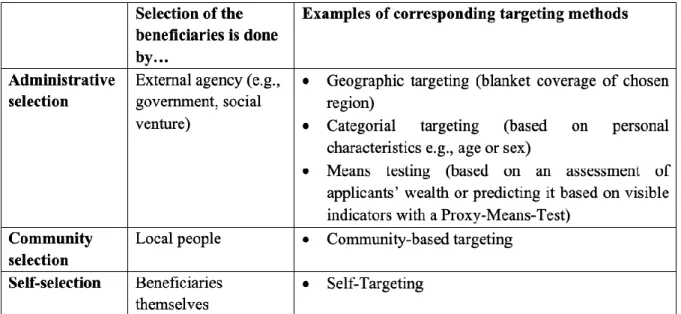
Devereux (2021) clusters known targeting methods in three different categories according to who is selecting the beneficiaries. An overview is provided in table 1.
Table 1: Categorization of targeting methods according to Devereux (2021)
What separates a self-targeting method from the other targeting methods is the fact that no external party is needed to assess the applicant’s poverty status individually (Devereux, 2021;
Van de Walle, 1998).
2.3.1 Self-Targeting
While self-targeted programs are technically open to everyone, incentives are introduced that induce the neediest more than the RoP (Devereux, 2021; Grosh et al., 2008; Hoddinott, 1999;
Van de Walle, 1998). Therefore the take-up is expected to be higher among the neediest than among the RoP (Grosh et al., 2008). The incentives can be manipulated for this purpose either by raising the costs to access the benefit (to make sure that only the neediest who have no other choice take up the benefit despite the inconveniences), by lowering the value of the benefit (to make them less attractive for the RoP but still essential for the neediest), or by combining both (Devereux, 2021; Van de Walle, 1998). Raising the costs of access could be done, for example, through waiting time/queuing (Nichols, Smolensky, & Tideman, 1971), requiring labor from the beneficiaries (Devereux, 2021), increased travel distance (Alatas et al., 2016), or an intentionally connected social stigma of poorness (FAO, 2001; Van de Walle, 1998). Apart
from the social stigma, all ways of increasing the costs of access are connected with some form of time commitment (Hoddinott, 1999). It is assumed that the RoP has higher opportunity costs of committing time than the neediest (Besley & Coate, 1992) although this is sometimes questioned (FAO, 2001). The value of the benefit could be reduced for example by offering lower-quality (e.g., food, health care) (FAO, 2001; Galtier, 2019), paying only minimal cash transfers (Hoddinott, 1999) or offering benefits (e.g., certain crops or flour) that are only consumed by the neediest but not by the RoP (FAO, 2001; Grosh et al., 2008; Hoddinott, 1999;
Van de Walle, 1998). One of the most common examples can be found in public work programs that only pay subsistence wages (Grosh et al., 2008).
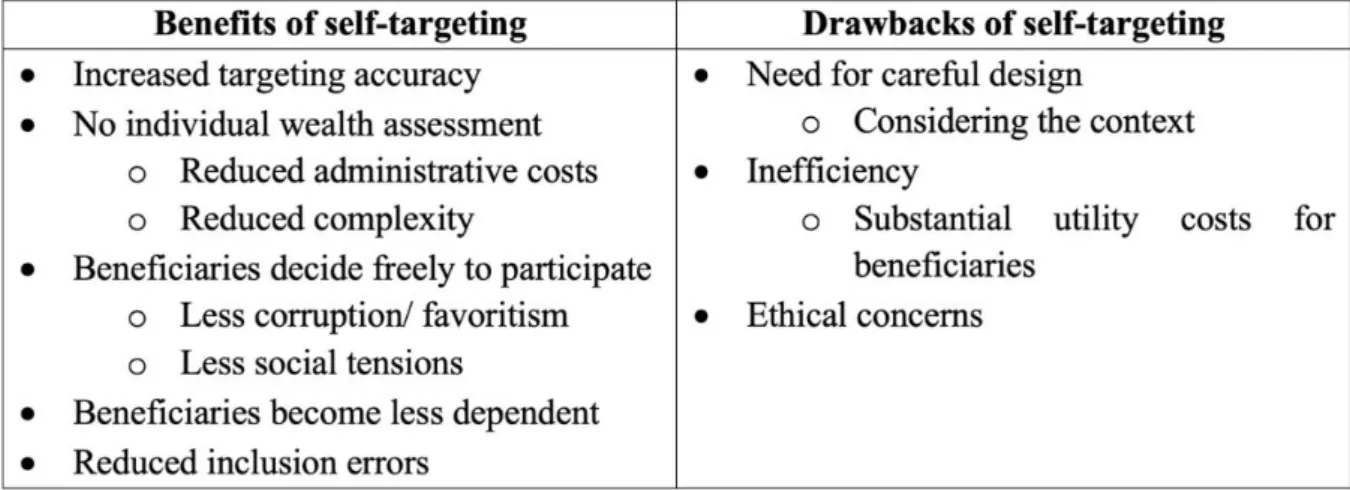
Research showed that self-targeting has several benefits (see table 2). Firstly, it was shown that self-targeting (or a combination of it together with other targeting methods) increased targeting accuracy (Alatas et al., 2016; Coady, Grosh, & Hoddinott, 2004). Secondly, self-targeting drastically reduces administrative costs since there is no individual wealth assessment needed (Devereux, 2021; FAO, 2001; Grosh et al., 2008; Van de Walle, 1998). Therefore, a larger amount of resources could be used to actually provide value to the eligible beneficiaries (Galtier, 2019). Due to the reduced complexity, there might be a higher chance that self- targeting methods are compatible with the existing infrastructure (FAO, 2001).
Thirdly, all the beneficiaries decide for themselves if they participate or not. This reduces opportunities for favoritism or corruption (FAO, 2001; Van de Walle, 1998). Furthermore, this might also reduce the likelihood of potential social tensions (Devereux, 2021) since no one is explicitly excluded.
Fourthly, self-targeting methods can make sure that the beneficiaries do not become dependent on the provided benefits (FAO, 2001; Van de Walle, 1998). Because of the reduced value or increased costs for accessing the benefits, the beneficiaries are assumed to leave the program as soon as a better opportunity occurs (FAO, 2001).
Finally, a well-designed self-targeting method can reduce inclusion errors effectively (Devereux, 2021; FAO, 2001). While it can be said that in theory, a perfectly designed self- targeting method can reduce exclusion errors (and inclusion errors) to zero (Barrett & Clay, 2003), the effect on exclusion errors in practice is more difficult. It depends on differences in the understanding of exclusion errors and the design of the chosen self-targeting method (Barrett & Clay, 2003; Devereux, 2021; Pellissery, 2005) which exceed the scope of this paper.
Nevertheless, self-targeting also comes with some considerable drawbacks (see table 2). Firstly, it requires a careful design in accordance with the context of application (FAO, 2001;
Hoddinott, 1999; Slater & Farrington, 2010). Secondly, the used self-targeting methods might be inefficient, because substantial utility costs (e.g., low-quality food; hard physical labor) are forced upon the beneficiaries (Alatas et al., 2016) just for the sake of identifying them. Finally, connected to the second point there are some relevant ethical concerns regarding self-targeting (e.g., when burdening the beneficiaries by intentionally serving low-quality food) as suggested by Galtier (2019). The author explains that the use of self-targeting conveys a message which involves symbolic violence (e.g., violence by nurturing a negative self-perception of the beneficiaries, violence by putting pressure/guilt on the beneficiaries, or violence by making them accept the inconveniences).
Table 2: Benefits and drawbacks of self-targeting
Nonetheless, it seems like a major part of the drawbacks could be potentially prevented by designing a more efficient, ethical, and context-adapted self-targeting method (Alatas et al., 2016; Devereux, 2016). Most targeting methods are a multi-level combination of different methods (Devereux, 2021; FAO, 2001) e.g., choosing the region (geographic) and then implementing self-targeting. Due to the potential benefits, self-targeting should be at least considered as a potential part of a targeting solution.
Yet, most of the examples of self-targeting stem from governmental programs (e.g., public work programs in rural India) (Alatas et al., 2016; Kozicka et al., 2019; Pellissery, 2005). There is a lack of examples from organizations in the private sector applying self-targeting, although the straightforwardness of the concept, the reduced administrative costs (Devereux, 2021), and the potential simplicity (Pellissery, 2005) should theoretically be especially intriguing for (smaller) private organizations (e.g., social ventures). To understand why this does not reflect in practice I aim to shed light on the barriers that social ventures perceive regarding self-targeting methods.
3 METHODOLOGY 3.1 Research Design & Method
To identify the barriers perceived by social ventures regarding self-targeting I chose a qualitative research design. Due to the lack of previous research on this specific topic, an exploratory qualitative research design fitted the purpose (Edmondson & McManus, 2007).
Furthermore, at this point improving the understanding of this phenomenon was more important than the generalizability of the results (Marshall, 1996). Therefore, I pursued a single case study approach to get a deeper understanding of the complex topic (Bell, 2022). The chosen method was individual semi-structured interviews within the social venture ODG. The benefit of semi- structured interviews is the ability to adapt to the interviewees’ responses and ask follow-up questions (Rubin & Rubin, 2005).
3.2 Data Collection
The sample contained nine country managers from ODG. The social venture is the chosen business case for this study since they target the neediest and operate across various contexts.
To identify and support the neediest while facing resource constraints, ODG uses different targeting strategies across the countries in which they operate. Furthermore, they are at least partly reliant on the generated revenues and can be considered a social venture applying the given definition (see 2.2).
In April 2022, I conducted semi-structured interviews with the country managers of Bolivia, Brazil, Burkina Faso, Colombia, India, Kenya, Liberia, Malawi, and Peru to understand the currently used targeting strategy and identify potential barriers to self-targeting. All interviews were conducted and recorded online via Google Meet and took between 35 and 65 minutes.
The interview guide (see 8.1) was created particularly for this research and contains 12 structuring, open-end questions with several optional follow-up questions depending on the interviewees’ responses in accordance with Given (2008). It was piloted beforehand with a representative of another social venture in the same industry as ODG. As suggested by Cassel
(2015) the interviews were started with some casual, stimulating questions and ended with some casual, less thought-provoking closing questions, which wrap around the core of in-depth, topic-related questions. Beforehand the participants were asked to sign the informed consent (see 8.2).
During the interview, the interviewee firstly was informed about the purpose and content of the research. Secondly, several questions were asked regarding the business model and the currently used targeting strategy. Thirdly, several questions were asked to further understand if ODG uses self-targeting in the respective country. Those questions were accompanied by a clear definition of self-targeting based on the corresponding section (see Self-Targeting).
Several examples were given, and a written definition was provided via the chat (see 8.1 #6).
Fourthly, based on the previous responses several questions referred to first impressions, previous experiences, and the perceived benefits/drawbacks of self-targeting. Those questions particularly aimed to identify the perceived barriers to self-targeting. Finally, the interviewees were asked whether the interview triggered any new thoughts about the topic of (self-)targeting and whether they have anything else to share.
3.3 Data Analysis
The recorded interviews were transcribed with the support of the online service Happyscribe.
Afterwards, they were further processed and coded with the software MAXQDA (see Coded Transcripts). The chosen method for data analysis was a content-structuring qualitative content analysis in accordance with Kuckartz (2018). This approach focuses on summarizing the data on the linguistic level by using case and code summaries. Fitting the style of semi-structured interviews, the coding procedure was an open, iterative process mainly focused on inductive coding (focused on identifying patterns in the data) as suggested by Kuckartz (2018).
Nevertheless, it had some characteristics of a deductive (theory-guided) coding process by using priorly available theoretical knowledge as suggested by Mayring (2015) (e.g. usage of
the categorization of targeting methods by Devereux (2021)). Combining both coding approaches led to a coding process that was partly led by theory but remained open to unpredicted patterns (Ligurgo, Philippette, Fastrez, Collard, & Jacques, 2017).
In accordance with Ruona (2005), the first step was familiarization with the data by re-reading the transcripts. As suggested by Kuckartz (2018), this led to forming main categories (superordinate codes). As proposed by the author, these main categories were then further differentiated and subdivided. All codes were clearly defined (see Coding) and the whole data was finally coded in two rounds. During the first round, the coding system was still adjusted to increase precision and reduce redundancy. During the second round, the finalized coding system, consisting of the adjusted main categories and relevant subcategories (subordinate codes), was applied. Afterwards, the data was summarized using code summaries (by the assigned codes) (see Summary-Table). This was done to break down the analysis process into smaller, more feasible steps to maintain clarity while analyzing. I decided against the use of case summaries (by interviewees) since they might be helpful for a cross-country comparison but not for the purpose of this study.
3.4 Research Quality & Ethical Considerations
The conducted pilot of the interview guide aimed to reduce response biases (e.g., socially desirable response bias) (Furnham, 1986; Van de Mortel, 2008). Using the feedback from the pilot, vague questions were clarified, and suggestive questions were re-phrased neutrally.
Furthermore, a neutral interview environment was created while maintaining the anonymity of the interviewees to the public (outside of ODG). To reduce my immutable subjectivity I reflected on my values/assumptions and focused on maintaining openness to alternative interpretations of the data (Given, 2008).
To ensure the high quality of this research I followed Ruona (2005) by focusing on maintaining internal validity (credibility; good match between findings and reality), external validity
(transferability of the results), and consistency (consistent and dependable results). In accordance with Given (2008), the main emphasis was put on a coherent and transparent research process that can be retraced by the reader. To maintain internal validity I met with colleagues working on different topics to discuss potential biases and monitor my self- perceptions (Lapan, Quartaroli, & Riemer, 2012). To maintain external validity I focused on providing sufficient details about the research setting and the participating organization (Lapan et al., 2012). To maintain consistency I elaborated on changes during the research process (Lapan et al., 2012). Due to the typical time and resource restrictions connected to a master thesis, intracoder-reliability was not calculated.
Following Given (2008), the research was designed and conducted to have integrity, considering the humane treatment of participants and respecting ethical conventions regarding the presentation of results. Furthermore, the Netherlands Code of Conduct for Research Integrity (VSNU, 2018) was followed as suggested by the University of Groningen.
Prior to the interviews, the interviewees were asked to read and sign the informed consent to provide them with crucial information about the research and to make sure that they agree with participating (Given, 2008).
4 FINDINGS
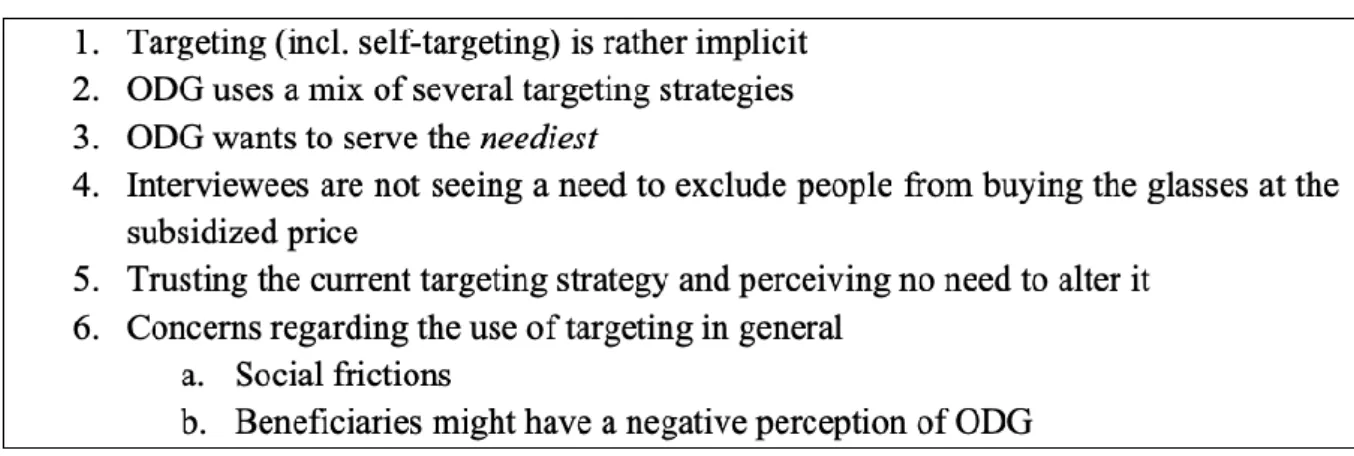
The findings of this paper can be categorized into two groups. They either touch on the topic of targeting in general (apart from self-targeting) or are particularly related to self-targeting. To begin with, the more general findings regarding targeting are presented. A summarized overview can be found in table 3.
4.1 Targeting (Apart from Self-Targeting)
Table 3: Findings regarding targeting (apart from self-targeting)
The interviewees indicated that (1) the topic of targeting strategies (incl. self-targeting) is rather implicit and rarely dealt with explicitly:
“I was never thinking, I was just doing it.” (BB/ Kenya, pos. 97)
Additionally, they indicated that (2) ODG in the corresponding country is using a mix of several targeting strategies without being aware of it. The used approaches are mainly a mix of geographic targeting (e.g., choosing the poorer, mostly rural regions), community-based targeting (e.g., working together with partners from the local community), and categorial targeting (e.g., campaigns for school children). The most dominant aspect was the choice of the poorest (mostly rural) regions which is used in all countries.
It became clear that (3) ODG aims to serve the neediest with its offer:
“[…] we are working for the marginalized, the rural poor, the urban poor.”
(PK/ India, pos. 45)
“[…] who either can’t afford or they can’t access or they aren’t aware.”
(PK/ India, pos. 109)
The interviews showed that (4) apart from RT/ Brazil none of the interviewees perceives a need to exclude people from buying the ODG glasses at a subsidized price:
“So, we're not exclusive, […] it's available to anybody who would want to purchase it.” (MZ/ Malawi, pos. 34)
Although the interviewees rarely test the accuracy of their targeting, it was shown that (5) they are mostly satisfied with their current targeting strategy and perceive no need to alter it:
“Today I am quite content with how we do it because we are very data driven.
And in the way it's possible, I think we do the best we can.” (RT/ Brazil, pos. 74)
The interviewees communicated (6) two concerns regarding the potential use of more exclusive targeting strategies (deviating from their current targeting strategies). One interviewee perceives (6a) a risk of upcoming social frictions:
“If you do separation of people based on status, there will be hard feelings among the people at the outreach.” (JS/ Liberia, pos. 95)
Another interviewee indicated the (6b) potential risk of the local community perceiving ODG in a negative light:
“Whether he can afford it or not afford it, that does not matter, we can't not give him the service because that will give a bad brand name, a bad credibility in that area.” (PK/ India, pos. 88)
4.2 Self-Targeting
The findings connected to self-targeting can be grouped into four categories: general findings, indicated aspects of self-targeting in the current targeting strategy, concerns, and potential benefits. A summarized overview can be found in table 4.
Table 4: Findings regarding self-targeting
4.2.1 General Findings Regarding Self-Targeting
Throughout the interviews, it became clear that (7) self-targeting is not as easy to understand as expected. Also, after providing a precise definition, it mostly needed further explanations and examples to establish a common understanding of self-targeting.
While several interviewees indicated that they are currently using aspects of self-targeting unintentionally (see section 4.2.2), they suggested that (8) self-targeting comes naturally from the circumstances under which ODG operates. This is well shown by the following quote:
“[…]it is not that we internally proceeded saying: Okay, we want to make the glasses less good. […] more often it's about circumstances, particularly with costs and material and trying to find the best combination between them.” (MZ/
Malawi, pos. 81)
4.2.2 Aspects of Self-Targeting in the Current Targeting Strategy
Various interviewees talked about aspects of their current strategy that have characteristics of self-targeting (although they were not aware of it). This included both aspects that referred to self-targeting by lowering the value of the benefit and aspects that referred to self-targeting by increasing the costs of access.
Self-targeting by lowering the value (9)
Interviewees shared aspects of the current strategy which refer to (9a) self-targeting by beneficiaries perceiving ODG’s offer as being for the poor:
“So, even middle class or somebody who can easily afford may not really want to go to that camp because they would understand that it would be for the poor and needy.” (PK/ India, pos. 107)
Several aspects were shared which refer to (9b) self-targeting by lower quality. This includes the glasses (physical product) and the process of getting them:
“We are not correcting fully with cylindric lenses. We only have spherical
correction. When you are going to an optic chain, you will get a proper eye check and you will get a full correction. And even the glasses are different than ours.”
(BB/ Kenya, pos. 28)
Furthermore, interviewees elaborated on aspects which refer to (9c) self-targeting by look and shared that it happens that people don’t get the glasses due to their look:
“For most times, the youth, the young people say the frame is too old school”
(JS/ Liberia, pos. 53)
Self-targeting by increasing the costs of access (10)
Several interviewees explained aspects that refer to (10a) self-targeting by discomfort. This is connected to the necessary process to obtain the glasses:
“[…] like sometimes we are in a favela, we are in a rural area, we are in a school, there are not the best conditions. So, they are not in the air conditioning waiting for our eye exam.” (RT/ Brazil, pos. 86)
Additionally, interviewees talked about aspects that refer to (10b) self-targeting by waiting time:
“They would come in the first two, three hours in large numbers and they have to wait to get themselves tested and get the glasses” (PK/ India, pos. 107)
4.2.3 Concerns Regarding Self-Targeting
The interviewees expressed several concerns about the use of self-targeting. These concerns can be assigned to four categories: risk of less acceptance, devaluing the work of ODG, ethical concerns, and no alternative options are available.
Risk of Less Acceptance (11)
Several interviewees indicated that they perceive (11a) the risk that potential beneficiaries might not accept ODG’s offer if the value is lowered, or the costs of access are increased due to self-targeting. The concern of (11b) less acceptance being harmful to ODG is particularly clear in the following quote:
“[…] we know if we do kind of like this method of self-targeting, it actually would work against us. That even people who are on the lower income are unlikely to stay if there's a long line or anything. (MZ/ Malawi, pos. 73)
Devaluing the work of ODG (12)
One interviewee expressed that (12a) the use of self-targeting could reduce the value of ODG’s work:
“And I never would lower the social value because then you are lowering the work of our team.” (MS/ Bolivia, pos. 90)
Another interviewee mentioned that (12b) the use of self-targeting could limit the education about eye care. When being asked if intentionally increasing the waiting time or offering uglier glasses would be an option the interviewee stated the following:
“I think it would make the education part more difficult if somebody is staying in the sun all day or if they don't like the look of our glasses.” (MZ/ Malawi, pos. 87)
Ethical Concerns (13)
Most of the interviewees expressed ethical concerns about the use of self-targeting. They assumed that (13a) although the beneficiaries might be poor, they might still have their individual values and the aspiration to get decent products/ services.
“I think even on, let's say quote, unquote low-income person… I think there's still a complex person with kind of values and needs […]” (MZ/ Malawi, pos. 73)
“Even if they are paying at a lower amount and they expect a decent service […]”
(PK/ India, pos. 105)
Several interviewees articulated the feeling that (13b) intentionally reducing the value of the benefit (e.g., uglier/lower quality glasses) is dismissive towards the beneficiary and therefore against ODG’s ethical values (e.g., MZ/ Malawi, pos. 85). Additionally, one interviewee indicated that the intentional creation of a more uncomfortable process (increased costs of access) would be against ODG's ethical values as well (JS/ Liberia, pos. 133-136). Various interviewees were concerned about (13c) connecting a stigma of poverty to their product:
“And for me, it would also be a kind of stigmatizing to tell them: Yeah, you know you are poor, and this is why I'm having this kind of glasses and they are not that nice but for you it's enough.” (BB/ Kenya, pos. 93)
No alternative options are available (14)
Several interviewees explained that they operate in places where no one else is serving the eye care needs of the people. It was emphasized that self-targeting might not work in a context where there are no alternative offers available. When asked about the possibility to use self- targeting by more simple/ugly looking glasses to make more wealthy people get glasses elsewhere, an interviewee expressed the following:
“[…] out there there is no optician. So, you just don't have this alternative.”
(MS/ Bolivia, pos. 90)
The interviewees did not further elaborate on potential operational difficulties when implementing self-targeting which can also be seen as a finding.
4.2.4 Potential Benefits of Self-Targeting
The interviewees also expressed some potential benefits of self-targeting. Since the perceived potential advantages of ST are not the focus of this paper they will only be presented briefly.
Two interviewees expressed that (15) the use of self-targeting increases the accuracy of ODG’s targeting (PK/ India, pos. 120; RT/ Brazil, pos. 97-101). One interviewee indicated that (16) the use of self-targeting could make ODG more independent from information provided by other organizations influencing ODG’s targeting (BB/ Kenya, pos. 84-85). Another interviewee suggested that (17) beneficiaries' self-selection into the program might prevent social tensions that could come from a wealth assessment (NB/ Colombia, pos. 177-179). Additionally, an interviewee emphasized that (18) self-targeting can be helpful to create an affordable but still good quality offer for people who got no suitable offer beforehand (BB/ Kenya, pos. 59). The fact that a large part of the interviewees could not come up with potential benefits of self- targeting can also be seen as a finding.
5 DISCUSSION 5.1 Lack of Awareness
The interviews showed that (self-)targeting is rather implicit (finding 1) and that self-targeting is not as straightforward as expected (finding 7). Therefore, the interviewees were not aware of the topic of targeting strategies in general and self-targeting particularly. Approaching self- targeting from a researcher’s perspective might be different than from a practitioner’s perspective which hinders the knowledge transfer between both parties (theory-practice gap) (Reed, 2009). The lack of awareness regarding targeting in general and the reduced clarity when looking at self-targeting from a practical point of view can therefore be seen as barriers to self- targeting.
5.2 Reluctance to Exclude the RoP
Most of the interviewees seem to have a pro-social mindset and are very enthusiastic about ODG’s glasses. Therefore, they want to offer the glasses to as many people as possible but thereby ignore the limits of a subsidized product (which is not covering the costs). It was shown that the interviewees are reluctant to exclude the RoP from buying at the subsidized price (finding 4) which leads to a logical contradiction with the stated aim to serve the neediest (finding 3). As long as the main goal is to serve the neediest it’s necessary, given ODG’s resource limitations, to exclude the RoP from buying at the subsidized price (which doesn’t mean they can’t be served with different less or non-subsidized offers). Targeting everyone with a subsidized offer while properly serving the neediest is beyond the capacities of any single private organization considering the global need (WHO, 2019). Therefore, a subsidized offer by ODG which is not accepted by/excludes the RoP would be a necessary means and nothing to be worried about (see finding 11). In general, it seems like the question of how to adequately allocate the scarce resources to achieve ODG’s mission (Sen, 1992) is not very present.
The reluctance to exclude the RoP seems to prevent the interviewees from explicitly addressing the topic of (self-)targeting although they implicitly use targeting methods (which always contain some form of exclusion). Drawing lines between the neediest and the RoP and deciding whom to exclude seems to be easier when done implicitly than when done explicitly.
5.3 Ambiguity Regarding Organizational Identity
The previously discussed reluctance to exclude the RoP (see finding 4) is connected to questions regarding ODG’s organizational identity (Whetten, 2006) (“Who/What are we as an organization?”): Is the goal to be a social venture serving the eye care needs of the neediest? Or is the goal to be an eyewear brand selling functional eyewear (and additional services) to all parts of society? Or maybe both? Most of the interviewees seem to have no clear answer to this question. The perceived risk of less acceptance connected to self-targeting (see finding 11) reflects the dissonance regarding what ODG wants to be. Being both a social venture and a well-established eyewear brand might be possible but needs various more differentiated offers and a more explicit, strategically developed targeting. At this point, it seems that ODG is stuck in the middle between both approaches without clearly distinguishing between them. This ambiguity regarding their organizational identity hinders them to address the topic of targeting explicitly and forms a barrier to self-targeting. Creating a coherent organizational identity and achieving a common understanding of it across the whole organization might be difficult due to ODG’s decentralized structure. Nonetheless, it might be a necessary step to act consistently with the stated mission. In the course of this, ethical values should also be discussed because they also seem to form a barrier to explicitly addressing the topic of (self-)targeting.
5.4 Need for a sophisticated design and an alternative offer
Despite the reluctance to exclude the RoP and the ambiguity regarding ODG’s identity, several interviewees indicated aspects of self-targeting in their current targeting strategy (without being
aware of it previously (see finding 1)). Although the interviewees aren’t intentionally considering the use of self-targeting, the nature of ODG’s activities and their goal to provide the best possible quality at an affordable price right on the spot might lead to the use of self- targeting methods (finding 8) (see 4.2.2. for examples).
Although aspects of self-targeting might emerge naturally a well-working self-targeting method needs a sophisticated design. A self-targeted offer needs to be appealing enough for the neediest to pick it up while being unappealing enough for the RoP to not pick it up. Considering the blurry definitions, finding the perfect balance might be utopic and the goal of a self-targeted program only an approximation. The perceived risk of offering something that is unappealing to the neediest (finding 11) is therefore reasonable when thinking about self-targeting (the risk to offer something unappealing to the RoP isn’t (see 5.2)). Furthermore, two interviewees indicated that (within certain contexts) even the poorest of the poor often have access to the internet and therefore a well-founded idea of how decent eyewear products look. The option to serve the neediest with products/services which are totally different from the market standards might therefore become outdated.
Furthermore, an available alternative offer (which is more appealing to the RoP) might be needed for self-targeting to work properly. An interviewee made a remark (finding 14) that self- targeting wouldn’t work in a context where people don’t have another option to buy glasses elsewhere. The concept of self-targeting circles around the idea that the reduced value of the benefit and/or the increased costs of access make the RoP pick up a more inducing (higher value of the benefit/lower costs of access), non-subsidized offer elsewhere. If there is no alternative offer available in the region the RoP may still pick up the self-targeted offer although they could afford a more inducing product/service. This is relevant for parts of the RoP that could afford a better locally available offer but aren’t able to afford the time and money (or lack information) for traveling to find a better offer in another region/city. This part of the RoP could then also
be considered as part of the neediest which shows that the lack of an alternative offer blurs the lines between the RoP and the neediest even more. Although the need for an available alternative offer (which is more inducing to the RoP) for self-targeting to work seems logical, it is not explicitly articulated in the literature. For ODG this is particularly relevant since they often are the only ones offering eyewear in the most marginalized rural areas.
To overcome this ODG could provide the alternative offer themselves. They could offer their subsidized basic product/service using self-targeting and additionally a not self-targeted, non- subsidized, premium product/service (which has a higher value of the benefit and/or lower costs of access). Thereby ODG could potentially serve the neediest with the subsidized offer and the RoP with a less-/non-subsidized offer (assuming a well-functioning targeting strategy). The Indian team (DM/ India, Pos. 96-98) already offers premium eyewear for a non-subsidized price.
Connected to this, an interviewee shared the idea (outside of the recorded interview) to invite independent local opticians to join ODG’s outreaches to offer their non-subsidized products/services additionally to ODG’s products/services. The local opticians could provide the alternative (non-subsidized) offer which might be needed for self-targeting to work while generating revenue for themselves. Thereby the relationship with the local opticians who partly perceive ODG as competition (e.g., MS/ Bolivia, Pos. 26) could be improved. In general, a working self-targeting strategy might be very helpful to protect local markets since it targets exclusively the neediest who aren’t able to buy at the local markets anyways.
6 CONCLUSION 6.1 Limitations
Firstly, due to the nature of being a master thesis, this research faced limitations in time and financial resources. Secondly, the interviews were influenced by some minor language barriers which didn’t affect the coverage of the important topics. One interview (JS/ Liberia) was affected by connection problems, so not all relevant topics could be discussed in detail. Another interview (AC, DM, PK/ India) included three interviewees which could have led to a different dynamic. Thirdly, the finding of self-targeting not being as straightforward as expected could be heavily biased by an insufficient explanation of the topic. Introducing a theoretical concept during an interview was more difficult than expected but was done to the best of my ability.
In general, readers should be aware that this research was conducted by an academic living in a western context who is not very aware of the local characteristics of the BoP contexts in which ODG operates. This article should not be understood as an attempt to push theoretical findings upon practitioners but provide food for thought.
6.2 Outlook for Future Research
The outcomes of this research open up numerous new questions about (self-)targeting which should be examined by future research. Firstly, the provided overview of perceived barriers regarding the consideration and implementation of self-targeting is not expected to be exclusive. Therefore, it should be tested and further developed. Secondly, future research should further examine how relevant a clear organizational identity is for social ventures targeting the BoP. Thirdly, future research should shed light on the suggestion that self- targeting comes naturally when organizations targeting the BoP try to offer good quality at an affordable price. Fourthly, the topic of self-targeting is quite broad and contains a large variety of different methods. Some of the perceived barriers may apply to one form of self-targeting but not to another which should be clarified in the future. Fifthly, the identified theory-practice
gap regarding self-targeting should be further examined and narrowed. Finally, it should be tested if the concerns regarding self-targeting are relevant when implementing self-targeting since this paper only considered interviews talking theoretically about self-targeting without any of the interviewees explicitly implementing it.
6.3 Concluding Summary
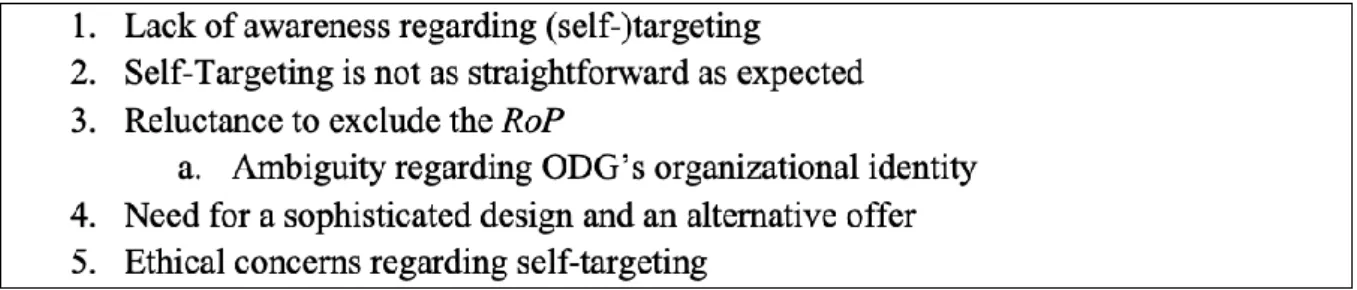
To answer the research question of this paper, several barriers regarding the consideration and implementation of self-targeting in the context of social ventures were identified. A summarized overview can be found in table 5.
Table 5: Identified barriers to self-targeting
Firstly, a lack of awareness regarding (self-)targeting hinders the explicit discussion of the topic and reduces the chances of strategically choosing certain methods. Secondly, self- targeting might be not as straightforward from a practical perspective as it is presented in the literature.
Thirdly, most of the interviewees don’t want ODG’s offer to be exclusive. ODG is aiming to serve the neediest but thereby not willing to exclude the RoP from buying at a subsidized price.
Considering their limited resources, this may limit ODG’s ability to serve the neediest.
The reluctance to exclude the RoP is connected to ODG’s identity: Is the goal to be a social venture serving the eye care needs of the neediest, or is the goal to be an eyewear brand offering functional glasses (and additional services) across all levels of society? Currently, it seems like ODG is pursuing both approaches without clear separation. They must gain clarity regarding
their organizational identity to then implement a well-designed targeting strategy explicitly.
Thereby, it could be possible to be both a social venture and an eyewear brand.
Fourthly, for self-targeting to work properly, a sophisticated design is required as well as an available alternative offer. The RoP for whom the value of the benefit is too low and/or the costs of access are too high needs to have the possibility to get glasses elsewhere. If there is no other option available in the area, they might still go for the self-targeted offer although they could afford better. The need for an alternative offer is neglected in literature but is particularly relevant for social ventures like ODG which often operate in the most marginalized contexts that aren’t served by anyone else.
Finally, interviewees expressed ethical concerns regarding the use of self-targeting. By no means this paper wants to encourage ODG to drop their ethical values when thinking about (self-)targeting but aims at raising awareness that their ethical values (under certain conditions) may limit their ability to pursue their mission of serving the neediest. This might be helpful to trigger discussions that again circle around ODG’s identity.
This paper adds to the literature by elaborating on the barriers that social ventures perceive regarding the consideration and implementation of self-targeting. Particularly relevant is the lack of awareness regarding (self-)targeting, the reluctance towards excluding people, ethical concerns, and the fact that self-targeting needs the availability of alternative offers to work properly. The reluctance to exclude the RoP is particularly interesting since it circles around questions of ODG’s identity. The lack of clarity regarding who/what ODG wants to be seems to hinder the implementation of a clear targeting strategy. Furthermore, this might be relevant for other social ventures targeting the BoP and should be examined by future research.
Practitioners can learn from this paper that organizations need a clear common understanding of their identity to operate successfully at the BoP. Furthermore, it is necessary to explicitly discuss the topic of targeting.
7 Bibliography
Alatas, V., Purnamasari, R., Wai-Poi, M., Banerjee, A., Olken, B. A., & Hanna, R. 2016. Self- targeting: Evidence from a field experiment in Indonesia. Journal of Political Economy, 124(2): 371-427.
Barki, E., Comini, G., Cunliffe, A., Hart, S., & Rai, S. 2015. Social entrepreneurship and social business: Retrospective and prospective research. Revista de Administração de Empresas, 55: 380-384.
Barrett, C. & Clay, D. 2003. How accurate is food-for-work self-targeting in the presence of imperfect factor markets? Evidence from Ethiopia. The Journal of Development Studies, 39(5): 152-180.
Bell, E. 2022. Business research methods: Oxford university press.
Besley, T., Kanbur, S. R., & Mundial, B. 1990. The principles of targeting: Office of the Vice President, Development Economics, World Bank.
Besley, T. & Coate, S. 1992. Workfare versus welfare: Incentive arguments for work requirements in poverty-alleviation programs. The American Economic Review, 82(1):
249-261.
Cassell, C. 2015. Conducting research interviews for business and management students:
Sage.
Coady, D., Grosh, M., & Hoddinott, J. 2004. Targeting outcomes redux. The World Bank Research Observer, 19(1): 61-85.
Dados, N. & Connell, R. 2012. The global south. Contexts, 11(1): 12-13.
Dembek, K., Sivasubramaniam, N., & Chmielewski, D. A. 2020. A systematic review of the bottom/base of the pyramid literature: Cumulative evidence and future directions.
Journal of Business Ethics, 165(3): 365-382.
Devereux, S. 2016. Is targeting ethical? Global Social Policy, 16(2): 166-181.
Devereux, S. 2021. Targeting, Handbook on Social Protection Systems: Edward Elgar Publishing.
Edmondson, A. C. & McManus, S. E. 2007. Methodological fit in management field research.
Academy of management review, 32(4): 1246-1264.
EinDollarBrille e.V. 2020. Annual Report 2020.
FAO. 2001. Targeting for nutrition improvement: resources for advancing nutritional well- being. Food and Agricultural Organization of the United Nations.
Furnham, A. 1986. Response bias, social desirability and dissimulation. Personality and individual differences, 7(3): 385-400.
Galtier, F. 2019. What is wrong with the self-targeting of food aid?: SFER.
Given, L. M. 2008. The Sage encyclopedia of qualitative research methods: Sage publications.
Goyal, S. & Sergi, B. S. 2015. Social Entrepreneurship and Sustainability—Understanding the Context and Key Characteristics. Journal of Security & Sustainability Issues, 4(3).
Goyal, S., Sergi, B. S., & Jaiswal, M. 2015. How to design and implement social business models for base-of-the-pyramid (BoP) markets? The European Journal of Development Research, 27(5): 850-867.
Grosh, M., Del Ninno, C., Tesliuc, E., & Ouerghi, A. 2008. For protection and promotion:
The design and implementation of effective safety nets: World Bank Publications.
Haugh, H. 2005. The role of social enterprise in regional development. International Journal of Entrepreneurship and Small Business, 2(4): 346-357.
Hockerts, K. 2006. Entrepreneurial opportunity in social purpose business ventures, Social entrepreneurship: 142-154: Springer.
Hockerts, K. 2015. How hybrid organizations turn antagonistic assets into complementarities.
California Management Review, 57(3): 83-106.
Hoddinott, J. 1999. Targeting: Principles and practice. Technical Guide, 9: 70-75.
Huybrechts, B. & Nicholls, A. 2012. Social entrepreneurship: Definitions, drivers and challenges, Social entrepreneurship and social business: 31-48: Springer.
Kolk, A., Rivera-Santos, M., & Rufín, C. 2014. Reviewing a decade of research on the
“base/bottom of the pyramid”(BOP) concept. Business & Society, 53(3): 338-377.
Kozicka, M., Weber, R., & Kalkuhl, M. 2019. Cash vs. in-kind transfers: the role of self- targeting in reforming the Indian food subsidy program. Food Security, 11(4): 915-927.
Kuckartz, U. 2018. Qualitative Inhaltsanalyse. Methoden, Praxis, Computerunterstützung: 4.
Auflage. Weinheim, Beltz Juventa.
Landrum, N. E. 2007. Advancing the “base of the pyramid” debate. Strategic management review, 1(1): 1-12.
Lapan, S. D., Quartaroli, M. T., & Riemer, F. J. 2012. Qualitative research: An introduction to methods and designs: Jossey-Bass/Wiley.
Ligurgo, V., Philippette, T., Fastrez, P., Collard, A.-S., & Jacques, J. 2017. A method combining deductive and inductive principles to define work-related digital media literacy competences, European Conference on Information Literacy: 245-254:
Springer.
London, T. & Hart, S. L. 2004. Reinventing strategies for emerging markets: beyond the transnational model. Journal of international business studies, 35(5): 350-370.
Marshall, M. N. 1996. Sampling for qualitative research. Family practice, 13(6): 522-526.
Martin, R. L. & Osberg, S. 2007. Social entrepreneurship: The case for definition: Stanford social innovation review Stanford.
Mayring, P. 2015. Qualitative Inhaltsanalyse. 12., überarb. Aufl: Weinheim: Beltz.
McMullen, J. S. & Bergman Jr, B. J. 2018. The promise and problems of price subsidization in social entrepreneurship. Business Horizons, 61(4): 609-621.
Mkandawire, T. 2005. Targeting and universalism in poverty reduction. Geneva: WHO.
Nichols, D., Smolensky, E., & Tideman, T. N. 1971. Discrimination by waiting time in merit goods. The American Economic Review, 61(3): 312-323.
OneDollarGlasses; Concept; https://www.onedollarglasses.org/concept/; 18.02., 2022.
Pellissery, S. 2005. Local determinants of exclusion and inclusion in rural public works programmes: A political economy approach. International Journal of Rural Management, 1(2): 167-184.
Peredo, A. M. & McLean, M. 2006. Social entrepreneurship: A critical review of the concept.
Journal of world business, 41(1): 56-65.
Prahalad, C. K. & Hart, S. L. 1999. Strategies for the bottom of the pyramid: creating sustainable development. Ann Arbor, 1001: 48109.
Prahalad, C. K. & Hart, S. L. 2002. The Innovation Sandbox Strategy+Business, 26: 2-14.
Prahalad, C. K. & Lieberthal, K. 2003. The end of corporate imperialism. Harvard business review, 81(8): 109-117.
Prahalad, C. K. & Hart, S. L. 2005. The Fortune at the Bottom of the Pyramid: Wharton School Pub.
Reed, M. I. 2009. The theory/practice gap: a problem for research in business schools? Journal of Management Development.
Rey-Martí, A., Mohedano-Suanes, A., & Simón-Moya, V. 2019. Crowdfunding and social entrepreneurship: Spotlight on intermediaries. Sustainability, 11(4): 1175.
Roundy, P. T. & Bonnal, M. 2017. The singularity of social entrepreneurship: Untangling its uniqueness and market function. The Journal of Entrepreneurship, 26(2): 137-162.
Rubin, H. J. & Rubin, I. 2005. Interviewing: The art of hearing data. Thousand Oaks, CA.
Ruona, W. E. 2005. Analyzing qualitative data. Research in organizations: Foundations and methods of inquiry, 223: 263.
Seelos, C. & Mair, J. 2005. Social entrepreneurship: Creating new business models to serve the poor. Business horizons, 48(3): 241-246.
Sen, A. 1992. The political economy of targeting: World Bank Washington, DC.
Slater, R. & Farrington, J. 2010. Appropriate, Achievable, Acceptable: A Practical Tool for Good Targeting ‘. London: ODI.
Sullivan Mort, G., Weerawardena, J., & Carnegie, K. 2003. Social entrepreneurship: Towards conceptualisation. International journal of nonprofit and voluntary sector marketing, 8(1): 76-88.
Van de Mortel, T. F. 2008. Faking it: social desirability response bias in self-report research.
Australian Journal of Advanced Nursing, The, 25(4): 40-48.
Van de Walle, D. 1998. Targeting revisited. The World Bank Research Observer, 13(2): 231- 248.
VSNU. 2018. Netherlands Code of Conduct for Research Integrity: Association of Universities in the Netherlands (VSNU) The Hague.
Whetten, D. A. 2006. Albert and Whetten Revisited: Strengthening the Concept of Organizational Identity. Journal of Management Inquiry, 15(3): 219-234.
WHO. 2019. World report on vision. World Health Organization.
Wilson, F. & Post, J. E. 2013. Business models for people, planet (& profits): exploring the phenomena of social business, a market-based approach to social value creation. Small Business Economics, 40(3): 715-737.
World Economic Forum. 2005. Partnering for success: Business perspectives on multistakeholder partnerships, World Economic Forum/International Business Leaders Forum/Kennedy School of Government Harvard University.
Zaefarian, R., Tasavori, M., & Ghauri, P. N. 2015. A corporate social entrepreneurship approach to market-based poverty reduction. Emerging Markets Finance and Trade, 51(2): 320-334.