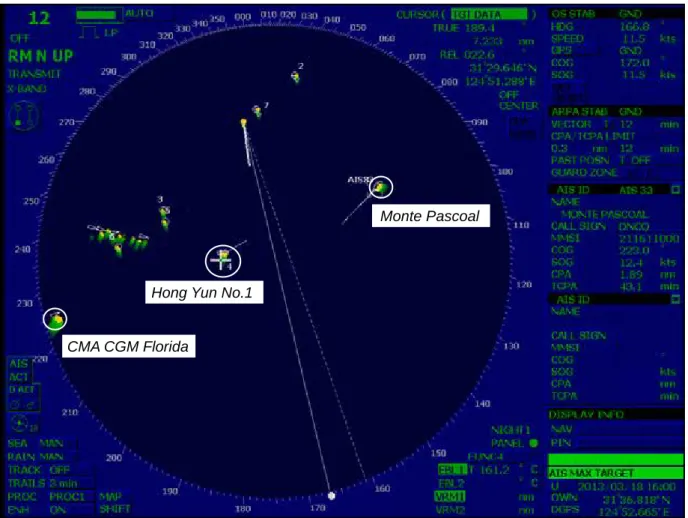
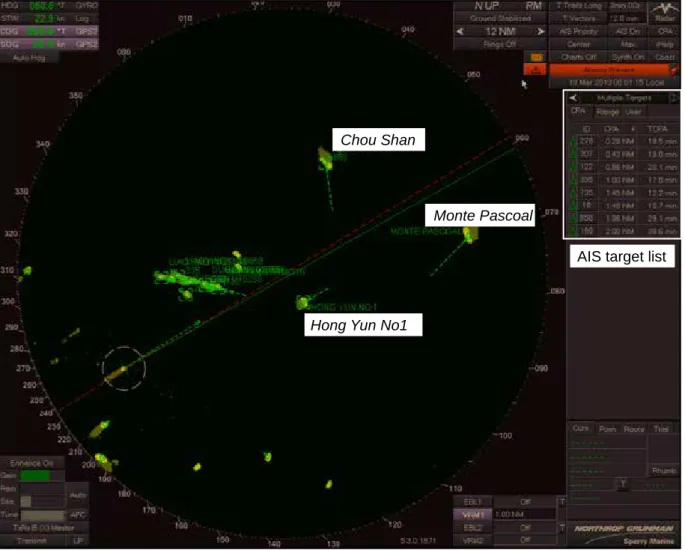
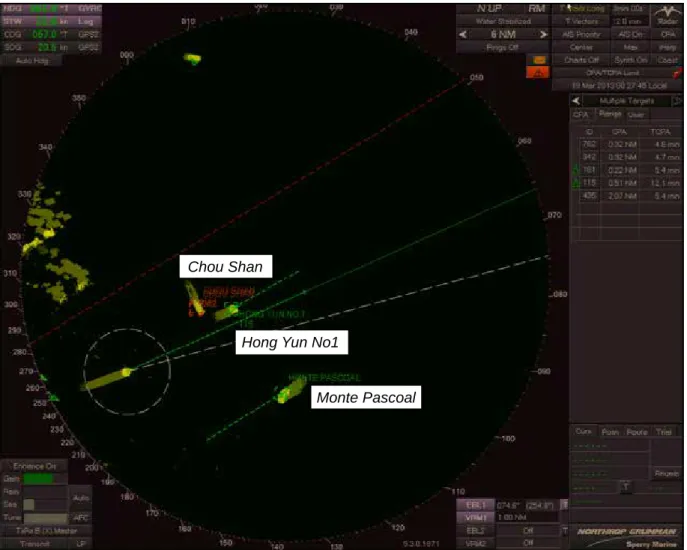
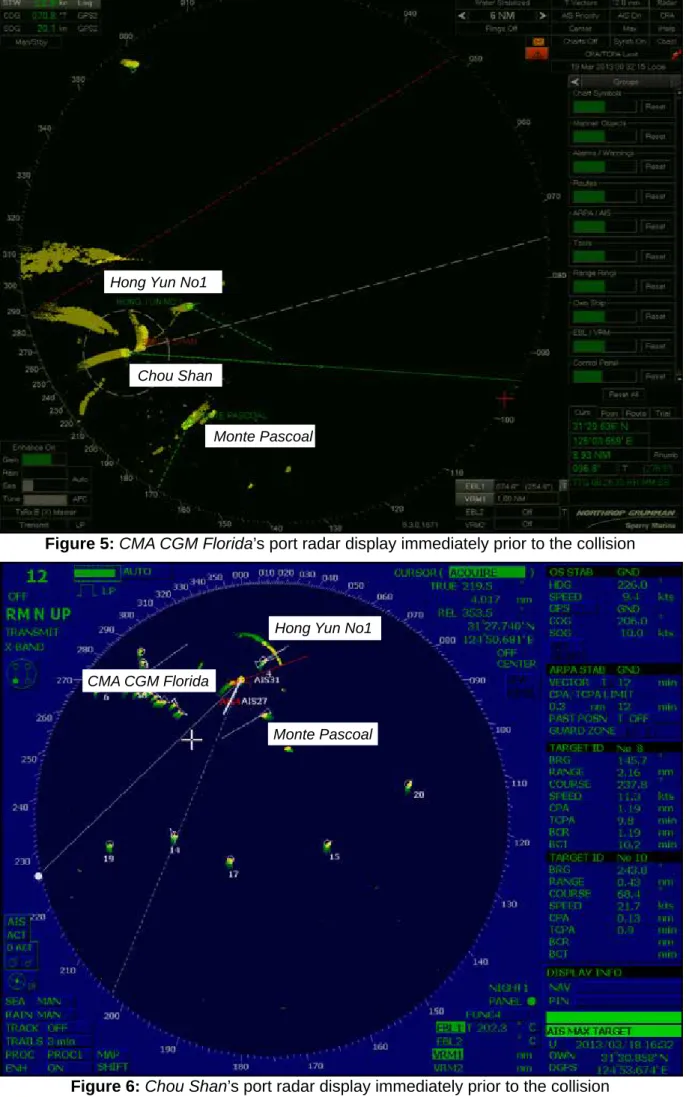
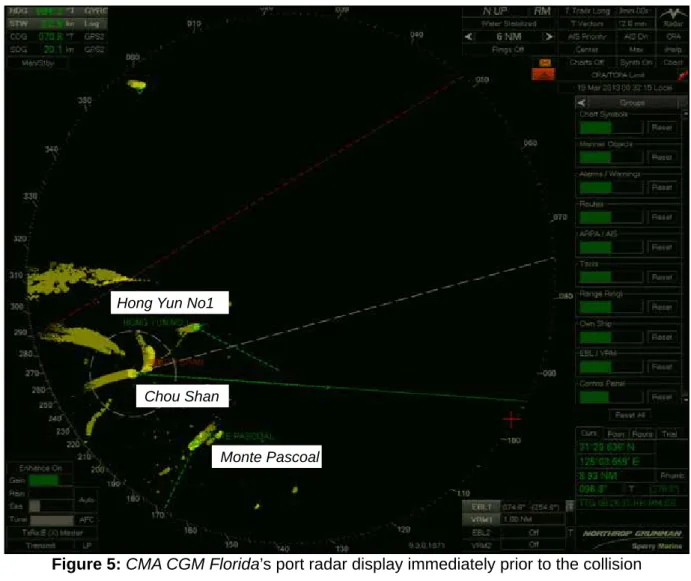
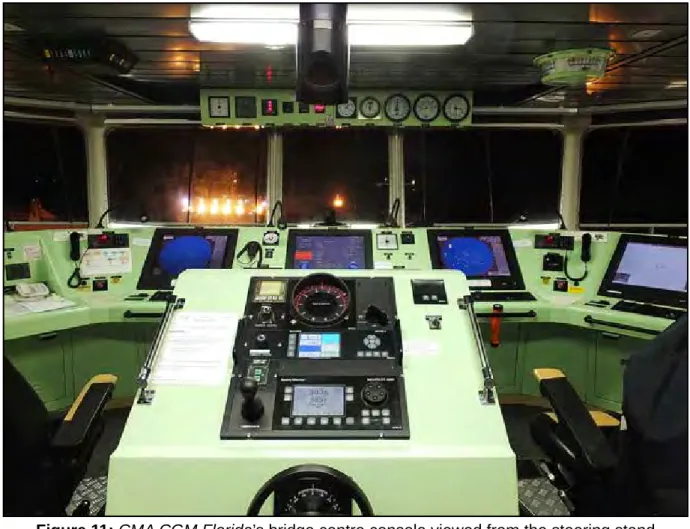
CMA CGM Florida had left Yang Shan, China on March 18 and was heading for Pusan, Korea. Chou Shan's watch officer then used the Very High Frequency (VHF) radio to request that CMA CGM Florida pass Chou Shan's stern. CMA CGM Florida's Filipino watch officer did not understand Mandarin and was unaware that the Chinese second officer had tacitly accepted Chou Shan's request.
CMA CGM Florida's Chinese second officer then called Chou Shan on the VHF radio to request that both vessels pass port to port.
BACkGROUND .1 CMA CGM Florida
NARRATIVE
Events leading up to the collision
Chou Shan was ahead and to port of CMA CGM Florida at a distance of 14 miles. At this point CMA CGM Florida's CPA was less than ½ mile ahead of Chou Shan. This led the Chinese 2/O to question whether CMA CGM Florida would pass Chou Shan's stern.
CMA CGM Florida's Chinese 2/O kept wondering if CMA CGM Florida would pass Chou Shan's stern.

Collision
Post-collision events
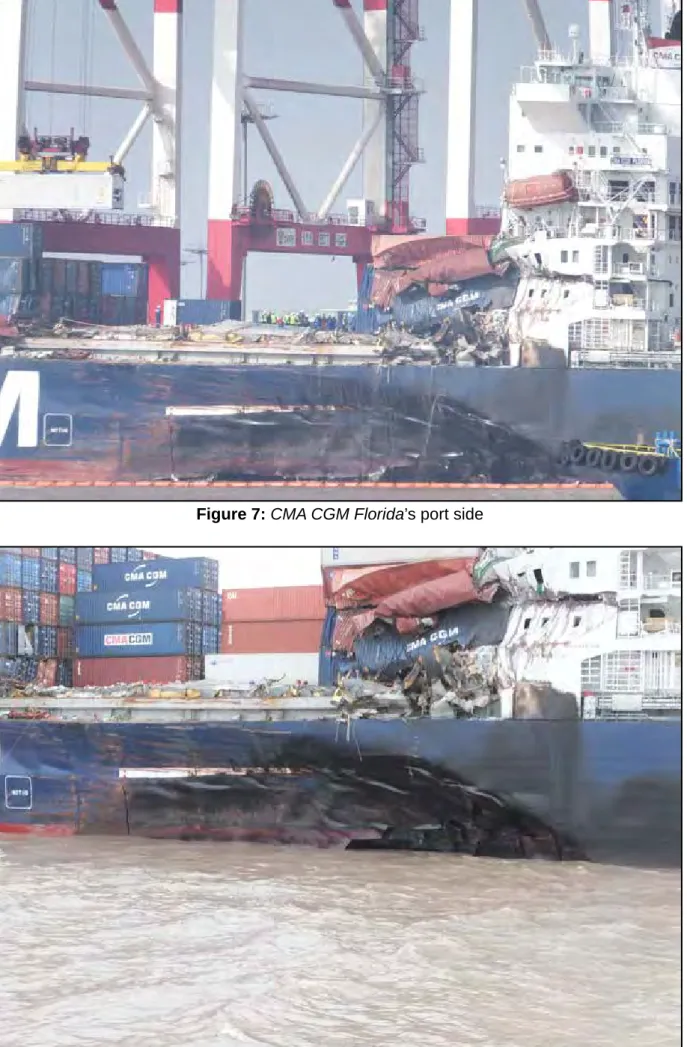
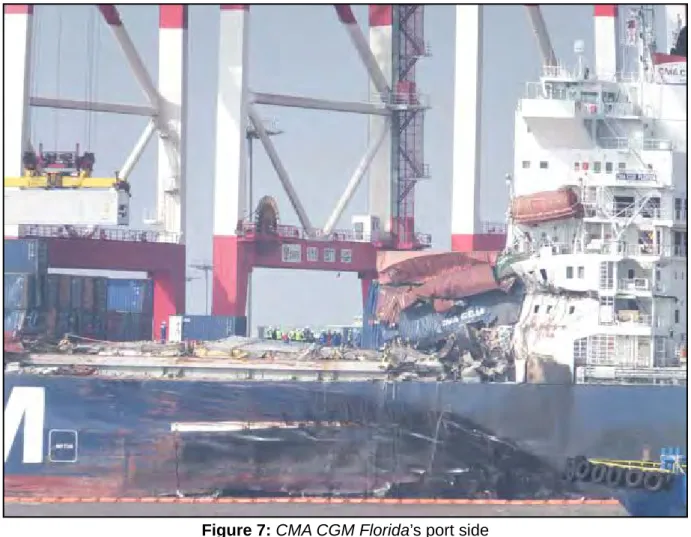
DAMAGE AND POLLUTION .1 CMA CGM Florida
ENVIRONMENTAL CONDITIONS
MANNING AND wATCHkEEPING .1 CMA CGM Florida
The Philippine 2/O joined CMA CGM Florida in September 2012 for a normal 6 month contract after 6 months leave. The Chinese 2/O joined CMA CGM Florida in Yang Shan on March 18, 2013 after a 16-month leave. CMA CGM Florida operated a traditional watch pattern with three officers working 4 hours on duty followed by 8 hours rest.
The Chinese 2/O had joined CMA CGM Florida in Yang Shan so that it could receive a handover from the outgoing Philippine 2/O.
BRIDGE EqUIPMENT .1 CMA CGM Florida
COMPANY INSTRUCTIONS AND MASTER’S STANDING ORDERS .1 CMA CGM Florida
Complete assessment of the situation and the risk of collision, stranding and other hazards to navigation…” [sic]. If the traffic conditions or the movements of other ships cause concern, when entering a traffic separation scheme..." [sic]. Except in the master's standing orders, no reference was made in the SMS regarding the use of VHF radio for collision avoidance.
However, in its internal publication "Maritime SSE Events Feed-back nº01/2009", CMA CGM included feedback on a previous collision. The Officer of the Watch must be aware of the dangers of using VHF in collision avoidance. The officer of the Watch will take frequent and accurate compass readings of approaching vessels to determine whether the risk of collision exists.
Such action must be in accordance with the Collision Ordinances and must then be checked to ensure that it has the desired effect.”. The deck log contained a general set of instructions for watch officers and a list of situations in which the captain should be called. The bridge's standing order book contained guidelines similar to those in the deck log, which was also preprinted in the front of the book.
When navigating in areas of high traffic density or restricted areas (defined as "an area where the presence of more than two vessels makes it difficult to maintain the vessel's original course and this condition occurs continuously, a channel of less than 2 miles in width, and insufficient under keel clearance"). VHF will be used to communicate with the vessel in the vicinity to avoid misunderstandings..." [sic].
REGULATIONS AND GUIDANCE
International Regulations for Preventing Collisions at Sea
International Chamber of Shipping’s Bridge Procedures Guide
Marine Guidance Note 324 (M+F)
International Maritime Organization Resolution MSC.192(79)
VOYAGE DATA RECORDER RECOVERY AND DATA .1 CMA CGM Florida
Request to the Marine Accident Investigators’ International Forum (MAIIF) As part of its investigation, the MAIB requested MAIIF members for information on
Significant reliance on AIS information to determine risk of collision solely in terms of CPA. The MAIB received a total of seven responses from MAIIF members, covering eight marine casualties or incidents involving one or more of the specified safety concerns.
ANALYSIS
- FATIGUE
- OVERVIEw
- ACTION BY CMA CGM FloridA ’S FILIPINO OOw .1 Situational assessment at 0002
- Action to avoid fishing vessels
- VHF radio communications
- Traffic situation and course alteration after passing the fishing vessels By 0021
- ACTION BY CMA CGM FloridA ’S CHINESE 2/O
- ACTIONS BY Chou ShAn ’S OOw
- ACTIONS BY CMA CGM FloridA ’S MASTER .1 Management style
- Post-collision actions
- USE OF VHF RADIO FOR COLLISION AVOIDANCE
- USE OF AIS AND RADAR FOR COLLISION AVOIDANCE .1 CMA CGM Florida
- Guidance
Specifically, hearing the VHF radio call broadcast in Mandarin prompted Chou Shan's OOW to call CMA CGM Florida. The fact that Chou Shan requested CMA CGM Florida to reverse was correctly conveyed. When the Philippine OOW checked the relative vector of Chou Shan's radar target, it was found that the ship was passing behind CMA CGM Florida.
Therefore, he dismissed Chou Shan's request that CMA CGM Florida fly over Chou Shan as inappropriate. At 0027, the Philippine OOW changed CMA CGM Florida's course to port by a further 5 degrees and loudly stated to the Chinese 2/O that the vessels were to proceed from port to port. Although OOW Chou Shan informed the Chinese 2/O CMA CGM Florida that he was concerned about the large turn he would have to make, this information was not conveyed to the Philippine OOW.
When the Chinese 2/O translated the VHF radio conversation to the Philippine OOW, he failed to announce that he had tacitly agreed to fly over the CMA CGM Florida after Chou Shan. After a VHF radio conversation, the Chinese 2/O informed the Philippine OOW that Chou Shan had agreed to port-to-port, but not stated that CMA CGM Florida would also change course. By 0019, CMA CGM Florida had changed course to 080º(T), creating a risk of collision with Chou Shan.
The master of CMA CGM Florida arrived on the bridge shortly after the collision and immediately took charge of the situation. After each of the two VHF radio communications between CMA CGM Florida and Chou Shan, the Filipino OOW and Chou Shan's OOW were left with different expectations.
CONCLUSIONS
SAFETY ISSUES DIRECTLY CONTRIBUTING TO THE ACCIDENT THAT HAVE BEEN ADDRESSED OR RESULTED IN RECOMMENDATIONS
OTHER SAFETY ISSUES DIRECTLY CONTRIBUTING TO THE ACCIDENT 1. Whether or not the two individuals had direct interpersonal conflicts is unclear,
SAFETY ISSUES NOT DIRECTLY CONTRIBUTING TO THE ACCIDENT THAT HAVE BEEN ADDRESSED OR RESULTED IN
ACTION TAkEN
If circumstances permit, a deviation vessel shall keep clear of 6 miles and a standing vessel shall keep clear of 3 miles. Watchmen must be familiar with the characteristics of the vessel and the operation of all navigation equipment on board. Specific guidance on measures to be taken in reduced visibility, with emphasis on the absence of vessels standing/giving way in such conditions.
Masters should take every opportunity to conduct practical training on avoiding collisions with guards.
RECOMMENDATIONS
Extracts from the International Rules for the Prevention of Collisions at Sea. a) Nothing in these rules shall relieve any vessel or its owner, master or crew from the consequences of any failure to comply with these rules or neglect of any precaution which the ordinary practice of seamen may require, or the special circumstances of the case. In interpreting and applying these rules, due regard must be given to all navigational and collision hazards and any special circumstances, including limitations of the vessels involved, which may make deviation from these rules necessary to prevent imminent danger. a} Every measure taken to prevent a collision is carried out in accordance with the rules of this part and must, if the circumstances of the case allow, be positive, carried out in a timely manner and with due regard for good maritime knowledge. Any change in direction and/or speed to avoid a collision must, if the circumstances of the case permit, be sufficiently large to be observed by another vessel observing visually or by radar; a sequence of small changes in direction and/or speed should be avoided.
If there is sufficient space at sea, a change of course alone may be the most effective action to avoid a doze-quarter situation provided it is done at the right time, is substantial and does not result in another doze situation - quarter. The effectiveness of the action must be carefully checked until the other vessel is finally passed and clear. A vessel which, under any of these rules, is required not to obstruct the passage or safe passage of another vessel shall, when required by the circumstances of the case, take early action to allow sufficient sea space for the passage of sure of the other. ship. ii).
A vessel required not to obstruct the passage or safe passage of another vessel is not relieved of this obligation if she approaches the other vessel so as to present a risk of collision and must, when action is taken, take full account of the conduct required by the Rules of this Part. iii). When two power-driven vessels are crossing in such a way that there is danger of collision, the vessel which has the other on her own starboard side must keep out of the way and must, if the circumstances of the case permit, avoid crossing in front of the other. vessel. Every vessel directed to keep out of the way of another vessel shall, as far as possible, take early and substantial steps to keep well clear.
The latter vessel may, however, take action to avoid a collision by her own maneuver only as soon as it becomes apparent to her that the vessel required to move out of the way is not taking appropriate action in accordance with these rules. Any approaching vessel which can be heard around a bend or behind an intermediate obstacle shall respond to such a signal with a long beep.
MGN 324 (M+F)
Radio: Operational Guidance on the Use Of VHF Radio and Automatic Identification Systems (AIS) at
If no sensor is installed or if the sensor (eg gyro) fails to provide data, AIS automatically transmits the data value "not available". The use of AIS on board a ship is not intended to have any particular impact on the composition of sailing hours, which must be determined in accordance with the STCW Convention. It should be noted that human failure metrics can be calculated at different levels (eg, individual, unit(ship) and company).
However, this study aims to examine the effects of seafarers' perceptions of national culture on individual human failings. Most respondents are probably the most qualified people on board to provide information on human failings. This study proposes that lower power distance as experienced by seafarers helps reduce human failures in container shipping operations in the first hypothesis.
This study predicts that the national culture dimension of uncertainty avoidance will have a negative impact on human failures. The effect of collectivism on human failures according to the level of Confucian dynamism for total sea distance. We develop a theoretical model to explain the occurrence of human failures in the context of container shipping and empirically validate the model.
In particular, this study examines and finds the moderating effect of cif Confucian dynamism on the relationships between dimensions of national culture and human error. To our knowledge, this is the first study to provide empirical evidence on the importance of national culture in explaining human error in occupational safety. Specifically, our study fills a gap in the literature that there are no studies that explain human error from the perspective of national culture in container shipping operations.
The results of this study also indicate that power distance and collectivism are negatively associated with human failure.