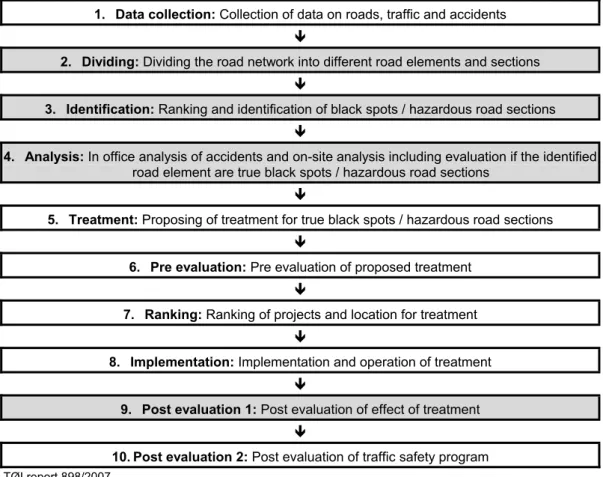
Based on the described state-of-the-art approaches, best practice guidelines for BSM and NSM are described in this report. The purpose of this project is thus to describe and develop state-of-the-art approaches and best practice guidelines for BSM and NSM.
Background
Objective
Even if not all the necessary data and resources are available, improved approaches to BSM and NSM can be developed. Therefore, the objective is to approach ideal practices and eliminate the most obvious shortcomings in the currently used approaches.
Method
Delimitation
Prerequisite about accident data
Report structure
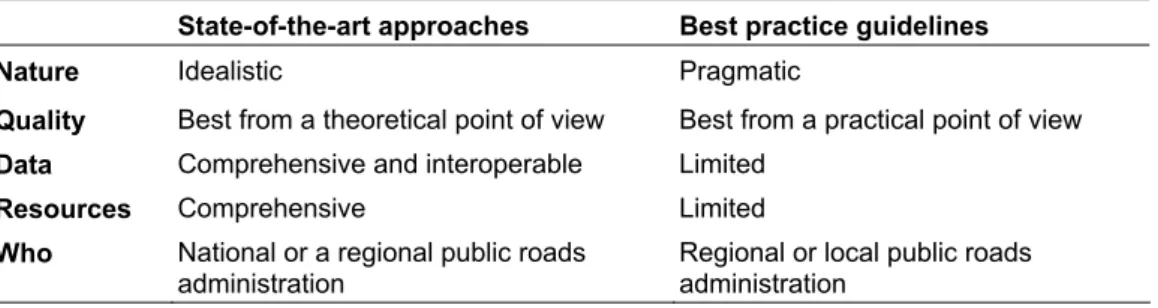
This chapter briefly summarizes the developed state-of-the-art approaches to black spot management (BSM) and safety analysis of road networks also called network safety management (NSM). Afterwards, the overall difference between state-of-the-art approaches and best practice guidelines will be discussed and clarified.
The key elements of the state-of-the-art approaches
This includes a discussion of why it is necessary and appropriate to distinguish between state-of-the-art approaches and best practice guidelines. Black spots should be identified based on the expected number of accidents, regardless of the number of accidents recorded.
Difference between state-of-the-art approaches and best practice guidelines
The more data available, the closer best practice guidelines come to state-of-the-art approaches. The more resources used, the closer the best practice guidelines can be to state-of-the-art approaches.
Why state-of-the-art and best practice guidelines
The limitation of the data determines how close best practice guidelines can come to state-of-the-art approaches. Table 2.2 summarizes the primary differences between state-of-the-art approaches and best practice guidelines.
Use of state-of-the-art and best practice guidelines
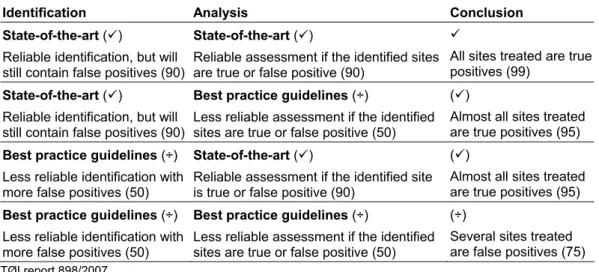
On average, 25% of processed locations will be false black spots or dangerous road sections. For example, you can use best practice guidelines in the identification phase and a state-of-the-art approach in the analysis phase.
Criteria for evaluating best practice
Supplementary criteria
Data and compatibility: The guidelines should be based on and compatible with existing and available accident, road and traffic data. Purpose: The guidelines must be as objective, unambiguous and formalized as possible, which is why the use of subjective and perhaps biased evaluations is limited as much as possible.
Classification of roadway elements
Recommendation
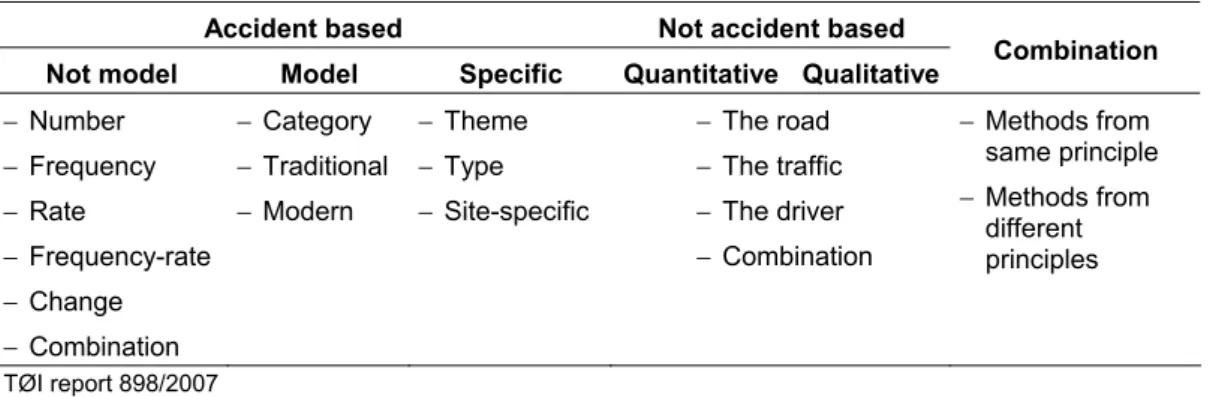
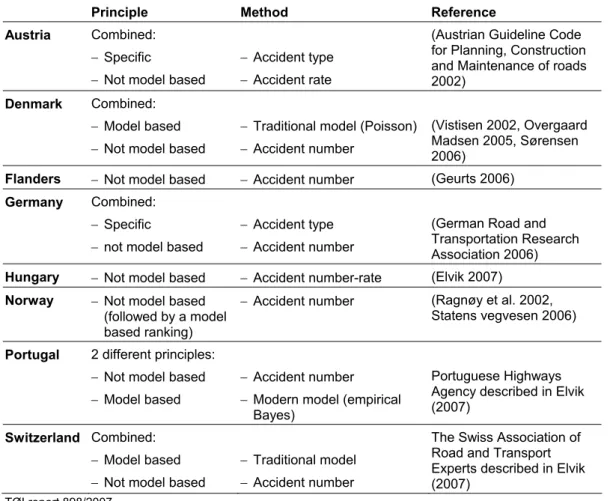
Identification principles
- Different identification principles
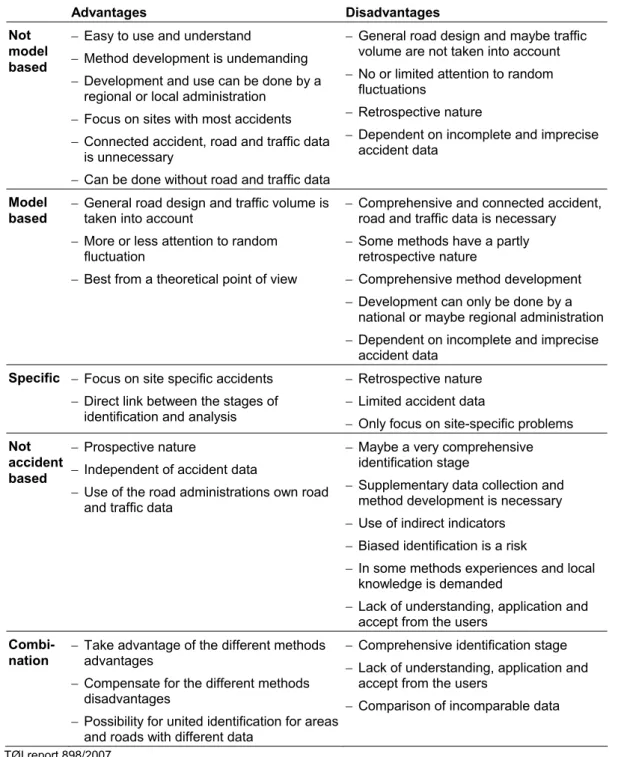
- Advantages and disadvantages
- The use of different principles
- Recommendation
This is also why Bayes' empirical method is described as the state-of-the-art approach. Thus, the second best method after the state-of-the-art approach is a simpler and traditional model-based method. Data − Same data requirements as the current approach (comprehensive and connected accident, road and traffic data).
Identification criteria
- Different identification criteria
- Advantages and disadvantages
- The use of different principles
- Recommendation
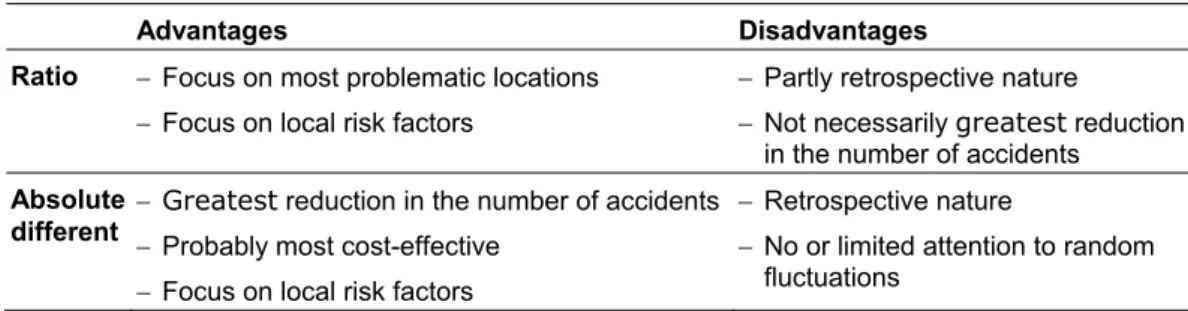
The disadvantage, on the other hand, is that the largest relative difference does not necessarily ensure focus on the place where the absolute greatest reduction in the number of accidents can be achieved. The use of this criterion ensures a focus on locations which have the greatest savings potential in the number of accidents, if the number after improving them. As can be seen from the state-of-the-art approach, the absolute difference criterion for use in the accident analysis can be supplemented with a criterion relating to the registered number of accidents at the identified locations.
Accident analysis
- Research, development and testing
- Objective of the analysis stage
- Recommendation
- The treatment stage
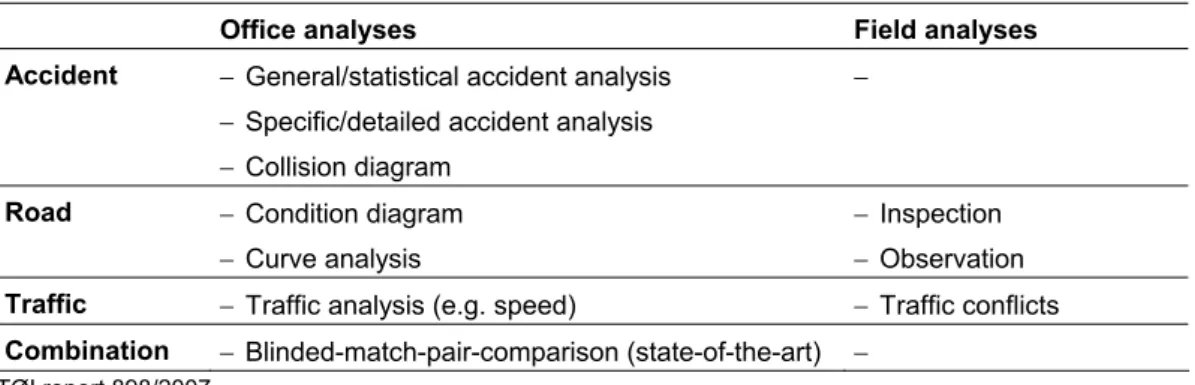
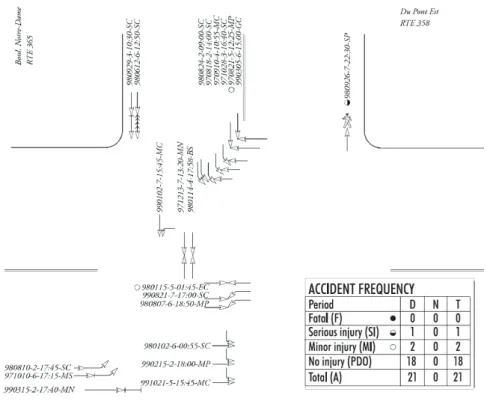
Despite the fact that it requires a lot of resources, it is advisable to supplement the analyzes at the office with a road inspection. It is important to confirm or refute the hypotheses of the previous accident analysis to increase the reliability of the analysis phase and to assess whether the given location is a true or false black spot. In this context, it is recommended to record the assessment in the report of the analysis, because this ensures an active assessment.

Evaluation of the black spot treatment
Criteria for doing the evaluation
Statistical relationship (3): A good estimate should be able to detect the effect of a quantity that is of practical interest. Internally consistent relationship (1): A good evaluation should be able to measure the internal consistency of an effect. Clarity of causal direction (5): A good evaluation should be able to make a clear determination of causal direction.
Different traditional evaluation studies
Can only be used to evaluate the general expected number of accidents and not the local expected number. It is assumed that the annual average number of accidents after the introduction of the measure provides an estimate of the locally expected number of accidents at the location after treatment. The advantage is that the method controls for regression-to-mean, long-term trends in the number of accidents and local changes at the site.

Recommendation
This means that the expected number of accidents with the measure is estimated by adjusting the independent variables in the accident model to the characteristics of the location in question. Similarly, the expected number of accidents without the measure is estimated by setting the independent variables in the accident model according to the characteristics for the location without the measure (Overgaard Madsen 2005a). This also means that it can only be used to evaluate the general expected number of accidents and not the local expected number.
Summary
However, it should be noted that the correction should only include changes that have nothing to do with the given measure (Amundsen and Elvik 2004). Evaluation of the black spot treatment: Whenever possible, a subsequent evaluation of the black spot treatment must be carried out. The evaluation itself should be conducted as a before-after study, controlling for long-term trends in the number of accidents, local changes in traffic volume and regression-to-the-mean using correction factors.
Classification of roadway elements
Constant or variable length
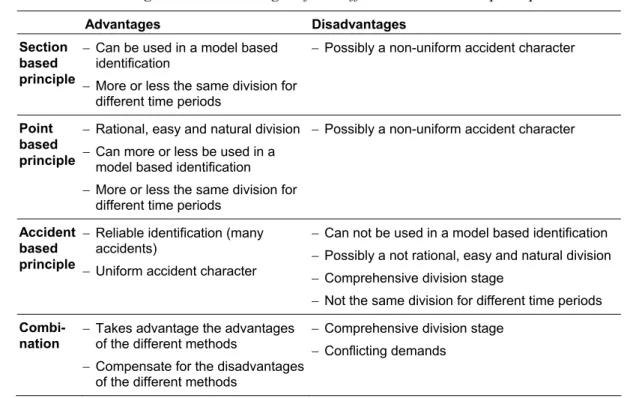
Chapter 4 discusses and recommends best practice guidelines for road network safety analysis or Network Safety Management (NSM). Furthermore, the problem is that there is a risk that local accident peaks on long sections will not be identified because they will be drowned in the average of the whole section, while local possibly random accident peaks on short sections will result in section identification. The reason is that more or less homogeneous sections are needed for model identification of dangerous road sections, which is recommended in chapter 4.2.
Division of road system
A further advantage is that the section-based and the point-based principles will result in more or less the same distribution of the road system for different periods, making it possible for each road section to compare the accident level for different periods. A possible disadvantage of the two road and traffic-based distribution principles is that the registered accidents are not taken into account. This means that the road sections must be homogeneous with respect to parameters that have a significant influence on the number of accidents.
Length of road sections
The road sections must be homogeneous with respect to the parameters used as independent variables in the crash model or category analysis. The basic philosophy for dividing the road system into "short" sections is to identify road sections with local road-related risk factors. This means that up to 20 % of the road sections differ from the rest of the section.

Identification principles
Difference between BSM and NSM
The analysis of the road sections is thus more in the nature of a general road survey with particular emphasis on standard improvements rather than treatment of local and road section-based accident factors. There is no doubt that general road survey and standard improvements contribute to road safety improvements, but since the standard improvements are in principle independent of the accident history, the ranking can be done in a better way as a non-accident based method. The desirability of allowing NSM to be included in the site-specific road safety work of BSM can therefore be questioned, as the resources can be used in a better way for road studies and standard improvements.
Recommendation
This shows that it is very difficult to find local and road section-based accident factors on the identified accident road sections according to the accident history.
Identification criteria – including severity
Accidents or injured road users
Furthermore, the identification is based on the professional and institutional responsibility of the road administration, which is an essential motivation for both BSM and NSM. The advantage of using injured road users as a basis for identification is that it is directly compatible with the police. The disadvantage is that the identification can be determined randomly and with parameters beyond traffic safety management related to the specific route and location.
Weighting principle
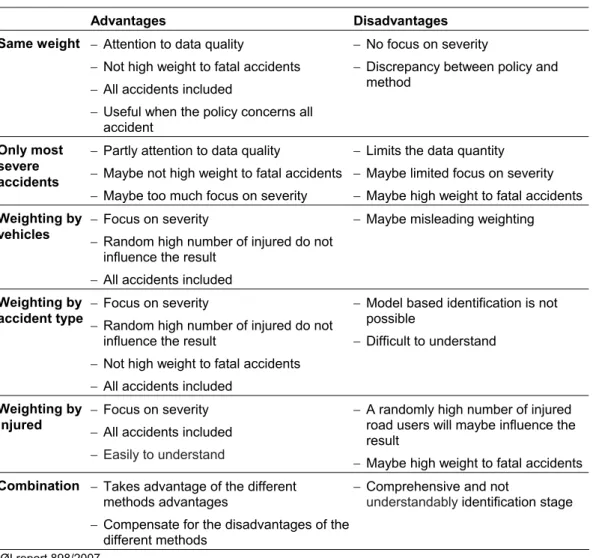
In addition, a few perhaps random fatalities will not dominate the result of the identification. Another advantage is that a possibly arbitrarily high number of injured road users in some crashes has no influence on the result of the identification. This means that fatal accidents often receive a very high weight and these accidents thus dominate the result of the identification.
Severity categories and weights
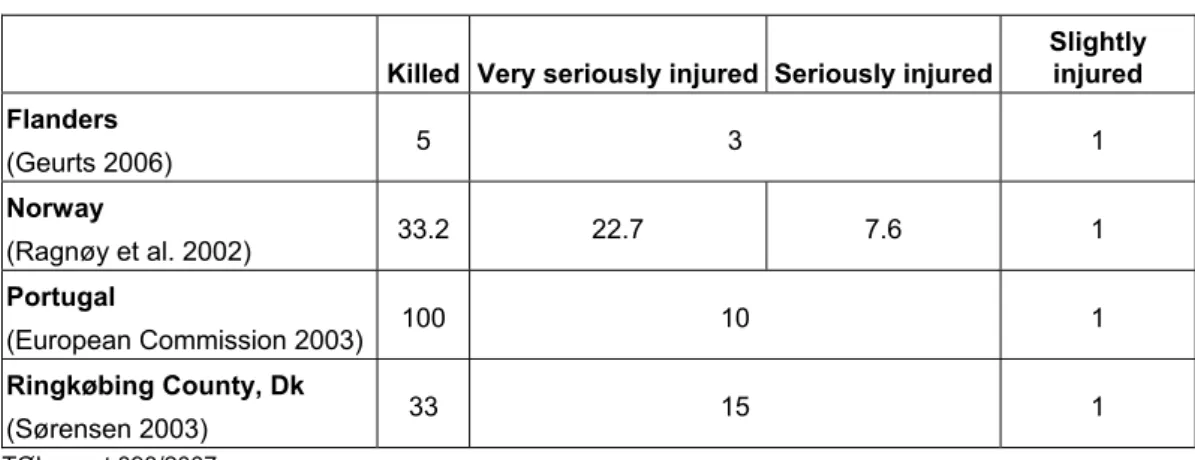
By way of comparison, in the latter method, fatal crashes are equivalent to four crashes with serious or minor injuries. The weights in the accident-based method described in O'Flaherty (1997), Persaud et al. 1997), German Road and Transportation Research Association (2003) and Sørensen (2006) are calculated using monetary values. In addition, it is recommended to calculate the weights for the different severity categories by using the monetary valuations and the average number of injured road users of different severity in the different severity categories.
Accident analysis
Difference between BSM and NSM
This applies in particular to the analysis of longer dangerous road sections in NSM and how this work differs from BSM. The black spots and the dangerous stretches of road differ primarily in terms of location length and overall philosophy for the work. Black spots usually have a length of up to 0.5 kilometres, while dangerous stretches of road, according to the recommendations, have a length of between 2 and 10 kilometres, with an average stretch length of around 5-6 kilometres.
Recommendation
The view of the road for a dangerous stretch of road differs from a view of the road for a black spot in two ways. The road inspection should be carried out by two people, one is a traffic safety officer and one is employed in the road service's operations or project department. The road inspection should not be carried out at a specific time of day and should not last longer than one working day (Sørensen.

Evaluation of the treatment of hazardous road sections
Difference between BSM and NSM
An example of a developed checklist for road inspection of dangerous roads is shown in table 4.7. The road inspection should be carried out by car and at the places of concern, the surveyors should stop to examine the places more closely.
Recommendation
Summary
Modern approaches are described in Elvik (2007) and based on this the best practice guidelines are described in this report. Features of the latest approach and best practice guidelines for black spot management (BSM) and road network safety analysis (NSM). Analytical Approach to Identifying Hazardous Road Locations: A Review of the Literature, Center for Research on Transportation, Montreal University, Montréal.