
The report presents key information on the most commonly used types of plastics and their characteristics and uses, as well as on the hazardous substances used in plastics that are present on the Norwegian Priority List of Hazardous Substances ("Prioritetslisten") and/or the candidate list under REACH until August 2012. This report presents information on the most commonly used types of plastics and their characteristics and uses, as well as on the hazardous substances used in plastics. The second part of the report focuses on 43 chemical substances used in plastics that are considered hazardous and are therefore accepted on the Norwegian Priority List of Hazardous Substances or the REACH candidate list of SVHC substances.
With regard to the hazardous substances, a screening procedure has been carried out to determine which substances on the Candidate List and the Norwegian Priority List are used in plastics.
Introduction
- Selection of plastic materials for the survey
- Selection of substances
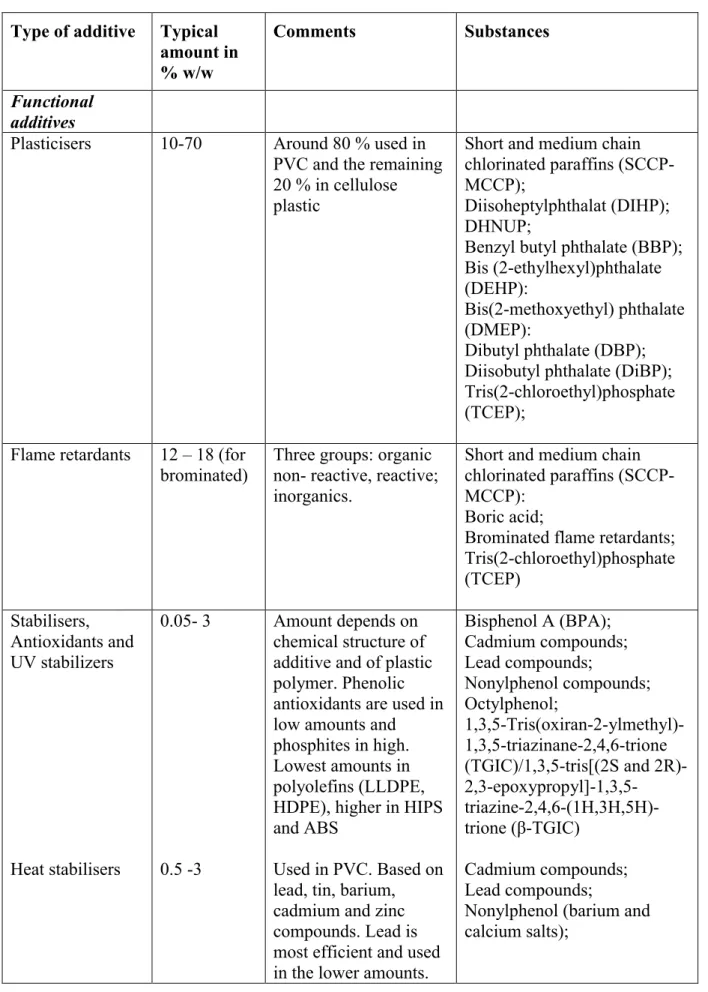
- Additives used in plastics
- Migration
- Degradation of plastic polymers
- Recycling potential of plastic materials
In other applications, it is necessary to improve the basic properties of the plastic polymer by using larger amounts of additives. There is a wide range of additives that can be used to improve the various properties of the plastic. It is possible to make a copolymerization of the plastic with halogen-containing reactive monomers, e.g.
Migration will decrease over time as the concentration of migrating substances in the plastic will be lower.
Important plastic materials, their characteristics and application
Introduction to the information presented
It has been listed which types of additives can be expected in the different types of plastic materials. The following tables with the most common thermoplastics show the consumption in 2011 in Europe and Norway according to the different forecasts in [AMI 2011]. The forecast for 2011 is very similar to the known consumption in 2010 and was made in the second half of 2011 (September), so it is estimated to be very close to the truth.
General literature is presented in the references section at the end of the report.
Polyethylene (PE-LD/PE-LLD)
Polyethylene HDPE
Polypropylene (PP)
Polystyrene (PS/HIPS)
Expanded Polystyrene (EPS and XPS)
Acrylonitrile butadiene styrene (ABS)
Polyvinylchloride (PVC)
Polyester (PET)
Polymethyl methacrylate (PMMA)
Polycarbonate (PC)
Polytetrafluoroethylene (PTFE)
Polyamides (PA)
Polyurethanes (PUR)
Epoxies
Unsaturated polyesters (UP)
Composites Market Report 2012 – Market Developments, Trends, Challenges and Opportunities, European GRP Market, (AVK) October 2012.
Melamine (MF)
Prioritized substances in plastics
Introduction to the information presented
Acrylamide
Main article groups Acrylamide is used almost exclusively (France) for the synthesis of polyacrylamides used as a flocculating agent, especially in waste water treatment and paper processing. No information - for uses presented under "main article group" it must be assumed that they still exist.
Alkanes, C10-13, chloro (Short Chain Chlorinated Paraffins-SCCP)
Arsenic and arsenic compounds
Main article groups Plasticizer in PVC: vinyl flooring, tile and carpet backing; casting and coating plastisols (eg coating textiles or other materials);. Release rates through migration are likely to be in the range of 0.1-1% per year or less (analogous considerations to DEHP). Given enough time, a significant proportion of the dust is likely to be re-released by leaching to the surface, followed by evaporation or removal by washing.
DIHP has never been marketed by Asian manufacturers, so it is unlikely to be present in blends and products imported from Asia. The lifespan of floor coverings and sealants is likely to be in the range of 10 to 25 years. No data - a typical concentration of 10-40 wt should be assumed. % than for other phthalates used as plasticizers.
The lifespan of electrical cables is often long (10-30 years), but products with plasticizers could still be.
Benzyl butyl phthalate (BBP)
Bis (2-ethylhexyl)phthalate (DEHP)
Alternatives Alternatives include alternative plasticizers, other flexible polymers without or completely different materials. Other flexible polymers include polypropylene, polyethylene, ethylene vinyl acetate copolymers (EVA), ethylene propylene diene terpolymers (EPDM), polyurethane (PU), and thermoplastic elastomers.
Bisphenol A (BPA)
Alternatives Instead of plastics based on or containing BPA, various alternative plastics and other materials can be used. Determination of bisphenol A in reusable food contact polycarbonate plastics and migration into liquids simulating food.Journal of. Assessment of dietary exposure of infants to bisphenol A through the use of polycarbonate baby milk bottles.
Bis(2-methoxyethyl) phthalate
Main product groups Polyurethane foam; polymers used in products such as flooring, tiles and carpets [Annex XV dossier]. Tributyltin may be present as an impurity in mono- and dibutyltin stabilizers for plastics (up to 1% [COHIBA 2011]), but their content is voluntarily controlled by industry to ≤ 0.67% (as tin) [Annex XV dossier]. The substance has been on the "candidate list" since 28 October 2010, but ECHA did not prioritize it for its first recommendation.
However, many of the applications listed under "main article groups" can be relatively long-lived and still be used in society. Function Boric acid can be used as a flame retardant for polystyrene beads [Weil and Levchik, 2009]. Non-reactive flame retardants (additive) are usually used for thermoplastics, while reactive flame retardants are usually used for thermosetting plastics (epoxy, unsaturated polyester and polyurethane) [Frisk et al, 2003; Zweifel, 2001].
The starting material is cadmium oxide for PVC pigments and stabilizers, but also cadmium metal can be used for stabilizer production [EU, 2007]. However, the amount released can be estimated as small compared to the amount present in the product. Alternatives Regarding pigments, many alternatives are available in the market covering organic and inorganic pigments.
Regarding stabilizers, both Ca/Zn systems and organotin compounds are well established on the market (tin compounds are partially banned in PVC from 1 January 2012 - REACH Annex VII). In Denmark, the use of lead chromates as pigments in plastics has been replaced by organic pigments in relation to Danish production [Hofmann et al 2002].
Chromium trioxide
Cobalt(II) diacetate
Function Curing agent for epoxy resins, intermediate in the manufacture of high performance polymers [Annex XV]dossier e.g. The use is described as "open use in the art" [Appendix XV dossier]. If present as unreacted residues or due to degradation of dyes or polymers, migration should be expected to occur.
No information - the uses described under "main article groups" must be assumed to still take place.
Dibutyl phthalate (DBP)
DBP has been used since about 1960 and has been a standard plasticizer for PVC products (along with DEHP) due to its efficiency and. Although its use and consumption declined after the year 2000, it is still available in many products on the market. [Hansen et al, 2008]. Main article groups PU used in construction, for wheels, cars, electrical wire coating, safety belts and recently also in biomaterials such as pacemakers and implants, polyurethane coatings, castable urethane (hardener).
Polyurethanes with a cross-linking agent can be used in the production of machines, buildings, cars, aircraft, mining and sports equipment.
Diisobutyl phthalate (DIBP)
Disodium tetraborate, anhydrous
Formaldehyde, oligomeric reaction products with aniline
Hexabromocyclododecane (HBCDD) and all major diastereoisomers
Polymer dispersion formulation for textile back coating 10-15 % (in dispersion) Industrial use of EPS beads to produce flame retardant EPS (in EPS) Industrial use of HBCDD in PS compound to produce flame retardant HIPS 1-3 % (in HIPS). Industrial use of HBCDD in PS composition to produce 1-3% flame retardant XPS (in XPS). Industrial use of HBCDD as powder to produce flame retardant XPS 0.5-3 % Industrial use of HBCDD in. Polymer dispersion for textile back coating 25 % or 6 to 15. in the final coat) (the lower space is used if used together with antimony trioxide) [Appendix XVdossier].
Hydrazine
Lead and lead compounds
Lead stabilizers and pigments have partially replaced cadmium compounds following the ban on cadmium introduced in Sweden, Denmark and later in the EU. The use of lead compounds was widespread in the EU until the RoHS Directive was enacted in 2002. This directive is widely regarded as a ban on lead and has started a slow process of phasing out lead stabilizers and pigments in the EU.
The use of lead stabilizers for drinking water pipes was voluntarily stopped at the end of 2005 by the pipe manufacturers who are members of the European association TEPPFA, partner of Vinyl 2010 [PVC, 2012]. Lego building blocks - lead was used until about 1980, but these bricks are kept from generation to generation and the actual lifespan seems to be "almost" unlimited until now. In addition, recycling such a product can significantly extend the life of lead stabilizers.
Lead chromate
Lead chromate molybdate sulphate red (C.I. Pigment Red 104)
Lead sulfochromate yellow (C.I. Pigment Yellow 34)
Medium-chain chlorinated paraffins (MCCP)
Mercury and mercury compounds
Options for reducing the use of mercury in products and applications, and the fate of mercury already circulating in society.
Nonylphenol and its etoxylates
Octylphenol and its ethoxylates
Organic tin compounds (tributyltin, trifenyltin)
Dibutyltin compounds have been in use for many years but are now restricted (see above). Triorganotin compounds have previously been used as biocides in antifouling paints and coatings and for other biocidal purposes [Annex XV dossier]. Measures to reduce tributyltin (TBT) and triphenyltin (TPHT) emissions in the Baltic Sea area.
Document developed in the context of ECHA's first recommendation for the inclusion of substances in Annex XIV.
Perfluorooctanoic acid (PFOA) and similar compounds
Polyaromatic Hydrocarbons (PAHs)
Testing and validating polycyclic aromatic hydrocarbons (PAH) for GS-Mark certification.
Potassium hydroxyoctaoxodizincatedichromate
As an ingredient in phenolic resins used in the formulation of adhesives As an ingredient in coatings, incl. It is noted that 4-tert-octylphenol may be application critical and alternatives may not be suitable [DEFRA 2008].
Trichloroethylene
Triclosan
Tris(2-chloroethyl)phosphate
It is mainly used as an intermediate in the production of pure anthracene, which is used intensively in the production of artificial dyes. It is used as a precipitating agent in copper smelting and in the manufacture of diarsenic trioxide [Appendix XV]. Catalyst in the production of p-xylene to terephthalic acid (which is a monomer for PET) [Appendix XV].
It is used in the dying industry, in metallurgy (for hardening copper, lead or gold in alloys), in the manufacture of special glass and in wood preservatives [Appendix XV]. Over 95% of 1,2-dichloroethane in 2009 was consumed in the production of vinyl chloride monomer [Appendix XV]. Precursor in the production of vinyl chloride monomer for the production of PVC, (an alternative route exists).
Will evaporate easily - to the best of our knowledge will not be present in the plastic material. It can be used as an ingredient in the production of lead chromates and lead molybdates that can be used as pigments in plastics [Charvat, 2003]. Used as a chemical intermediate for the production of dyes and pigments (including methylene red, C.I.
It is also used as a chemical intermediate in the manufacture of its hydrochloride salt [Appendix XV]. It can potentially be used in the fabrication of integrated circuits [Appendix XV] and has been developed for use in specialized doping. DTDMAC can be used to modify clay mineral (yielding a double surfactant . organoclay), which can be used (in amounts of 4 %) in the production of.
It is mainly used as an intermediate in the production of pesticides and is further used as a process solvent in closed systems.
