User adoption of innovations in the context of sustainable transitions: A theory analysis of car sharing and urban mobility practices in Oslo. Although it does not represent a radically new technology, car sharing challenges the foundations of the current mobility system based on private ownership.
Research area and topic
I am not interested in whether car sharing will lead to a sustainable mobility transition – such a topic is much too extensive for the scope of a master's thesis. I am more interested in how users interact with an innovative mobility solution in a city that actively promotes a mobility transition.
The need for sustainable mobility
The research topic is also of general interest due to the universality of mobility as a social function and climate change as a phenomenon that affects everyone. However, the costs of fossil fuel automobiles are not limited to what comes out of the last gas.
Car sharing: what it is and why it is worth studying
What is car sharing?
There are some forms of car access-without-ownership that will not be considered car sharing in this thesis. There are three main business models for formal car sharing service providers: corporate, cooperative and peer-to-peer (P2P).
Why study car sharing?
Second, car sharing's focus on moving from ownership to access embodies many of the values and practices associated with the sharing economy. Viewed in the context of the sharing economy and shared mobility in particular, the use of car sharing can shed light on broader changes in mobility behavior associated with the car system.
The importance of Oslo as an urban mobility context
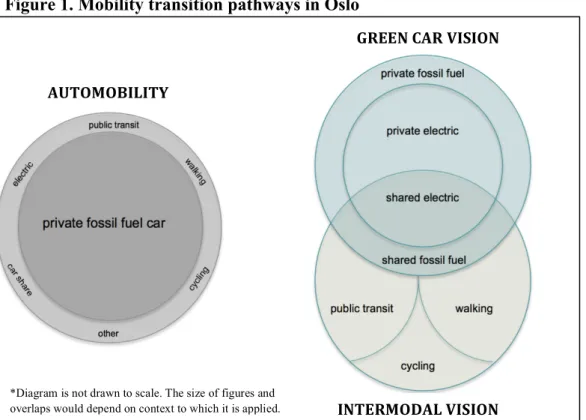
Almost the only forms of transportation that would not be considered shared mobility are privately owned vehicles intended primarily for one user - the heart of the automobile system. In addition, the regional plan for regional transport in Oslo og Akershus (Regional plan for land use and transport in Oslo and Akershus), which serves as a joint strategic platform for coordinating land use and transport planning in the metropolitan area of Oslo, states as one of its main objectives: "...the transport system will be effective, environmentally friendly,.
Thesis Outline
I will begin by introducing a sociotechnical approach to transitions and describing the MLP and the typology of transition routes. I will then extend the motoring literature and relate it to MLP and a socio-technical approach.
Transitions and automobility
- The socio-technical approach
- The multi-level perspective
- Transition pathways
- The automobility system
In the case of the technological replacement pathway, there is a niche innovation ready to be incorporated into the regime to help steer it in the right direction. Automotiveness is a portmanteau that suggests that the automobile is the central artifact of the mobility system.
Research gaps and questions
Shortcomings of the MLP/socio-technical approach
Perhaps the most common and persistent criticism of the MLP is that it is too top-down and supply-driven (Southerton & Watson, 2015). MLP's advantages in scope and generalizability diminish as one zooms in on the transition process.
From research gaps to research questions
Criticism that MLP is too top-down - and that we need to be more aware of. The unique, national and top-down approach to MLP can be very useful for.
What is practice theory?
Above all, the theory of practice differs from classical social theories, which view man as homo economicus and homo sociologicus. Practice theory separates the human from social analysis and instead focuses on practice itself as the site of the social.
Elements of Practice
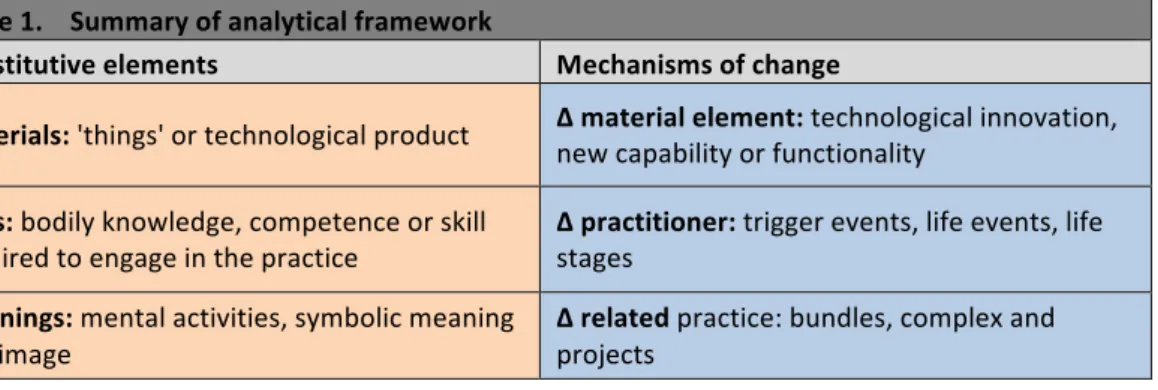
There is no consensus on the constituent elements of a practice, and the application of practice theory to mobility has been limited. The constituent elements of a practice are: (1) things or materials; (2) bodily knowledge, competence, or skill; and (3) mental activities, symbolic meaning, and image.
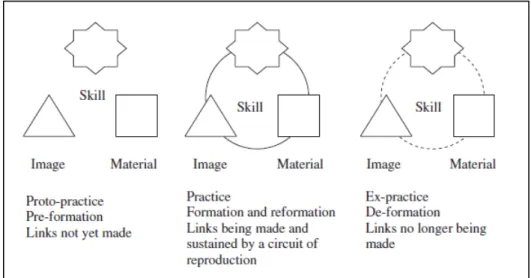
How practices change
However, there are relationships that are more 'tightly integrated', whereby one is deemed necessary for the other to succeed. The relationship between practices in a complex is typically functional – the practices depend on each other to be put into action. In order for car sharing to have a meaningful impact on the mobility system, it will need to recruit enough users, especially defectors from private car use, and retain them to repeat the practice of car sharing until it can sustain itself.
Practice theory and car sharing
This means, for example, that a visit to a family member or a friend should take into account the period of availability for which the car is booked, or vice versa.
Practice theory and socio-technical transition
The qualitative approach
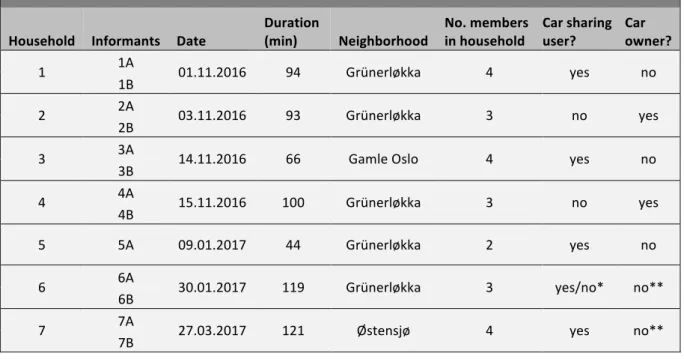
In the next section, I will describe the methodology used to collect and analyze the empirical data used in this project. As such, this project is partly exploratory as it does not attempt to provide final or definitive solutions regarding the sustainability of urban mobility or a theoretical understanding of socio-technical transitions. The data used in this project were collected and analyzed taking into account later and more conclusive research4.
Data collection
Towards the end of the interview, each household was asked to complete a mobility biography covering the previous three years. To help with this task, I demonstrated the completion of the biography based on my own mobility behavior. Whenever possible, I encouraged both adult members of the household to participate in filling out the form.
Data analysis
I then categorized these codes into broader themes and concepts – in the previous example, 'other forms of mobility' would be the broadest category. It was at the classification stage that my methodological approach deviated significantly from grounded theory in that I applied a pre-existing theoretical framework to inductively derived concepts and categories. My use of grounded theory was warranted insofar as it helped me generate useful codes and categories to apply to the practice theory framework.
Reliability and validity
For example, this project did not seek to create or test theories based on the data analyzed and did not explicitly consider grounded theory during research formulation and interview sampling. It is also consistent with the not uncommon tendency to “see grounded theory as a set of principles and. Some of these efforts were already described in the data collection and analysis subsections.
Reflexivity and Positionality
I recognized early in the project formulation period that I was a critic of the car mobility system and that I was in favor of a mobility transition where the car was less prominent. This expansion of the informant pool was driven by the desire to have at least one contrasting housing perspective compared to the first six households. Furthermore, I have emphasized, for myself and in the text of the thesis, that this project is a limited (but still useful) snapshot of much larger and more complex mobility-related phenomena.
Ethics
By comparing and contrasting car sharing with private ownership in this way, I look for mechanisms to change the established practice.
Elements of car sharing as a practice
Materiality
Since all but one of the interviewed families had young children, the legal requirement to use car seats affected almost every informant's use or potential use of car use. As a non-negotiable aspect of driving with young children, car seats represent a necessary material element of car sharing for certain populations. So it was really nice to have a car.” Topography is also important to the relationship between car sharing and other practices, particularly cycling.
Skills and competence
Planning skills and competencies related to car sharing can be broken down into skills related to planning and organizing activities and those related to finances and paperwork. Another type of planning associated with car sharing has to do with finances and paperwork. On the one hand (with regard to driving skills), car-sharing required more skill and competence than the existing mobility practice.
Meaning
The social meaning of car sharing is very similar to the social meaning of using a private car. Many of the car sharing users expressed a strong connection to the city and their neighborhoods, including its residents. Many of the informants in the project considered car sharing as part of an alternative lifestyle.
Mechanisms of change
Changes in the practitioner
Two interviews also touched on the household's use of carpooling as children get older. According to the informant, there was a direct connection between this unpleasant incident and her decision to become a car sharing user. The first event helped convince the adults in the family to become car sharing users.
Changes in related practices
The use of car sharing only makes sense within the context of the informants' determination to live in a walkable and connected urban environment. The ability to avoid this stress has been cited as one of the main benefits of using car sharing. With the exception of occasional trips to stores outside the city center, car sharing was not used by the households for shopping.
Integrating the elements of car sharing
As was evident from the interviews, the informants had most of the necessary knowledge before becoming car sharing users. Also, none of the informants went out and got a driver's license in order to use car sharing. On the other hand, car sharing has provided users with new freedoms – a release from many of the burdens associated with the dominant mobility practices of the existing regime.
Car sharing as a collective accomplishment
According to Truffer (2003, p. 139), car sharing is a good example of user-led innovation, both in the initial phase and in the expansion phase. Finally, informants' experiences with car sharing reflect similar trends in the wider sharing economy. As with other forms of sharing, car sharing also depends on reputation or trust in other users and the institution that manages the collective (Botsman, 2012).
Practitioners and promoters (companies)
This does not mean that car sharing will replace private automobiles as the dominant form of mobility in Oslo and other cities. Rather, understanding how users engage with carsharing and how their conditions and circumstances differ from those of promoters provides tools by which the practice of carsharing can grow into a mainstream or dominant mode of transportation. There were several cases in the interviews in which real-world use of car sharing by informants provided concrete recommendations (from users) on how to make car sharing more attractive.
Practitioners and promoters (government actors)
As mentioned in the literature section, MLP describes the process by which a niche innovation becomes part of a regime as a process of emergence, development, breakthrough and replacement (Geels, 2005, pp. 684-5) or pre-development, take-off. , breakthrough and. Practice theory, on the other hand, allows for a richer and more detailed understanding of the micro-phenomena that occur when a niche becomes part of a regime. Once other, more effective recruitment mechanisms are identified and used, the environmental value of car sharing may carry more weight and help sustain the transition.
The importance of residency
The project of urbanism was far more important to the informants than any feelings they had about car sharing. The importance of urban residence is impossible to ignore when trying to understand why the informants in this project engage in the practice of car sharing. With a view to future research and/or policy, I propose two potential transition scenarios involving car sharing and residential practices.
User recommendations
Such a shift would be an example of how car sharing could fit into the broader policy mix of mobility transitions. For the user, this would make car sharing more similar to the practice of using private cars. It would also require car-sharing firm employees who drive around Oslo, pick up and drop off cars.
Research questions and summary of findings
The meanings associated with urban living were more important to the informants than any meanings associated with car sharing. Simply put, the informants used car sharing because it helps them achieve a preferred urban lifestyle. Another important reason why user informants engaged in the practice of car sharing was because they could.
Implications
Hentet fra https://www.aftenposten.no/osloby/Rundt- 1800-parkeringsplasser-skal-fjernes-i-Oslo-de-neste-arene-585893b.html. Hentet fra https://www.regjeringen.no/no/tema/okonomi-og-budsjett/skatter-og- avgets/avgotssatsers-2017/id2514838/. Hentet fra: http://www.eltis.org/discover/case-studies/oslo-electric-vehicle-capital-world-norway.
INTERVIEW GUIDE