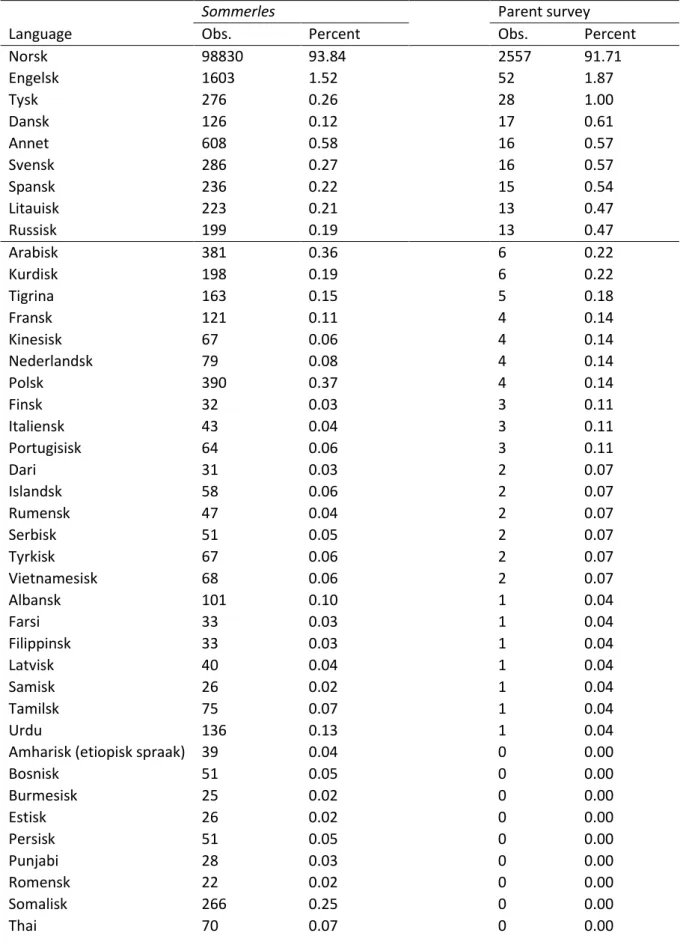
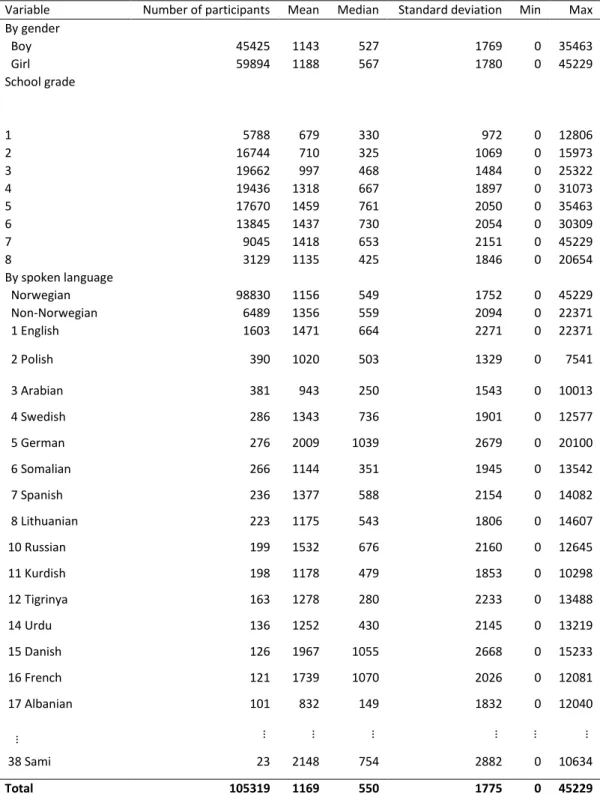
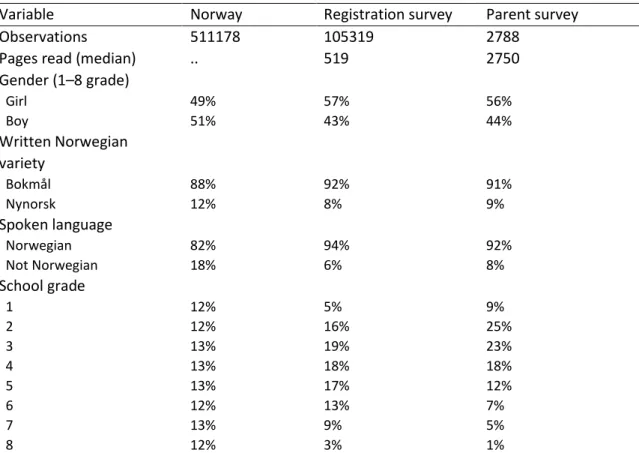
The voluntary parent survey/evaluation is a feature of the Sommerles.no program at the end of the program. Study of the correlation between participation in Sommerles.no and scores in standardized reading tests.
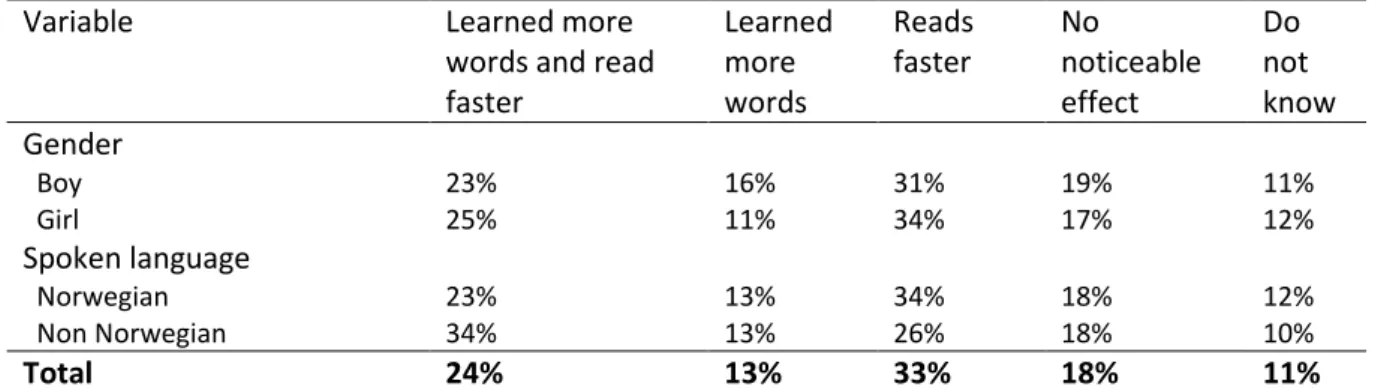
Combining data from the registration and the parents study: Reading improvement by gender, language and pages read
When asked which Sommerles.no elements they believe encourage their children's enjoyment of reading, 59% of parents answered "prizes children collect in the library", 57% answered. Combining data from the registration and parent study: Reading improvement by gender, language, and pages read.
Reading improvement by parents´ observations of schools´ encouragements
Second, reading improvement may be affected by the intensity with which they used Sommerles.nr. In the teachers' survey, 22% say that Sommerles.no participants develop reading skills faster and 36% answered that they noticed differences between the two groups, but some children develop skills faster than others. The percentage of parents answering "No apparent effect" appears to decrease (from 18 to 16%) as the number of pages increases.
Of the group of parents who responded that the schools shared written information on Sommerles.no, 74% also said that their children read faster or learned more words than before, and of those, 27% stated that their children both read faster and learned more words. About 73% of parents who answered “Yes” to this activity also think their children have experienced improvements in reading speed or word learning, while 27% of them have noticed improvements in both reading speed and word learning . Of the parents contacted by schools, 74% of respondents think Sommerles.no has helped their children read faster or more words than before, and 28% of their children have seen this.
Among parents who confirmed school visits to libraries or visits from librarians, 71% responded that their children read faster or learned more words than before participating in Sommerles.no.
Parents´ view of reading improvements by collaboration with libraries
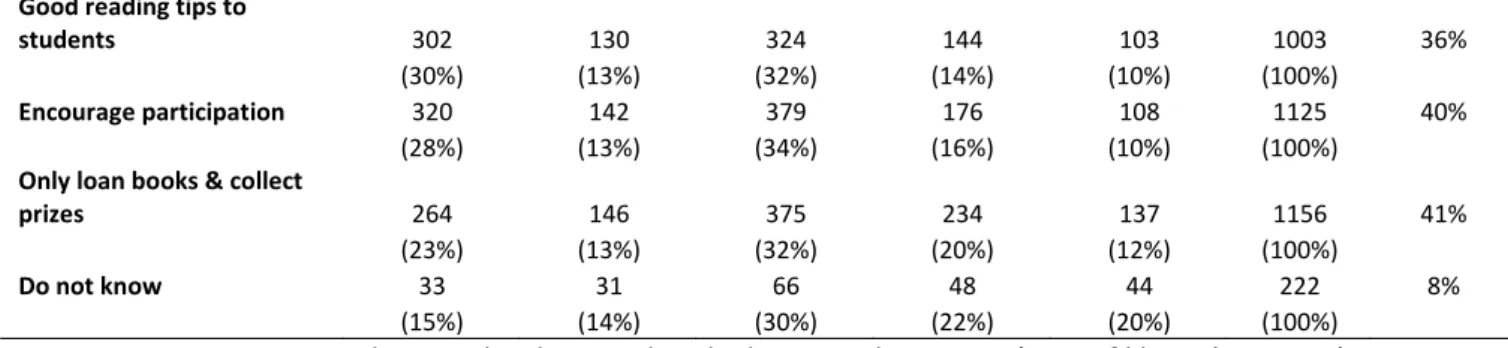
Note: Percentages in parentheses are the proportion within the horizontal category (encouragement type) Parent survey responses show a positive relationship between literacy. Note: Percentages in brackets are the proportion within the horizontal category (type of library activity). When studying the proportions within each group, it appears that literacy appears to be associated with active involvement from the library.
Of the parents who answered that libraries shared useful tips with students in Sommerles.no, it was noted that 75% of their children improved their reading skills in cooperation with Sommerles.no, and 30% of their children read faster and more words than before. Similarly, of the parents who accept/say that local libraries have done a successful job of encouraging their children's participation in Sommerles.no, 75% agree that their children have improved their reading skills (either reading speed or improved vocabulary) , while 28% see improvement in both in reading speed increased vocabulary. Relatively 68% of the parents who answered that they only use the library to borrow books and collect prizes reported an increase in their children's reading skills.
Parents view of how Sommerles.no can attract more participants (parents survey)
Other frequent responses were: "the teacher should bring the class to the library" (47%) and "a librarian visits the school" (40%). Although Sommerles.no focuses on reading for pleasure, less than 30% of parents think that the program should be completely voluntary and not linked to the schools.
The teacher survey
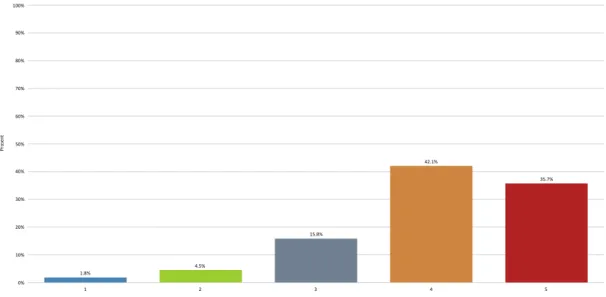
On a scale of 1 to 5, where 1 is not useful and 5 is very useful, how useful do you think Sommerles.no is for your students. 97.3% of teachers in this survey find Sommerles.no useful (answering 3 to 5 on the usefulness scale) for their students, while 76.2% of teachers give Sommerles.no a 4 or 5 on the usefulness scale. The fact that only 3.1% of teachers responding to this survey answered no to question 1 “Have you encouraged participation in Sommerles.no” strongly indicates that the teachers responding to this survey represent the most interested teachers.
However, when teachers provide information about their own experiences with Sommerles.no, it is a reliable source of information. 60.4% of the teachers found that children who participated in Sommerles.no were more motivated to read than the children who did not participate. To the question "Who do you think benefits from Sommerles.no in your class?" the teachers alternate "Children who need to be stimulated to read more" (45.4%) third to "Children who already like reading" (86.6%) and "Strong readers" (59.9%).
For these children, it is especially important to be introduced to the joy of reading through, for example, Sommerles.no.
The librarian study
The proportion of fourth-graders who are classified as weak readers has significantly decreased, from 24% to 20%. The percentage of poor readers in the 5th grade is stable, at 9% in both surveys (Gabrielsen et al. 2017). PIRLS results - also prove that weak readers read less during leisure time than strong readers and read less for fun and pleasure, which according to Shin and Krashen (1973) is the most important way of reading for the development of reading skills.
Another important factor that Lundetræ & Gabrielsen (2013) point out is that whether the children experience reading pleasure and positive reading experiences is related to their parents' attitude towards reading. In their study, parents of weak readers reported that they read only when they had to, to a much greater extent than parents of strong readers. It is possible that some parents of poor readers are also poor readers and therefore avoid reading-related situations.
The librarians were also asked a series of open-ended questions about how Sommerles.no could be improved to boost children's reading enjoyment in general, to better reach weak readers and children who speak languages other than Norwegian at home.
Factors in Sommerles.no that can be developed to stimulate interest and participation in the program (librarian’s study)
Teachers should receive better information and spread knowledge to students to encourage participation in Sommerles.no. Parents should be informed about the importance of maintaining their children's reading level during the summer. effectively train and support students in how to register and log in to Sommerles.no. Schools can obtain prior permission from parents to help everyone in the class start Sommerles.no.
More direct marketing is needed to parents, to clearly show why it is beneficial for their children to participate in the Sommerles.no reading campaign during their summer holidays. Libraries or schools can organize meetings to explain the importance of participating in Sommerles.jo to maintain their children's reading competence and for its further development. First of all, Sommerles.no should not become compulsory homework after school, but should remain a summer activity of leisure and enjoyment.
The teacher's recommendations on how to encourage more student attendance and how to achieve better operation and performance of Sommerles.no.

Collaboration between the libraries and schools
24.1% collaborate more with the libraries throughout the year as a result of the collaboration with Sommerles.no, and 17.4% do not know. Suggestions from the teacher for better cooperation with the libraries and for improving Sommerles.no Sommerles.no. This measure is also recommended by the librarians and is often used by the libraries to kick off Sommerles.no.
These responses clearly signal that Sommerles.no's information has not fully reached the teachers, and reveal a potential for better or better targeted communication with the teachers. The librarian's ideas for better collaboration with schools, and some ideas and suggestions about Sommerles.no Sommerles.no. The librarian survey also provided insightful suggestions on how schools and libraries could collaborate better on Sommerles.no.
They also suggest organized meetings with teachers so that teachers can spread the updated information about Sommerles.no to schools and classes.

Analysis of the importance of collaboration between school/library and participation according to teacher survey
Both groups want librarians to visit schools more often, school classes to visit libraries, and parents to become more involved in Sommerles.no. In total, only 3% of teachers say that no promotional activities have been undertaken at their school to encourage students to participate in the Sommerles.no campaign. A potential problem with this analysis is that the librarians and/or teachers with the greatest interest in the Sommerles.no campaign may also be the ones who actually visit the school and library.
Note: Percentages in brackets are the share within the horizontal category (type of library's activity) As you can remember, 221 library employees answered questions regarding cooperation between libraries and schools to promote the Sommerles.no program. From the table we can see that the most effective cooperation activity is for library employees to visit schools and provide information about Sommerles.no. Of the 129 library employees who selected this measure, nearly 94% estimated that students' reading interest and skills were significantly stimulated.
Librarians' opinions on how Sommerles.no can reach more primary school students and parents whose home language is not Norwegian.
Librarians opinions on how Sommerles.no can reach more elementary school students and parents whose home language is not Norwegian
How can Sommerles.no reach more primary school students and their parents who speak languages other than Norwegian at home. Information letters in different languages that can be distributed to parents at the beginning of Sommerles.nr. The trick is to reach their parents and make them aware of the importance of Sommerles.nr.
Main Idea 1 Teachers should train students in the Sommerles.no program and follow up with them before the holidays. Information letters in different languages must be available for distribution to parents in the libraries long before the start of Sommerles.no. However, due to the new GDRP conventions, only parents (supervised) children can register for Sommerles.no.
Summer reading loss and the effect of the summer reading campaign Sommerles.no in Norwegian schools. The information on Sommerles.no should be available in all major minority languages represented in Norway. Apply for support to translate information about Sommerles.no into the main non-Western European languages represented in Norway.