
5
NOMATEN Winter School 2021 Welcome Address
As members of the scientific committee of the NOMATEM winter school and on behalf of the organizing committee, we sincerely welcome you all to this school in Paris. This is the very first edition of this type of event in the frame ofthe European NOMATEN project and the associated Center of Excellence (CoE).
The NOMATEN Centre of Excellence (CoE) is a novel created (2020) polish research organization in which international world-class research teams will design, develop and assess innovative multifunctional structures:
Novel high-temperature, corrosion and radiation resistant materials for industrial applications on one side, and novel radiopharmaceuticals for medical applications on the other side. Hosted by the National Centre for Nuclear Research (NCBJ, Swierck, Poland), the CoE involve by design a strong scientific partnership with the French Alternative Energies and Atomic Energy Commission (CEA, France) and the Technical Research Centre of Finland (VTT, Finland) with joint financial support from the Foundation for Polish Science (FNP) and the European Commission (the NOMATEN project).
As all of you are aware, this first school is related to the material sciences topic of NOMATEN, and the subject chosen for the first edition of such a joint event is “Modeling of the behavior of materials under irradiation”. This theme is not only essential in the objectives and the mission attributed to NOMATEM; It will also be a unique opportunity for all our junior scientists - doctoral and post-doctoral students - to meet and discuss together first, but more important, learn about basic notions in sciences of materials – especially under irradiation – coupled to the latest scientific developments carried out in our laboratories (CEA, VTT and of course NCBJ). Finally, a visit of three major facilities on the CEA Saclay site, two related to material sciences (the LECI hot laboratories, the JANNUS platform facility) and one related to radiopharmaceutical sciences (the SCBM laboratories) has been organized and will remain unforgettable for those who will attend it.
It is therefore our great honor and pleasure to have you here first in Paris, in the French Geological Society facilities, a few kilometers north from the CEA Paris-Saclay center, which we recall, is now an integral part of the new Paris-Saclay University, already ranked 13th worldwide and 1st in continental Europe. This world-class research-intensive university not only brings together ten constituent faculties and institutes, four Grandes Écoles, the Institut des Hautes Etudes Scientifiques, two associate institutions, but also shared laboratories with six national research organizations, including the CEA. With 48,000 students, 8,100 lecturers and 8,500 administrative and technical staff members, Université Paris-Saclay offers a comprehensive and varied range of undergraduate to doctorate level programmes and engineering degrees, renowned for their quality thanks to the reputation and commitment of the University’s academic staff.
This first edition of the NOMATEM School program is deliberately not organized digitally but physically in Paris – thanks to a slow down of the COVID-19 crisis – however with a reduced number of participants, mainly to fulfil restrictive criteria linked to the pandemia. Nevertheless, we will have the pleasure of welcoming about 60 people from Poland, Finland and France. Oral and poster contributions are all given in the booklet attached with the program, and with a summary detailing the content of each contribution.
As we are initiating the first school within the European NOMATEN project, we are quite confident that we will have great time during this event in 2021. We hope all of you will enjoy fruitful discussions during this winter school, and wish you an enjoyable and safe stay in Paris.
On behalf of the local organizing committee
Christophe Gallé, Jean-Luc Béchade, and Frédéric Dollé
6
7
The French Geological Society is welcoming us in Paris
The Geological Society of France (SGF), a learned society founded on March 17, 1830, recognized as being of public utility, aims to contribute to the development of Earth and Planetary Sciences, both in itself and in its relations with industry, agriculture. , environment and education. SGF also offers nice facilities for hosting small- sized schools and is located in the center of Paris, close to the Luxembourg gardens.
Société Géologique de France (SGF), 77 Rue Claude Bernard, 75005 Paris
8 About lectures, communications and poster sessions ...
Please note that all lectures and communications will be given in the conference room (salle Van Straelen).
Please note that poster sessions will be organized in the library lecturer room (salle de lecture de la bibliothèque), just in front of the conference room.
About coffee breaks and lunches ...
Please note that all caffee breaks will also be served in the back of the conference room (salle Van Straelen).
Please note that all lunches will be served in the library lecturer room (salle de lecture de la bibliothèque), just in front of the conference room, at the exception of the last day, where lunch boxes will be provided at the CEA Paris-Saclay before living the site.
About the welcome diner ...
For those of you that reserved for this diner, please remind that the location is the POLIDOR restaurant, 41 Rue Monsieur le Prince, 75006 Paris (https://www.polidor.com), which is located walking distance from the French Geological Society building.
About sanitary issue (Covid-19)
Restrictions are still in force in metropolitan France. Thus, while you are in France you will need to present a “health pass (Covid-19)” for access to certain events and places, currently all cafés, bars and restaurants, whether indoors or on the terrace, as well as in some shopping malls. It is also mandatory on board airplanes, trains and long-distance buses, as well as for access to all events or leisure and cultural places receiving more than 50 people (theaters, cinemas, museums, concert halls, festivals …)..
Nationals of European Union countries have a digital “Covid certificate” (QR code) accepted in France. More informations: https://www.gouvernement.fr/en/coronavirus-covid-19
9
Detailled programme
NOMATEN Winter School 2021: programme
Tuesday, November 16, 2021
8:45 • Registration 9:00
9:05 9:20 9:30 9:45
• Welcome words, Christophe GALLÉ (CEA Saclay, France)
• General introduction of CEA, Christophe GALLÉ, Frédéric DOLLÉ (CEA Saclay, France)
• NOMATEN Teaming project and the framework of the Winter School, Jacek JAGIELSKI (NOMATEN-NCBJ, Poland)
• Introduction to the winter school: objectives and scientific contents / expectations, Jean-Luc BÉCHADE (CEA Saclay, France), Mikko ALAVA (NOMATEN-NCBJ, Poland)
• Round table 10:15 Coffee Break
SESSION 1:Lectures on basic notions on materials and irradiation,Part1,Nov.16TH(A.M.) Chairman: Lukasz KURPASKA, NOMATEN
10:30 • Primary damage, point defects formation, migration and properties, cascades, Jean- Paul CROCOMBETTE (CEA Saclay, France)
11:45 • Thermodynamics, diffusion and phase stability under irradiation, Maylise NASTAR (CEA Saclay, France)
13:00 Lunch Break (Library room)
SESSION 2:Lectures on basic notions on materials and irradiation,Part2,Nov.16TH(P.M.) Chairman: Jean-Paul CROCOMBETTE, CEA
13:45 • Plasticity at atomic scale, dislocations motion, irradiation defects interactions, Emmanuel CLOUET (CEA Saclay, France)
15:00 • Nanoindentation and irradiated materials: technique, applications, results, Lukasz KURPASKA (NOMATEN-NCBJ, Poland)
16:15 • Coffee break
16:30 • SAFIRBRUTE project - Barsebäck RPV material used for true evaluation of embrittlement, Pentti ARFFMAN (VTT, Finland)
17:45 18:00
Questions relative to organization End of day 1
10
Detailled programme (continued)
NOMATEN Winter School 2021: programme
Wednesday, November 17, 2021
SESSION 3:Communications,Part1,Nov.17TH(A.M.) Chairman: Maria OKSA, VTT
8:45 • Welcome
9:05 • Frenkel pair accumulation in the molecular dynamics framework to study irradiation effects (in Fe, MgAl2O4, UO2…), Alain CHARTIER (CEA Saclay, France)
9:45 • Modelling irradiated materials: from molecular dynamics to nanoidentation, Javier DOMINGUEZ (NOMATEN-NCBJ, Poland)
10:25 Coffee Break
10:40 • Machine learning for atomistic materials science, Cosmin MARINICA (CEA Saclay, France)
11:20 12 :00
• Materials informatics of high entropy alloys, Stefanos PAPANIKOLAOU (NOMATEN- NCBJ, Poland)
• Quantitative microscopy for multiscale modelling, Wade KARLSEN (VTT, Finland) 12:40 Lunch Break (Library room)
SESSION 4:Communications, Part 2,Nov.17TH(P.M.) Chairman: Christophe GALLÉ, CEA
13:25 • Solutes effects on the microstructural evolution of nickel base alloys as model alloy of austenitic steels, Marie LOYER-PROST (CEA Saclay, France)
14:05 • Nanoindentation of ion-irradiated materials and thin films, Lukasz KURPASKA (NOMATEN-NCBJ, Poland)
14:45 Coffee Break 15:00
15:40
• Development of thermodynamic tools for Zr base alloys using the Calphad method, Caroline TOFFOLON (CEA Saclay, France)
• Corrosion modelling: Estimation KINetics OXidation code, Laure MARTINELLI (CEA Saclay, France)
16:20 Break
16:45
• Poster session 1 (Library room)
• Evaluation of alternative oxides as a strengthening particles for ODS Reduced Activation Ferritic steels, Małgorzata FRELEK-KOZAK et al. (NOMATEN-NCBJ, Poland)
• The influence of manufacturing parameters on microstructure and mechanical properties of CoCrFeNi high entropy alloys produced via Mechanical Alloying and Spark Plasma Sintering, Artur OLEJARZ et al. (NOMATEN-NCBJ, Poland)
• Experimental and computational study of intrinsic mechanical properties of pristine and irradiated Fe, Katarzyna MULEWSKA et al. (NOMATEN-NCBJ, Poland)
11
conditions, Kinga SUCHORAB et al. (NOMATEN-NCBJ, Poland)
• Transmission Electron Microscopy as a tool for studying defects of irradiated materials, Witold CHROMIŃSKI (NOMATEN-NCBJ, Poland)
• NOMATEN’s XRAYLAB – The newly-created X-Ray diffraction laboratory, Maciej ZIELIŃSKI (NOMATEN-NCBJ, Poland)
• Annealing-induced strengthening in the NiCoCr alloy: The role of segregation, Axel POISVERT et al. (NOMATEN-NCBJ, Poland)
• Molecular dynamics simulation of interface structure and shape of Nb precipitate in Zr matrix, Zhengxuan FAN et al. (CEA Saclay, France)
• Thermodynamic modeling of Ti-O from ab initio calculations, Martin-Stéphane TALLA NOUTACK et al. (CEA Saclay, France)
• Replacement chemicals for hydrazine in PWR secondary side cycles, Konsta SIPILÄ (VTT, Finland)
17:45 19:30
Free time
Welcome dinner (POLIDOR restaurant, 41 Rue Monsieur le Prince, 75006 Paris)
12
Detailled programme (continued)
NOMATEN Winter School 2021: programme
Thursday, November 18, 2021
SESSION 5:Communications,Part3,Nov.18TH(A.M.) Chairman: Jean-Luc BÉCHADE, CEA
8:45 • Welcome
9:05 • Dislocation interactions with irradiation defect-loops in metals, Laurent DUPUY (CEA Saclay, France)
9:45 • Multiscale modelling of plasticity with discrete dislocation dynamics, Mikko ALAVA (NOMATEN-NCBJ, Poland)
10:25 Coffee Break
10:40 • Impact of radiation damage on functional properties of alumina coatings deposited via PLD technique, Agata ZABOROWSKA (NOMATEN-NCBJ, Poland)
11:20 12 :00
• Polycrystalline modeling of the behavior of neutron-irradiated recrystallized zirconium alloys during strain path change tests, Fabien ONIMUS (CEA Saclay, France)
• Utilizing micromechanical modeling as a part of the ICME workflow for irradiated materials, Matti LINDROOS (VTT, Finland)
12:40 Lunch Break (Library room)
SESSION 6:Communications, Part 4,Nov.18TH(P.M.) Chairman: M. ALAVA, NOMATEN
13:25 • Interfaces, intergranular fracture prediction using multi-scale simulations, Laurent VAN BRUTZEL (CEA Saclay, France)
14:05 • Modelling of inhomogeneous fracture toughness behavior of irradiated reactor pressure vessel steels, Sebastian LINDQVIST (VTT, Finland)
14:45 Coffee Break 15:00
15:40
• Fracture behavior of austenitic stainless steels used for Pressurized Water Reactors (PWR) internals structures, Jérémy HURE (CEA Saclay, France)
• Study and modelling of tritium trapping in fusion relevant materials, Etienne HODILLE (CEA Cadarache, France)
16:20 • Unconventional application of microscopic techniques in analysis of irradiated materials, Iwona JÓŹWIK (NOMATEN-NCBJ, Poland)
17:00 Break
17:10
• Poster session 2 (Library room)
• Structure-based optimization of crystal plasticity parameters in metal alloys, Karol FRYDRYCH et al. (NOMATEN-NCBJ, Poland)
• Shear banding instability in high entropy multi-component metallic glasses: The role of composition and order, Kamran KARIMI et al. (NOMATEN-NCBJ)
13
MD simulation, Amin ESFANDIARPOUR BOROUJENI et al. (NOMATEN-NCBJ, Poland)
• Configurational entropy in high entropy metallic glasses, Rene A. ALVAREZ DONADO et al. (NOMATEN-NCBJ)
• Discrete dislocation dynamics simulations with free surfaces: Applicaton to mechanical testing of micropillars, Fabrizio ROVARIS et al. (NOMATEN-NCBJ, Poland)
• Structural, mechanical and electrical properties of ion-irradiated polymers used as cable insulation, Anna KOSIŃSKA et al. (NOMATEN-NCBJ, Poland)
• Synthesis of high-entropy alloy coatings obtained by magnetron sputtering, Magdalena WILCZPOLSKA et al. (NOMATEN-BCBJ, Poland)
• Challenges concerning industry partnerships and communication towards companies, science and public sector, Maciej DROZD et al. (NOMATEN-NCBJ, Poland)
• Crystal plasticity law calibration of non-irradiated and proton irradiated 304L austenitic stainless steel, Rachma AZIHARI et al. (CEA Saclay, France)
• Study of Ni based alloys obtained by Additive Manufacturing, Martin MADELAIN et al.
(CEA Saclay, France) 18:00 End of the day
14
Detailled programme (continued)
NOMATEN Winter School 2021: programme
Friday, November 19, 2021
LECI hot laboratory, SCBM hot laboratories and JANNuS ion irradiation platform visits, nov. 19TH (A.M.).
6:45 8:15
• Meeting at the main entrance of Luxembourg Gardens in Paris and departure (by bus) to the North gate of CEA Saclay
• welcome and entrance formalities ***
9:00 • Visit of the LECI hot laboratory (DES/ISAS/DMN, B625)
10:15 • Visit of SCBM hot laboratories and coffee break (DRF/Joliot Institute, B547) 11:45 • Visit of the JANNuS Ion irradiation platform (DES/ISAS/DMN, B126)
12:45 • Conclusion (farewell message)
13:00 Lunch (take-out boxes provided in the JANNuS Hall) 13:30 • End of the Winter School and departure to Paris by bus
Meeting point at the main entrance of Luxembourg Gardens (St Michel Boulevard, Paris 6e)
*** reminder, entry at the CEA Paris-Saclay request the presentation (compulsory) of a valid identity document (IC or passport).
15
Abstracts of the Lecture
(Tuesday, November 16, Parts1 & 2)
16
17
Modelling of the promary damage and the properties of point defects
Jean-Paul CROCOMBETTE
Université Paris-Saclay, CEA, Service de Recherche en Métallurgie Physique, 91191 Gif-sur-Yvette cedex, France
Abstract
In this lecture, we want in a first part to address the various aspects of the modelling of the primary damage of irradiation and, in a brief second part to describe how one can calculate the basic formation and migration properties of the defects created by irradiation. The methodologies of each modelling step will be briefly recalled, the tools and codes used in CEA will be presented and the results will illustrated with examples from CEA’s studies.
The simulation of primary damage starts with the determination of Primary Knocked-on Atom (PKA) spectrum for a given neutron flux. We use the DART code (Luneville et al. 2006), which also enables to study which ion beam could be contemplated to reproduce approximately a given neutron flux. Once the PKA spectrum (or ion energy) is determined, the primary damage modelling aims to describe the collision cascades created by the PKAs, and to obtain the amount and nature of created defects. In the case of ion irradiation, one is also interested in the spatial distribution of damage and ion implantation. There are two complementary simulation framework:
- The Binary Collision Approximation (BCA) which is specifically devoted to the modelling of irradiation damage.
Some details will be given about these simulations. In particular, we will discuss the differences between and respective advantages of the so-called Full cascade and Quick-Calculations of damage in connection with NRT standard of damage creation. For ion irradiations, this modelling relies heavily on the famous SRIM code. We shall present the IRADINA code (Crocombette et al. 2019) which has been developed by the university of Jena and adapted by CEA to a nuclear context. We believe Iradina can be a nice alternative to the ageing SRIM.
- The Molecular Dynamics with empirical potential is the complementary tool. MD allows for a much more detailed description of the collision cascades. MD simulation provide a detailed description of the structure of cascade created defects as well as a much more precise evaluation of the number of these defects. The well- known overestimation of the number of defects by BCA simulations and NRT standard has recently led to a proposition of new standard, the so-called arc-dpa (Nordlund et al. 2018), which we shall present and briefly discuss.
Both simulation methodologies rely on the distinction between electronic and ballistic loses for the fast moving atoms. The electronic stopping power is usually tabulated. However in the recent years, Time Dependent Density Functional Theory (TD-DFT) has been used to calculate it ab initio. We shall mention the MolGW code (Maliyov et al. 2018), which implements TD-DFT to calculate electronic stopping power in an atomic basis.
The properties of defects we are interested in in the context of irradiation damage are their structure, and their formation and migration energies. DFT is the method of choice to study these properties. It usually proceeds through super-cell calculations. We shall introduce the ANETO code (Varvenne et al. 2013), which improves the convergence of the calculations with respect the supercell size considering the elastic dipole of the defects. With the same tool, noticeable stress effects on the migration barriers can be obtained which can be important for later microstructural evolution. DFT calculations are usually performed at 0K. Finite temperature can naturally affect the properties of defects. This will be illustrated with the PAFI code (Swinburne et al. 2018) for the calculation of finite temperature energy barriers.
We shall end-up with an introduction to a method that bridges the atomic-description of defects and the modelling of microstructure evolution while bypassing the detailed description of primary damage. Indeed the accumulation of Frenkel pairs within empirical potential MD has proven a valuable methodology to evaluate the possible microstructure evolution of a crystal under irradiation. This methodology will be presented in details I
18
latter talk, but we shall introduce it with the case of the variation, with temperature and composition, of the amorphization dose of oxides (Chartier et al. 2009).
References
[A. Chartier, G. Catillon et J. P. Crocombette2009] A. Chartier, G. Catillon et J. P. Crocombette, Key Role of the Cation Interstitial Structure in the Radiation Resistance of Pyrochlores, Physical Review Letters 102: 155503 (2009).
[J.-P. Crocombette et C. Van Wambeke2019] J.-P. Crocombette et C. Van Wambeke, Quick calculation of damage for ion irradiation: implementation in Iradina and comparisons to SRIM, EPJ Nuclear Sci. Technol. 5, (2019).
[L. Luneville, D. Simeone et C. Jouanne2006] L. Luneville, D. Simeone et C. Jouanne, Calculation of radiation damage induced by neutrons in compound materials, Journal of Nuclear Materials 353: 89-100 (2006).
[I. Maliyov, J.-P. Crocombette et F. Bruneval2018] I. Maliyov, J.-P. Crocombette et F. Bruneval, Electronic stopping power from time-dependent density-functional theory in Gaussian basis, The European Physical Journal B 91: 172 (2018).
[K. Nordlund, S. J. Zinkle, A. E. Sand, F. Granberg, R. S. Averback, R. E. Stoller, T. Suzudo, L. Malerba, F. Banhart, W. J. Weber, F. Willaime, S. L. Dudarev et D. Simeone2018] K. Nordlund, S. J. Zinkle, A. E. Sand, F. Granberg, R. S. Averback, R. E. Stoller, T.
Suzudo, L. Malerba, F. Banhart, W. J. Weber, F. Willaime, S. L. Dudarev et D. Simeone, Primary radiation damage: A review of current understanding and models, Journal of Nuclear Materials 512: 450-479 (2018).
[T. D. Swinburne et M. C. Marinica2018] T. D. Swinburne et M. C. Marinica, Unsupervised Calculation of Free Energy Barriers in Large Crystalline Systems, Phys Rev Lett 120: 135503 (2018).
[C. Varvenne, F. Bruneval, M. C. Marinica et E. Clouet2013] C. Varvenne, F. Bruneval, M. C. Marinica et E. Clouet, Point defect modeling in materials: Coupling ab initio and elasticity approaches, Physical Review B 88: 134102 (2013).
19
Thermodynamics, diffusion and phase stability under irradiation
Maylise NASTAR
Université Paris-Saclay, CEA, Service de Recherche en Métallurgie Physique, 91191 Gif-sur-Yvette cedex, France
Abstract
To illustrate the modeling of phase stability under irradiation, we rely on a recent theoretical and experimental investigation of the dilute cubic-centered phase Fe(Ni) alloy [1]. Atom probe tomography and transmission electron microscopy investigations report an effect of the Fe-ion irradiation on the redistribution of Ni close to voids and dislocation loops. At higher radiation dose, one observes large precipitates of the austenite phase, that is not predicted by the phase diagram. This phase transformation is the consequence of the long time evolution of the numerous Frenkel pairs of point defects (vacancy and Self-Interstitial Atom (SIA)) left after the primary radiation damage. Through this example, we will give an overview of the multiscale approaches followed nowadays to model the evolution of metallic alloy microstructures under irradiation. Many lengths and time scales are involved, starting from the creation, migration, and elimination reactions of point defects at the atomic scale, to their long-range diffusion leading to the formation of point defect clusters such as voids and dislocation loops, mixed solute-point defect nano-clusters and the precipitation of stable or metastable secondary phases.
In addition, the sustained fluxes of point defects towards the extended defects of the microstructure may also yield to local solute redistributions at these point defect sinks. This is the so-called radiation induced segregation [2]. The impact of the microstructure evolution on the macroscopic material properties is multiple, such as dimensional changes of the component, a lower or higher resistance to corrosion and the modification of the mechanical properties. Depending on their time and spatial scales, the kinetic events described above require different modeling techniques. The formation of Frenkel pairs within a displacement cascade occurs at the time scale of a few picoseconds. Whereas, the vacancy in Fe at 400 °C, takes 1 microseconde to diffuse over a few nanometers through a series of first nearest neighbor atom-vacancy exchanges. Kinetics events controlled by the diffusion of point defects requires simulation methods at the time scale of the atom-point defect exchange. The latter is a thermally activated process associated with an activation barrier and an attempt frequency, which one determines from the transition state theory. At this scale, the vibrational frequencies of the atoms are not explicitly treated. They are accounted for as an entropic contribution to the exchange activation barrier and the formation enthalpy of the point defect. Thermally activated events lead the system towards the equilibrium state, while the a-thermal events such as the creation of Frenkel pairs, the forced atomic relocations, the recombination reactions between point defects and the elimination of point defects at sinks drive the system towards a non equilibrium steady state. The radiation-induced microsctructure is a non equilibrium microstructure resulting from the competition between thermal and athermal kinetic events. On-lattice simulation techniques such as the atomic kinetic Monte Carlo method, tackle this competition at the atomic scale [3]. This method covers timescale fixed by the atom-point defect exchange frequencies and volumes containing around one million of atoms (corresponding to simulation box sides of around 20 nm). In such volumes, the simulation of a reasonable concentration of point defects implies that only one or two point defects operate in the simulation box. To simulate the evolution of a point defect clusters distribution, we may rely on object kinetic Monte Carlo methods or mean field rate theories [4]. These are mesoscopic techniques that do not require an on-lattice modeling of the point defect reactions, but the interactions between point defects and solutes is poorly described. In particular, kinetic phenomena such as the precipitation of a semi-coherent phase, the loss of coherency of precipitates, require an off-lattice modeling of the coupled solute-point defect kinetic events. The phenomenological thermodynamics of irreversible processes is a thermodynamic formulation of the kinetic events that can be extended to the modeling of driven phase transformations in irradiated systems. The corresponding thermodynamic and kinetic parameters, when derived from the atomic scale, include the effects of a-thermal events [1,5]. The latter are introduced as non-equilibrium constraints affecting the diffusion proper- ties and the thermodynamic driving forces. By relying on the atomic scale characterization of the Fe-Ni system, we present the different steps of a multi-scale modeling scheme aiming at predicting the solute redistribution and point defect clustering resulting from radiation induced segregation and precipitation phenomena.
20
1. Experimental investigation of the Fe-Ni system under irradiation
We introduce the various mechanisms of solute redistribution that occurr in the ion irradiated ferritic Fe(Ni) alloy.
2. Thermodynamic driving forces of the alloy and lattice point defects under irradiation
We briefly present the atomic Monte Carlo methods, statistical physics models and the CALPHAD approach, that are currently employed to model the thermodynamic properties of alloys and lattice point defects. Under irradiation, point defects are not at equilibrium. We show how to build a constrained thermodynamic formulation accounted for the effect of a non equilibrium concentration of point defects. The diffusion and precipitation driving forces become then a function of the point defect chemical potential, the atomic density of phases, and the alloy thermodynamics. On the Fe-Ni example, we illustrate the role of point defects from the calculation of the constrained phase diagram and the resulting driving forces.
3. Diffusion mechanisms and phenomenological transport coefficients under irradiation
By relying on the thermodynamics of irreversible processes formulation, we explain why diffusion experiments are not sufficient to understand point defect solute flux couplings. The latter require the calculation of the full Onsager matrix of the phenomenological transport coefficients. We present a combined ab initio-KineCluE analysis of the flux couplings in Fe-Ni.
4. Modeling the synegertic kinetics of point defects, precipitates and point defect clusters
We show how to derive kinetic laws for the evolution of the point defect concentration in interaction with the growth of semi-coherent precipitates and point defect clusters. We rely on the phenomenological transport coefficients, the constrained Gibbs free energies of phases, and the enthalpy of formation of point defects.
5. Radiation induced segregation as a nucleation catalyst of semi-coherent precipitation
RIS in alloys results from the net flux of point defects, which is sustained by the production and elimina- tion reaction of point defects at the extended defects. Solute atoms segregate because the net flux of point defects toward extended defects induces fluxes of the various atomic species. On the example of Fe-Ni, we will show how the radiation induced segregation of Ni triggers the precipitation of the phase.
References
[1] M. Nastar, L. Belkacemi, E. Meslin, M. Loyer-Prost, Thermodynamic model for lattice point defect-mediated semi-coherent precipitation in alloys, Communication Materials 2 (2021) 32.
[2] M. Nastar and F. Soisson, Radiation induced segregation, Comprehensive Nuclear Materials (2020).
[3] F .Soisson, E. Meslin, O. Tissot, Atomistic modeling of α’precipitation in Fe-Cr alloys under charged particles and neutron irradiations: Effects of ballistic mixing and sink densities Journal of Nuclear Materials 508 (2018) 583.
[4] D. Carpentier, T. Jourdan, P. Terrier, M. Athenes, Y. Le Bouar, Effect of sink strength dispersion on cluster size distributions simulated by cluster dynamics, J. of Nuclear Materials, 533 (2020), 152068.
[5] L. Huang, M. Nastar, T. Schuler, L. Messina, Multiscale modeling of the effects of temperature, radiation flux, and sink strength on point-defect and solute redistribution in dilute Fe-based alloys, Phys. Rev. M 5 (2021) 033605.
21
Crystal plasticity at the atomic scale
Emmanuel CLOUET
Université Paris-Saclay, CEA, Service de Recherche en Métallurgie Physique, 91191 Gif-sur-Yvette cedex, France
Abstract
Plasticity of crystal materials is mainly controlled by the motion of dislocations, i.e. line defects carrying shear increments. Although elasticity theory [1,2] allows rationalizing a large part of dislocation behavior, in particular their long-range interactions, some of their fundamental properties like their glide plane and their mobility highly depend on their core. This core region corresponds to the immediate vicinity of the defect where the perturbation of the crystal is too important to be described by elasticity. The modelling of this core region necessitates an atomic description, and atomistic simulations have thus become a valuable tool to study dislocation properties.
Such simulations can rely either on ab initio calculations or on empirical potentials, these two approaches offering different potentialities with a balance between the needed accuracy for the description of atomic bonding and the size of the system to model. In this lecture, we will review how both approaches can be used to model dislocations at the atomic scale and to build a multiscale approach of plasticity starting from an atomic description. The lecture will be illustrated by examples coming from studies in body-centred cubic (bcc) and hexagonal close-packed (hcp) transition metals, like Fe and Zr, which are the base of alloys largely used as structural materials in the nuclear industry.
Ab initio calculations based on the density functional theory (DFT), as they rely on an electronic description of the atomic bonding, appear as the most accurate and predictive simulation tools. As these calculations are still limited in the size of the system they can handle, typically at most a few hundred atoms, the ab initio modelling of dislocations need special attention. Specific methodologies have been therefore developed to study dislocation core properties with ab initio calculations [3,4]. Starting from the modelling of dislocations in the pure metal and the determination of the energy barriers opposing their glide, one can build mobility laws for these dislocations and predict the temperature- and orientation-dependence of the single-crystal yield stress in the thermally activated regime where plasticity is governed by the glide of screw dislocations through nucleation and propagation of kink-pairs [5]. Such ab initio calculations also allow studying the interaction of dislocations with solute atoms, to model then the impact of solute addition on dislocations mobility.
The use of empirical interatomic potentials instead of ab initio calculations allow handling much larger simulation cells. It becomes then possible to simulate the glide of long dislocations through molecular dynamics, thus without supposing a priori the mechanism controlling the dislocation motion. More complex situations involving several dislocations can also be accessed, to evidence the interaction and the possible reactions between dislocations or between dislocations and irradiation defects.
References
[1] Hirth J.P., Lothe J. Theory of dislocations, 2nd edn. (Wiley, New York, 1982).
[2] Bacon D.J., Barnett D.M., Scattergood R.O. Anisotropic continuum theory of lattice defects, Prog. Mater. Sci. 23, 51–262 (1980).
[3] Rodney D., Ventelon L., Clouet E., Pizzagalli L., Willaime F. Ab initio modeling of dislocation core properties in metals and semiconductors. Acta Mater 124, 633–659 (2017).
[4] Clouet E. Ab initio models of dislocations, in Handbook of materials modeling (Springer, 2018).
[5] Clouet E., Bienvenu B., Dezerald L., Rodney D. Screw dislocations in BCC transition metals: from ab initio modeling to yield criterion, C. R. Phys. 22, S3 (2021).
22
Nanoindentaion and irradiated materials: technique, applications
Łukasz KURPASKA
NOMATEN Centre of Excellence, National Centre for Nuclear Research, ul. A. Sołtana 7, 05-400 Swierk/Otwock, Poland
Abstract
From the historical poin of view the nanoindentation method have been introduced in 1992. At the beginning this technique was devoted to measuring hardness and elastic modulus by instrumented indentation experiment procedure. Since its original development, the method has undergone numerous refinements and changes.
These brought improvements to testing equipment and techniques as well as improve our understanding of the elastic–plastic contact point. I will review our current understanding of the method and provide an update of how we now implement it so to make the most accurate mechanical property measurements [1]. The limitations of the method, with special emphasis on thin layers (ion irradiation can also be treated as a multi-layer system) systems will be discussed.
In the second part of my talk I will focuse on indentation with spherical indenter. Although these experiments have long been used to measure the hardness and Young’s modulus, the utility of this technique in analyzing the complete elastic–plastic response of materials under contact loading has only been realized in the past few years.
This could be done due to recent advances in analysis protocols.
In this lecture I will review basic idea of the spherical experiment procedure and provide infromation in respect to extracting meaningful indentation stress–strain curves from the raw datasets. These indentation stress–strain curves have produced highly reliable estimates of the indentation modulus and the indentation yield strength in the sample [2]. These are the most basic parametrs which must be determined in order to properly assess impact of radiation defect on the mechanical properties and structural integrity of the components.
Final part on my talk will be related to nanoindentation measurement capabilities at elevated temperatures.
These have developed considerably over the last ten years. Commercially available systems can now perform stable indentation testing at temperatures even up to 800 or 1000 °C (NCBJs system, up to 650 °C) with thermal drift levels similar to those present at room temperature [3]. I will discuss the thermal management and measurement techniques necessary to conduct valuable indentation at high temperature.
Special emphasis will be put on independent heating of both the indenter and the sample. Finally, problem of oxidation of the indenter and/or sample will be presented. A natural extension of testing in vacuum or Ar-like atmosphere in elevated temperature, is nanoindentation in situ in the scanning electron microscope. One of the solutions currnelty available in the market will be discussed too.
References
[1] W.C. Oliver et al., “Measurement of hardness and elastic modulus by instrumented indentation: Advances in understanding and refinements to methodology”, Journal of Materials Research 19 (2004).
[2] S. Pathak et al., “Spherical nanoindentation stress–strain curves”, Materials Science and Engineering R 91 (2015).
[3] J.M. Wheeler et al., “High temperature nanoindentation: The state of the art and future challenges”, Current Opinion in Solid State and Materials Science 19 (2015) 354.
23
SAFIR BRUTE Project – Barsebäck RPV material used for true of embrittlement evaluation
Pentti ARFFMAN
VTT Technical Research Centre of Finland, P.O. Box 1000, FI-02044 VTT, Finland
Abstract
BRUTE is a research project within the Finnish national nuclear research programme SAFIR. The project has been ongoing since 2018 and is planned to finish in the end of 2022. It works as an extension of the BREDA programme, aimed to utilize the decommissioned Barsebäck 2 (B2) nuclear power plant in evaluation of BWR safety. In addition to SAFIR, BRUTE has received funding from Swedish NKS programme.
The project BRUTE has two primary objectives. First, commissioning of new research facilities at VTT CNS have meant introduction of new equipment. The facilities and equipment require training, and new hot cells require new tools, applicators etc. Once the equipment and practises are familiar, validation tests must be performed for each test method. Quality control includes accreditation with annual external inspections. This process was a major part of BRUTE during the first half of the project. On the other hand, characterisation of material extracted from B2 enables comparison to the surveillance program results, providing thus a potential validation to the safety of similar BWRs. BRUTE aims to demonstrate the correlation between surveillance material and the true material extracted from the RPV. Secondary objectives include intensified Nordic collaboration by means of meetings, workshops. An international seminar in under consideration for 2023. Furthermore, a generational shift is ongoing in nuclear research. BRUTE acts as a means for the young generation to familiarize themselves with people and methods in the industry, learn from the experienced, and finally take the reins. This also includes academic development: a Master’s thesis has been produced in the project, and a dissertation in under work.
Scientific publications will be prepared from all valuable discoveries.[1]
The test program of BRUTE has focused on the weld metals in the pressure vessel. Mechanical and fracture mechanical test program includes tensile tests, impact tests and brittle fracture testing. Tensile tests are performed with flat miniature specimens, using laser illumination to produce a speckle pattern in the specimen.
The measurements are able to closely trace material behaviour in the yield region, something that has not always been possible with older equipment. Impact testing is conducted with an instrumented hammer tip. In addition to the conventional impact energy, this provides detailed information of the dynamic fracture phenomenon.
Different characteristic points in the load-displacement curve correlate with different events during impact.
Fracture mechanical tests are performed utilising the master curve methodology, aimed at determining the brittle fracture transition temperature.[2] In addition to the regular master curve methodology, the individual tests are analysed more thoroughly to obtain further knowledge and for quality control. Furthermore, test series are screened for inhomogeneity and evaluated using corresponding methods, if needed. While the standard information obtained from mechanical and fracture mechanical tests may provide a good starting point for modelling of material behaviour, more information is required to improve the models. Instead of performing new tests, the material response signals may provide much of this information, if the analysis is improved.
Microstructural investigations within BRUTE include metallography, spectroscopy and various electron microscopy investigations, among others. The analysis of initiation sites, inclusions, grain sizes and types enhance the material knowledge from simple numbers to much more detailed evaluation. The merger of mechanical test results and fractographical investigations, along with statistical analysis of them provides superior material information for modelling.
24
References
[1] N. Hytönen et al., “Effect of weld microstructure on brittle fracture initiation in the thermally-aged boiling water reactor pressure vessel head weld metal,” International Journal of Minerals, Metallurgy and Materials, vol. 28, no. 5, pp. 867–876, 2021, doi: 10.1007/s12613-020-2226-6.
[2] S. Lindqvist and T. Seppänen, “BREDA: Fracture toughness measurements with miniature C(T) specimens in reference condition,” 2017.
25
Abstracts of the communications
(Wednesday, November 17, Parts 1 & 2)
26
27
Frenkel pair accumulation in the molecular dynamics framework to study irradiation effects
Alain CHARTIER
Université Paris-Saclay, CEA,Service de la Corrosion et du Comportement des Matériaux dans leur Environnement, 91191 Gif-sur-Yvette cedex, France
Abstract
Molecular dynamics simulation of radiation damages in materials frequently refer to studies in which displacement cascades, threshold displacement energies and sometimes, thermal spikes are performed. Each of these techniques are meant to address the primary damage – i.e. single events – produced by electronic loss and/or ballistic interactions. Recent attempts have tried to explore the effect of the irradiation dose by accumulating these single events. However, this demarche is limited to low doses (0.1 dpa) since very cpu demanding. One may circumvent single events and access higher doses – in some specific cases – by shortcutting part of the story. Instead of repeating ‘single event’ one after the other to get the effect of dose, the final state can be used as a starting point.
Here, we show that as long as single events end up with point defects or very small clusters, it is convenient to accumulate point defects to reach doses up to 10 dpa or more [1]. Such a simulation procedure opens highways for understanding complicated mechanisms at work when materials are in severe irradiation environments. For example, one can (i) identify the specific defect responsible for amorphization in titanate pyrochlores [1], (ii) shed light on the wrinkling responsible for the anisotropic swelling in graphite [2], (iii) exhibit Frank loops as part of the monitoring mechanism for UO2 swelling [3], or (iv) evidence that C15 clusters are seeds for both ½ <111>
and <100> loops [4].
References
[1] A. Chartier, G. Catillon, and J.-P. Crocombette, Phys. Rev. Lett. 102 (2009) 155503.
[2] A. Chartier, L. Van Brutzel, B. Pannier, and P. Baranek, Carbon 91 (2015) 395.
[3] A. Chartier, C. Onofri, L. Van Brutzel, C. Sabathier, O. Dorosh, and J. Jagielski, Appl. Phys. Lett. 109 (2016) 181902.
[4] A. Chartier, and M.C. Marinica, Acta Mater. 180 (2019) 141.
28
Modelling irradiated materials: from Molecular Dynamics to nanoindentation
Francisco Javier DOMÍGUEZ-GUTIÉRREZ
a,b,∗, Stefanos PAPANIKOLAOU
a, Amin ESFANDIARPOUR
a, Pawel SOBKOWICZ
a, M. ALAVA
a,caNOMATEN Centre of Excellence, National Centre for Nuclear Research, ul. A. Sołtana 7, 05-400 Otwock, Poland
bInstitute for Advanced Computational Science, Stony Brook University, Stony Brook, NY 11749, USA
cDepartment of Applied Physics, Aalto University, P.O. Box 11000, 00076 Aalto, Espoo, Finland
Abstract
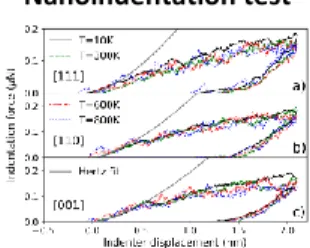
The development of novel technology in aerospace and energy industries requires the use of materials that can sustain extreme operating environments with high temperature and under irradiation. Molybdenum is selected as a candidate for its high melting point and good resistance to deformation under plasma irradiation. In this work, we perform Molecular Dynamics (MD) simulations to emulate neutron irradiation in crystalline Mo to investigate Frenkel pairs and crowdion formation at different primary knock-on atom energies by EAM and Gaussian Approximation potentials frameworks, obtained results are shown in Fig 1 and 2. Besides, we study the thermomechanical stability of molybdenum at high temperatures (10–1000K) through nanoindentation tests. We report the effects of increase of temperature on the nanoindentation process (Fig 3) like modifying dislocation densities and material hardness, in agreement with reported experimental measurements (Fig 4.).
Our results suggest that [001] dislocation junctions are responsible for high-temperature material mechanical stability. Finally, we will present results for the nanoindentation test of irradiated Mo samples.
Neutron irradiation Nanoindentation test
Fig 1. Number of displaced atoms as a function of the simulation time,wherere-crystallizationoccursduringthethermalization phase.
Fig 3. P− ℎ curve of the nanoindentation of crystalline Mo for the [111] in (a), [110] in (b), and [001] in (c) crystal orientations.
Fig 2. Total number of defects as a function of the PKA. Fig 4. Hardness as a function of temperature for the [100]
orientation References
[1] F. J. Dominguez et al., Modelling Simul. Mater. Sci. Eng. 29, 055001 (2021).
[2] F. J. Dominguez et al.,Materials Science & Engineering A 826, 141912 (2021).
29
Machine Learning for Atomistic Materials Science
Alexandra M. GORYAEVA
1, Tom D. SWINBURNE
2,
Clovis LAPOINTE
1, Jacopo BAIMA
1, Julien DÉRÈS
1, Mihai-Cosmin MARINICA
11Université Paris-Saclay, CEA, Service de Recherches de Métallurgie Physique, CEA, Université Paris-Saclay, F- 91191 Gif-sur-Yvette, France. 2CNRS, Centre Interdisciplinaire de Nanoscience de Marseille (CINaM), Université
Aix-Marseille, France
Abstract
I will present recent advances in atomistic material simulations by means of machine learning and data-driven approaches. Machine learning (ML) methods cannot fully replace traditional approaches in physics and/or materials science. The phase space in physics / materials science has a well defined structure and is too vast and complex to be described only by the inherent statistical correlations within the data points. To our knowledge, none of the current statistical methods alone, generically called Machine Learning and its subclass deep learning (DL), can provide a valuable alternative to the laws of physics. In order to provide reliable results in the field of physics, ML/DL should learn and be trained on logically coherent data provided by well established methods from the community of physics. Nevertheless, statistical methods trained on the physical data can be of great help when the traditional approaches are limited and/or their direct application is hindered by factors such as high computational cost. Multi-scale approaches in materials science face a traditional dichotomy in the choice of the atomistic force fields: robust, accurate and numerically expensive ab initio methods against less transferable but fast empirical methods. The ML methods propose a third avenue that allows control of the balance between the accuracy and numerical efficiency. Moreover, the ML-based vision of fundamental concepts in materials science, such as structural defects, can augment and revise traditional interpretations. In metals, the interaction and transformation of crystal defect networks gives rise to an extraordinarily diverse range of defect morphologies [1]. Using the recently developed package MiLaDy (Machine Learning Dynamics) [2]: (i) we redefine the concept of defects in materials science [3]; (ii) we provide reliable force fields for complex defects such as interstitial, dislocation loops, dislocations; (iii) we are able to explore the atomistic free energy landscape of point defects in metals with ab initio accuracy up to the melting temperature [4], and, finally, (iv) we are able to propose surrogate models that bypass the traditional approaches [5]. We exemplify and discuss in the framework of experimental findings the case of energetic landscape of defects in body centered and face centered cubic metals.
References
[1] K. Arakawa , M.-C. Marinica et al. Nature Mat. 19, 508(2020) ; R. Alexander et al. Phys. Rev. B 94, 024103 (2016).
[2] M.-C. Marinica, A. M. Goryaeva, T. D. Swinburne et al, MiLaDy - Machine Learning Dynamics, CEA Saclay, 2015-2021 ; A.M. Goryaeva, J.-B. Maillet, M.-C. Marinica. Comp. Mater. Sci. 166, 200 (2019).
[3] A. M. Goryaeva et al. Nature Commun. 11, 4691 (2020).
[4] C. Lapointe et al. (to be submitted). , T.D. Swinburne, M.-C. Marinica, Phys. Rev. Lett. 120, 135503 (2018).
[5] C. Lapointe, T. D. Swinburne et al. , Phys. Rev. Materials 4, 063802 (2020); F. Bruneval et al. J. Chem. Theory Comput.
16, 4399 (2020).
30
Materials informatics of High Entropy alloys
Stefanos PAPANIKOLAOU
NOMATEN Centre of Excellence, National Centre for Nuclear Research, ul. A. Sołtana 7, 05-400 Swierk/Otwock, Poland
Abstract
The identification of alloys with exceptional properties has recently become rather promising with the advance of single-phase concentrated solid solutions (commonly known as high entropy alloys), containing multiple elements at large (>15%) concentrations. However, the search and understanding of such alloys is rather challenging, due to the prohibitive size of the multi-dimensional elemental and configurational space, together with the complexity of annealing-driven short-range disorder [1, 2] that masks the origin of mechanical properties' excellence. Facing these challenges requires multiscale modeling methods (ab-initio, molecular dynamics, Monte Carlo) that may allow for the appropriate physical interpretations of alloy searches, together with new approaches [3, 4 , 6], inspired from data science and widely labeled as materials informatics, where microscale parameters that control mechanical deformation at large scale can be identified, and even learned, from statistical analysis of large amounts of data.Consequent statistical predictions may range in a wide gamut of applications, for understanding of elastic and plastic features of deformation in crystals. By using multiscale modeling and materials informatics, I will outline several results related to the search [6], classification [3, 4, 5]
and understanding [7, 8] of concentrated solid solution alloys.
References
[1] Papanikolaou, S., 2018. Learning local, quenched disorder in plasticity and other crackling noise phenomena. npj Computational Materials, 4(1), pp.1-7.
[2] Papanikolaou, S., Cui, Y. and Ghoniem, N., 2017. Avalanches and plastic flow in crystal plasticity: an overview. Modelling and Simulation in Materials Science and Engineering, 26(1), p.013001.
[3] Frydrych, K., Karimi, K., Pecelerowicz, M., Alvarez, R., Dominguez-Gutiérrez, F.J., Rovaris, F. and Papanikolaou, S., 2021.
Materials Informatics for Mechanical Deformation: A Review of Applications and Challenges.
[4] Papanikolaou, S. and Alava, M.J., 2021. Direct detection of plasticity onset through total-strain profile evolution. Physical Review Materials, 5(8), p.083602.
[5] Papanikolaou, S., 2020. Microstructural inelastic fingerprints and data-rich predictions of plasticity and damage in solids.
Computational Mechanics, 66(1), pp.141-154.
[6] Papanikolaou, S. 2021. Iron-based Alloys Informatics: Choosing how to alloy based on ab-initio-based charge profiles (in preparation).
[7] A. Esfandiarpour, S. Papanikolaou, M. Alava, Edge dislocations in multi-component concentrated solid solutions: Beyond the traditional elastic depinning theory (to be submitted, Phys. Rev. Letters).
[8] A. Naghdi, A. Poisvert, R. Alvarez, A. Esfandiarpour, K. Karimi, P. Sobkowicz, M. Alava, S. Papanikolaou, Segregation effects in equiatomic NiCoCr due to thermal annealing: A hybrid Monte-Carlo, Molecular Dynamics Investigation.
31
Quantitative microscopy for multiscale modelling
Wade KARLSEN
VTT Technical Research Centre of Finland, P.O. Box 1000, FI-02044 VTT, Finland
Abstract
Modelling of the plastic behavior of irradiated materials used in nuclear reactors can be described by constitutive equations capturing the temperature and strain rate sensitivities. To reflect the microstructural context, the flow stress must be decomposed into its fundamental components associated with the microstructure features peculiar to the particular steels, such as carbides, the dislocation network, deformation confinement inside grains, and strain localization in cleared channels. The contribution of radiation defects can be accounted for using atomistic and dislocation dynamics results. The effect of radiation-induced solute clusters and faulted dislocation loops can be analyzed in detail in terms of the feater size, density and strength. The aforementioned process involves a number of equations involving various parameters. In order to conduct calculations on real and representative materials systems, a number of inputs are often needed, many of which require quantifications to be carried out on images collected by microscopy and microanalysis techniques. Souces of error in such microscopy approaches in turn can introduce false or incorrect values into a multiscale computation exercise. Quantitative microscopy and associated considerations are the focus of this communication.
At the VTT Centre for Nuclear Safety, hot cell facilities combined with analytical electron microscopy enable experiments to be carried out on radiactive neutron irradiated materials such as reactor pressure vessel steels, austenitic stainless steel and nickel based internals materials, and nuclear fuel claddings. When it comes to reactor pressure vessel steels, examples are given of microstructural features that that can be involved in influencing the fracture toughness of the materials, such as dislocations, second phase particles, and irradiation- induced clusters. In austenitic stainless steels, features of primary importance to the materials’ susceptibility to irradiation-assisted stress corrosion cracking include clusters and dislocation loops, localized plasticity through channel deformation, radiation-induced matrix precipitates, and radiation-induced grain boundary segregation.
In precipitation-hardenable Ni-base alloy, the precipitate population size and distribution plays and important role in their mechanical performance in irradiation stress corrosion cracking performance. Finally, when it comes to zirconium fuel cladding, the dislocation loop population and particular properties are an important feature in the creep properties
References
[1] Wade Karlsen, “The new VTT Centre for Nuclear Safety”, Suomalaisen Ydintekniikan Päivät 2016 – SYP2016.
http://www.ats-fns.fi/fi/syp2016/proceedings.
[2] W. Karlsen, A. Toivonen and P. Efsing, Cor. and Mat. Deg., 2021, 2, 248-274. https://doi.org/10.3390/cmd2020014 [3] M. Sauzay, K. Bavard, W. Karlsen, J. of Nuc. Mat., Vol. 406, Issue 1, 1 November 2010, Pages 152-165.
[4] K. R. Anderson, W. Karlsen, M. Ivanchenko, J. J. Carter, R. W. Smith, J. of Nuc. Mat. Vol. 513 (2019) 260-270.
[5]W. Karlsen, K. Dohi, T. Onchi, 13th Int. Con. on Env.Deg. of Mat. in Nuc. Power Sys. Whistler, B.C., Canada, August 19 - 23, 2007. Canadian Nuclear Society, CNS (2007), 12 s.
[6] A. Toivonen, P. Aaltonen, W. Karlsen, U. Ehrnstén, J-P. Massoud, J-M Boursier 6th Int. Sym. on Contribution of Materials Investigations to Improve the Safety and Performance of LWRs. Fontevraud 6. Proceedings. Volume 1. Fontevraud Royal Abbey, France, 18-22 Sept. 2006. French Nuclear Energy Society, SFEN (2006), 567-579.
32
Solutes effects on the microstructural evolution of nickel base alloys as model alloy of austenitic steels
Kan MA
1,4, Brigitte DECAMPS
2, Thomas JOURDAN
1, Anna FRACZKIEWICZ
3, Frédéric PRIMA
4, Marie LOYER-PROST
11Université Paris-Saclay, CEA, Service de Recherches de Métallurgie Physique, F-91191 Gif-sur-Yvette, France. 2 Laboratoire de Physique des 2 infinis Irène Joliot-Curie (IJCLab), Université Paris-Saclay, Orsay, France entre de Sciences Nucléaires et de Sciences de la Matière (CSNSM), CNRS-IN2P3- Université Paris-Sud, 101 Domaine de
l'Université de Paris Sud, 91400 Orsay, France. 3 Institut de Recherche de Chimie Paris, CNRS UMR 8247–
Chimie ParisTech, 11 rue Pierre et Marie Curie, Paris, 75005
Abstract
Austenitic Stainless Steels (ASSs) are foreseen as cladding material for next generation reactors even though their swelling under irradiation will limit the fuel burnup. Micro-additions of solute elements, such as chromium (Cr) and titanium (Ti), are known to efficiently reduce this swelling [1, 2] but the mechanism is still unexplained. To increase the swelling threshold, it is utmost important to get a better understanding of the mechanisms involved.
Here we focus on the effect micro-additions (0,4% wt.) of an element (for example Ti and Cr) on the microstructure evolution of nickel at small irradiation dose. Nickel is considered as a model alloy for ASSs as they have the same crystallographic structure (face-centered cubic structure). Ni and its alloys were irradiated at high temperatures (450-510°C) by 2 MeV Ni2+ ions with a flux of 4 ± 0.8 x10¹¹ ions/cm2/s in a TEM using JANNuS-Orsay facility. The fluence was up to 10 ± 1.8 x10¹⁴ ions/cm2 (0.7 dpa by SRIM-2013 and IRADINA [3). The microstructure evolution of samples was recorded and analyzed. The drastic impact of solute elements on loop growth, morphology and nature will be detailed [4, 5]. The mechanisms involved will be discussed.
TEM micrographs of typical Frank loops in Ni (a), Ni-0,4Ti (b) and Ni-0,4Cr (c) irradiated at 450°C up to 0,7 dpa
References
[1] F.A.Garner, Radiation Damage in Austenitic Steels , volume 4, p. 33 (2012).
[2] A. Benkaddour et al. J Nucl. Mater. 217 (118-26). (1994).
[3] J.P Crocombette, et al. EPJ Nuclear Sciences & Technologies 5:7 (2019);
[4] K. Ma, et al., Materials Research Letters. 8 (2020) 201–207.
[5] K. Ma, et al., Acta Materialia. (2021) 116874.
33
Nanoindentaion of ion-irradiated materials and thin films
Łukasz KURPASKA
NOMATEN Centre of Excellence, National Centre for Nuclear Research, ul. Andrzeja Soltana 7, 05-400 Otwock, Poland
Abstract
In this study two subjects will be presented. First analyzes of the elastic-to-plastic transition during nanoindentation of polycrystalline iron (pristine and ion-irradiated) will be described. We conducted series of nanoindentation (by using Berkovich and spherical indenters) experiments and electron backscatter diffraction analysis and we investigated the initiation of plasticity by the appearance of the pop-in phenomenon in the loading curves. Numerous load–displacement curves were statistically analyzed to identify the occurrence of such events. According to our work, first pop-in results from plasticity initiation caused by homogeneous dislocation nucleation and requires shear stresses in the range of the theoretical strength of a defect free iron crystal [1]. The results also suggest that plasticity initiation in Fe specimen with preexisting dislocations is significantly affected by small amounts of interstitially dissolved atoms (such as C) that are segregated into the stress fields of dislocations, impeding their mobility (which is visible for ion irradiated sample). Another strong influence on the pop-in behavior may be the presence of grain boundaries, which can lead to large pop-ins at relatively high indentation loads. Obtain results suggest that the pop-in behavior appears to be a statistical process affected by interstitial atoms, dislocation density, grain boundaries, and surface roughness. Presented work is a part of the experimental campaign carried out at NCBJ in the frame of M4F project, and continued in the frame of NOMATEN.
Second part of the work will consist of the description of nanoindentation tests performed on alumina coatings [2]. In this study functional properties of a 1 μm thick Al2O3 coating, deposited on 316L stainless steel by Pulsed Laser Deposition (PLD), subjected to high energy ion irradiation were assessed. A comprehensive characterization combining Transmission Electron Microscopy and Grazing-Incidence X-ray Diffraction provided deep insight into the structure of the tested material at the nano- and micro-scale. Variation in the local atomic ordering of the irradiated zone at different doses was investigated using a reduced distribution function analysis obtained from electron diffraction data. Findings from nanoindentation measurements revealed a slight reduction in hardness of all irradiated layers. At the same time TEM examination indicated that the irradiated layer remained amorphous over the whole dpa range. No evidence of crystallization, void formation or element segregation was observed up to the highest implanted dose. Reported mechanical and structural findings were critically compared with each other pointing to the conclusion that under given irradiation conditions, over the whole range of doses used, alumina coatings exhibit excellent radiation resistance. Obtained data suggest that investigated material may be considered as a promising candidate for next-generation nuclear reactors, especially LFR-type, where high corrosion protection is one of the highest prerogatives to be met.
References
[1] F. Pohl, “Pop-in behavior and elastic-to-plastic transition of polycrystalline pure iron during sharp nanoindentation”, Scientific Reports 9 (2019) 15350.
[2] A. Zaborowska et al. “Absolute radiation tolerance of amorphous alumina coatings at room temperature”, Cremics International (2021), published.
34
Application of Calphad method (Zr Base alloys, carbides, etc)
Caroline TOFFOLON
Université Paris-Saclay, CEA, Service de Recherches Métallurgiques Appliquées, 91191 Gif-sur-Yvette cedex, France
Abstract
The so-called CALPHAD (CALculation of Phase Diagrams) method has shown its interest in the last 30 years for several alloy families such as steels, Ni-base, Ti-base alloys and in many fields of application.
This presentation aims at presenting how the CALPHAD method has been used for the development of useful tools for the study of phase transformations in fuel claddings used in Water Pressure Reactors.
Claddings containing the nuclear fuel in pressurized water reactors are made of zirconium alloys. It is of high interest to be able to predict the nature of the reactions with the surroundings (water), the precipitation or the dissolution of phases induced by the presence of alloying elements, but also to test new alloy compositions.
In a first part, the creation of thermodynamic database using the CALPHAD method will be presented. This method is an extensively used semi-empirical technique for phase modeling. It consists in describing the Gibbs energies of the different phases present in a system by adjusting parameters to fit the known experimental data and DFT calculations [1].
Then, results showing the interest of thermodynamic calculations to metallurgical studies of multi-component zirconium based alloys will be presented [2-3].
In a last part, it will be shown how thermodynamic databases, when linked to other modelling tools, can provide useful thermodynamic and/or metallurgical data [4].
References
[1] P. Lafaye et al., “Experimental study, first principles calculations and thermodynamic modelling of the Cr-Fe- Nb-Sn-Zr quinary system for nuclear applications”, Journal of Nuclear Materials, 544 (2021) 152692.
[2] J.-C. Brachet et al., “Oxygen, Hygroden and Main Alloying Chemical Elements Partitioning Upon Alpha-Beta phase Transformation in Zirconium Alloys”, Solid State Phenomena 172-174 (2011) 753-759.
[3] C. Toffolon-Masclet et al. “Contribution of Thermodynamic Calculations to Metallurgical Studies of Multi-Component Zirconium based Alloys”, Journal of ASTM International 5 N°7 (2008) 1-21.
[4] C. Toffolon-Masclet, C. Desgranges, C. Corvalan and J.-C. Brachet, “Simulation of the beta to alpha (O) phase transformation due to oxygen diffusion during high temperature oxidation of zirconium alloys”, Solid State Phenomena 172-174 (2011) 652-657.
![Fig 3. P− ℎ curve of the nanoindentation of crystalline Mo for the [111] in (a), [110] in (b), and [001] in (c) crystal orientations](https://thumb-eu.123doks.com/thumbv2/9liborg/19325518.0/28.892.200.359.627.766/fig-ℎ-curve-nanoindentation-crystalline-mo-crystal-orientations.webp)
![Fig 2. Total number of defects as a function of the PKA. Fig 4. Hardness as a function of temperature for the [100]](https://thumb-eu.123doks.com/thumbv2/9liborg/19325518.0/28.892.522.711.810.939/fig-total-number-defects-function-hardness-function-temperature.webp)
