The results of the research show the controversial nature of the relationships between CSR disclosure practices and market performance of the companies in the tobacco industry. Second, the main assumptions and frameworks used in the content analysis of the CSR reports will be described.
THEORETICAL BACKGROUND AND LITERATURE REVIEW
The concept of Corporate Social Responsibility
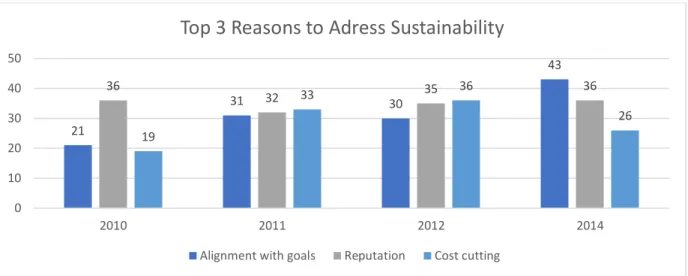
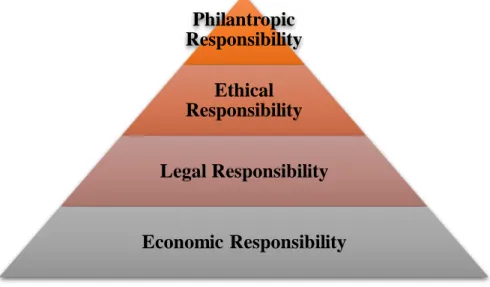
Afterwards, many studies have implemented Carroll's tree-dimensional model in their findings, making the concept of CSR clearer. Source: McKinsey Global Survey, 2014 Therefore, the benefits of implementing CSR initiatives both for internal and external stakeholders in the organization can be seen from different perspectives.
Approaches to measure Corporate Social Responsibility
However, insofar as the method is one of the easiest for the researcher, the number of his'. Thus, in this case, research may be limited by the availability of the data itself (Galant and Cadez, 2017).

Relationship between Corporate Social Responsibility and Financial Performance
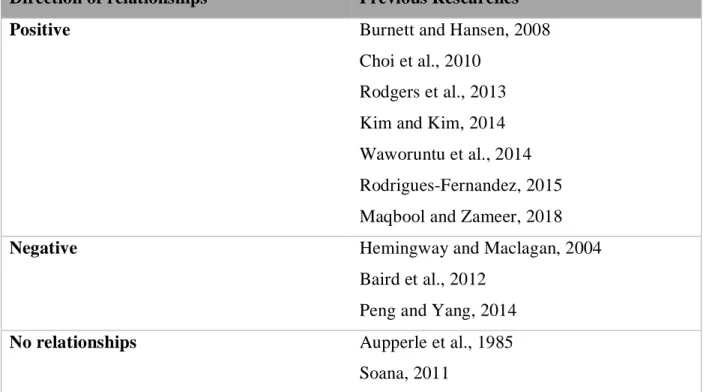
If a company's focus is shifted to a particular CSR practice, research may show that the company is outperforming or underperforming competitors without taking the bigger picture into account. The summary table below for previous work on relationships between corporate CSR practices and FP can be found. Source: Created by author based on literature review Regarding the impact of the introduction of CSR practices on firm financial performance, previous studies lacked common results on this topic due to the difficulty of quantifying the CSR impact in monetary terms and to evaluate.
Nevertheless, there have been many attempts to analyze the relationship between corporate performance indicators and corporate social responsibility. Lee (2008) summarized all the possible reasons for the inconsistency of results between CSR and CF companies. To avoid these reasons, the tobacco industry and its CSR practices need to be examined in more detail to create a more sophisticated framework for analysis.
Tobacco industry: global market description and analysis
In addition, in the long term, cigarette retail sales are projected to decrease by 22% in the best-case scenario for tobacco companies by 2031. Therefore, tobacco companies should develop a new strategic vision to mitigate the negative impact of the shrinking industry in which they operate. Since the year, the company's shares belong to institutional investors, the largest of which are Capital Group Companies, The Vanguard Group, BlackRock, State Street Corporation, T.
JTI - is the third largest producer of tobacco product in the world, its products are supplied in 120 countries, about 27 thousand employees work at factories of the company in 74 countries. The International Tobacco segment is involved in the manufacture and sale of tobacco products by JT International S.A. The company's shares are listed on the London Stock Exchange, a component of the FTSE 100 index.
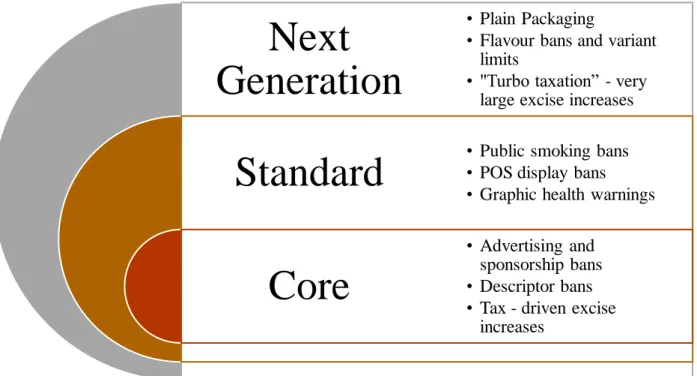
The tobacco industry is extremely sensitive to regulation and public opinion due to the harmful nature of the products it produces. Corporate Social Responsibility, according to this portal, is one of the tactics used by the tobacco companies to create a viable illusion for the public. So it is necessary to take a closer look at the CSR practices of the tobacco companies to understand whether it is really just a way to create the illusion that they are a good citizen or whether tobacco companies are really improving their social behavior and are starting to participate. engage with the health facilities to reduce the harmful effect of their activities.

Corporate Social Responsibility in tobacco industry
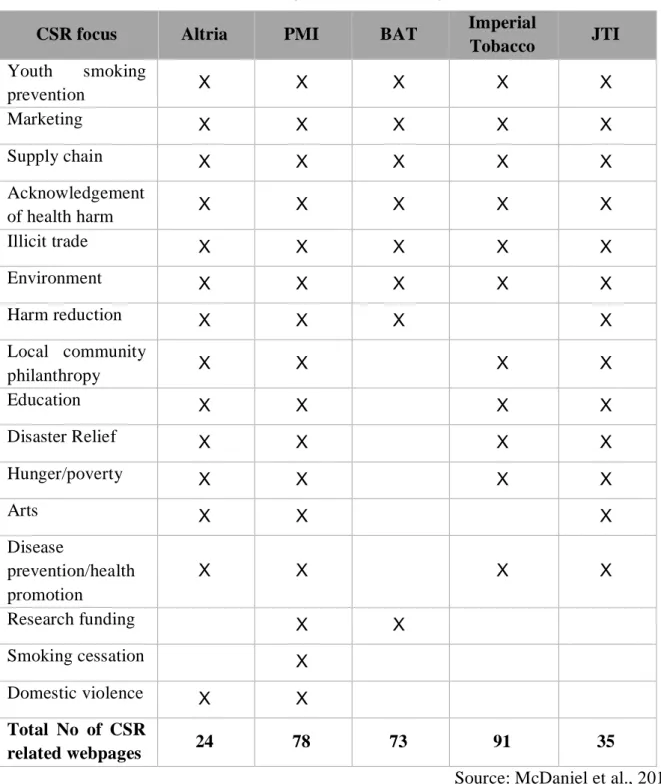
As an example of the doubts that can arise, the World Health Organization questioned the real motives of tobacco companies for banning marketing activities aimed at children (Rondinelli, 2002). By 2018, most of the major players in the market will elaborate their initiatives in various types of sustainability, environmental and more specifically target reports. Most companies publish their SCR report on their websites and also create certain web pages to make the exploration process easier for any interested party.
It turned out that most players have a shared vision for the development of such a program, insofar as there is no absolutely unique content intrinsic to a particular company. Most companies mentioned two directions of desired impact: eliminating child labor and developing regions where tobacco is grown. Virtually all companies discuss their efforts to minimize the negative impact of tobacco cultivation on the environment (Otanez and Glantz, 2011).
To varying degrees, all companies publish information about harm caused by smoking on their websites. In the last four years, most companies have embarked on a crucial transformation in terms of the vision of the future of companies. Thus, most companies see their future growth in developing a new niche for the smokers, which will attribute to the need to reduce the harmful effects of burning tobacco on health.
CSR DISCLOSURE AND MARKET PERFORMANCE IN TOBACCO: AN
Development of hypothesis
To evaluate the extent of Corporate Social Responsibility disclosure, researchers use unweighted disclosure index by creating specific checklists within the chosen framework of CSR. Furthermore, they examined the relationship with the financial results of the companies from the sample in the subsequent analysis. This can be done by giving a score from 1 to 3 depending on the quality of the information the company presents.
Today, companies are looking for a solution to reduce the harm caused by smoking conventional cigarettes. Most of the major players in the market have started their investment process in the development of alternative products containing nicotine. On the opening page of the company's main website, Philip Morris International calls their new vision "Designing a Smoke-Free Future".
In this research, the effect of implementing the new strategic vision, which is becoming an essential topic of CSR disclosure for many tobacco companies, on market performance should be tested. One of the rating systems that takes tobacco companies into consideration is the Dow Jones Sustainability Index (DJSI) launched in 1999 by RobecoSAM and S&P Dow Jones Indices. The DJSI is one of the most famous and oldest sustainability indices in history, which.
Research Method, Sample and Variable Description
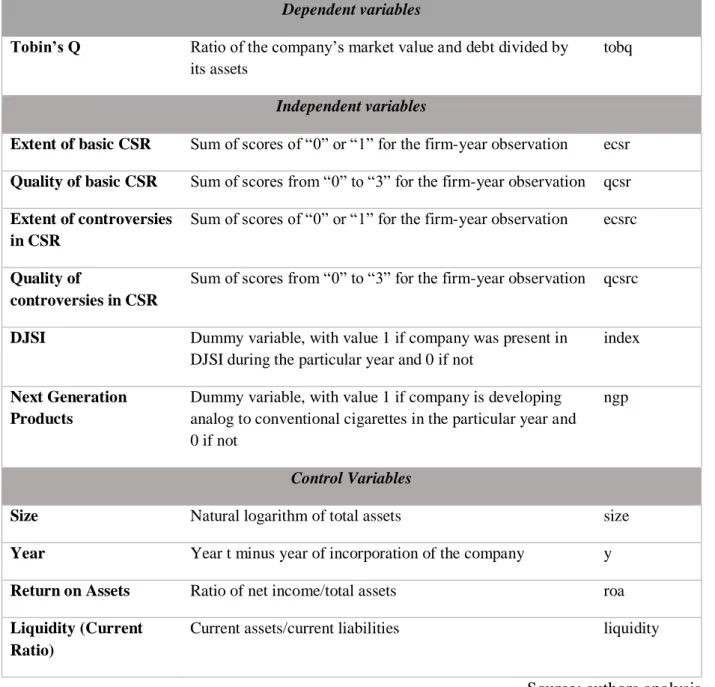
Here, the score basically represents the extent of the company's transparency towards several issues, which is unlikely to have a positive impact on the brand image. Working with Retailers' means highlighting programs designed to increase awareness among tobacco retailers. To assess the market performance of companies, a coefficient such as Tobin's Q was taken as a representation of market expectations regarding the performance of companies.
Tobin's Q is defined as the ratio of the market value of the firm and its debt book value to the total assets of the firm (Chung and Pruitt, 1995). According to Luo and Bhattcharia (2006), the ratio corresponds to potential of growth as well as profit sustainability of the company. However, some research notes that it can only translate investors' investment behavior perception instead of the company's actual outlook (Shleifer, 2000).
Tobin's Q was chosen as a dependent variable to describe the companies' performance, since this measure as well as CSR reflects more than short-term situations as well as it has already proven itself as a working variable in CSR-CFP research (Luo and Bhattacharya , 2006; Kim et al., 2015). In order to obtain a more accurate evaluation of the extent to which the quality and extent of basic CSR practices and controversies in CSR, several control variables were added to the model to control for the factors potentially predicting Tobin's Q. Year Year t minus year of incorporation of the company y Return on assets Net income/total assets roa Liquidity (Current . Ratio).
Model Specification
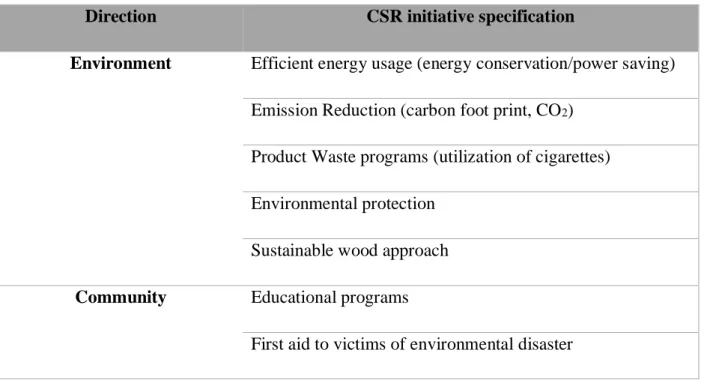
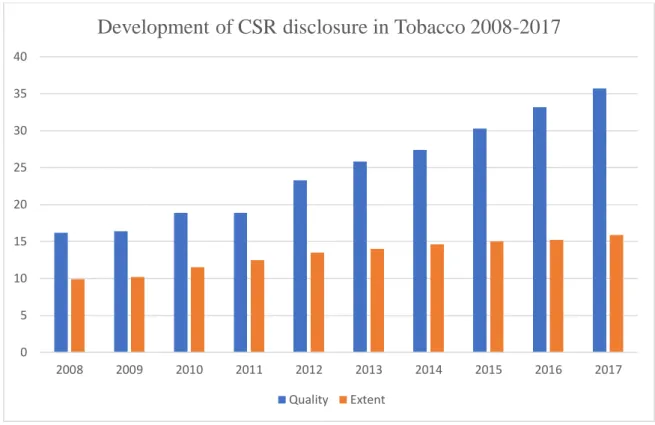
To get a head start, it can be useful to look more specifically at SCR categories, looking for trends in companies' disclosure practices. It is clear that environmental and community development issues were and still are the main focus of CSR disclosure topics. From the regression results, it is clear that the basic disclosure rate of CSR is significant (p<0.05) and gives a positive relationship with the dependent variable.
Both quality and extent of disclosure of controversial information about CSR activities of the companies did not show statistical significance in the research conducted. If we talk about the quality of disclosed information about basic CSR initiatives, despite the importance of the factor, the sign of the relationship appeared to be opposite to the one hypothesized. After conducting the research, it was decided to investigate the nature of negative sign of the quality of basic CSR disclosure variable.
However, for the size of the company, the sign of relations turned out to be negative. Which means that the market expectation of the future performance of companies actually has a negative relationship with the size of the company. After conducting the research, it is necessary to proceed to a discussion of the collected results.
Results and managerial implication
Even the company's inclusion in the sustainability indices did not affect the market perception of the companies. Tobacco companies rely on CSR initiatives to improve their public image and advance their strategic goals, which include overcoming the image consequences of the tobacco industry (McDaniel et al., 2016). In this particular paper, the main research question of this paper was: "Is there any relationship between CSR disclosure practices and market performance of tobacco companies?", that is, whether business specifics affect "market sentiment" towards the company.
But when we return to the question, the answer is "Yes, CSR disclosure practices have a positive effect on the activities of tobacco companies if they have to be limited in the amount of information disclosed" Thus, CSR initiatives show the company's dedication to make a better effect, regardless of the industry it operates in. The main limitations of these studies are undoubtedly the human factor during the period of data collection, which can lead to bias in the results. It gave an interesting result in relation to the main faces that tobacco companies have to make to become more attractive to investors who look at the companies' performance in the market, which is to focus mostly on the coverage of CSR initiatives weather then its detailed description.
In summary, two-way relationships with CSR disclosure and market performance for the tobacco companies showed the complexity of the CSR concept for the industry. Principal actors should pay close attention to the conceptual part of their disclosure practices if they want the market to trust them and their motives for increasing the prosperity of the social and business environment in which they exist. 34;A Review Of The Theories Of Firms social responsibility: its evolutionary path and the way forward".