
Computer Science Logic (CSL) is the annual conference of the European Association for Computer Science Logic (EACSL). It was hosted by the University of Birmingham's School of Computer Science and held at its Edgbaston campus.
Programme Committee
External Reviewers
The Ackermann Award 2018
Dexter Kozen
Thomas Schwentick
1 The Ackermann Award 2018
Citation
Background of the Thesis
Kozen and Th. Schwentick 1:3
Contributions of the Thesis
Biographical Sketch
2 Jury
3 Previous winners
Kozen and Th. Schwentick 1:5
Relating Structure and Power: Comonadic Semantics for Computational Resources
Nihil Shah
1 Introduction
In this paper, we develop a new approach for linking categorical semantics, which illustrates the first strand, with finite model theory, which illustrates the second.
The setting
Model theory and deception
Main Results
Abramsky and N. Shah 2:3
For an Ehrenfeucht-Fraïssé comanade, the coalgebra number A corresponds exactly to the tree depth A [27]. For a modal co-algebra, the number of the coalgebra A exactly matches the depth of the modal unfolding of A.
2 Game Comonads
Abramsky and N. Shah 2:5
- The Ehrenfeucht-Fraïssé Comonad
- The Pebbling Comonad
- The Modal Comonad
A coKleisli morphism EkA → B represents a duplicator strategy for the existential Ehrenfeucht-Fraïssé game withkrounds, where Spoiler plays only inA, andbi=f[a1,. The universe is (k×A)+, the set of finite nonempty sequences of moves (p, a), where p∈kis a pebble index, and a∈A. pn, an)] for these sequences, which can be of arbitrary length.
3 Logical Equivalences
Abramsky and N. Shah 2:7
- The Ehrenfecht-Fraïssé comonad
This means that there are morphisms CkA→B and CkB→Which are inverses of each other inKl(Ck). Note that, for every coKleisli morphism :EkA→B, there exists anI-morphism :EkA→B, obtained by first restricting f to non-repeated sequences, then extending it by enforcing the I-morphism condition on repetitions.
Abramsky and N. Shah 2:9
- The Pebbling Comonad
- The Modal Comonad
We define the modal depth of a modal formula ϕ as the maximum nesting depth of modalities appearing in ϕ. Extensions of the modal language to include counting capabilities have been studied in the form of graded modalities[10].
Abramsky and N. Shah 2:11
4 Coalgebras and combinatorial parameters
The Ehrenfeucht-Fraïssé comonad and tree-depth
We write κE(A) for the coal algebra of A with respect to the Ehrenfeucht-Fraïssé co-monad.
The pebbling comonad and tree-width
Abramsky and N. Shah 2:13
- The modal comonad and synchronization tree depth
Thus, having a coalgebra at all, regardless of the value of the resource parameter, is a strong constraint on the structure of the transition system.
5 Further Directions
Abramsky and N. Shah 2:15
Taking the colimits of these diagrams, we obtain a comonad Mω, which corresponds to the usual unfolding of a Kripke structure to all finite levels. This would correspond to the bisimulation approach∼ω, which coincides with bisimulation itself on image-finite structures [ 17 ].
Concluding remarks
Abramsky and N. Shah 2:17
Climbing up the Elementary Complexity Classes with Theories of Automatic Structures
Faried Abu Zaid
Dietrich Kuske
Peter Lindner
To determine the truth of the sentenceϕin the forestFh+2, it is sufficient to determine it in a forest whose trees have a size h-fold exponential inr. For the lower bound, we first reduce each problem in the mentioned complexity class to the theory of the free monoid, where quantification is limited to words of h-times exponential length.
2 Preliminaries
Thus, technically, the main achievement of this paper is the complete characterization of the complexity of the theory of the forest Fh+2. The height of T is the height of the root, equivalent to the maximum depth of a node in T.
3 Trees of Bounded Height
4 Upper Bound
For eachh, r∈N, let≡hr denote the constraint on the relation≡rom trees of height≤h. Since the size of the order tree Tj is bounded as described above, so is the size of the order tree T.
5 Lower Bound
Reduction to the theory of the bounded free monoid
There is a comphom(x, y) formula such that for all configurations c and c0 we have Mp(n)2 |= comphom(c, c0) if and only if there is a homogeneous computation. Similarly, there is a formula comp∃ that expresses the existence of an existential computation with the same length limit.
Interpretation of the bounded free monoid in F H+2
- Nodes as numbers
- Tuples of nodes as words
Since H was fixed from the beginning, the formula eqH+2N = eqN can be constructed from N in time polynomial inN. Note that the length of the word N(v) is the successor to the maximum number represented by any of the children of node sva from tuplev.
6 Conclusion
This completes the construction of the interpretation of the bounded free monoid MN in the forest FH+2. Since all the formulas wordN, prodN and is letterN,a can be computed in polynomial time, we can reduce the theory of bounded free monoid MN in polynomial time to the theory FH+2.
High-Level Signatures and Initial Semantics
Benedikt Ahrens
André Hirschowitz
Ambroise Lafont
This material is based on work supported by the Air Force Office of Scientific Research under award number FA.
1 Introduction 1.1 Initial Semantics
Computer-checked formalization
The intricate nature of our main result made it desirable to provide a mechanically controlled proof of this result, along with a human-readable summary of the proof. Here below, in teletype font, we give the name of the corresponding result in the computer-controlled library when it is available - often in the format filename:identifier.
Related work
Our computer-controlled proof is based on the Uni Math library [26], which itself is based on the proof assistant Coq[25].
Organisation of the paper
2 Categories of modules over monads 2.1 Modules over monads
The total category of modules
Derivation
The substitution of σ allows us to interpret the derivative M0 as a "module M with one added formal parameter". The endofunctor Mod(R) of the mapping M to the R-module M×R is left associated with the derivational endofunctor, and the unit is the substitution morphism σ.
3 The category of signatures
For any functor F: Set −→ Set and any signature Σ, the assignment R7→F·Σ(R) gives a signature which we denote F·Σ. Moreover, it is distributive: for every signature and family of signatures (So)o∈O, the canonical morphism.
4 Categories of models
The usual application:LC2−→LCis an action of the elementary signature Θ2in the monadLCof syntactic lambda calculus. Application+absissa then an action of the algebraic signature of the lambda calculus Θ2+ Θ0 in the monadLC.
5 Syntax
Representability
During formalization, this category is recovered as the fiber category over Σ of the displayed category [2] of models, see Signatures/Signature:rep_disp. The initial algebra (constructed as the colimit of the initial chain) is given the structure of a monad with an action of the algebraic signature, and then a routine verification shows that it is in fact initial in the category of models.
Modularity
As part of the current work, we provide a computer-checked proof asalgebraic_sig_representable in the file Signatures/BindingSig. Below we present a more general representation result: Theorem 35 states that presentable signatures, which form a superclass of algebraic signatures, are representable.
6 Recursion
- Example: Translation of intuitionistic logic into linear logic
- Example: Computing the set of free variables
- Example: Computing the size of a term
- Example: Counting the number of redexes
We now define an action of the signature of lambda calculus ΣLC in the monad P. We take union operator∪:P×P →P as action of the application signature Θ×Θ; it is a module morphism since binary union spreads over union of sets.
7 Presentable signatures and syntaxes
The main desired property of our representable signatures is that they are representable by virtue of the following theorem:. A sketch of the proof is available in Appendix A. For a formalized proof, see Presentableis Representable in Signatures/PresentableSignature.
8 Examples of presentable signatures
- Example: Adding a syntactic binary commutative operator
- Example: Adding a syntactic closure operator
- Example: Adding an explicit substitution
- Example: Adding a coherent fixed point operator
The fixed-point eigenoperator for the monadoR is a morphism of the module f from R0 to R, which makes the following diagram commute. Thus, given the representable signature Σ, we can safely expand it with a syntactic coherent fixed-point operator by adding the representable signature Rn:N.
9 Conclusions and future work
Now let us vary and say that a total fixed point operator on a given monadRassigns to any n∈N ann-ary fixpoint operator on R. Given a monadR, we define a coherent fixed point operator onR as a module morphism of Rn:Nn×(R(n )) n toRwhere, for everyn∈N, the then-th component is a (rough) 14n-ary fixpoint operator.
A Proof of Theorem 35
Then we can construct a quotientπ :R →R in the category of monads that satisfies the usual universal properties. It remains to show that (R/F , mR/F) is a prime in the category of Σ-models. iii) Given a Σ-model (S, ms), the initial morphism Υ-modelsiS :R→F∗S induces the monadic morphismιS :R/F →S.
B Miscellanea
The diagram needed to turn mR/F into a module morphism onR/F is proved by precomposing it with the epimorphism π·(Σ(π)◦FS) and unfolding the definitions. ii) Now, π can be seen as a morphism of the patterns Υ between R and F∗R/F, by the naturalness of F and using the previous diagram. Precomposing the diagram involved by the epimorphism Σ(π)FR and unfolding the definitions shows that ιS :R/F →S is a morphism of Σ patterns. iv) We show that ιS is the only morphism R/F →S.
The True Concurrency of Herbrand’s Theorem
Aurore Alcolei
Pierre Clairambault
Martin Hyland
Glynn Winskel
In this paper, we provide such a compositional form of Herbrand's theorem, presented as a game semantics for classical first-order logic. In Section 2 we recall Herbrand's theorem and introduce the language of game theory that leads to our compositional reformulation of it.
2 From Herbrand to winning Σ-strategies
- Herbrand’s theorem
- Expansion trees as winning Σ-strategies
- Constructions on games and Herbrand’s theorem
- Compositional Herbrand’s theorem
Beyond the game-theoretic language, the difference with spanning trees is superficial: on ϕ, spanning trees essentially coincide with the minimal top-winning Σ-strategiesσ:JϕK. To compose Σ-strategies, we need to recreate the symmetry between ∃loïse and∀bélard in the interpretation of formulas.

3 A ∗-autonomous category
Composition of Σ-strategies
Disregarding terms, any two σ and τ have a meeting σ∧τ; it is a simplification of withdrawal in the category of event structures that exploits the absence of conflict [31]. A partial order (|σ∧τ|,≤σ∧τ) has events of all normal moves σinτ with a causal history compatible with both ≤σ and ≤τ, and for ≤σ∧τ a minimal causal order compatible with both.
Compact closed structure
We use this to define the structural morphisms for the symmetric monoidal structure of ArΣ. As a corollary, we get coherence for structural morphisms (following those on isomorphisms) and naturalness.
A linearly distributive category with negation
4 A model of first-order MLL
A fibred model of V -MLL
For any finite V, the fiber T(V) is the category GaΣ]V constructed in Section 3, in the extended signature Σ] V. Morphisms between V-gamesAndWinningBare(Σ] V)-strategies overA⊥`I considered as a game in the signature Σ] V – also called winning strategiesΣ in the game V A⊥`B.
Quantifiers
In fact, ∀IxA,C(τσ) and∀IxB,C(τ)σ also have the same events – they correspond to the same expansion tree, only the acyclicity witness is different. As this would not hold in the presence of contraction and weakening, we leave this to future work.
5 Contraction and weakening
Both phenomena could be avoided by adopting a polarized model, but giving up our allegiance to the raw Herbrand content of the evidence. It is a fascinating open question whether a non-polarized model of classical first-order logic can be found that remains finite – this is strongly related to the actively researched question of finding a strongly normalizing logic.

A Counter-examples
This counterexample also means that we do not have the adjunction expected from categorical logic∃V,x a T(wV,x)a ∀V,x. 4_∃c1, which cannot be of the form∀Ix∀11,1 – this construction would not establish any causal relation from∀4 to ∃c1, since it does not involve the variablex.
B Non-finiteness of the interpretation
After composition, however, we may end up with Σ-strategies that are not minimal, that is, they have direct causal connections that do not directly reflect a syntactic dependency. For readability, we also annotate the direct causal links with the subevidence from which they arise, i.e. $3 or $4.
C Compactness
Hence, after hiding, ∃loïse responds to an initial ∀bélard move∀ by playing all∃sn(∀), forn≥1 simultaneously. Finally, cutting $5 against a proof of∃x.>playing a constant symbol 0, we get a proof$6 of` ∃x.>whose interpretation plays all∃sn(0) forn≥1 simultaneously.
Cartesian Cubical Computational Type Theory
Constructive Reasoning with Paths and Equalities
Carlo Angiuli
Robert Harper
Contributions
In the spirit of Martin-Löf's interpretations of meanings [24], we define judgments of type theory as relations on programs in an untyped programming language. We currently implement our type theory in the RedPRLproof helper [28], in which we have already formalized the proof of univalence (https://git.io/vFjUQ).
2 Programming language
Our type theory is the first two-level type theory with canonicity, and the second univalent type theory with canonicity, after the cubic type theory of Cohen et al. 17], our type theory is inspired by a homotopy type theory model on cubic sets [12], and represents n-dimensional cubes as terms parameterized by variables varying in a formal interval.
3 Cubical PER semantics
Judgments
The open judgments must be defined simultaneously, by induction over the length of the context. Allen's PER semantics is an example of our semantics, in the case where types are constant presheaves and terms do not have free dimension names.
Properties of Judgments
Given the different roles of term variables and dimension names in Definition 8, it is natural that our judgments separate the contexts (a1:A1, . . . , an:An) and Ψ.
4 Kan types
These Kan operations are variants of the uniform Kan conditions first proposed by Bezem et al. In unpublished work in 2014, Licata and Brunerie [22] and Coquand [18] considered uniform Kan operations on Cartesian cubic groups, but failed to define univalent type theories based on those operations.
5 Type formers
- Booleans
- Circle
- Dependent function and pair types
- Path types
- Exact equality types
- Univalence
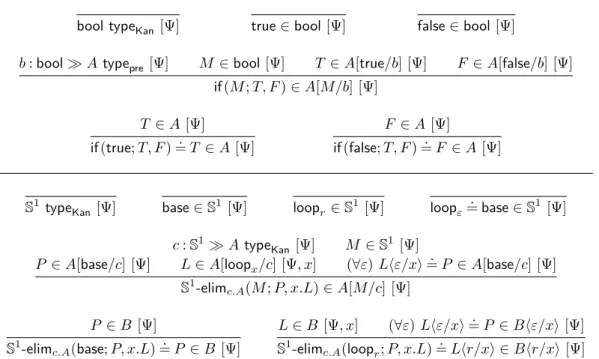
By restricting Kan operations to valid context constraints, we ensure that JS1K∅ contains nohcoms – there are no valid constraints at dimension∅whereri6=r0i for alli. The rules for the circle can be found in Figure 3, including the eliminator assignment from S1 to any.
6 Universes
We establish by induction that eachτiκ is indeed a cubic type system in the sense of Definition 4, and each is closed under the appropriate type generators. We take the "extreme" cubic type of systemτωpre (containing universes for allej) as our model, and validate each rule presented in this paper.
7 Conclusion and Related Work
Two-level type theories
3] proposed a two-level type theory with two intensive identity types: one to internalize paths, and the other satisfying uniqueness of identity proofs and function extension, but not equality reflection. Our contributions to two-level type theory are twofold: (1) we define the first two-level type theory that satisfies canonicity, and (2) by introducing the notion of discrete Kan types (see our preprint [7]), we obtain a type theory in which some exact equality types are fibrous.
Cubical type theories
Definable Inapproximability: New Challenges for Duplicator
Atserias and Dawar 7:3
Indefinability of a class of structures C in FPC is typically established by showing that structures in C are indistinguishable from structures not inC inCk - first-order logic with counting and justk variables - for any fastk. For a fixed positive integer k, we write Lk to denote the fragment of first-order logic where each formula has at most k variables, free or bound.
Atserias and Dawar 7:5
3 The Basic Gap Construction
Systems of constraints
Atserias and Dawar 7:7
- Gap construction
By induction ont≤αn, we prove that if A⊆U in|A|=t, then there exists an assignment that sets all variables invAin that satisfies all equations ineA. The induction hypothesis applied to B=A\ {u0} yields an assignmentg that sets all variables invB and satisfies all equations ineB.
Atserias and Dawar 7:9
First, it is clear that if I is a 3XOR instance that is satisfiable, then Θ(I) is also satisfiable. Now suppose that I is a system of equations not (3/4 +/4)-satisfiable, and let be an assignment of truth values to the variables X of Θ(I).
4 Amplifying the Gap
Parallel repetition
Atserias and Dawar 7:11
- First long-code reduction
- Second long-code reduction
Defining I0 from I is no problem at all: the FO-interpretation is even linear. To define I00 from I0, we assume that it is a constant and that the weights W(u, v) of I0 are either 0 or 1, so again no problem.
Atserias and Dawar 7:13
- Optimal gap inexpressibility
A statement similar to Theorem 4.8 can be obtained by applying the standard reduction of 3XORto3SATto Theorem 4.7, as in Theorem 3.8. However, this would only show that the class of 3SAT instances that are (1−)-satisfiable is Ck-inseparable from the class of instances that are not (7/8 +)-satisfiable; note that Theorem 4.8 makes the stronger claim that this is the case for the class of fully satisfiable cases, rather than the (1−)-satisfiable cases.
5 Vertex Cover
Atserias and Dawar 7:15
This has the consequence that no approximation algorithm for the vertex coverage problem expressible in FPC can achieve an approximation ratio better than 8/7. There are simple polynomial-time algorithms that provide a vertex cover in a graph with guaranteed approximation ratio 2.
6 Conclusions
Atserias and Dawar 7:17
In Proceedings of the Ninth ACM SIGACT-SIGMOD-SIGART Symposium on Principles of Database Systems, pages 61–71.
A Proof of Lemma 2.1
B Proofs Omitted from Section 3.2
Atserias and Dawar 7:19
We then claim that the position in the bijective game where the pebbles in G(I), onxa11,. By assumption, the Duplicator has a response in the existential game whenever the Spoiler moves a pebble from xj toxl.
C Deriving Theorem 4.3 from [16]
To see this, first notice that ifxr+xs+xt=bi is an equation inI, for 1≤r, s, t≤k0, and then, assuming the position is winning in the existential game, vr+vs+vt=bi . In [16], on the other hand, the values are understood as arbitrary truth assignments to the variables of a set of clauses, and not all these assignments satisfy all clauses.
D Proof of Theorem 5.5
Atserias and Dawar 7:21
J For the proof of the following lemma, we need the notion of a break point cover of a graph G= (V, E). Since pGis the value of the minimum weight vertex cover of (Xg, w), we have|S∩UX| ≥pG/2,.
Safety, Absoluteness, and Computability
Arnon Avron
Shahar Lev
Nissan Levi
Basic Definitions
S1 is a weak substructure of S2 (notation: S1 ⊆σ S2) if the domain of S1 is a subset of the domain of S2 and the interpretations in S1 and S2 of the constants ofσ are identical. A security signature is a pair (σ, F), where σ is an ordinary first-order signature with equality and no function symbols, and F is a function that assigns to each nth predicate symbol ofσ a subset of the power set of{1,.
Examples
- Computability Theory
- Set Theory
- Databases
- Querying the Web
If F(p) is nonempty for everypinσ, then by note 7S1 is a substructure of S2. in the usual sense of model theory) when S2 is a (σ, F)-extension of S1. Therefore, a formula is (σZF, FZF)-absolute if it is absolute in the usual sense of set theory.
The Corresponding Syntactic Relation
It is not difficult to see that the notion of security given there for this framework is equivalent to (σweb, Fweb)-safe in our sense, where {L, N, C} ⊆σweb, andF is defined as in the databases of usual, except that F(L) ={2, ,. were introduced independently by Gandy in [12] and by Jensen in [13].
3 The General Completeness Theorem
This follows from the facts that σ does not contain function symbols and that for every constant c in σ formulac=zof σsatisfier=zs(σ,F){z}, which ensures that α(σ,F)[S,¯a] contains all interpretations in S constant σ. It is really easy to conclude from Theorem 16 that, in general, if σ contains no constant and ϕ(σ,F)X, then there exists a formula ψ such that ψ is logically equivalent to ϕ,ψs(σ,F){x} and F v(ϕ)⊆F v(ψ).
4 Characterization of General Absoluteness
It is easy to prove that there is no formula ψ of this language that holds for ψ s(σ,F) F v(ψ). We show the necessity of the condition by proving a stronger claim: For every formula ϕ such that ϕs(σ,F)Y, there exists a formula ϕ0 ∈∆(σ,F) such that ∃Yϕ≡ϕ0.
5 Characterization of Absoluteness in N
To prove the converse, we repeat the reasoning in reverse order: Assume that vϕ≤x1,..,xk.
6 Absoluteness in Rudimentary Set Theory
Consequently, the external induction hypothesis for ϕ and the internal induction hypothesis for ψ1,ψ{t/x} are equivalent in RST to a ∆0 formula. Since ϕRST {x} in this case, we must prove that for every ∆0-formulaψ, ∃x(x∈t∧ψ) is equivalent to a ∆0-formula.
7 Conclusion and Further Research
Combining Linear Logic and Size Types for Implicit Complexity
Patrick Baillot
Alexis Ghyselen
Baillot and A. Ghyselen 9:3
It also includes other features (references and multithreading) that we will not be interested in here. We will first define languages`T of linear types of magnitude and investigate its properties (Sect. 2).
2 Presentation of s`T and Control of the Reduction Procedure
Syntax of s`T and Type System
We define free variables and free phenomena as usual and work up to renaming α. We define for indices the notions of free variables and free phenomena in the usual way and work up to variable renaming.
Baillot and A. Ghyselen 9:5
- Subject Reduction and Upper Bound
Since indices can only define polynomials, the weight of the sequence can only be a polynomial on the index variables. And so, ins`T, we can only define expressions that operate in time polynomial in their inputs.

Baillot and A. Ghyselen 9:7
3 Elementary Affine Logic and Sizes
- An EAL-Calculus
- Baillot and A. Ghyselen 9:9
- Syntax and Type System for sEAL
- Baillot and A. Ghyselen 9:11
- Example: Testing Satisfiability of a Propositional Formula
- Subject Reduction and Measure
- Baillot and A. Ghyselen 9:13
They are defined in the same way as in the previous part on the EAL account. We encode formula in conjunctive normal form in the type N⊗W, which represents the number of separate variables in the formula and the encoding of the formula by a word on the alphabet Σ ={0,1,#,|}.

4 Complexity Results: Characterization of 2k-EXP and 2k-FEXP
Baillot and A. Ghyselen 9:15
The class k-EXP is the class of problem solvable by a Turing machine that operates in time 2p(n)k on an entry of size, where pi is a polynomial. The difference with seEAL can be explained by the fact that in EAL, in the typeN(Nwe only have polynomials of degree 1 (polynomials generally have the type !N(!N), while in our case polynomials have the typeN(N ).
5 Conclusion
Baillot and A. Ghyselen 9:17
6 Appendix
- Type System for Words and boolean in s`T
- Some Intermediate Lemmas for the Subject Reduction
- Examples in s`T
- Baillot and A. Ghyselen 9:19
- Adding Polynomial Time Functions in EAL
- Type System for Words and Boolean in sEAL
- Baillot and A. Ghyselen 9:21
- Examples in sEAL
- Simulation of a Turing Machine in sEAL
We can give this constructor a typing rule close to that of the iteration, with an extra argument in the step clause for typeNa. The height of the exponential tower we can calculate in this calculation is closely related to the difference of.
Beyond Admissibility: Dominance Between Chains of Strategies
Nicolas Basset
Ismaël Jecker
Arno Pauly
Jean-François Raskin
Marie Van den Bogaard
The study of acceptability in the context of games played on graphics was initiated by Berwanger in [4] and subsequently became an active research topic (e.g. see related work below). We test the abstract notion in a concrete setting of generalized security/accessibility games (Definition 21).
2 Background
Games on finite graphs
We say that σ0 is weakly dominated by σ0, denoted σσ0 ifσv0 σ0, kuv0 is the initial state of G. To study the rationality of different behaviors in a game G, it is useful to be able to know, for one player, a fixed strategy σ∈Σi and some history h, the worst possible payoff that the player will get meσfromh (i.e., the payoff that he would get assuming the other players antagonistically), as well as the best possible payoff The player can to hope for meσfromh (ie, the payoff he would receive assuming that the other players play cooperatively).
Order theory
To summarize, we see that there exists an infinite sequence (sk)k∈N of strategies such that none of its elements is dominated by the only admissible strategies. Based on these observations, we take the approach to consider not only single strategies, but also such ordered sequences of strategies, which may represent a type of rational behavior that is not captured by the concept of acceptability.
3 Increasing chains of strategies 3.1 Ordering chains
Uncountably long chains of chains
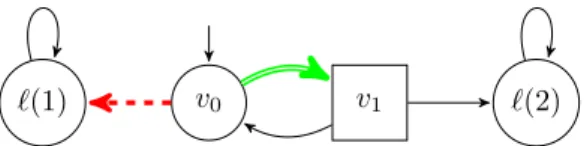
The strategies of the protagonist in this game can be described by the functions f :N→N∪ {∞}describing how often the protagonist is willing to repeat the second cycle (betweenv1and2) given the number of repetitions the antagonist made in the first cycle ( in v0). There exists an inclusion of (NN,≤) in the game strategies in Example 13 ordered by dominance such that no strategy in the inclusion range is dominated by a strategy outside the inclusion range.
Chains over countable posets (X, )
4 Generalised safety/reachability games
Dominance in generalised safety/reachability games
The existence of non-dominant witnesses allows us to conclude that in generalized security/attainment games all increasing chains are countable (not just those consisting of finite memory strategies). In a generalized security/accessibility game, each strategy is either permissible or dominated by an permissible strategy.
Parameterized automata and uniform chains
In a generalized security/accessibility game, each dominated finite memory strategy is dominated by an admissible finite memory strategy or by a maximal uniform chain. There is a general security/reachability game in which there are countless incommensurable maximal chains of finite memory strategies.
Algorithmic properties
The proof of each forward implication relies on the study of the loops appearing in witnesses of non-dominance, whose existence is guaranteed by Lemma 23. IfM is dominated by TNT, we exhibit a loop in a witness of non-dominance, which, once pumped, allows us to create witnesses of non-dominance of M byTN for arbitrarily largeN, giving the desired result.
5 Conclusion and outlook
Furthermore, our results in this class of games rely mainly on the prefix independence and finite range of the payoff function and the restriction to finite memory strategies. 3 Nicolas Basset, Ismaël Jecker, Arno Pauly, Jean-François Raskin and Marie Van den Boogard.
A Proofs omitted from Section 3
Thus, by moving to a suitable cofinal subset, we can safely assume that allαγ is equal to some fixed α. Due to the transitivity of the previous proposition, it suffices to show that (fma+1)m<ω 6v (fna)n<ω.
B Proofs omitted from Subsection 4.1
C Proofs omitted from Subsection 4.2
In particular, whether or not a given history witnesses the inadmissibility of σ depends only on the final vertex of the state σ is in after reading h. By Lemma 42, h0 cannot witness the non-admissibility of σN, and by Lemma 23 it cannot witness the non-domination of σN byτ0, since σN τ0.
D Proofs omitted from Subsection 4.3
Rule Algebras for Adhesive Categories
Paweł Sobociński
The most famous example in mathematical physics is the Heisenberg-Weyl algebra [6, 7], which served as the starting point for [2]. Next, in Section 4 we give the abstract definition of rule algebra, and demonstrate that it captures the well-known Heisenberg-Weyl algebra in Section 5.
2 Adhesive categories and Double-Pushout rewriting
Behr and P. Sobocinski 11:3
A commutative diagram is given as below,. draw version) if the right square is a draw, then the left square is a draw if and only if the entire outer rectangle is a draw. pushout version). If the left square is a push, then the right square is a push if and only if the entire outer rectangle is a push. i) Monomorphisms are stable under push. ii) Pushouts along monomorphisms are also pullouts. iii) The driving complements of monomorphisms (if they exist) are unique up to isomorphism.
3 Concurrent composition and associativity
Behr and P. Sobocinski 11:5
Since the entire region and the left square are pushes, the right square is a push (Lemma 2.4). From Lemma 3.2, since matchm3(21) is admissible by assumption, we can find a push and push complement to expand the above diagram as follows.