Graduate School of Management Saint Petersburg State University
Master in Management Program
CUSTOMER EXPERIENCE IN TECHOLOGY-ENABLED COMMERCE OF APPAREL IN RUSSIA: THE ROLE OF THE WEBSITE FEATURES
Master’s Thesis by the 2nd year student Concentration – International Business Daria A. Blokhina
Academic Advisor:
Maria M. Smirnova, Associate Professor, Head of Marketing Department
Saint Petersburg 2020
2 ЗАЯВЛЕНИЕ О САМОСТОЯТЕЛЬНОМ ХАРАКТЕРЕ ВЫПОЛНЕНИЯ
ВЫПУСКНОЙ КВАЛИФИКАЦИОННОЙ РАБОТЫ
Я, Блохина Дарья Алексеевна, студент второго курса магистратуры направления
«Менеджмент», заявляю, что в моей магистерской диссертации на тему «Клиентский опыт в сфере онлайн торговли одеждой в России: роль функциональных характеристик веб- сайта», представленной в службу обеспечения программ магистратуры для последующей передачи в государственную аттестационную комиссию для публичной защиты, не содержится элементов плагиата.
Все прямые заимствования из печатных и электронных источников, а также из защищенных ранее выпускных квалификационных работ, кандидатских и докторских диссертаций имеют соответствующие ссылки.
Мне известно содержание п. 9.7.1 Правил обучения по основным образовательным программам высшего и среднего профессионального образования в СПбГУ о том, что «ВКР выполняется индивидуально каждым студентом под руководством назначенного ему научного руководителя», и п. 51 Устава федерального государственного бюджетного образовательного учреждения высшего образования «Санкт-Петербургский государственный университет» о том, что «студент подлежит отчислению из Санкт- Петербургского университета за представление курсовой или выпускной квалификационной работы, выполненной другим лицом (лицами)».
(Подпись студента) 03.06.2020 (Дата)
STATEMENT ABOUT THE INDEPENDENT CHARACTER OF THE MASTER THESIS
I, Blokhina Daria, (second) year master student, program «Management», state that my master thesis on the topic «Customer experience in technology-enabled commerce of apparel in Russia: the role of the website features», which is presented to the Master Office to be submitted to the Official Defense Committee for the public defense, does not contain any elements of plagiarism.
All direct borrowings from printed and electronic sources, as well as from master theses, PhD and doctorate theses which were defended earlier, have appropriate references.
I am aware that according to paragraph 9.7.1. of Guidelines for instruction in major curriculum programs of higher and secondary professional education at St. Petersburg University
«A master thesis must be completed by each of the degree candidates individually under the supervision of his or her advisor», and according to paragraph 51 of Charter of the Federal State Institution of Higher Education Saint-Petersburg State University «a student can be expelled from St. Petersburg University for submitting of the course or graduation qualification work developed by other person (persons)».
(Student’s signature) 03.06.2020 (Date)
3
АННОТАЦИЯ
Автор Блохина Дарья Алексеевна
Название ВКР Клиентский опыт в сфере онлайн торговли одеждой в России: роль функциональных характеристик веб-сайта
Образовательная программа
38.04.02 Менеджмент Направление
подготовки
Международный бизнес
Год 2020
Научный руководитель
Смирнова Мария Михайловна, к.э.н., доцент, заведующая кафедрой маркетинга
Описание цели, задач и основных результатов
В данной работе исследуется роль функциональных характеристик веб-сайта для клиентского опыта в сфере онлайн торговли одеждой в России. Целью данной работы является исследование функциональных характеристик веб- сайта, которые влияют на клиентский опыт в процессе онлайн-покупок, и разработка практических рекомендаций для существующих и потенциальных интернет-магазинов. Задачи данного исследования состоят в том, чтобы подчеркнуть растущую важность онлайн торговли для рынка одежды;
конкретизировать различия между традиционным ритейлом и онлайн- ритейлом; изучить исследования касательно факторов, влияющих на поведение потребителей при совершении покупок в Интернете; провести анализ функциональных характеристик сайтов крупнейших российских интернет-магазинов; изучить влияние характеристик сайтов на клиентский опыт покупателей, и разработать практические рекомендации для интернет- магазинов.
На основе анализа литературы и результатов качественной части исследования автор разрабатывает модель функциональных характеристик веб-сайта, влияющих на клиентский опыт покупателей с опосредованным эффектом уверенности в выборе размера. Количественное исследование затем используется для эмпирической проверки модели и тестирования гипотез.
Результаты показывают, какие функциональные характеристики веб-сайта оказывают существенное влияние на уверенность клиента в выборе правильного размера и доказывают важность данной уверенности в размере для общего опыта покупок на сайте. Кроме того, изучается прямое влияние функциональных характеристик веб-сайта на клиентский опыт, а также вытекающее из этого влияние на желание рекомендовать веб-сайт и вероятность повторных покупок.
На основании полученных результатов разработаны рекомендации для существующих и потенциальных интернет-магазинов одежды на российском рынке.
Ключевые слова Клиентский опыт, пользовательский опыт, онлайн торговля, электронная коммерция, рынок одежды, Россия, выбор размера
4
ABSTRACT
Master student’s name Blokhina Daria
Master thesis title Customer experience in technology-enabled commerce of apparel in Russia:
the role of the website features Educational program 38.04.02 Management
Main field of study International Business
Year 2020
Academic advisor’s name
Smirnova Maria, Dr., Associate Professor, Head of Marketing Department Description of the goal,
tasks and main results
This paper studies the role of the website features on customer experience in technology-enabled commerce of apparel in Russia. The research goal of this paper is to investigate the website features that influence customer experience during the process of online shopping and develop practical recommendations to the existing and potential online retailers. The objectives of this research are to specify the growing importance of technology-enabled commerce for apparel retail; to particularize the difference between traditional retail and online retail; to define the researched factors influencing consumers during their online shopping; to conduct an analysis of the website features used by biggest Russian online retailers; to study the website features influencing customers’ shopping experience and to develop practical recommendation for online retailers.
Based on the analysis of the existing literature and the results of the qualitative part of the research, author develops a model of the website features influencing consumers’ shopping experience with the mediated effect of size security. Quantitative research is then used to empirically test the model and the stated hypothesis. The results show which website features have a significant influence on customer’s certainty in choosing the right size (their size security) and prove the importance of size security on overall shopping experience. Moreover, the direct influence of the website features on customer experience is studied as well as the resulting effect on the likelihood to recommend the website and on the probability of recurring purchases.
Based on the acquired results, the recommendations for existing and potential online retailers of apparel on the Russian market are developed.
Keywords Customer experience, user experience, Russia, technology-enabled commerce, e-commerce, m-commerce, apparel retail, size security
5
CONTENT
INTRODUCTION ... 7
LITERATURE REVIEW ... 9
1. MAIN THEORETICAL ASPECTS OF USER EXPERIENCE ... 9
Usability and user experience ... 9
User experience aspects ... 10
Online customer experience... 14
Evaluating user experience ... 17
Summary ... 18
2. THE EVOLUTION OF THE TECHNOLOGY-ENABLED COMMERCE PHENOMENON AND SPECIFICS OF CONSUMERS ... 19
Overview of the electronic retail and its specifics ... 19
The evolution of technology-enabled commerce ... 20
Specifics of customers in e-tail and factors affecting them... 22
Summary ... 27
3. ONLINE RETAIL TENDENCIES AND ANALYSIS OF THE RUSSIAN ONLINE MARKET OF APPAREL ... 28
Online retail sector growth and development by regions... 28
Overview of the Russian e-tail market of apparel ... 31
Websites’ features analysis ... 34
Summary ... 35
METHODOLOGY ... 37
1.RESEARCH FRAMEWORK... 37
2.RESEARCH METHODS AND DATA COLLECTION ... 44
Research methods ... 44
Data collection ... 46
Observational studies and interviews results ... 48
3.QUESTIONNAIRE DESIGN ... 50
SUMMARY... 55
RESULTS AND FINDINGS ... 56
1. EMPIRICAL RESULTS ... 56
Reliability test and normality test ... 56
Data analysis... 57
General findings ... 62
Factor analysis ... 64
6
Hypotheses testing ... 66
Summary ... 71
2. DISCUSSION AND MANAGERIAL IMPLICATIONS ... 71
Discussion of empirical findings ... 72
Managerial implications ... 73
Limitations and further research ... 76
CONCLUSION ... 78
REFERENCES... 80
APPENDICES ... 87
APPENDIX 1.WEBSITES’ FEATURES ANALYSIS ... 87
APPENDIX 2.QUESTIONNAIRE (ENGLISH VERSION)... 88
APPENDIX 3.QUESTIONNAIRE (RUSSIAN VERSION)... 97
APPENDIX 4.RELIABILITY TESTING ... 106
APPENDIX 5.NORMALITY TESTING ... 107
APPENDIX 6.FACTOR ANALYSIS ... 108
APPENDIX 7.TESTING THE RELATIONSHIP BETWEEN CUSTOMER SATISFACTION AND THE LIKELIHOOD TO SHOP AGAIN ... 110
APPENDIX 8.TESTING THE RELATIONSHIP BETWEEN CUSTOMER SATISFACTION AND THE LIKELIHOOD TO RECOMMEND ... 111
7
INTRODUCTION
In our time, the technological progress is not only not staying still but the speed and the degree of its’ development continue to unstoppably increase. With the further development of modern technologies, a lot of things change even in our daily life. People order take-out food online if they don’t feel like leaving the house, they get their groceries delivered if they don’t want to carry the bags to their apartment on the 5th floor, they order clothing to avoid the crowds and the fitting rooms and so on. And they can pay for all of that not even with a bank card but with a phone or even a watch. These are just some of the most wide-spread examples of how technology is constantly evolving to make our lives easier. The global online retail sector grew by 15.5% in 2017 to reach a value of $929.6 billion and is still constantly growing. The forecasted GAGR up to the year 2022 is estimates at 13,3% (MarketLine, 2018). This demonstrates how important the online retail market is and how its significance continues to grow.
But all these technological changes also influence people’s behavior that needs to adapt to the new high-tech reality. What makes a customer press that “buy” button after all, what influences their decision – these questions are among those that are arising in the era of online shopping. However, this area hasn’t been sufficiently studied due to the fact that it only recently became relevant. But with the increasing power of consumers, the necessity of studying what influences consumers’
shopping experience in online retail is becoming even more visible. Especially with the enhancing backward integration of consumers that allows buyers become sellers with the development of different e-commerce platforms (eBay in North America and Europe, Taobao in Asia) which further enhances the already high buyers’ power nowadays.
Because of this, this paper will focus on consumer shopping experience in the era of e-tail – retail conducted via the internet (Collins English Dictionary, 2014). The inspiration for this research was brought on by the experience of living in China and having the opportunity to see how the technology-enabled retail business is developing there. China is currently the biggest online retail market in the world with other countries significantly lagging behind in the total retail value. The 2019 McKinsey report on China digital consumer trends states that China’s online retail market is larger than the next 10 markets combined with its total value equal to USD 1,5 trillion (McKinsey, 2019). Seeing how important online retail is there, makes us imagine what we can soon expect here, in Russia. For that reason, this topic can be considered quite relevant as the more detailed research of the website features that influence consumers’ experience can bring useful practical recommendations to existing, as well as potential, online retailers.
8 The research gap of this topic is existent due to the lack of understanding of what website features have an impact on the customers’ experience during the process of online shopping. There are published articles about different aspects of online retail but not a lot of those specifically focusing on the customers’ experience when using the website. And the existing researches on online customer experience are often dated from beginning of the second decade of 2000th and this could imply the lack of relevance and informativity due to the fact that the electronic retail, as well as online shopping platforms and technology in general, have made significant progress in their development over the past 10 years.
The research goal of this paper is to investigate the website features that influence customer experience during the process of online shopping and develop practical recommendations to the existing and potential online retailers.
Several research objectives can also be named:
• To specify the growing importance of technology-enabled commerce for apparel retail
• To particularize the difference between traditional retail and online retail;
• To define the researched factors influencing consumers during their online shopping;
• To conduct an analysis of the website features used by biggest Russian online retailers;
• To study the website features influencing customers’ shopping experience;
• To develop practical recommendation for online retailers.
9
LITERATURE REVIEW
1. Main theoretical aspects of user experience
The first theoretical chapter of this paper will focus on the main aspects of user experience and especially particularize the aspects of online customer experience. The purpose of this chapter is to provide sufficient theoretical overview of the topic and to build on the theoretical frameworks that could further be used in the model development for this study.
The objectives of this chapter are:
• to study the definitions of usability and user experience;
• to look into different views on user experience aspects;
• to explain the difference between user experience and customer experience and decide on the appropriateness of their use in the paper;
• to research the aspects of evaluating user experience;
• to focus more on online customer experience and study existing models in that area.
Usability and user experience
It seems logical to start by looking at, probably, the vital part of user experience – usability. A general definition of usability can be formulated as “the fact of something being easy to use, or the degree to which it is easy to use” (Cambridge Business English Dictionary, 2019). Before usability was mostly seen as a subset of user experience, which is still true, since being usable is one of the key factors of a positive user experience. However, the understanding of this definition has evolved in such a way that usability now also includes the holistic experience of the user. For that reason, these two concepts should be looked at together. Usability can be considered as a part of user experience and implies the extent to which one can use the object (Rosenzweig, 2015).
The meaning of the term “user experience” differs depending on the author and the context in which it is being used. International Organization of Standardization defines user experience as "a person's perceptions and responses that result from the use and/or anticipated use of a product, system or service" (ISO, 2019). From this we can see that user experience is a subjective perception and, moreover, this definition is quite abstract and does not provide you with an understanding of how user experience can be improved or even how it can be measured.
In some views, user experience is seen as a set of quality criteria that focus on those subjective feeling of users during their interaction with a product and not on the precise tasks they perform with it. And these are the user experience goals as they are – the quality criteria, while the usability
10 goals represent the classical usability criteria such as suitability for the task, suitability for learning, controllability, etc. (Preece, et al., 1994).
User experience is a person’s involvement with any product, technology or service – with anything from software, smartphone or other mobile device, car dashboard to any other human-made objects.
It is an overall experience that includes many touchpoints and can include all the following types of interactions:
• Physical interaction (with any of the five senses);
• Mental interaction (problem solving, for example);
• Mechanical interaction (operating a machine, for example) (Rosenzweig, 2015).
User experience is a complex term that doesn’t only include the interaction with the product, service or technology itself but also with all other touch points with the brand. It can include all point of involvement – the website, the store, the personnel in the store, unboxing, instructions, customer service and etc. It’s important to note and track all user experience touch points, since they will help indicate where the design of that experience would be the most important for the user.
User experience aspects
This field is still evolving and, for that reason, there are many interpretations and points of view on what makes user experience important. One of the most well-known views on the facets of user experience was created by Peter Morville, who created a special diagram – the user experience honeycomb – that has gained popularity over the years as a great visualization tool (Figure 1). Its goal is also to illustrate the aspects of user experience to better understand why the move beyond usability is necessary (Morville, 2004).
Figure 1 User Experience Honeycomb (Morville, 2004)
11 Each facet or quality of the user experience is then further explained:
• Useful – products and systems need to be useful and professional need to always use their knowledge to define innovative solutions that are more useful;
• Usable – usability is necessary but not sufficient, since the interface-centered methods and perspectives don’t address all dimension of web design;
• Desirable – constant strive for efficiency should be tempered by an appreciation for the power and value of image, identity, brand, and other elements of emotional design;
• Findable – users need to be able to find what they need, so having navigable web sites and locatable objects is important;
• Accessible – the web sites should be accessible to people with disabilities just like the building have elevators and ramps – it is an ethical thing to do and it may become the law at some point;
• Credible – it is important to understand the design elements that influence whether users trust and believe what we tell them;
• Valuable – value should be delivered to the sponsors: the user experience must advance the mission for non-profits or contribute to the bottom line and improve customer satisfaction in the case of with-profit.
The honeycomb reaches several purposes at once. Firstly, it helps advance the conversation beyond usability and to clarify the importance of defining priorities. Secondly, it supports a modular approach and allows graduate and focused implementation. Thirdly, Peter Morville states that “each facet of the user experience honeycomb can serve as a singular looking glass, transforming how we see what we do, and enabling us to explore beyond conventional boundaries”
(Morville, 2004).
It can also be said that user experience aspects describe “distinct quality aspects of an innovative product” and can have crucial importance for further user experience review and the evaluation process. And with this term evolving, more profound views on user experience facets appear. For example, researches from SAP - Martin Schrepp and Theo Held in their recent “User Experience Review Handbook” provide a very useful and thorough list of 16 aspects that was obtained through the research of existing research papers and via analysis of currently used user experience scales in questionnaires (Schrepp and Held, 2019).
The currently available user experience aspects include:
12
• Content Quality – the information, provided by the product to the user needs to be of high quality, up-to date, reliable and interesting as well;
• Adaptability – the product needs to be easily adaptable to the user’s personal preferences and working style. The customization opportunities should be understandable to the user, as well as easy to find and set up.
• Perspicuity – the product’s underlying concepts need to be clear and logical, it should be easy for the user to understand the product and learn how to use it, including through the trial and error method;
• Efficiency – the product should be efficient, respond quickly to user’s actions and have no unnecessary steps when completing typical tasks. The user should be able to achieve his or her goals with little effort;
• Intuitive Use – the product should be easy to operate immediately, even without trainings or instructions. The user should be able to figure everything out on his own, without the help of others of additional information materials;
• Usefulness – the usage of the product needs to be beneficial to user and help them in achieving their goals, as well as becoming more productive and saving time;
• Novelty – product’s design should be interesting and it should attract users by its’ look already, distinguishing it from other products of a similar functional;
• Beauty – product’s design should be beautiful and appealing in order to attracted the target users of the product;
• Controllability – the product should be easy to control – predictable and consistent in response to user’s commands. The product should help to avoid mistakes and correct errors, while leaving the user with the feeling of full control over the process;
• Stimulation – the product should seem stimulating and exciting for users, be fun to work with and motivate the user to use the product more frequently;
• Clarity – product’s user interface should look tidy and clear so that the users could easily find relevant information and orient themselves in the user interface without significant effort;
• Trust – the users should have the impressions that their data in in safe hands and not being misused to harm them;
• Value – the product makes a high quality and professional impression, while communicating a certain exclusivity;
13
• Immersion – product’s design should contain captivating elements to capture user’s complete attention and let them immerse themselves into the product and forget time when using it;
• Identity – the product should help users positively present themselves and they should be able to obtain prestige from ownership and access to the product;
• Loyalty – product’s design and placement should support a feeling of loyalty so that the users would be unlikely to change the product, even if there are equivalent products for the same tasks (Schrepp and Held, 2019).
This list of aspects, of course, is not completely universal and does not cover all possible aspects relevant to all products. The aspects in this list are more manageable and can be attributed to a larger sample of products, while, some specific products can have individual distinct aspect that are important. Taking washing machines or dishwashers as an example, a very important aspect would be the sound quality, or more like the lack of it, because you would want it to be as silent as possible, while this will not be a significant aspect for some other household appliances.
So, this list of aspect provides generally important points but, when working on a user experience review, it is important to consider special requirements and prerequisites of a product and extend this list to cover all necessary points.
But why are the user experience aspects important for designers of the product or service? This can be easily explained through an example that Harry Santoso and Martin Schrepp have used in their paper (Santoso and Schrepp, 2019). Taking business applications as an example and looking at efficiency and intuitive usage as the user experience aspects here. If we’re talking a program that a person uses constantly during his workday, opens it multiple times and regularly performs tasks there, we can imagine how efficiency here would be more important than the intuitively of usage. An employee wouldn’t want to sacrifice efficiency to make it more intuitive, especially since he’s constantly using it and knows exactly what to do. But, if we think about a program that one uses maybe once in few month – here intuitive usage would probably be more important than efficiency, because the employee will not know the program that well and, since it’s not something you use frequently, you can sacrifice a bit of the efficiency in order to make the application easier to use. So, with this example we can intuitively see how the importance of the aspects of user experience varies depending on the product categories. Of course, it is not always that easy to comprehend and thorough empirical investigations are often needed to define the particular importance of different user experience aspects depending on the situation.
14 Online customer experience
Another definition that can be considered is the following of consumer experience – “the internal and subjective response customers have to any direct or indirect contact with a company”
(Schwager and Meyer, 2007). Direct contact implies the purchase, use and service that is normally initiated by the consumer, while indirect contact most often involves unplanned encounters with company’s products, services or brands that can be in form of advertising, word-of-mouth recommendations, reviews and so on.
Even though customer experience and user experience have significant similarities, there are also quite important differences and reasons why these terms shouldn’t be mixed. While customer experience is focusing on boosting revenues through advertising, improving customer service and creating a stronger brand, user experience is focusing on usability as their main factor. Moreover, customer experience looks at all channels of the brand, while user experience is focusing on the website or the app. Furthermore, if customer experience can be related to practically any sphere, user experience mostly refers to digital products (White, 2020).
Speaking of customer experience, the differences between online and offline customer experience are undeniable. And online experience these days is related to many aspects of life – getting access to news and other information, using social networks for both business and leisure, shopping online for different product categories, using multiple online services like travel booking, online banking and etc. The extent to which internet is now a vital part of a person’s life makes online customer experience extremely important. Speaking of the differences per say, firstly, the most important one is probably the degree of personal contact – from face-to-face offline to non-existent online.
Secondly, the there is also a difference in relation to the manner in which information is provided.
Online context enables very detailed and thorough provision of the information, while the information provided face-to-face will most likely be limited. Taking shopping for clothing as an example – if you’re buying a dress online, you can easily see its length, material and laundering directions, the size and the dimensions for each size, how it fits on the model, what are the model’s parameters and which size she is wearing and so on. If buying it in the store you will need to perform several actions to get half of this information – from finding a tag on the item to asking the store staff, not even mentioning trying it on to see how it fits. And, thirdly, another important difference is the time period. Online context provides customers with an opportunity to access the information they need and purchase the things they want anywhere at any time they prefer - they are not limited to working hours as offline and do not experience time pressure. If they want to
15 purchase something, they don’t have to do it on the spot, they can come back to it whenever they want while this would be more complicated for offline (Rose, Hair and Clark, 2011).
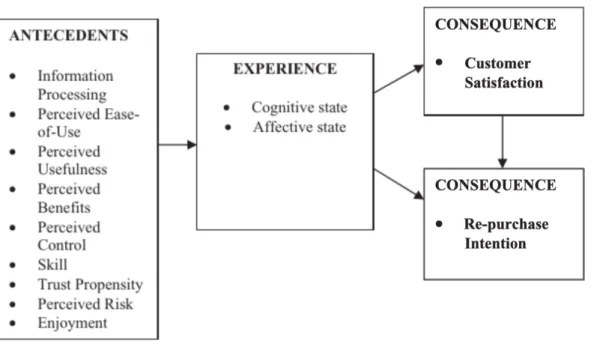
Moreover, for online shopping experience, some user experience aspects would be more important than then the others in comparison to offline. Susan Rose and others in their paper illustrate a conceptual framework of online customer experience, where we can see their proposed antecedents that influence the experience itself as well as the consequences of their influence (Figure 2).
Figure 2 Conceptual framework of online customer experience (Rose, Hair and Clark, 2011, p.29) This framework is focusing on the positive online customer experience and suggests that the ultimate consequences of that are customer satisfaction and further re-purchase intention using this specific retail channel. In general, this framework proposes that online-retailers need to keep in mind that functional features of the websites are not the only important thing for customer experience and that it is crucial to also understand the emotional and cognitive state of consumers during their online shopping (Rose, Hair and Clark, 2011). Looking into all aspects of user experience will help enhance the development of the website and increase overall experience.
The conceptual model of online customer experience was further expended in another work of Susan Rose and others, where they adapt the input-response-output framework and compose the model out of three types of variables: antecedent variables, online customer experience variables and outcome variables. This model makes several contributions to the previously existing models of customer experience. Firstly, it separates the variable into the ones that affect customer’s
16 cognitive state and those that influence the affective state, unlike the previous models. Secondly, it proves previously unidentified mediating effect of the “perceived control” variable by showing how three variables (ease-of-use, customization and connectedness) directly impact the perceived control levels. It is suggested that customization and connectedness empower the consumers and give them more confidence, while ease-of-use is making them feel in control even with the advances in technology. Moreover, this model provides new linkages between cognitive and affective experiential state and repurchase intention, mitigated by the levels of trust and satisfaction in online shopping (Rose, et al., 2012).
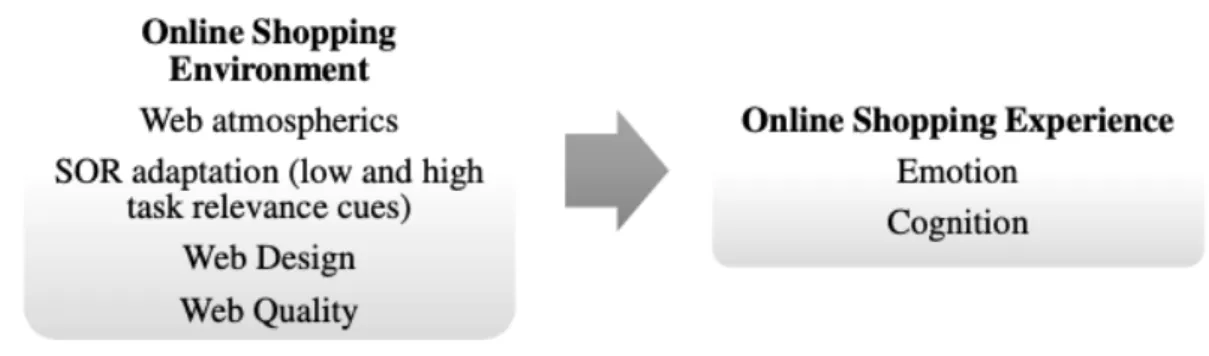
Another view on online shopping experience comes from its relation with online shopping environment that looks into how Stimulus-Organism-Response (SOR) model, Web design, Web quality and Web atmospherics affect experience (Figure 3). Emotion and cognition here are implied as critical part of experience, thus, the idea is to affect them (Kawaf and Tagg, 2017). This model, however, can be considered as prelude to the conceptual framework of online customer experience previously discussed (Rose, Hair and Clark, 2011).
Figure 3 The Environment and the Experience (Kawaf and Tagg, 2017, p.224)
Moreover, we would like to put an emphasis on the interconnection between customer’s experience and their satisfaction, which is especially important in the case of online shopping. One of the implications that has been made is that customer’s satisfaction goes beyond simple satisfaction with the product and that the channel experience has an impact on overall satisfaction.
Moreover, some researches also suggest considering the cumulative purchase experience over time in measuring satisfaction (Beaven and Scotti, 1990). Hye-Ran Kim in his paper on developing an index of online customer satisfaction also illustrates the relation between customer’s experience and their satisfaction. In his e-commerce customer satisfaction model, he uses a framework similar to the ones demonstrated before on customer experience (Figure 4).
17 Figure 4 The proposed e-commerce customer satisfaction model (Kim, 2005, p.55)
The outcomes of this satisfaction model are also similar and focus on repurchase intention and repurchase behavior, while the inputs, on which he builds his model are a bit more specified (like product information and attractiveness, site design, payment method, delivery and after sales service, etc.) than those used in the customer experience model (Kim, 2005). These inputs provide the basic model of online customer satisfaction and some are interconnected to the aspects of user experience that have been previously discussed.
Evaluating user experience
In many organizations, the whole responsibility concerning collecting and assessing the data on customer experience is placed in the hands of a single, IT-supported customer-facing group (Schwager and Meyer, 2007). This way is, of course, money saving as well as it protects the customer from redundant solicitations and provides the means of comparing customers on the basis of different parameters. However, Schwager and Meyer in their famous Harvard Business Review
18 paper emphasize the importance of a cross-functional approach in collecting customer experience in order to make the product more successful.
Moreover, the customer experience information patterns can be divided into three types: past patterns, present patterns and future patterns. The methods of data collection will also differ depending on the pattern. Past patterns capture a recent experience and are intended to improve transactional experiences, assess impact of new initiatives and identify emerging issues. This type of information pattern is meant to be collected persistently, most frequently through automatic web-based surveys after, for example, a new product purchase. Present patterns track current relationships and experience issues with an aim of identifying further opportunities. These are usually conducted periodically and with more critical population and issues. Lastly, potential patters target inquiries to unveil and test future opportunities. The process of data collection, in that case, is normally one-off and is driven by a special purpose (Schwager and Meyer, 2007).
One of the most commonly used tools for evaluating user experience is a survey. Questionnaires can be used for user-driven assessment of quality and usability of the product. But a well-designed survey should not only collect the desired information but also doesn’t jeopardies consumer’s experience by becoming an unfortunate aspect of it. So, in general, the surveys should be brief and not onerous as well as they should allow the respondents to express their thoughts (Schwager and Meyer, 2007). However, even though they can sometimes be used as a stand-alone method, the questionnaires usually need to be combined with other qualitative assessment methods in order to achieve reliable and interpretable results (Laugwitz, Held and Schrepp, 2008). So, surveys, of course, have their limitations and other methods, such as focus-groups, user-group forums, blogs, observational studies and others can often provide insights that the surveys can’t. However, surveys do provide an easier access to a bigger sample of respondents and can be made user- friendly and convenient to use.
Summary
This chapter covered the main theoretical aspects of user experience, pointed out several existing view on the user experience aspects, especially focusing on a very thorough list of user experience aspects, created by Schrepp and Held, due to its recentness and, therefore, better relevance.
Moreover, the importance of user experience aspects has been explained and exemplified.
Furthermore, several online customer experience models have been studied and the most appropriate ones for this research have been explained in detail, as well as a correlated model of e-commerce customer satisfaction, demonstrating the relationship between customer experience
19 and customer satisfaction. Thus, this chapter provided theoretical frameworks that would be further used in the development of the theoretical model for this study.
2. The evolution of the technology-enabled commerce phenomenon and specifics of consumers
The second theoretical chapter of this paper focuses on the specific area that is being studied – technology-enabled commerce. The purpose of this chapter is to particularize the term and to emphasize the evolution of this term over the years as well as to look into the researched factors that influence customers in during their online shopping.
The objectives of this chapter can be specified in such way:
• Provide the definition of e-tail and look into the different types of it;
• Define the similarities and differenced of electronic retail vs tradition retail;
• Look into the evolution of the technology-enabled commerce and examine the terms of e- commerce, m-commerce, s-commerce and etc.;
• Specify the main specifics of customers in e-tail;
• Study the existing researches on the factors affecting customers in online shopping.
Overview of the electronic retail and its specifics
Electronic retailing (e-tailing) is the sale of consumer goods and services through the internet. It can also be called as online retail, online shopping and so on. There are two main types of e-tailing, similar to traditional retail:
• Business-to-Consumer (B2C) e-tailing – the most widely spread and well-known type of electronic retail that implies companies selling finished product directly to consumers through their websites;
• Business-to-Business (B2B) e-tailing – involves companies selling to other companies. If talking about consumer goods, then this type of e-tail would mostly talk about wholesalers, selling the products in bulk to smaller B2C companies. (Investopedia, 2019).
Compared to physical stores, online stores can have several advantages, because they are convenient and save a lot of time and effort since you no longer need to travel to the store and wait in lines. They are open all the time, can be accessed from anywhere and provide detailed information on the products, as well as often offer competitive prices. There are several specific features of online shopping that can be emphasized:
• It is based on the concept of flexi time;
20
• It can be accessed from anywhere;
• One can evaluate many online shopping stores at a time;
• Comparison can be made in real time;
• There is provision of replacement of product if it is not as per the aspiration of the customer;
• Casual shopping (Agarwal, 2013).
Electronic retailing can include a broad spectrum of companies from different industries. However, there would still be some similarities among the successful companies – like a pleasantly made engaging website, efficient and convenient distribution network, good marketing strategy and so on.
There is existing research on how certain strategical resources can be crucial for e-commerce success. The most important ones are brand strength and supplier relations – those can be considered the main organizational resources that drive competitive advantage of e-tail (Danahler, 2003). It is easier for strong brands to lure online consumer to retail web sites so online retailers often benefit a lot from strong brands. Moreover, another obvious fact, influencing the e-commerce success is that e-tail companies should work very closely with their suppliers in order to ensure quick and accurate fulfillment of the orders (Korper, 2001). If online retailers want to deliver superior services they need to closely monitor the product availability, processing and transportation of the order and other logistic issues. Moreover, the study on “Drivers of International E-Tail Performance: The Complexities of Orientations and Resources” shows the importance of identifying those elements of organizational culture that better enhances the understanding of customers and markets that can strengthen the brands and the relationships with suppliers (Colton, Roth and Bearden, 2010). This study examined e-tailers from different countries and resulted in the reinforcement of the importance of specific orientation, because the orientation helps create resources and then further influence performance, thus, there are some resources that can be considered as critical mediator of the orientation-performance relationship. The antecedent nature of market and foreign market orientations to brand strength and supplier relations is further demonstrated by the authors (Colton, Roth and Bearden, 2010).
The evolution of technology-enabled commerce
When the commercialization of the Internet was just beginning and shopping online was only starting to become an existing trend, many retailers felt unease to develop their e-commerce presence. They’ve feared the cannibalization of their offline sales but had no choice due to the pressure within the retail industry. It soon became understandable that e-commerce websites bring
21 more of a strategic advantage than the threat and in order to stay competitive companies started to cave in, even the US retailer Sears that stayed reluctant to develop their e-tail website for quite a while (Ranganathan et al., 2004). We can see how now the things have changed comparing to when e-commerce was just starting to appear in the end of the 20th century - nowadays e-commerce is widely spread and even leaving the way for m-commerce and s-commerce to develop.
The evolution of e-commerce has many consequences for the market, both positive and negative.
Maris Goldmanis, Ali Hortaçsu and others investigated some of those consequences in their article on “E-commerce and the market structure of retail industries”. The authors went further than the advent and diffusions of e-commerce on prices that had already been researched and looked at how the growth of e-commerce affects the market structure and, specifically, the market shares.
They’ve concluded that there are shifts in market shares from low- to high-type businesses.
Meaning that, with the growth of online retail, the share of smaller firms started declining and larger companies were becoming more dominant. The article studied several industries, including travel agencies, car dealerships and bookstores, and found similarities in the market share relocation but noticed that it was often driven my different mechanisms. The industry-wide declines turned out to be more industry specific – for example, the travel agencies were mostly influenced by aggregate changes due to the airlines’ reduction in agent commission encouraged by the growing online ticket purchases (Goldmanis and Hortaçsu, 2010).
E-commerce is not standing in one place but continues to significantly develop – there are a lot of upcoming inventions that would soon be expected to change the way consumers shop – both in physical stores and online. Virtual reality (VR) and augmented reality (AR) can be mentioned as the examples of one of those futuristic trends that are to soon affect e-tail also. These inventions prove the rapid speed of development and the necessity of further research of current trends in e- tail in order to have a better foundation for the implementation of new inventions into the everyday life (Martínez-Navarro et al., 2019).
One of the main things that most e-business operators have to move on to is the m-business. Mobile commerce is a step forward from the regular e-commerce that makes the access to products even easier for consumers. M-commerce is the process of buying and paying for goods and services via mobile devices such as smartphones and tablets. Even though it was born out of e-commerce, m- commerce shouldn’t simply be regarded as an extension to its predecessor – m-commerce presents their own advantages and opportunities (Ritchie, 2015). However, on the rise of m-commerce, even though the firms realized the potential importance of having m-business as a strategy, many companies were still slow to optimize it and unsure of whether they have the capabilities for it.
22 Ester Swilley and others researched the pressure of isomorphic forces and existing e-business capabilities on the intention for m-business adaptation. They’ve came to an important finding that relationships, partnerships and alliances established during the implementation and continuation of e-commerce could have a significant impact on the company’s adaptation of m-commerce. In this case firm who have already developed a strong e-commerce platform would be capable to modify their capabilities for m-commerce (Swilley, Hofacker and Lamont, 2012). This can be one of the reasons to why nowadays most of the e-commerce websites have convenient and easy to use mobile versions of their websites and even mobile apps available for download. It can be related not only with the growing demand for digital convenience but also with the company’s experience and capabilities in platform development.
Thinking that the development of e-commerce can’t go any further after the m-commerce adaptation would be a serious misjudgment in the year 2020. As we are moving forwards, the trends are constantly changing and new technologies are evolving even faster and in today’s time social media platforms are playing a very important role - this is where the social commerce comes in. S-commerce encourages e-commerce businesses to start selling their products through social media as well – whether it’s Facebook or Instagram or something else. Selling products or services through these platforms can reach a wider audience and can be beneficial for both the business and the consumer (Agile Infoways, 2018).
Specifics of customers in e-tail and factors affecting them
After looking into the theoretical aspects of consumer behavior and the particularities of electronic retail as well as the worldwide trends for online commerce, it is logical to further study the online buying behavior of the consumers. Online shopping behavior is a process related to purchasing products or services via the Internet. This process is somewhat similar to the traditional shopping behavior and consist of five steps resembling those of traditional retailing. During the online shopping, when potential customers understand a need or desire for a certain product or service, they would go to the Internet and look for the information related to that need. They evaluate the alternatives and choose the one that is the most appropriate for the satisfaction of the mentioned need and meets all the criteria incurred by the consumer. After the choice has been made, the transaction is norm wise complete and then the post-sales services are provided (Li and Zhang, 2002).
There can be multiple factors affecting consumers decision-making process and their shopping experience and ultimately influencing purchasing decisions and decisions after sale. Many of those
23 factors in different environments have been studied by researchers over the years – the table below overviews a number of factors and whether they influence the consumer during their online shopping. The factors have been grouped into the several categories for easier classification and visibility and are provided in the Table 1.
Table 1 Researches on factors affecting the consumers in online shopping (created by the author)
Factor Affect Source
Experience
Past purchases Significant positive impact on the probability of purchase
Mallapragada, et al., 2016
Page views Positively associated with purchase probability – demonstrate interest and effort
Danaher, 2007;
Mallapragada, et al., 2016
Visit duration Positively associated with purchase probability – demonstrate interest and effort
Danaher, et al., 2006;
Mallapragada, et al., 2016
Website characteristics
Website scope Websites with broad scope (multiple product categories) have an increases likelihood of a purchase
Mallapragada, et al., 2016
Communication functionality
Negatively associated with the purchase likelihood Mallapragada, et al., 2016
Navigation functionality Negatively associated with the purchase likelihood Mallapragada, et al., 2016
Hedonic website features Positive influence on online shopping experience of general population
Bilgihan, 2016
Utilitarian website features
Positive influence on online shopping experience, especially with Gen Y customers
Bilgihan, 2016
Mobile app availability Important due to the widespread use of smartphones instead of PCs for shopping online
PwC, 2019
24 Table 1 Researches on factors affecting the consumers in online shopping (created by the author) (continued)
Factor Affect Source
Delivery
Speed of delivery Crucial for online retailers, has a significant influence on delivery experience
PwC, 2019
Specific time of delivery Is of importance to the customers, leading to high demand for pick-up points
PwC, 2019
Same day delivery The more frequently consumers use same day delivery when shopping online, the stronger the substitution effect is from local stores
Xi, Cao and Zhen, 2020
Risk
Product price risk Negative impact on product consumers’ trust ultimately influencing purchasing decisions
Pappas, 2016
Product quality risk Negative impact on product consumers’ trust ultimately influencing purchasing decisions
Pappas, 2016
Web-vendor quality risk Negative impact upon web-vendor consumer trust ultimately influencing purchasing decisions
Pappas, 2016
Web-vendor security risk Negative impact upon web-vendor consumer trust ultimately influencing purchasing decisions
Pappas, 2016
Web-vendor security risk Negative impact upon web-vendor consumer trust ultimately influencing purchasing decisions
Pappas, 2016
First group of factors that I would like to underline is related to overall experience points – both past and present. Girish Mallapragada and others in their research concluded that consumer’s past purchasing incidence matters. Past purchase incidence, has a significant positive impact on the probability of purchase, implying that consumers who purchased more frequently in the past, all else being equal, have a greater likelihood of purchase in a given session. Moreover, they’ve positively associated page views and visit duration with purchase probability (Mallapragada, et al., 2016). This shows consistency with previous existent research that has conceptualized page views and visit durations as interest and effort of the consumer (Danaher, 2007; Danaher, et al., 2006).
Hence, the more pages consumers scroll through and the more time they spend on the website – the bigger the purchase probability.
Another important point to consider when considering consumer’s shopping experience are the website characteristics and the was a positive effect of the website scope – meaning that the website
25 with broad scope of products had higher purchase likelihood (Mallapragada, et al., 2016). So, the flexibility of the website that allows people to choose from different product categories positively influences purchasing intentions. PwC’s research on Russian consumers also concluded that “good assortment” is one of the key elements of a successful online shopping experience that 67% of the respondents found important (PwC, 2019).
However, the website functions related to communication and navigation, that were created in order to help consumers and make their experience easier, are, in reality, doing the contrary. The research shows that communication functionality and navigation functionality of the website are negatively associated with purchase likelihood (Mallapragada, et al., 2016). People often perceive them as irrelevant and unnecessary and feel like those features are interfering with their shopping process.
Other interesting factors that have been studied by Anil Bilgihan are the effect of hedonic and utilitarian features on shopping experience. He mainly looked into the effects on Generation Y but considered other generations as well. The results of his study suggested that hedonic features of the website can have positive influence on customer’s experience. A well-designed website with a creative and distinctive layout was said to be able to attract more Gen Y customers and encourage them to return to the website. While a website with a poor design can prevent customers from returning (Park, et al., 2007). Moreover, the important hedonic features include things like color combinations, background images, font size and type, animations and other points contributing to website’s visual attractiveness (Mandel and Johnson, 2002; Park et al., 2007). While the hedonic features have been found to be more important for general population, for Gen Y the utilitarian features have been shown to have a higher impact on positive experiences. Therefore, in order to attract customers websites should be designed with utilitarian features in mind, focusing on usefulness and value (Bilgihan, 2016).
Another website characteristic that, in my opinion, is important to add is the availability of the mobile application for online shopping. PwC’s Global Consumer Insights Survey 2019 showed that consumers shop on smartphones more than on PCs and even though the difference is relatively small for now, we can still see the growing trends towards mobile (Figure 5) (PwC, 2019). Since not only the time we spend on our phones is increasing but also the number of things for which we can use them, it is very important for companies to carefully consider the mobile users of their website. If 20 years ago we only used our phones for making calls, now people want to have convenient access to whatever they may want within their finger reach, so mobile applications are becoming increasingly more important and, for example, mobile users in the US were said to be
26 spending 87% of their time in apps versus just 13% on the web in 2017 already and now this percentage may have even increased (Comscore, 2017).
Figure 5 Consumer’s shopping channels for buying products) (PwC, 2019, p. 5)
Another factor that plays an important role in consumer’s perception of online shopping process and purchasing probability is the delivery. For Russian consumers in 2018, fast and reliable delivery was the second most important element after better prices – 71% said that convenient delivery would significantly improve their shopping experience with online retailers (PwC, 2019).
Not only the speed of delivery is important but also the specific time delivery and that consumer need had already led to the widespread of pick up points in Russia. Consumers are often even willing to pay more for the delivery with the specific time frame of 1-2 hours. Another point that can be considered when speaking of delivery is the growing popularity of same day delivery.
Guangliang Xi and others researched the impacts of same day delivery on local stores in China and came to conclusion that the more people use same day delivery the stronger the substitution effect is. So, same day delivery encourages people to move from offline shopping in local stores to online shopping (Xi, Cao and Zhen, 2020).
Another group of factors that is maybe not as visible as the previously mentioned ones is risk.
There is undoubtedly a higher perceived risk for online consumers in comparisons to those shopping in offline stores. There are three main reasons behind it: firstly, they consumer cannot examine the product before they receive it; secondly, they are concerned about the after-sales service and, thirdly, they may not fully understand the language used in e-sales (Hong and Yi, 2012). There are different types of risk affecting purchasing decisions and Nikolaos Pappas in his research divided them into product risk and web-vendor risk. He concluded that both product price
27 risk and product quality risk negatively affect the purchasing decisions through influencing consumers’ trust. The same conclusion has been made related to the web-vendor quality risk and web-vendor security risk (Pappas, 2016). If consumers don’t trust the web-vendors and have doubts on whether the quality of their products would be good enough and whether it is actually safe to make purchases thought these vendors – it would lead to the lower purchase probability.
Another interesting controversial point I would like to mention is the effect of social influence on online product ratings and whether the reviews are as trustworthy as they seem. There have been researches stating that users are affected by the reviews of others and that the reviewers decrease their product ratings after seeing other’s online ratings (Schlosser, 2005). In some other cases, there has been evidence of both – decreasing and increasing their personal rating after seeing previous reviews (Moe and Trusov, 2011). These points have been supported by the findings that there’s substantially large social influence effect on online product rating – social influence was shown to decrease the marginal effect of regular positive features by 84% (Shridhar, et al., 2012).
So, considering that the social influence effects can sometimes be large enough to alter real marketing phenomena. Further research on prevalence of social influence in online contexts should be conducted, especially with the growth of social media influencers. It can be assumed that users’
online product ratings can be influenced by them, both positively or negatively.
While these are some of the factors and website characteristics that can influence consumers’
shopping experience, that have been chosen after thorough literature review, many areas haven’t been sufficiently covered by existing researches or haven’t been touched at all. This leaves significant potential for further research on the influencers on customer experience when shopping online and brings the inspiration for the model developed in this paper.
Summary
This chapter studied the phenomenon of e-tail with its description and specific characteristics and investigated how e-commerce has been developing recently and moving forward to m-commerce and s-commerce, while trying to make certain predictions for future changes and growth.
Moreover, this chapter covered multiple factors and characteristics from existing researches on factors influencing consumers’ experience during their online shopping. Thus, this chapter emphasized the importance of technology-enabled commerce through its evolution and gave the understanding on which factors, influencing online customers’ experience, haven’t been sufficiently research, so that this research can focus more precisely on them.