Determinants of joint supplier-retailer project performance in category management field // GSOM Emerging Markets Conference 2014. Recent legal and regulatory developments in Slotting Grants and category management // Journal of Public Policy and Marketing. The Impact of Category Management on Retailer Pricing and Performance: Theory and Evidence // Journal of Marketing.
The use of category management practices to achieve a sustainable competitive advantage in the fast moving consumer goods industry // Journal of Business and Industrial Marketing. Determinants and outcomes of plan objectivity and implementation in category management relationships // Journal of Retailing. Changing category management relationships in the UK and Australian food distribution channels // Management Decision.
Supporting the Category Management Challenge: How Research Can Contribute // International Journal of Market Research. An analysis of supplier roles in category management collaboration // Journal of Retail and Consumer Services. Joint optimization of product pricing, display orientation and shelf space allocation in retail category management // Journal of Retailing.
Incorporating third parties into existing dyads: An exploratory study of category management programs (CMPs). Using category management practices to gain sustainable competitive advantage in the consumer goods industry.
Determinants of joint supplier-retailer project performance in category management field
Introduction and main purpose of the research
Category Management (CM) is one of the key tools of Efficient Consumer Response (ECR) concept and is now widely used by many suppliers and retailers around the world (Dussart, 1998; Desrochers et al., 2003; Basuroy et al. 2001; Gajanan et al., 2007; Kurtuluş, Toktay, 2011). There is a lot of literature on category management strategies, in-store marketing activities, all kinds of category management techniques (Cortiñas et al., 2008; Hübner, Kuhn, 2012) and consequences of CM implementation (Desrochers et al., 2003; Kurtuluş, Nakkas, 2011; Kurtuluş et al. al., 2014). However, the gap in research still exists as a lack of systematic research on key factors that influence CM projects' performance and the ways of supplier-retailer relationship management that lead to successful CM implementation.
Existing studies in this field have quite controversial results and are mainly based on emerging market data (Gruen, Shah, 2000; Gooner et al., 2011), while emerging markets undoubtedly have specific characteristics of the development of sales chains. retail. First, retail chains continue to grow in Russia, and competition among major retailers will be even "hotter" as opportunities for extensive growth such as regional development are almost exhausted. In this situation, category management should be seen by retailers as a tool for customer attraction and market diversification.
Since the key idea of category management is to "produce improved business results by focusing on delivering better consumer value" (AC Nielsen 2006; Dupre, Gruen, 2004), these tools can be used more effectively in the context of category management when retailer and manufacturer join their marketing opportunities. Retail chains in the 2000s grew rapidly and became the largest companies in the FMCG sector, significantly larger than most manufacturers; so market power shifted from suppliers to retailers (Spector, 2005). Radaev the specific features and strength of relational conflicts in Russian retail discussed in detail (Radaev.
Considering all of the above, in this context of increasing market competition, the effective implementation of category management practices can be used to gain a sustainable competitive advantage for both the retailer and the manufacturer (Dupre, Gruen, 2004; Pepe et al., 2012). However, failed category management projects can have negative consequences for supplier-retailer relationships, as they can damage trust between partners. Therefore, when using CM to achieve a sustainable competitive advantage for both sides of the collaboration, partners must remember the negative consequences of failed projects and be clearly aware of what can harm or support the success of the project.
Thus, the main objective of our research is to define factors that can influence the performance of category management projects in a negative or positive way and try to analyze how they can be eliminated (if possible) in the supplier-retailer relationship.
Theoretical Background
A special form of category management is category captaincy, where the retailer chooses one of the manufacturers in the category for close cooperation to manage the category. This manufacturer is called a category captain and provided access to the retailer's entire sales and marketing data. Based on this data and his own market expertise, the captain provides retailers with a category plan with recommendations on shelf space management, pricing, product assortment, promotions and consumer navigation across categories.
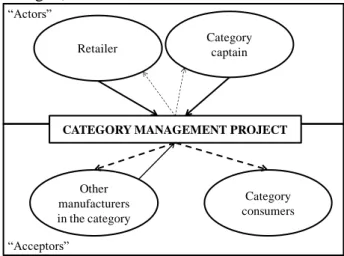
The interactions between the retailer and the captain are governed by category captain arrangement which usually outlines the responsibilities and rights of the parties, projects timing, resources and objectives (Bandyopadhyay et al., 2009). This type of supplier-retailer collaboration in category management field is the most common practice nowadays (Kurtuluş, Toktay, 2011; Kurtuluş, Nakkas, 2011; Kurtuluş et al., 2014). Considering all the above, the stakeholders of category management process can be defined (see Fig. 2).
The first group consists of 'actors' who directly initiate and lead the project, and anticipate and (to some extent) control the objectives and consequences of the project: the retailer and the captain. The second group are influenced 'acceptors' who are influenced by the project; they cannot directly influence its implementation. While other players in the category can at least partially participate in the category management project and thus influence it, consumers can typically only observe the final stages of the project and cannot influence the CM process.
Therefore, we hypothesize that the three stakeholders that can influence the implementation and performance of CM projects are the captain, the retailer, and other manufacturers in the category.
Factors, influence CM project performance
For most of the determinants of CM project performance, the relative conceptual categories can be found in relationship marketing theory. For example, one of the best elaborated categories in relationship marketing 'opportunism' in CM projects can be associated with the category captain opportunistic behavior, objectivity in the category plan (the plan should be aimed at improving the performance of the whole category and the captain should not take advantage of of the). The impact of "communication quality and data sharing" on the effectiveness of relationships is also well-studied, but it has not yet been reflected in research on relationships in the field of category management.
We assume that this should be added to the performance analysis of CM projects, because inefficient data exchange due to industrial exports is mentioned as one of the main obstacles to the development of CM in Russia (according to material from the ECR Russia Conference 2012) . There are also some factors that influence the implementation and performance of category management projects, which cannot be directly referred to any of the major categories of relationship marketing. We hypothesize that these factors reflect the specificity of the category management process as a supplier-retailer collaboration.
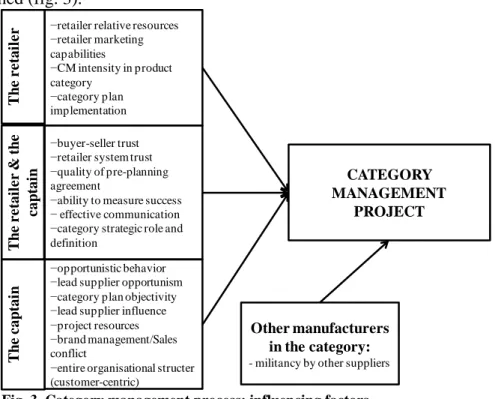
As previously mentioned, three main stakeholders can influence the implementation and success of a category management project – the retailer, the master and, to a lesser extent, other suppliers in the category. We associate each of the identified factors with the stakeholders who assign it or can moderate it. Based on this consistency, a two-level model of implementation and performance of category management projects was established (Figure 3).
The first level of analysis represents the stakeholders of the category management project, while the second level includes the determinants defined and/or controlled by this stakeholder.
Findings and further research developments
This two-tiered approach allows us to structure the data collection process, which includes an interview with industry experts by each stakeholder. It is also used to adapt the model to the context of emerging markets based on the collected data, as sets of second-level factors will be determined for each first-level variable.
Так, 1 октября 2014 года завершился этап монтажа и пуско-наладки оборудования на территории Тибожской обувной фабрики, которая вскоре откроется в Красном Селе. Например, по данным компании «Обувь России», в среднем цены на импортную обувь в сезоне весна-лето 2016 вырастут на 20-25%, а на обувь российского производства - до 10%7. Так, в Москве для организаций со штатом более 100 сотрудников установлена квота на прием на работу инвалидов и молодежи в размере 4% от общей численности работающих (инвалидов - не менее 2%)17.
В рамках проекта «Пара за пару» на платформе сбора бумстартер планируется реализовать 1000 пар обуви, что даст фабрике производственную партию в 2000 пар (по принципу «пара за пару»).
Анализ внешней и внутренней среды. SWOT анализ для компании
Модель маркетингового предложения фирмы
- Price – ценообразо-
- Place – дистрибуция,
- Promoti
Интересная возможность ценообразования на продукты социальных предприятий может заключаться в том, что цена продукта определяется непосредственно потребителем (принцип «плати сколько хочешь»).