The main objective of the current research is to identify the most important factors for employee engagement in relation to the generational cohort he/she belongs to. The survey results provide information that engagement factors are different for each generational cohort. Therefore, the aim of the current research will be to identify what are the differences between factors that influence the degree of commitment in the context of generational differences.
THEORETICAL BACKGROUND OF THE STUDY
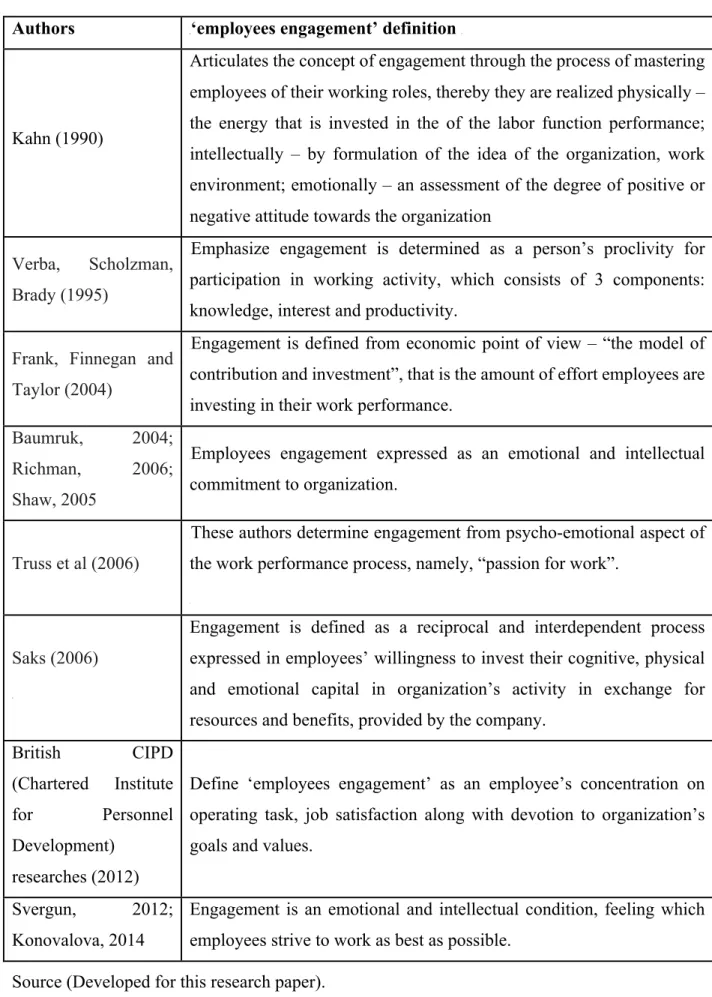
Theoretical approach to engagement definition in previous researches
- Theoretical models which are alternative to «employee engagement»
- JD-R model
- Utrecht work engagement scale
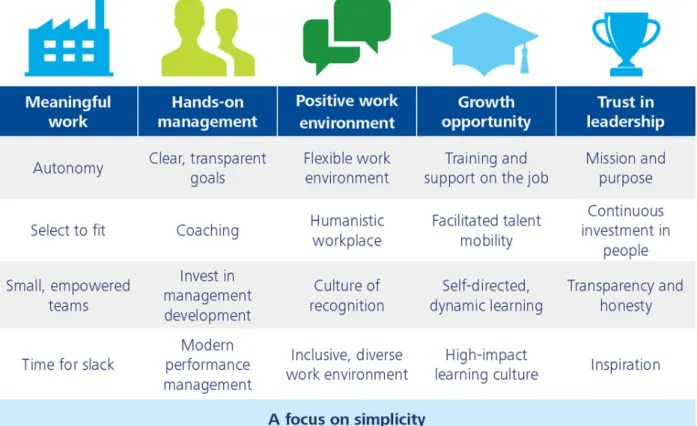
- A new approach to engagement. Five driving elements of engagement by Bersin
The main purpose of this chapter is to come up with the general overview of the literature and research done in this field and to have a complete understanding of engagement and generational concepts. In general, the results of the conducted studies show that commitment to organization and involvement in work can be combined in the involvement concept. The structure of the scale is as follows: there are several statements (about 5-6 each in UWES-17) that each employee must rate according to his/her preference.
Generational cohorts’ differences
- Main generational cohorts identified by previous researches
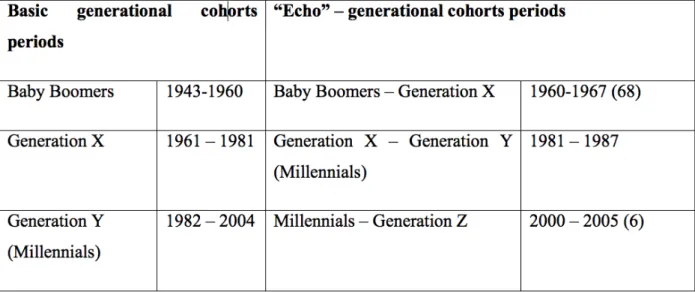
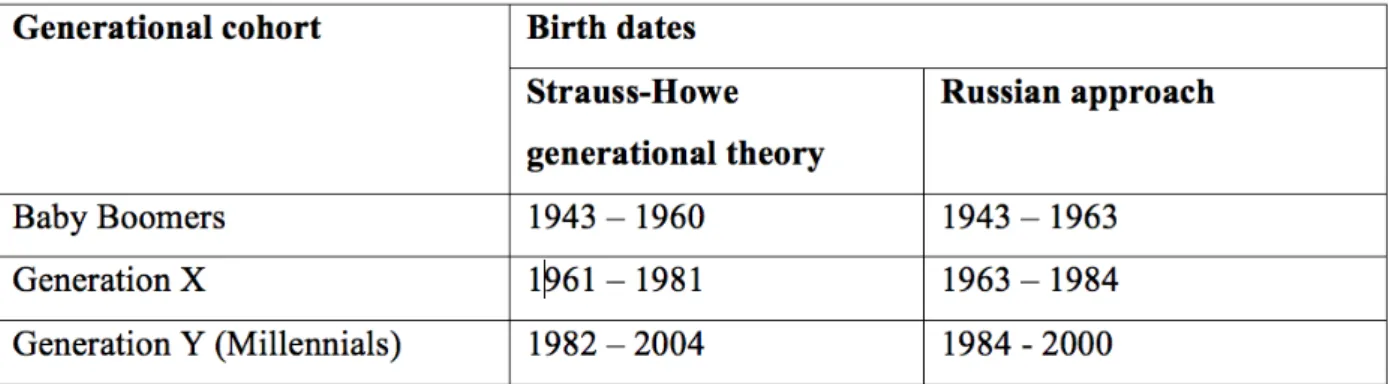
- Baby Boomers (born 1946 – 1964 (or 1943 – 1960))
- Generation X (born 1965 – 1980 (or 1961 – 1981))
- Millennials (or Generation Y) (born 1981 – 2000 (or 1982 – 2004))
- Generational differences in workplace
- Generational cohorts in Russia
They grew up in economic buoyancy after World War II and underwent several major economic and political changes in history, such as the civil rights movement, Watergate, the Vietnam War, etc. (Twenge et al., 2010; Dries et al., 2008). Boomers are generally more labor intensive and work is a more important part of their lives compared to their offspring (Twenge et al., 2010; Meriac et al., 2010; Smola and Sutton, 2002). People of this generation are recognized as loyal and dedicated to their company in return for comparable pay because they believe that hard work should be done fairly (Smola and Sutton, 2002; Gursoy et al., 2008; Patterson and Pegg, 2009) .
This generation group is a dominant generation after the retirement of the Boomers and they were growing up facing various cardinal political changes such as the end of the Cold War as well as economic downturns (late 1970s - early 1980s); unemployment and families move due to economic instability (Twenge et al., 2010). However, the study by Highhouse et al. provides an information that the ethics of this generation is constantly declining compared to previous generations (Highhouse et al., 2010). They have always been given the opportunity to make their own choices and taught to doubt their credibility (Nobel et al., 2009).
Compared to Generation X, they were the first generation to use computers and the Internet throughout their childhood and for the time being (technology) occupies a significant part of their lives. The emergence of interactive media such as social networks, instant messaging, blogs, multiplayer games led to the development of new skills and collaborative styles in generations X and Y to be enough to make them different (Kim et al., 2009) . The main results of the Russian research approach to generational periodization are shown in Table 2.
80% of organizations feel that their employees are overloaded with work, but only 8% of them have programs to solve this problem (Hodson T. et al., 2014).
METHODOLOGY
- Description of methodological research process
- Case study selection
- Heineken company’s background
- Heineken company’s rewarding system
- Data collection
- Time horizons
- Evaluation criteria and viability
- Limitation of the study
The case study is applicable in the real context, and the main aim is to apply the distinctiveness of each case to gain an understanding of the complex problem in general. Therefore, one of the first and important issues for the company is to set clear goals and improve them more often than once a year. The next big step in the history of the company was in 1873 when the company's name changed to Heineken's Bierbrouwerij Maatschappij.
One of the significant events took place in 1939, when the company was listed on the Dutch stock exchange for the first time. Another notable event was Heineken's acquisition of Amstel, one of the most significant rivals in the Netherlands. As it was proved before the one case study, research could be considered as a research method and the results will be explained in the empirical part of the current research which also covers contextual conditions (Yin, 2004).
This research method provides a lot of additional information that will be helpful in the further steps of the study. As it is a source of collecting primary data directly from the key representatives of the research, it is necessary to ensure that several important questions are addressed. The Heineken company consists of a large number of representatives of the main generational cohorts: Generation X and Millennials.
There are not many representatives of this generation group in the company, as many of them suffered during World War II; The researcher will be involved in the research as an active participant in the research. Limitations are an important part of the research analysis, so it is necessary to explain them.
EMPIRICAL STUDY
Results of the research
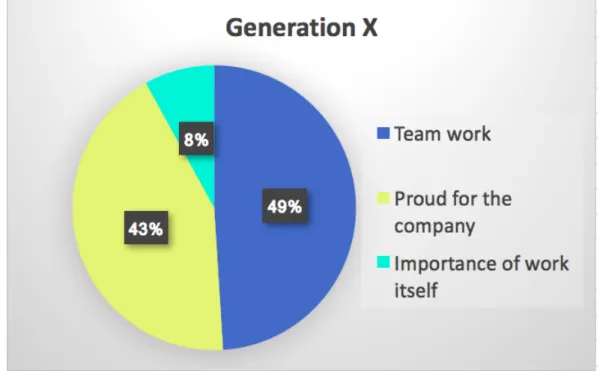
The primary advantage of this type of survey is that it is flexible and can be changed, without losing the direction of the survey (Matthews and Ross, 2010). The initial part of the survey consisted of questions regarding the assessment of the following three options according to the employees' personal preferences (see Appendix 1). Despite the fact that Generation X representatives are really devoted to the company and their pride in the company is high enough (43% is 13 people out of 30 respondents), there are more percentages (almost half of the sample – 49%) of the respondents prefer working in teams to show more significant work performance.
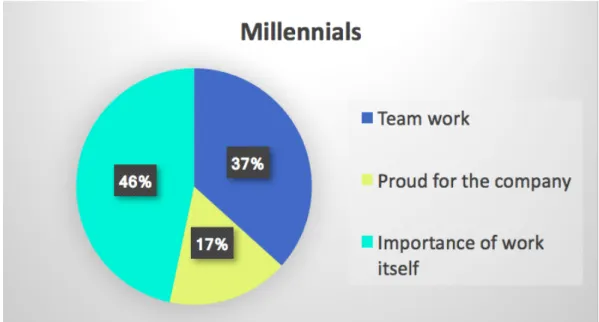
According to the Millennial respondents, they really tend to prefer and chose the importance of work rather than just being proud of the company they work in (46% are 14 people versus 17% - 5 people). In second place, according to personal preference is teamwork people). Results from this part of the questionnaire became a complementary element that helped to understand the preferences of the respondents. Nevertheless, there is still one of the most important factors mentioned by both cohorts during the interviews with the representatives as well as it can be notices from Figure 6, is working in teams.
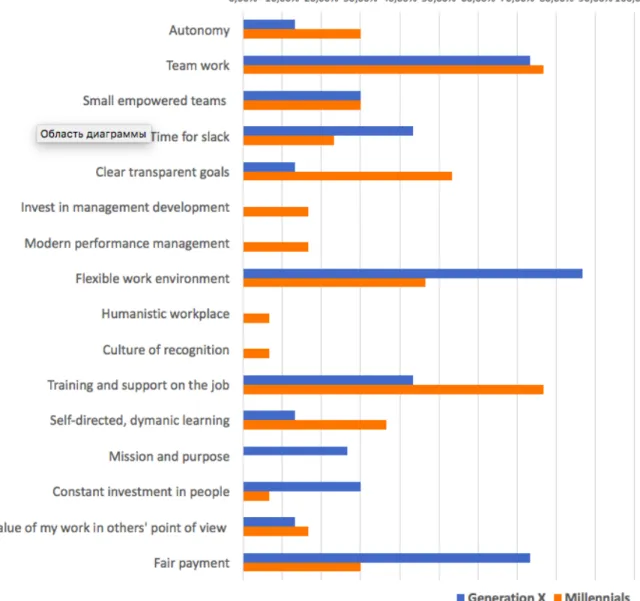
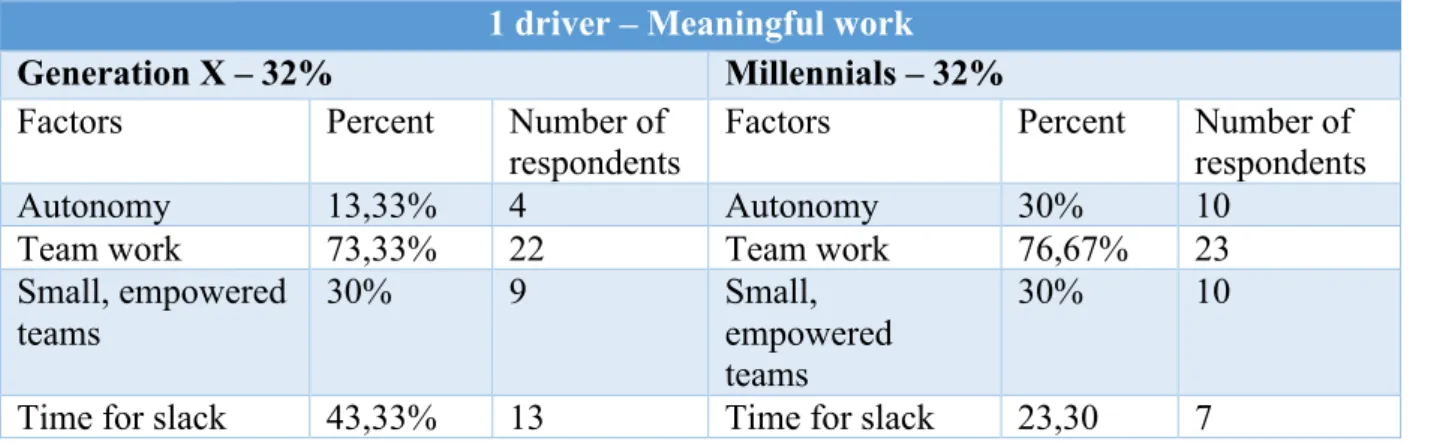
As it is clear from the figure 3 Generation X people desire to have a clear understanding of the goals they are going to achieve and also to have a whole visualization of the work process and its final destinations. Meanwhile, it is still very important for the Millennials to have clear transparent goals instead of having a visualization of the entire work process and its results. This means that the meaning of the work is important for both generational cohorts in equal portions, nevertheless there are differences between preferences of representatives of the cohorts among the factors that make up this driver.
As can be seen from the results of the questionnaire, representatives of Generation X pay more attention to the organization's mission and goals compared to millennials.
Discussions
As it can be seen from the Table 10, the results of the questionnaire provided some significances between factors that each generational cohort prefers more. Trainings are important for Millennials, as many of them have just started down their career path and they prefer some developments that will help them grow professionally. Therefore, the first difference can be mentioned in the fact that Millennials' preference in autonomy is twice more than Generation X's respondents.
This is reasonable because, as mentioned in Chapter 1, millennials tend to be more freedom-loving people compared to their older peers. Another key difference is that Millennials need reading time to rest than Xers, which is why the results show the latter would rather have more time for slack, while Millennials are ready to work harder at the time the study was conducted. Recognition culture is also very important, especially for millennials, as the youngest representatives of this generational cohort have just entered the company and want to be recognized for their achievements, which in turn could help them in rapid development on a professional path.
As mentioned before, millennials have been taught to be free in the decision-making process since their childhood, therefore they prefer to have self-directed and dynamic learning more than their peers from another generational group. According to the fair pay factor, it is worth noting that Millennials are not refusing to have a fair salary based on their results and productivity, but for now they are willing to sacrifice that return of professional development and career advancement. Also, since this study was provided in the Heineken company, there is already a financial reward system in place, which may be the reason why the new employees paid less attention to this factor and did not choose it as one of the main factors for increasing their commitment. .
The next chapter will provide some recommendations on how to use the achieved results and outcomes to increase the engagement rate of staff based on the knowledge of the generational cohort they belong to.
CONCLUSIONS AND IMPLICATIONS
- Conclusions
- Theoretical contribution
- Managerial implication
- Recommendations for future researches and limitations
To summarize, as the results of the literature review indicated the existence of a research gap for further development at the intersection of the two scientific fields that are employee engagement and generational group differences, the research gap for this investigation has been found. This can be mentioned as an innovation in scientific terms, as previously conducted research did not have results in the Russian market. The implementation of such a systematic approach in the company will help improve the level of employee engagement and as a sequence of satisfied personnel the performance of the entire organization will increase.
This can be seen as a great opportunity for further research to create a consolidated framework that can help identify main factors. Another significant limitation is that the research excluded Generation Z as respondents because due to their age there are still no representatives of this generational cohort in the companies (the oldest are only 17 which means that they are not involved in the work process of the company ). Heintzman R, Marson B (2006), People, Service and Trust: Links in the Public Sector Service Value Chain, Canadian Government Management. www.hrma-agrh.gc.ca/veo-be/publications/atricle_e.asp.
Compensatory control in the regulation of human performance under stress and high workload: A cognitive-energetic framework. Macey WH, Schneider B., (2008), ʹThe meaning of employee engagementʹ, Industrial and Organizational Psychology, 1, pp. enhancing performance through employee involvement. The psychological conditions of meaningfulness, safety and availability and the involvement of the human spirit at work.
Bridging the generation gap in the workplace, Traditionalists, Baby Boomers, Gen X, Gen Y (and Gen Z) working together.
Preliminary survey
Questionnaire