Global talent mobility is becoming a hot issue due to knowledge-oriented economic development around the world. This article aims to discover what are the trends in global talent mobility in Chinese multinationals, what are the repulsion factors that lead to talent loss, and what are the attraction factors that draw overseas talents back to Chinese multinationals. This dissertation aims to find out which factors influence global talent mobility in Chinese multinationals and what are the current trends in global talent mobility in Chinese multinationals.
In the first chapter, we discussed that global talent mobility is the mobility of highly qualified individuals, which is different from labor migration (migration of both highly and low-skilled workers). Sari Pekkala Kerr, William Kerr, Çağlar Özden, Christopher Parsons, 2015) Highly skilled immigrants are more likely to move to developed countries, and “brain drain, brain acquisition and brain circulation” are three phenomena of global talent mobility. In addition, we researched that the popular repulsion and attraction factors discussed by relevant research on China's global talent mobility in recent years are as follows: “living conditions, compensation, work environments, opportunity for advancement, globalization”; and "state economic development, state policies, investment in research and development."
Global Talent Mobility
Global Talent Mobility
- Definition of “Talent” and “Global Talent Mobility”
- Trends of global talent mobility in the world
- Phenomenons of global talent mobility
T1: “The amount of talent loss is greater than the amount of overseas talents acquired in Chinese. T2: "The amount of male talent loss is greater than the amount of female talent loss in Chinese multinational companies." First trend (T1) is "The amount of brain drain is greater than the amount of overseas talent acquisition in Chinese multinational companies.", the second trend (T2) is "The male employees are more likely to resign from Chinese MNCs and get jobs. in the foreign rather than female employees.", and T3 refers to "The married employees are more likely to resign.
The trend of "the number of lost talents is greater than the number of attracted foreign talents in Chinese multinational enterprises" supports the fact that among all the influencing factors, the repulsive factors dominate. Ma Jianmin, Zhang Zaixu, Si Jiangwei, “Investigation and Analysis of the Current Situation of Enterprises.
Theories of analyzing influential factors of global talent mobility
Global Talent Mobility in Emerging Markets
Influential Factors of global talent mobility
- Repulsion factors of lossing talents from emerging markets
- Attraction factors of attracting talents back to emerging markets…
Repulsive factors causing loss of talent in emerging markets. The lack of scientific and technological talent in the developed countries. In the developing countries, leaders of governments and enterprises and institutions tend to appreciate the actual economic benefits, put most of their attention on investment and construction, while ignoring the most important object----scientific and technological talents in science and technology innovation talents create great productivity. A large number of people can not find their right place in developing countries after graduating from college graduates with non-learning phenomenon is very common, so they.
Between 1980 and 1989, there were 14,882 students who returned to Taiwan from abroad, while the number increased from 30,198 in that year, accounting for 44% and 55% of the number of postgraduates and doctoral students who graduated from the institutions of higher education in Taiwan respectively during the same period (Shi Zhilei, 2011). From the history of the world economy, we can see that several times the flow of factors in the situation, we can find that human capital is always in line with the physical capital flow direction (Pol Antras, 2009).
Relevant researches about global talent mobility in China
The factors influencing on global talent mobility in China
- Repulsion factors causing talents loss from China
- Attraction factors attracting talents back to China
Most empirical research on the influencing factors of talent mobility only analyzes negative (repulsion) or positive (attraction) factors that influence global talent mobility (FK Afridi, W Afridi, 2016). Wei Lin and Xiangqian Zhang (2013) argued in their research that the lack of promotion opportunities is one of the factors affecting the outflow of highly skilled workers from Chinese multinational companies to foreign countries. Wei Lin and Xiangqian Zhang (2013) confirmed that flexible working has a negative or forced impact on talent mobility in China.
In the end, he emphasized that poor living conditions are one of the key reasons for the brain drain in China. In recent years, environmental migration has become a popular topic of discussion among researchers due to the worsening air pollution in China. One of the special living conditions in China is the climate, fog and mist.
Economic globalization has deepened the degree of interdependence and mutual penetration of the world's countries. Most studies on global talent mobility emphasized the importance of R&D investment during the brain circulation process in China. (Hao Yanli, 2017; Gao Ziping, 2012) Generally, the influential R&D factors include government investment and Chinese companies' own costs. . Gao Ziping (2012) argued that R&D investment is one of the main reasons for global talent mobility. For example, R&D investment in the EU has declined in recent years, causing talent from the EU and other developed countries to move to the United States. Zippen, 2012).
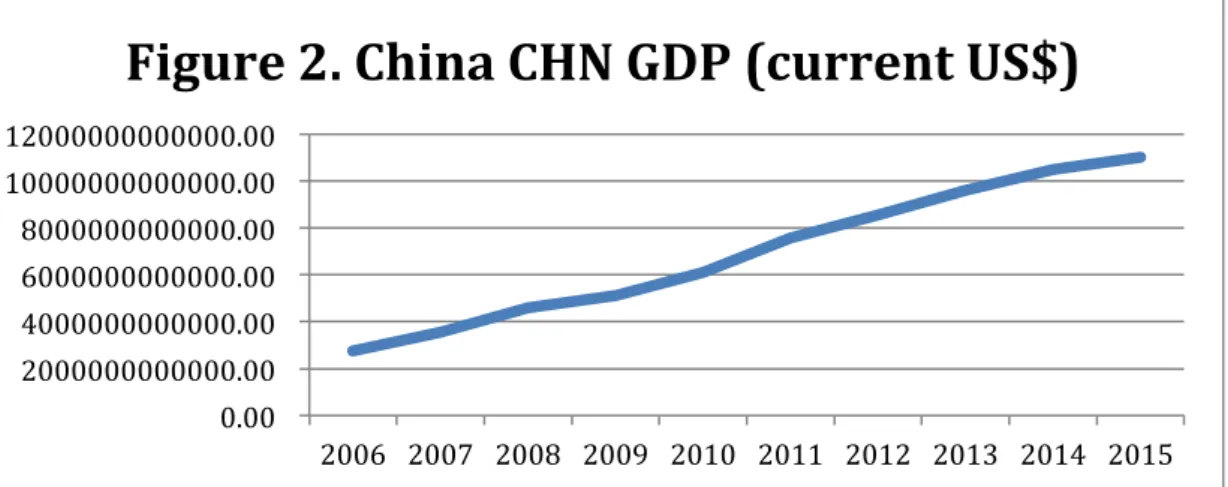
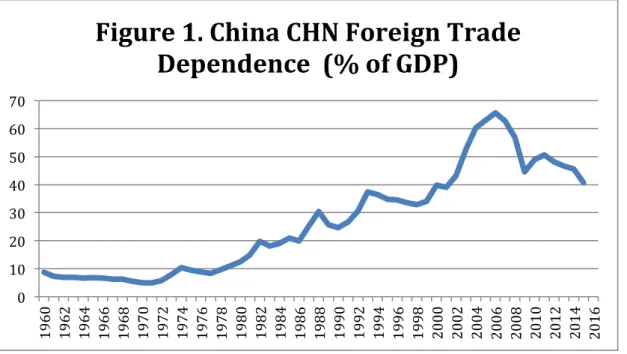
Most researchers pointed out that economic development is the most important reason to attract overseas talent to developing countries. China's economic development in recent years is steady, and China's GDP is growing at a higher rate than most other countries in the world, especially after the economic depression of 2008. Source: International Talent Mobility Research in China under economic globalization (3) State policies for talent attraction.
Research gap and research questions
Talents will enjoy its preferential policies in terms of exit and entry, residence, medical care, insurance, housing, taxes, wages, 1 million RMB individual subsidies and 3-5 million RMB research subsidies in basic scientific research (Zheng Yan, 2013 ). In addition, in late 2012 China issued a "permanent residence for foreigners in China to enjoy the relevant treatment approach", which highlighted the specific rights and obligations that "card holders" can enjoy "green" of China for foreigners.
Framework
Using the one sample t-test to find out which factors lead to talent loss (rejection factors), which factors attract overseas talent back to Chinese MNCs (attraction factors), which factors are insignificant influential factors.
Empirical analysis
Empirical object selection
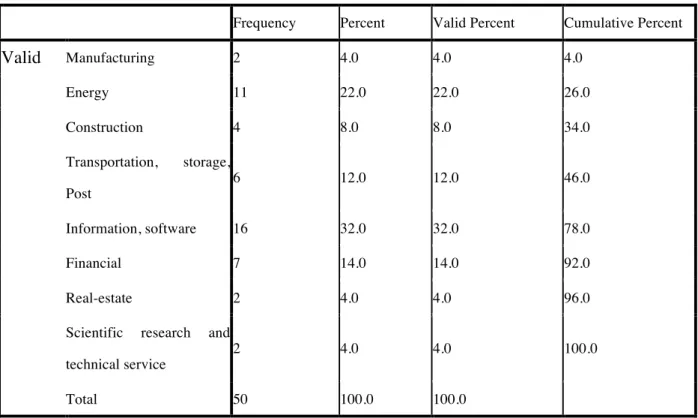
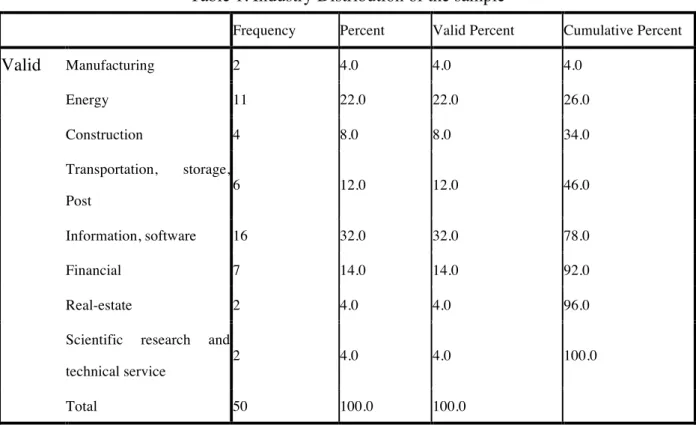
In the sample, 32% of recruiters were from information companies, software companies, 22% of recruiters from energy companies, 14% from financial companies, 12% from transport, storage, post-industry, 8% from the construction industry, 4% from production. industry, 4% from the real estate industry, and 4% of HR professionals were from scientific research and technical services companies.
Research design (methods)
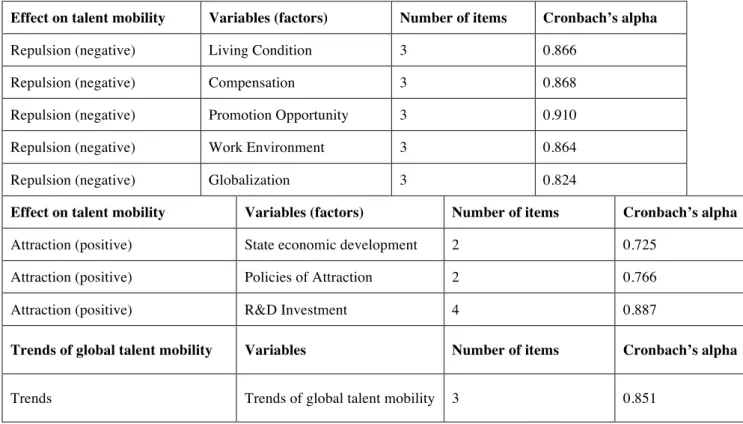
Five factors are designed in this block, they are “compensation factors”, “promotion factors”, “working environment factors” and “living conditions factors” and. globalization”, which can lead to talent loss from Chinese multinational companies abroad. Therefore, in this block there will be 12 statements which must be scored by the respondents. Three factors are designed in this block, they are "state economic development", "relevant policies that attract talents" and "R&D investment" which can attract overseas talents back to Chinese multinational enterprises.
Therefore, in this block there will be 8 statements, which must be marked by the respondents. The first is "The amount of talent loss is greater than the amount of foreign talent attraction in Chinese multinationals." ”, the last one is “Talented married employees are more likely to resign from our company and find work in foreign countries than talented unmarried employees”. For data analysis we took inspiration from the article of "An Analysis of Factors Preventing and Reversing the Brain Drain Phenomenon in Khyber Pakhtunkhuwa: Evidence from the Education Sector" (FK Afridi, W Afridi, 2016), the article "Factors that promote "Brain Drain in Pakistan: An Exploratory Look" (Muhammad et al, 2012), and the article "Accounting Brain Drain" (Ryan Pengelly et al, 2008).
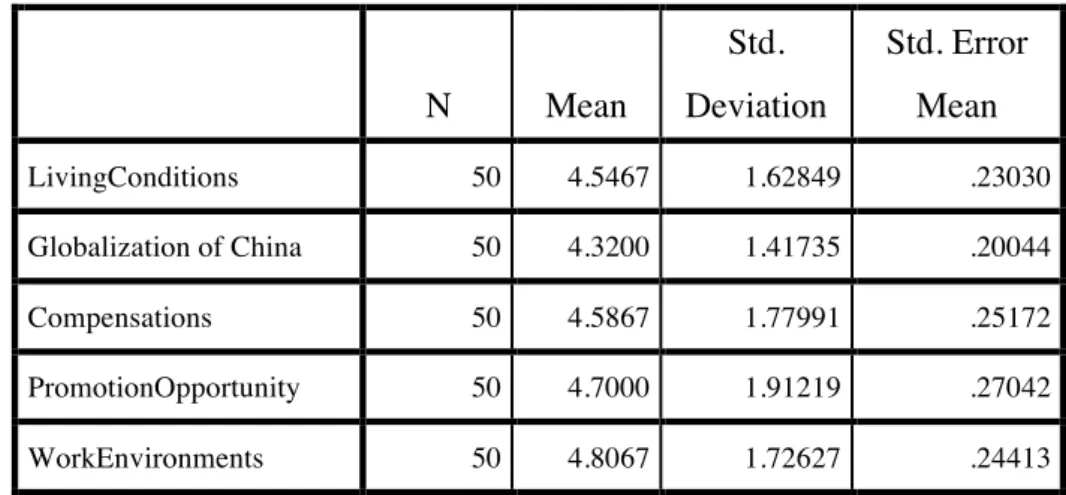
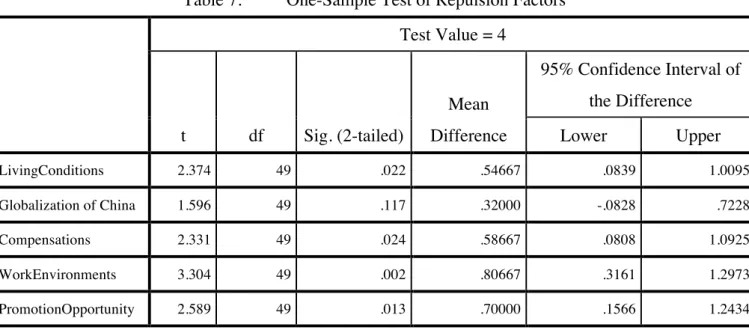
All three articles used a one sample t-test to determine which factors influence global talent mobility based on Likert scale score data. We use this analysis method to investigate what are the influential factors of talent loss repulsion, what are the influential factors of attraction, and what are the current trends of global talent mobility in Chinese multinational companies. To identify the influencing factors, we used a one-sample t test to compare the mean of each repulsion factor (living conditions, compensation, globalization, work environment, and opportunity for advancement), the mean of each attraction factor (state economic development, state policies, and investment in research and development), the average of 3 trend variables separated by a hypothetical test value – 4 representing the midpoint on a 1-7 biopolar response Likert scale.
Then we got the answer whether they were significantly different from the “4” test value, and the test was performed at a 95% confidence level.
Findings and discussion
In general, the range of Cronbach's alpha is divided into several parts, respectively indicating different degrees of reliability: When 0.5 > α, the internal consistency of the data is unacceptable. T3: "Married employees are more likely to resign from our company and find work in foreign countries than unmarried employees." In 2015, the generation born in the 80s entered the middle management level, even entered the top management level, and the new force - the post-90s began to enter the labor market and began become common in Chinese companies.
Working time without 'core' hours is 'flex time' which allows staff to balance. work and life, coordinate your working hours with your children's and parents' schedules. 41716.2 Average annual wages are almost 3 times higher than wages in first-tier cities. Although the rate of GDP growth is not as high now as it was a few years ago, China still remains the fastest growing country of the G-20, even though the Asian economy is no longer expanding as fast as it was a few years ago. (Hao Yanli, 2017) China's economy grew by 6.9% in 2015, which is higher than the average world development rate, especially higher than developed countries. (OECD) Rapid GDP growth shows overseas talented individuals that China's economic development will bring them opportunities and benefits during the career development process.
Bijwaard, Govert, Christian Schluter and Jackline Wahba, "The Impact of Labor Market Dynamics on the Return-Migration of Immigrants", Review of Economics and Statistics. Blitz B.K Brain circulation': the Spanish medical profession and international medical recruitment in the United Kingdom" Journal of European Social Policy. Cao Caihong & Han Liyan (2015) "The assessment of the social health costs caused by fog and haze".
Jean-Baptiste Meyer (2010), Skilled Labor Migration from Developing Countries: A Study of Southern and Southern Africa. 2015) “The Gender Difference in Work-Life Balance in Chinese Enterprises.” No. Lai Desheng Meng Dahu Wang Qi. 2015) “Working Time Characteristics and Policy Choice in China” China Work, no. Liu Xiaocan, Zhu Qinghua, Pan Yuntao (2014) “Study on Law of Return of International Qualified Scientists and Technicians – Taking the “Global Experts Recruitment Program” as an example” Journal of Modern Information, Vol.34 No.
Ryan Pengelly, Beverley Lord and Yvonne Shanahan (2008) "Accounting Brain Drain" Second New Zealand Management Accounting Conference 20-21 November 2008. Stephan, Paula, "I's Have It: Immigration and Innovation, the Perspective from Academe" and Josh Lerner and Scott Stern (ed.) Innovation Policy and the Economy (Cambridge, MA: MIT Press, 2010).