
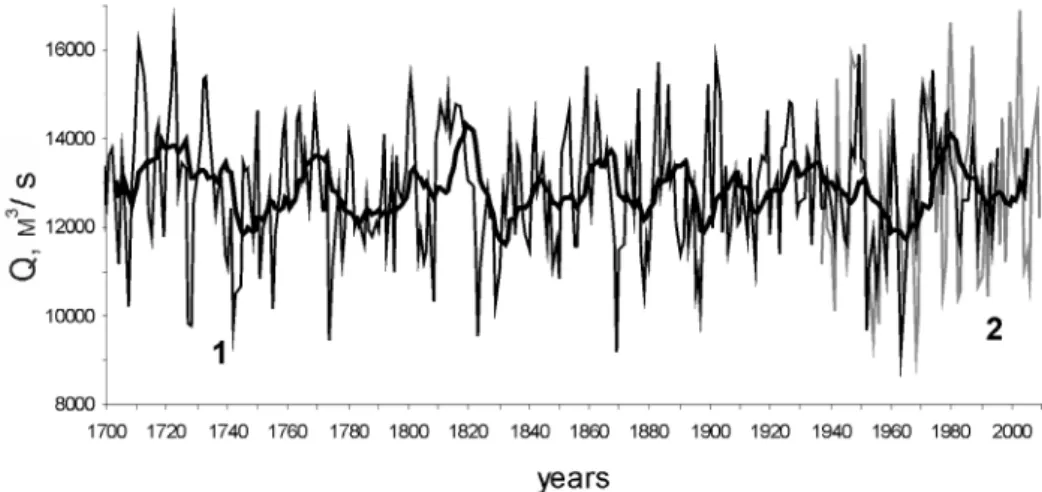
Reconstruction of the discharge of the Ob River (1) for the period from August of last year to July of the current year and current discharge data (2) for the Salekhard gauge (287 km from the mouth of the Ob River). Vegetation of the Moscow River Valley in the Subboreal Period (Late Neolithic and Bronze Age) from pollen analysis.
THE NEW MAP OF ICE MARGINAL FORMATIONS OF RUSSIA
West of the Russian border, they are called either glacial phases (in Poland) or ice-marginal zones (Kalm, 2012). Ice flow pattern and extent of the last Scandinavian Ice Sheet southeast of the Baltic Sea.
MIDDLE PLEISTOCENE FAUNA OF VESHENSKAYA (MIDDLE DON RIVER, ROSTOV REGION, RUSSIA)
This Veshenskaya vertebrate fauna is important for late Middle Pleistocene paleoecology and paleogeography of the middle and lower Don River region. New data on the stratigraphy of Quaternary terraces in the Middle Don (Veshenskaya) based on mammalian fauna.
LAST GLACIAL–INTERGLACIAL VEGETATION
This study integrates data on invertebrates and lower and higher vertebrates from the Veshenskaya site. In: New data on the geology and mineral resources of the Rostov region and adjacent areas.
AND ENVIRONMENTAL DYNAMICS IN SOUTHERN SIBERIA Key words: Baikal region, Late Pleistocene, Holocene, vegetation and landscapes,
The greatest distribution of taiga communities in the region is associated with a warmer and wetter climate than the present ~7 kyr BP ago. A sudden wind shift in western Europe at the beginning of the Younger Dryas cold period.
CHRONOLOGY AND CLIMATIC PECULIARITIES OF THE PERIOD BETWEEN CA. 94 AND 70 KA (MIS 5B–5A)
OF THE VOKA REFERENCE SECTION
Pollen zone M6 (Carpinus-Tilia-Quercus-Ulmus-Corylus-Pinus Haploxylon type) in the visible part of the unit corresponds to the period 94.2–81.6 ka. Using the Voka event stratigraphy as a template facilitates the search for correlative horizons in neighboring and more distant regions.
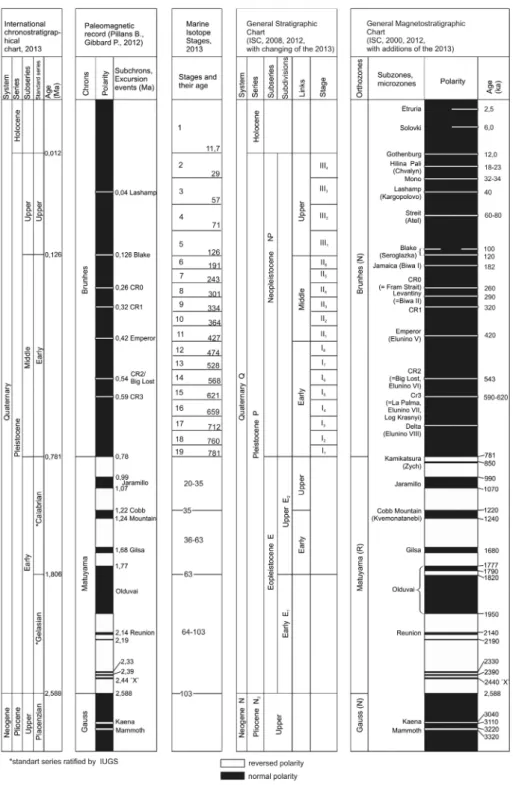
PROPOSAL ON STRUCTURE OF THE GENERAL
STRATIGRAPHIC SCALE OF THE QUATERNARY OF RUSSIA Key words: Quaternary System, Pleistocene, Eopleistocene, Neopleistocene, stages
The questions raised must find their answers in the near future, because it is due to the urgent needs of geological and cartographic production.
EVOLUTIONARY PATTERNS IN THE DENTITION OF ARVICOLINAE (CRICETIDAE, RODENTIA)
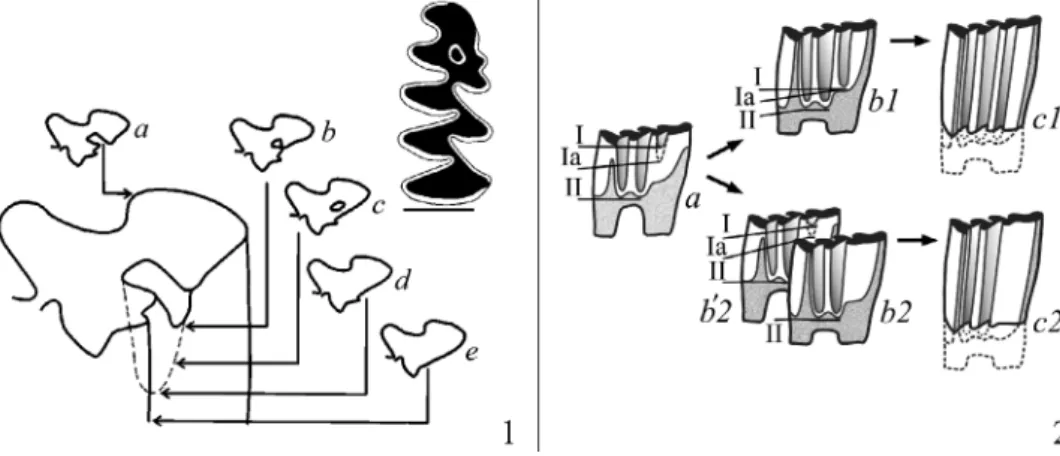
For example, the simplification of the occlusal surface of teeth in molluscs (Ellobius) can be considered as the development of a hypselodont tooth pattern, which may have resulted from the delay of the lower (basal) part of the tooth crown. 1 — The lines represent the levels of cross-sections (stages of wear): a — the enamel fold is not closed in the island; b-c - stages in which the enamel island is closed; d.
PALEOENVIRONMENTS IN THE FRAM STRAIT, NORTH ATLANTIC, DURING MIS 2–6
These data indicate the lack of long-term ice-free conditions in the Strait of Fram. Finally, the third HP layer in the discussed interval is characterized by the occurrence of sparse G.
PEAT-BOG SITES OF THE TRANS-URALS
GEOLOGY AND CHRONOLOGY OF PLEISTOCENE CULTURAL RECORDS IN THE CENTRAL URALS
This, in conjunction with dynamic palaeo-geomorphic processes, which govern early site preservation, represent the main constraints for documentation of the pre-Upper Palaeolithic people. The Cave Paleolithic of the Chusovaya River Valley and Problems of the Initial Population of the Central Urals.
ALLUVIAL STRATIGRAPHY AND FLUVIAL DYNAMICS AT THE LATE PLEISTOCENE-HOLOCENE TRANSITION
Climatic trends causing the activation of periglacial and gravity-slope/geliflux processes are seen as a limiting factor in the preservation of former open sites before the Upper Paleolithic. Despite this, due to the unique geomorphological configuration and paleo-environmental conditions, the territory of the Central Urals and Trans-Urals are a great potential for future research of Paleolithic geoarchaeology.
IN THE ITALIAN APENNINES
The chronology of the Late Pleistocene alluvial sedimentation extends back to the late MIS 4-early MIS 3, at the extreme limit of the 14C method. Deeper and more confined gravel channel fills are characteristic of the upper part of the Late Pleistocene successions that pass upward into overlying fines containing buried truncated immature paleosols.
TECTONICS, CLIMATE AND FLUVIAL SEDIMENTATION
THE PLEISTOCENE RECORD OF CENTRAL ITALY
Along the steeper slopes of the Apennines, including those generated by normal Pleistocene faulting activity, and at the foot of present-day escarpments of active fault lines, sedimentation is virtually absent under current interglacial conditions. However, during the Quaternary and on the scale of glacial-interglacial cycles, fluvial, coarse-grained faces and architecture, despite continued tectonic activity, were always determined by climate.
BIOSTRATIGRAPHICAL CHARACTERISTIC OF THE LOWER NEOPLEISTOCENE DEPOSITS
Therefore, the long-term uplift and displacements are responsible for the creation of mountain ridges that form the source for sediments and tectonic basins that generated the accommodation space for the accumulation of thick terrestrial successions. The Holocene fluvial record cannot be considered a good actualist example for Interglacial fluvial sedimentation, because since the Neolithic period it has been strongly influenced by human induced changes in terms of slope degradation and related sediment supply to the valley floors.
OF THE SOUTHERN URALS REGION
In the Atasevo time, when erosion was reactivated, fluvial sediments were uplifted and they are now observable in the lower parts of third terraces above the floodplain in the lower reaches of the Belaya River (Danukalova et al., 2002). The refined Quaternary Stratigraphic Scale of the Sisuralian Region and Main Events in the South Urals.
SARYKUL’ PALEOSOL IN BATURINO QUARRY (SOUTHERN URALS, RUSSIA)
The characteristics of the elemental composition, spectral properties in the ultraviolet, visible and infrared range were obtained. The change in the magnetic sensitivity of the horizontal soil mass testifies in favor of the synlithogenic model of its formation.
PRELIMINARY DATA ON THE PLEISTOCENE HISTORY OF PERMAFROST IN CENTRAL URALS (RUSSIA) DERIVED
Siberia) and the Baturino quarry (Southern Urals) have shown their specificity and differences with continental Eurasian paleosols of other Pleistocene periods, which can probably be used for long-distance chronocrelations. This fact requires further research in the direction of expanding the number of similar objects distributed in different conditions of continental Eurasia.
FROM CRYOGENIC CAVE CARBONATES
CCC is therefore an indicator of the developing or degrading permafrost conditions, when the cave temperature fluctuates very close to 0°C. Unusually large CCCs (diameter up to 40 mm) were recently found in a number of caves of the Ural Mountains, Russia (Chaykovskiy et al., 2014).
INSECTIVOROUS MAMMALS (EULIPOTYPHLA)
IN THE PERM PRE-URALS DURING THE LATE PLEISTOCENE AND HOLOCENE PERIODS
During the periods of warming (bully-allred), the list of insectivorous mammals in the explored territory changes dramatically: remains of shrews (Sorex araneus), straight-toothed shrews (Sorex isodon), Laxmann's shrews (Sorex caecutiens) ) and pygmy shrews (Sorex minutus), the remains of the tundra mouse were not found. Since that period, the remains of tundra mice have not been found among the fossil insectivores.
NEW INVESTIGATIONS OF QUATERNARY DEPOSITS IN THE VIENNA BASIN (AUSTRIA)
Although it was already possible to develop more detailed ideas about younger fluvial sediments of the Danube in the Vienna Basin by means of OSL dating (e.g. Fiebig et al., 2009), the overall knowledge about the Quaternary history of sedimentation and erosion in the Vienna Basin is fragmentary. The application of independent dating methods will hopefully serve to close this gap in knowledge in the course of further research projects such as the current FWF project P23138-N19.
HOLOCENE EOLIAN LOESS-SOIL STRATIGRAPHY AND CLIMATE CHANGE OVER THE MIDDLE YELLOW RIVER
An attempt to test the first results of OSL dating is made by measuring the content of the cosmogenic isotopes Al26 and Be10 in cobbles of both terraces (see figure A3, appendix 3). Each of these cobbles is examined and measured separately, so that different histories of individual cobbles can reveal a more robust and detailed database for the reconstruction of the deposition history of the entire sedimentary unit.
BASIN OF CHINA
Reworked loess components were incorporated into the surface soil during the early Holocene as a result of increased runoff and consequent erosional redeposition. Charcoal preserved in the soil has intermittently recorded human fire from the landscape during the Neolithic and Early Bronze Age.
GENETIC VARIABILITY OF BURBOT, LOTA LOTA, AND THE CONNECTION OF THE MAIN HOLARCTIC RIVER
BASINS IN THE QUATERNARY
Most control region haplotypes, revealed in the Ob-Irtysh River Basin, fall into Eurasian and Beringian haplogroups. Genetic Consequences of Quaternary Climate Variations // Philosophical Transactions of the Royal Society B-Biological Sciences.
LATE-GLACIAL CLIMATIC EVENTS AND CHRONOLOGY OF ENVIRONMENTAL DEVELOPMENT IN SOUTH EAST
LITHUANIA
Subsequently, the supply of immigrant material from the catchment decreased and as a result the increasing value of recorded CaCO3 must have come from the lake itself, indicating that the productivity of the basin is increasing. Simultaneous gradual rise of the δ18O curve indicates some deterioration of the climate regime, including increasing aridity, which is consistent with paleobotanical data.
RODENTS AS INDICATORS OF A STEPPE BIOME DEVELOPMENT IN LATE MIDDLE
These variations can be correlated with climatic events recorded in Greenland ice cores, European lacustrine and Atlantic Ocean sediments during the Late Glacial period (Yu and Eicher, 2001). Synchronization of paleoenvironmental events in the North Atlantic region during the Last Termination: A revised protocol recommended by the INTIEM group.
AND LATE PLEISTOCENE OF POLAND
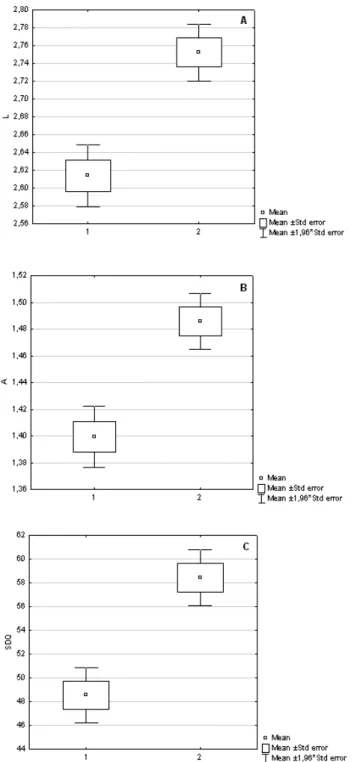
The mean value of the maximum length of the occlusal tooth surface (L) (van der Meulen, 1973) was 2.71 mm for the entire population, 2.61 mm for the Late Middle Pleistocene sample and 2.75 mm for the Late Pleistocene sample . The mean value of A parameter was 1.46 mm for the entire population, 1.40 mm for the late Middle Pleistocene sample, and 1.49 mm for the late Pleistocene sample.
THE SCH Ö NINGEN MIDDLE PLEISTOCENE SEQUENCE
A BROADER PERSPECTIVE
Behre (Hrsg.), Die chronologische Einordnung der paläolithischen Stätten von Schöningen / Die chronologische Lage der paläolithischen Stätten von Schöningen, Mainz: Verlag des Römisch-Germananses Zentralmuseums, 97-112. Behre (Hrsg.), Die chronologische Einordnung der paläolithischen Stätten von Schöningen / Die chronologische Lage der paläolithischen Stätten von Schöningen, Mainz: Verlag des Römisch-Germananses Zentralmuseums, 113-124.
SURFACE SOILS AND PALEOSOLS OF ROCK-SHELTER SVETLYI (THE MIDDLE URALS)
Fluctuations of their content over the profile of Soil III mean gradual formation of the deposits or initial heterogeneity of the sediments. It should be noted the high values of humic acid and fulvic acid ratio (Cha:Cfa) in the studied soils, especially at the eastern wall for which we did not find analogues among modern soils of the region.
Therefore, in further analysis, the change of humus characteristics over the profiles is of greater importance than absolute values. Ulitko (IPAE, Ekaterinburg) for the invitation to participate in the research, help with fieldwork and discussion of the results.
LATE NEOPLEISTOCENE STRATIGRAPHY ACCORDING TO THE SEDIMENT SUCCESSIONS FROM EASTERN KOLA
PENINSULA, PONOY RIVER VALLEY
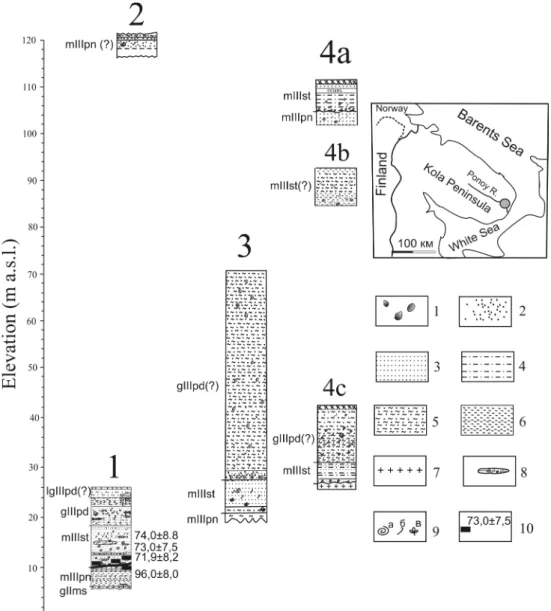
The sedimentary sequences from the eastern Kola Peninsula, Ponoy River Valley (sections 2-4 are plotted according to the description of (Gudina, Yevzerov, 1973). The stratigraphic units are drawn by indices: gIIms — Moskovski/Saali moraine; Upper Neopleistocene units: mIIIpn — Mikulinian/Eemian marine Ponoi Beds, mIIIst — Early Weischelian marine Strel'na Beds, gIIIpd — Podporozh'e/Early Weischelian till). The main stratigraphic section in the Ponoy river valley has been studied to recognize the correlation between the Ponoy and Strel'na beds.
ELASMOTHERIUM (ELASMOTHERIUM SIBIRICUM FISHER, 1808): NEW DATA ON THE PERIOD OF EXISTENCE AND
Geological-stratigraphic position of Upper Pleistocene marine sediments in the Southern Kola Peninsula: evidence from geochronological and geological data.
GEOGRAPHIC RANGE
The species composition of the faunas associated with the Elasmotherium bones indicates that they are all of Late Pleistocene age. Radiocarbon dating of Elasmotherium bones from these sites will indicate whether Elasmotherium lived in the Late Pleistocene.
CARNIVORES OF THE URALS IN THE LATE PLEISTOCENE AND HOLOCENE
In the Late Pleistocene, European and Asian species were equally represented in the carnivore fauna of the Urals. The changes in the terrestrial carnivore fauna occurred through the Late Pleistocene and Holocene to modern times.
ONCE AGAIN ABOUT THE EARLY VALDAIAN GLACIATION Key words: Upper Pleistocene, Early and Late Valdaian glaciations, LGM, Russian
Absence of the Early Valdaian till in the area was confirmed in the process of the Quaternary depositional map compilation for O-37 sheet. Problems of Stratigraphy of Quaternary Sediments and Marginal Glacial Formations of the Vologda Region (Northwestern Russia).
NEW DATA ON THE HOLOCENE SMALL MAMMAL COMMUNITIES FROM URAL-SAKMARA INTERFLUVE,
SOUTHERN URALS
Yellow-necked mouse recorded in series of Holocene sites on the western slope of the South Urals (Danukalova, 2010; Yakovlev, 2003). Simultaneous presence of Eliomis quercinus and Apodemus flavicollis was previously discovered only in Holocene Sim fauna (Smirnov, 1990) on the western slope of the South Urals.
HOLOCENE HISTORY OF CARABUS KARPINSKII (KRYZHANOVSKIJ ET MATVEEV, 1993)
It is clear that the original range of Carabus odoratus was significantly shifted to the south during the Ice Age (after the tundra and tundra-steppe zones) and was reduced in interglacial periods, retreating to the north, leaving enclaves in tundra sites of large mountain areas. A — basic relict habitats in the mountain tundra and rock streams at an altitude of 1000 m above sea level; B — temporary perennial micropopulation groups in the valleys at the foot of the mountains; C — depressive habitats on mountain peaks below 1,000 m above sea level below the forest canopy.
CHRONOLOGY OF THE LATE WEICHSELIAN GLACIATION IN THE SOUTHEASTERN SECTOR OF THE SCANDINAVIAN
ICE SHEET
The last SIS reached close to the LGM position in the western part of the study area, in NW Belarus no earlier than 22.6 cal. 14C ka BP and in the eastern part of the study area, in NE Belarus no earlier than 19.1 cal.
THE ICELANDIC BASALTS: AN “EXOTIC” CONTRIBUTION TO THE PLEISTOCENE BEACH DEPOSITS
OF WESTERNMOST EUROPE. HOW THEY GROUNDED IN FRANCE
After a maximum transport of 1,000 kilometers (the theoretical maximum effect of katabatic winds), this drift was captured by the southern branch of the eastward-flowing Gulf Stream. Growth, dynamics and deglaciation of the last British-Irish ice sheet: records of detritus drifted by deep-sea ice.
BIOSTRATIGRAPHIC IMPORTANCE OF ROOT VOLE (MICROTUS OECONOMUS) IN PLEISTOCENE OF POLAND
Some aspects of the evolution and biostratigraphy of Arvicola (Mammalia, Rodentia) in the Central European Pleistocene. Late Pleistocene environment of the highland of Częstochowa (Poland) reconstructed from the faunal evidence from archaeological research.
CORRELATION OF THE TOBOLIAN INTERGLACIAL (LOCATION KRIVOSHEINO/OB RIVER BANKS, NORTH
This article was supported in part by the Russian Foundation for Basic Research project and by the integration project of the SB RAS N4.16. Walker M., Johnsen S., Rasmussen S.O., Popp T., Steffensen J.-P., Gibbard P., Hoek W., Lowe J., Andrews J., Björck S., Cwynar L.C., Hughen K., Kershaw P., Kromer B., Litt T., Lowe DJ, Nakagawa T., Newnham R., Schwander J., 2009. Formal definition and dating of the GSSP (Global Stratotype Section and Point) for the Holocene base using of the Greenlandic NGRIP ice core and selected relief records.
OF NOVOSIBIRSK) WITH THE HOLSTEINIAN
MEASUREMENTS (TL), AND AMINO ACID RACEMIZATION
Today, there are several analytically and numerically processed interglacial pollen deposits on the territory of Northern Germany. They will be presented and discussed together with the results of exploratory drilling of qho4 and Holstein molluscs treated with amino acids in relation to Tobolian.
CARBONATE CEMENTS IN GLACIAL SEDIMENTS
IMPLICATIONS FOR PALAEOHYDROLOGIC CONDITIONS AND GLACIAL CHRONOLOGY
The time of precipitation of inorganic carbonates in a cold climate could be determined using the radiocarbon dating method. However, some ages are relatively older/younger compared to the regular dating of the ice margin positions.
FOSSIL DIATOMS IN THE NORTH OF WESTERN URALS AND BOLSHEZEMELSKAYA TUNDRA
The Centrophyceae genera (Aulacoseira, Cyclotella, Stephanodiscus) and Pennatophyceae (Fragilaria, Navicula, Achnanthes, etc.) occur in numbers (especially F. brevistriata Grun.) Species Aulacoseira granulata (Ehr.) Sim., Stephanodiscus hantzshinan., Achnanthe Grun. . lanceolata (Ag.) Ehr., and others also dominate. As a whole, Pleistocene marine and freshwater diatom floras in the North of West Ural and Bolshezemelskaya tundra consist of more than 900 taxa and characterize all interglacial horizons.
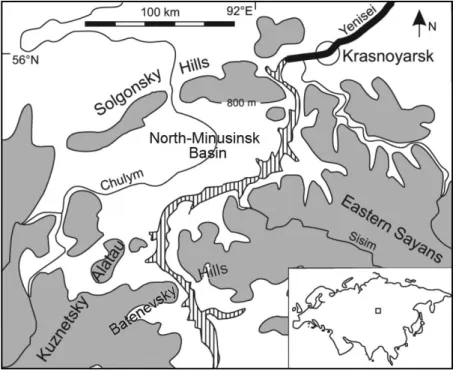
THE LARGE MAMMALS OF NORTH-MINUSINSK BASIN IN THE LAST GLACIAL PERIOD
Of the 10 species of order Artiodactyla that inhabited this area in the Last Glacial period, only 6 species have survived to date (although there are sometimes 3 species), of 9 species of Carnivora only 5 have been preserved (4 species are rare). The modern fauna of large mammals of the Northern Minusinsk Basin has lost its Pleistocene form.
EUROPEAN SMALL MAMMAL FAUNAS DURING THE END OF EARLY PLEISTOCENE — THE BEGINNING OF THE
MIDDLE PLEISTOCENE
Mul’achuun jalqabaa Microtus arvalinus fi Prolagurus posterius (Shamin locality, Markova, 1992) dhuma Matuama wajjinis walqabatee jira. Kilaamoonni hundee qaban gosa Mimomys naannoowwan jalqaba bara maagneetii idilee Brunhe wajjin walqabatanittis ni argamu.
SMALL MAMMALS AS INDIRECT BIOTIC MARKERS FOR CLIMATE DYNAMICS ASSESSMENT IN THE CENTRAL
But sometimes the sites with very few remains of this species have compared with each other which can lead to wrong conclusions. Analysis of early - Middle Pleistocene small mammal remains, especially Arvicolinae, provides the unique material, which helps to elucidate the evolution in different phylogenetic lineages, to date of the deposits that include the bone localities (which is very important for this interval for which practical unknown are absolute dates), to compare the faunas of the different regions of Europe and also to help reconstruct the palaeoenvironments.
PART OF NORTHERN EURASIA
The figure also illustrates a steep decline in the amount of species related to moss cover (group 3). Quaternary rodent and insect faunas of the Urals and Western Siberia: connection between Europe and Asia.
STRATIGRAPHY OF THE LAST PLEISTOCENE GLACIAL PERIOD IN POLAND
Initial sand infilling of the older generation of ice wedges is TL-dated to 49±7 to 43±7 ka (Heinrich event H5). Sand infill of the second ice wedge generation was TL-dated to 23±4 ka which coincided with the Last Glacial Maximum (Heinrich event H2).
DISPERSAL EVENTS OF SAIGA ANTELOPE (SAIGA TATARICA) IN CENTRAL EUROPE IN RESPONSE TO THE CLIMATIC
In the first part of Allerød (GI-1c3), the saiga once again appears to have reduced its range. The history of the origin, evolution and dispersal of the late Pleistocene Mammuthus-Coelodonta faunal complex in Eurasia (large mammals).
SOME CHARACTERISTICS OF BATURINO QUARRY BURIED LATE HOLOCENE SOIL (SOUTHERN URALS, RUSSIA)
Magnetic susceptibility values correlate with the content of total organic carbon in the top 75 cm of the soil layer. In the humus horizon they have maximum values, the reaction of the lower sequence profile of the soil solution is in the area of alkaline values.
TWO EARLY BIHARIAN MORPHOTYPES OF MERIDIONALOID ELEPHANTS, ARCHIDISKODON
LOWER DON AREA, SOUTHERN EUROPEAN RUSSIA) Key words: biostratigraphy, mammals, meridionaloid elephants, Archi-
2, Plioscirtopoda stepanovi, Apodemus sp., Spermophilus sp., Spalax minor, Cricetus nanus, Allocricetus ehiki, Cricetulus sp., Eolagurus argyropuloi adventus, Prolagurus pannonicus, Lagurodon arankae, Allophaiicomys, Milumocamys, interimmocamys, cimocamys, cimulus, citromys, citroen. ionomys hintonianus, Ellobius ( Bramus) tarchancutensis, Ellobius (Ellobius) sp. Tidlig biharisk Archidiskodon meridionalis (Nesti, 1825) fra Sarkel (Lower Don-området, det sydeuropæiske Rusland) og tilhørende små pattedyr.
LATE GLACIAL AND HOLOCENE ENVIRONMENTAL HISTORY ON THE EASTERN SLOPE OF THE MIDDLE URAL
Early Pleistocene mammalian fauna of Sarkel (Lower Don River area, Russia): small moths (Ellobiusini, Arvicolinae, Rodentia).
MOUNTAINS, RUSSIA
The first Mesolithic site (Beregovaya 2) of the Gorbunovsky peat bog has been shown to correspond to this interval. Dynamics of the natural environment in the Holocene by data from complex analysis of VI Section of the Gorbunovsky peat bog.
TO THE QUESTION OF BOUNDARIES AND COMPOSITION OF GELASIAN STRATUM IN THE MIDDLE VOLGA REGION
Although he later mentioned that the Omarian subscene in the Lower Kama sections may correspond to the Upper Akchagyl. In the Cis-Ural region, the Biklyanian subscene is contemporaneous with the deposits of the lower part of the Voivode subscene [9].
ARVICOLINE FAUNA OF ZVERINOGOLOVSKOYE LOCALITY (PLIOCENE-EARLY EOPLEISTOCENE, SOUTHERN
TRANSURALS)
IN THE QUATERNARY OF THE DNIEPER AREA
AN ABILITY OF A BIOSTRATIGRAPHICAL IMPLICATION
A special feature of the hypoconid occurs in all the specimens studied, a kind of heel that extends from the upper third of the hypoconid outwards and forwards (i.e. at the site of the ectostylid). So, this means that ectostylids were actually present in all the studied specimens of the species, sometimes only as part of the hypoconid floor.
PALYNOLOGICAL RECORD OF THE QUATERNARY DEPOSITS OF GARDING-2 RESEARCH DRILL CORE,
NORTH-WEST GERMANY
Presence of dinoflagellate cysts and foraminifera test liners from 19.80 to 17.05 m and from 12.52 m with occurrence of Elphidium sp., Nonion sp., Ammonia sp. The first Holocene occurrences of Fagus at 15.97 m and Carpinus at 16.40 m with decreasing abundance of Corylus at 16.04 m reveal the beginning of the Subboreal around 5660 years BP.
MAMMAL DIVERSITY DURING THE PLEISTOCENE–
HOLOCENE TRANSITION IN EASTERN EUROPE
The biological diversity of the last glacial maximum (LGM) and the Holocene thermal optimum was investigated in more detail with data on all taxa of mammals (PALEOFAUNA database, Markova (1995)). The orientation of the boundaries between large geographic groups of mammals, especially in the northwestern part of Eastern Europe, depended on the expansion of the Scandinavian Ice Sheet.
THE GEOMAGNETIC RECORDING MEDIUM FROM WESTERN DACIC BASIN (ROMANIA) DISTURBED BY COAL
For Holocene fauna, diversity indices are almost independent of physical environmental conditions; the α diversity index decreased and the β diversity index increased. Nowadays, the relatively low α-diversity and high β-diversity indices in Eastern Europe refer to the decrease in the number of populations of some forest species in historical time and the increase in the dominance of non-specialized species or species associated with intrazonal ecosystems . .
PALAEO-FIRES: PLEISTOCENE PORCELLANITES WITHIN PLIOCENE LIGNITE — CLAY SEQUENCES; MULTI-PROXY
The α-, β- diversity values show only a negative correlation with the temperature conditions during the Late Pleistocene, the period characterized by the so-called "Mammoth Fauna" complex (Fig. 1).
EVIDENCE
As for the sedimentary rocks, which are the "m.r.m." from the Western Dacian Basin (WDB) (southwestern Romania), their magnetic properties are mainly determined by the composition of the original detrital minerals and the character of the subsequent diagenetic changes. The former polarity zone (related to the time of clay deposition) is assigned to the Gilbert Chron, namely C2Ar Subchron Ma), while the latter (related to the time when clay was fired by naturally burning coal fires) is assigned to the Brunhes Chron Ma) of the latest astronomically aligned Neogene time scales, ATNTS 2004/ATNTS 2012.
TOWARDS ASSESSING THE POTENTIAL FOR STRATIGRAPHIC STUDIES IN THE DANUBE DELTA
GEO-ENVIRONMENTS BY USING
MAGNETOSUSCEPTIBILITY AND LITHOLOGICAL RECORDS RETRIEVED FROM RECENT SEDIMENTS
The MS – LITHO data provided by the sediment cores are very important in the context of deciphering the spatial and temporal evolution of the deltaic geosystem. In fact, this paper is specifically dedicated to evaluate the magnetosensitivity capabilities and lithological data for stratigraphic studies in the Danube Delta geosystems.
REMAINS OF SAIGA TATARICA (LINNAEUS, 1766) FROM THE QUATERNARY DEPOSITS OF EMINE-BAIR-
KHOSAR CAVE (CRIMEA) AND OTHER LOCALITIES OF UKRAINE AND POLAND
The Late Pleistocene environment of the Częstochowa Highlands (Poland) reconstructed on the basis of faunal evidence from archaeological cave sites. Socha (Eds), Karst of the Częstochowa Highlands and the Eastern Sudetenland: palaeoenvironment and protection.
ULTRASTRUCTURE OF THE TOOTH ENAMEL OF VOLES (ARVICOLIDAE, RODENTIA) AND THE POSSIBILITY
Distribution Events of the saiga antelope (Saiga tatarica) in Central Europe in response to the climatic fluctuations in MIS 2 and the first part of MIS 1.
OF ITS USE IN BIOSTRATIGRAPHY
Different morphological types of the enamel layers were highlighted and details of their structure were characterized (Koenigswald, 1997). These changes are manifested in the process of enamel morphogenesis aimed at the development of the more complex structure - lamellar enamel (HSB-uniserial) with a defined structure (weaving) of its elements.
NEW PALEOFLORISTIC DATA FROM HOLOCENE BOTTOM SEDIMENTS OF THE LAPTEV SEA OUTER SHELF
AND CONTINENTAL SLOPE
Relative frequency of pollen from tundra dwarf shrubs, such as Betula nana type and Dusheckia fruticosa rises to 40% and 11% respectively, while pollen from conifers almost disappears towards the top of the LPZ-3 (8–0 cm) . Late Glacial to Holocene environments in the present-day coldest region of the Northern Hemisphere inferred from a pollen record from Lake Billyakh, Verkhoyansk Mts, NE Siberia.
POLLEN CORRELATIONS FROM LAKE SEDIMENTS OF THE SOUTHERN URALS AND WESTERN EUROPE
Holocene dynamics of vegetation and ecological conditions in the Polar Urals// Russian Journal of Ecology 34—4, p. Lake status records from the former Soviet Union and Mongolia: documentation of the second version of the database.
PLEISTOCENE CHRONOSTRATIGRAPHICAL CORRELATION OF LITHUANIA AND BELARUS
These findings contributed to some changes in the Lower Pleistocene stratigraphy in Lithuania (Baltrūnas et al. A more detailed division of the Upper Pleistocene deposits is possible, but remains problematic in both countries.
PHYLOGEOGRAPHY OF SIBERIAN CONIFERS BASED ON CYTOPLASMIC AND NUCLEAR DNA MARKERS
Here we present the results of the studies of genetic variability of Siberian larch Larix sibirica (Semerikov et al., 2013) and Siberian spruce Abies sibirica (Semerikov, Semerikova two conifers widespread in northern Eurasia, although they are characterized by contrasting ecological niches. Allelic composition and chloroplast DNA variation of the northern Urals and the West Siberian Plain suggests migration from several putative refugia to this colonized territory.
MOLECULAR PHYLOGENY AND BIOGEOGRAPHIC HISTORY OF FIRS (ABIES, PINACEAE) BASED ON AFLP
This study included 39 Abies taxa representing the main lines of evolution of the genus. Calibrations of the divergence times based on paleobotanical data and on the estimation of the mutation rate of cpDNA in the Pinaceae, produced similar results (Semerikova, Semerikov, 2014a).
VEGETATION AND CLIMATE CHANGES IN THE SENTSA RIVER VALLEY(EAST SAYAN HIGHLAND) IN THE MIDDLE-
A number of extant and highly differentiated Abies taxa occur in western North America. VEGETATION AND CLIMATE CHANGES IN THE SENTSA RIVER VALLEY (EASTERN SAYAN MOUNTAINS) BETWEEN-.
LATE HOLOCENE
A few such dammed lakes still exist in the upper part of the Zhom-Bolok river valley. The pollen record of the Sentsa peat deposits reflects significant changes in the regional and local vegetation composition of the area during the mid-late Holocene.
CORRELATION OF THE LATE PLEISTOCENE LOESS-PALEOSOL SEQUENCE OF SW SIBERIA
Magmatism and geodynamics of the South Baikal volcanic region (Mantle hotspot): results of geochronological, geochemical and isotopic (Sr, Nd and O) investigations.
AND DYNAMICS OF ITS FORMATION
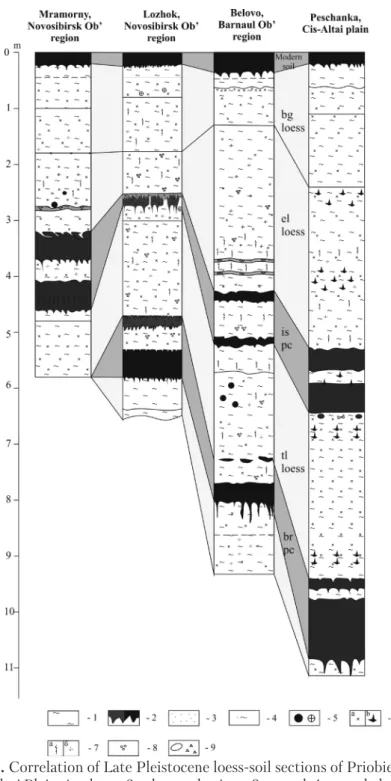
Correlation of Late Pleistocene loess-soil sections of the Priobie Loess Plateau and the Cis-Altai Plain. This study includes late Pleistocene loess-paleosol sections of the Priobie Loess Plateau (Lozhok, Marble, Belovo) and the Cis-Altai Plain (Peschanka).
STEPPE SPECIES OF SMALL MAMMALS IN PLEISTOCENE AND HOLOCENE COMMUNITIES OF NORTH EURASIA
Thus, practically all the species that now inhabit the trans-Ural steppes were spread much further north in the late Pleistocene, they were registered in the middle and even in the northern Urals. In the Trans-Urals, the Late Pleistocene was marked by the aridity of the climate and the appearance of some semi-desert animal species.
RODENT COMMUNITIES AS INDICATORS OF CLIMATE DYNAMICS IN POLAND DURING LATE MIDDLE
AND LATE PLEISTOCENE
The lowest values of temperatures of the warmest month ranging from +5.1°C to +9.6°C were obtained in the Late Pleistocene and Holocene layers in Deszczowa Cave and Krucza Skała shelter. The highest values of this parameter ranged from -6.0°C to -1.0°C and were obtained from Middle Pleistocene layers in Biśnik Cave and Late Pleistocene and Holocene layers of Biśnik Cave, Komarowa Cave and Krucza Skała shelter.
RODENT BIODIVERSITY IN THE MIDDLE AND LATE PLEISTOCENE OF POLAND
The values of Margalef index from the late Pleistocene layers from the analyzed sites were very variable. In the late Pleistocene strata, the variation of the values of the Shannon-Wiener index was very large.
A CANIDAE ASSEMBLAGE FROM THE KURUKSAY FAUNA (SOUTHERN TAJIKISTAN) AS THE REFLECTION
AT THE BEGINNING
OF EARLY PLEISTOCENE IN СENTRAL ASIA
In recent years, opinion regarding the systematic status of Canis members of the Kuruksay fauna has changed. Distribution of the Canini (Mammalia, Canidae: Caninae) across Eurasia during the late Miocene to early Pleistocene.
BIOSTRATIGRAPHY OF THE LATE PLEISTOCENE DEPOSITS IN THE SITE OF NIZHNYAYA TAVDA
WESTERN SIBERIA, RUSSIA)
The radiocarbon date of 24820±750 BP (SOAN-4535) has been obtained for plant debris from the upper floodplains of the ancient riverbeds. All species are typical of the Late Pleistocene of the Urals and Western Siberia (Kosintsev, 2007; Kosintsev, Vasilyev, 2009).
Subfossil beetle assemblages associated with the "mammoth fauna" in Late Pleistocene localities of the Ural Mountains and Western Siberia. Development of chernozem soils in the Transural region in the second half of the Holocene.
MYOSPALAX PSILURUS — A RELIC OF THE SOUTHEASTERN OUTSKIRTS OF THE MAMMOTH FAUNA
Individual zokor teeth were found at almost all depths in cave deposits. Meanwhile, it should be mentioned that in the layers where the fossils of the zokor bones were found, the bone remains of forest species prevail.

THE PLIO-QUATERNARY DEFORMATION OF THE LAKE VAN BASIN (EASTERN ANATOLIA) FROM MULTI-CHANNEL
Natural and archaeological complex of Sukhaya cave in Primorsky region (Russian Far East).
SEISMIC REFLECTION PROFILES
Central Tatvan Basin: the fault-controlled block geometry of the Central Tatvan Basin is illustrated in the seismic sections. The margins of the central Tatvan basin in the W and S appear to be covered by intrusive-extrusive activity (Fig. A15).
EARLY PLEISTOCENE OF NORTH-WEST ARMENIA
The eruptions of moderately alkaline basalts and basaltic andesites balanced the topography of the Upper Akhurian and Lori basins in the Gelasian. Dating and correlation of the Quaternary river terraces in Syria applied to tectonic deformation in the region.
PALAEOENVIRONMENT AND DATING
Nicht erst seit der Entdeckung paläolithischer Jagdspeere (Thieme, 1997) sind die stratigraphische Lage und Korrelation der interglazialen Ablagerungen des Holsteiner, Reinsdorfer und Schöninger im Bergwerk Schöningen umstritten (Urban, 2007; Kuijjer, 2014). . . Behre (Hrsg.), Die chronologische Einordnung der paläolithischen Stätten von Schöningen / Die chronologische Lage der paläolithischen Stätten von Schöningen, Mainz: Verlag des Römisch-Germanischen Zentralmuseums, 171-182.
STRATIGRAPHY OF SEDIMENTS AND MAMMALS IN THE KARST CAVES IN THE IRGINA RIVER VALLEY
Behre (Hrsg.), Die chronologische Einordnung der paläolithischen Stätten von Schöningen / Die chronologische Lage der paläolithischen Stätten von Schöningen, Mainz: Verlag des Römisch-Germananses Zentralmuseums, 143–154. Neue Erkenntnisse zur Vegetationsentwicklung und zum Zeitpunkt der Interglaziale im Oberen Mittelpleistozän in Norddeutschland und vorläufige Korrelationen.
MIDDLE URALS)
The layer formation time corresponds to the Subboreal period of the Holocene based on the stratigraphic position. On the cross profiles, there is a noticeable protrusion of the sediments of layer 2 into the underlying layer 3.
SOME FEATURES OF 4-MILLENIUM BURIED SOILS OF ZAURALYE (TRANS-URALS)
Support by the scientific research of higher education institutions within the state task of the Russian Federation project № 2485.
FOSSIL FINDS AND MOLECULAR PHYLOGEOGRAPHY OF THE SIBERIAN FLYING SQUIRREL
PTEROMYS VOLANS L., 1758)
The Hokkaido clade is well differentiated which may be a result of the previous isolation of the island population. According to paleontological and molecular-genetic data, the common trends of higher haplotype diversity and the earliest dating of fossil finds of P.
THE MAIN MATTERS OF STRATIFICATION FOR LOWER VOLGA NEOPLEISTOCENE, RUSSIAN FEDERATION
An absence of precise binding of observation points in the process of description and definition of new Quaternary units. Despite a wealth of data, questions about the stratification of these sections, sometimes referred to as the Pleistocene Stratigraphic Scheme of Northern Eurasia, are still speculative.
THE NEW QUATERNARY MAP OF THE RUSSIAN FEDERATION, SCALE 1:2 500 000
The map legend is built on the traditional stratigraphic-genetic principle in matrix form. In general, the left part of the legend provides a correlation of stratigraphic divisions of the new Russian map with European chronostratigraphy.
THE GENUS DICROSTONYX (MICROTINAE, RODENTIA) FROM LATE EOPLEISTOCENE AND EARLY
NEOPLEISTOCENE OF EAST SIBERIA
FIRST RECORDS OF THE SUB-FOSSIL INSECTS FROM QUATERNARY DEPOSITS
The first site (Zaharovo), located by the Aley River, is attributed to this period based on the geomorphological level of the flood terrace. These sites may thus represent a broad chronological interval from the beginning of the Late Pleistocene to the Holocene, but radiocarbon dating of the investigated layers is necessary; we have only one 14C date made for the Bun'kovo site.
DISJUNCTIVE AREAS OF INSECTS AS A REFLECTION OF ENVIRONMENTAL PECULIARITIES OF NORTHERN
A History of the Ground Beetle Fauna of Western Siberia and the Urals During the Late Pleistocene to Holocene. Pile beetles (Coleoptera, Byrrhidae) in late Pleistocene deposits in the south of the West Siberian Plain.
EURASIA IN THE PLEISTOCENE AND HOLOCENE Keywords: paleoecology, sub-fossil insects, Late Pleistocene, Holocene,
It is possible that these beetles belong to arctic, subarctic and non-analogue insect faunas, typical of the Late Pleistocene of the Urals and Western Siberia. In: Ecological groups of ground beetles (Coleoptera, Carabidae) in natural and anthropogenic landscapes of the Urals.
STRATIGRAPHY AND CHANGES OF ENVIRONMENT AND CLIMATE IN THE LATE CENOZOIC OF WESTERN
SIBERIA
The Middle and Late Pleistocene loess-soil sequence of western Siberia is one of the most significant archives of terrestrial paleoclimate in North Asia. The loess sediments of Western Siberia, deposited during the Lower and Middle Pleistocene, occupy uplift territories - the CisAltai plain, river valleys with low Altai mountains, the western slopes of Salair and the Kuznetsk depression.
DENTAL MICROWEAR IN LATE QUATERNARY RODENTS
Irregular distribution of the microwear patterns on the enamel surface in young rodents with immature occlusal surface (in voles) or with the pointed cusps (in mice). The data from the analysis will make it possible to reconstruct the diet of modern and late quaternary rodents.
APPENDICES (COLOR FIGURES)
ПРИЛОЖЕНИЯ (ИЛЛЮСТРАЦИИ В ЦВЕТЕ)
The left photo shows gravel deposits of the Gaenserndorfer Hochterrasse containing a crystalline rock with a maximum diameter of about 50 cm (please compare shovel for size). The right photo shows sediments from the next higher fluvial level - the so-called Schloss Hof Terrasse Again, a crystalline rock of comparable size (about 50 cm maximum diameter - please see a small metal dust can on the right side of the rock) with a group of pebbles in its vicinity were exposed.


