Nationality can be used in the same sense, but is usually more restricted to international law contexts. However, in the common law tradition, "acquisition" is often used to cover both attribution at birth and subsequent acquisition on the basis of an application.
SUMMARY
The Covenant on the Rights of the Child in Islam provides that children have the right to have their birth registered and their citizenship determined. Support for the adoption of the draft protocol of the African Charter on Specific Aspects of the Right to Citizenship and the Eradication of Statelessness in Africa.
THE HISTORY OF NATIONALITY LAW IN THE HORN OF AFRICA
6 Imperial Order for Federal Incorporation and Inclusion of the Territory of Eritrea in the Empire of Ethiopia, No. Nevertheless, the constitutions of several of the federal member states provide citizenship at the state level.
COMPARATIVE ANALYSIS OF NATIONALITY LEGISLATION
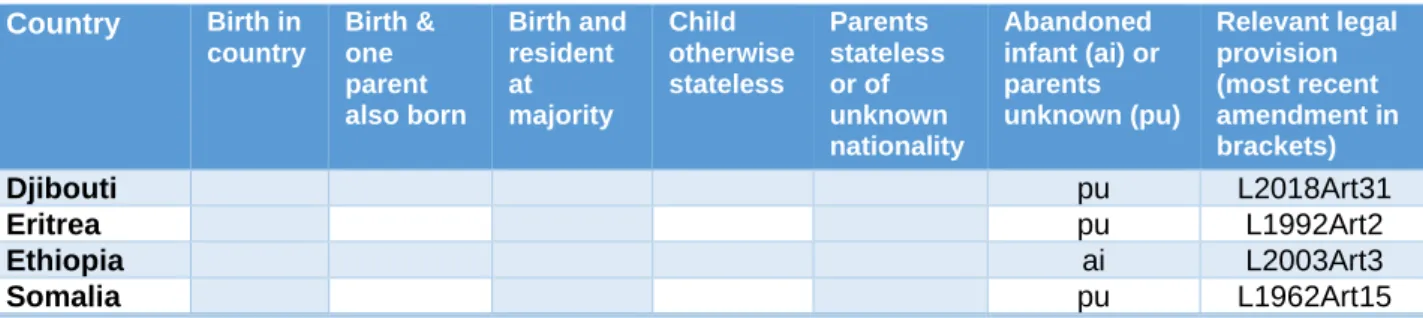
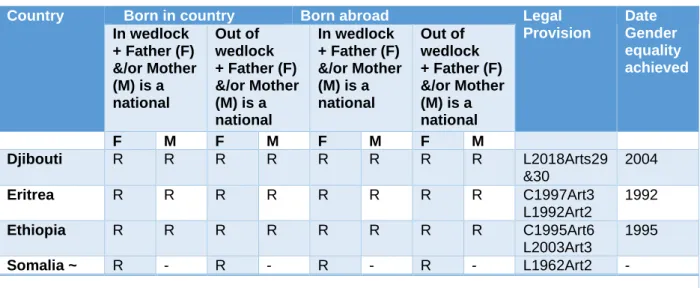
None of the laws considered in this study give general rights to nationality (regardless of one's other possible nationalities) based on birth in the territory. Any minor who is a child of unknown parents and was born in the territory of the Somali Republic is considered a citizen of Somalia, provided that he has not acquired foreign citizenship or the status of a national of a foreign country. Any child of unknown parents found on the territory of the Somali Republic will be presumed to have been born on the territory of the Somali Republic until proven otherwise.
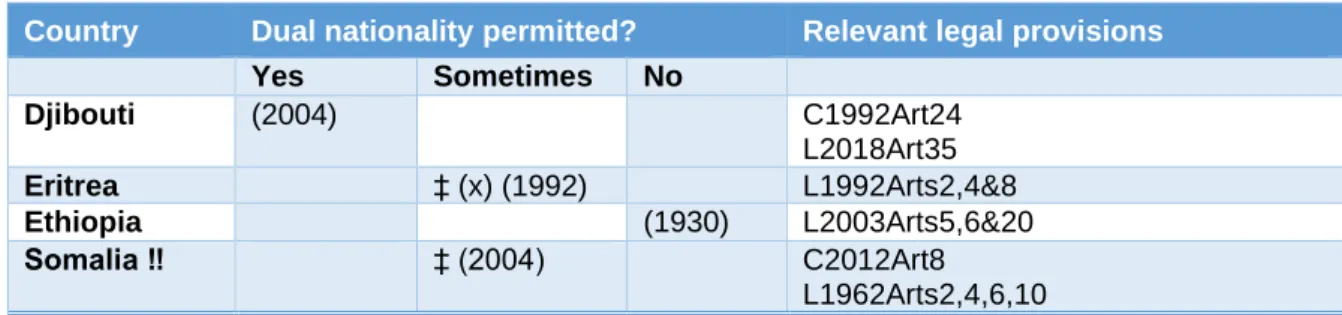
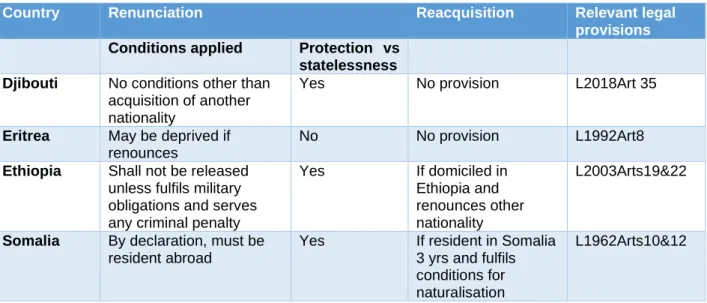
77 Convention on the Rights of the Child, art.20(3); African Charter on the Rights and Welfare of the Child, art. Dual nationality was generally banned by the laws of the newly independent African states in the 1960s. The countries of the Horn of Africa have only partly moved in the same direction.
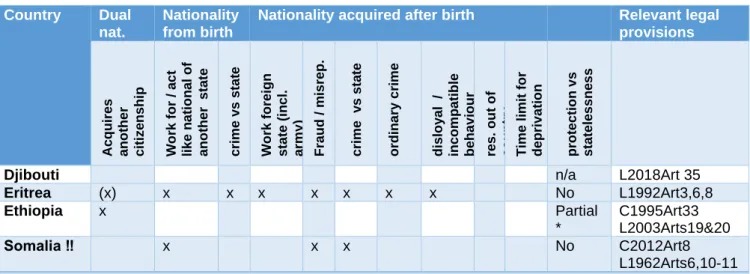
23(1): “A Committee on Nationality Matters shall be formed, consisting of the following members: a) a representative of the Authority (Chairman); b) a representative of the Ministry of Foreign Affairs (member); c) a representative of the Ministry of Justice (member); d) a representative of the Federal Police Commission (member); e) a representative of the Authority (member and secretary)”. Eritrea provides for deprivation of nationality by decision of the relevant authorities if a person renounces their nationality – i.e. permission is required to relinquish Eritrean nationality (as for dual nationality).
NATIONALITY ADMINISTRATION IN PRACTICE
After this investigation had been successfully completed by the kebele, the municipality carried out an independent investigation and verified the data and issued the birth certificate. 123 Origin Report Eritrea, National Government, February 2017 https://www.rijksoverheid.nl/documents/reports land-van-oorsprong-rapport-over-eritrea-februari-2017. The national identity card is compulsory for all adult citizens and states the nationality on the front of the card.
Djibouti introduced a biometric passport in 2017, with the requirement to replace the old passports by the end of the year. 161 Country of Origin Report on Eritrea, Government of the Netherlands, February 2017 https://www.government.nl/documents/reports country- of-origin-report-on-eritrea-february-2017. Ethiopian passports are issued on the basis of the kebele identity card and birth certificate (also obtained from the kebele administration).
A statement in respect of the individual, made in court by the Ministry of Interior registered Akil (clan chief) of the individual's community. b) The form designed for this purpose by the Citizenship Office and signed by the individual.”. 192 Country of Origin Report Eritrea, National Government, February 2017 https://www.rijksoverheid.nl/documents/reports land-van-herkomstrapport-over-eritrea-februari-2017.
GROUPS AT RISK OF STATELESSNESS
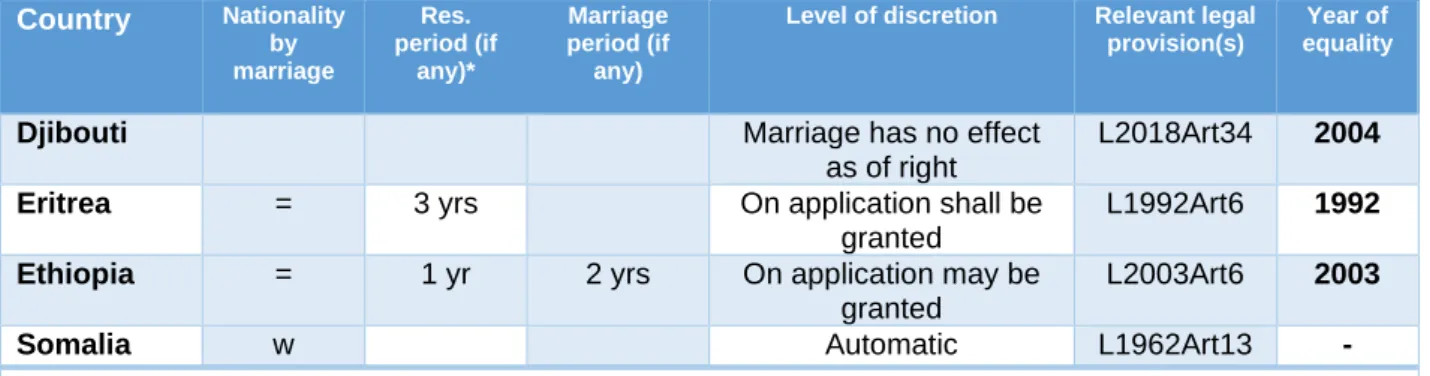
Only a minority of orphans or unaccompanied children are at risk of becoming stateless: if the child's family members can be traced, identity and nationality can usually be established (even as an adult child). Somalia (and Somaliland) legislation, however, continues to discriminate on the basis of the gender of the parents. If the child acquires the citizenship of the father, there is in principle no risk of statelessness.
In the Horn of Africa, where much of the land is arid or semi-arid, a large percentage of the population is traditionally of a nomadic, or semi-settled, pastoral lifestyle. They include groups speaking dialects of the Somali language, including the Rer Hamar, who live in Mogadishu and the traditional inhabitants of the Merca port. Eno, "A Tale of Two Minorities: The State of the Gaboye and Bantu Communities of Somalia," in Minorities and the State in Africa, ed.
The draft citizenship bill was presented to the Council of Ministers together with a summary of the public feedback. At the outbreak of the war, there were still about half a million people of Eritrean origin living in Ethiopia, including about 200,000 who lived in the Tigray border region.
INTERNATIONAL AND AFRICAN LAW
The African Charter of Human and Peoples' Rights and the case law of the African Commission. The African Charter on the Rights and Welfare of the Child and the jurisprudence of the African Committee of Experts. The African Charter on the Rights and Welfare of the Child (ACRWC) states in Article 6, in a language similar to the CRC, that every child has the right to acquire a nationality.
The African Committee of Experts on the Rights and Welfare of the Child adopted a general comment on Article 6, which provides detailed guidance on the obligations of States in relation to birth registration and the reduction of statelessness.309. 306 Decision on the report on the activities of the African Commission on Human and Peoples' Rights (ACHPR), doc. 309 African Committee of Experts on the Rights and Welfare of the Child, 'General Comment No.
The African Charter on the Rights and Welfare of the Child also includes the right to birth registration. 320 African Committee of Experts on the Rights and Welfare of the Child, "General Comment on Article 6".
CONCLUSIONS: STATELESSNESS IN THE HORN OF AFRICA
Perhaps the most important recommendation of this report would be that the initiatives to strengthen the identification systems should pay close attention to the protection of the right to a citizenship and the reduction of statelessness right from the moment of design. Universal birth registration is particularly important for the establishment of the right to citizenship for any child (either in the state of birth or in one of the parents' state of origin). There is extensive international guidance on the establishment of civil registration systems.329 However, birth registration does not provide a complete solution to the problem of statelessness unless it is accompanied by legislation and policy reforms to provide at least the minimum rights of nationality outlined in international law, including the right to citizenship in the country of birth , if the child would otherwise be stateless; and to establish child protection systems that ensure that children at risk of statelessness are in practice recognized and documented as citizens of the state of birth or, where relevant, the state of origin of their parents.330.
The proposal in Somalia to create a biometric database of all residents, regardless of citizenship or not, is loosely based on India's biometric identity system known as "Aadhaar". The status of Somalia's minorities as full citizens of the modern state has been contested for decades. Principles and Recommendations for a System of Vital Statistics, Revision 3', Statistical Papers, Series M (New York: United Nations, 2014), http://unstats.un.org/unsd/demographic/standmeth/principles/M19Rev3en.pdf.
While Somalia is perhaps the most challenging environment, the same challenges exist in all countries of the region. Any discussion of the best institutional arrangements to address these issues should therefore focus on the reality that in contexts where a very large percentage of people currently do not have birth certificates or other official proof of identity, alternative proof of identity systems are required for initial registration to take place.
RECOMMENDATIONS
Somalia should review the provisions of its nationality law that create preferential access to citizenship based on ethnicity, to ensure they comply with international and African norms and standards, and in particular to avoid the risk of statelessness for those living in born in the country and who are not members of the preferred group or groups. Review laws to ensure access to nationality for nomadic and frontier populations, using the provisions of the draft Protocol to the African Charter on the specific aspects of the right to a nationality and the elimination of statelessness in Africa. Supporting the finalization of the draft Protocol to the African Charter on the Specific Aspects of the Right to a Nationality and the Eradication of Statelessness in Africa by the AU's Specialized Technical Committee on Justice and Legal Affairs and the subsequent adoption of the Protocol by the heads of state and government.
If this is not possible, the person should be granted stateless protection, as a temporary measure, with facilitated acquisition of citizenship in accordance with the requirements of the Convention for the Protection of Stateless Persons. Conduct research on populations at risk of statelessness to identify those groups or individuals who require confirmation of their right to citizenship in the country in which they live, or temporary protection as stateless persons, prior to facilitated acquisition of citizenship. CEDAW: Convention on the Elimination of All Forms of Discrimination Against Women, 1979 CRC: Convention on the Rights of the Child, 1989.
Sex, citizenship and the state: the construction of the public and private spheres in colonial Eritrea. The Child and the Law in Ethiopia: The Case of the UN Convention on the Rights of the Child.