In addition, it is theoretically argued that external efficiency has two dimensions, outcome efficiency and means efficiency. In the results of the thesis, four general approaches to external efficiency are presented and analyzed. Second, it is argued that external efficiency has two dimensions: Outcome efficiency and means efficiency.
External effectiveness refers to “the degree of influence that people believe they can exert as a result of the actual functioning of the political system” (Caprara et al 2009:1001). External effectiveness is about the degree of influence that people believe they can exert because of the actual functioning of the political system. It is further argued that external efficacy has two dimensions; outcome efficacy and means efficacy.
Previous research
To make climate action compatible with the representative task, some use a "cosmopolitan claim" to act in the interests of the global community without public pressure. Another survey of MPs in the UK shows that a majority is resigned to the way things are done. Further interviews with UK MPs suggest that politicians mostly understand the scientific support for and significance of catastrophic climate change.
An overview of the party programs of the parties in the Riksdag shows that all are closer to the ecological modernization paradigm than the social change paradigm (references to the party programs listed under Party programs in the bibliography). However, sometimes indications are given in the results about how many respondents used certain expressions, to improve transparency. Swedish participation in the Paris Agreement and the Swedish climate goals, and its affiliates sometimes express doubts about the seriousness of the crisis (Arenander et al 2022).
Indeed, external efficacy has a dimension of personal agency, as it again concerns "the degree of influence that people feel they can exert" because of this structure. Above all, the end is defined in a subjective sense; sufficient emissions reduction is in the eye of the beholder. In relation to climate change, the perception is that politicians can choose means to reduce emissions that they believe are beneficial to the country as a whole, regardless of emissions reductions per se.
The citations on which these judgments are based are coded (see "Task to be presented" in the codebook), and the most important citations are listed below the results. The interviews were semi-structured in the sense that they were conducted using an interview guide, but the order of questions depended on how the interview developed. We can also ask how free the respondents are in reflecting on the premises of changes in dominant discourses (cf. ibid: 98).
The weakness of the study is that the questions did not cover in which measures the politicians believe that their effectiveness is manifested.
Results
Typology of general outlooks on external efficacy
However, they are optimistic about electoral acceptability in the long term, perceiving it as possible to escape the 'government trap'. While optimists perceive climate measures as beneficial to the national economy and without restrictions on citizens' lifestyles, they have difficulty understanding the lack of electoral acceptability. The respondent quoted below stated that they felt that the means of carbon capture and storage techniques were necessary, although they would have preferred more profound changes in consumption habits.
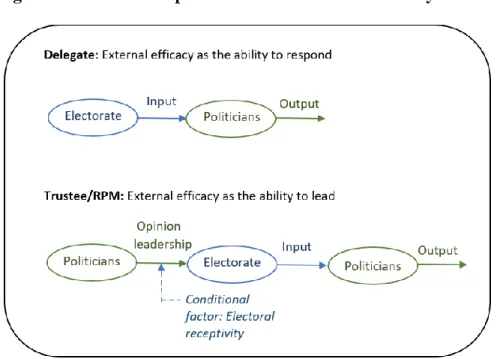
The next respondent mentioned that he would prefer to advocate for fossil fuel bans, but is afraid of ending up in the "banned box". Respondents expressed that they found it almost impossible to constructively discuss such a complex issue. To defend political proposals and political choices of direction, therefore there is a responsibility. As in RPM, the respondent believes that politicians are responsible for gathering support for their program and promoting public opinion from above.
On the whole, the respondents did not understand their representative ideal as a delegate who should implement what the voters want; they expressed that politicians should also get voters to want what is best in the representative's views. As shown in the previous section, their conceptualization of the representative task does not account for this more passive approach to public opinion. According to the respondents, leading public opinion from above is an ideal, but what is actually happening is an approach to public opinion that is closer to the delegate concept of representation.
The smaller the change in living situation, the more attractive it is to voters and vice versa. In the following, the respondent justifies that he would prefer stable and fossil-free electricity production, but the rest is less clear. The answer seems to be an ecologically modernizing type of politics that dominates responses across party affiliations.
Like [laughter] the way we used to live in the old days […] we eat what we grow ourselves and we help each other […] this is what I think society should look like if we're going to live sustainably […] But I think it is impossible to scale back this way.
Discussion
Since climate change is considered the least likely case for external effectiveness, this provides an indication that the respondents see themselves as all-in-all capable of governing. The dismissed realists do not believe they have a realistic chance of ensuring that the climate transition takes place with means that are best for society in general. It may be easier to think (or admit) that the means are limited than that the outcome itself is out of reach.
An explanation for the lack of politicians without result effectiveness could be that the sample consists of senior climate politicians and politicians with a special interest in climate change. The perception that lifestyle changes are beyond their means may explain the lack of visions of deep change. From one perspective, the (perceived or actual) inadmissibility to climate policies that imply lifestyle changes may be due to the lack of visions.
The optimists believe that the electorate is receptive to the economic benefits they think will flow from climate policy as efficiency improvements. Notably, the perceived receptivity to lifestyle changes is also ubiquitous among these respondents, but the perceived lack of need for such changes allows the optimists to fully escape the government trap. Thus, economic co-benefits from technological innovations and the lack of need for lifestyle changes enabled the optimists to have both outcome and means efficiency.
Since they do not find deep social changes desirable, they avoid the perceived wall of electoral inadmissibility regarding lifestyle changes. In line with this claim, the only ones who have both types of efficiency imagine that the sustainable society remains the same, but high-tech.
Conclusions
In connection with research question two, it is theoretically argued that ideals of representation define which tasks politicians need external efficiency to perform. Empirically, it appears that the politicians interviewed here perceive the representative task to include driving opinion from above, but again that this is beyond their external effectiveness when it comes to lifestyle changes. Thus, driving public opinion is the prevailing ideal, but this ideal is deviated from when it comes to policies involving lifestyle changes.
Because voters are seen as apathetic to such climate policies, social change is seen as a means of mitigation beyond their means. As such, the idea of what people can perceive as the good life has set the stage for what climate policy is envisioned. The only MPs who can imagine a sustainable society are the optimists who think that society can remain the same but high-tech.
The perceived lack of electoral responsiveness makes preserving current lifestyles a starting point for climate policy that makes sense to propose. Future research should examine how politicians perceive their external effectiveness in other contexts and with regard to other political issues, and also how these perceptions vary with party membership. Further, future research should decipher how politicians' perceptions of external effectiveness and ideals of representation are statistically linked, as this design does not allow for that.
Finally, it would be interesting to see actual electoral responsiveness to lifestyle-changing policies as opposed to perceived ones; the politicians interviewed here overestimate resistance to social climate policy.
Bibliography
External efficacy and political participation revisited: The role of perceived output structures for state- and non-state-oriented forms of action. The Economic Roots of External Efficacy: Assessing the Relationship between External Political Efficacy and Income Inequality. Economic Globalization, the Perceived Maneuver of National Governments, and Electoral Participation: Evidence from the 2001 British General.
Towards an integrative social identity model of collective action: a quantitative research synthesis of three social psychological perspectives.
Appendix
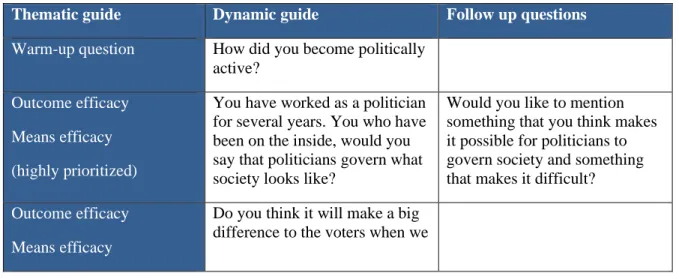
In the public debate, you often hear that it is the politicians' responsibility to stop climate change. Do you think it is politically possible for Sweden to reach net-zero emissions by 2050. Find out if this is with emission reductions or other societal effects in mind.
Do you think big reductions in emissions can be made while we're making a better society? Do you think it is possible for you as a politician to exert an influence to bring us closer to such a society? Do you think growth can be combined with large and rapid reductions in emissions, and thus net zero emissions?
Do you think voters want the politics of a society with a fraction of today's emissions? Some questions concern perceptions of growth, as this was expected to be important for climate change externalities due to previous research (presented in Policy response so far).