
1–26 of the former Springer series on atoms and plasmas are at the end of the book. This forms the basis for practical applications in atomic and molecular physics in Part III of the book.
Elementary ideas
Dirac's theory gives a very satisfactory account of the spectrum of atomic hydrogen, including the fine structure [15, 16]. An extension of Breit's equation in terms of the fine structure constant α adds a family of perturbation operators to the two- (or many-) electron Schr¨odinger Hamiltonian [20, p.181].
The one-electron atom
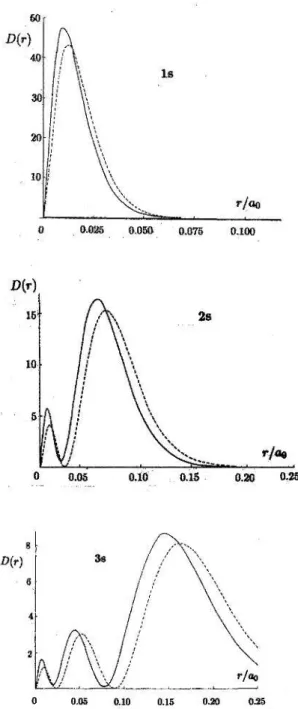
For electrons, PEκ(r) approaches the Schr¨odinger radial amplitude in the formal nonrelativistic limit α → 0 (c → ∞), while QEκ(r) =O(α) and thus vanishes in that limit; the former is therefore often designated as the large and the latter the small radial component.3 The bound state radial quantum number counts the number of nodes or zeros in the large component. Noticeable relativistic effects require that the relative mean orbital velocity vn2/c2 must be at least approximately 0.1, so that the criterion (1.2.7) from mean kinetic energy gives Z/n≥40. The average speed is less than the maximum achievable so a better indicator might be the fraction of the orbital charge density that moves within the (sphere class density) within the (sphere class density) within the (sphere class density) >0.1mc2/Eh.
Many-electron atoms
The Hartree-Fock (HF) and Dirac-Hartree-Fock (DHF) eigenvalues give a very simple picture of how this happens. The Pyper/Grant model thus approximates the total energy of anlN configuration using the formula of the formula.
Applications to atomic physics
The relative dominance of the electron-nuclear interaction in highly ionized atoms often makes a central field model a surprisingly good starting point. Treatment of the magnetic part of the electron-electron interaction on the same footing as the Coulomb interaction in the DHF calculation.

Relativistic molecular structure
The problem is that this requires compact basis functions to reproduce the correct knot structure in the nuclear region of the atom. Similar calculations have been made for nuclear PT odd effects in the TlF molecule [137], aiming to place limits on the proton's EDM. ICAMDATA - First International Conference (AIP Conference Proceedings 434) (Woodbury, NY: American Institute of Physics). The quote is used with permission from the Royal Society.).
Some explanations of the organization of the bibliography can be found in the printed books.
The special theory of relativity
The topics presented in this chapter are indispensable foundations for the relativistic theory of atomic and molecular structure, often taken for granted by those whose main interest is in the application of the theory. Although §2.4–§2.6 can be read and mostly understood without first reading material on the Lorentz and Poincar groups, the reader will likely find that they need it to fully understand the properties of these relativistic wave equations. Thus, if O and O′ are two inertial observers who have set up coordinate systemsxandx′, it can be shown that the most general transformation compatible with the assumptions is of linear form.
The simple form of the Minkowski metric, (2.1.3), means that the distinction between covariant and contravariant indices is not very significant here, except for algebraic accounting.
The Lorentz group
However, the identity inL↑+ can be generated with (u0,u showing once again the two-valued nature of the homomorphism. Let D(Λ) be a representation of the Lorentz group, and denote the infinitesimal generators of the representation of Mµν. To find the representations of these Lorentz representations, we must therefore identify all possible Lorentz representations.
They are therefore group invariants, and, by Schur's first lemma [6,§4.8], are multiples of the identity in any irreducible representation.
The Poincar´ e group
The construction of irreducible representations of the Poincar'e group requires a complete set of six commutative operators. Since C2 is an invariant, we can calculate its value in any suitable frame, in particular the rest frame of the particle in which p = 0 and thus H = mc2. According to (2.3.14), the components of wµ satisfy the usual commutation relations for angular momentum operators, so that the states can be classified in terms of the eigenvalues of J2 and J3.
Thus τ∗−1τ commutes with all the components of s, and by Schur's first lemma is a multiple of the identity.
The Klein-Gordon equation
The undefined energy sign E appears related to the appearance of the second-order time derivatives in the Klein-Gordon equation (2.4.2). Solving the initial value of the equation thus requires that φ and ∂0φ be given first, whereas the usual quantum theory, in which only a first-order time derivative appears, only needs the value of φ. It follows that χ(x) is a basis vector for the 2-dimensional representation (s= 0) of the complete Poincar´e group since .
We will see in Chapter 3 that an eigenvalue expansion of the Dirac equation confirmed the conjecture of Uhlenbeck and Goudsmit.
The Dirac equation
By writing, we can correct the representation of the infinitesimal operators of the Foldy algebra. However, L := X×p is a motion constant in the Foldy-Wouthuysen representation, and so is the mean value rotation operator. The Foldy-Wouthuysen transformation was a major step forward in understanding the nature of the solutions of the Dirac equation for the free electron.
Dirac realized that this meant that even "The simple problem of the scattering of a photon on an electron is no longer a two-body problem.
Maxwell’s equations
The variation of the action with respect to the A field components gives Maxwell's equations as before. Because ∆(x) is invariant, it must be a function of the single invariant argument x2 when x2<0 (xspace-like), and of the invariant arguments x2 and. From (2.9.29) and (2.9.35) we see that the Coulomb gauge splits the four-potential into a scalar potential that depends only on the ν= 0 component of jν(x′), the charge density, and a vector potential that depends only on the 3-current vector.
Additional material on relativistic notation (§A.1), Dirac matrices (§A.2), properties of spherical Bessel functions (§A.3.1), confluent hypergeometric functions (§A.3.2), and frequently used properties of central field Dirac orbitals (§A.4) has been collected in the Appendices.
Free particles
Since the operators P P and W W commute with each operator of the group, they can be used to label the irreducible representations. These two quantities are examples of bilinear covariants that can be constructed from expressions of the form ψ(x)A ψ(x), where A is one of the Γ operators mentioned in Section 3.1.1. The plane wave solutions of Dirac's equation can be divided into disjointed sets according to the sign of the energy.
The irreducible representations of the Poincar´e group can be characterized by the invariants C1 = P·P and C2 = w·w, §2.3, which we can work with.
Spherical symmetry
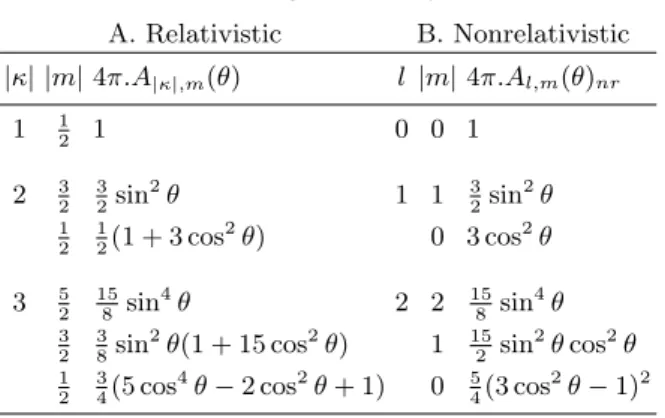
Basis functions for representations D(j) mej =l±12 can now be constructed from sums of products of the form2. The linear independence of the roll angle functions allows us to separate the radial parts to give the coupled equations. The structure of (3.2.25) implies that the two components ofu(r) must contain Riccati-Bessel functions of the same type.
For standing waves, the integral on the right can be evaluated in terms of the well-known integral [6, pages 90-91].
Hydrogenic atoms
Most discussions of the Dirac hydrogen equation ignore (3.3.5), and avoid discussing the status of the analytic bound state solutions; however Greiner [8,. In fact, the same problem occurs for s states in the Schr¨odinger theory of the hydrogen atom. In terms of n, nr and N are therefore the normalized bound state solutions of the Dirac hydrogen problem.
Similar inequalities can be constructed for the radial moments of the charge distribution (2Zr)snκ.

Scattering by a centre of force
Asymptotic analysis of the solution reveals that (3.4.1) is not quite right for Coulomb waves since terms involving lnp appear in the exponents. The linear independence of the functions χκ,m allows us to choose the coefficients A±k = eiδ±k so that Ψ has an asymptotic form that is the sum of an incident plane wave propagating forward along outgoing spherical Ozand waves as in the nonrelativistic case. The differential cross section is the ratio of the number of particles scattered in a solid angle element dω per unit time to the number of particles in the unit area of the incident beam passing per unit time.
By definition, the spin of a particle is defined as the total angular momentum in the particle's rest frame.
Green’s functions
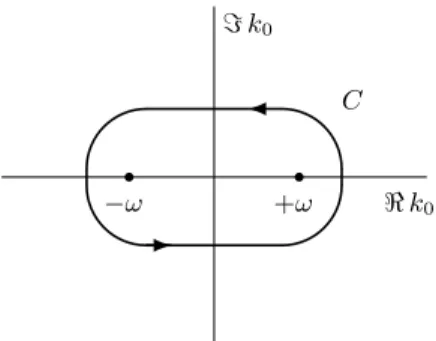
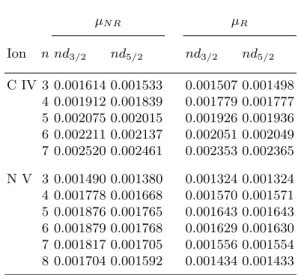
A typical model calculation for the relativistic nd3/2.5/2 series in the C IV ion is shown in Figure 3.3. The Green's function for the relativistic hydrogen ions was similarly constructed by Brown and Schaefer [32] and by Wichmann and Kroll [33]. As a function of z, Coulomb Green's function Gκ(r,s;z) has branch points atz=±c2as in the case of free particles.
Although the sum over partial waves can be performed analytically for the non-relativistic hydrogenic Green's function, no comparable result is known for the relativistic hydrogenic case.
The nonrelativistic limit: the Pauli approximation
Dirac's prediction that the electron possesses an intrinsic magnetic dipole was a major theoretical breakthrough. The magnetic dipole moment of the electron has been measured within an uncertainty of several parts in 1012 [34, p. So the Theg factor has the same absolute value for the electron and the positron and its sign is that of the particle charge.
The Pauli approximation was the earliest attempt to devise an approximate treatment of the Dirac equation, and it remains a popular method for approximately accounting for relativistic effects.
Other aspects of Dirac theory
Quantum electrodynamics (QED), the study of the motion of electrically charged particles such as electrons, positrons, and charged nuclei, provides the formal framework for the relativistic theory of atoms, molecules, and other forms of matter. Quantum field theory [1, 2], of which QED is an example, was devised to model physical processes in which the number of particles is not necessarily fixed. The coupling of the electron-positron field with the Maxwell photon field in QED allows us to build a relativistic theory of atoms and molecules.
The interaction of a charged particle with the fluctuations of the Maxwell photon field leads to a correction to the energy of the particle and to its magnetic moment, while the charge of the particle modifies the electromagnetic field nearby.
Second quantization
A subset of these diagrams corresponds to the well-known self-consistent field theory, which is both the starting point for more accurate calculations and a popular model in its own right. Diagrams associated with "radiation corrections", which are not normally included in theories of atomic or molecular electronic structure, pose additional technical challenges. Similarly, we now interpret ψ as an operator on an as yet undefined space in the Heisenberg picture and replace ψ∗ with the operator adjointψ†. Then is the Hamiltonian operator.
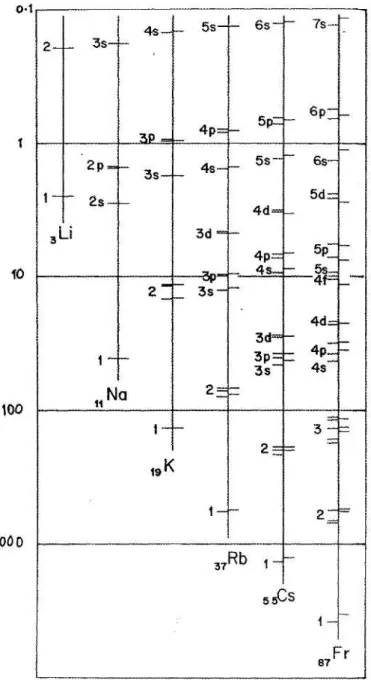
![Fig. 1.7. Koopmans’ theorem binding energies for alkaline earths, Group 2. The electron configurations are [Core] ns 2](https://thumb-eu.123doks.com/thumbv2/5dokinfo/19312660.0/47.661.134.523.86.815/koopmans-theorem-binding-energies-alkaline-earths-electron-configurations.webp)
![Fig. 1.8. Koopmans’ theorem binding energies for Group 13. The electron config- config-urations are [Core] ns 2 np](https://thumb-eu.123doks.com/thumbv2/5dokinfo/19312660.0/48.661.133.496.95.815/koopmans-theorem-binding-energies-group-electron-config-urations.webp)
![Fig. 1.9. Koopmans’ theorem binding energies for carbon Group 14. The electronic configurations are [Core] ns 2 np 2](https://thumb-eu.123doks.com/thumbv2/5dokinfo/19312660.0/49.661.159.488.81.715/koopmans-theorem-binding-energies-carbon-group-electronic-configurations.webp)
![Fig. 1.10. Koopmans’ theorem binding energies for nitrogen Group 15. The elec- elec-tronic configurations are [Core] ns 2 np 2 np 3](https://thumb-eu.123doks.com/thumbv2/5dokinfo/19312660.0/50.661.175.491.82.728/koopmans-theorem-binding-energies-nitrogen-group-tronic-configurations.webp)
