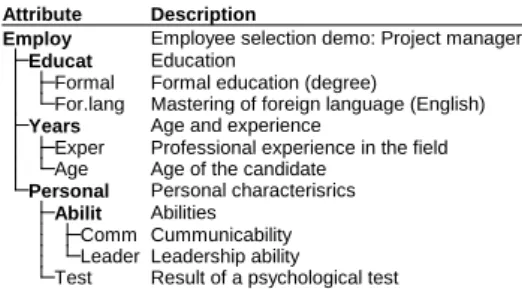
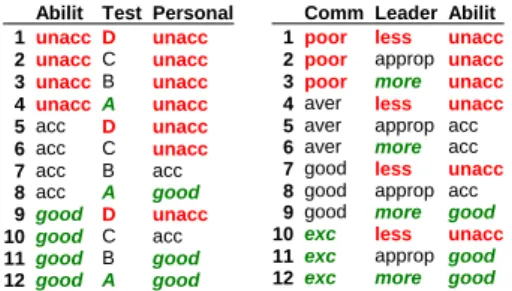
Originally, DEXi was designed as an educational software (the letter "i" in DEXi, pronounced "ee", actually comes from the Slovenian "izobraževanje", education). Attributes with 𝑆(𝑥) ≠ ∅ are called aggregated attributes and are also considered (partial, lower level) outputs of the model. The most important results are those that map to one or more roots of the model.
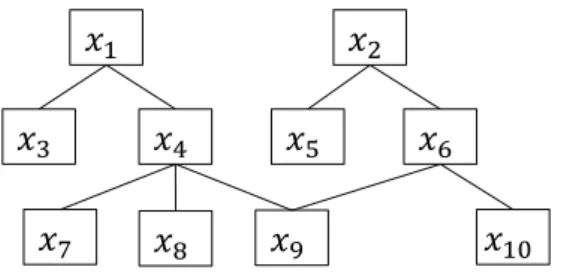
Given a particular model 𝑀, the evaluation is performed as a bottom-up clustering of model inputs against its outputs according to a hierarchical structure of attributes and associated clustering functions. About scale order: Use priority-ordered scales whenever possible; they really help in the definition of decision tables. An expert system is expected to provide some answers, albeit incomplete or less accurate, even in the case of missing or uncertain input data or "holes" in the knowledge captured by the system.
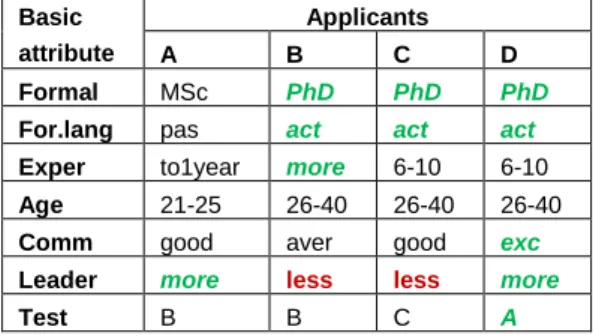
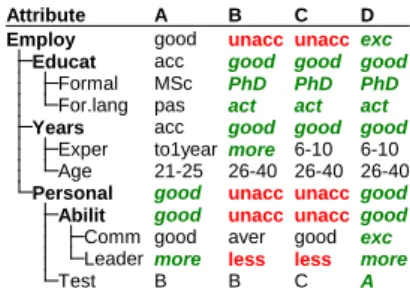
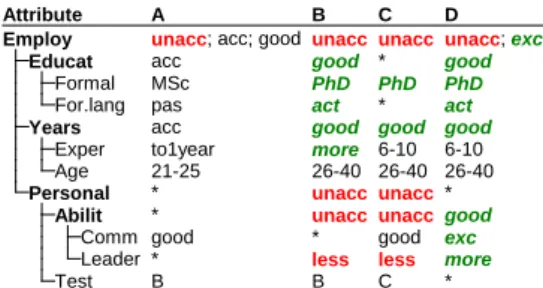
For example, if For.lang was not "after" but one step less (ie . "no"), the candidate would have been evaluated as "unacc".
Applications
DEX applications generally fall into one of the following categories: (1) one-time decisions, (2) recurring decisions, and (3) decision support systems. The first applications of DEX were mostly one-off and addressed decision problems related to computer technology, for example choosing a database management system (Rajkovič and Bohanec, 1980) and purchasing a mainframe computer for a large factory (Bohanec, et al. al. , 1983). The focus gradually shifted to other problem domains, such as employee selection (Rajkovič, et al., 1988).
Since then, similar problem types have been approached, e.g. for the evaluation of public administration e-portals (Leben, et al., 2006), project self-assessment (Žnidaršič, et al., 2009), mountain huts (Stubelj Ars and Bohanec, 2010) , and mountain lakes (Ravnikar, et al., 2016). Since 1990, with the further development of DEX and supporting software, recurring decision problems have become increasingly accessible. Examples include support for admissions processes in public schools (Olave, et al., 1989), performance evaluation of enterprises (Bohanec and Rajkovič, 1990), and evaluation of research and development projects (Bohanec, et al.). estimating risks associated with breast cancer and diabetic foot.
Probably the most important applications in the 1990s were Talent, a system for advising children in choosing a sport (Bohanec, et al., 2000b), and a series of applications for the allocation of housing loans in cooperation with the Slovenian Housing Fund (Bohanec et al., 1998). For example, more recent applications in recurring problems related to the evaluation of researchers (Taškova, et al., 2007), data mining workflows (Žnidaršič, et al., 2012), detection of financial market manipulations (Alić, et al., 2013) , and water management investment projects (Brelih, et al., 2019). Many recurring decision problems seek to implement the decision process in the form of a decision support system (DSS).
OVJE: a DSS for the evaluation of electricity generation technologies in Slovenia (Bohanec, et al., 2017a); IPSIM Chayote: prediction and management of fruit fly damage to chayote on Reunion Island (Deguine, et al., 2021). 23 Other recent international applications of DEX addressed hydropower investments (Saracoglu, 2016), assessment of offshore installation risks (Erdogan, et al., 2018), redeployment of employees (Hajnić and Mileva Boshkoska, 2020 ) and the development of ethno villages (Prevolšek, et al., 2020).
Two real-world examples
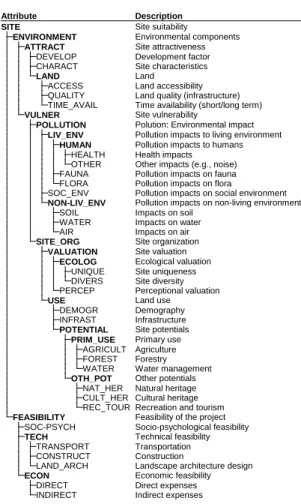
TECH is at the bottom of the tree; such attributes are often associated with specific decision rules and tables, which aim to solve the decision problem at that level and provide useful evaluations/interpretations for higher levels of the model. The second example in Figure 15 is at the base of the model and merges ENVIRONMENT and FEASIBILITY into the overall site assessment (SITE). This is a typical representative of high-level aggregation functions, which tend to be symmetric or nearly symmetric, excluding all cases that evaluate poorly (i.e., "unacc") at lower levels of the hierarchy.
SOC_ENV Pollution impacts on the social environment NON-LIV_ENV Pollution impacts on the non-living environment. NAT_HER Natural heritage CULT_HER Cultural heritage REC_TOUR Recreation and tourism FEASIBILITY The feasibility of the project. 25 out of a series of "what if" scenarios, explore possible improvements to the characteristics of the locations and foresee an "optimistic" or "pessimistic" development of the investment project.
The second example is taken from a more recent project aimed at identifying reliable, rational and environmentally friendly production of electrical energy in Slovenia by 2050 (Kontić, et al., 2016; Bohanec, et al., 2017a). Here we will only briefly outline the first one; for more information the interested reader is referred to (Kontić, et al., 2016; Bohanec, et al., 2017a). The first one (Figure 18) merges the assessments of Rationality, Feasibility and Uncertainties into the root assessment of the suitability of Technology.
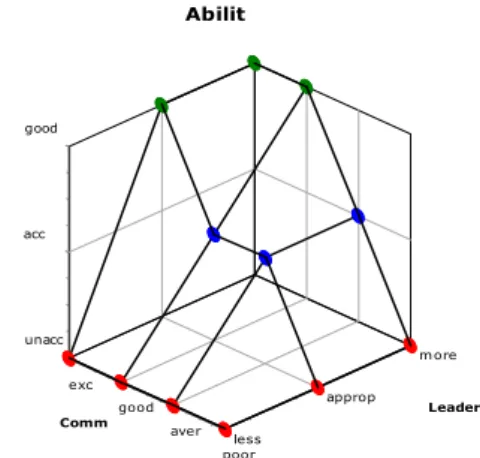
This table is evaluative, because it evaluates several criteria (in this case Technology) according to the ratings of the input criteria: the better the value of each input criterion, the better the overall rating. The latter usually occur at lower levels of the model and define concepts that enter the evaluation process at higher levels of the hierarchy. Using Model T, the study (Bohanec, et al., 2017a) concluded that there were only three technologies suitable enough for Slovenia: Hydro, Gas and Nu-cle.
DEX extensions
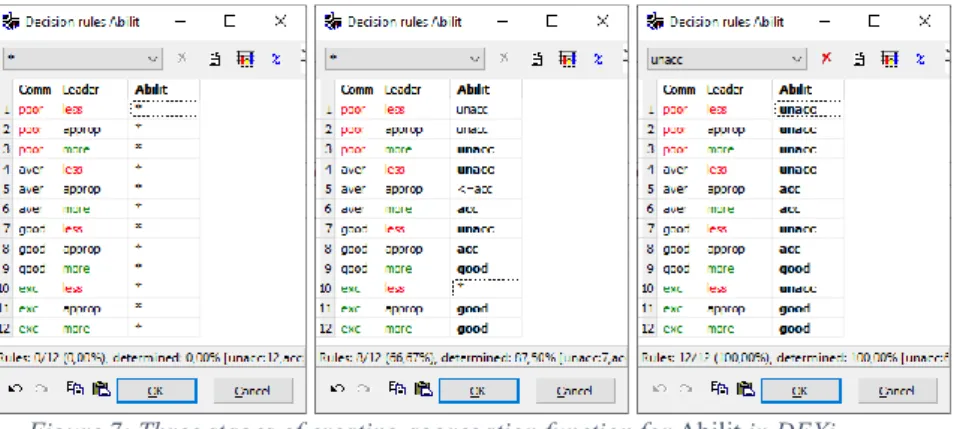
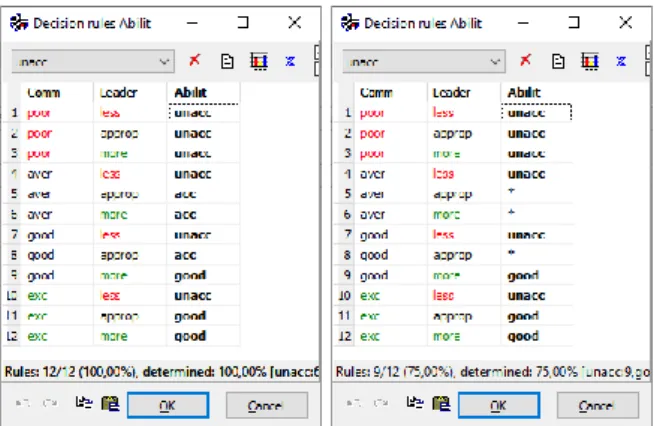
However, this is not enough, because such a change should also preserve the dynamic aspects of the method: support of the creation and modification of aggregation functions, consideration of completeness, consistency and monotonicity of aggregation functions, and performance in the case of missing or uncertain data or knowledge. The formal DEX model does not define any weights to be associated with qualitative attributes and decision rules. This method is actually implemented in DEXi and is used for approximate two-way transformations between weights and decision tables: (1) estimation of weights from defined rules using the above approach, and (2) determining the values of still undefined decision rules on the basis of already defined rules and user-specified weights.
With qualitative DEX, this is in principle possible by refining the model by adding new categories and/or adjusting decision rules to improve the separation; however, this requires redefinition of at least some parts of the model. If possible, the process should not entail additional work and should rely only on information already available in the model. The offset -0.5 is interpreted as "particularly bad" in the context of 𝑣, and +0.5 is interpreted as "particularly good".
In the estimation algorithm, the quality estimate of 𝑣 remains exactly the same as before, and 𝜔 is estimated from the corresponding decision table using the dominance principle and some additional assumptions. The idea is to allow the use of distributions of values instead of single qualitative values at all locations marked 𝐸𝑥 and 𝐸𝑦 in the formal model. This extension places additional requirements on the estimation procedure: uncertainties, represented by vague probabilities or probabilities, must be propagated from input to output attributes in the hierarchy.
This evaluation procedure was actually implemented in the previous generation of DEX software, and is still supported by software libraries JDEXi, DEXi.NET and DEXx. On the other hand, it is also true that the task is demanding, especially since the definition of decision rules generally requires more effort than the definition of comparable pooling functions in other MCDM methods. In the third attempt, Bohanec and Delibašić (2015) followed an intermediate approach: given the structure of attributes and data, construct all aggregation tables in the model, taking into account probability distributions of input attributes and applying the principle of dominance.
Summary
The authors demonstrated the approach by developing a model for predicting injury risk in ski resorts. 33 DEX models can suffer from the combinatorial explosion: the size of decision tables increases exponentially with the number of incoming attributes. When developing a DEX model, it is therefore important to follow recommendations aimed at keeping the size below around 100: make "narrow" hierarchies with only 2 or 3 descendants of a total trait, and use the least number of values per attribute that still distinguish between qualitatively different states of that attribute.
In the future, the main development will go in the direction of Extended DEX, as suggested by Trdin and Bohanec (2018). The proposal includes introducing numerical attributes into DEX models and explicitly addressing uncertainty using probabilistic and fuzzy value distributions. Two challenges remain open for further research and possible software implementation: combined qualitative-quantitative evaluation of alternatives and learning DEX models from data.
Acknowledgment
A multi-criteria qualitative modeling approach for the assessment of electrical energy production technologies in Slovenia. Proceedings of the 20th International Conference Information Society IS 2017, Volume A, Ljubljana: Jožef Stefan Institute. A decision support model for the operational management of employee redeployment in large government organizations. 2019): Whole-system analysis of ecological and economic sustainability in arable farming systems: a case study.
Sustainability evaluation of organic vegetable production using a qualitative multi-attribute model. 2013): Multi-criteria decision analysis: Methods and software. International Journal of Decision Support System Technology for crossing knowledge boundaries in agricultural value chain, Journal of Decision Systems 27, 88–97. A decision support system for evaluating the knowledge sharing that crosses borders in agri-food value chains.
A comparative study of selected multi-criteria decision-making methods for site selection of very large concentrated solar power plants in Nigeria. Assessment of innovative cropping systems with DEXiPM, a qualitative multi-criteria assessment tool derived from DEXi. 2015): Multi-criteria and multi-stakeholder assessment of cropping systems for a results-oriented water quality conservation action programme.
Sustainability assessment of potato fields using DEXi decision support system in Hamadan Province, Iran. A qualitative multi-attribute model for the selection of private hydropower investments in Turkey. An extension of the DEX multi-criteria decision-making method with numerical attributes, value distributions and relational models.