YAŞAR UNIVERSITY GRADUATE SCHOOL
MASTER THESIS
IMPACTS OF DEVELOPMENT AID ON MIGRATION FLOWS:
CASE OF DEMOCRATIC REPUBLIC OF THE CONGO
EVELYNE GASPER RWEBUGISA
THESIS ADVISOR: ASSOC.PROF.(PHD) AYSELIN YILDIZ
M.A. INTERNATIONAL RELATIONS PRESENTATION DATE: 14.01.2022
BORNOVA/İZMİR JANUARY 2022
We certify that, as the jury, we have read this thesis and that in our opinion it is fully adequate, in scope and in quality, as a thesis for the degree of Master of Science.
--- Prof. (PhD) Yücel Öztürkoglu Director of the Graduate School
Jury Members: Signature:
Assoc. Prof. (PhD) Ayselin YILDIZ
Yaşar University ...
Assist. Prof. (PhD) Dilaver Arıkan AÇAR
Yaşar University ...
Assoc. Prof. (PhD) Elif UZGÖREN
Dokuz Eylül University ...
ABSTRACT
IMPACTS OF DEVELOPMENT AID ON MIGRATION FLOWS: CASE OF THE DEMOCRATIC REPUBLIC OF THE CONGO
Rwebugisa, Evelyne Gasper MA, International Relations
Advisor: Assoc.Prof. (PhD) Ayselin YILDIZ
January 2022
Development aid provided by the international donors has always been a significant policy tool to support and improve the development of recipient countries and also curb outward international migration. The European Union (EU) ranks as one of the largest donor organizations that has been utilizing the development aid to maintain peace, security, and economic development in the recipient countries. EU’s development aid also aims to curb migration flows towards EU. The Democratic Republic of the Congo (DRC), as a country of origin for many migrants fleeing to Europe, is amongst the top countries that receive EU’s development aid. This thesis aims to understand how and to what extend the development aid provided by the EU to the DRC affects the migration flows from the DRC to the EU member states.
Accordingly, it seeks to examine the EU’s development aid policy in terms of understanding whether or not the delivery of aid has a significant impact on curbing migration from the DRC by eradicating poverty and improving the economy with sustainable growth. It elucidates that development aid yields both negative and positive impacts in the sense that it does improve the living conditions and economic development on one hand, but it plays relatively a minor role in reducing migration.
keywords: European Union, Democratic Republic of the Congo, migration, development aid, poverty.
ÖZ
KALKINMA YARDIMLARININ GÖÇ ÜZERİNE ETKİLERİ:
DEMOKRATİK KONGO CUMHURİYETİ ÖRNEĞİ Rwebugisa, Evelyne Gasper
Yüksek Lisans Tezi, Uluslararası İlişkiler Danışman: Doç. Dr. Ayselin YILDIZ
Ocak 2022
Uluslararası bağışçılar tarafından sağlanan kalkınma yardımı, her zaman alıcı/faydalanıcı ülkelerin kalkınmasını desteklemek ve geliştirmek ve ayrıca uluslararası göçü engellemek için önemli bir politika aracı olmuştur. Avrupa Birliği (AB), yardım alan ülkelerde barış, güvenlik ve ekonomik kalkınmayı sürdürmek için kalkınma yardımını kullanan en büyük bağışçı kuruluşlardan biridir. AB'nin kalkınma yardımı aynı zamanda AB'ye yönelik göç akışlarını da engellemeyi amaçlamaktadır. Avrupa’ya yönelen birçok göçmenin menşe ülkesi olan Demokratik Kongo Cumhuriyeti (DKC), AB'nin kalkınma yardımı alan ülkelerin başında gelmektedir. Bu tez, Avrupa Birliği'nin DKC'ye sağladığı kalkınma yardımının DKC'den AB üye ülkelerine olan göç akımlarını nasıl ve ne ölçüde etkilediğini anlamayı amaçlamaktadır. Buna göre, AB'nin kalkınma yardımının, yoksulluğu ortadan kaldırarak ve sürdürülebilir büyüme ile ekonomiyi geliştirerek DRC'deki göçü engellemede önemli bir etkisinin olup olmadığı incelenecektir. Tez, kalkınma yardımlarının yaşam koşullarını ve ekonomik kalkınmayı iyileştirmesi anlamında hem olumsuz hem de olumlu etkiler yarattığını, ancak göçün azaltılmasında göreceli olarak küçük bir rol oynadığını açıklamaktadır.
Anahtar kelimeler: Avrupa Birliği, Demokratik Kongo Cumhuriyeti, göç, kalkınma yardımı, yoksulluk.
ACKNOWLEDGEMENTS
This thesis would not have been possible without the support of many people. Many thanks to my supervisor, Assoc.Prof. (PhD) Ayselin Yıldız, who has provided me numerous revisions on the content and helped to solve out the confusion I had in conducting my research. She provided with a perfect blend of encouragement and advice. I am proud of, and grateful for my time working with her. Also thanks to my jury committee members, Assist.Prof. (PhD). D. Arıkan Açar and Assoc.Prof. (PhD) Elif Uzgören, who offered guidance, insight and support.
I am indebted also to several Yasar University stuff and my friends who helped me find my footing as I started this thesis. Lastly, my family and relatives deserve my endless gratitude: my late father who encouraged me to pursue my master' degree, my beloved mother for her love, patience and constant support, and my siblings for teaching me that a proclamation of dominance is not necessarily a bad thing. To my family, I give everything, including this.
Evelyne Gasper Rwebugisa İzmir, 2022
TEXT OF OATH
I declare and honestly confirm that my study, titled “Impacts of Development Aid on Migration Flows: Case of The Democratic Republic of the Congo” and presented as a Master’s Thesis, has been written without applying to any assistance inconsistent with scientific ethics and traditions. I declare, to the best of my knowledge and belief, that all content and ideas drawn directly or indirectly from external sources are indicated in the text and listed in the list of references.
Evelyne Gasper Rwebugisa January, 2022
TABLE OF CONTENTS
ABSTRACT ... iv
ÖZ ... v
ACKNOWLEDGEMENTS ... vi
TEXT OF OATH ... vii
TABLE OF CONTENTS ... viii
LIST OF FIGURES ... x
LIST OF MAPS ... xi
LIST OF TABLES ... xii
LIST OF ABBREVIATIONS/ACRONYM ... xiii
CHAPTER 1. INTRODUCTION ... 1
1.1. Relevance, Aim of the Study and the Research Questions ... 2
1.2. Methodology and Case Selection ... 3
1.3. Outline of the Thesis ... 5
CHAPTER 2. CONCEPTUAL AND THEORETICAL DEBATES ON “DEVELOPMENT” “DEVELOPMENT AID” AND IMPLICATIONS ON MIGRATION GOVERNANCE ... 7
2.1. Defining and Conceptualizing “Development” ... 8
2.2. Selected Theoretical Debates on Development ... 10
2.2.1. Modernization Theory ... 10
2.2.2 Dependency Theory ... 12
2.2.3 Neoliberal Theory ... 13
2.3. Debating Development Aid as a Tool for Inducing Development ... 16
2.4. Development Aid and Migration Governance ... 18
CHAPTER 3. DEVELOPMENT AID AND MIGRATION GOVERNANCE IN THE EU . 21 3.1 History of EU’s Development Policy ... 22
3.1.1. From Yaoundé Convention to “Agenda for Change” ... 22
3.1.2 The New European Consensus on Development ... 24
3.2. EU’s Approach to Address Root Causes of Migration ... 26
3.3 Overall Assessment of the European Union’s Development Policy ... 28
CHAPTER 4. CASE STUDY: DEMOCRATIC REPUBLIC OF THE CONGO ... 31
4.2. Political, Economic and Social situation of DRC ... 32
4.3. Migration Profile of the DRC ... 36
4.4. Development Cooperation between the EU and the DRC ... 40
4.4.1. Impacts and Assessment of EU Development Aid on DRC’s Developmental Path .. 45
4.4.1.1. Prevention of Conflict and Ensuring Stability ... 49
4.4.1.2. Social Development ... 49
4.4.2. Challenges faced by European Development Cooperation in the DRC ... 50
4.4.3. Impacts of EU Development Aid on Migration Flows from the DRC ... 52
CHAPTER 5 CONCLUSION ... 55
REFERENCES ... 59
LIST OF FIGURES
Figure 2.1.Aid Flows to Sub-Saharan Africa from OECD countries ... 17 Figure 3.1.Top Recipients of EU Aid in Sub Saharan African Countries ... 22 Figure 4.1.Net Official Development Assistance received (Current US Dollars) - Congo,
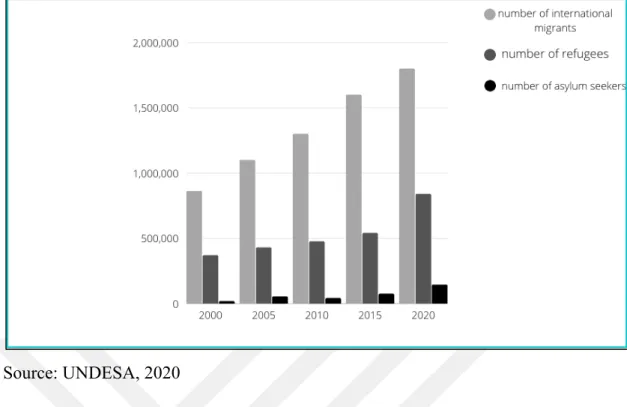
Dem. Rep. ... 35 Figure 4.2. Top Aid Donors in DRC ... 36 Figure 4.3. Graph on the Total Number of International Migrants, Refugees and Asylum
Seekers from DRC. ... 39 Figure 5.1.Migration Trends ın DRC versus Development Assistance received in DRC
(2000-2020). ... 56
LIST OF MAPS
Map 4.1: Administrative map of the DRC including its provinces and bordering countries. 31
LIST OF TABLES
Table 2.1. Selected Theoretical Approaches to Development ... 15
Table 2.2. Selected push and pull factors of migration ... 18
Table 3.1. Total amount of EU aid disbursed to Sub-Saharan Africa. ... 22
Table 4.1. Timeline of key events in the DRC that induced further migration ... 40
Table 4.2. Allocations of Aid under the 9th, 10th, and 11th EDFs in the DRC ... 43
Table 4.3. Development indicators of Democratic Republic of the Congo (2000-2018) ... 48
LIST OF ABBREVIATIONS/ACRONYM
ACP African, Caribbean and Pacific (Groups of States) AU African Union
BODA Belgium Official Development Assistance CA Cotonou Agreement
COFACE Compagnie Française d'Assurance pour le Commerce Extérieur COMESA Common Market for Eastern and Southern Africa
CSDP The Common Security and Defense Policy DRC Democratic Republic of the Congo
ECA European Court of Auditors
ECCAS The Economic Comminity of Central African States EEC European Economic Community
EU European Union
EUFOR-RDC European Union Military Operations in the DRC
EUTFA Africa European Union Emergency Trust Fund for Africa GDP Gross Domestic Product
GNI Gross National Income
IDMC Internal Displacement Monitoring Center IMF International Monetary Fund
IOM International Organization for Migration LDCs Least Developing Countries
MDGs Millennium Development Goals MIDA Migration for Development in Africa MLC Movement for the Liberation of the Congo NGO Non-Governmental Organisation
NIP National Indicative Programme ODA Official Development Assistance
OECD Organization for Economic Co-operation and Development PCD Policy Coherence for Development
QuODA Centre for Global Development Quality of Development Assistance
RCD-G Rassemblement Congolais pour la Démocratie-Goma, RCD-ML Congolese Rally for Democracy Liberation Movement SADC Southern Africa Development Cooperation
SADC Southern African Development Community SSR Sector Security Reform
UN United Nations
UNDP United Nations Development Programme WBDI World Bank Development Indicator
CHAPTER 1. INTRODUCTION
They have marched and camped, some have fully integrated, but some have not.
From Lubumbashi and Kinshasa to Brussels, Paris, and Berlin. These are citizens that have emigrated from the Democratic Republic of the Congo (DRC); all of them have something in common which is to improve their lives by migrating to developed countries. Some work as construction workers while others as cleaners.
Some are more skilled and works in hospitals and universities. On some occasions, some opt for voluntary return to their country because of several reasons yet others decide to stay and only plan to return once they have set aside enough money.
Although statistics suggest that the primary reasons for the DRC migration are unemployment and poverty, some also migrate for political reasons such as to escape war, political persecution, or the local setting regarded as oppressive (IOM, 2019).
The main reasons as to why an individual decides to migrate are as a result of the social, economic, political, and cultural context in which they find themselves (De Abreu, 2012). With the accelerated globalization and technological advances, migration also increases either trans-local or transnational (Levitt, 2004). People tend to emigrate to a country with better standards of living so as a result international migration from least developing countries to developed countries increases on an annual basis. Currently, there are 281 million migrants in the world (IOM, 2020).
The Democratic Republic of the Congo is one of the countries in sub-Saharan Africa that faces many challenges related to economic migration even though external aid aiming to support development has been constant in the country since the 1950s.
With over 5.6 million displaced persons in early 2021 alone (UNHCR, 2021) the political instability that resulted in weak infrastructure has heavily caused poor provision of services. The country relies heavily on cross border exchanges and with no doubt experiences a high demand for out-migration aspirations either by force or voluntarily. This thesis aims to contribute to the debate on the development- migration nexus by analyzing the case of the Democratic Republic of the Congo as a migrant-sending country. In this context, the thesis aims to understand how, and to
what extend the development aid provided by the European Union (EU) to the DRC affects the migration flows from DRC to the EU member states. Accordingly, EU being the world’s largest development donor (European Union, 2020), the study seeks to examine the European Development Policy in terms of understanding whether or not the delivery of aid has a significant impact on curbing migration in the DRC by eradicating poverty and improving the economy with sustainable growth. Thus, the thesis limits its scope with migration flows stemming from economic reasons, specifically due to poverty and high unemployment in the DRC.
Asylum flows are excluded.
1.1. Relevance, Aim of the Study and the Research Questions
The pertinence of addressing the relationship between development aid and migration is justified by its utter relevance. It is also colluded by the considerable increase in both political attention and academic response that the development- migration nexus has amassed. The migration-development nexus specifically in this thesis covers the significant role it plays in terms of shaping future migration trends.
The study examines the DRC as a case study to understand to what extent does development aid provided by the EU affects outward international migration flows in countries that are categorized as socio-economically fragile. The findings from this study are a paramount contribution, as they will conceivably act as a guide to policymakers on how development aid can make an impact on migration. Briefly, the thesis aims to contribute to the development and migration literature constructively by providing insights from the case of the DRC. Accordingly, it makes an analysis on whether or not EU’s development aid helps to curb migration in the DRC.
The main research question of this thesis is “How and to what extent EU development aid plays an efficient role in policies aimed at mitigating migration from the DRC?” Accordingly, it also seeks to answer the complementary following sub-research questions:
• To what extent are development and migration linked?
• Is development aid alone sufficient in addressing the root causes of migration?
• What are the short term and long-term impacts of EU’s development aid to DRC?
1.2. Methodology and Case Selection
This descriptive study mainly relies on an extensive literature review based on the collection of data from secondary sources. It examines books, journal articles, newspaper articles, reports, government, and non-governmental publications as well as all existing data and statistics to make a pondering analysis on the migration and development nexus. The research also highly benefits from various reports of the European Union, The United Nations, and its agencies, particularly International Organizations for Migration (IOM). Additionally, data from sources such as World Bank and International Monetary Fund play a significant role in the analysis of DRC.
The thesis also uses data from other sub-Saharan African countries from different periods to get a proper comparison between the DRC and other neighboring countries. Finally, yet importantly, the study has also benefited from wide archived research including the data from private research organizations together with EU development policy reports.
The research relies on a case study of analyzing development aid from the EU to the DRC and the impact on migration from the DRC. The main reason to choose DRC amongst other sub-Saharan African countries is because the researcher was motivated by the geographical closeness and cultural similarities of the DRC with Tanzania, that is, the researcher’s country of origin. The researcher is able to follow the local debates and interpret local activities taking place in the DRC. Second, among the Sub-Saharan Africa countries, the DRC is one of the significant cases in terms of having high numbers of migration outflow to Europe and high amount of inflow of EU external development aid as well.
The Democratic Republic of the Congo is the most populous country in sub-Saharan Africa with a population of about 80 million as of 2019 (World Bank, 2019). Of which 2% of its population are migrants in different parts of the world and 8.9% of the total Congolese migrants reside in the EU (European Commission, 2017).
Besides, Democratic Republic of the Congo is vital for the EU in line with the major objective to ensure international security and development based on peace and stability (Knutsen, 2009). DRC is the country where the EU conducted its first military intervention –CSDP (The Common Security and Defense Policy) outside of
Europe laying down an important example for the later engagements of the EU in Africa.
The DRC is a country that is considered tremendously resource-rich in terms of forest resources, agricultural potential, and hydroelectric capacity. The Democratic Republic of the Congo accounts for about 60-80% of the global coltan (the mineral used in the production of electric devices) located in the north and south of the Kivu area. Ten percent of the world’s copper located in the Katanga area, 34% of the world’s cobalt is located in the Kolwezi area, 17% of the global production of rough diamonds, and other minerals include tin, gold, and tantalum. However, “the abundance of natural resources in the DRC and the absence of regulation on this sector have created chaos and violations of human rights and international humanitarian law” (OHCHR, 2000). It is the chaos that includes executions, torture, and cruel inhuman treatments and extortion done by the national army (FARDC) and the national police (PNC) that have contributed to the increase in instability of the country. Hence, resulting to the increase in migration outflows of the country.
Poverty is common wide issue and unemployment remains at 4.6 percent as of 2020 (World Bank, 2020).
This study covers a post war period of 15 years starting from 2005 to 2020 in analyzing the DRC. Some of the events that led to the endless chaos in the DRC include, The Great African War or Congo Second War that took place from 1998 to 2003 between the Congolese rebel groups (RCD-G, RCD-ML, MLC) and Congolese Para militia groups (Mai Mai militia, Hutu-aligned forces) under Laurent Kabila backed by Libya, Angola, Namibia, Sudan, and Chad and neighboring countries such as Rwanda, Burundi, and Uganda backed the rebel groups. The war ended in 2003 with an interim government established under Laurent Kabila. Later in 2006 general elections were held, and Laurent Kabila won as the president. In this postwar period, there was the resumption of international aid and the country showed some positive change in its GDP growth. A change in real GDP growth occurred from 5.6 percent in 2006 to 10.0 percent in 2008. There was a rise in per capita from 2.5 percent in 2006 to 3.2 percent to 6.8 in 2008 (World Bank, 2015).
According to UN DESA, the number of Congolese migrants due to conflict has significantly increased from 559,800 in 1995 to 862,100 in 2000 and it was recorded
and natural causes. However, this is not the only reason migration keeps rising, with conflict comes a drop in employment opportunities, destruction of infrastructure, and poor social services hence making the citizens of the DRC emigrate in search of a better economic life. This study opts to put its main focus on the economic reason migration trends. Concerning the main limitations of the research, the most significant challenge is the availability of reliable statistics on the DRC due to poor public governance (Birungi 2006). Additionally, given the time of the research, one challenge faced by the researcher was the inability to travel to the DRC to conduct field research due to the COVID 19 outbreak as well as the Ebola epidemic in the DRC. However, although most of the international available information on the DRC is written in French, the researcher had the advantage of following up on some of the local news and documents published in Swahili, which is the researcher’s native language.
1.3. Outline of the Thesis
Following the introduction, the second chapter discusses the conceptualization of
“development” and “development aid” in international relations literature, with a focus on theoretical debates and their relevance to migration flows. The chapter explains the theoretical link between development and migration. Furthermore, investigates whether development aid serves for eliminating the root causes of migration. The type of development aid that the thesis will focus on is multilateral aid in the form of international developmental aid.
The third chapter studies the EU’s development policy as part of its external relations. It examines the history of EU development policy, its important agendas, successes and challenges of the EU’s policy on development aid. The chapter also assesses the impact of the EU on development aid on addressing root causes of migration.
The fourth part of the thesis studies the case of DRC and investigates whether the EU’s development aid has an impact on migration flows from DRC by improving economic growth and reducing poverty in the country. Accordingly, the chapter provides information on the socio-economic profile of the DRC, migration issues, and the development aid provided by the EU. The chapter analyzes the impact of the EU’s development aid on the DRC’s economy and welfare of the people, use of the aid through public and private institutions as well as civil society organizations, the
challenges observed in terms of determining the gaps between the targets of the EU’s development policy and the realities in practice. Lastly, the chapter evaluates the mid-term and long-term implications of the development aid on migration flows. In the conclusion, the study presents some final remarks and puts suggestions for further research.
CHAPTER 2. CONCEPTUAL AND THEORETICAL DEBATES ON
“DEVELOPMENT” “DEVELOPMENT AID” AND IMPLICATIONS ON MIGRATION GOVERNANCE
Development refers to a multidimensional process involving the reorganization and reorientation of the entire economic and social system (Todaro, 1981). The study of development and its practices remain skeptical since its introduction after the end of World War II despite the existence of evidence that shows the perseverance of global inequality up-to-date. Hence the framework under which the idea of development is built on has raised some questions in both theory and practice. This chapter aims to understand the conceptualization of development and development aid in social sciences with a focus on how it affects migration dynamics.
Explicitly in international relations, the discipline has for a long time had extraordinarily little to say about the development of states in both political and economic perimeters of the international system and the inequality between them (Neuman 1988, Jones 2005). Furthermore, the international relations discipline has sometimes gone further to deny that poverty and related subjects are not part of international relations (Smith, 2007). However, development policies and practices have always been a part of international politics. The discipline has changed over the years to include issues that were once known as low politics and have now become among the primary concerns of international relations example development, migration, climate, and gender issues. The reason for this change is the rise in economies, rise in technology, globalization, and the shift of power relations to mention just a few (Potter ,2002).
This section is structured into three parts; the first part lays out the conceptual debates on development and the theories of development within the international relation perspectives. The second part argues the development aid as a tool for development and the last section examines the interaction between development aid and migration governance.
2.1. Defining and Conceptualizing “Development”
The idea of development is complex, ambiguous, and is therefore still being evolved (Thomas, 2004). In the 1950s to 1960s, the understanding of development was associated with economic growth where the idea was that growth of the economy meant the growth of the whole society either by state driven social policy or by market driven policy (Sant’Ana, 2008). However, scholars and international organizations point out that the economic growth concept of development does not explain the exact nature of development since it fails to examine an individual’s physical capabilities and conditions.
In the 1970s the idea of development shifted from economic growth to the basic needs of the individuals including, access to education, proper healthcare, employment opportunities, and free from poverty (Stewart, 1981). The main characteristic of development in this period was that the development of a country can be determined if factors such as inequality, poverty, and unemployment have reduced significantly even if the country doubled its per capita income (Seers, 1970).
It is this idea, later on, that stimulated the establishment of the United Nations Human Development Index (UNHDI) as a way to measure development (Harris, 2000).
In the 1980s the meaning of development no longer meant basic needs but rather liberalization of trade, elimination of government deficits, and dismantling of parastatal organizations through Structural Adjustment Programs (SAPs). This approach of defining development resulted in hardship and an increase in global inequality that led to the considerations of a new meaning of development. So as a result, in the 1990s, the UNDP offered a new interpretation of development and defines it as a process of expanding people’s choices. Accordingly, in its Human Development Report, UNDP defines development as:
“This report is about people and how development enlarges people’s choices. It is about more than GNP growth, more than income and wealth, and more than producing commodities and accumulating capital. A person’s access to income may be one of those choices, but it is not the total of human development.” – (UNDP, 1990, p.2)
During the 2000s, the meaning of development was viewed as multidimensional in both theories and practice (Thomas, 2000). There was the introduction of the Millennium Development Goals by the United Nations that included issues such as gender empowerment, reduction of child mortality, eradication of extreme poverty, improvement of maternal health and achievement of universal primary education.
The Millennium Development Goals took a wider and different approach that reflected the global changes. The wider approach has 17 goals focused on 3 dimensions: social, economic, and ecological. The goals are referred to as the Sustainable Development Goals, adopted in 2015 with a focus primarily on ending poverty, protecting the planet, and ensuring prosperity for all.
Defining development has continued to evolve in the 2000s by not only incorporating the social dimensions but by also keeping the economic growth aspect alive. To begin with, Herath (2009), inspired by the ideas of Myrdal (1974) conceptualizes development by arguing that it should address and include local culture characteristics as well as it should be clarified to fit a wide variety of human needs. Accordingly, Sen (1999) identifies these “needs” as freedom. He argues that development is freedom. Although it includes GDP and economic growth, he consents that the two factors influence education, health, and civil rights aspects of development but they are just the means to an end, and the “end” being freedom. In support of this end, Chambers (2004), Blaike (2000), and Smith (2004) define development in relation to poverty reduction. They argue that development addresses poverty alleviation in two ways, i) fight against poverty and ii) long term economic development. The fight against poverty puts its focus on short-term development measures to end miseries such as hunger and famine while the long-term economic development compares the development amongst regions, countries, and the underlying factors causing the differences in equality. Parr (2003) does not come up with a new perspective of development, but rather categorizes the existing conceptualizations based on a global set of ideas. Parr addresses the first, ideas as the economic growth approach that focuses on how the political system (governments and institutions) is responsible for good governance. And second, the human development approach where the idea is government advocates for justice and thus, increases participation and empowerment of the minorities and the poor. World Bank (1991) also defines development as a multidimensional process involving major
changes in national institutions, popular attitudes, social structures, reduction of inequality, eradication of poverty, and the acceleration of economic growth.
Accordingly, this study benefits from the definition of Todaro (1994) that explains development as a physical reality and a state of mind in which the society has the combination of economic, social, and institutional processes. It also benefits from the definition of Pearson (1992) that identifies development as not only referring to one particular social, economic, or political aspect but is rather an amalgamation of all the three. Briefly, the study addresses development as a multidimensional process involving changes in social and political structures as well as poverty eradication and reduction of inequality.
2.2. Selected Theoretical Debates on Development
To understand migration induced by economic and social factors, it is important to explain the economic and social inequalities between countries and regions. In other words, migration mostly occurs from less developed to developed countries/regions.
Thus, development is also addressed as a solution to prevent or eliminate the root causes of migration. Accordingly, this study will make a review of some key selected theories to explain and understand development theories with regards to their relevance to migration. These selected theories include modernization theory, dependency theory, and neo-liberal theory.
2.2.1. Modernization Theory
Modernization theory explains the term development based on economic growth disparities by analyzing the social variables in the societies. It attempts to explain why some countries are more developed than others and what should a country do for it to be developed as well. Inspired by the ideas of a German sociologist Max Weber (1964), modernization theorists have mostly defined development as a process that follows a progressive transition from traditional society to modern society. Lipset (1959), explains the development of societies according to their sociopolitical characteristics, focused on democracy as the direct result of economic growth. Furthermore, Kuznets (1955) characterized the dynamic of the socioeconomic development process into six characteristics: high rates of growth per
ideological transformation, the propensity of trade and lastly limited spread of economic growth.
According to Rostow’s theory of development, who is among the key modernization theorists, there are five stages of the development of society (Rostow 1956). The first stage is “traditional society” and it is characterized by an economy based on agriculture and intensive labor. In this stage, the levels of trading are quite low. Once the society has gone through with this stage, the second stage begins where the society now begins to develop manufacturing industries, this stage is known as
“preconditions to take off.” The third stage is a period of high but short intensive growth that drives the society to the fourth stage of “maturity.” In that stage, many things occur since it is not a short period but rather a long one, the rise in use of technology, rise in the standard of living, the society’s economy shows growth and diversity. The last stage, in which the society will be considered as a fully developed society, is the “age of high mass consumption.” At this point, Rostow believes countries such as the United States fall under this stage where the society flourishes in a capitalist system that emphasizes mass production and consumption (Rostow, 1960). For that reason, the categorization of society from traditional to modern corresponds with the process of society to move from underdevelopment to development. Rostow’s stages represent a guide for this to happen, from steady growth, social mobility, economic freedom, and education. Rostow links development to a consequence of certain social and political changes, he recommends that for development to occur then society has to develop not only its social and economic spheres but also political institutions (Smith, 2003). This line of thinking is also backed up by Apter (1965) who connects economic development to political development. He argues that the economic development of a society is directly associated with democracy and good governance. In his title “Politics of Modernization,” Apter suggested that modernization is part of development since modernization involves the process of growth where there is a spread of knowledge, skill, and information. Additionally, McClelland (1967) supports this argument where he adds that for development to occur then the spread of knowledge is important, any given society has to value innovation, success, and free enterprise.
2.2.2 Dependency Theory
Andre Gunder Frank (1966) propounded dependency theory in response to Rostow’s modernization idea that traditional society is equivalent to an underdeveloped society. His arguments on dependency theory are based on the notion that wealthy nations dominate poor nations whose main role in the system is to provide cheap labor and raw materials (Frank, 1966). Most dependency theorists define the theory in terms of the economic development of a state. For instance, Sunkel (1969) argues that the economic development of a state depends on, the external influences of the nations’ development policies including, political, economic and cultural. Todaro (2014) defines underdevelopment as an economy in which there are high levels of unemployment, low per capita income, poor health services and high dependence on foreign countries. Lange (1973) shares the same opinion and defines underdevelopment as an economy where the available stock of capital goods is not enough to employ the available labor force based on modern techniques of production. Myrdal (1963) defines this insufficiency of capital as unpleasant conditions, he generally defines underdevelopment as an economy in which there is an array of numerous unpleasant conditions of work and life; where income and levels of living are low, there is an existence of unfavorable institutions and a high dependency on external actors. All these definitions of underdevelopment share similar assumptions of the causes of underdevelopment in an international system. In dependency theory, the international system consists of two sets of states; the dominant states and dependent states. The dominant states are the powerful states that exploit the dependent states for raw materials and cheap labor (Santos, 1971).
Dependency theory assumes that external forces are important to the economic situation of the dependent states; forces include multinational corporations, international markets, and foreign assistance. In addition to that assumption, the relationship between the sets of states is dynamic because they tend to reinforce and intensify unequal interaction patterns (Ikechukwu, 2013).
Dependency theory explains underdevelopment by examining the patterns of interaction between dominant and dependent states and by arguing that inequality is an intrinsic part of these interactions. The two sets of states are similar to Wallenstein’s (1974) concepts of core and periphery. According to Wallerstein, the
the world economy is organized in a way to make this happen. Hence looking at the patterns and the vicious cycle where the system is designed to deem periphery countries to stay dependent is what Frank (1966) called the development of underdevelopment. In this system, the victims are the citizens of the periphery country because the capitalists gain more at expense of the peasants and workers of the periphery. This leads us to Samir Amin’s (1974) idea of structured and unstructured economies. Core nations have a highly structured economy in the sense that the sectors are closely interrelated, development in one sector automatically leads to the development of another unlike in the periphery economies which are unstructured and development in the sector is unable to revitalize another, so in one way or another the periphery stays dependent to the core.
Theotonio Dos Santos’ (1970) concept of dependency and underdevelopment provides a good basis to understand dependency with a linkage to colonial history and also insights for the case of the Democratic Republic of the Congo. He suggests various forms of dependency. First, colonial dependency, began in the 16th century with the colonization of land mines and labor by the European capitalist powers. It was mainly associated with exports and slavery. Secondly, financial-industrial dependency, it took place in the 19th century and this was the evolvement from slave trade to wage labor and the exploitation of the periphery was part and parcel of the monopoly phase of the capitalist development. There was heavy investment in the periphery just to produce raw materials. This is seen in DRC under Belgium rule that began in the late 19th century. The last form is new dependency, this is the post- World War II period characterized by the emergence of transnational corporations that invested in third world countries an example is the Union Miniere in the case of post-independent DRC.
2.2.3 Neoliberal Theory
Neoliberalism studies development by focusing on policies such as privatization, economic deregulation, and lowering taxation. Even though the theory takes its roots from Adam Smith’s idea of liberalism, the theory itself is merely economical and mostly the struggle to establish an agenda whose crux interest is political economy (Harvey, 2005). Friedrich Von Hayek (1930) advocates for this theory by emphasizing the promotion of private investment rather than government spending.
Another key thinker is Friedman Milton (1976) followed the same path as Hayek and
his ideas sparked change in different countries such as the United Kingdom under Prime Minister Margaret Thatcher and the United States under President Ronald Reagan. Milton rejected government fiscal policy as a means of influencing monetarism. Under the influence of Friedman, Thatcher came up with six neoliberal policies which came to be known as Thatcherism, they include; deregulation, less protection for workers and the environment, privatization, and cutting taxes.
Neoliberalism also makes an effort on removing the free-market barrier and the establishment of multilateral institutions, which act as global forces to help the reinforcement of the development agenda. These ideas dominated in the 1980s where neoliberals argued that the best strategy to achieve development is through free trade, and not structural transformation as argued by modernization theorists. In order for free trade to pave the way, there has to be a reduction in state intervention for the market to set its prices and eventually ensure the best allocation of resources that results in the increase in growth rates and social benefits for the community (Balassa, 1971).
Neoliberalism is defined as a theory of development with an emphasis on human development being advanced by liberating individual trade and market freedoms within an institutional framework. At this point, the role of the state is addressed to create and preserve an institutional framework that supports such practices (Harvey, 2005). According to neoliberals, governments prevent development by not allowing freedom of the individual. Furthermore, they argue that aid prevents development.
They give a shred of evidence that most African corrupt dictators emerged at the same time when aid from western countries was being siphoned into the pockets of government officials (Bauer, 1973). The critical part is aid was not being used for developmental purposes at all hence limiting development in these countries. So, one would ask, how do neoliberals suggest the achievement of development? As the mother of free trade, all the assumptions are based on this strategy, once a society allows free trade it will automatically increase investments and this leads to an increase in exports that eventually lead to the society’s economic growth. So basically neoliberals, suggest privatization, cutting down taxes, and modification of government policies and restrictions as a way through which a society can develop.
The table below summarizes how different theories in international relations have
Table 2.1. Selected theoretical approaches to development
Theory Main Idea Key Assumptions Notable Theorists
Modernization theory (was dominant during the 1950s -1960s)
Traditional societies will develop as they practice more modern practices
-Development happens in stages.
-Development and underdevelopment are due to internal conditions - Development can be achieved through structural transformation.
Rostow (1990)
Lipset (1959), Kuznets (1955), Lerner (1958).
Dependency theory (was dominant during 1970s)
Development in the North is conducted in a way that maintains the dependency of the South
- There is unequal relationship between the north and the south.
-Development is a relational process between two sets of countries.
Luxemburg (1913) Prebisch (1950),
Frank (1977) Wallerstein (1988
Dos Santos (1996)
Neoliberal theory (was dominant during 1980s)
Society should be shaped by free market and trade
-Capitalism is the catalyst of development.
-Underdevelopment is due to government policies
- Governments should retreat from direct involvement in economic policies
Hayek (1930), Friedman (1970)
2.3. Debating Development Aid as a Tool for Inducing Development
Development aid is one of the most influential policy tools that developed countries use to maintain global peace, security whilst also securing their own interests (Lancaster, 2008). Many governments, organizations, and the EU as well invest highly in development assistance not only to induce development in the under- developed regions but also to extend their foreign policy interests such as expanding free trade. Referring to migration, development aid is also used in addressing and tackling the root causes of migration (Carling et al., 2015)
Organization for Economic Co-operation and Development’s (OECD) is a council involved in managing development assistance and poverty reduction in third world countries. It consists of 30 members majority of which are European Union member states. OECD adopted Official Development Assistance in 1969 as the gold standard of foreign aid whose main aim is to promote and specifically target the economic development of developing countries. Principles of development aid as established by Official Development Assistance (ODA) include i) promoting economic growth ii) the aid should come at a concessional financial term having a grant of at least 25%
and technical cooperation iii) development aid excludes grants, loans, and credit for military purposes.
Development aid is given for different developmental purposes and not just economic, it could be political or social. It is then distributed from donor to recipient through the official institutions of the recipient country. The flow of aid from donor to the recipient can either be bilateral where it is given from one country to another or multilateral which is given from donor organizations such as United Nations, World Bank, or European Union and is later distributed to the recipient country.
Furthermore, the development aid is then allocated in different sectors and used to fund projects that will boost development example, the building of infrastructure, support for elections, improvement of education and healthcare, etc. (Lancaster, 1999). This thesis focuses on specifically on multilateral aid, using the European Union’s development aid as a case study.
As a result of the UN conference held in March 2002 which emphasized the attainment of the 2000 Millennium Development Goals by 2015 as well as the need to be good, OECD member countries are convinced that helping developing
recipient country as this will help to reduce the inequality in the international system.
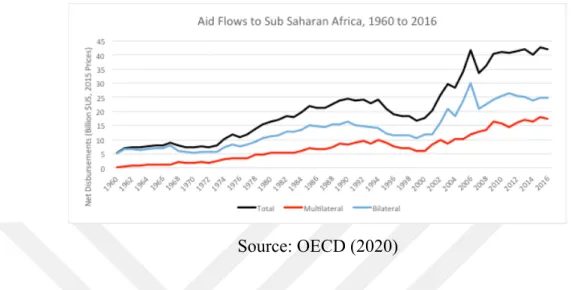
Following this, ODA flows increased in Sub Saharan Countries with an average annual flow varied from 38.9 billion US Dollars in the 1990s to 3.1 trillion US Dollars in the 2000s.
Source: OECD (2020)
Figure 2.1.Aid flows to Sub-Saharan Africa from OECD countries
After a massive inflow of development aid to developing countries, some countries have been able to improve their performance and are no longer categorized as low- income countries. Unfortunately, most African countries remain in the developing country category (OECD, 2019). According to ODA (2018) in 2010-2017 alone, development aid to Africa was 45% of the total ODA where the EU provided 42% of that aid. Additionally, the top five aid recipients were; Ethiopia, Nigeria, Tanzania, the Democratic Republic of the Congo, and Nigeria (ODA, 2018). Hence prompting the study to address the question of to what extent has the European development aid affected the development of sub-Saharan Africa.
Theoretically, scholars such as Rostow (1990) argue that aid is a precondition for economic development in that, for a society to take off then foreign assistance is necessary. Similarly, Burnside and Dollar (1997) acknowledge the use of aid as a tool for development but only when it is applied in an effective policy environment for its impact includes a strong and positive economic development. In support of this Collier and Dollar (2001) asset that aid is conditionally effective meaning, the positive effects can only be seen assuming there are a good policy environment, good governance, and low rates of corruption and conflict. Some existing works of literature that focus on sub-Saharan Africa found that aid induces development and is
significant in good governance (Armah & Nelson, 2008), social cohesion (Baliamoume-lutz, 2012), as well as strengthening of the institutions (Tang and Bundhoo, 2017). Development aid has also shown an increased possibility for the
“end of poverty by 2025” campaign of the UN (Sachs, 2005). To illustrate this possibility, according to a study done in 36 sub-Saharan African countries in 2013, 27 out of these countries have experienced positive results in GDP and investments as impacts of development aid (Galiani et al., 2017).
2.4. Development Aid and Migration Governance
According to the World Migration Report of 2020, it is estimated that the number of international migrants in 2019 alone was about 272 million which is 3.5% of the world's total population with reasons being work, study, family, to mention just a few (IOM, 2020). In response to the increasing migrant numbers most of which settle in the OECD countries, these states’ authorities have mobilized development assistance as a way to govern and manage migration hoping to decrease the numbers.
In the EU specifically, the current immigration policy includes the development aid packages aimed towards the concert countries as a way to encourage cooperation and also towards the origin countries as a way to address the causes of migration in other words known as root causes of migration.
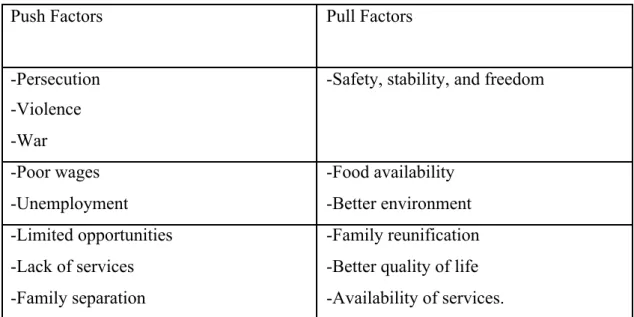
The causes of migration can be classified into two i) push factors and ii) pull factors (Lee 1966 & Parkins 2010). These factors can be economic, social, or political.
Table 2.2: Selected push and pull factors of migration
Push Factors Pull Factors
-Persecution -Violence -War
-Safety, stability, and freedom
-Poor wages -Unemployment
-Food availability -Better environment -Limited opportunities
-Lack of services
-Family reunification -Better quality of life
The research on reliable empirical impacts of development aid on international migration is limited as opposed to theoretical. Some scholars examined and linked the impacts of aid on the determinants/drivers of migration such as infrastructure and concluded that aid in form of infrastructural improvement and employment opportunities can have a short-term effect of stimulating emigration, but if directed into policy reform on trade and investment sectors then aid can create a path towards reduction in migration aspirations in the long-term (Martin and Widgren 2002).
Belloc (2011) examined the link between aid and migration in sub-Saharan Africa and concluded that development aid has a positive effect on migration outflows since aid improves worker’s ability to earn more and hence eliminating the cost of migration but on the other hand, aid in terms of projects such as education, business opportunities and technological advancement may stimulate mobility demand in potential migrants. Additionally, Faini and Venurini (1993) argue that even though international aid is meant to increase economic growth, it does not necessarily mean that it will also reduce migration. Furthermore, Berthelamy (2009) researched the link between aid and migration as to whether the two are substitutes or complements to one another. The results were that aid tends to increase outflows from recipient countries to donor countries below a certain income threshold hence making migration policies in the destination countries more restrictive (Berthelamy, 2009)
Lahiri (2000) developed a two-country model to research the link between the development aid and migration governance, specifically governing irregular migration. The results were that the amount of aid given does not matter unless other factors such as political instability of a country are kept into considerations as well.
Aid should come with proper migration approaches and a special focus on poverty reduction and the causes of high levels of poverty (Van-hear & Engberg-Pedersen, 2002). Development aid is to be given to developing countries in sectors that stimulate economic growth. In the long run, it will lead to the reduction of emigration although this effect is mostly seen significantly on skilled migrants rather than unskilled migrants. (Ziesmer, 2012)
Another link that is worth discussing between migration and development aid is brain drain, which is in most cases accompanied by brain gain (Stark, 1997). In Layman's terms, brain drain means the emigration of skilled, well educated, or highly trained and qualified people from a certain country. The terms brain drain is a
phenomenal one and some scholars refer to it as High Skilled Migration –HSM (Hart, 2006). It is phenomenal because it is assumed that there is an unequal distribution of global migration in relation to human capital (Grubel & Scott 1977).
The link between brain drain/gain and that of migration and development aid is through the departure of most skilled migrants, after receiving scholarships or better wages they tend to have an impact on both country of origin and destination country (De Haas, 2005). Brain drain is significantly accompanied by brain gain because there is a net loss of skilled people in the developing countries when they emigrate.
This comes with a brain gain in the developed countries due to immigration of skilled labor into their country (Adams, 1968). For instance, the Australian government is one of the leading when it comes to selecting only the skilled labor, the Australian immigration policies give more opportunities to the skilled and well- educated young people (Hugo, 2012). With the recent increase in the global talent competition and skilled workers, most nations have been very selective (Abella, 2005). And as a result, this has accelerated the rate of brain drain in the sending countries, which in development terms can be referred to as the decline of workforce, skilled and able workforce in the origin country.
CHAPTER 3. DEVELOPMENT AID AND MIGRATION GOVERNANCE IN THE EU
EU’s principle of peace and security is based on the assumption that development, peace, and security are inherently related to one another and good governance is a catalyst (Martinelli, 2007). The EU's development policy is derived from external policies and its crux aim is to eradicate poverty, foster sustainable growth, stabilize and promote democracy, promote equality, defending human rights as well as tackling environmental challenges and climate change. Recently the EU has reformed some of its external policies in the development arena to tackle the
“migration crisis” that most of its members are facing and seems to have been the only chatter in the union.
The EU is one of the world's biggest development aid donors and it has provided 19.4 billion dollars in Official Development Assistance in 2020 alone (OECD, 2020).
Its long-run objective is to eradicate poverty, promote democracy and boost development cooperation in the non-member third countries. The EU works with more than 150 counties to ensure the objectives are fulfilled, countries including the ACP (African and Caribbean Pacific) countries, EU’s eastern and southern neighbors, Latin America, Asian countries, and also the other aspiring countries that wish to join the union.
The long historical ties and geographical proximity play a crucial role in the deepening of Africa and EU’s strong partnership (Lilyanova, 2021). The cooperation is mostly based on the traditional “donor-recipient” relationship. The EU, together with its member states, is sub-Saharan’s top donor and has so far provided a total of 196.23 billion euros in ODA as of 2021 (European Commission, 2021). The development aid is delivered through key channels such as public sector, NGO’s and civil society, multilateral organizations and other implementers. Through these channels EU has been able to fund different development projects and promote stability in the sub-Saharan African countries, thus strengthening development cooperation.
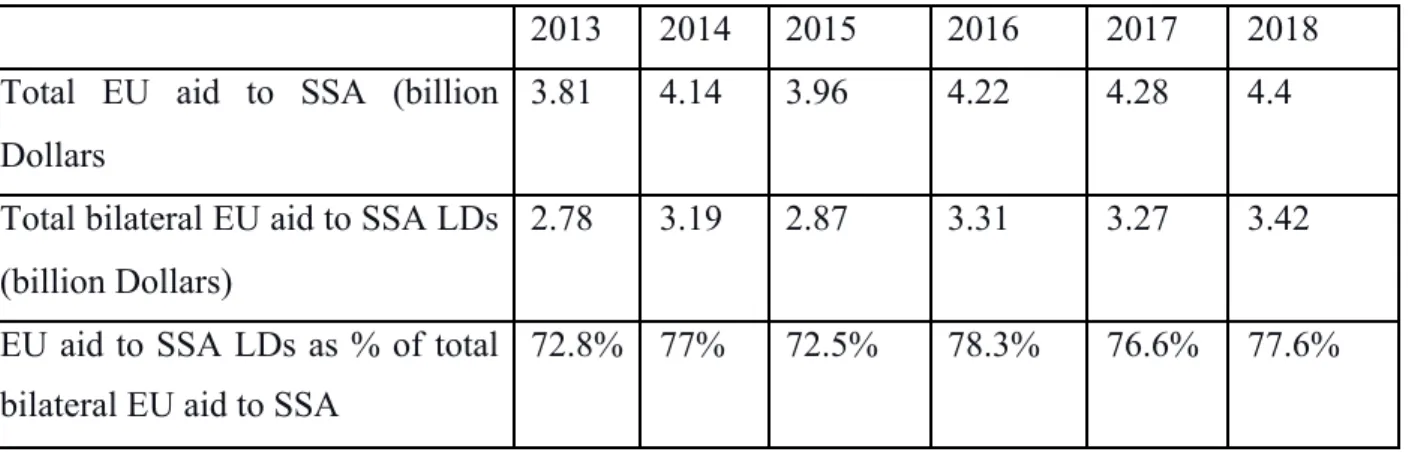
Table 3.1. Total Amount of EU Aid disbursed to Sub-Saharan Africa.
2013 2014 2015 2016 2017 2018
Total EU aid to SSA (billion Dollars
3.81 4.14 3.96 4.22 4.28 4.4
Total bilateral EU aid to SSA LDs (billion Dollars)
2.78 3.19 2.87 3.31 3.27 3.42
EU aid to SSA LDs as % of total bilateral EU aid to SSA
72.8% 77% 72.5% 78.3% 76.6% 77.6%
Source: OECD, gross disbursements, 2019
Source: EU aid explorer.
Figure 3.1. Top Recipients of EU Aid in Sub Saharan African countries
3.1 History of EU’s Development Policy
3.1.1. From Yaoundé Convention to “Agenda for Change”
EU development policy goes all the way back to Schuman declaration of 1950 where the development of African countries was an essential part of the European Community (EC). Subsequently following this, the treaty of Rome formally introduced development assistance into the European Community framework. This
solemnly responsible for managing, allocating and coordinating financial development assistance (Smith, 2007).
The first legitimate act for development cooperation between EC and African countries was established by the Yaoundé Convention in 1963 in Cameroon and later the second Convention in 1969 after the expiration of the former (EC, 2020). The basis of these conventions was to strengthen the cooperation with African countries whilst respecting the national sovereignty of them thus, promoting equal partnership (Smith, 2007). Thereafter, with an increased effort to expand the EC development policy, the Lomé Convention of 1974, extended the cooperation beyond African countries to include Caribbean and Pacific countries. The Lomé Convention was defined by its three guiding principles, namely, 1) the abolishment of non-reciprocal trade from ACP countries to European Economic Community (EEC), 2) the recognition of equality between participants, sovereignty as well as mutual interests and interdependence 3) freedom of all participants to possess and make their own policies (EC, 2020).
In 2000, the European Union established the Cotonou Agreement (CA) that compensated for the shortcomings of previous agreements and widened the extent of the EU development policy. It included factors such as promotion of human rights, democracy and rule of law. The CA is being revised after every five years to make an assessment of countries breaching the principle of conditionality (EC, 2020). It means development aid can be suspended if the country is in breach of the CA’s conditions in regards to maintaining rule of law, human rights and democracy.
(Santiso, 2002). Conclusively, EU development policy is cross cutting, as economic assistance is linked to human right and good governance (Krumme et al., 2019, p.5).
Therefore, EU development policy cooperation with ACP countries is based on the conditions above to achieve long-term sustainability within a particular developing country (EC, 2020).
The main objective of EU development policy is based on poverty eradication and development cooperation. In order to achieve these, in 2012 the EU adopted
“Agenda for Change” which aims to maximize the impacts of EU development policy. Agenda for Change stems from the 2005 European Consensus on Development and its main focus is to eradicate poverty, promote aid efficiency and development effectiveness as well as Policy Coherence for Development (PCD)
(Council of European Union, 2012). The policy calls for the promotion of human rights, democracy, good governance, rule of law and inclusive and sustainable growth amongst EU, member states and partner countries. The relations between EU, member states and partner countries is based on two principles;
• The principle of differentiation that emphasizes on the need to target development assistance on highly in need and fragile states, including low income countries and least developed countries.
• The principle of concentration that stresses on focusing resources for maximum of three sectors. This will prevent aid fragmentation and ensure a strategic use of resources (Council of European Union, 2012).
In reference to sub-Saharan countries, none of the least developed countries are able to rise up from the ODA eligibility due to the principle of differentiation. Most countries are fragile and experiencing extreme poverty and instability (example, the DRC). Although the Agenda for Change is meant to increase impact of EU aid, most sub-Saharan countries are still considered as least developing countries despite endless provision of development aid. The policy contradicts itself in the principle of concentration since EU aid in sub-Saharan countries extends beyond just three sectors. European aid is spread in various and broad sectors that are not entirely connected (Herrero et al., 2015).
3.1.2 The New European Consensus on Development
As a result of the United Nations 2030 agenda for Sustainable Development Goals in September 2015, the EU decided to revise the 2005 European Consensus on Development since it was no longer in line with the global development policy framework. A new European Consensus on Development was adopted in June 2017 with an update and guide for the development policy of the EU and its member states until 2030. The consensus advocates for an integrated approach to achieve the UN Sustainable Development Goals by interlinking different sectors, increasing effectiveness of EU development assistance and combining different financial resources (Jones et al., 2020)
The new European Consensus on Development is relevant to this study as it focuses on eradication of poverty, policy coherence for development and development
Furthermore, the consensus highlights the links between development and other policies. The emphasis is kept on promoting coaction between humanitarian aid, peace, security, migration, the environment and climate (European Consensus on Development, 2017). However, the new consensus differs from that of 2005 when addressing the issue of Official Development Assistance towards Africa. It does not set a clear objective on ODA in relations to Africa, while the 2005 consensus states that at least half of the arranged increase in ODA should go to Africa (Council of the European Union, 2017)
To ensure aid efficiency and coherency, the EU firstly adopted the Policy Coherence for Development (PCD) as a tool that was first introduced by the Treaty of Maastricht (1992) and then later reinforced under the Treaty of Lisbon (2009). Its main aim was to increase the effectiveness of aid and minimize the challenges that prevent the achieving the United Nations Sustainable Development Goals. In 2017, it was reiterated in the new European Consensus for Development to implement the 2030 agenda and increase the effectiveness of development cooperation to benefit partner countries (EU report on PCD, 2019) the strategy is divided into different areas, including:
1. To protect the environment and tackle climate change, 2. Boosting trade, finance, and commerce,
3. Addressing global food security,
4. To address the links between security and development concerning global peace building
5. Tackle the challenges and address migration and mobility.
In relevance to this study, the EU's Policy Coherence for Development tool targets facilitating orderly, safe, regular, and responsible migration and not just in Europe but also in Africa and other continents. The EU's Agenda on Migration can be linked to the recent increase in migrant-sending countries. As quoted from the 2019 EU report, “The European Migration Agenda (COM (2015) 240 final) sets out a comprehensive approach to address all aspects of migration inside and beyond EU borders in a balanced way which includes addressing the root causes of irregular migration and forced readmissions of persons not entitled to stay in the EU"
(European Commission, 2019 final, p.22)
As a result of the Policy Coherence for Development (2005) in relevance to migration and mobility, a new tool was adopted in November 2015 that is the Valletta Declaration. During the Valletta summit in Malta participated by European and African official leaders and its partners, the agenda on the table was to discuss the European migration crisis and what is to be done. One of the conclusions of the summit was to set up an Emergency Trust Fund for Africa, which is an off-budget financial tool to help development in the migrant-sending countries in Africa with hopes that boosting the development of these countries through development aid will curb outflow migration. An estimate of 1.8 billion Euros in aid was pledged and other humanitarian assistance. The EU president Donald Tusk, by then, was quoted saying " we need to regain control of the external border as a precondition for European migration policy" that is, migrants and asylum seekers would have no rights without registration. To summarize, in 2015, the joint Valletta action plan was structured along five pillars namely, addressing root causes of migration, legal migration, and mobility, protection and asylum, fighting against irregular migration, and return readmission and reintegration.
3.2. EU’s Approach to Address Root Causes of Migration
“Root cause” is an approach used by policy makers to manage migration. The idea is identifying the main reasons as to why people migrate and using policies and different activities to shape the migration patterns of the country of origin (Thorburn, 1996). Managing migration by root causes approach became popular amongst the European community through the 1990s (Carling & Telleraas, 2016). Basically, root causes of migration are thought as factors that induce and motivate people to migrate. Accordingly, the way to manage these root causes is by the provision of aid and adjustment in the political, economic and social sectors in the country of origin (Aubarell et al., 2009). Politically, these adjustments can be made through the advocating of democracy, promotion of human rights as well as reforms in the justice system. Economically, it could be through improvement of social services, funding of developmental projects and creation of job opportunities (Yildiz, 2016).
The EU has engaged in several projects and programs to address the root causes of migration in all over Africa, specifically in the underdeveloped and developing