Page
1
Annual Report
April 2019 – March 2020
Page
2
Introduction
This year’s annual report comes at a time of unprecedented upheaval for our health service and indeed our lives as we embark on a new way of living in isolation or at a
distance. The impact for us in research is not yet clear though activity will undoubtedly slow as many of us are called back into clinical work. As is often the way though, the impact for our patient community is greater.
Living with a communication impairment is always a challenge. We use language in a multitude of forms to make friends, to learn, to work, to challenge, to inform, to ask questions and so much more. When we are ill, we need to be able to tell people we are unwell and what our symptoms are. And at all times, we need to communicate to connect with others.
For people with communication impairments, this is challenging when we are talking in person. Their problems may be exacerbated when such communication has to happen remotely via phone or video conferencing or text messaging.
For some of our clients, new technologies offer an alternative which is becoming increasingly normalised. If everyone uses electronic means to communicate, then simply not being able to speak becomes less of a limitation. But for many communities that we work with, their ability to use such technology is often restricted by impaired language and processing skills, making it difficult to use complex or sophisticated alternative means to communicate. For them, the isolation we may all be feeling at this time is greater still.
So, while we have had a positive and productive year at BSLTRU these past 12 months and have welcomed new members of the team and new collaborators, it is a good time to reflect on why we do what we do. Communication is complicated. Communication is challenging. Communication is humanising. Our role is to continue to explore the reasons why people have communication impairment and what we can do to minimise its impact and maximise their opportunities. Thank you to you for the part you play in helping us to do this.
Yvonne
Dr Yvonne Wren Director, BSLTRU
3
Contents
BSLTRU activities – April 2019 to March 2020
51 BSLTRU People
71.1 BSLTRU staff 7
1.2 Honorary staff 8
1.3 Postgraduate students, placements and internships 8
1.4 Steering Group 9
1.5 Measures of esteem 10
2 Funding and Grant Applications
132.1 Infrastructure Grants 13
2.2 Research Grants 13
3 Project Updates
13Active Projects in 2019/20 (those marked with * are led by holders of NIHR clinical academic fellowships or internships)
13
3.1 The Cleft Collective Speech and Language Study 13
3.2 Understanding the Causal Pathway for Persistent Speech Disorder 14 3.3 The involvement of speech and language therapists in the treatment of people who
need an awake craniotomy
15
3.4 A randomised controlled trial of the effectiveness of parent-based models of speech and language therapy intervention for 2- to 3-year-old children with primary
language impairment in areas of social disadvantage
15
*3.5 Speech processing in children born with cleft palate and its relationship to speech articulation at age 5
16
*3.6 The effect of infant feeding and non-nutritive sucking on speech sound development at age 5 years
16
*3.7 The Fluency Trust Residential Course for young people (13-17yrs) who stammer: A feasibility study
17
3.8 A systematic exploration of the terminology used in the diagnosis and treatment of medically unexplained oropharyngeal dysphagia
18
3.9 What works in speech and language therapy interventions for children born with cleft palate
19
*3.10 Exploring relationships and associations between children’s cleft type and early speech and language development
19
Page
4
3.11 Speech Analysis Software as a Clinical Screening Tool for Speech Sound Disorders in Cantonese-Speaking Children - Validation in a English speaking population
20
3.12 Identifying and supporting children’s early language needs 21
3.13 The Language Explorer Study 22
Hosted Student Projects 23
*3.14 Unspoken Voices: What are the perspectives of people who use alternative and augmentative communication (AAC) on the impact and effectiveness of AAC equipment?
23
4 Research Outputs and Engagement
254.1 Publications 25
4.2 Presentations and conferences 26
4.3 Public and patient involvement 31
4.4 Website 32
4.5 Social Media 33
Glossary
34Page
5
BSLTRU activities - April 19 to March 2020
Miriam Seifert presenting at the Craniofacial
Society Conference, London Katarina Pavicic Dokosa, Sue Roulstone and Maja Kelic, pictured at the final conference of the European COST Action in Sofia, Bulgaria. Together they have been investigating the decision making of speech and language
therapists in Croatia.
Dr Yvonne Wren, Katherine Broomfield, Prof Sue Roulstone and Sam Burr
Dr Sam Harding and Jennifer Short Katherine Broomfield
Some of our poster
RCSLT Conference, Nottingham The team at BSLTRU presented 2
workshops, 6 oral and 4 poster
presentations
Page
6
Dr Sam Harding receiving a North Bristol NHS Trust (NBT) hero award
from
NBT's Chief Executive, Andrea Young
Dr Sam Harding receives the Green Impact Silver award on behalf of the BSLTRU Team from Matthew Champion, Sustainable Healthcare
Engagement Coordinator at NBT Fay Smith receiving a North Bristol
NHS Trust (NBT) long service award from Dr Yvonne Wren & Dr Rebecca
Coad
Dr Yvonne Wren joining the Cleft India workshop by skype
Dr Yvonne Wren, attending the Cleft Collective International
genetics workshop
7
1. BSLTRU People
BSLTRU consists of a core workforce of research and support staff who work in partnership with our honorary staff, students, clinical interns and volunteers.
1.1 BSLTRU staff
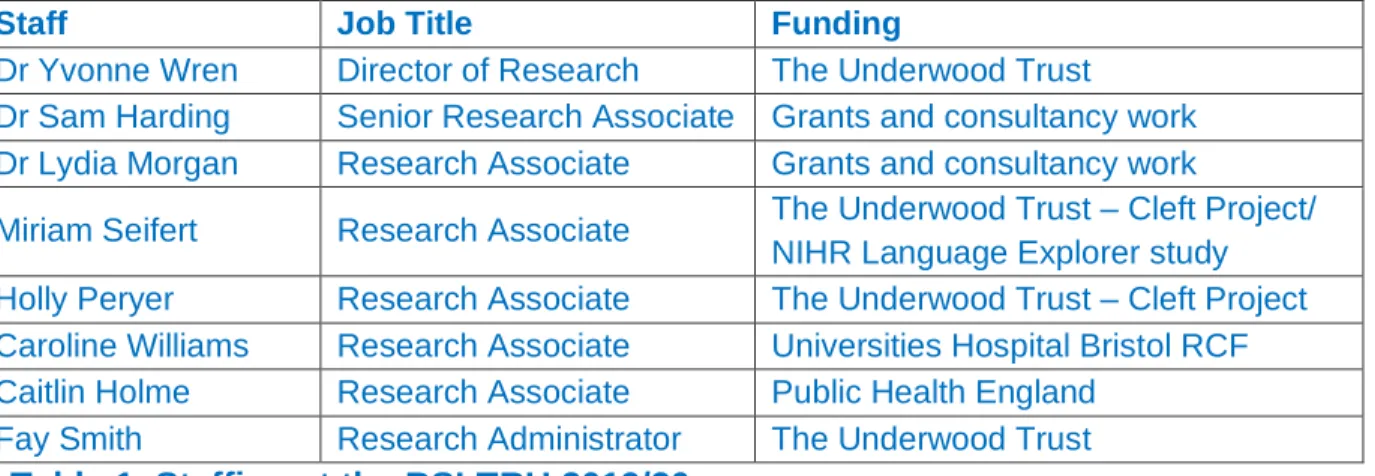
Yvonne Wren, Director of BSLTRU, is funded by the Underwood Trust. She also continues in her post at the University of Bristol Dental School. Our core research team consists of Sam Harding as Senior Research Associate and Lydia Morgan as Research Associate. Both Sam and Lydia have been with the unit for many years and also have complementary roles with the Research and Innovation Office and the clinical SLT team at North Bristol NHS Trust respectively. We continue to be well- supported by Fay Smith, Research Administrator for BSLTRU.
We welcomed a new member of staff Caitlin Holmes, Research Associate, who joined the team in May 2019. We were also pleased that Miriam Seifert was able to join us in December in a funded role following her secondment from her clinical role earlier in the year. Two other secondments, Holly Peryer and Caroline Williams, returned to the clinical roles with cleft teams in Birmingham and Newcastle respectively following a successful time working with the team on Cleft Collective projects.
Staff Job Title Funding
Dr Yvonne Wren Director of Research The Underwood Trust
Dr Sam Harding Senior Research Associate Grants and consultancy work Dr Lydia Morgan Research Associate Grants and consultancy work
Miriam Seifert Research Associate The Underwood Trust – Cleft Project/
NIHR Language Explorer study Holly Peryer Research Associate The Underwood Trust – Cleft Project Caroline Williams Research Associate Universities Hospital Bristol RCF Caitlin Holme Research Associate Public Health England
Fay Smith Research Administrator The Underwood Trust Table 1. Staffing at the BSLTRU 2019/20
In addition, two clinical speech and language therapists from North Bristol NHS Trust have worked with us this year with funding obtained to carry out discrete pieces of work with BSLTRU. These projects address clinically motivated queries
Staff Job Title Funding
Helen Spear Specialist Speech and Language Therapist
PAT Fund NBT Charities Fund No 20190
Jennifer Short Specialist Speech and Language Therapist
PAT Fund NBT Charities Fund No 20190
Table 2. Clinical project staff at the BSLTRU 2019/20
Page
8
1.2 Honorary Staff
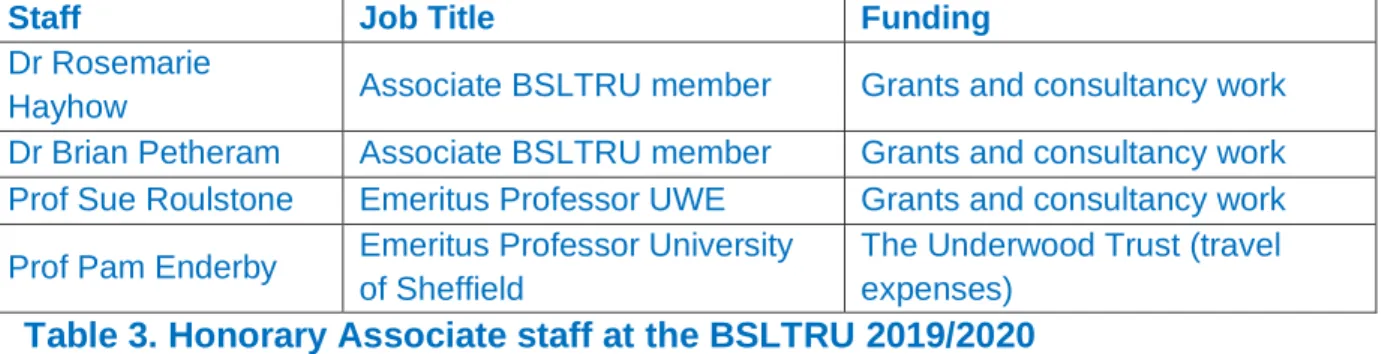
We continue to benefit from the input of experienced colleagues who have previously worked at the unit and are now involved on an honorary basis. In particular, our work in the fields of stammering (Dr Rosemarie Hayhow), aphasia and technology (Dr Brian Petheram) and primary speech and language impairment (Professor Sue Roulstone) is growing as a result of this team work.
We are also extremely grateful for the advice and guidance from Professor Pam Enderby OBE and for her ongoing connection with The Underwood Trust.
Staff Job Title Funding
Dr Rosemarie
Hayhow Associate BSLTRU member Grants and consultancy work Dr Brian Petheram Associate BSLTRU member Grants and consultancy work Prof Sue Roulstone Emeritus Professor UWE Grants and consultancy work Prof Pam Enderby Emeritus Professor University
of Sheffield
The Underwood Trust (travel expenses)
Table 3. Honorary Associate staff at the BSLTRU 2019/2020
1.3 Postgraduate students, placements and internships
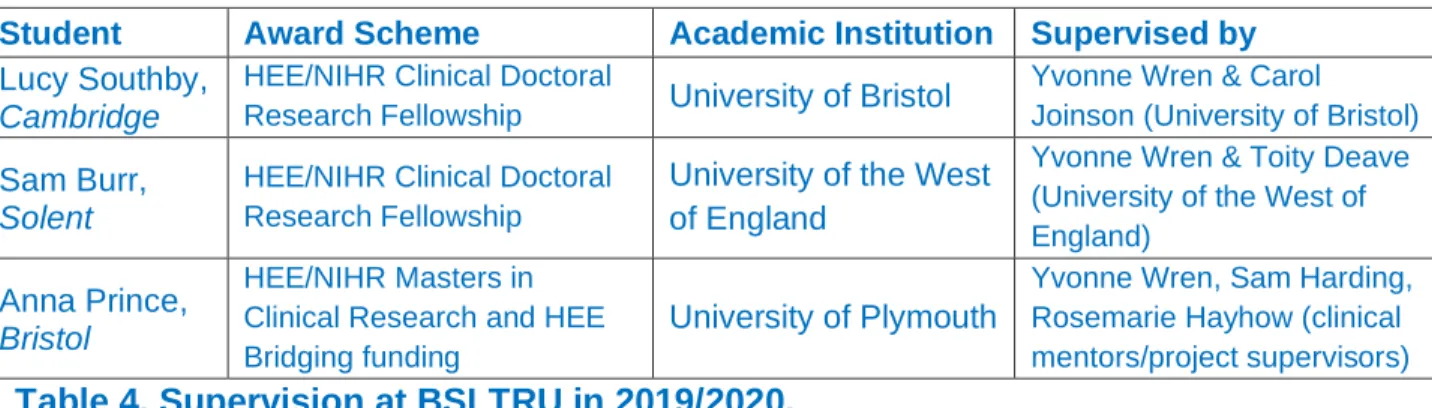
BSLTRU has successfully continued to support a number of clinical speech and language therapists to embark on a research career through the HEE/NIHR Integrated Clinical Academic Pathway (ICA) Doctoral scheme. Two of these students are supervised directly by BSLTRU while the third is supervised remotely and hosted at the unit. In this capacity, BSLTRU provides a research environment which is essential to the training and development of clinical academics.
In addition to the doctoral students, BSLTRU continues to support one Masters in Clinical Research student and has hosted two HEE internships. The reputation of the unit in terms of applied clinically based research and success with the HEE/NIHR ICA scheme is demonstrated by the geographical spread of the students and interns who request our support, as shown in tables 4-6.
Student Award Scheme Academic Institution Supervised by Lucy Southby,
Cambridge
HEE/NIHR Clinical Doctoral
Research Fellowship University of Bristol Yvonne Wren & Carol Joinson (University of Bristol) Sam Burr,
Solent
HEE/NIHR Clinical Doctoral Research Fellowship
University of the West of England
Yvonne Wren & Toity Deave (University of the West of England)
Anna Prince, Bristol
HEE/NIHR Masters in Clinical Research and HEE Bridging funding
University of Plymouth
Yvonne Wren, Sam Harding, Rosemarie Hayhow (clinical mentors/project supervisors)
Table 4. Supervision at BSLTRU in 2019/2020.
9
Student Award Scheme Academic Institution Supervised by Katherine
Broomfield, Gloucestershire
HEE/NIHR Clinical Doctoral Research Fellowship
Sheffield Hallam University (SHU)
Karen Sage (SHU), Georgina Jones (Leeds Becketts University), Dr Claire Craig (SHU), Simon Judge (clinical supervisor)
Table 5. Hosted students at BSLTRU in 2019/2020.
Intern Award Scheme NHS Institution Supervised by
Hannah Lane,
SLT HEE Internship Doncaster and
Bassetlaw NHS Trust
Yvonne Wren and the BSLTRU team Sarah
Overton, SLT HEE Internship Oxford Community Health NHS Trust
Yvonne Wren and the BSLTRU team Lucy
Rodgers, SLT HEE Internship Sussex Community
NHS Foundation Trust Yvonne Wren
Table 6. Funded internships at BSLTRU in 2019/2020.
BSLTRU has an international reputation and over the past year has hosted a visit from Cymie Ng, Speech Therapist, Division of Speech Therapy, Department of Otorhinolaryngology, Head and Neck Surgery, Faculty of Medicine, The Chinese University of Hong Kong. A hosted visit from Professor Sharynne McLeod of Charles Sturt University, Australia is planned for the Autumn. Professor McLeod was
awarded a Benjamin Meaker Fellowship from the University of Bristol for this visit.
1.4 Steering Group
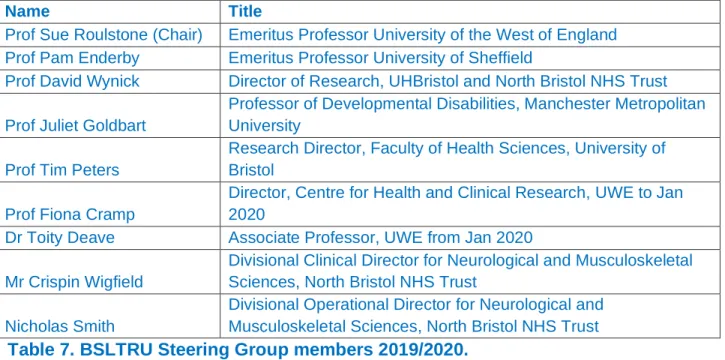
BSLTRU continue to be well supported by the BSLTRU Steering Group who maintain oversight and governance of the BSLTRU for the achievement of the unit objectives.
Name Title
Prof Sue Roulstone (Chair) Emeritus Professor University of the West of England Prof Pam Enderby Emeritus Professor University of Sheffield
Prof David Wynick Director of Research, UHBristol and North Bristol NHS Trust Prof Juliet Goldbart
Professor of Developmental Disabilities, Manchester Metropolitan University
Prof Tim Peters
Research Director, Faculty of Health Sciences, University of Bristol
Prof Fiona Cramp
Director, Centre for Health and Clinical Research, UWE to Jan 2020
Dr Toity Deave Associate Professor, UWE from Jan 2020 Mr Crispin Wigfield
Divisional Clinical Director for Neurological and Musculoskeletal Sciences, North Bristol NHS Trust
Nicholas Smith
Divisional Operational Director for Neurological and Musculoskeletal Sciences, North Bristol NHS Trust Table 7. BSLTRU Steering Group members 2019/2020.
Page
10
1.5 Measures of esteem
Members of the BSLTRU team have been invited to participate in a variety of activities in recognition of the work we carry out to understand the nature of speech, language and communication impairments and what we can do to help.
Board meeting of IALP (International Association of Logopedics and Phoniatrics) held in
Malta.
The Board members include Dr Yvonne Wren, Professor Pam Enderby (President IALP) and representatives from the
USA, Australia, New Zealand, Egypt, Ireland, Cyprus, Belgium, Germany, Israel, Greece, France
as well as the UK
The Unspoken Voices Project: Co-designing a conceptual framework with people who have complex communication needs (CCN) who
rely on augmentative and alternative communication (AAC).
Congratulations to Katherine Broomfield, HHE/NIHR Clinical Doctoral Research Fellow, who was awarded the best oral presentation by an
early career researcher
Patient Reported Outcome Measure PROMS Research Conference
Psychological understanding of the impact of health interventions in relation to chronic conditions. – By Dr Sam Harding
This PhD was a doctorate by publication, meaning that Sam selected nine articles that had already been published in peer review journals, which she was either the sole or joint author of (where she had a significant role in the research and writing up of the project). She then wrote a critical commentary showing how these pieces of work fit together. As with a traditional PhD by research she had a viva voce (oral defence) exam.
Congratulations to Dr Sam Harding
11
Yvonne Wren, Sam
Harding, Juliet
Goldbart & Sue Roulstone
A systematic review and classification of interventions for speech-sound disorder in
preschool children 53, 446-467 DOI: 10.1111/1460-6984.12371
Yvonne Wren, Sam Harding, Juliet Goldbart & Sue Roulstone
Amongst articles published between January 2018 and December 2019, this article received some of the highest count of citations and generated immediate impact and helped to raise the visibility of International Journal of Language & Communication Disorders.
Well-Being and Resilience in Children With Speech and Language Disorders This article has been selected by the
editor-in-chief and editors of the Language section of the Journal of
Speech, Language and Hearing Research as the winner of the 2018 Editor’s Award. Selection is limited to the most impactful works that meet the
highest quality standards in research design and presentation
Page
12
Members of BSLTRU have also been invited to give talks on topics related to the research we carry out:
1. Wren, Y. (May 2019) Invitation to give keynote speech at the Irish Association of Speech and Language Therapists Biannual Conference, Dublin, Ireland.
2. Wren, Y. (July 2019) Invitation to speak at the RCSLT London Speech Disorders Clinical Excellence Network
3. Wren, Y. (September 2019) Invitation to run workshop at RCSLT biannual conference, Nottingham. From research idea to research active: How to get involved in research in SLT.
4. Wren, Y. (November 2019) Invitation to give keynote speech at Irish Association of Speech and Language Therapists Research Conference.
5. Wren, Y. (January 2020) Invitation to speak at All Wales Speech Pathway Clinical Excellence Network
6. Wren, Y. (March 2020) Invitation to give keynote speech at annual meeting of the Association of Speech and Language Therapists in Independent Practice, Birmingham, UK.
7. Wren, Y (April 2020) Invitation to give keynote speech at the Portuguese Association of Speech and Language Therapists. Lisbon, Portugal
8. Wren, Y. (April 2020) Invitation to give seminar at University of Newcastle.
9. Wren, Y. (April 2020) Invitation to speak at SLTs in Cleft Clinical Excellence Network Meeting on Educational outcomes for children born with cleft lip and palate 10. Roulstone, S. (October 2020) Invited as a key speaker at 6th Congress of Croatian
Speech and Language Therapists – “Challenges of Modern Speech and Language Pathology“ Split, Croatia.
Members of BSLTRU have been asked to review papers from a wide range of
journals including: International Journal of Speech-Language Pathology; Language,
Speech and Hearing Services in Schools; Journal of Child Language; Scientific
Reports; Journal of Developmental Medicine and Child Neurology; British Medical
Journal; PeerJ; Current Paediatrics Reviews; The Open Nursing Journal; Health and
Quality of Life Outcomes; Psycho-Oncology; International Journal of Language and
Communication Disorders; Frontiers Education; Journal of Child Psychology and
Psychiatry; and Cleft Palate and Craniofacial Journal.
13
2. Funding and grant applications
BSLTRU, together with our collaborators, has been successful in grant applications for new funding totalling £995,106.00 over the past year, with £213,850.00 specifically allocated to BSLTRU activity. Additional funds from existing grants and infrastructure support enable us to continue to develop our research programme .
2.1 Infrastructure grants
The Underwood Trust has been a long-term supporter of BSLTRU and this has continued through 2019/20 through their agreement to provide funds to support the core administration and management function of the unit, to a total of £50,000. We are very grateful for the support of the Underwood Trust to enable us to further develop our research into speech, language and communication.
2.2 Research grants
The BLSLTRU team have led five research grant submissions this year and contributed to another seven. Out of this total of 12, five have been successful, four rejected and we are awaiting the outcome of another three.
Grants were submitted to a wide range of funding streams in 2019/2020. Where bids have been unsuccessful, feedback from reviews has been taken on board and applications have been redeveloped for alternative funding streams.
3. Project updates
Over the past year, two projects have been completed and two new studies have begun. Our ongoing work includes grant funded research, doctoral and masters fellowship studies and collaborative work with other institutions. A summary of each study is provided below. (N.B. *indicates clinical academic fellowships)
3.1 The Cleft Collective Speech and Language Study
Investigators: Yvonne Wren, Sam Harding, Lydia Morgan, The Cleft Collective Team
Timescale: 2012-2021
Funder: NIHR Fellowship/ University of Bristol/The Scar Free Foundation
Page
14
As with speech disorder in the non-cleft population, it is currently not possible to predict which children are likely to have persistent rather than transient problems with their speech.
Working with colleagues on a cross-sectional study of 248 non-syndromic children with unilateral cleft lip and palate (Cleft Care UK), considerable progress has been made towards the identification of risk factors for PSD in children born with cleft palate. However, this study is limited to children with unilateral cleft lip and palate. A larger, longitudinal and more inclusive study involving all cleft types is needed to fully explore the risk factors for PSD in this population.
The Cleft Collective Speech and Language Study (CC-SL) is a national cohort study of children born with cleft palate in which data on speech and language and relevant risk factors are being collected. Carried out in partnership with the £2.4million funded joint University of Bristol/University of the West of England/Scar free Foundation Cleft Collective Cohort studies, it is currently recruiting from 16 regional specialist clinical sites. At the time of writing, over 800 participants have been recruited to the CC-SL study with recruitment increasing month on month.
The CC-SL study is collecting data on a range of potential risk factors including parent-child interaction, infant vocalisations, the audio environment, SLT assessments at 24 and 36 months and hearing assessment data. Other important variables are available from the Cleft Collective Birth cohort (e.g. demographics, psychology, syndromic status, genetics, type/size of cleft, surgical interventions). This is an extensive dataset that is unprecedented in terms of its size and scale and will be a unique resource that will be made available for other researchers and clinicians to access. Current work from the team includes development of norms for the Intelligibility in Context Scale for this population. This will provide useful reference data for clinical teams when reporting outcomes for surgery.
3.2 Understanding the Causal Pathway for Persistent Speech Disorder
Investigators: Yvonne Wren, Paul White (University of the West of England) Timescale: 2012-2020
Funder: NIHR Fellowship
Children born with cleft palate are at high risk of persistent speech disorder (PSD) with 44%
children showing ongoing difficulties with their speech at age 5.
While prevalence is high in the younger years at 16% of three-year- olds, three quarters of children who present with speech sound disorder at age 3 will have typically developing speech by the time they start school. However, when problems persist beyond age 5, children are more likely to be bullied and have difficulties being understood and making friends than their peers. These children are also at risk of low outcomes in education and employment.
15
Currently, there is no way to identify which children who present to speech and language therapy clinics at age 3 with delayed speech will have persistent speech disorder beyond age 5. This study is using data from a population cohort study, the Avon Longitudinal Study of Parents and Children (ALSPAC), to identify risk factors which are associated with persistent speech disorder at age 5. These risk factors could then be used by clinical speech and language therapists to identify children who are at risk of persistent speech disorder and to prioritise them for early intervention.
Current work with this dataset involves investigations of the minimum word count required for a reliable and valid speech sample. Further work will report on which measure of speech provides the most robust score and should be used in future analyses.
3.3 The involvement of speech and language therapists in the treatment of people who need an awake craniotomy
Investigator: Helen Spear Timescale: 2017 - 2018 Funder: PAT funded
The aim of this work is to understand the contribution that speech and language therapists can make to the care and management of individuals who require awake craniotomy. There are two separate parts to this study: a qualitative element to understand the experience of having an awake craniotomy through talking to patients who have undergone the procedure and a systematic review.
The qualitative work is providing us with a meaningful bank of information which is useful for patients to receive before attending an awake craniotomy which will include language mapping. We are in the process of developing a form that can be used across North Bristol Trust to ensure patients are given important details of what their surgery will be like in order to ensure they are as relaxed as possible, with the aim to optimise results. It is hoped that this will also manage expectations and empower the patients to ask questions and be better informed about their care and treatment outcomes.
The second aspect of this project is a systematic review of the literature covering language mapping undertaken during awake craniotomy.
3.4 A randomised controlled trial of the effectiveness of parent-
based models of speech and language therapy intervention for 2- to
3-year-old children with primary language impairment in areas of
social disadvantage
Page
16
Investigators:
Deb Gibbard (Solent NHS Trust), Chris Markham (University of Portsmouth), Claire Smith (Solent NHS Trust), Sue Roulstone, Sam Harding, Lydia Morgan
Timescale: 2017-2021 (extended for 12 months) Funder: Nuffield Foundation
The unit continues to work on a Nuffield Foundation grant, led by Solent NHS Trust, which aims to evaluate the clinical effectiveness of an enhanced parent-based intervention programme on outcomes in children with primary language delay in areas of social disadvantage.
The team from the Unit worked initially with Solent NHS Trust to advise on the use of Language Environment Analysis Software (LENA) in the study and the adaptation of the Patient Activation Measure (PAM) for use with parents. We supported the development of protocols for data collection and analysis. Data collection will be completed in early summer the unit will continue to beinvolved with and support the use of the software and assist in the analysis of the language samples from LENA and PAM.
*3.5 Speech processing in children born with cleft palate and its relationship to speech articulation at age 5
Investigator: Lucy Southby
Timescale: June 2016 – May 2020
Funder: HEE/NIHR Clinical Doctoral Fellowship
The aim of this study is to understand whether there are relationships between speech input processing skills and cleft speech characteristics, in children born with cleft palate with or without cleft lip at five-years-old. Children born with cleft palate are at high risk of disordered speech and this study will further inform clinical practice with this population.
Based on the model of speech processing proposed by Stackhouse and Wells (1993), the focus in this cross-sectional study is input processing skills. Eligible children have been identified and recruited from five regional cleft centres. Their parents were invited to consent to an assessment of their child’s speech processing and some related skills. In addition, parents were asked to complete questionnaires and provide consent for additional data to be collected from clinical records. Recruitment to this study closed at the end of May 2019 and data analysis is in progress.
.
*3.6 The effect of infant feeding and non-nutritive sucking on speech sound development at age 5 years
Investigator: Samantha Burr
Timescale: June 2017- January 2022 (including 8 months maternity leave)
17
Funder: HEE/NIHR Clinical Doctoral Fellowship
When a baby is born parents make different choices about feeding their baby. Some breastfeed, some bottle-feed and some use a mixture of both. Some babies also like to have a dummy, while others suck their hand and some don’t suck anything. Some studies have found that breastfeeding is linked to better language and learning in later childhood, while others have found that dummy sucking has the opposite effect. However, the effect that different types of feeding have on speech sound development has not been looked at in as much detail.
A systematic review identifying studies, which investigate the association between infant feeding, dummy and finger sucking and early speech development has been completed and published in Folia Phoniatrica et Logopaedia (2020; https://doi.org/10.1159/000505266).
The ongoing work in this fellowship will consider the impact of patterns of infant feeding and non-nutritive sucking using data collected from three samples: Avon Longitudinal Study of Parents and Children (ALSPAC), CoCo90s (Children of the Children of the 90s – ALSPAC second generation study) and a NHS clinical sample. Recruitment began in October 2017 for the CoCo90s strand of the study and closed, as planned, in May 2018 having recruited 182 children aged between 2-5 years. This total comfortably exceeds the original target of 135 children. Recruitment began in January 2018 for the NHS strand of the study and was put on hold between January and September 2019 (due to maternity leave). Recruitment restarted in September 2019 and will continue until January 2021. Recruitment has been slower than hoped and several measures have been put in place, following consultation with the clinical team, to boost referrals. Numbers have improved to some extent following this work and to date 42 children aged 2-5 years have participated in the study, with a further 10 new referrals awaiting contact, following a pleasingly high referral rate in January 2020.
Engagement from clinical staff has been excellent and, with the monthly recruitment target for the next 12 months revised from 6 to 8 children, the target of 135 participants continues to be achievable.
*3.7 The Fluency Trust Residential Course for young people (13- 17yrs) who stammer: A feasibility study
Investigator: Anna Prince
Timescale: Sept 2017 – Sept 2019 (Masters), Sept 2019- March 2020 (Transitional
Award)
Funder: NIHR Funding for Masters in Clinical Research and Transitional Award (at
Plymouth University)
Stammering is a communication disorder involving interruption of the forward-flow and timing of speech. Stammering can have adverse effects upon emotional and mental health, anxiety levels and vocational choices; the potential negative consequences are far-reaching.
There is a significant lack of interventions developed specifically for adolescents who stammer, and the evidence-base for such interventions is currently weak. The Fluency Trust
Page
18
for adolescents who stammer. It combines speech and language therapy and outdoor activities within a residential context.
Anna conducted a feasibility study of the Fluency Trust Residential Course for adolescents who stammer. The study measured some of the key parameters required to design a future feasibility RCT and to determine if and how a future study could be completed. The main study utilised a mixture of quantitative and qualitative methods, and was informed by a PPI consultation with young people who have previously attended the course.
Feasibility outcomes were very positive: Descriptive statistics showed group
means/medians of all outcome measures shifted in a positive direction between pre and post-tests. Outcome measures showed good test- re-test reliability: Progress Questionnaire Child ICC= 0.87 (95% CI= 0.69-0.94 sig<0.001), Progress Questionnaire Parent ICC= 0.88 (95% CI= 0.70-0.95 sig<0.001). Recruitment, retention and outcome measure completion levels were all 100%. Intervention fidelity was 95% and there were no adverse events.
Acceptability of the intervention by adolescents was high. Themes from interviews with adolescents two months after the course included: increased confidence in communicating, a new sense of freedom, the ability to control stammering, increased knowledge about stammering and the importance of peer support. All parental written comments about the course were positive.
Qualitative and quantitative data indicate that a future definitive trial of the FTRC is indicated after additional feasibility testing.
Anna has been awarded an NIHR Transitional Award, and is using this to compile an application for the NIHR Clinical Doctoral Research Fellowship.
3.8 A systematic exploration of the terminology used in the
diagnosis and treatment of medically unexplained oropharyngeal dysphagia
Investigators: Jennifer Short and Sam Harding
Timescale: Dec 2018-Dec 2019 (some work still in progress)
Funder: North Bristol NHS Adult Speech and Language Therapy department
charitable funds.
A wide range of terms is used to define and describe medically unexplained dysphagia, across many different specialties. The lack of consistent terminology makes it difficult to draw meaningful conclusions from the research base and to develop standard pathways for diagnosis and treatment.
This project aims to explore what the most appropriate and acceptable terminology is, for patients and professionals, and to move towards a consensus term across the range of involved specialties. A Delphi methodology is being used to explore consensus amongst expert professionals, alongside a review of the literature and local patient record review. We
19
are also undertaking patient focus groups, and continue to run patient and public involvement activities to ensure that the outcomes of this work are relevant to practice.
3.9 What works in speech and language therapy interventions for children born with cleft palate
Investigator: Caroline Williams, Sam Harding and Yvonne Wren Timescale: 4/11/2018- 3/08/2019
Funder: Above and Beyond, University Hospital Bristol
As part of the Cleft Collective Speech and Language Study (CC-SL), we want to collect information on what interventions speech and language therapists are undertaking with children in the study. To do this we need a tool that allows therapists to send this information to us. The aim of this piece of work is to design and build this tool. Ten focus groups have been completed with 62 speech and language therapists, from specialist cleft teams and community services across the country. Using data from these groups, we have designed and piloted an online tool to collect data on SLT interventions received. This tool is now being used to collect data within the CC-SL study and will be available for the research community to use to address important questions on the effectiveness of different therapy approaches and patterns of service delivery.
3.10 Exploring relationships and associations between children’s cleft type and early speech and language development
Investigator: Miriam Seifert and Yvonne Wren Timescale: 4/11/2018-3/08/2019
Funder: The Underwood Trust
This project used existing questionnaire data that has already been collected, as part of the Cleft Collective Birth Cohort study. Specifically, the “You and Your Child at 3 Years - Mother’s Questionnaire” and the question items for ‘Intelligibility in Context Scale’ (ICS), which investigates parents’ views on how often their child is understood when talking to different communication partners.
ICS data from 412 mothers of 3-year-old children born with any cleft type have been used in the analyses. The findings indicate strong evidence to suggest that there is a difference in intelligibility between children with cleft lip only and children with a cleft involving the palate.
Findings also show that there are only minor differences between the different types of clefts with palatal involvement (i.e. cleft palate only, unilateral cleft lip and palate or bilateral cleft lip and palate). Further findings indicate that children with additional syndromes are less often intelligible compared to children without additional syndromes.
Page
20
These findings provide preliminary data to support use of the ICS in baseline measurement and in outcome measurement after surgery in 3-year-old children born with cleft lip and palate, with or without additional syndromes. The study will be repeated with a larger sample size and with older children (age 5), as children in the Cleft Collective mature
This funding has enabled us to exploit the Cleft Collective dataset to address research questions which have clinical relevance for SLTs working with children born with a cleft lip and/or palate.
3.11 Speech Analysis Software as a Clinical Screening Tool for Speech Sound Disorders in Cantonese-Speaking Children - Validation in a English speaking population (NEW
)Investigators: Yvonne Wren, Miriam Seifert, Cymie Ng (Chinese University of Hong
Kong)
Timescale: 2019-2020
Funder: Chinese University of Hong Kong
Speech sound disorder is usually diagnosed by speech and language therapists using formal articulation tests and oral mechanism assessments. Screening tests can also be used to identify children with speech sound disorder who would benefit from speech and language therapy. The Chinese University of Hong Kong has developed an algorithm which could be used to automate the screening of children for speech sound disorder.
The tool which has been developed for this purpose needed to be tested on a sample of native English-speaking children. The research team in Hong Kong approached BSLTRU to ask for their help in carrying out this work. 150 children have now been assessed and the data is being prepared to send back to the research team for their analysis. BSLTRU will also be using the data collected to carry out analyses on the relationship between teachers’
perceptions of children’s intelligibility and their performance on standardised tests of speech.
Pictured left to right –
Miriam Seifert, Cymie, Ng and Dr Yvonne Wren During Cymie’s visit to BSLTRU
Page
21
3.12 Identifying and supporting children’s early language needs
Investigators:
James Law, Cristina McKean, Jenna Charlton, Rose Watson (University of Newcastle), Sue Roulstone (University of the West of England, Bristol
& BSLTRU), Caitlin Holme (BSLTRU)
Timescale: 2019-2020Funder: Public Health England
Public Health England (PHE) has created a programme to improve early identification of speech, language and communication needs (SLCN). As part of the programme they have commissioned the University of Newcastle to develop and evaluate a new early assessment tool for use with children during their 2- year developmental check. Sue Roulstone and Caitlin Holme from BSLTRU are collaborating with the University of Newcastle on the project alongside representatives from the Institute of Health Visiting.
The Early Language Identification Measure (ELIM) has been developed to be used alongside the Ages and Stages Questionnaire (ASQ), which is commonly employed by health visitors and early years practitioners at the 2-year check. The tool has been piloted in five sites across England – Middlesbrough, Derbyshire, Wakefield, Newham and Wiltshire – and as of February 2020 704 families had been recruited.
There are four strands to the project, including development of the tool, public and patient involvement (PPI) groups, co-design groups and evaluation. The team at BSLTRU is leading on the evaluation strand, as well as attending and leading some meetings for the PPI and co-design elements. In order to evaluate practitioner opinions, Sue and Caitlin have held focus groups in all 5 sites with health visitors and nursery nurses, as well as additional groups for SLTs involved in the project. The parents of children who have participated have been asked for their opinions via a survey and additionally up to 10 parents from each site will be interviewed via telephone (at the time of writing, 24 had been interviewed). The project will come to a close in May 2020 when a final report will be submitted to PHE.
The team pictured left to right - Rose Watson, Prof Sue Roulstone, Victoria Jackson, Caitlin Holme, Dr Jenna Charlton, Dr Cristina McKean, Vicky Gilroy, Prof James Law
Page
22
3.13 The Language Explorer Study
Investigator: Yvonne Wren, Miriam Seifert, Sam Harding, Lydia Morgan, Rebecca
Bright, Swapnil Gadgil (Therapy Box), Cristina McKean (University of Newcastle), Geraldine Bates (Sirona Care)
Timescale: 01/11/2019 – 31/10/21 Funder: NIHR i4i Scheme
This study will lead a new app which will facilitate automated language transcription and analysis to assist speech and language therapists with clinical decision making in the evaluation of developmental language disorders.
Currently, SLTs use formal assessments or language sampling to assess children’s
expressive language, determine targets for intervention and measure outcomes. Language sampling is arguably a better approach as it more closely resembles typical language use.
Children will often be asked to retell a story as a means to generate a language sample.
However, it is very time consuming to then transcribe the sample and takes even longer to analyse the sample to calculate measures such as mean length of utterance and use of syntactic markers. The new app, titled Language Explorer, will reduce the time required for this significantly, providing SLTs with a robust measure for clinical management.
The app could also be used as a screening tool to determine whether a child needs further assessment or whether advice alone would be sufficient. BSLTRU are working with app developers Therapy Box on the development of the tool and are also leading the evaluation work package. With involvement from three clinical sites, the app will be used to screen 60 children referred to SLT services with concerns about their language development. Their performance on the app will be compared with that on a standardised language assessment and also with the clinical judgement of the SLT.
The study team is about to launch a national campaign to collect normative data through a citizen science approach. The evaluation is currently in the set-up stages and the protocol and relevant documentation is being prepared for ethical and HRA submission.
23
Hosted Projects
In addition to the speech and language therapists who are fellowship or internship awardees and supervised directly by BSLTRU staff, we also host a therapist/NIHR Clinical Doctoral Fellow who is local to the area but registered at a distant institution.
The hosting arrangement means that we do not provide supervision but instead provide a research environment and networks with local clinical academics.
*3.14 Unspoken Voices: What are the perspectives of people who use alternative and augmentative communication (AAC) on the impact and effectiveness of AAC equipment?
Investigator: Katherine Broomfield (Sheffield Hallam University) Timeline: April 2017-March 2022
Funder: HEE/NIHR Clinical Doctoral Fellowship
Alternative and augmentative communication, otherwise known as AAC or communication aids, can support people with communication difficulties. We know that some people engage really well with their communication aid equipment and with the services who provide it, but others do not. There is currently no consistent way of gathering feedback from people who use AAC services and they are rarely involved in decision-making concerning their equipment.
This research aims to build on existing knowledge to develop a greater understanding about what factors influence how well people engage with communication aid services. It also aims to find out what supports people to use their communication aid equipment and what outcomes are important following receipt of equipment. This will enable the development of tools that allow AAC services to gather feedback from people who use communication aids.
A systematic review to identify and appraise the quality of tools used to record patient- reported outcomes in users of alternative and augmentative communication (AAC) has been completed. The report has been written and published in the Journal for Quality of Life Research (https://doi.org/10.1007/s11136-019-02228-3). The results of this systematic review were presented at the Communication Matters conference in Leeds by two members of the PPI group and at the Royal College of Speech and Language Therapists conference in Nottingham in in September 2019.
A second narrative review has also been completed exploring what is already known about the communication experiences of people who rely on AAC. The final report is in- preparation for submission to the Journal for Augmentative and Alternative Communication.
The results have been used to develop a topic guide for the second phase of data collection and will provide a framework to support qualitative data analysis.
The PPI group continues to provide excellent support and inspiration to the project. Sharing the challenges and methods used to enable greater inclusion in this group has led to collaborations with other speech and language therapy researchers, resulting in a joint submission to the RCSLT conference in 2019. Following the submission review process, Anna Volkmer, Lauren Longhurst and I were invited to run a workshop on PPI at the conference which was well attended and from which we received excellent feedback. Anna
Page
24
and I have had a book proposal accepted by J&R Press which will document some of inclusive methods that have been successfully used by colleagues for involving people with
‘seldom-heard’ or unspoken voices in collaborative projects. A presentation about the methods used in the PPI group was awarded ‘Best Oral Presentation from an Early Careers Researcher’ at the PROMs conference in Leeds in June. The prize was an open access publication in the Journal of Patient Reported Outcomes. A commentary paper about the methods is in-preparation for submission to this journal. A poster documenting the creative methods used in the group was awarded second prize, a £50 book token, at the ‘AHPs:
Achieving Impact through Research’ conference in London in October.
Recruitment to phase 1 of the qualitative stage of the project has been open since last April.
This phase of data collection aimed to recruit 6-9 participants for a cohort study that would follow the journey of participants through the Bristol Communication Aid Service, from acceptance of the referral to 12 months after receipt of equipment. Eight participants have been recruited in total, to date. Recruitment has been slower than anticipated and there has been some attrition from recruited participants, resulting in 4 ongoing active recruits.
Reflections on the challenges of recruiting people with complex communication needs will be an important element in the analysis of the overall project. Phase 2 of qualitative data collection, recruiting people who have experience of using communication aids to reflect on their experience of communication using AAC, will commence imminently, following receipt of permissions from overseeing ethics bodies.
The focus of the coming year is in on gathering good quality data from the two phases of qualitative interviews and identifying a suitable method for analysis. The challenges of collecting interview-data from people with complex communications needs are inadequately represented in the research literature at present. I hope to reflect on some of these challenges in a methods paper for publication alongside publications concerning the results from the data. I continue to learn from my experiences of collaborating with the PPI group and in their evolving roles in the project. I will present on these experiences and get feedback from colleagues at the Design for Health conference in Amsterdam in July. Ongoing collaborations with design-research colleagues is providing a though-provoking lens through which to view potential methods for research with seldom-heard voices in future.
25
4. Research outputs
4.1 Publications
The unit has maintained a strong record of publishing both as lead and co-authors this year with ten publications in respected peer-reviewed journals for the field and four in non-peer reviewed publications and grey literature. A further three have been submitted and are awaiting outcome.
Published- peer reviewed
1. Shriberg, L. & Wren, Y. (April 2019) A frequent acoustic sign of speech motor delay.
Clinical Linguistics and Phonetics DOI:10.1080/02699206.2019.1595734
2. Sainsbury, D., Davies, A., Wren, Y., Southby, L., Chadha, A., Slator, R., Stock, N.M.
& The Cleft Multidisciplinary Collaborative. (April 2019) The Cleft Multidisciplinary
Collaborative: Establishing a network to support cleft lip and palate research in the United Kingdom. Cleft Palate and Craniofacial Journal DOI:10.1177/1055665618790174
3. Broomfield, K., Harrop, D., Judge, S., Jones, G. & Sage, K. (June 2019) Appraising the quality of tools used to record patient-reported outcomes in users of augmentative and alternative communication (AAC): a systematic review. Journal for Quality of Life Research,
4. Harding, S. & Bradford, J. (June 2019) Drawing: A novel approach to understanding appearance change in people following treatment for head neck cancer. Sage Open Medicine
5. Morgan, L.,Marshall, J., Harding, S. Powell, G., Wren, Y., Coad, J., & Roulstone, S. (Sept 2019) “It depends”: characterising speech and language therapy for preschool children with developmental speech and language disorders. International Journal of Language and Communication Disorders. DOI:10.1111/1460-6984.12498 online open access
6. Seifert, M., Morgan, L., Gibbin, S., & Wren, Y. (Sept 2019) An alternative approach to measuring reliability of transcription in children’s speech samples. Folia Phoniatrica et Logopedica. DOI: 10.1159/000502324
7. Sainsbury, D., Williams, C., de Blacam, C., Chadha, A., Wren, Y., Hodgkinson, P. &
the Cleft Multidisciplinary Collaborative. (Nov 2019). Non-Interventional Factors Influencing Velopharyngeal Function for Speech Following Initial Cleft Palate Repair: A Systematic Review Protocol. Systematic Review, 8:1, 261.
8. Coad, J., Harding, S., Hambly, H., Parker, N., Morgan, L., Marshall, J. &
Roulstone, S. (Feb 2020) Perspectives of Pre-school children in England with speech and
Page
26
language needs in the development of an evidence based framework of activities. Child:
Care, health & Development. DOI: 10.1111/cch.12746
9. Burr, S., Harding, S., Wren, Y. & Deave, T. (Feb 2020) The relationship between feeding and non-nutritive sucking behaviours and speech sound development: A
systematic review. Folia Phoniatrica et Logopedica. DOI: 10.1159/000505266
10. Dardani, C., Howe, L., Stergiakouli, E., Wren, Y., Humphries, K., Davies, A., Ho, K., Mangold, E., Ludwig, K., Relton, C.L., Davey Smith, G., Lewis, S.J., Sandy, J., Davies, N.M. & Sharp, G.C. (in press) Cleft lip/palate and educational attainment: cause, consequence, or correlation? A Mendelian randomization study. International Journal of Epidemiology.
Published - non peer reviewed
11. Wren, Y.E. (2019) How do we identify children whose speech problems are unlikely to resolve. RCSLT Bulletin, August 2019
12. Wren, Y.E. (2019) Gender Disparity in the Speech and Language Therapy Profession. RCSLT Bulletin, May 2019.
13. Harding, S.A. (2019) Maximising Impact. RCSLT Bulletin, December 2019.
14. Burr S. (2019). Creating Shared Ownership. Bulletin Magazine. London, UK:
Redactive Publishing Ltd.
Other outputs (research reports/books/book chapters/
software/apps/website)
1. Roulstone, S., Atherton, M., Davidson, B., Harding, D., Kelic, M. & McAllister, L. (In press) Using qualitative research to explore professional practice. In Lyons &
McAllister. Qualitative Research in Communication Disorders: An Introductory Guide for Students and Clinicians’. J & R Press.
4.2 Presentations and conferences
Members of BSLTRU have been invited to present at a number of national and international events and have had abstracts accepted at a range of conferences.
Invited presentations
1. Wren, Y. (May 2019) Invitation to give keynote speech at the Irish Association of Speech and Language Therapists Biannual Conference, Dublin, Ireland.
27
2. Wren, Y. (July 2019) Invitation to speak at the RCSLT London Speech Disorders Clinical Excellence Network
3. Wren, Y. (September 2019) Invitation to run workshop at RCSLT biannual conference, Nottingham. From research idea to research active: How to get involved in research in SLT.
4. Wren, Y. (November 2019) Invitation to give keynote speech at Irish Association of Speech and Language Therapists Research Conference.
5. Wren, Y. (January 2020) Invitation to speak at All Wales Speech Pathway Clinical Excellence Network
6. Wren, Y. (March 2020) Invitation to give keynote speech at annual meeting of the Association of Speech and Language Therapists in Independent Practice, Birmingham, UK.
7. Wren, Y (April 2020) Invitation to give keynote speech at the Portuguese Association of Speech and Language Therapists. Lisbon, Portugal
8. Wren, Y. (April 2020) Invitation to give seminar at University of Newcastle.
9. Wren, Y. (April 2020) Invitation to speak at SLTs in Cleft Clinical Excellence Network Meeting on Educational outcomes for children born with cleft lip and palate
10. Roulstone, S. (October 2020) Invited as a key speaker at 6th Congress of Croatian Speech and Language Therapists – “Challenges of Modern Speech and Language Pathology“ Split, Croatia.
Panel presentations
11. Wren, Y., Bright, R., McKean, C., Bates, G. (September 2020). Panel Presentation:
Language Explorer: Bringing Clinical Language Transcription and Analysis into the 21st Century. ICPLA Conference, University of Strathclyde, Glasgow, Scotland, UK
Paper Presentations
12. Seifert, M., Wren, Y., Davies., A., McLeod, S., and the Cleft Collective Cohort Studies Team. (April 2019) Parents’ ratings of intelligibility in 3-year-olds with cleft lip and/or palate using the Intelligibility in Context Scale: Findings from the Cleft Collective Cohort Studies. Craniofacial Society of Great Britain and Ireland Annual Conference, London.
13. Baker, S., Wren, Y., Cooper, F., Zhao, F. & Extence, H. (April 2019) Is there a relationship between conductive hearing loss and cleft speech characteristics in children with cleft palate? Craniofacial Society of Great Britain and Ireland Annual Conference, London.
14. Fell, M., Davies, A. & Wren, Y. (April 2019) Current UK trend in primary surgical interventions for cleft lip and palate. Craniofacial Society of Great Britain and Ireland Annual Conference, London.
Page
28
15. Williams, C., Wren, Y. & Harding, S. (April 2019) The Cleft Collective Speech and Language Intervention Survey: An Update. Cleft Speech Clinical Excellence Network at The Craniofacial Society of Great Britain & Ireland Conference, London (oral presentation).
16. Jensen de Lopez, K., Lyons, R., Rodriguez Ortiz, I., Zajdó, K., Kelic, M., Medina, S., Ulfsdottir, T., Harding, S., Feilberg, J., Mantel, T., Klatte, I., & Zajdó, K. (May 2019) Pilot Study: Cross-cultural exploration of how parents construe language disorder and their experiences of accessing services. Nordic Network on Disability Research 2019 (Copenhagen)
17. McCormack, J. & Wren, Y. (June 2019) Using psycholinguistic profiling to examine responsiveness to intervention. Speech Pathology Australia Annual Conference
18. Baker, S., Wren, Y., Cooper, F., Zhao, F. & Extence, H. (June 2019) Is there a relationship between conductive hearing loss and cleft speech characteristics in children with cleft palate? European Cleft Palate and Craniofacial Association, Utrecht, The Netherlands.
19. Lewis, S., Humphries, K., Davies, A., Wren, Y., Sandy, J., Stergiakouli, E. & Sharp, G. (June 2019) The Cleft Collective: A unique set of cleft cohort studies recruited from centres across the UK. European Cleft Palate and Craniofacial Association, Utrecht, The Netherlands.
20. Lewis, S., Sharp, G., Stergiakouli, E., Howe, L., Dardani, C., Davies, A., Humphries, K., Wren, Y., & Sandy, J. (June 2019) How genetic data can help us to understand the causes and consequences of being born with an orofacial cleft. European Cleft Palate and Craniofacial Association, Utrecht, The Netherlands.
21. Davies, A., Wren, Y., Deacon, S., Cobb, A. & Chummum, S. (June 2019) Is there a relationship between palatal cleft type and the use of relieving incisions as an adjunct to intravelar veloplasty? British Association of Plastic, Reconstructive and Aesthetic Surgeons, Bournemouth, UK.
22. Broomfield, K. (June 2019) - The Unspoken Voices Project: Co-designing a conceptual framework with people who have complex communication needs (CCN) who rely on augmentative and alternative communication (AAC). PROMs conference, Leeds (oral).
23. Broomfield, K. (June 2019) - Living with unspoken voices: developing our understanding the communication experiences of people who use augmentative and alternative communication (AAC) Communication Matters, Leeds.
24. Watson, L., Lu, L., Sharp, L., Harding, S. & Patterson, J. (Sept 2019) Trajectory &
sequelae of eating and drinking outcomes in head and neck cancer survivors. RCSLT Conference 2019, Nottingham, UK.
25. Seifert, M. & Fricke, S. (Sept 2019) Speech and Language Therapists’ Practices and Views on Evidence-Based Practice and Continuing Professional Development Specific to
29
Intervention for Children with Speech Sound Disorders. RCSLT Conference 2019, Nottingham UK.
26. Jensen de Lopez, K., Lyons, R., Harding, S., Medina, S., Feilberg, J.,Kelic, M., Mantel, T., Novo, R., Ortiz, I., Ulfsdottir, T. & Zajdo, K. (Sept 2019) Pilot Study: Cross- cultural exploration of how parents construe language disorder and their experiences of accessing services. RCSLT Conference 2019, Nottingham, UK.
27. Williams, C., Wren, Y. & Harding, S. (Sept 2019) Cleft Collective Speech and Language Study: Using focus groups to explore intervention provision. RCSLT Conference 2019, Nottingham, UK.
28. Roulstone, S., Klatte, I., Lyons, R., Harding, S., Marshall, J., Davies, K. & McKean, C. (Sept 2019) Understanding collaborative practice with parents - using realist principles.
RCSLT Conference 2019, Nottingham, UK
29. Broomfield, K. (Sept 2019) Living with unspoken voices: A qualitative narrative synthesis of the communication experiences of people who use augmentative and alternative communication. RCSLT Conference 2019, Nottingham, UK
30. Broomfield, K., Volkmer, A. & Longhurst, L. (Sept 2019) Ensuring research meets the needs of people with communication needs: two examples of PPI in practice. RCSLT Conference 2019, Nottingham, UK
31. McDonald, D., Guest, S., Hegarty, H., Wallace, T., Young, J & Wren, Y. (Sept 2019) A pilot evaluation of early identification training for health visiting teams: service improvement in practice. RCSLT Conference 2019, Nottingham, UK
32. Williams, C., Wren, Y. & Harding, S. (November 2019) The Cleft Collective Speech and Language Intervention Survey: An Update. Cleft Clinical Excellence Network Study Day, Birmingham.
33. Williams, C., Harding, S. & Wren, Y. (April 2020). Cleft Collective Speech and Language Study: Using focus groups to explore intervention provision. Craniofacial Conference, Cardiff, UK.
34. Lane, H., Harding, S. & Wren, Y. (April 2020) A Systematic Review of Early Speech and Language Therapy Interventions for Children with Cleft Palate. Craniofacial Conference, Cardiff, UK.
35. Wren, Y., Grewal, S., Ponduri, S., Leary, S., Ireland, A., Ness, A. & Sandy, J. (April 2020) Educational attainment of children born with unilateral cleft lip and palate: Findings from Cleft Care UK. Craniofacial Conference, Cardiff, UK.
36. The Cleft Collective Team, CRANE, The Cleft Multidisciplinary Collaborative. (April 2020). Validation of cleft phenotype in the Cleft Collective Cohort Studies. Craniofacial Conference, Cardiff, UK.
Page
30
37. Sainsbury, D., Williams, C., de Blacam, C., Mullen, J., Chadha, A., Butterworth, S., Breakey, W., Murphy, C., Fell, M., Hodgkinson, P., Wren, Y., & the Cleft Multidisciplinary Collaborative. Non-Interventional Factors Influencing Velopharyngeal Function for Speech In Initial Cleft Palate Repair: A Systematic Review. Craniofacial Society of Great Britain and Ireland, Cardiff, UK.
38. Southby, L., Joinson, C., Wren, Y. (April 2020) Speech input processing skills and their association with the presence of Cleft Speech Characteristics (CSCs) in children born with cleft palate +/- lip at age 5 years. Craniofacial Society of Great Britain and Ireland, Cardiff, UK.
39. Berman, S., Davies, A., Humphries, K., Wren, Y., Sandy, J., Lewis, A., Sharp, G., Stergiakouli, E., (April 2020) Behavioural outcomes in children born with cleft lip and/or palate from the Cleft Collective. Craniofacial Society of Great Britain and Ireland, Cardiff, UK.
40. Broomfield, K. (July 2020) Voicing Unspoken Voices: Co-designing patient reported outcome measures with people who have communication difficulties. Design4Health Conference, The Waag, Amsterdam (oral presentation)
Workshops
41. Volkmer, A. & Broomfield, K., & Longhurst, L. (Sept 2019) From engagement to co-production in research and clinical practice@ PPI in practice. RCSLT Conference 2019, Nottingham, UK.
Poster presentations
42. Davies, A., Wren, Y., Deacon, S., Cobb, A. & Chummum, S. (April 2019) Is there a relationship between palatal cleft type and the use of relieving incisions as an adjunct to intravelar veloplasty? Craniofacial Society of Great Britain and Ireland Annual Conference, London
43. Seifert, M., Wren, Y., Davies., A., McLeod, S., and the Cleft Collective Cohort Studies Team. (June 2019) Parents’ ratings of intelligibility in 3-year-olds with cleft lip and/or palate using the Intelligibility in Context Scale: Findings from the Cleft Collective Cohort Studies. European Cleft Palate and Craniofacial Association, Utrecht, The Netherlands (poster) Sharon Baker is presenting
44. Broomfield, K. (June 2019) (PPI)The Unspoken Voices Project: Creating accessible research through collaborative design. RESNA/RehabWeek, Toronto, Canada (poster)
31
45. Jensen de Lopez, K., Lyons, R., Harding, S., Medina, S., Feilberg, J., Kelic, M., Klatte, I., Mantel, T., Novo, R., Rodriguez Ortiz, I., Ulfsdottir, T. & Zajdó, K.(Sept 2019) Methodological revelations from a pilot cross-cultural exploration of how parents construe language disorder and their experiences of accessing services. RCSLT Conference 2019, Nottingham, UK
46. Roulstone, S., Kelic, M., Pavicic, K & McKean, C. (Sept 2019) Attitudes and rules governing work with parents: an exploration of the perspectives of speech and language therapists. RCSLT Conference 2019, Nottingham
47. Short, J. & Harding, S. (Sept 2019) Exploring consensus in terminology used in treatment and diagnosis of medically unexplained dysphagia. RCSLT Conference 2019, Nottingham, UK
4.3 Public and Patient Involvement
BSLTRU continues to actively engage with members of the public and patients to ensure that our activities are relevant and meaningful to the people that matter.
Some of our studies, in particular Kath Broomfield’s Unspoken Voices project, are focused on ensuring that the patient voice for groups for whom communication is particularly challenging is heard and becomes a focus for future research. In other work, we are seeking to engage with the patient community and members of the public to inform our research questions and how we deliver and report on research activity.
Many of our studies are focused on children. PPI with this group can involve the children themselves or their parents. Both groups can be challenging; children given their age and parents given their availability. We use a range of methods to engage with both populations, including arts-based methods with children.
In our work as partners with the Cleft Collective team at the University of Bristol, we lead the PPI group, CLAPA (Cleft Lip and Palate Association) Cleft Collective Patient Consultation group. The group meets remotely twice a year and once in person at the Cleft Collective offices in Bristol. This work builds on many years of engagement with the support organisation CLAPA and the patient community. This was recognised this year through being awarded the PIER (Patient Involvement and Engagement in Research) prize by the Royal College of Paediatrics and Child Health.
.
Page
32
4.4 Website
In 2017 BSLTRU integrated our original standalone website into the North Bristol NHS Trust’s (NBT) website. We work with the web team at NBT to create an accessible, innovative web site for the unit which is managed through NBT but that the team can edit and create content.
The website homepage is www.nbt.nhs.uk/BSLTRU
33
4.5 Social Media
BSLTRU has several active social media platforms with a relatively small but targeted worldwide audience of key professionals, collaborators and colleagues as well as members of the public. These social media streams are an important way to help us stay connected with the speech and language therapy community world- wide, as well as providing a route of public engagement activities and recruiting to research studies.
Ways to engage with us on social media
d between January 2018 and December 2019, this article received some of the highest count of citations and generated immediate impact and helped to raise the visibility of
International Journal of Language & Communication Disorders.
https://www.facebook.com/BSLTRU/
@Bristol_SLTRU
Bristol Speech and Language Therapy Research Unit http://bsltru.blogspot.co.uk/
https://www.linkedin.com/company/bristol -speech-and-language-therapy-research-unit
Our Facebook page saw an 11% increase in followers in the last year. We also had a 4% increase in engagements over 2019/20 from the previous year. Engagement rate is the percentage of people who saw a post that liked, shared, clicked or commented on it.