APPOINTMENT BUSINESS CASE FINAL – PUBLIC VERSION
PLEASE NOTE
SOME SECTIONS HAVE BEEN REDACTED FOR REASONS OF COMMERCIAL CONFIDENTIALITY
REDACTED SECTIONS ARE MARKED AS
[REDACTED]
EXECUTIVE SUMMARY 1. INTRODUCTION
Following a PFI competition, this Appointment Business Case sets out North Bristol NHS Trust's intention to appoint a bidder-Carillion to build and maintain a new 800 bed hospital on the Southmead site. The hospital is 110,000sqm and has an out-turn capital value of £435m.
The aim is to open these facilities in 2013.
This hospital is the main element in the rationalisation of acute services at Southmead and Frenchay hospitals on to a single acute site at Southmead. This development is a component part of the Bristol Health Service Plan (BHSP) that aims to modernise health services and hospital facilities in Bristol, North Somerset and South Gloucestershire. It follows on from a major public consultation and an Outline Business Case (OBC), which was prepared by North Bristol Trust, South Gloucestershire PCT and Bristol North PCT and was approved by the Department of Health in February 2007.
2. RATIONALE
The rationale for the development was laid out in the OBC and is summarised as follows:
Poor configuration of acute services around Bristol: The central problem is a legacy of acute and specialist services scattered over 4 sites in the Greater Bristol area: Frenchay Hospital, Southmead Hospital, The Bristol Royal Infirmary and Weston General Hospital. The distribution of these services is based around historical development and they lack the coherence and concentration necessary to provide effective and efficient healthcare. There is a clear belief amongst local services that four separate A&E and acute receiving centres are not sustainable in the long term and a clear intention to focus down to three centres at Southmead, the Bristol Royal Infirmary and Weston.
Poor configuration of services on site: The campuses at Frenchay and Southmead house a collection of acute and non-acute services with the acute services thinned out across the sites.
The essential ingredients for an acute core hospital, A&E, Coronary Care, acute assessment, hot imaging, theatres, ITU and acute wards are spread all over the sites and provide a very poor and inefficient environment totally unsuited to delivering care to modern standards within acceptable costs. In addition the building environments are not suited to enabling fast processes and efficient delivery of care with insufficient investment in diagnostic facilities and technology.
Poor access for patients: The acute hospital campuses contain a number of non acute services that could be provided without difficulty or cost pressure at local community sites. The presence of these services on the central sites is pulling large numbers of patients from outlying areas in to congested city centre areas when there is no strong clinical or economic sense for this centralised pattern of provision.
Poor environment: The fabric of the buildings at Frenchay and Southmead is very poor with a range of pre-war buildings mixed in with a combination of semi-permanent and some reasonable 1980s/1990s buildings. Consequences of this poor estate include: sub-standard patient environments that cannot comply with NHS standards, continual outbreaks of Hospital Acquired Infections, and wasteful energy consumption.
Difficulties in responding to Regional and National Requirements: A combination of the above factors has meant that the local NHS organisations are unprepared to respond to overall NHS requirements including:
High quality patient care as defined in National Service Frameworks.
New targets and aspirations as described by the Darzi reviews.
Ambitions contained within The Strategic Framework for Improving Health in the South West 2008/09 to 2010/11.
Options for patients and choice and control over the services they receive with the ability to select from a range of high quality providers.
New workforce and education requirements, including the European Working Time Directive and the improvement in training of doctors and other staff.
Underpinning all these is the creation of Foundation Trusts with: long term sustainable systems and processes; and the ability to meet objectives for patient care and manage resources effectively.
The local health services have identified the real problem of establishing Foundation Trusts fit for purpose with a legacy of outdated, inefficient and poorly structured services. The local NHS infrastructure has had a ‘patched-up quality’ that has prevented the systematic approach that is now required for the future. This has led to periodic financial and service crises and significant room for improvement in areas such as length of stay for inpatients and waiting time for treatments.
3. BACKGROUND AND THE BRISTOL HEALTH SERVICES PLAN
To address these issues, the local health services established the Bristol Health Services Plan in 2003. The creation of this plan has allowed the local Trusts to develop services within an agreed financial and capacity framework and avoid duplication or inconsistency in capital planning across the locality.
Through the Bristol Health Services Plan, the local health services developed a series of integrated proposals including:
New, community healthcare facilities in Yate, Thornbury and Kingswood, South Bristol and Central and East Bristol.
Development of the Bristol Royal Infirmary (BRI) site (including new facilities for children, to enable inpatient children’s services from across Bristol to be integrated at the Bristol Children’s Hospital).
The centralisation of surgical specialties across the city in order to efficiently and effectively use expert resources.
New cardiothoracic facilities at the BRI and in North Bristol/South Gloucestershire.
A major new acute hospital for North Bristol and South Gloucestershire on the Southmead site with a community hospital on both Southmead and Frenchay sites.
The capacity and financial implications of these proposals and the balance achieved between them were then captured in an affordability and capacity framework document that was signed off by the Avon, Gloucestershire and Wiltshire Strategic Health Authority in October 2005.
4. FROM THE OBC TO THE ABC 4.1 Reviews
Having agreed the overall framework, the OBC for the Southmead development was prepared by NBT, North Bristol and South Gloucestershire PCTs and signed off by the Strategic Health Authority in February 2006.
Following this sign-off, a number of changes to NHS policy and structure were made including:
A national re-appraisal of PFI and affordability.
The creation of new larger Strategic Health Authorities including the SWSHA
A restructure of PCTs including the merger of South Bristol and North Bristol into a single Bristol PCT.
The formalisation of the Independent Treatment Centre proposals into an agreed scheme with set capacity at Emerson’s Green in South Gloucestershire.
As a result of this there was a requirement for the Trust to put the scheme through a number of vigorous reviews to ensure that it complied with new and more stretching targets and that it could be supported by the new organisations. The scheme was able to pass through these reviews due to its basis of rationalisation and modernisation of services, leading to favourable financial ratios.
These reviews are shown in the following table:
Table 4.1i Summary of reviews to date
Stage By whom Summary
Assessment of PFI
Affordability April 2006 DH The scheme was reviewed by the DH to check that it was affordable in the context of new nationally set ratios. The scheme was agreed to be affordable in this context. In particular, the scheme was carrying a normalised Unitary Payment (UP) to Turnover ratio of 12.2%, significantly better than the usual PFI ratios of between 15% and 20%. On this basis the scheme was given the all-clear to proceed.
Reappraisal of BHSP by
SW SHA Sept 2006 SHA The newly formed SW SHA undertook a comprehensive review of the BHSP to check affordability before authorising the capacity and affordability basis for the procurement. It was agreed the development should proceed as proposed.
Review and final sign-off
of OBC March 2007 DH The OBC was approved and given terms to work within:
that the scheme remains within the
affordability ratios agreed with HM Treasury and notified to the Trust in our letter of 2nd March 2007 (normalised UP under 12.2% of turnover);
that the scheme remains within the
normalised unitary charge affordability ceiling of £44.76 million at 2006/7 price base;
that PCTs’ and SHA support remains as indicated in their letters, December 2006;
that regular updates on progress are sent to the PFU and CIB; and more specifically on bid cost issues;
copies of project board minutes are forwarded to CIB;
the procurement process is conducted in line with PFU guidance on competitive dialogue;
the funding competition is run in line with PFU guidance.
Affordability review of scheme by Bristol PCT Sept 2007
Bristol
PCT The scheme was referenced back to the updated Local Development Plans to check that affordability and capacity assumptions were still valid. This review confirmed that the scheme was still affordable in the context of the overall BHSP
Stage By whom Summary Review and sign-off of
procurement
documentation May 2007
DH The procurement documentation, scope of
procurement and commercial drafting were agreed by the DH
Competition September
2007-July 2008 NBT The procurement was conducted in line with the documents agreed with the DH. The OJEU was submitted in May 2007, a short-list of 3 Bidders was drawn up in August 2007 and this was reduced to 2 bidders in December 2007. Draft bids were received in July 2008.
KPMG review April 2008 Bristol
PCT The scheme was reviewed for a final time by KPMG with the conclusion that ‘Overall, the current capacity and financial projections appear reasonable with a number of risks taken into account’
PCT sign-off Bristol,
South Glos and North Somerset PCTs
A summary ABC was approved by the PCTs in July 2008.
SHA review and sign-off
July2008-January 2009 South
West SHA The SHA conducted an extensive review of the proposals and concluded that the scheme:
Was still of strategic importance,
Had the correct capacity
Could be afforded in the current financial climate
4.2 Policy
A further development has been the review of the NHS by Lord Darzi that included five key themes:
Equity
Personalised Care
Concentration on outcomes
Safer services
Local accountability
These themes were then incorporated into strategic frameworks developed by each SHA. The South West strategic framework links this review to a series of specific ambitions that this ABC has reconciled to the ambitions laid out in the OBC including waiting times, length of stay and access rates. These are incorporated in the benefits realisation plan.
In addition, the Trust and the other participants in the BHSP, led by Bristol PCT, are conducting a further review of the strategic configuration of services across the city to take full advantage of the opportunity presented by the new hospital at Southmead. This work will generate a range of scenarios that could be applied to the new hospital and other facilities across the city.
4.3 Changes from the OBC
Further to the reviews and analyses identified above, the scope of the scheme has been re- assessed and tweaked to address any new issues or changes in circumstance. In general, the impact of these scope changes have been fairly minimal and have not resulted in wholesale updates to the Public Sector Comparator. The overall scope has remained the same in terms of:
The range and type of service to be provided.
Assumptions concerning other providers in the locality including the ISTC.
The reason that these changes have been minor is that:
The OBC was able to accommodate the implications of the ISTC at Emerson’s Green before it was finally approved last year.
The capacity of the community schemes in Bristol was identified as part of the BHSP framework in 2005.
The option appraisal in the OBC originally included costs associated with the development of a community hospital on the Frenchay site, either as new build or refurbishment. The OBC confirmed that the Trust would progress with the procurement of an acute and community hospital on the Southmead site, but that a separate OBC would be developed to take the Frenchay community scheme forward. This ABC does not therefore include any costs or analyses associated with the Frenchay community hospital business case. This project is being project managed by NHS South Gloucestershire who will submit a business case to the Strategic Health Authority in due course.
The only other changes from OBC to ABC have related to a tightening of performance parameters to reduce capacity with a small offset from an increase in growth assumptions by the Office of National Statistics. A summary of these changes is shown in the following tables:
Table 4.i Change in bed capacity assumptions OBC to ABC
Type of bed OBC ABC Change
Acute Beds PFI
Acute Beds in Retained Accommodation 802
145 768
97 -34
-48
Sub-total 947 865 -82
Southmead Community Hospital PFI 28 32 4
This table shows an overall reduction of 30 beds in the PFI development as a consequence of the revised assumptions, together with a reduction of 48 beds in retained accommodation. In addition there has been a general reduction in capacity in other areas of the hospital to reflect an increase in throughput assumptions as shown below:
Table 4.ii Change in treatment room capacity assumptions OBC to ABC
Type of bed Current OBC ABC
Theatres 32 26 24
Endoscopy Rooms 4 4 4
Recovery & Daycase Trolleys 117 101 83
MR Rooms 3 7 4
CT Rooms 3 5 4
Ultrasound Rooms 12 6 6
Plain Film Rooms 19 12 10
Other Radiology Rooms 13 13 14
Outpatients Clusters 30 16 12
(Plus 2 OP clusters for R&D/trials) These changes were accommodated in the Public Sector Comparator and brief that was given to the Bidders.
5. RE-APPRAISAL OF OBJECTIVES AND STRATEGY 5.1 Objectives and Benefits of Investment at OBC
Alongside the reviews and minor changes to scope, the objectives and strategy on which the development is based were re-appraised.
The original aim of this development was to introduce a far more systematic approach to care in North Bristol and South Gloucestershire, as part of the overall Bristol Health Services Plan. The proposals will give North Bristol and South Gloucestershire a health system supported by a purpose-built and flexible environment that will allow it to provide excellent patient care within a long-term sustainable framework.
Within this overall aim the following objectives were defined in the OBC:
Concentrate acute and specialist services in North Bristol and South Gloucestershire on a single site and improve the safety and sustainability of care.
Improve the efficiency and effectiveness of services by harmonising primary care, social care and local hospital services to avoid gaps in provision, delays and duplication of effort.
Improve accessibility of care to patients and reduce the amount of unnecessary journeys.
Improve the very poor patient environment and working conditions in the old hospitals and provide buildings fit for purpose.
Contribute to neighbourhood renewal and regeneration.
The consequences of delivering the above objectives were to be:
All patients will be assessed and treated within 18 weeks.
All quality targets within the National Service Frameworks will be met including reduction in mortality rates in key areas such as cancer and heart disease.
There will be significant improvement in efficiency with inpatient lengths of stay in line with current national upper decile levels.
All estate will be in condition B and above and the Trusts will comply with the national energy target of maximum 55gj/m3.
North Bristol NHS Trust will be fit for purpose as a Foundation Trust and the local health economy will have a financially sustainable structure for the long term.
5.2 Updated Ambitions
The main potential impact on these objectives is the Darzi review and the resultant SHA framework.
The ABC objectives have been reviewed and the consequences been reappraised in line with the ambitions in this SHA strategic framework. An analysis of the ABC targets matched against the SHA framework is shown in the following table:
Table 5.2i ABC response to SHA ambitions
Area SHA Ambition ABC response
Long term
conditions Reduce emergency bed days for people with
long-term conditions by 30% Emergency bed length of stay target tightened to 35% reduction
Planned care 75% of the 160 procedures identified by the British Association of Day Surgery will be carried out as a day case
Daycase target of 75%
At least 50% of outpatient appointments to
take place in a local setting 30-59% transfers by type 90% of admitted patients and 95% of non-
admitted patients to be treated within eight weeks by 31 March 2011
No-wait strategy
90% of diagnostic tests are carried out and the results available to the referrer within two weeks by 31 March 2011
No-wait strategy
Acute care Accident and emergency attendances at acute hospitals will reduce by 10% per annum over five years
65% transfer of ED attendances
95% of acute medical patients will have an assessment by an acute physician consultant within four hours of admission
100% acute medical patients assessed within 4hours in integrated acute front-end model
90% of stroke patients will spend 90% of their time in hospital in an acute specialist multi- disciplinary stroke unit
100% acute stroke patients will be in
dedicated service whilst in the Southmead Hospital The length of stay for acute medical care will
be in the best quartile for England by 31 March 2011
Acute medical LoS will have top quartile performance Resources Improve the productivity of clinical activity by at
least £700 million per annum by 31 March 2014 Overall productivity gains will be c 25%
Improving clinical quality and user experience
30% reduction in clostridium difficile in hospitals from 2007/08 to 2008/09
Eliminate mixed-sex accommodation by 31 March 2009
Single room strategy will target 50% reduction in CD and zero mixed sex accommodation
Area SHA Ambition ABC response Investing in
Facilities Reduce primary energy consumption by 15% or 0.15 million tonnes carbon from 31 March 2000 levels
Achieve energy levels of 35-55 gigajoules per 100m3 for new developments
Energy consumption will be reduced by 50% to 40Gj per 100m3
This analysis demonstrates how the ambitions for the SHA are reflected in the Southmead scheme, and how the execution of these proposals would lead to delivery of the SHA ambitions.
The targets in the ABC tend towards the ambitious end of the framework and this emphasises the need for a coherent clinical strategy and change programme.
5.3 Clinical Strategy
The proposed changes to the hospital structures and the intended benefits outlined above will therefore be accompanied by a major restructure of health systems and modernisation of health processes. This change is governed by a clinical strategy that has been developed as part of the BHSP and includes the following main principles:
Enhancement of Primary Care: The role of primary care as the principle orchestrator of patients’ care will be enhanced and developed.
Joined Up Hospital and Community Services: Better outcomes will be achieved by joining up hospital, community and social care services more effectively facilitated by use of technology including the National Care Record Service.
Concentration of Acute Services: More rapid and effective decision-making, avoidance of duplication and increase in quality, flexibility and speed of throughput will be achieved by a concentration of acute and specialist resources and expertise in a smaller number of places.
Patient Empowerment: Patients and carers will be supported and encouraged to make informed decisions regarding their health and condition and will be full partners in the development and delivery of care plans.
Rapid Access and Rapid Throughput: Patients will get treatment as soon as they are clinically ready and will not be waiting in queues for a diagnosis or treatment. Immediate expert assessment will be provided to patients with acute problems when required, leading to better health outcomes, more efficiency and prevention of crises.
Harmonisation of Approach: Equity of access for patients will be achieved by a more systematic approach across the community including the adoption of joint protocols by community providers and Social Services.
Case Management: Patients in all parts of the health system will receive co-ordination of their care by staff who will be responsible for them. To enable this co-ordination, there will be an integration of assessment and planning processes for patients.
Flexibility: Services will be designed that have the ability to flex and change in response to changes in technology, service approach and overall clinical process. They will be responsive to local needs and national drivers. This will dictate a more generic approach to the provision of beds, theatres and diagnostics.
Governance: Shared governance arrangements will support the models of care with an emphasis on enabling patients to move smoothly between services regardless of organisation.
These themes in the strategy mirror a number of the key initiatives in the new SHA framework. In particular the ambitions in the framework for long term conditions, planned care and acute care are addressed by the above strategy with its emphasis on case management, concentration of acute services and joining up of the various strands within community and hospital care programmes.
5.4 Change Programme
This new clinical system requires a radical restructure of existing teams and services and this change will be driven by a joint programme of clinical change.
This work has already started and the aim of the initial phase of redesign work is to agree and deliver a clinical model of care for each prioritised work stream, supported by an implementation plan with key performance indicators. The current work streams include:
Simple Elective Surgery
Orthopaedics
Stroke Care (including Transient Ischemic Attacks)
Rehabilitation
These work streams cross boundary and specialty care delivery, and have targets such as introducing a no-wait strategy for planned care.
5.5 Workforce
This pathway work also covers workforce implications, closely linked to performance management, appraisals, staff skills and competence and commissioning of education and training packages.
The Trust has established a Workforce Development Group to identify and take forward the significant workforce agenda associated with this ABC.
Key issues for this group have been:
Redesign of the workforce to facilitate the introduction of new care pathways.
Restructuring the workforce to ensure that it provides the right skill mix for the new hospital, e.g. the 32 bedded inpatient clusters.
The need to be clear how the Trust will provide enhanced services at a number of community locations, and the implications of this shift for the workforce.
The need to be clear about the implications for staff, as some specialist services are concentrated within Bristol.
The development of a transition plan setting how the Trust will get from where it is now, to where it needs to be in 2013/14.
Management of the facilities workforce, and in particular managing the implications of the transfer of hard FM by the PFI Company.
It is anticipated that the overall ratio of staff will accommodate a higher percentage of unregistered staff, who will be required to deliver care supported by a range of generic skills and competencies.
The registered workforce will need to be more highly skilled, responsible for the management, co- ordination and delivery of specialist patient care and education, undertaking expanded roles and capable of autonomous working.
In the OBC the Trust made an initial assessment of the structure of the workforce in 2013/14.
This assessment took into account the workforce changes, which would take place as a result of:
Growth, service development and cost of quality pressures.
Financial Recovery Savings.
Transfers to the independent sector.
Transfers to and from other acute providers.
Transfers to the community and primary care.
Staff changes consequent upon the creation of one acute hospital and the associated synergy savings.
This assessment has been updated for the ABC to include changes such as:
The establishment of an IVF service on the Southmead Hospital site, bringing together the NBT and the University of Bristol service. This brought additional 36 WTE staff to the staff.
Success by the Trust in being identified as the preferred provider for CAMHS and Community Paediatrics across Bristol and South Gloucestershire. This will bring an additional 260 WTE staff into the Trust.
An update of projections to reflect latest assumptions on synergy savings.
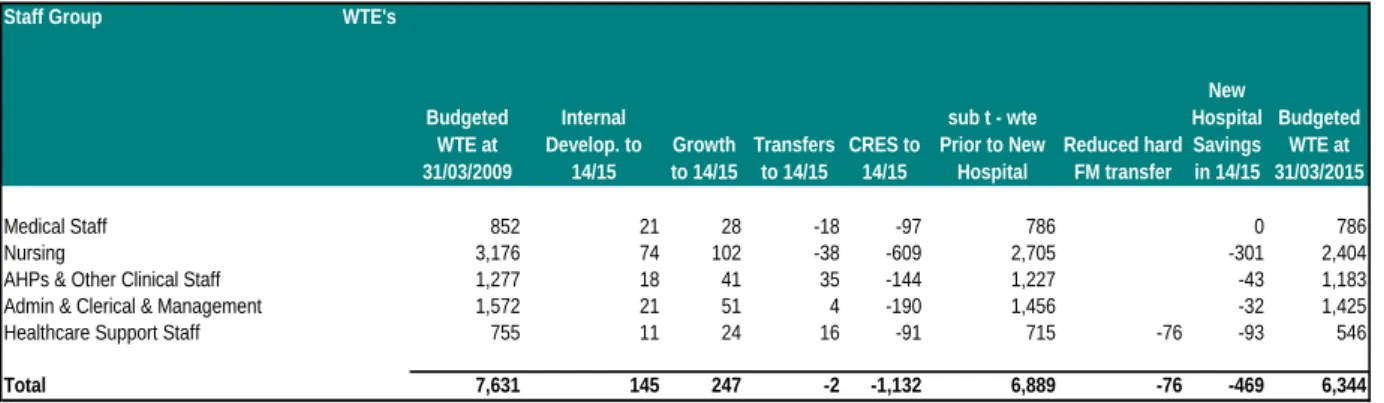
The resulting planned workforce changes are shown in the following table:
Table 5.5.i Summary of workforce changes
Staff Group WTE's
Medical Staff 852 21 28 -18 -97 786 0 786
Nursing 3,176 74 102 -38 -609 2,705 -301 2,404
AHPs & Other Clinical Staff 1,277 18 41 35 -144 1,227 -43 1,183
Admin & Clerical & Management 1,572 21 51 4 -190 1,456 -32 1,425
Healthcare Support Staff 755 11 24 16 -91 715 -76 -93 546
Total 7,631 145 247 -2 -1,132 6,889 -76 -469 6,344
Budgeted WTE at 31/03/2015 CRES to
14/15
sub t - wte Prior to New
Hospital
Reduced hard FM transfer
New Hospital Savings in 14/15 Budgeted
WTE at 31/03/2009
Internal Develop. to
14/15
Growth to 14/15
Transfers to 14/15
The 7631 WTEs budgeted currently is made up of 3739 WTEs on the Southmead site, 3558 WTEs on the Frenchay site and 334 WTEs on other sites.
The net reduction in staff numbers prior to the opening of new hospital of 742 WTEs is due to ongoing activity changes and efficiency savings on all sites. The reduction of 469 WTEs on the move to the new hospital is achieved to a great extent by the synergies and economies of scale that can be achieved by moving from two aging acute hospitals to a single purpose-designed new hospital. The new acute hospital will have approximately 5800 WTEs.
5.6 Specialist Services
The development will house a number of specialist services with catchment populations extending to the whole of the South West and beyond.
These services include:
Burns and plastics
Renal medicine
Neurosciences
Specialist orthopaedics
The strategy is to develop these services and to house them in the new hospital in such a way as to keep the coherence of their parts as well as to allow flexibility to change.
At the present time, a number of specialist services are split between acute provider trusts and also between hospital sites in Bristol. The strategy within the Bristol Health Services Plan (BHSP) is for the integration and concentration of specialist services across Bristol. This will ensure the viability of these services and the provision of the best possible care, recognizing the need to make the most effective use of specialist expertise, skills and equipment. The BHSP identifies a number of service reconfigurations to achieve this objective. Those which will impact on North Bristol Trust are:
Concentration of general paediatric services at the Bristol Children's Hospital at United Bristol Healthcare Trust (UBHT), completed in April 2007.
Concentration of specialist paediatric services at the Bristol Children's Hospital with effect from 2013/14. An outline business case has been approved by the SHA and the FBC is currently being prepared by UBHT.
Concentration of inpatient breast services at UBHT – scheme has been stopped pending a wider review of breast care services across BNSSG.
Concentration of ENT and oral and maxillofacial services within NBT with effect during early 2008 – currently pending final outcome of review of Head & Neck services by the Avon, Wiltshire and Somerset Cancer Network.
6. ACTIVITY AND CAPACITY 6.1 Growth
The objectives and strategies identified above have been matched up to assumptions around activity and capacity. Projections of population growth have been reviewed in line with predictions from the Office of National Statistics. The projections have increased from the OBC levels as shown in the following table:
Table 6.1.i Projected annual growth in weighted population
A further consideration for the scheme is the major development of new homes in the Greater Bristol area including 30,000 new homes planned for South Gloucestershire. The base year for activity projections is activity planned to be undertaken in 2008/9. Growth-projections from 2009/10 onwards build on the work done at OBC stage and take account of:
The population projections above and the plans for large numbers of new homes.
Historical growth trends assessed by BNSSG PCTs as averaging approximately 2% per annum (before reflecting the increased level of demand management initiatives more recently).
Local clinical knowledge regarding differentials between different specialties in the likely demand growth going forward.
Potential for demand to be managed in other settings (other than the transfer of care to community hospitals which is assessed separately below).
Elimination of non-recurring activity as waiting times stabilise at lower levels.
The resulting annual percentage demand changes are summarised below:
Table 6.1.ii Projected annual percentage demand changes
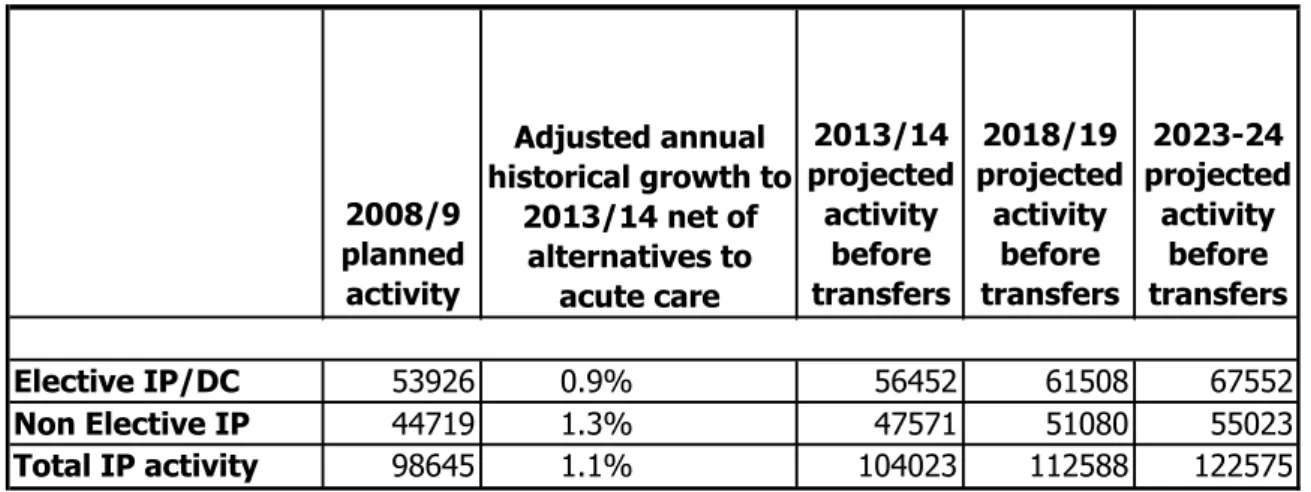
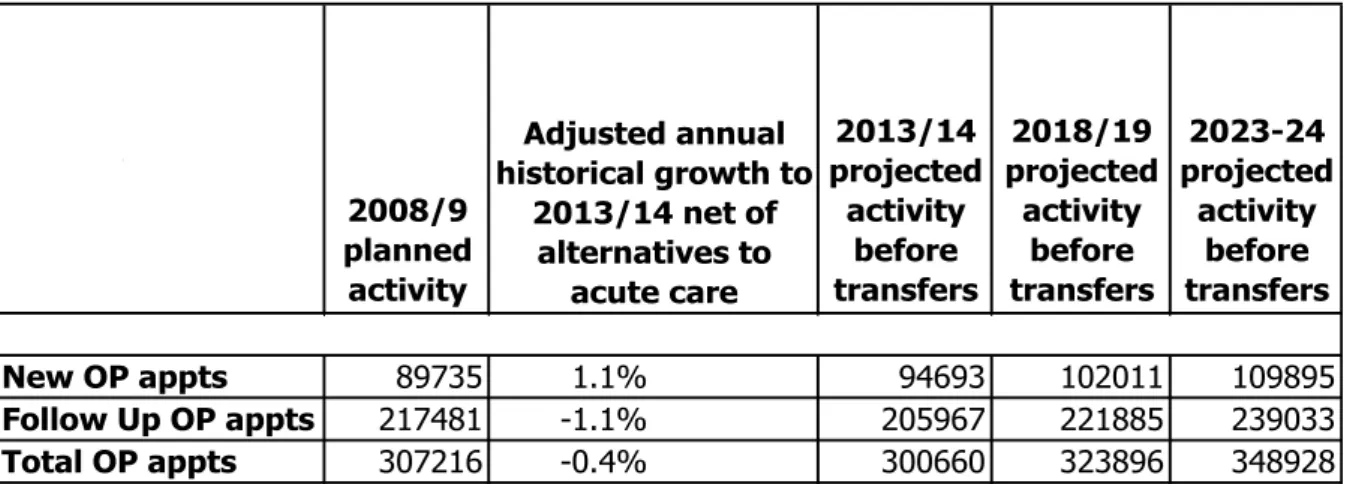
The base activity in 2008/9 and the resulting activity in 2013/14 after projected growth, and subsequently in 2018/19 and 2023/24, are summarised in the tables below.
2004 to 2013 2007 to 2013 2013 to 2018
Bristol 0.3 0.6 0.6
South Glos 1.3 1.5 1.3
North Somerset 1.3 1.6 1.5
Total BNSSG 0.9 1.2 1.1
Other PCTs 0.9 1.2 1.1
Total 0.9 1.2 1.1
OBC Annualised weighted pop'n growth projections %
ABC annualised weighted pop'n growth projections %
2009/10 2010/11 2011/12 2012/13 2013/14 2014/15 to 2018/19 2018/19 to 2023/24
Electives inpatients and daycases -1.66% 1.52% 1.56% 1.59% 1.63% 1.8% 1.9%
Non elective cases 1.03% 1.04% 1.37% 1.38% 1.39% 1.6% 1.7%
New outpatient attendances -5.6% -4.0% 1.5% 1.5% 1.5% 1.5% 1.2%
Annual percentage growth
Table 6.1.iii Projected growth in outpatient demand 2008/09 to 2023/24
Table 6.1.iv Projected growth in inpatient and day case demand 2008/09 to 2023/24
6.2 Transfers
Having established the total demand, assessments have then been made of planned service transfers to and from other organisations within the BHSP. These remain broadly in line with the BHSP Steering Group’s report to the SHA on the Bristol Health Services Plan of October 2005 and are shown below:
The main differences in acute flows from the BHSP position captured in the OBC are due to:
Commissioning decisions on services that have happened subsequent to the agreement with the ENT and breast transfers being scaled down.
Data predictions being supplanted by actual commissioning decisions-the actual ISTC capacity that has been agreed is less than the volume estimated in the OBC although with a heavier case-mix.
Estimates needing to be brought up to date in particular the acute flows in the OBC being calculated prior to the transfer of A&E services to Frenchay in 2005 and reduced levels of overall non-elective activity available to transfer.
2008/9 planned activity
2013/14 projected activity
before transfers
2018/19 projected activity
before transfers
2023-24 projected
activity before transfers
Elective IP/DC 53926 0.9% 56452 61508 67552
Non Elective IP 44719 1.3% 47571 51080 55023
Total IP activity 98645 1.1% 104023 112588 122575
Adjusted annual historical growth to
2013/14 net of alternatives to
acute care 2008/9
planned activity
2013/14 projected
activity before transfers
2018/19 projected activity
before transfers
2023-24 projected
activity before transfers
New OP appts 89735 1.1% 94693 102011 109895
Follow Up OP appts 217481 -1.1% 205967 221885 239033
Total OP appts 307216 -0.4% 300660 323896 348928
Adjusted annual historical growth to
2013/14 net of alternatives to
acute care
Table 6.2.i Acute transfers
Acute Transfers OBC
Spells Spells OP Atts Breast surgery transfer to UHBT -191 0
ENT transfer from UHBT 1618 1197
Transfers to ISTC -7956 -4701 -23390
Acute Flows transfer out -4311 -2542
Specialist Paediatrics to UHBT -3747 -3550 -17474 Additional Transfers to Weston -820
Total -15407 -9596 -40864
ABC
In addition to these acute transfers there is a major switch from acute to community settings as shown below:
Table 6.2ii Acute to community transfers
Transfers to Community Settings Percentage Transfer at
OBC Stage Percentage Transfer at ABC Stage
Outpatient Attendances 29% 32%
Therapy Contacts 59% 65%
Diagnostic scans 32% 35%
ED Attendances 56% 65%
6.3 Demand Summary
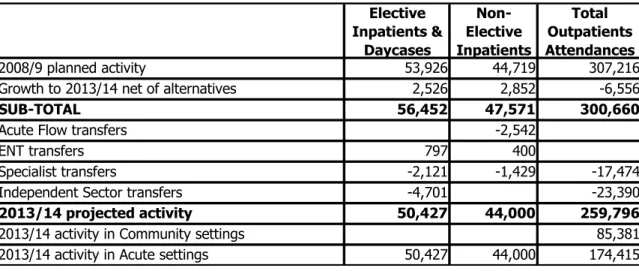
The table below summarises the projected inpatient and outpatient demand in 2013/14:
Table 6.3.i Summary of activity to 2013/14
Elective Inpatients &
Daycases
Non- Elective Inpatients
Total Outpatients Attendances
2008/9 planned activity 53,926 44,719 307,216
Growth to 2013/14 net of alternatives 2,526 2,852 -6,556
SUB-TOTAL 56,452 47,571 300,660
Acute Flow transfers -2,542
ENT transfers 797 400
Specialist transfers -2,121 -1,429 -17,474
Independent Sector transfers -4,701 -23,390
2013/14 projected activity 50,427 44,000 259,796
2013/14 activity in Community settings 85,381
2013/14 activity in Acute settings 50,427 44,000 174,415
6.4 Performance
The assessment of bed numbers required take account of reductions in average length of stay and increases in daycase rates, which are enabled by both the planned clinical model for the future, and also by the design and adjacencies of the new hospital.
The 2013/14 planned performance levels in comparison with current 2007/8 performance levels are shown below.
The non-elective reduction is 34% and the elective 28%, and these are pushing ahead of SHA targets but with the benefit of a purpose-built environment.
Table 6.4.i Length of stay excluding obstetrics and psychiatry Excluding Obstetrics &
Psychiatry outside the PFI Current
2007/8 ABC
in 13/14 % Change
Non Elective Spell Length of Stay 8.3 5.5 -34%
Elective Spell Length of Stay 4.6 3.3 -28%
Daycase Rate 70% 75% 7%
Bed Occupancy 90% 84% -7%
This analysis excludes maternity and other specialties excluded from the PFI. An analysis including these specialties is shown in the following table:
Table 6.4.ii Length of stay including obstetrics and psychiatry All specialties Current
2007/8 ABC
in 13/14 % Change
Non Elective Spell Length of Stay 6.3 4.8 -24%
Elective Spell Length of Stay 4.4 3.6 -18%
Daycase Rate 68% 75% 10%
Bed Occupancy 90% 84% -7%
6.5 Beds
The requirement derived from this analysis of demand and performance is 865 acute beds on the Southmead site, of which 768 are in the new hospital. This compares with current beds of 1114.
However, in addition to this analysis, the Trust has agreed to target further performance improvements in line with overall falls in bed utilisation averages across the NHS. This equates to a further 50 beds. These additional beds have not been removed from the scheme however, but left as a buffer in recognition of the need to accommodate planning error and potential changes in service provision across Bristol and the local area. The resulting bed requirement and provision is shown in the following table:
Table 6.5.i 2013/14 Bed Requirements and Provision
Beds Required acute & community beds in 2008/09 1114 Growth( net of alternatives to acute admission) 56
Specialist catchment area/transfers 10
Increase in casemix complexity 16
Reduction in length of stay -151
Increase in daycase rates -47
Decrease in occupancy rates 53
Further improvement in productivity -50
Required beds in 2013/14 before transfers 1001 Transfer of step-down/rehabilitation to comm hosps -96
Specialist paediatrics and ENT transfers -22
Transfer to ISTC -13
Transfers from changed acute flows -55
Required acute beds in 2013/14 after transfers 815
Acute beds in the PFI scheme 768
Acute beds in retained estate 97
Planned acute beds 865
Required community beds
Transfer of step-down/rehabilitation from acute 96
Step-up/admissions avoidance beds 10
Transfer of step-down beds from Bristol General 10
Total required community beds 116
Southmead Community Hospital (in PFI scheme) 32 Frenchay Community Hospital (outside PFI scheme) 84
Planned community beds 116
6.6 Sensitivity Analysis and Contingency Planning
Table 6.6.i below shows how the requirement for acute beds in the new hospital would compare to the 768 physical beds in the scheme if some of the key assumptions were changed, and what the resulting surplus or shortfall of beds would then be, based on Trust modelling.
Table 6.6.i Bed sensitivity analysis
If the Trust achieved current upper quartile performance across every specialty, then it would have 22 surplus beds in 2013/14. However, achieving upper quartile in every specialty is likely to push the Trust into upper decile performance as a whole entity, measured against current benchmarks. Achieving upper decile in every specialty would result in 106 surplus beds, but given the same point this is not considered a sensible basis for planning.
If length of stay was not improved above the actual level achieved in 2007/8, this would leave the Trust short of 276 beds. This emphasises the importance of performance improvement in the project.
Other scenarios shown in the table are growth being 0.5% per annum greater or less than anticipated (giving a 21 bed shortfall/22 bed surplus), and the maximum realistic activity transferring to Weston (giving an 18 bed surplus). All these scenarios have a relatively small impact upon bed requirements.
However, the SHA has also conducted sensitivity analysis, which takes account of the underlying national rate of improvement in productivity rather than simply a standstill analysis based on current productivity benchmarks as the Trust analysis above is. This gives a range of bed requirements which is lower, as shown in Table 6.6ii below:
Table 6.6.ii SHA bed sensitivity analysis
Best case
Appointment Business Case
Worst Case
Beds required 612 768 949
Difference to Appointment Business
Case -156 - +181
This shows that there is a best case in which bed demand is 156 beds lower than the capacity of the new hospital, and a worst case in which it is 181 beds higher. As explained above, in light of this analysis, the Trust is now increased its productivity targets to plan for a demand for beds 50 below the 768 acute beds planned for the new hospital.
Beds required based on ABC assumptions
Total Acute beds in the new hospital 768
Surplus beds at Upper Quartile length of stay 22
Surplus beds at Upper Decile length of stay Est 106
Shortfall of beds at current length of stay -276
Surplus beds if maximum transfer to Weston 18
Surplus beds if growth 0.5%pa less than planned 21
Shortfall of beds if growth 0.5%pa greater than planned -22
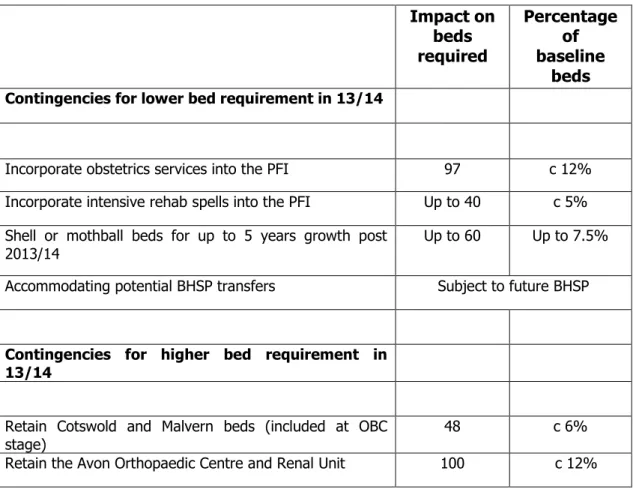
The advantage that the BHSP has in this development is that the PFI only accounts for around 30% of the total bed capacity between the local Trusts. Furthermore, NBT has not committed all its bed capacity to the PFI. This allows the use of a bed buffer to insure the development against either over or under capacity. This position is shown in the following table:
Table 6.6.iii Contingencies
Impact on beds required
Percentage of baseline
beds Contingencies for lower bed requirement in 13/14
Incorporate obstetrics services into the PFI 97 c 12%
Incorporate intensive rehab spells into the PFI Up to 40 c 5%
Shell or mothball beds for up to 5 years growth post
2013/14 Up to 60 Up to 7.5%
Accommodating potential BHSP transfers Subject to future BHSP
Contingencies for higher bed requirement in 13/14
Retain Cotswold and Malvern beds (included at OBC
stage) 48 c 6%
Retain the Avon Orthopaedic Centre and Renal Unit 100 c 12%
The contingencies shown for a higher bed requirement cover a higher demand of 148 beds. The SHA analysis indicates a worst case position of an additional requirement of 181 beds, and the Trust analysis indicates a scenario of no performance improvement at all would give a 276 bed shortfall.
Both of these scenarios are extremely unlikely and the contingency is considered adequate.
The other key issues in terms of contingency planning:
The rooms in the PFI have been designed to a standard template that allows flexible use e.g. between theatres, catheter laboratories and imaging.
The PFI bidders have designed the scheme to be able absorb a further 200 beds.
The planning permission for the scheme allows for additional 30% capacity.
7. CAPITAL COST AND AFFORDABILITY 7.1 Financial Context
The OBC described how the Trust accumulated a deficit of £44m in 2002/3 and subsequently put in place a recovery programme that it was on track to meet. Since the OBC the Trust has achieved its target to get into recurring balance and is now on an agreed programme to repay the
£52m debt incurred as a consequence of the £44m deficit. The repayment plan is shown in the following table:
Table 7.1.i Repayment plan for £52m historical deficit loan
31-Mar-07 2007/8 2008/9 2009/10 2010/11 2011/12 2012/13 Total
£m £m £m £m £m £m £m £m
Minimum I&E surplus 4.0 9.0 6.2 7.9 9.0 8.8 44.8
Capital receipts/change in working capital 4.0 2.0 0.5 0.7 7.2
Outstanding Loan 52.0 48.0 35.0 26.9 18.5 8.8 0.0
Cumulative I&E deficit 44.8 40.8 31.8 25.7 17.8 8.8 0.0
The Trust is on track to meet its planned repayments, and the repayment period ends in advance of the PFI commencement.
7.2 Capital Cost
The OBC assumed completion of the scheme by 2013/14 at a capital cost of £374m (MIPS 445).
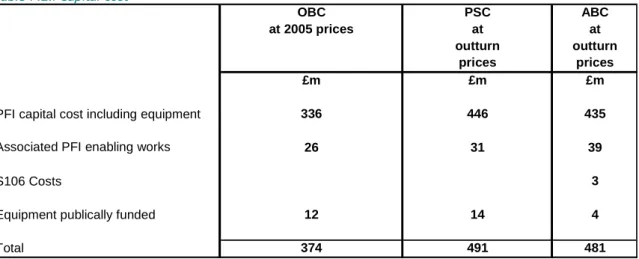
This included a combination of public funding for enabling costs and some equipment, and PFI funding for the bulk of the scheme. This equates to a capital spend of £491m at out-turn prices.
The capital cost of the scheme is now marginally lower at £481m. The PFI element is £435m of the total. This is based on Carillion’s bid of £429.7m at BAFO stage, together with an estimated
£5.3m for improvements to the Carillion scheme at BAFO. These improvements comprise an increase to the size of the single bedrooms and additional medi-rooms to support the theatre complex. The unitary payment consequence of these changes is reflected in the planned unitary payment, as described in section 7.3 below.
Table 7.2.i Capital cost
OBC PSC ABC
at 2005 prices at at
outturn outturn
prices prices
£m £m £m
PFI capital cost including equipment 336 446 435
Associated PFI enabling works 26 31 39
S106 Costs 3
Equipment publically funded 12 14 4
Total 374 491 481
Note: The £4m for equipment excludes £7m of minor equipment items charged to revenue and included in Table 10.3.5i.
As the table indicates, the Trust is funding a further £8m of enabling works over and above the level in the OBC, and removing this from the scope of the PFI contract. This improves value for money and affordability.
Table 7.2.ii shows the Trust’s summary capital expenditure and funding plan over 2007/8 to 2013/14:
Table 7.2.ii Capital Expenditure
07/08 08/09 09/10 10/11 11/12 12/13 13/14 Total
£m £m £m £m £m £m £m £m
Expenditure
Pre-PFI enabling 7.9 15.3 7.8 31.0
Advanced enabling 8.0 8.0
Section 106 costs 0.9 0.9 0.9 2.6
Equipment for the scheme 4.0 4.0
Sub total PFI related 7.9 15.3 15.8 0.0 0.9 0.9 4.9 45.5
Other 25.0 32.6 25.2 29.4 28.9 26.6 11.2 179.0
Total expenditure 32.9 47.9 41.0 29.4 29.8 27.5 16.1 224.5
Funding
PDC- enabling 6.8 16.0 8.1 31.0
PDC - other 11.0 16.1 7.9 35.1
Normal depreciation 15.1 15.8 16.2 17.6 18.7 19.2 20.1 122.5
Accelerated depreciation 5.4 11.8 9.1 9.4 5.1 40.8
Other sources 3.3 2.0 5.3
Total Funding 32.9 47.9 41.0 29.4 29.8 28.6 25.2 234.7
Net surplus 0.0 0.0 0.0 0.0 0.0 1.1 9.1 10.2
Provision for SHA smoothing 0.0 0.0 0.0 0.0 0.0 0.0 -4.9 -4.9
Surplus 0 0 0 0 0 1.1 4.2 5.3
Funding sources exceed planned expenditure £5.3m over the period to 2013/14. Therefore, the capital expenditure directly related to the ABC, together with other schemes supporting the new hospital and all other planned capital expenditure, is affordable within the available resources, with a modest surplus for contingency purposes.
7.3 Unitary Payment
The Unitary Payment (UP) resulting from the PFI financing element of the capital cost is shown in the following table:
Table 7.3.i: Unitary payment adjusted for risks provision [REDACTED]
The risk-adjusted unitary payment shown above is £34.5m at 2008/9 price and is based on the following assumptions:
Commercial bank funding is available for 50% of the senior debt at the time of the funding competition in autumn 2009, with an assumed LIBOR for a 25 year swap of 3.8%, a margin of 2.5% and a buffer of 0.5%. Funding from the European Investment Bank (EIB) has been planned for the balance of the senior debt. The EIB has indicated its intention to invest in the scheme subject to credit committee approval on selection of the preferred bidder. The full funding terms are set out in Section 12.4 and in Appendix 10.ii.
The Trust finances £8m of advance enabling works (in addition to the originally planned
£31m) and also £2.6m of Section 106 planning costs, out of its capital programme.
Adjustments have been made to the Carillion proposed unitary payment to allow for further improvement to the theatres accommodation and bedroom space within the scheme, and take up a Carillion offer to contractually underwrite energy consumption at 40 Gj/m3 (instead of 45 GJ/m3) for a £[REDACTED] increase in unitary payment. The total adjustment for these three elements is £[REDACTED] . There is a £[REDACTED] downward adjustment as the Trust plans to fund second stage demolition costs (c £[REDACTED]) directly from transitional funds and this was included in the bidder unitary payment proposals at BAFO.
A reduction of £180k has been made to reflect plans for the Trust to purchase a small number of the radiology analysers currently included in the PFI contract, where replacement of the existing analysers is required before the new hospital opening.
A risk provision of 0.3m has been set aside for potential changes in cost prior to financial close. This is based on a 50% risk provision for both a potential 1.5% increase in cost due to design risk and the impact of a potential 9 month delay in financial close. The bids received are subject to a 6 month absolute price hold, so the impact of a 9 month delay would be an increase in cost for a 3 month delay.
The £34.5m unitary payment on this basis at a 2008/9 price base is slightly in excess of the base affordability plan previously defined by the Trust of £34.2m. However it is well within the DH cap based on the PSC of £39.2m, and the subsequent revised £37.6m cap on the unitary payment agreed when permission by the Department of Health was given to close the dialogue. There remains £3.1m headroom above the risk-adjusted unitary payment before the unitary payment cap would be breached, which is almost 10%.
Under HM Treasury’s application of International Financial Reporting Standards (IFRS) in relation to PFI contracts and similar arrangements, this PFI scheme should now be accounted for as “on balance sheet”. This means that there will be a charge to the Trust’s income and expenditure account consists of finance lease interest, operating costs and depreciation and PDC dividend.
There is an higher average revenue cost through the contract term associated with the scheme being accounted for under IFRS in comparison with the previous off balance sheet accounting approach, largely as a result of the impact of depreciation and capital charges. An agreement has been reached between the Trust and NHS South West PCT’s to fund this additional cost. Funding will be provided to cover the difference between the on balance sheet charge and the off balance sheet charge, to put the Trust in the same position as it would have been had the scheme been accounted off balance sheet (i.e. £4.5m below the actual unitary charge payment). This funding will be capped at £4.0m at a 2008/9 price base (which equates to approx £4.7m at 2013/14 prices when the building is planned to open).
However, in addition, the revenue impact of going on balance sheet varies through the term of the contract. In the early years the revenue charge is greater than the average, and the position is reversed in the second half of the concession period with the charge being less than the average. The SHA have agreed to provide smoothing funds to keep the annual impact constant.
The table below shows a summary of the impact of on balance sheet accounting, together with impact of the PCT funding and the SHA smoothing mechanism:
Table 7.3.ii: Impact of unitary payment on income and expenditure [REDACTED]
The table indicates that the projected impact of going on balance sheet averages £3.3m per annum less than the unitary payment in cash terms. Thus, under the terms of the agreement with PCTs, a PCT tariff supplement of £1.2m is assumed. The actual impact will depend critically on the assessed fair value of the hospital on completion. These figures are based on an assumption of a fair value at 90% of the cost of construction. The highest valuation that could be expected would be 100% of the cost of construction. In this event, the impact of going on balance sheet averages £1.2m less than the unitary payment in cash terms, and the PCT tariff supplement would be £3.3m.
Normalised unitary payment
This is the unitary charge to revenue adjusted to put it on a like for like footing with other schemes. The Department of Health has set a cap for the normalised unitary charge at 12.2% of turnover. The estimated normalised unitary charge for the scheme of £44.1m equates to 10.0% of estimated turnover, and so is well within the cap. If the unitary payment increased to the agreed cap of £37.6m, the normalised unitary charge would still be well within the 12.2% cap.
The normalised UP is summarised in the following table:
Table 7.3.iii: Normalised unitary payment as a percentage of turnover
OBC OBC ABC
at 2005/6 at 2008/9 at 2008/9
prices prices prices
£m £m £m
Risk adjusted unitary payment 36.4 39.2 34.5
Impact of accounting treatment on charge to revenue -3.6 -3.9 -3.3
Adjustment to convert to a normalised unitary payment 12.0 12.9 12.9
Risk-adjusted most likely normalised unitary
payment 44.8 48.2 44.1
Projected turnover 2013/14 @ 2008/9 prices 439.0
Normalised UP as a percentage of turnover 12.2% 12.2% 10.0%
7.4 Savings
The table below shows the synergy and performance savings arising as a direct result of the PFI scheme:
Table 7.4.i Operational cost savings resulting directly from the new hospital
Performance Improvement enabled by new
hospital
Two or more Departments reduced to one
Design Related Savings
Savings '08/09
prices Savings
£000/year WTE
Synergy Savings:-
Theatres, Daycase unit and Recovery × × 2,309 100.4
Pharmacy, Radiology and Pathology × 1,149 31.3
Outpatient Nursing × × 296 10.3
Nursing (not ward based includes clinical site management team) × × 596 14.5
Junior doctor rotas and consultant on call rotas × 527 0.0
Therapy Services × 380 11.0
Management and Admin Staff × × 1,271 31.8
Travel and Transport × 455 6.0
IT Costs × 386 0.0
Catering & Restaurant x 662 49
Portering x 417 18
Security x 250 0
Other Facilities Support × 222 7.0
Non Pay Harmonisation though procurement × 150 0.0
9,070 279
Lower Nursing Costs of Larger Wards × 1,638 65.8
Bed savings - 50 beds × 2,594 62.5
Further Performance Savings × 2,594 62.5
Total Savings 15,897 469.2
The savings above arise from three key drivers:
Performance improvements enabled by the new hospital resulting in lower bed numbers.
Achievement of significant economies of scale resulting from services currently provided from two or more locations being provided from one location in the new hospital. The move to a single site also reduces the cost of out of hours junior doctor and emergency theatre staffing, reduces management costs and avoids cross-site transport costs.
Savings enabling by the design of the new hospital. The large flexible wards designed for the new hospital reduce staffing costs, even taking account of the fact they include 75% single rooms. A single medi-room facility integrating the current traditional separate daycase and recovery areas enables more productive use of capacity and staff. The move to an integrated outpatient area reduces staffing costs by allowing more flexible use of nursing staff and reception staff.
7.5 Overall Revenue Impact
The table below shows the overall revenue impact of the scheme:
Table 7.5.i Recurring revenue impact of the new hospital
OBC ABC
£m £m
Revenue Impact of PFI charges for new Hospital
Average charge to revenue resulting from PFI contract 35.3 30.8
Provision for UP adjustments including risk 0.4
Average SHA smoothing 0.0
PCT Tariff supplement (1.2)
35.3 30.0
Other costs associated with the new hospital scheme
Capital charges on associated enabling works & equipment 1.9 3.1 Premises running costs of new hospital & enabling schemes 7.8 10.2
Impact on third party income (0.8) (0.1)
8.9 13.2
Gross cost of the new hospital scheme 44.2 43.2
Costs savings from release of existing accommodation
Premises running costs (11.4) (10.7)
Capital charges (13.2) (11.4)
(24.7) (22.2) Operating cost savings
Synergy and design related savings (9.5) (10.7)
Performance related savings (6.5) (5.2)
Total savings (15.9) (15.9)
Net recurring revenue impact 3.6 5.1
Net recurring revenue impact if UP was at base level before risk 4.9 Net recurring revenue impact if UP was at the cap level 8.2
This table shows the risk adjusted unitary charge of £30.0m (net of the PCT tariff supplement to reflect balance sheet treatment), plus additional consequential costs of £13.2m, giving a total gross revenue impact of £43.2m. This cost is off-set by:
£22.2m of capital charges and premises costs being released from Frenchay and Southmead.
£15.9m of synergy and performance savings attributable to the scheme.
The resultant net recurring revenue impact is £5.1m on a risk adjusted basis, which equates to approximately 1.1% of trust turnover. If the risk could be managed out this net cost would be
£4.9m, whilst if the full risk impact, including the maximum potential exceptional funding costs resulted it would be £8.2m. Appendix 10.v. shows the revenue impact on a year by year basis.
The £5.1m net recurring cost is affordable as the Trust is generating surpluses in its medium term financial plan sufficient to absorb this net cost and remain in surplus. The projected surplus in 2015/16 (after taking account of the cost of the new hospital) is £11.9m. This is demonstrated in section 10.3.6 below.