Banking benefits
CAB evidence on payment of benefits into bank accounts
This report was written by Tony Herbert and Francesca Hopwood Road
January 2006
Executive summary 1
1. Introduction 5
The impact of direct payment 6
Local Housing Allowance – the next stage of direct payment 6
Progress made but problems remain 7
2. Problems opening basic bank accounts 9
Problems proving identity and address 9 The failure of banks to promote basic accounts 13 Banks’ attempts to sell other accounts 14 Access to banking for people in debt or bankrupts 16 Delays in opening basic bank accounts 19
Opening bank accounts in rural areas 20
Upgrading basic bank accounts 21
The consequences of not being able to open a bank account 22 The need for support for vulnerable people 24
3. Problems operating accounts 26
Banks’ right of set-off 26
Direct debits and administration charges 28 Poorer levels of service for basic bank account holders 31
Access to cash in rural areas 32
4. Conclusions and recommendations 35
Transforming access to basic bank accounts 35 Specific recommendations to improve current practice 37
Recommendations to banks 37
Recommendations to the Banking Code Standards Board 39 Recommendations to the Joint Money Laundering
Steering Group 40
Recommendations to Post Office Limited 41 Recommendations to Association of British Credit Unions Ltd 42
Recommendations to Government 43
Bibliography 45
Appendix 1 Support needed to open a bank account for a vulnerable person 48 Appendix 2 List of Citizens Advice Bureaux that submitted evidence 49 Appendix 3 Bureaux which have undertaken research into basic bank accounts 52
Executive summary
1. Access to bank accounts is crucial if financial exclusion is to be tackled successfully, yet about one in twelve households in the UK currently have no bank account of any kind .
2. Having a bank account helps to make people “job ready” since almost all employers now insist on paying people directly into bank accounts. It also enables people to obtain cheaper deals on fuel, insurance and credit.
3. The banking industry was encouraged to develop basic bank accounts to support the government policy of paying benefits direct into accounts. Since April 2003 over 1.5 million basic accounts have been opened, and 96 per cent of claimants now receive their benefit by payment into an account of some type.
4. Reforms of Housing Benefit (HB) which are currently being piloted in 18 local authorities around the country depend on access to bank accounts, as HB will usually be paid into the claimant’s bank account. The policy intention behind this change is to encourage tenants to take more responsibility for paying their rent, and to promote work-readiness.
5. However, CAB evidence demonstrates that at present there is a poor fit between the government’s policy of paying benefits direct into bank accounts and some of the banking industry’s current practices. Consequently many of the most vulnerable people are denied access to a bank account, or are unfairly penalised when they open one. This report highlights difficulties experienced in both opening and using bank accounts.
Problems opening an account
6. CAB clients experience particularly acute problems opening bank accounts because they may not have acceptable evidence of their identity and address, which banks must check to comply with money laundering legislation.
Although there is government guidance about how financially excluded people can prove their identity and address, CAB clients find that bank staff are frequently not willing to follow it. Our evidence reveals that the people who are most affected include discharged prisoners, non-UK citizens, people on benefits and homeless people.
7. Few banks provide much marketing information about their basic account.
This causes particular problems for the most excluded who may lack the confidence to ask for information relating to a basic bank account, or may not even be aware of the existence of basic bank accounts.
8. The Banking Code, which sets out minimum standards that banks have to comply with, states that people should be offered a basic account if they ask for and meet the conditions for one. However, CAB evidence shows that some bank staff prefer to sell accounts a nd services which may not be
suitable for customers’ needs. Since basic bank accounts are not deemed to be sufficiently profitable they are unlikely to feature in sales targets so bank staff have few incentives to sell them.
9. In spite of the fact that it is not possible to go overdrawn with a basic bank account, only a few banks allow people in debt to open accounts. As a result they find it difficult to manage their income or make repayments to creditors.
10. People are experiencing long delays attempting to open basic accounts with some banks, as the relevant processes are carried out centrally rather than at local bank branches. Delays can leave people without any income for
essential needs for several weeks.
11. People in rural areas are experiencing problems opening bank accounts.
Cost-cutting measures launched by the banks to increase their profitability have led to bank closures which have left nearly 1,000 mainly rural
communities bankless. As a result people who live in rural areas have a very limited choice of banks, and cannot open bank accounts at post offices.
12. A significant goal in spreading ownership of bank accounts is to bring
financially excluded individuals into the financial mainstream, and allow them to take advantage of the benefits that this can confer. However CAB
evidence shows that banks upgrade accounts to full current accounts with overdrafts where this may not be in an individual’s best interests.
13. The consequences of not being able to open a bank account can be severe.
People may have to use companies which charge fees to cash cheques, having to pay about 10 per cent of the cheque value for this service. For people in receipt of benefits this charge can represent a very sizeable proportion of the money they have to live on.
Problems using an account
14. CAB evidence demonstrates that providing access to banking is not enough to bring people into the financial mainstream; the design and features of a bank account are also important.
15. Banks often take money out of a basic or current account to pay other debts owed to the bank without checking the customer’s circumstances first. This is called the right of set-off, and there is no limit on the amount a bank can take.
This has major implications where housing benefit is paid into an account, as rent arrears and even eviction could result.
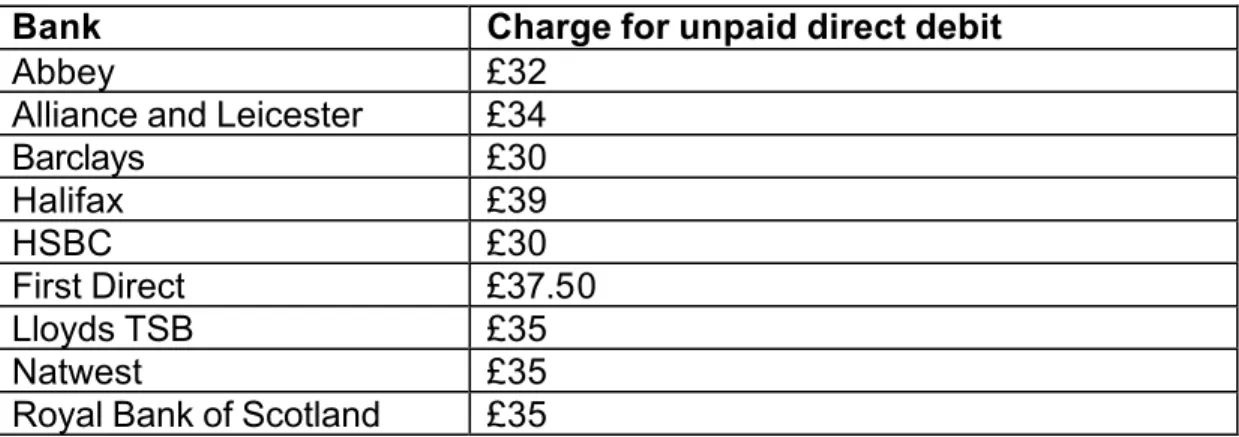
16. Charges levied by banks for items such as failed direct debits can also cause considerable hardship. Such charges range widely, with some banks
charging £39 for each failed direct debit. The imposition of this charge could leave someone on jobseekers allowance with less than £20 per week to live on if they experience even one failed direct debit in a week due to, for example, a delay in payment of their benefit into the account.
17. Some banks are providing poorer levels of service for basic bank account holders. It is taking up to 10 days to clear a cheque through some basic bank accounts, compared to the usual three to four working days. Other banks are preventing basic account holders withdrawing cash at a bank branch counter.
Key recommendations
18. All banks should review their existing basic bank accounts against the following principles:
• full credit scoring should not be used to determine access to a basic account. It is only acceptable to access the customer’s credit reference file to check they are on the electoral roll, as part of the money laundering check
• basic bank accounts should not exclude people in financial difficulties or undischarged bankrupts
• people opening a basic account rather than a current account should receive the same level of service on the time taken to open an account.
Accounts should be opened on the spot, provided the customer provides acceptable forms of identification
• banks should not exercise their right of set off from basic bank accounts
• charges for failed direct debits and standing orders should be capped at a level to be determined by the government’s Financial Inclusion Task Force
• all basic accounts should offer a buffer overdraft zone of £10
• the clearance time for cheque payment into basic accounts should be the same as for the bank’s current accounts.
19. As well as improving the features of basic bank accounts, banks need to improve their practices:
• information about basic bank accounts should be prominently displayed in both bank branches and on bank corporate websites
• on opening accounts clients should be given basic information on budgeting and handling money.
20. Some of the improvements required should apply to all bank accounts. These include:
• all bank accounts should be accessible at post office counters, ATMs and bank branch counters
• banks should make publicly available information about the documents that will be accepted as proof of identity to open an account
• where a bank refuses to open a bank account for a customer it should provide them with a proforma letter detailing the reasons for the
refusal, and outlining exactly the steps needed to remedy the problem.
21. The Banking Code should require subscribers to:
• display information about basic bank accounts in bank branches
• tell customers who have been turned down for an account the reasons for the refusal, and what they need to do to remedy the situation
• open a basic bank account where acceptable ID is provided, and set it up, within a maximum of 10 working days
• not to exercise their right to set-off other debts to the bank from basic accounts.
22. The Joint Money Laundering Steering Group (JMLSG), which aims to
promulgate good practice in countering money laundering, should produce a single list of acceptable documents to prove ID and address, drawing on banks’ best practice. This must include letters of entitlement to HB, official Home Office travel documents and residence permits.The list should be communicated clearly to all bank branch staff.
23. All current account holders should be able to withdraw cash over the counter at Post Offices.
24. And to make better use of the extensive Post Office network, we consider that that the Financial Inclusion Task Force should undertake a feasibility study into people being able to open basic bank accounts at Post Office branches.
25. The Office of Fair Trading (OFT) should investigate the level of charges for failed direct debits on basic bank accounts to ensure that charges are not disproportionate but reflect the costs incurred by the banks.
26. The national rollout of HB reform should not start until difficulties with opening and using bank accounts for payment of local housing allowance have been resolved. DWP should work with HM Treasury and the Financial Inc lusion Task Force to achieve this, and to consider the funding of support services for people opening basic bank accounts more generally.
27. To make a real and lasting difference, efforts to extend access to bank accounts need to become an integral part of banks’ core business. We therefore recommend that the Financial Inclusion Task Force should commission a report to outline the business case for banks to actively offer bank accounts to people on low incomes.
1 Introduction
1.1 A bank account is often considered to be the key product for achieving financial inclusion. The lack of one can result in individuals becoming excluded from an array of financial services, which makes them more vulnerable to exploitation and indebtedness. For example those who do not have bank accounts - the ‘unbanked’ - face higher costs on simple
transactions like cashing cheques or paying for their fuel bills via a pre-
payment meter, and find it more difficult and costly to purchase other financial products such as insurance or credit.
1.2 In 2002-2003 around eight per cent of households in Britain were without access to any kind of bank account. This equates to one in twelve households or approximately 2.8 million adults, with a further 1.1 million households having to manage with some sort of savings account, which offer limited services (for example they do not offer the facility to set up direct debit payments).1
1.3 The ‘unbanked’ are often the most vulnerable members of society. They are often living on a low income, with more than 25 per cent in the lowest income decile2 and 65 per cent of ‘unbanked’ households in the lowest three income deciles, meaning they have an annual household income of just under
£14,500. They are also more likely to be in receipt of benefits: half of the unbanked have been receiving benefits for more than five years3 and they are more likely to live in socially rented accommodation. Unbanked individuals and families can also be in danger of getting locked into a cycle of poverty and exclusion, leading them to turn to high cost credit or even illegal lenders.
This inevitably results in further financial strain and unmanageable levels of debt.
1.4 Enabling the unbanked to open bank accounts offers a gateway to financial inclusion, one which can bring people into the financial mainstream. It also confers additional benefits, such as making people “job ready” since almost all employers now insist on paying people directly into bank accounts.
1.5 In the 2004 Spending Review, the government announced that it was working together with the banks towards the goal of halving the number of adults in households without a bank account – and to have made significant progress in that direction within two years.4 To achieve the spending review goal would involve up to 1.4 million new bank accounts to be opened by people who have no such account. That is equivalent to 1,900 new accounts opened every day.
1 Promoting Financial Inclusion, HM Treasury, December 2004
2 Ibid
3Affordable credit for low-income households, Sharon Collard and Elaine Kempson, Joseph Rowntree Foundation, February 2005
4Pre-Budget Report 2004 - Opportunity for all: The strength to take the long-term decisions for Britain, HM Treasury, 2 December 2004, p.100
Available at: www.hm-treasury.gov.uk/media/92B/F6/pbr04_chap05_282.pdf
The impact of direct payment
1.6 Direct payment of benefits into accounts formed part of the financial inclusion agenda. Other reasons for this change included: the prevention of benefit fraud; better safety and security for benefit recipients; and a substantial
reduction in the cost of social security administration (from 68p per transaction for order books to 1p per transaction for direct payment), saving the
government around £400 million each year when fully implemented.
1.7 Basic bank accounts were developed to support the move to direct payment.5 They are designed for people who want to ensure that they do not overdraw their accounts or who may not meet the banks’ criteria for opening a current account. However, they do permit the payment of bills by direct debit or standing order. They can also be accessed at post office counters as well as bank branches and ATMs. Since April 2003, over 1.5 million basic bank accounts have been opened.6
1.8 The Department for Work and Pensions (DWP) is now paying over 96 per cent of customer accounts by direct payment.7 However, many people have
chosen to receive direct payments into a Post Office card account (POCA) rather than a bank account. These are very simple accounts which have no overdraft, direct debit or standing order facilities and can only accept
electronic payment of state benefits, pension and tax credits. It is believed that many of the POCA holders already have bank accounts but are signalling a preference for using post office services. As at 15 May 2005, 4,720,824 POCAs had been opened for the receipt of benefits, pensions and tax
credits8, accounting for approximately 40 per cent of benefit claimants invited to convert to direct payment.9
Local housing allowance – the next stage of direct payment
1.9 The next stage in the rollout of direct payment is the introduction of Local Housing Allowance (LHA) as part of the wider reform of HB. Under the LHA, which is currently being piloted in 18 pathfinder areas throughout the country, payment of HB will in most cases be made direct from the local council to the claimant or into the claimant’s bank account for tenants in private rented
accommodation, rather than direct to the landlord, as at present. The
claimant can then set up a direct debit or standing order for payment of rent to the landlord. The policy intention behind this change is to encourage tenants to take more responsibility for paying their rent, and to promote work-
readiness. This change is likely to affect a large proportion of the four million households who currently receive housing benefit for help with their rent.10
5 PAT 14, Access to Financial Services, Social Exclusion Unit, 1999
6 British Bankers’ Association (BBA) press release, 24 November 2005
7 Hansard, House of Commons, 20 June 05, Column 707W
8 Hansard, House of Commons, 4 July 2005, Column 72W
9 Direct Payment Statistics, Department for Work and Pensions Payment Modernisation Programme, March 2005
10 DWP Statistics, May 2004
1.10 This poses a number of additional problems for tenants who have already chosen to set up a POCA to receive benefits payments from DWP. Firstly, at present only DWP administered benefits and tax credits can be paid into a POCA. Local authorities cannot pay LHA into a POCA, as the Memorandum of Understanding between the banks, the DWP, Post Office Limited (POL) and the Department for Trade and Industry (DTI) would need to be rewritten to include every local authority.11 Secondly, the POCA does not offer direct debit or standing order facilities necessary to enable tenants to make secure rent payments to their landlords. For these reasons, ease of access to bank accounts will be one of the most essential factors in determining whether the national rollout of LHA is a success. Citizens Advice’s policy
recommendations on LHA are contained in a separate report.12 Progress made but problems remain
1.11 Significant progress has been made by the banking industry in extending access to bank accounts, with 1.52 million basic bank accounts opened since April 2003,13 though precisely how many of these accounts represent bank accounts opened by the ‘unbanked’ remains unclear. The new version of the Banking Code which came into force in March 2005 included more stringent requirements in relation to access to basic bank accounts.
1.12 However, evidence from Citizens Advice Bureaux indicates that opening basic bank accounts is still proving problematic for many people. Between April and September 2005, 73 bureaux submitting detailed statistics to Citizens Advice reported that over a third of their enquiries about bank accounts – and by far the largest number - related to problems with access.
11 The Local Government Association states that in June 2003 there were 410 Local Authorities in England & Wales. www.lga.gov.uk/Documents/Briefing/LG%20structure%202003.pdf. In addition, there are 32 local authorities in Scotland.
12 See Early days: CAB evidence on the Local Housing Allowance, December 2005 for further information about the LHA Pathfinder pilots, and Citizens Advice’s recommendations about how the policy should be implemented nationally.
13 Basic bank account growth continues, British Bankers’ Association, 24 November 2005
Table 1.1 Banking enquiries dealt with by bureaux April–September 2005
1%
1%
35%
1%
1%
11%
9%
18%
22%
0% 5% 10% 15% 20% 25% 30% 35% 40%
Product info Selling methods Administration Access to accounts Terms+Conditions Charges Complaints Cross-border Other
Base: 2,295 enquiries about banking made to 73 Citizens Advice Bureaux in England and Wales from 1 April to 30 September 2005
1.13 CAB evidence shows that clients are experiencing problems not only in setting up basic bank accounts but also in using either basic or current accounts to manage their money. Indeed, common banking practices, such as the right of set-off or the imposition of administration charges, are in many instances having a detrimental impact on the vulnerable and excluded – precisely those people that the financial inclusion agenda aims to help. Unless these
problems are addressed, we fear that they will undermine the DWP’s plans to introduce LHA on a national scale and, more generally, inhibit the success of the government’s financial inclusion agenda.
1.14 This report is based on 435 evidence reports submitted by 290 Citizens
Advice Bureaux in England, Wales and Northern Ireland from January 2004 to August 2005. We have also drawn on the findings of 49 CAB surveys of local access to basic bank accounts for the period August 2002 to March 2005.
1.15 Chapter 2 outlines the problems experienced by CAB clients in opening accounts for receipt of benefits; and Chapter 3 details the problems experienced by CAB clients in operating these accounts. Following this, Chapter 4 puts forward a number of recommendations to the banking industry, government and other stakeholders to improve the procedures involved in opening and running basic and current accounts.
2 Problems opening basic bank accounts
2.1 This chapter examines the difficulties experienced by CAB clients in opening basic bank accounts. The impact of these difficulties is to restrict people’s access to banking facilities and, in so doing, threaten the success of
government efforts to tackle financial exclusion. These difficulties comprise:
• problems proving identity and address when trying to open bank accounts
• failure to promote and advertise basic bank accounts
• attempts to sell accounts other than basic bank accounts
• lack of access to basic bank accounts for people in debt or undischarged bankrupts
• delays in opening basic bank accounts – often due to over-centralisation
• difficulties opening bank accounts in rural areas
• the need for support for vulnerable people opening bank accounts.
Problems proving identity and address when trying to open bank accounts
2.2 Since 1994, when the first EU Directive on money laundering was transposed into UK legislation, all banks, building societies, and other businesses
providing financial services have had to put procedures in place to stop criminals from using them to launder the proceeds of crime or to finance terrorism. Financial institutions are required to obtain two separate
documents from potential customers to prove their identity and address. This usually takes the form of “primary” evidence of ID such as a passport or a driving licence, and “secondary” evidence with proof of address such as utility bills in the customer’s name.
2.3 Citizens Advice recognises the need for procedures to be in place in order to stop criminals from using bank accounts to launder money. However, a sensible and appropriate balance needs to be struck between the need to protect against money laundering and the desire to expand access to banking services, as part of efforts to promote financial inclusion. For people on low incomes and dependent on benefits, it is crucial that the process of opening a bank account is simple and speedy, and they are not required to provide documents in order to satisfy the money laundering legislation. The Financial Services Authority (FSA) recognised this with guidance in its Money
Laundering Sourcebook, which provides guidance on alternative documents by which financially excluded people could prove their identity and address easily.14 For example, the guidance states that if a financial services
provider has reasonable grounds to conclude that an individual cannot produce detailed evidence of their identity and cannot reasonably be expected to do so, it may accept as identification evidence a letter or statement from a person in a position of responsibility who knows the individual.
14The Money Laundering Sourcebook forms part of the FSA Handbook, and sets out the
requirements on firms to put in place anti-money laundering systems and controls. It is available at:
www.fsahandbook.info/FSA/html/handbook/ML
• upgrading basic bank accounts
• the consequences of not being able to open a bank account
2.4 Despite the guidance, CAB clients find that bank staff are frequently not willing to be flexible in the type of documents they are willing to accept. This is a significant issue reported by bureaux – nearly a third of the case studies used to compile this report concerned problems with banks not regarding customers’ documents as suitable or sufficient to prove identity and address.
The impact can be substantial:
A Somerset CAB’s client had been offered a job and so needed to open a bank account to receive his wages. However, as he was homeless this proved impossible. The client found himself caught in a vicious circle in which he was unable to open a bank account without an address, he could not find a place to live without one month’s rent and deposit, and yet could not start work without opening a bank account to receive his wages.
A Sussex CAB reported that two migrant workers from the EU
accession states sought advice when they found themselves unable to open bank accounts after working in the UK for three months, as the banks would not accept the documentation they offered. As a result, the clients either had to use a cheque cashing service or rely on a friend to cash a cheque to access their wages.
A South-West Wales CAB reported that a woman who had held a savings account with her bank for 32 years was shocked to discover that the bank would not open a new account without her proving her identity and address. The client only had a marriage and birth
certificate to prove her identity, but no passport, credit cards or driving licence. The bank, however, did suggest that she apply for a credit card instead, even though the client was not interested in borrowing money.
2.5 Our evidence reveals that the main groups who experience problems in providing proof of ID to open basic bank accounts include:
• discharged prisoners
• refugees and asylum seekers
• workers from abroad
• UK citizens returning to the UK after living abroad
• people on benefits
• students from abroad
• homeless people
• those living in hostels
• people who live in houses in multiple occupation (HMOs)
• elderly married women
• widows.
2.6 Of these groups, people from abroad, including asylum seekers and refugees, migrant workers, students and UK citizens returning to live in the UK, suffer more acutely as their documentation is more likely to differ from the usual
documents requested by banks. Clients from outside the EU have faced major problems in getting banks to recognise their documents, especially where they have entered the country as asylum seekers and do not have passports from their country of origin. Travel documents are not acceptable as primary ID despite bearing a photograph which will almost certainly be recent, a copy of the holder’s signature and the official stamp of the Home Office.
Here are a few recent examples:
A CAB in Wiltshire reported that a couple recently arrived i n the UK from Zimbabwe could not open a bank account because they had no UK address. However they could not find anywhere to live until they had opened a bank account. No local estate agents were prepared to accept a cash deposit and rent in advance from the clients in these circumstances.
A Somali refugee who had recently been granted indefinite leave to remain in the UK sought advice from a Sussex CAB about opening a bank account. When the client approached the bank where her mother already held an account, she found that they would not accept the documentation she had, namely her Home Office registration card, a letter from the local authority about a social care grant and her NHS medical card.
A CAB in Shropshire reported that a student from Latvia could not open a bank account for payment of her wages from a part-time job, because she had no evidence of her address which was acceptable to the banks.
One bank would not accept letters from her prospective employer, a national pub chain or from the college she was attending. Instead they insisted she got a letter from her Latvian bank, which would take several weeks to arrive.
2.7 The lack of flexibility is evident when banks will not accept letters of
entitlement to housing and council tax benefits. This is a particularly acute problem for those bureaux in LHA pathfinder areas who report that banks are unwilling to accept letters from the local authority proving their entitlement to HB, even though they accept entitlement letters from DWP. This is
unreasonable on the part of the banks, as virtually all local authorities rigorously check all aspects of the housing benefit claim under the requirements of the housing benefit verification framework.15
15 Local authorities are not required to use the HB verification framework, however, there are financial incentives for them to do so. The HB verification framework is a set of guidance produced by the DWP to provide local authorities with minimum standards for the collection of evidence and on-going checks in both housing benefit and council tax benefit (HB/CTB) cases. The intention is that where local authorities adhere to the framework, the amount of fraud and error entering the system will be reduced, and any that does enter will be detected more readily. Details of the checks which are required can be found in the Verification Framework Manual on the DWP website www.dwp.gov.uk.
2.8 Evidence from LHA pathfinder bureaux show the problems caused by banks being unwilling to accept HB/CTB entitlement letters:
A CAB in an LHA area reported that a single man in receipt of income support and housing benefit was unable to open a bank account
because the local banks were not willing to accept a letter of entitlement to housing benefit as proof of identity. As a result the client was unable to cash his LHA cheques.
The same CAB was so concerned at the problems their clients were facing in this regard that they organised a meeting with representatives from local banks. The issues discussed covered staff training, basic bank literature, appropriate selling of products, the length of time to open an account, possible systems for copying original ID documents and the need for a single list of acceptable documents to prove identity and address. The CAB proposed that one way of safely addressing this problem would be for banks to accept HB notification letters from the local council as proof of address, in the same way that they can (in theory) accept letters from central government bodies (e.g. DWP benefits offices or JobCentre Plus offices). However, although delegates agreed the meeting had been useful, only two local banks subsequently accepted HB letters as proof of address.
2.9 This is a major problem which is not just experienced by CAB clients. In their report Banking the unbanked – a snapshot, Services Against Financial
Exclusion (SAFE) found that “identification and address verification
requirements are still a significant barrier [and] only 40 per cent of applicants were able to open their [basic bank] account first time around”.16 And the Banking Code Standard Board’s (BCSB) mystery shopping exercise which seeks to check how easy it is to open a basic bank account, found that “anti- Money Laundering checks still create difficulties. Many benefit recipients do not have documents such as driving licences or passports. Some bank staff need to be more aware of alternative forms of identification: greater flexibility is needed at branch level.”17 Worryingly, these findings are unchanged from the BCSB mystery shopping exercise conducted in 2004.
2.10 Nevertheless, there is some good practice in this area, as the following case demonstrates:
A CAB in Sussex reported an example of good practice by Nationwide Building Society. Their client needed to move out of a rehabilitation centre, but needed to open a new bank account to enable him to manage his finances in his new flat. He did not have any of the usual forms of ID needed to open an account, but the building society
manager agreed that a letter from the manager of the rehabilitation centre confirming the client’s identity would be acceptable proof of identity. The CAB commented that the flexibility of the building society’s
16 Banking the unbanked – a snapshot, SAFE, November 2005, p.46
17 Basic Bank Accounts – substantial progress but room for improvement remains, Banking Code Standards Board, 17 November 2005
approach meant that the client’s transition out of rehab into his own home was much easier.
The failure of banks to promote basic bank accounts
2.11 The main ways in which people can find out about basic accounts is through advertising and marketing material and by talking to bank staff.
2.12 Yet in practice few banks advertise or provide much information about their basic account, which causes particular problems for the most excluded who may lack the confidence to ask for information relating to a basic bank account, or may not even be aware of the existence of basic bank accounts:
Brighton and Hove CAB found that staff in only one bank out of the eleven they visited knew about their basic account, and had the leaflet about the basic account on display in the branch. At the branch, the receptionist also told the CAB adviser that their basic account was one of their most popular accounts. In complete contrast another bank told the CAB adviser that it was the bank’s policy not to display leaflets promoting the basic bank account.
In March 2005 North Liverpool CAB and Speke Advice Service (CAB) Ltd undertook their own research into basic bank accounts to find out if the picture differed at a local level. The results from the mystery
shopping they carried out led them to conclude, “staff appear not to be trained about who basic accounts are appropriate for, nor do they appear keen to promote information about basic accounts. There also appears to be little promotional or information material about the accounts, e.g. how to open and access them”.18
2.13 These disappointing results are not confined to evidence collected by
bureaux. Mystery shopping exercises by the BCSB have consistently found that information on basic accounts is not readily available, with their latest round of research concluding “it remains a concern that in 62 per cent of cases literature was not on display alongside other current account promotional material in the banking hall.”19
2.14 It is perhaps unsurprising that branch staff do not promote basic bank accounts. Since they are not deemed to be suitably profitable they are unlikely to feature in the sales targets which are set centrally so branch staff have few incentives to sell them. Even the BCSB has been moved to comment that it does not rule out staff sales incentives as a possibly significant factor in determining the type of account that is promoted by branch staff.20
18 Money Talk – Report into Basic Bank Accounts in Liverpool, North Liverpool CAB and Speke Advice Services (CAB) Ltd, March 2005
19 Survey of subscribers providing basic bank accounts, Banking Code Standards Board, November 2005, page 6
20 ibid, page 6
2.15 Our evidence also reveals that some branch staff’s knowledge of basic bank accounts can be unsatisfactory, with contradictory information given by different branches of the same bank. As one CAB survey notes, “in general the information from banks [about basic bank accounts] was not consistent, different b ranches gave different information and even the same branches gave different information”.21 The fact that knowledge about basic bank accounts differs from one branch to another results in an inconsistent
application of the rules, and causes an unhelpful degree of confusion among consumers. Such poor practice contravenes the Banking Code, which requires that staff understand the products they offer.22
Banks’ attempts to sell accounts other than basic bank accounts 2.16 The Banking Code rules relating to basic bank accounts have recently been
strengthened,23 and the most recent version now states that banks offering basic accounts will “assess whether your needs are suited to a basic bank account (if we offer one) and if they are, we will offer you this product; [and will] offer you a basic bank account if you specifically ask and meet the qualifying conditions for one.”24 The BBA and the APACS (the UK payments association) assert that the commitment in the new version of the Banking Code is equivalent to the French statutory right to a bank account.25
2.17 In theory then, low income consumers should not experience any problems opening a basic rather than full current account. Nevertheless, CAB evidence shows that people experience real problems. Some bank branch staff
appear, at best, to be ignorant of the undertakings in the Banking Code or, at worst, seem intent on ignoring them:
A CAB in South-East Wales reported that staff from one bank subjected a client who wanted to open a basic bank account for receipt of his benefits to a full 20 – 30 minute sales talk on everything from a full current account to home insurance, which he did not want.
2.18 Most worryingly, it appears that banks ignore requests by consumers for the basic bank account, selling them a full current account instead. For example:
North Liverpool CAB and Speke Advice Service (CAB) Ltd found that one bank admitted that they “would always try to open a current account rather than a basic account, as these are better”,26 while the BCSB’s mystery shopping exercise found that “even where a [basic bank
21 Money Talk – Report into Basic Bank Accounts in Liverpool, North Liverpool CAB and Speke Advice Services (CAB) Ltd, March 2005
22 Key commitment 2 of the Banking Code states “We will publicise this code, and make sure that our staff are trained to put it into practice”.
23 Independent Review of the Banking Code: Report to Code sponsors - Summary of recommendations, Elaine Kempson, Personal Finance Research Centre
September 2004, Paragraph 2. 3.1
24 The Banking Code - Guidance for subscribers (March 2005)
25 Financial Inclusion – access to advice, banking and credit, BBA and APACS, November 2005
26 Money Talk – Report into Basic Bank Accounts in Liverpool, North Liverpool CAB and Speke Advice Services (CAB) Ltd, March 2005
account] was clearly appropriate, in 20 per cent of cases staff attempted to dissuade applicants from taking such an account”.27
A CAB in Nottinghamshire reported that a client with schizophrenia and in receipt of income support and disability living allowance went to a bank to open an account in order to receive benefit payments from the DWP. The client was granted an account, but was also offered a
£2,000 loan, a £600 overdraft and use of a credit card. The client is now in financial difficulties.
In April 2005 a CAB in Cumbria advised a client with multiple debts to open a basic bank account. The CAB had given the client the FSA leaflet28 in order to help them choose one. The clients chose one particular bank because it had a local branch. When the client had completed the application form, the bank staff told them they could not have the basic account, but could have a full current account instead.
When the clients told the bank that they had been advised by the CAB to open a basic account and produced the FSA leaflet, the bank
grudgingly agreed to open one.
In April 2005 a CAB in Worcestershire had a client with debts of approximately £17,000 in unsecured lending and credit cards. These debts caused his bank to close his account and cancel his standing orders. The client then got a new job and needed to open a new bank account to receive his wages. He wanted a basic bank account so that he would not be able to incur any furthe r debt, but when he asked for this the bank informed him that a basic bank account would not be suitable. Instead they offered him a current account with a cheque card, potentially allowing him to get into greater debt.
2.19 These examples appear to contravene the further requirement contained in the Code “to give you information about a single product … if you have already made up your mind”29 and show that despite a strengthening of the Banking Code recommended by the Independent Reviewer of the Banking Code, banks continue to fail to adhere to this.
2.20 Some banks use credit scoring to decide which account an individual should be offered. For example:
One bank told Speke CAB and North Liverpool CAB that they would always try to open a current rather than basic account because the facilities were better and that they would always use a credit check.
2.21 The BCSB research also highlights this issue. Even where their mystery shoppers asked specifically for a basic account, little notice of their request
27 Survey of Subscribers providing basic bank accounts, Banking Code Standards Board, November 2005. p.10
28 No bank account? Why it could pay you to have one, Financial Services Authority
29 The Banking Code - Guidance for subscribers (March 2005).
was taken. One of their mystery shoppers had the following to say about their experience:
“Three times I explained the simple needs and three times she said they would always start with the best account and work down.”
Lack of access to basic bank accounts for people in debt or undischarged bankrupts
2.22 The use of credit scoring by some banks helps to explain the prevalence of CAB evidence on people in financial difficulties or who are undischarged bankrupts being unable to open a basic account. As a result, people with these problems suffer financial exclusion.
2.23 Basic bank accounts have been designed with the needs of the unbanked in mind, who have not had access to mainstream financial services before.
However, basic accounts are also very useful for people with multiple debts, particularly those with income which would otherwise go into an overdrawn current account and be used to service the debt, leaving them without enough income to meet their essential needs, or to make offers of repayment to all their creditors. Consequently bureaux commonly have to advise clients with overdrafts to open a new basic bank account which will enable them to manage their money and deal with their debts, without compounding their indebtedness.
2.24 Debt is a growing problem in the UK – over the last 10 years CAB enquiries about consumer debt have increased by 118 per cent. Bureaux report that they often have to deal with overdrafts as part of a multiple debt case.
Enquiries to CABx about overdrawn accounts form a significant proportion of debt enquiries – it is the fourth most common debt.30 So there is a potentially large market for basic bank accounts for this group of people.
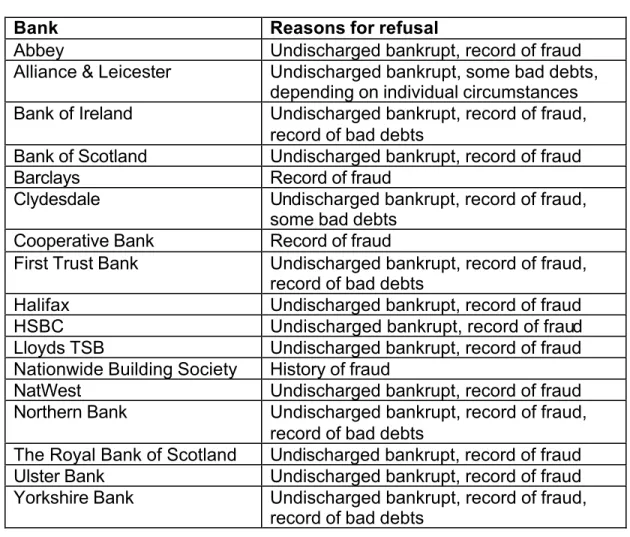
2.25 However, it can be very difficult for someone with multiple debt problems to open a basic bank account. As the table below shows, a significant number of banks do not allow people in debt to open a basic bank account:
30 The most common debt enquiries to CAB from July to September 2005 related to (in order of magnitude) credit card and storecard debts (23,138 enquiries), unsecured personal loan debts (15,151 enquiries), council tax debts (6,961 enquiries) and bank and building society overdrafts (6,003 enquiries).
Table 2.1 – Reasons for refusing basic bank accounts31
Bank Reasons for refusal
Abbey Undischarged bankrupt, record of fraud Alliance & Leicester Undischarged bankrupt, some bad debts,
depending on individual circumstances Bank of Ireland Undischarged bankrupt, record of fraud,
record of bad debts
Bank of Scotland Undischarged bankrupt, record of fraud
Barclays Record of fraud
Clydesdale Undischarged bankrupt, record of fraud, some bad debts
Cooperative Bank Record of fraud
First Trust Bank Undischarged bankrupt, record of fraud, record of bad debts
Halifax Undischarged bankrupt, record of fraud
HSBC Undischarged bankrupt, record of fraud
Lloyds TSB Undischarged bankrupt, record of fraud Nationwide Building Society History of fraud
NatWest Undischarged bankrupt, record of fraud Northern Bank Undischarged bankrupt, record of fraud,
record of bad debts
The Royal Bank of Scotland Undischarged bankrupt, record of fraud Ulster Bank Undischarged bankrupt, record of fraud Yorkshire Bank Undischarged bankrupt, record of fraud,
record of bad debts
2.26 Banks’ refusal to open basic accounts for those in debt seems to stem from their use of credit scoring. However, the application of credit scoring to basic bank accounts is unwarranted since these accounts offer no credit. As the BCSB note “there should be no necessity for any form of credit searches as the BBA has been designed as an account that offers no credit. If there is a requirement to search to confirm identification and address, an identity check only will suffice and such a check with a [credit reference agency] does not leave a footprint on the credit register.”32
A CAB in Cumbria recommended that their client open a basic bank account. However, he was only allowed to open a savings account.
When the bureau called to query this, they were informed that the bank submits all applications to credit scoring and credit reference agency checks.
A CAB in Wiltshire had a client who was experiencing debt problems so was given advice to open a basic bank account. However, he was refused an account as he had a bad credit history. This meant that the client was unable to take steps to deal with his debt – he did not wish to
31 Basic bank accounts – your questions answered, FSA, October 2005
32 Survey of subscribers providing basic bank accounts, Banking Code Standards Board, November 2005, page 17
make payments to his existing account as the bank would use them to pay off his non-priority debts to the bank, at the expense of paying his other, more pressing creditors.
A Surrey CAB reported that a man who was too ill to work needed to claim incapacity benefit when he had used up all his savings. The Jobcentre told him to open a new basic account for payment of his benefits. The client sought advice when he was turned down by two banks because of a poor credit record.
2.27 People who are undischarged bankrupts suffer particularly acute problems in being able to open basic bank accounts. As Table 2.1 shows, only three banks say they are willing to allow undischarged bankrupts to open their basic account. One of the consequences of bankruptcy is that the debtor’s bank account may be frozen in case there are any assets which could be used to distribute to creditors, and in many cases the bank subsequently closes the account. This is an important issue, as personal bankruptcies are on the increase in England and Wales. The latest personal insolvency figures show an increase of 46 per cent in personal insolvencies over the past 12 months.33
A CAB in Northern Ireland reported that a woman who had petitioned for bankruptcy two months earlier had her bank account frozen by her bank. The bank advised the client that this was done by the Insolvency Service, and also told her that she would be subject to a n installment order for anything up to 10 years. Yet the Insolvency Service confirmed to the client that they had written to the bank advising them that they had no interest in her bank account.
2.28 The limited choice of bank accounts for undischarged bankrupts arguably contradicts the government’s policy intention that bankruptcy should allow people in unmanageable debt to make a fresh start:
A CAB in North Yorkshire reported that they were approached by a couple in February 2005 who were unable to open a basic bank account because both partners were undischarged bankrupts. The inability to open an account had meant that the client’s partner had lost a job offer because the employer had insisted on paying by direct transfer. Both the client and her partner therefore remained on benefits.
A CAB in Staffordshire reported that a man who had recently petitioned for bankruptcy needed to open a basic bank account for receipt of his incapacity benefit. He sought advice when he had visited all the local banks, none of whom were willing to open an account due to his recent bankruptcy.
2.29 This is also a problem for people in employment as the following case shows:
33 DTI press release, 4 November 2005
A CAB in Staffordshire had a client who had his current account frozen when he was made bankrupt in March 2004. He had not been able to open another account so had to resort to receiving his wages by
cheque. However, he had to pay six per cent to cash the cheques from his employer at a cheque cashing shop, meaning that he was losing around £50 of his wages per month.
Delays in opening basic bank accounts – often due to over-centralisation 2.30 Bureaux report that their clients are experiencing long delays when attempting
to open basic accounts with some banks, as the relevant clearance processes are carried out centrally rather than at branches. This presents particular difficulties as banks can often insist on original documents being sent to the relevant processing department. Delays can leave clients without any income to meet essential needs, and they can soon get into debt which they may struggle to repay. For example:
A CAB in Sussex reported that their client applied for a basic bank account and was obliged to send his ID off in the post. He was left with no form of ID for at least two weeks since the head office would not accept Xeroxes or confirmation from an employee that they had seen originals in the bank branch.
2.31 Indeed it appears delays may be getting even worse. One bank has recently changed their application process for opening a basic bank account, and the new procedure involves completing a four page postal application which must include photocopies of any proof of identity. Potential applicants are informed that it takes about four weeks to process the application. Other bureaux have reported that another bank requires that original documents must be
submitted and sent to Glasgow for processing.
2.32 Bureaux in LHA pathfinder areas regularly report lengthy delays in opening accounts, which causes difficulties in accessing their payments and can have a serious impact on clients’ ability to pay their rent on time, exposing them to rent arrears, and the potential threat of eviction.
A CAB in a pathfinder pilot area reported problems experienced by their client who needed to open a bank account in order to receive LHA. She made an application for a basic bank account in the local branch in early February 2005, presenting identification documents which were accepted and verified by branch staff. After several weeks had passed the client asked the bank for details of her account so that she could arrange to have her LHA paid into it. She was told that it might take up to three months to open because there was such a high demand for accounts.
A CAB in a pathfinder area reported a case where a client applied for a bank account in November 2004 but the account had still not been opened by February 2005, despite the client phoning the bank’s
helpline. This delay has caused great inconvenience, as the client has had to travel to the city centre ‘one stop shop’ to cash her LHA cheque.
2.33 The BCSB also discovered long delays in opening basic bank accounts, finding that “in some cases it took up to seven weeks for an account finally to be opened, in large part due to unnecessary delays at the account opening centre”.34 Such delays and conditions are unacceptable. Prompt benefits payments are essential to enable claimants to meet their basic needs, so must be designed to avoid lengthy delays. And where original identification documents are required, delays are even more problematic as clients often do not possess other means of identification.
Difficulties opening bank accounts in rural areas
2.34 People in rural areas are also experiencing problems opening bank accounts.
Cost-cutting measures launched by the banks to increase their profitability have led to a contraction of the bank branch network, with nearly 6,000 bank branches having closed since 1990. This has left nearly 1,000 mainly rural communities bankless, with this trend looking set to continue. This
programme of bank closures hits CAB clients particularly hard:
An Oxfordshire CAB reported that an elderly couple faced difficulties in accessing benefit payments following being moved over to direct payment. The woman was told that she could no longer collect
attendance allowance at the Post Office. As there was no bank or ATM in her village she was forced to open a POCA or travel six miles to the nearest town in order to withdraw some money.
A CAB in Shropshire reported that they had advised a client, who was off work due to mental ill-health, to open a basic bank account with the only bank in her village. However, the client was turned down because she could not provide a passport or driving license to verify her identity.
There was no alternative bank in the small rural community, causing the client a great deal of inconvenience.
2.35 The contraction of the banking network means that only four per cent of villages have a bank branch. In contrast, 60 per cent of villages have a post office branch, and the rural post office network serves approximately 12 million customer visits a week.35 The Post Office is keen to move into provision of financial services to provide alternative income streams to replace the income lost by cashing benefit order books and girocheques. Their large network of branches provides a unique opportunity to make a positive contribution to tackling financial exclusion in both urban and rural areas through the provision of access to banking facilities. However, it is not possible to open a basic bank account in a post office, so people in rural areas will have to travel to the nearest town in order to open one or to have a choice of banks.
34 Survey of subscribers providing basic bank accounts, Banking Code Standards Board, November 2005, p.16
35 The Three Rs: Research, Urban Reinvention, Rural Network - Postcomm's fifth annual report on the network of Post Offices, 2004-05, Postcomm, October 2005
Upgrading basic bank accounts
2.36 A significant goal in spreading ownership of bank accounts is to bring
financially excluded individuals into the financial mainstream, and allow them to take advantage of the benefits that this can confer. We therefore recognise that there will be cases where it is appropriate for people to move from basic bank accounts to current accounts, and that this may be something to aspire to. Reports from the BBA reveal that since the launch of basic bank accounts in 2001, 122,000 basic bank accounts have been upgraded to standard accounts.36
2.37 However, we are concerned that banks may take the opportunity over time to upgrade accounts to conventional accounts with full banking facilities where this is not in an individual’s best interests:
A CAB in Wiltshire reported that their client sought to move from a basic bank account to an account with a chequebook and debit card. The staff at the bank branch recommended an account which has charges of £9 per month. These charges were not mentioned at the time. As a consequence she has accrued charges totalling more than £50. The bank staff failed to inform the client about another current account which has a chequebook and debit card but has no charges.
A CAB in the West Midlands reported that a single 51 year old man needed to open a basic bank account for receipt of his JSA. When the client went into the bank to open the account, he explained that he was not very good with money and that he wanted an account which did not allow him to go overdrawn. The bank assured him their basic account would not allow this. Safe in this knowledge, the client felt able to withdraw money from his account without having to check the balance first, as he knew he would be informed if there were insufficient funds in the account for the withdrawal. However the bank upgraded the client’s account without asking him, and on one occasion he went overdrawn.
The first time the client realised that his account was changed was when the bank informed him they had given him an overdraft facility of
£50. The client was also charged £50 for going overdrawn, and with interest and charges, he now owed the bank £238. His account was closed and the client opened a POCA instead. The client subsequently received a letter from a debt collection agency threatening legal action if he did not pay the overdraft.
2.38 In addition, there may be a temptation for banks to use the opening of a basic bank account as an opportunity to sell additional banking and other financial services.
A CAB in Hampshire reported a case in which their clients had multiple debts, and had opened a basic bank account with a high-street bank to
36 Basic bank account take-up continues, BBA Press Release, 4 July 2005
have their benefits paid into. Despite being in debt and having to rely on benefits as their sole source of income, an official at the bank
attempted to persuade the clients to take out life assurance. On advice from the CAB, the client declined this offer.
2.39 No doubt, some account holders will welcome the additional services and products as appropriate to meet their changed and developing banking needs.
However, there is a clear danger of mis-selling as those who take out basic bank accounts are amongst the most financially vulnerable.
2.40 We expect banks to recognise this fact and exercise additional care and internal controls when targeting basic bank account holders with the offers of upgraded facilities or other products.
The consequences of not being able to open a bank account
2.41 In instances where bank accounts cannot be opened and giro cheques from the DWP are received instead,37 people face a limited choice: they can cash uncrossed cheques for up to £449.99 at the Post Office38 or they can go to a company which charges fees to cash the cheques. A recent report found that
“the British Cheque Cashing Association (BCCA) claims that the average fee charged by one of their members for cashing a cheque is around 10 per cent of the cheque’s value.”39 For people in receipt of benefits this charge can represent a very sizeable proportion of the money they have to live on.
A CAB in South East Wales reported that a client without a bank account received a benefit cheque from Inland Revenue for £3,230 in March 2005 for backdated Tax Credits. Although she had a POCA to receive benefits payments, she was unable to pay the cheque into this account as no money other than electronic payments of state benefits and tax credits can be paid into a card account. As a result the client had to resort to a cheque cashing company. She was charged £123 to cash the cheque.
A Somerset CAB reported the case of a client on low income who was working full time. He had tried to open a bank account in order to have his wages paid in but was turned down because he did not have a passport or driving licence. The bank refused to accept his NHS card from his doctor, his wage slips, a letter from his landlord and ID from
37 As at April 2005 the DWP was paying 712,000 customers by cheque, Hansard, House of Commons, 20 June 05, Column 708W
38 “Cheques are issued [by the DWP] to the claimant’s home address on a regular basis to match the frequency of their benefit or pension payments. Uncrossed cheques may be cashed at any post office and will give claimants immediate access to the value of the cheque. Any uncrossed cheques may, and all crossed cheques must, be paid into bank accounts. Presently cheques of value up to £349.99 are not crossed. The crossing limit for DWP cheques will be raised from October 2004 to £449.99.”
National Federation of SubPostmasters, June 2004
39 Would you credit it?, Paul A Jones & Tina Barnes, Liverpool John Moores University, January 2005, p.43
work. As a result, he is currently being paid by cheque and has had to use cheque-cashing facilities where he incurs large fees.
2.42 These problems will become more acute in relation to LHA because the
fallback option of opening a POCA is not available. Five of the bureaux in the LHA pathfinder areas have been particularly well placed to monitor these problems because they have specific contracts with their local authorities to help clients facing difficulties managing their financial affairs, including the opening of bank accounts. Many of their clients cannot open a bank account because they do not have sufficient proof of their identity and address which is acceptable to the banks.
A pathfinder CAB client had spent a considerable amount of time trying to open a bank account but with no success as he did not have the required photographic ID. He was therefore being paid LHA by crossed cheque. This meant he had to go to the council’s One Stop Shop every four weeks to get his cheque cashed, causing him stress and additional worry about how to pay his rent.
2.43 The LHA guidance allows for payment to be made direct to the landlord where the claimant is unable to open a bank account. However this does not resolve the problem for people whose LHA exceeds their rent. These people are then penalised for not having a bank account because they have to pay for the privilege of cashing their “LHA excess” cheque:
A CAB in an LHA pathfinder area reported that their client tried to open a bank account to receive LHA but was turned down because of a lack of acceptable ID. The bureau recommended that the local council make direct-to-landlord payments for a period to allow client time to obtain ID and open a bank account. The local council accepted this and began making direct payments to the land lord. However, the client has excess benefit of £17.50 per week which the local council sends to the client by crossed cheque, even though they are aware that he does not have a bank account to pay it into. This forces him to use a substantial part of his benefit entitlement just to cash the cheque.
2.44 In some instances, bureaux have reported that their local authorities have negotiated directly with their corporate banking partner to allow HB claimants who do not possess a bank account to cash their cheques free of charge at their branches.40 We applaud this innovative approach, and challenge other local authorities to replicate this example. Given that local councils in
England and Wales are responsible for £74 billion of public expenditure we are keen to see them use their procurement and banking power to benefit local people.41
40 London Borough of Wandsworth and Conwy County Borough
41 See www.lga.gov.uk/About.asp?lsection=456
The need for support for vulnerable people
2.45 Not everyone will be able to open a bank account easily, prompted solely by receipt of a leaflet about the banking options available to them. Some people, often the most vulnerable and socially excluded, will need practical support to enable them to open and use a bank account.
2.46 CAB evidence shows the level of support that some people need to open a bank account:
An adviser at a pathfinder CAB spent a whole day with an elderly woman with memory problems to get a bank account opened for her.
The details of this case are reproduced in Appendix 1 of this report.
A Kent CAB reported that a man with severe mental health problems was taken to the bureau for help with his debt problems by his social worker. The social worker explained that the client’s mental health problems were so severe that the client had not claimed state benefits for two years. The CAB helped him claim income support and advised him to open a basic bank account for payment. The client and social worker visited five bank branches, only one of whom was willing to let him open an account, but only when he could bring them a letter of entitlement to benefits. The social worker told the CAB that it was a totally humiliating experience for the client, particularly as most banks did not take him into a private interview room to tell him he could not have an account, but gave him their decision in earshot of other people using the bank.
A CAB in Sussex reported that a client with mental health problems and an alcohol and drug addiction tried to open a basic bank account.
However, due to his volatile behaviour, the bank he visited called the police who arrested him. The client felt that the bank staff could have tried to understand his needs, rather than just call the police.
2.47 Recent FSA research notes that “many commentators think that the best way to give advice is face to face”,42 while other studies have found that this is particularly the case for vulnerable consumers, those on a low income and the financially unconfident, who find support and guidance essential in digesting financial information.43
2.48 Some bureaux have received funding for support to individuals opening bank accounts. A number of bureaux received funding from DWP in 2004/5 to provide financial literacy work with hard-to-reach groups claiming benefits who had not opened an account, and eight bureaux in pathfinder areas have
received funding to provide money advice and support to people who need to open bank accounts.
42 Advice and the best way of delivering it – Literature survey for the Financial Capability Generic Advice project, Virginia Wallis, August 2005.
43 Would you credit it?, Paul A Jones & Tina Barnes, Liverpool John Moores University, January 2005
Conclusion
2.49 This chapter has highlighted the range of problems people experience in attempting to open basic bank accounts. What is clear is that the process of opening an account is often more difficult than it should be, with the most vulnerable people frequently finding that there are significant obstacles placed in their way as they attempt to open accounts. It is clear that more needs to be done b y the banking industry to tackle these problems.
2.50 The next chapter looks at the difficulties that are encountered by people after they have successfully opened a bank account and are using it for receipt of benefit payments. These difficulties are experienced by people with both current or basic bank accounts.