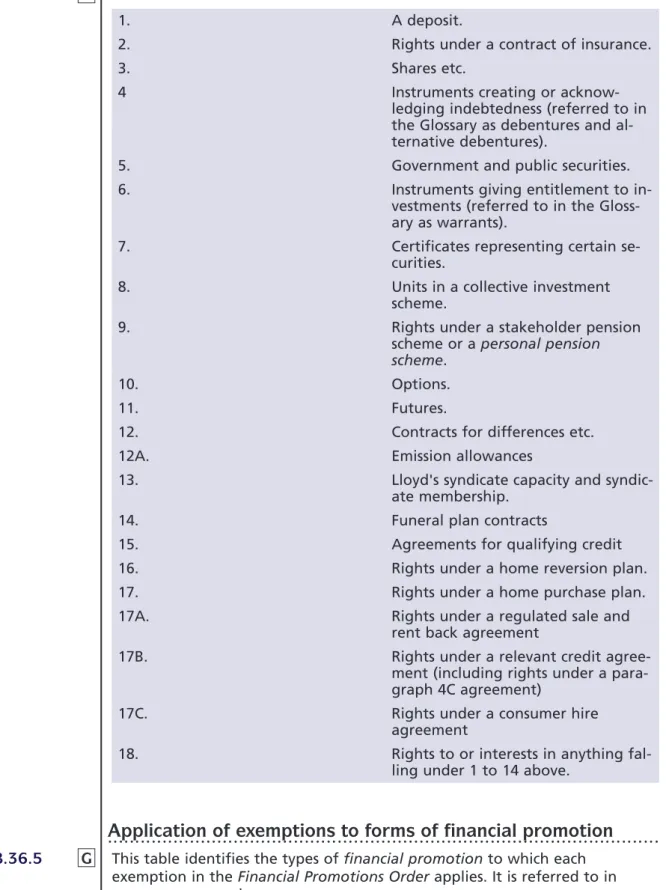
Chapter 8
Financial promotion and
related activities
8
G 8.1.1
G 8.1.1A
G 8.1.2
G 8.1.3
8.1 Application and purpose
Application
...
This chapter applies to persons who need to know whether their
communications are subject to or comply with the Act. It also helps them decide whether their activities in making or helping others to make financial promotions are regulated activities.
This chapter also applies to persons who need to know whether they are marketing an AIF.
Purpose of guidance
...
The purpose of this guidance is three-fold:
(1) to outline the restriction on financial promotion under section 21 of the Act (Restrictions on financial promotion) and the main
exemptions from this restriction; and
(2) to outline the main circumstances in which persons who are primarily involved in making or helping others to make financial promotions may be conducting regulated activities requiring authorisation or exemption themselves; this part of the guidance may also be of more general relevance to persons who may be concerned whether or not they are carrying on the regulated activities of advising on
investments or making arrangements with a view to transactions in investments; and
(3) to provide guidance in relation to marketing an AIF.
In particular, this guidance covers:
(1) invitations and inducements (see■PERG 8.4);
(2) meaning of 'in the course of business' (see■PERG 8.5);
(3) meaning of 'communicate' (see■PERG 8.6);
(4) meaning of 'engage in investment activity' (see■PERG 8.7);
(4A) meaning of ‘engage in claims management activity’ (see■PERG 8.7A);
(5) meaning of 'having an effect in the United Kingdom' (see■PERG 8.8);
(6) circumstances where the restriction in section 21 does not apply (see
8
G 8.1.4
(7) types of financial promotion, including:
(a) meaning of 'real time financial promotion' (see■PERG 8.10.2 G);
and
(b) meaning of 'unsolicited real time financial promotion' (see
■PERG 8.10.8 G);
(8) types of exemption under the Financial Promotion Order, including:
(a) exemption for certain one-off promotions (see■PERG 8.14.3 G);
(b) exemption for financial promotions not directed at the United Kingdom (see■PERG 8.12.2 G);
(c) exemptions for financial promotions by journalists and in broadcasts (see■PERG 8.12.23 G);
(9) financial promotions concerning deposits and contracts of insurance other than life policies (see■PERG 8.13);
(10) financial promotions concerning promotions by members of the professions (see■PERG 8.15);
(11) [deleted]
(12) financial promotions concerning the Lloyd’s market (see■PERG 8.18);
(13) additional restrictions on the promotion of:
(a) life policies (see■PERG 8.19);
(b) collective investment schemes (see■PERG 8.20);
(14) company statements, announcements and briefings (see■PERG 8.21);
(15) financial promotions made on the Internet (see■PERG 8.22);
(16) regulated activities:
(a) advising on investments (see■PERG 8.24);
(b) making arrangements with a view to transactions in investments (see■PERG 8.32);
(17) the business test for regulated activities (see■PERG 8.34); and (18) the marketing of an AIF (see■PERG 8.37).
This guidance is issued under section 139A of the Act. It represents the FCA's views and does not bind the courts. For example, it would not bind the courts in an action for damages brought by a private person for breach of a rule (see section 138D of the Act (Actions for damages)), or in relation to the enforceability of a contract where there has been a breach of sections 19 (The general prohibition) or 21 (Restrictions on financial promotion) of the Act (see sections 26 to 30 of the Act (Enforceability of agreements)).
Although the guidance does not bind the courts, it may be of persuasive effect for a court considering whether it would be just and equitable to allow a contract to be enforced (see sections 28(3) and 30(4) of the Act).
Anyone reading this guidance should refer to the Act and to the Financial Services and Markets Act 2000 (Financial Promotion) Order 2005 (SI 2005/
8
1529) (the Financial Promotion Order) and the Financial Services and Markets Act 2000 (Regulated Activities) Order 2001 (SI 2001/544) (as amended) (the Regulated Activities Order). These should be used to find out the precise scope and effect of any particular provision referred to in the guidance and any reader should consider seeking legal advice if doubt remains. If a person acts in line with the guidance in the circumstances mentioned by it, the FCA will proceed on the footing that the person has complied with the aspects of the requirement to which the guidance relates.
8
G 8.2.1
G 8.2.2
G 8.2.3
G 8.2.4
8.2 Introduction
The effect of section 21 of the Act (Restrictions on financial promotion) is that in the course of business, an unauthorised person must not
communicate an invitation or inducement to engage in investment activity or to engage in claims management activity unless either the content of the communication is approved for the purposes of section 21 by an authorised person or it is exempt. Under section 25 of the Act (Contravention of section 21), a person commits a criminal offence if he carries on activities in breach of the restriction in section 21 of the Act. A person who commits this criminal offence is subject to a maximum of two years imprisonment and an unlimited fine. However, it is a defence for a person to show that he took all reasonable precautions and used all due diligence to avoid committing the offence.
Another consequence of a breach of section 21 of the Act is that certain agreements could be unenforceable (see section 30 of the Act (Enforceability of agreements resulting from unlawful communications)). This applies to agreements entered into by a person as a customer as a consequence of a communication made in breach of section 21.
An authorised person will not breach section 21 when communicating a financial promotion. Nevertheless, this guidance may be relevant where an authorised person needs to know whether the financial promotion rules apply to a particular communication.
A person who is concerned to know whether his communications will require approval or, if he is an authorised person, whether the appropriate financial promotion rules will apply to his communications will need to consider the following:
(1) am I making a communication or causing a communication to be made? (see■PERG 8.6);
(2) if so, is it an invitation or inducement? (see■PERG 8.4);
(3) if so, does the invitation or inducement relate to a controlled investment? (see■PERG 8.7);
(4) if so, is the invitation or inducement to engage in investment activity?
(see■PERG 8.7);
(4A) alternatively, is the invitation or inducement to engage in claims management activity? (see■PERG 8.7A);
8
G 8.2.5
G 8.2.6
G 8.2.7
G 8.2.8
G 8.2.9
(5) if so, is it made in the course of business? (see■PERG 8.5);
(6) if so, and the financial promotion originates outside the United Kingdom, is it capable of having an effect in the United Kingdom?
(see■PERG 8.8);
(7) if so, or if the answer to (5) is yes and the financial promotion was made in the United Kingdom, is the promotion exempt? (see
■PERG 8.12to■PERG 8.15 and■PERG 8.21);
(8) if not, am I an authorised person?
If the answer to■PERG 8.2.4G (8)is yes then the appropriate financial promotion rules will potentially apply (subject to the application provisions in■COBS 1 and■COBS 4). If the answer is no, then the promotion must be approved by an authorised person if it is a non-real time financial
promotion. Authorised persons are not allowed to approve real time financial promotions (see■COBS 4.10.4 R).■PERG 8.36.1Gcontains a flowchart explaining these steps.
[deleted]
The restriction in section 21 applies to all forms of communication such as advertising, broadcasts, websites, e-mails and all other forms of written or oral communication whether sent to one person or many. However, the restrictions only apply to a communication made in the course of business and not, for example, to personal communications between individuals.
There are extensive exemptions in the Financial Promotion Order. This is explained in greater detail in■PERG 8.11to■PERG 8.15and■PERG 8.21.
Because of the United Kingdom’s exit from the EU, the Treasury amended the Financial Promotion Order. This included the amendment or removal of certain exemptions in the Financial Promotion Order that had previously been in place to take account of the United Kingdom’s membership of the EU. Where those amendments are relevant to the guidance in this Chapter the FCA has amended the guidance accordingly. The Treasury also made transitional provision so that nothing in those amendments to the Financial Promotion Order will cause a communication to breach the restriction in section 21, if the communication is required under a contact entered into before IP completion day, and it would not have constituted a breach if it had been made before IP completion day.
[Note: see Part 4 of the Financial Services and Markets Act 2000 (Amendment) (EU Exit) Regulations 2019 (SI 2019/632)]
8
G 8.3.1
G 8.3.2
G 8.3.3
G 8.3.4
8.3 Financial promotion
The basic restriction on the communication of financial promotions is in section 21(1) of the Act. Sections 21(2) and (5) disapply the restriction in certain circumstances. Their combined effect is that a person must not, in the course of business, communicate an invitation or inducement to engage in investment activity unless:
(1) he is an authorised person; or
(2) the content of the communication is approved for the purposes of section 21 by an authorised person; or
(3) the communication is exempt under an order made by the Treasury under section 21(5) – the Financial Promotion Order (as amended).
Section 21 of the Act does not itself (other than in its heading and side-note) refer to a ‘financial promotion’ but rather to the communication of ‘an invitation or inducement (a) to engage in investment activity or (b) to engage in claims management activity’. References in this guidance to a financial promotion mean an invitation or inducement to engage in investment activity or to engage in claims management activity.
Section 21 of the Act contains a number of key expressions or phrases which will determine whether or not it will apply. These are:
(1) 'invitation or inducement' (see■PERG 8.4);
(2) 'in the course of business' (see■PERG 8.5);
(3) 'communicate' (see■PERG 8.6);
(4) 'engage in investment activity' (see■PERG 8.7);
(4A) ‘engage in claims management activity’ (see■PERG 8.7A); and (5) 'having an effect in the United Kingdom' (see■PERG 8.8).
The FCA's views as to the meaning of these are explained in ■PERG 8.4to
■PERG 8.8.
8
G
8.3.5 In addition, this guidance deals with other factors such as when the exemptions in the Financial Promotion Order can be applied, including the exemptions relating to territorial scope and one-off financial promotions.
8
G 8.4.1
G 8.4.2
G 8.4.3
8.4 Invitation or inducement
Promotional element
...
The Act does not contain any definition of the expressions ‘invitation’ or
‘inducement’, leaving them to their natural meaning. The ordinary dictionary entries for ‘invitation’ and ‘inducement’ offer several possible meanings to the expressions. An ‘invitation’ is capable of meanings ranging from merely asking graciously or making a request to encouraging or soliciting. The expression ‘inducement’ is given meanings ranging from merely bringing about to prevailing upon or persuading. In the FCA's view it is appropriate, in interpreting the expressions, to take due account of the context in which they are being used and their purpose.
The Treasury, responding to consultation on the draft Financial Promotion Order, stated its intention that only communications containing a degree of incitement would amount to ‘inducements’ and that communications of purely factual information would not. This is provided the facts are presented in such a way that they do not also amount to an invitation or inducement. This was made clear both in the Treasury’s consultation
document on financial promotion and during the passage of the Act through Parliament. Under questioning, the Minister confirmed that the
government’s policy was “to capture promotional communications only. The Minister also stated that 'inducement', in its Bill usage, already incorporates an element of design or purpose on the part of the person making the communication and that “design or purpose" is implicit in this context (Hansard HL, 18 May 2000 cols 387 and 388). In the same debate, the
Minister stated that the restriction would not apply to such things as “public announcements, exchange of draft share purchase agreements in corporate finance transactions or cases in which the recipient of a communication simply misunderstands its contents and engages in investment activity as a result.”
The FCA recognises that the matter cannot be without doubt. However, it is the FCA view that the context in which the expressions ‘invitation’ or
‘inducement’ are used clearly suggests that the purpose of section 21 is to regulate communications which have a promotional element. This is because they are used as restrictions on the making of financial promotions which are intended to have a similar effect to restrictions on advertising and
unsolicited personal communications in earlier legislation. Such
communications may be distinguished from those which seek merely to inform or educate about the mechanics or risks of investment. In this respect, the FCA supports the views expressed by Ministers as referred to in
■PERG 8.4.2 G. To the extent that doubt may remain as to the true meaning of ‘invitation’ or ‘inducement’ when used in section 21, it is the opinion of
8
G 8.4.4
G 8.4.5
G 8.4.6
the FCA that the courts are likely to take account of the ministerial
statements under the judgement in Pepper (Inspector of Taxes) v Hart [1993]
AC 593.
The FCA considers that it is appropriate to apply an objective test to decide whether a communication is an invitation or an inducement. In the FCA's view, the essential elements of an invitation or an inducement under section 21 are that it must both have the purpose or intent of leading a person to engage in investment activity or to engage in claims management activity, and be promotional in nature. So it must seek, on its face, to persuade or incite the recipient to engage in investment activity or to engage in claims management activity. The objective test may be summarised as follows.
Would a reasonable observer, taking account of all the circumstances at the time the communication was made:
(1) consider that the communicator intended the communication to persuade or incite the recipient to engage in investment activity or to engage in claims management activity, or that that was its purpose;
and
(2) regard the communication as seeking to persuade or incite the recipient to engage in investment activity or to engage in claims management activity.
It follows that a communication which does not have any element of persuasion or incitement will not be an invitation or inducement under section 21.
Invitations
...
An invitation is something which directly invites a person to take a step which will result in his engaging in investment activity or engaging in claims management activity.. It follows that the invitation must cause the engaging in investment activity or engaging in claims management activity. Examples of an invitation include:
(1) direct offer financial promotions;
(2) a prospectus with application forms; and
(3) Internet promotions by brokers where the response by the recipient will initiate the activity (such as ‘register with us now and begin dealing online’).
A communication may contain a statement that it is not an invitation. Such statements may be regarded as evidence that the communication is not an invitation unless its contents indicate otherwise.
Merely asking a person if they wish to enter into an agreement with no element of persuasion or incitement will not, in the FCA's view, be an invitation under section 21. For example, the FCA does not consider an invitation to have been made where:
(1) a trustee or nominee receives an offer document of some kind and asks the beneficial owner whether he wishes it to be accepted or
8
G 8.4.7
G 8.4.8
G 8.4.9
(2) a person such as a professional adviser enquires whether or not his client would be willing to sign an agreement; or
(3) a person is asked to sign an agreement on terms which he has already accepted or to give effect to something which he has already agreed to do.
Inducements
...
An inducement may often be followed by an invitation or vice versa (in which case both communications will be subject to the restriction in section 21 of the Act). An inducement may be described as a link in a chain where the chain is intended to lead ultimately to an agreement to engage in investment activity or to engage in claims management activity. But this does not mean that all the links in the chain will be an inducement or that every inducement will be one to engage in investment activity or to engage in claims management activity. Only those that are a significant step in
persuading or inciting or seeking to persuade or incite a recipient to engage in investment activity or to engage in claims management activity will be inducements under section 21. The FCA takes the view that the mere fact that a communication may be made at a preliminary stage does not, itself, prevent that communication from being a significant step. However, in many cases a preliminary communication may simply be an inducement to contact the communicator to find out what he has to offer. For example, an
advertisement which merely holds out a person as having expertise in or providing services about investment management or venture capital will not be an inducement to engage in investment activity. It will merely be an inducement to make contact for further material and will not be a
significant step in the chain. However, that further material may well be a significant step and an invitation or inducement to engage in investment activity. In contrast, an advertisement which claims that what the recipient should do in order to make his fortune is to invest in securities and that the communicator can provide him with the services to achieve that aim will be a significant step and an inducement to engage in investment activity.
■PERG 8.4.9 Gto■PERG 8.4.34 Gapply the principles in■PERG 8.4.4 Gto
■PERG 8.4.7 Gto communications made in certain circumstances. They do not seek to qualify those principles in any way. A common issue in these
circumstances arises when contact details are given (for example, of a provider of investments or investment services). In the FCA's view, the inclusion of contact details should not in itself decide whether the item in which they appear is an inducement or, if so, is an inducement to engage in investment activity or to engage in claims management activity. However, they are a factor which should be taken into account. The examples also refer, where appropriate, to specific exemptions which may be relevant if a communication is an invitation or inducement to engage in investment activity or to engage in claims management activity.
Directory listings
...
Ordinary telephone directory entries which merely list names and contact details (for example where they are grouped together under a heading such as ‘stockbrokers’) will not be inducements. They will be sources of
information. Were they to be presented in a promotional manner or accompanied by promotional material they would be capable of being inducements. Even so, they may merely be inducements to make contact
8
8.4.10 GG 8.4.11
with the listed person. Specialist directories such as ones providing details of venture capital providers, unit trust managers, contractual scheme managers or investment trusts will usually carry greater detail about the services or products offered by the listed firms and are often produced by
representative bodies. Such directories may also be essentially sources of information. Whether or not this is the case where individual entries are concerned will depend on their contents. If they are not promotional, the entries will not be inducements to engage in investment activity or to engage in claims management activity. However, it is possible that other parts of such a directory might, for example, seek to persuade recipients that certain controlled investments offer the best opportunity for financial gain.
They may go on to incite recipients to contact one of the member firms listed in the directory in order to make an investment. In such cases, that part of the directory will be an inducement to engage in investment activity.
But this does not mean that the individual entries or any other part of the directory will be part of the inducement.■PERG 8.6provides guidance on the meaning of 'communicate' and 'causing a communication'. This is of
relevance to this example and those which follow.
Tombstone advertisements (announcements of a firm’s past achievements)
...
Such advertisements are almost invariably intended to create awareness, hopefully generating future business. So they may or may not be
inducements. This depends on the extent to which their contents seek to persuade or incite persons to contact the advertiser for details of its services or to do business with it. Merely stating past achievements with no contact details will not be enough to make such an advertisement an inducement.
Providing contact details may give the advertisement enough of a
promotional feel for it to be an inducement. But, if this is the case, it will be an inducement to contact the advertiser to find out information or to discuss what he can offer. Only if the advertisement contains other promotional matter will it be capable of being an inducement to engage in investment activity or to engage in claims management activity. In practice, such
advertisements are often aimed at influencing only investment professionals.
Where this is the case, the exemption in article 19 of the Financial Promotion Order (Investment professionals) may be relevant (see■PERG 8.12.21 G).
Tombstone advertisements will not usually carry the indicators required by article 19 to establish conclusive proof. However, article 19 may apply even if none of the indicators are present if the financial promotion is in fact directed at investment professionals.
Links to a website
...
Links on a website may take different forms. Some will be inducements.
Some of these will be inducements under section 21 and others not. Links which are activated merely by clicking on a name or logo will not be inducements. The links may be accompanied by or included within a narrative or, otherwise, referred to elsewhere on the site. Whether or not such narratives or references are inducements will depend upon the extent to which they may seek to persuade or incite persons to use the links. Simple statements such as ‘these are links to stockbrokers’ or ‘click here to find out about stockmarkets – we provide links to all the big exchanges’ will either not amount to inducements or be inducements to access another site to get information. If they are inducements, they will be inducements to engage in investment activity or to engage in claims management activity only if they specifically seek to persuade or incite persons to use the link for that
8
G 8.4.12
G 8.4.13
G 8.4.14
purpose. Where this is the case, but the inducement does not identify any particular person as a provider of a controlled investment or as someone who carries on a controlled activity or a controlled claims management activity, the exemption in article 17 of the Financial Promotion Order (Generic promotions) may be relevant (see■PERG 8.12.14 G).
Banner advertisements on a website
...
These are the Internet equivalent to an advertisement in a newspaper and are almost bound to be inducements. So whether they are inducements to engage in investment activity or to engage in claims management activity will depend upon their contents as with any other form of advertising and the comments in■PERG 8.4.11 Gwill be relevant.
Publication or broadcast of prices of investments (historic or live)
...
These may or may not involve invitations or inducements. Where a person such as a newspaper publisher, broadcaster or data supplier merely presents prices of investments whether historic or live the information can be purely factual and not be an inducement. Historic prices on their own will never be invitations or inducements. Merely adding simple contact details to such prices will not make them invitations or inducements to engage in
investment activity. However, any additional wording seeking to persuade or incite persons to contact firms so that they may buy or sell such investments may do so. In other circumstances, the publication of prices may involve an invitation or an inducement to engage in investment activity. For example, persons may use an electronic trading system to display prices and other terms such as lot size and volume at which they are prepared to deal, on screens viewed by potential counterparties. The price and other terms may be firm or indicative. The persons using the trading systems will have accepted the general terms and conditions for trading. Where prices and terms quoted are firm, the screen display may be an invitation to engage in investment activity by entering into a transaction at that price and on those terms. This will be where the offer may be accepted by the counterparty by a simple electronic response. Where the price or other terms are indicative, the screen display may be an inducement to engage in investment activity after negotiating acceptable terms. But in either case, the display of prices and other terms will only be invitations or inducements to engage in investment activity if it also contains material which seeks to persuade or incite the recipient to do so.
Company statements and announcements and analyst briefings
...
Encouraging (or discouraging) statements may be made by a company director. These will typically be made in reports or accounts or at a presentation or road show or during a briefing of analysts. Alternatively, such statements may be made on the company’s behalf by its public relations adviser. Statements of fact about a company’s performance or activities will not, themselves, be inducements to engage in investment activity even if they may lead persons to decide to buy or sell the company’s shares.
However, statements which speculate about the company’s future
performance or its share price may have an underlying purpose or intent to encourage investors to act. If this is so, whether they will be inducements to engage in investment activity will depend entirely on their contents and the
8
G 8.4.15
G 8.4.16
extent to which they seek to promote investment in the company.■PERG 8.21 contains detailed guidance on the various exemptions which may apply in this area.
Journalism
...
Journalism can take many forms. But typically a journalist may write an editorial piece on a listed company or about the investments or investment services that a particular firm provides or the controlled claims management activity that it carries on. This may often be in response to a press release.
The editorial may or may not contain details of or, on a website, a link to the site of the company or firm concerned. Such editorial may specifically
recommend that readers should consider buying or selling investments (whether or not particular investments) or obtaining investment services (whether or not from a particular firm) or obtaining services which constitute a controlled claims management activity (whether or not from a particular firm). If so, those recommendations are likely to be inducements to engage in investment activity (bearing in mind that a recommendation not to buy or sell investments cannot be an inducement to engage in investment activity) or to engage in claims management activity. In other cases, the editorial may be an objective assessment or account of the investment or its issuer or of the firm and may not encourage persons to make an investment or obtain investment services or other services which constitute a controlled claims management activity. If so, it will not be an inducement to engage in
investment activity or to engage in claims management activity. Article 20 of the Financial Promotion Order (Communications by journalists) contains a specific exemption for journalism and journalists may be able to make good use of the generic promotions exemption in article 17 of the Financial
Promotion Order (see■PERG 8.12.23 Gand■PERG 8.12.14 G). Journalists should bear in mind that they may communicate a financial promotion by repeating a recommendation that originates from another source. That source could be, for example, an authorised person, an academic or another publication.
Such a financial promotion would be viewed as communicated by the journalist where he has editorial control over its form and content. In the FCA's view, a person is not causing the communication of a financial promotion merely by providing material, including a press release or a quotation, to a journalist who uses it in an article. This is provided that the person has no control over the way in which the article is prepared and published. The press release or quotation itself, if it is a financial promotion, should be exempt under article 47 of the Financial Promotion Order (Persons in the business of disseminating information) – see■PERG 8.21.10 G.
Performance tables
...
League tables showing the past performance of investment products of a particular kind or investment firms of a particular class (such as investment managers) and determined by the application of pre-set criteria will not, in themselves, be inducements. The fact that such tables represent pure information could, for example, be made clear by their being accompanied by a statement to the effect that the fact of a product or firm being well placed in the tables based on past performance is no guide to their likely future performance. The effectiveness of such a statement will, of course, depend upon it being the case that they do, in fact, represent mere
information. But if, for example, the tables are accompanied by or presented or provided in a way that they are an actual or implied recommendation that a particular product’s performance suggests it is a potential buy or sell they may become inducements.
8
G 8.4.17
G 8.4.18
G 8.4.19
Tables or other forms of list may identify products with their relevant features such as interest rates, redemption periods and charges. Again, provided that the tables amount to purely factual information enabling comparison of products they will not be inducements. This includes such things as electronic systems that allow users to programme in their
requirements and find details of the products that meet them. Producers of the table or list may, to some extent, expect that the information will lead persons to make investments. Or they might have negotiated a payment from the firms featured that reflects leads generated. In either case, the absence of a promotional element in the table will be determinative. As with performance tables, these can become inducements to engage in investment activity. This will happen when there is an actual or implied recommendation that either the products which come out best in respect of certain features or a specific combination of features or those that have been chosen for inclusion are likely to be good or best buys. This might, for example, include identifying the top ten deposit accounts for persons looking for deposit accounts offering certain features. The mere inclusion in tables of the kind referred to generally in this paragraph or those in■PERG 8.4.16 Gof contact details should not turn what is otherwise factual or neutral information into an inducement. Both types of table may benefit, if necessary, from the exemption for journalists in article 20 (see■PERG 8.12.23 G). This will be where they are prepared by a person acting as a journalist and are included in a publication, service or broadcast as described in article 20(5)(b). Where the tables are merely a reproduction of information supplied by a third party data source which does not provide them as a journalist article 20 will not be available.
Decision Trees
...
A decision tree (or flow chart) will generally be used in one of two ways.
Either it will be an educational tool (for instance, where an employer wishes to help his employees understand their pension options) or a promotional tool. As an educational tool which does no more than enable a person to identify generic investment options it will not be an inducement. But if its use is intended to procure business for an investment firm then it is likely to be an inducement. For example, electronic decision trees on websites may typically invite persons to enter basic information about their circumstances and objectives leading to a recommendation or choice of products or
services, or both, possibly with links to other firms’ sites. These decision trees will be inducements to engage in investment activity although, in some cases, the journalists’ exemption in article 20 of the Financial Promotion Order may be relevant (see■PERG 8.12.23 G).
Investment agreements, share purchase agreements and customer agreements
...
These types of agreements will only rarely be inducements or invitations. For instance, where the terms of a deal have been agreed in principle and the agreement is merely the means of giving it effect, the inducement phase has clearly passed. And an agreement or draft agreement itself may usually be seen as a document setting out the terms and conditions of a deal and not itself an inducement (or an invitation) to deal. However, an agreement or draft agreement may often be accompanied by an invitation or inducement such as a covering letter or an oral communication that seeks to persuade or incite a person to enter into the agreement. Whilst such accompaniments are capable of being inducements (or invitations), merely offering concessions or amendments to a draft agreement during negotiations will not turn those
8
G 8.4.20
G 8.4.21
G 8.4.22
accompaniments into inducements. It is, however, possible for an agreement itself to be or to include an invitation or inducement. For example, an advertisement that contains the terms and conditions and the means to enter into it as a binding contract, a direct offer financial promotion or a prospectus with an application form included.
Image advertising
...
Activities which are purely profile raising and which do not identify and promote particular investments or investment services or services which constitute a controlled claims management activity may not amount to either an invitation or inducement of any kind. Examples of this include where listed companies sponsor sporting events or simply put their name or logo on the side of a bus or on an umbrella. This is usually done with a view, among other things, to putting their names in the minds of potential
investors or consumers. In other cases, an image advertisement for a company which provides investment services (for example, on a pencil or a diary) may include, along with its name or logo, a reference to its being an investment adviser or fund manager or a telephone or fax number or both.
Profile raising activities of this kind may involve an inducement (to contact the advertiser) but will be too far removed from any possible investment activity or, where relevant, controlled claims management activity, to be considered to be an inducement to engage in investment activity or to engage in claims management activity.
Advertisements which invite contact with the advertiser
...
These will be advertisements that contain encouragement to contact the advertiser. They are likely to be inducements to do business with him or to get more information from him. If so, they will be inducements to engage in investment activity or to engage in claims management activity if they seek to persuade or incite persons to buy or sell investments or to get investment services or services which constitute a controlled claims management activity.
See■PERG 8.4.7 Gfor more guidance on preliminary communications and whether they are a significant step in the chain of events which are intended to lead to the recipient engaging in investment activity or engaging in claims management activity. Where advertisements invite persons to send for a prospectus, article 71 (Material relating to prospectus for public offer of unlisted securities) may provide an exemption. Any financial promotion which contains more information than is allowed by article 71 but which is not the prospectus itself is likely to require approval by an authorised person unless another exemption applies.
Introductions
...
(1) Introductions may take many forms but typically involve an offer to make an introduction or action taken in response to an unsolicited request. An introduction may be an inducement if the introducer is actively seeking to persuade or incite the person he is introducing to do business with the person to whom the introduction is made. So it may fall under section 21 if its purpose is to lead to investment activity or controlled claims management activity. For example, if a person answers the question ‘do you or can you provide investment advice’ with a simple ‘no, but I can introduce you to someone who does’, that may be an inducement. But, if so, it is likely to be an inducement to contact someone to find out information about his
8
G 8.4.23
services rather than to engage in investment activity or to engage in claims management activity.
(2) Where a person calls in to an office or branch of a company and asks to see ‘the investment adviser’, a person who responds merely by directing or showing the way is not making an inducement.
(3) Neither would a person be making an inducement by responding to an enquiry with ‘we do not provide investment services – you need to consult an authorised person’ or words to that effect. That is provided he does not go on to seek to persuade or incite the enquirer to contact a particular authorised person for investment services.
(4) But a person would be making an inducement to engage in investment activity if, for example, he seeks to persuade or incite persons to allow him to introduce them to a particular authorised person so that they may take advantage of the cheap dealing rates which that person offers.
(5) Where introductions do amount to inducements under section 21 they may fall under the exemption for generic promotions (article 17 of the Financial Promotion Order) (see■PERG 8.12.14 G). This will be the case provided the financial promotion does not identify any particular investment or person to whom introductions are to be made or identify the introducer as a person who carries on a regulated activity (typically of making arrangements with a view to transactions in investments under article 25(2) of the Regulated Activities Order - (see■PERG 8.33 (Introducing)) or making
arrangements with a view to regulated mortgage contracts under article 25A(2) of the Regulated Activities Order (see■PERG 4.5 (Arranging regulated mortgage contracts)). It is most likely to apply where the financial promotion relates to deposits or contracts of insurance which are not contractually based investments.
(6) The journalists' exemption in article 20 of the Financial Promotion Order (Communications by journalists) may be relevant where the introduction is made through or in a publication, broadcast or regularly updated news or information service (see■PERG 8.12.23 G).
(7) Article 15 (Introductions) may apply provided certain conditions are met (see■PERG 8.12.11 G). In addition, article 28B (Real time
communications: introductions) may apply where an introduction is a real time financial promotion about home finance transactions and home finance activities (see ■PERG 8.17.12 G).
Distributors
...
A person may be distributing financial promotions which have been issued or approved by an authorised person. This may be by displaying copies or delivering them or handing them out whether or not on request.■PERG 8.6 explains when such a person will be communicating the financial
promotions. Where this is so, the exemption for mere conduits in article 18 of the Financial Promotion Order may apply (see■PERG 8.12.18 G). But article 18 will not apply if the distributor creates his own financial promotion by seeking to persuade or incite the recipient to act upon the financial promotions he is distributing.
8
G 8.4.24
G 8.4.25
G 8.4.26
G 8.4.27
Investment trading methods and training courses
...
Trading methods and techniques, such as traded options training courses and software-based or manual trading tools will, in many cases, be too remote from any eventual investment dealing activities to be inducements to engage in investment activity. Promotions of such things will be inducements (or invitations) to receive training and general trading tips and techniques.
However, such things may be sold on the basis that they are almost certain to produce profits from the trading which the recipient will undertake using the training or technique. If this is the case, the promotions are capable of being inducements to engage in those trading activities. Such financial promotions are capable of being generic promotions under article 17 of the Financial Promotion Order (see■PERG 8.12.14 G).
Invitations to attend meetings or to receive telephone calls or visits
...
These are clearly invitations or inducements. Whether they will involve invitations or inducements to engage in investment activity or to engage in claims management activity rather than to attend the meeting or receive the call or visit, will depend upon their purpose and content.■PERG 8.4.7 G discusses communications which are a significant step in the chain of events leading to an agreement to engage in investment activity or to engage in claims management activity. The purpose of the meeting, call or visit to which the invitation or inducement relates may be to offer the audience or recipient investment services or services which constitute a controlled claims management activity. In this case, the invitation or inducement will be a significant step in the chain if it seeks to persuade or incite the invitee to engage in investment activity or to engage in claims management activity at the meeting, call or visit. Any financial promotions made during the
meeting, call or visit would still need to be communicated or approved by an authorised person or be exempt.
Explanation of terms
...
An explanation of the terms of an agreement or of the consequences of taking a particular course of action can be merely factual information unless it includes or is accompanied by encouragement to enter into the agreement or take the course of action. The mere fact that the explanation may present the investment in a good light or otherwise influence the recipient will not make it an inducement. Where such communications are financial
promotions they may fall under one of the exemptions for one-off promotions in articles 28 and 28A of the Financial Promotion Order (see
■PERG 8.14.3 G).
Enquiries about a person’s status or intentions
...
A person ('A') may enquire:
(1) whether another person is certified as a high net worth individual or a sophisticated investor so that A may determine whether an
exemption applies; or
(2) whether a person has received material sent to him; or (3) how a person might propose to react to a take-over offer. or
8
G 8.4.28
G 8.4.29
G 8.4.30
(4) whether a person has been involved in an accident.
Enquiries of this or a similar kind will not amount to inducements to engage in investment activity or to engage in claims management activity
unless they involve persuasion or incitement to do so. The enquiry may be accompanied by a brief statement of the reason why it is being made. This may, for example, include a reference to the type of investment to which any subsequent financial promotions would relate. Such initial enquiries may be followed up with an inducement but this fact alone will not turn the initial enquiry into a financial promotion. For example, an enquiry about whether a person is certified for the purposes of article 48 (Certified high net worth individuals), article 50 (Sophisticated investors) or article 50A (self-certified sophisticated investors) may, where the answer is positive, be followed by a financial promotion. That financial promotion can then rely on article 48, 50 or 50A as the case may be.
Solicited and accompanying material
...
Solicited or accompanying material which does not contain any invitation or inducement to engage in investment activity will not itself be a financial promotion. This is provided that the material is not part of any financial promotion which may accompany it. This is explained in greater detail in
■PERG 8.4.29 Gto■PERG 8.4.30 G.
Persons may sometimes be asked to send material which has not been prepared for use as a financial promotion to a person who is interested in making an investment. For example, a prospective participant in a Lloyd’s syndicate may ask for a copy of the business plan or forecast prepared by the managing agent to comply with Lloyd’s requirements. As another example, a prospective purchaser of, or investor in, a company may wish to see a
valuation report, a due diligence report or legal advice. The fact that the person requesting the material may intend to rely on it in making his
investment decision does not, itself, make the material an inducement under section 21.
The person who responds to the request for the material in the
circumstances in■PERG 8.4.29 Gmay make a financial promotion in the form of a covering letter or oral communication ('C'). This will not mean that the material accompanying C must itself be treated as an inducement. This will depend on the circumstances. The material itself would only become an inducement if it is turned into part of the financial promotion in C. For example, C may refer to the contents or part of the contents of the
accompanying material and claim that they will convince the recipient that he should engage in investment activity. In such a case, the contents, or the relevant part of the contents as the case may be, would become part of the financial promotion in C. In other cases, C may simply refer to the fact that certain material has been enclosed or is available without using it as a selling point to persuade or incite the recipient to engage in investment activity. In that case, the material will not become part of the financial promotion. A similar situation arises if a person other than the person who originated an oral or written communication which is not itself a financial promotion uses it to persuade or incite a potential investor.
8
G 8.4.31
G 8.4.31A
G 8.4.32
G 8.4.33
G 8.4.34
Telephone services
...
A person ('P') may be engaged, typically by investment product companies, to provide telephone services. Where such services require P to seek to persuade or incite prospective customers to receive investment literature or a personal call or visit from a representative of his principal they will
frequently involve inducements to engage in investment activity. This is so whether the inducement results from P making unsolicited calls or by his raising the issue during a call made by the prospective customer. Generally speaking, it is likely that P would be carrying on a regulated activity under article 25(2) of the Regulated Activities Order and require authorisation or exemption (for example, as an appointed representative) if he is required to procure leads for his principal. In other cases, P may merely respond to a request from a prospective customer. This may be a request for investment literature or to arrange a call or visit. P will not be making an inducement simply by agreeing to send the literature, referring the caller to a
representative of his principal or agreeing to arrange for the visit or call.
Where persons providing telephone services are appointed representatives the exemption in article 16 of the Financial Promotion Order (Exempt persons) may apply (see■PERG 8.12.12 G).
Where the telephone services that P provides, or other services provided in conjunction with those telephone services, have the result that P is carrying on the regulated activity of seeking out, referrals and identification of claims or potential claims, instead of (or in addition to) communicating a financial promotion that relates to controlled claims management activity, P will require permission to carry on the regulated activity of seeking out, referrals and identification of claims or potential claims.
Personal illustrations
...
A personal illustration (for instance, of the costs of and benefits under a particular investment product) may or may not be an invitation or
inducement. This will depend on the extent to which it seeks to persuade or incite the recipient to invest as opposed to merely providing him with information. A personal illustration may, however, be accompanied by an invitation or inducement to buy the investment in which case the
exemptions for one-off financial promotions in articles 28 or 28A may apply (see■PERG 8.14.3 G). Authorised persons should note that, where personal quotations or illustrations do amount to a financial promotionthe financial promotion rules will not usually apply to them.
Instructions or guidance on how to invest
...
Things such as help-lines for persons who wish to make an investment will not usually involve invitations or inducements to engage in investment activity. This is where their purpose is merely to explain or offer guidance on how to invest or to accept an offer. In such cases, the investor will already have decided to invest and there will be no element of persuasion on the part of the person giving the explanation or guidance.
Communications by employers and contracted service providers to employees
...
Employers and their contracted service providers may communicate with employees on matters which involve controlled investments. For example,
8
work-related insurance, staff mortgages, personal pension schemes (including stakeholder schemes) and other employee benefit schemes other than
occupational pension schemes. Interests under the trusts of an occupational pension scheme are not a controlled investment (see paragraph 27 (2) of Schedule 1 to the Financial Promotion Order).
In the case of personal pension schemes (including stakeholder schemes), such communications will only be invitations or inducements to engage in investment activity if they seek to persuade or incite employees to do things such as:
(1) participate in or leave the pension or other benefit scheme;
(2) exercise certain rights under such a scheme, including making additional contributions or exercising options.
Communications which seek to persuade or incite employees to subscribe for work-related insurance or enter into staff mortgages may also be invitations or inducements to engage in investment activity.
Communications which are intended to educate or give employees information with no element of persuasion or incitement will not be invitations or inducements under section 21. Employers may wish to give their employees investment material prepared and approved by an authorised person. This material may be given under cover of a
communication from the employer. If so, the covering communication will not itself be an inducement if all it does is to refer employees to the material and explain what they should do if they wish to act on it, without seeking to persuade or incite them to act. Where the covering communication is itself a financial promotion it will need to be approved by an authorised person provided it is a non-real time financial promotion unless an exemption applies. If it is a real time financial promotion it cannot be approved (see, for example,■COBS 4.10.4 R). In such cases, an exemption would need to apply.
Where employee share schemes are concerned, the exemption in article 60 of the Financial Promotion Order (Participation in employee share schemes) is likely to apply to any financial promotions made by employers or members of their group. Where an employer’s financial promotions relate to such things as company health or general insurance benefit packages, the exemptions in article 24 (Relevant insurance activity: non real time communications) or 26 (Relevant insurance activity: real time
communications) of the Financial Promotion Order may apply. Employers who promote pension products, work-related insurance or staff mortgages to their employees will be able to use the exemptions in article 72, article 72B and article 72D and contracted service providers who promote pension products, work-related insurance or staff mortgages to employees will be able to use the exemptions in article 72A, article 72C and article 72E, provided certain conditions are met. These conditions are explained in
■PERG 8.14.40A Gto■PERG 8.14.40AE G.(Pension products offered by employers (article 72)). Any financial promotion made by an employer for the purpose of meeting his obligations under the Welfare Reform and Pensions Act 1999 to offer his employees a stakeholder pension scheme should be able to use the exemption in article 29 (Communications required or authorised by enactments).
8
G 8.5.1
G 8.5.2
G 8.5.3
G 8.5.4
8.5 In the course of business
Under section 21(4) of the Act, the Treasury has the power to specify circumstances in which a person is viewed as ‘acting in the course of business’ or ‘not acting in the course of business’. The power under section 21(4) relates only to financial promotions and is distinct from the power in section 419 which relates to regulated activities. To date, the Treasury has not used the power in section 21(4). As a result, the phrase has its ordinary or natural meaning.
The FCA considers that ‘in the course of business’ requires a commercial interest on the part of the communicator. This does not necessarily have to be a direct interest. And the communicator does not need to be carrying on regulated activities (the test in section 19 of the Act) as or as part of his business. Neither does the communication need to be made in the course of carrying on activities as a business in their own right (the test in article 3 of the Financial Services and Markets Act 2000 (Carrying on Regulated Activities by Way of Business) Order 2001) (SI 2001/1177). For example, if a holding company proposes to sell one of its subsidiaries, that sale will be ‘in the course of business’ irrespective of the fact that the company may well not be in the business of selling subsidiaries.
The position is slightly more blurred with individuals. The ‘in the course of business’ test is intended to exclude genuine non-business communications.
Examples of these would be friends talking in a pub, letters between family members or e-mails sent by individuals using an Internet chat-room or bulletin board for personal reasons. An issue arises where capital is raised for small private companies. Where such a company is already in operation, it will be acting ‘in the course of business’ when seeking to generate
additional share or loan capital. At the pre-formation stage, however, it will often be the case that individuals who are proposing to run the company will approach a small number of friends, relatives and acquaintances to see if they are willing to provide start-up capital. In the FCA's view, such individuals will not be acting ‘in the course of business’ during the pre-formation stage of a small private company. This is provided that they are not:
(1) forming companies with such regularity that they would be regarded as carrying on the business of forming companies; or
(2) already running the business which the company will carry on (for example, as a partnership).
There is, of course, no reason why an individual cannot act ‘in the course of business’. For example, sole traders who are independent financial advisers
8
G 8.5.5
will give investment advice ‘in the course of business’ and so satisfy the test.
Individuals who are merely seeking to make personal investments will not be acting ‘in the course of business’ by approaching a company about making an investment in its shares. However, it is possible that an individual who regularly seeks to invest in companies who are seeking to raise venture capital with a view to becoming a director and influencing their affairs may be regarded as acting in the course of business. In approaching companies, such a person should be able to make use of the exemptions for one-off financial promotions in articles 28 and 28A of the Financial Promotion Order (see■PERG 8.14.3 G).
Persons who carry on a business which is not a regulated activity will need to be particularly careful in making communications which may amount to financial promotions (because they seek to persuade or incite persons to engage in investment activity (see■PERG 8.4)). For example, where a company makes financial promotions to its employees, they may well be made in the course of business. Examples of these include financial promotions concerning employee share schemes, group wide insurance arrangements and stakeholder pension schemes. These would need to be approved by an authorised person unless an appropriate exemption is available.■PERG 8.4.34 Gprovides further guidance on this.
8
G 8.6.1
G 8.6.2
G 8.6.3
8.6 Communicate
The word ‘communicate’ is extended under section 21(13) of the Act and includes causing a communication to be made. This means that a person who causes the communication of a financial promotion by another person is also subject to the restriction in section 21. Article 6(d) of the Financial Promotion Order also states that the word ‘communicate’ has the same meaning when used in exemptions in the Order. Article 6(a) also states that the word
‘communication’ has the same meaning as ‘financial promotion’. It appears to the FCA that a person is communicating where he gives material to the recipient or where, in certain circumstances (see■PERG 8.6.5 G), he is responsible for transmitting the material on behalf of another person. As both causers and communicators communicate under section 21 the distinction between them is not usually of great significance. What is
important is whether a person who is not himself communicating is or is not causing a communication to be made by another. In the FCA's view, primary responsibility for a communication to which section 21 applies and which is capable of being read will rest with its originator. This is the person
responsible for its overall contents. Where it is an oral communication primary responsibility will rest with the speaker. A speaker will, of course, be an individual. But where the individual speaks on behalf of his employer, it will be the employer who is responsible. The same will apply if the individual is an officer of a company or partner in a partnership and speaks on behalf of the company or partnership. Individuals who make financial promotions otherwise than in their capacity as employees, officers or partners will need to consider their own position (they may not be acting in the course of business (see■PERG 8.5)). Where a person other than the originator (for example a newspaper publisher) transmits a communication on the originator’s behalf he is communicating it and the originator is causing its communication.
Persons who communicate or cause a communication
...
Apart from the originators of a financial promotion, the FCA considers the following persons to be communicating it or causing it to be communicated:
(1) publishers and broadcasters who carry advertisements (including websites carrying banner advertisements); and
(2) intermediaries who redistribute another person’s communication probably with their own communications.
Persons who do not communicate or cause a communication
...
In the FCA's view, the following persons will not be causing or communicating:
8
G 8.6.4
G 8.6.5
G 8.6.6
(1) advertising agencies and others when they are designing advertising material for originators;
(2) persons who print or produce material for others to use as advertisements;
(3) professional advisers when they are preparing material for clients or advising them on the need to communicate or the merits or
consequences of their communicating a financial promotion; and (4) persons who are responsible for securing the placing of an
advertisement provided they are not responsible for its contents.
Need for an active step to communicate or cause a communication
...
The FCA considers that, to communicate, a person must take some active step to make the communication. This will be a question of fact in each case.
But a person who knowingly leaves copies of a document where it is reasonable to presume that persons will pick up copies and may seek to act on them will be communicating them.
The Financial Promotion Order contains an exemption for mere conduits in article 18. It does not follow that all persons who provide services for facilitating the distribution of financial promotions are communicating.
Where persons of this kind would normally be unaware of the fact that they may be distributing financial promotions or are indifferent as to whether they are doing so, or both, they will not be regarded as communicating them. This may, for example, include:
(1) postal services providers;
(2) telecommunication services providers;
(3) broadcasting services providers;
(4) courier services providers;
(5) persons employed to hand out or disseminate communications;
(6) a newsagent who sells newspapers and journals containing financial promotions.
In other cases, persons of this kind may need to rely on the mere conduit exemption (see■PERG 8.12.18 G).
Website operators
...
Where a website operator provides links to other sites he is not usually to be regarded as causing the communication of the contents of those other sites to persons who may use the links. See further guidance on Internet issues in
■PERG 8.22.
8
G 8.6.7
G 8.6.7A
G 8.6.8
G 8.6.9
Application of exemptions to persons causing a communication
...
A general point arises about causing and communicating on whether a particular exemption that applies to a communication made by a specified person also applies to a person who is causing that communication to be made. For example, article 55 of the Financial Promotion Order
(Communications by members of professions) applies only to a
communication by an exempt professional firm. This exemption may apply where a person ('P') requests an exempt professional firm ('E') to
communicate an offer to a client of E. In this case, where P causes E to communicate, it is the FCA's view that the exemption that applies to E will also apply to P. This is because, as ‘communicate’ includes ‘causing to communicate’, the exemption applies where P causes the communication of the financial promotion by E.
The position of an unauthorised person (‘U’) who, in the course of business, causes an authorised person to communicate a financial promotion is
somewhat different. This is because the authorised person (‘A’) is not subject to section 21 of the Act and so will not necessarily be communicating the financial promotion in circumstances in which an exemption would apply. To avoid any doubt about the application of section 21 to U, a specific
exemption is provided in article 17A of the Financial Promotion Order (Communications caused to be made or directed by unauthorised persons).
This exemption app