Consumers are also unsure how the EU fares compared to other countries in terms of the environmental impact of food production and consumption. Consumer awareness of today's food supply chains needs to be increased in order to correct misconceptions about the real environmental impact of food production and consumption in the EU.
BEUC RECOMMENDATIONS
On average, more than half of consumers say that concerns about sustainability have some influence (42.6%) or a lot of influence (16.6%) on their eating habits. Consumers in Italy, Portugal, Spain, Austria and Slovenia are more likely to say that their eating habits are influenced by sustainability issues than consumers in Belgium, Lithuania, the Netherlands and Slovakia.
BEUC RECOMMENDATION
On average, only 1 in 3 consumers say they are ready to reduce their consumption of red meat. On average, 41.6% of consumers say they have stopped (6.2%) or reduced (35.4%) red meat consumption due to environmental concerns. A third have not reduced their consumption of red meat and do not intend to do so.
In the Netherlands, it has been estimated that consumers eat an average of 76 grams of red meat per day (ie 27.8 kilograms per person per year).30.
DETAILED RESULTS OF THE SURVEY
1 Food habits and the environment
MY FOOD HABITS NEGATIVELY AFFECT THE ENVIRONMENT
On the other hand, when consumers are asked about the environmental impact of food consumption habits in general compared to the impact of other types of activities, consumers are more likely to recognize that what we eat is no less harmful to the environment than, for example, car use ( Figure 2). On average, close to half of the respondents (47.9%) disagree with the statement: "Compared to car use, eating habits have little influence on. Nevertheless, a quarter of the respondents (25.8%) believe that car use has a greater impact on the environment than food habits.
Austrians (59.3%), Germans (54.3%) and Greeks (53.9%) are more likely to correctly assess the impact of food consumption habits on the environment compared to car use, while Slovenians tend to to underestimate (with only 36.3%) % disagree that food habits cause less environmental damage than car use).
WHEN COMPARED TO CAR USE, FOOD HABITS HAVE ONLY LITTLE IMPACT ON THE ENVIRONMENT
IN RELATIVE TERMS, THE ENVIRONMENTAL IMPACT ARISING FROM FOOD SCIENCES AND PRODUCTION IN THE EU IS LESS THAN.
IN RELATIVE TERMS, THE ENVIRONMENTAL IMPACT RESULTING FROM FOOD HABITS AND PRODUCTION IN THE EU IS SMALLER THAN
IN COUNTRIES SUCH AS CHINA OR THE USA
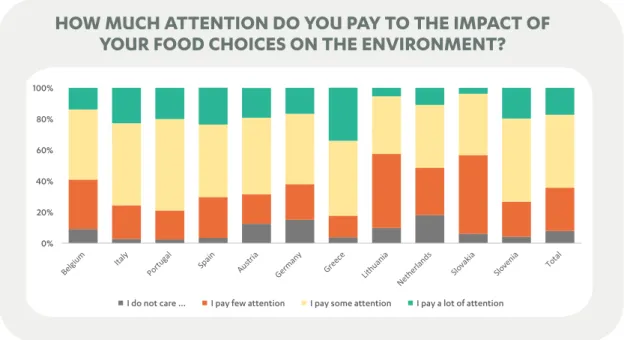
HOW MUCH ATTENTION DO YOU PAY TO THE IMPACT OF YOUR FOOD CHOICES ON THE ENVIRONMENT?
2 What ‘sustainable’ means to consumers in relation to food
WHAT COMES TO YOUR MIND WHEN THINKING ABOUT ‘SUSTAINABLE FOOD’?
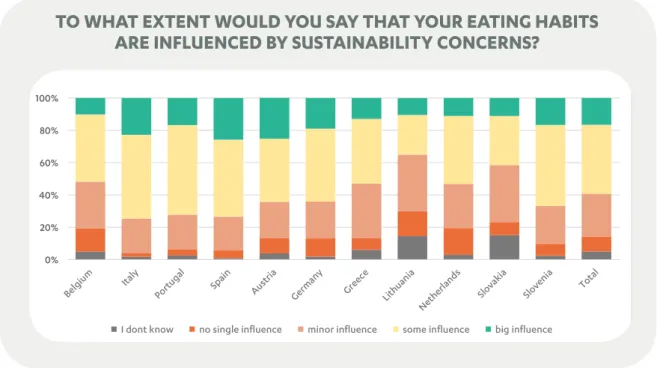
On average, more than half of consumers say that sustainability concerns have some influence (42.6%) or a lot of influence (16.6%) on their eating habits (Figure 6). For one in three, sustainability has no influence (9.2%) or only a slight influence (26.5%) on their food choices. But as with Q2, there are differences between countries; consumers in Italy, Portugal, Spain, Austria and Slovenia are more likely to say that their eating habits are influenced by sustainability issues than those in Belgium, Lithuania, the Netherlands and Slovakia.
TO WHAT EXTENT WOULD YOU SAY THAT YOUR DINING HABITS ARE AFFECTED BY SUSTAINABILITY CARE.
TO WHAT EXTENT WOULD YOU SAY THAT YOUR EATING HABITS ARE INFLUENCED BY SUSTAINABILITY CONCERNS?
Findings are very similar to those for Q2 ("How much attention do you pay to the impact of your food choices on the environment?"), which makes
3 Barriers to eating (more) sustainably
In Belgium, Lithuania and the Netherlands, resistance to change (“I'm not willing to change my eating habits”) and indifference to sustainability concerns (“I'm not worried about sustainability”) also seem to be important limiting factors in adoption anymore.
MAIN REASONS PREVENTING CONSUMERS FROM EATING SUSTAINABLY
4 Steps consumers are willing to take
Ready for change?
I’M NOT WILLING TO CHANGE MY EATING HABITS, EVEN IF THEY ARE NOT ENVIRONMENT-FRIENDLY
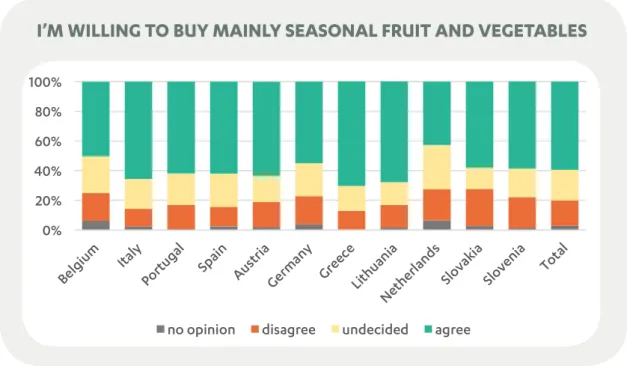
I’M WILLING TO BUY MAINLY SEASONAL FRUIT AND VEGETABLES
I’M WILLING TO WASTE LESS FOOD AT HOME
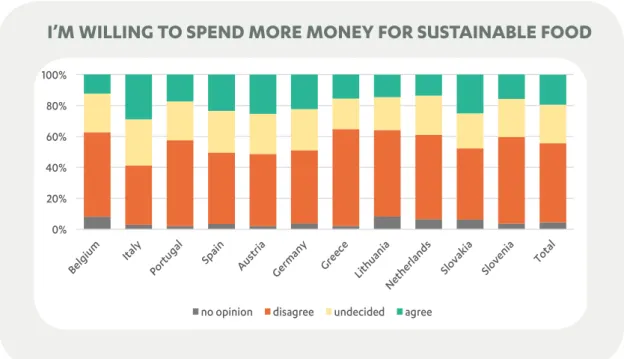
But unlike eating more seasonal produce and wasting less food, paying more for sustainable food garners little support from consumers (Figure 11). On average, only one in five consumers are willing to spend more money on sustainable food. The situation varies in different countries; while only 12.4% of Belgian consumers are willing to spend extra money on sustainable food, close to a third of Italians are willing to pay more.
Consumers in Italy, Spain, Austria, Germany and Slovakia are more willing to pay more for sustainably produced food, while those in Belgium, Greece, Lithuania, the Netherlands and Slovenia are less prepared to do so .
What about prices?
This reflects the earlier finding that price is seen as the most important barrier to eating more sustainably.
I’M WILLING TO SPEND MORE MONEY FOR SUSTAINABLE FOOD
I AM PREPARED TO SPEND MORE MONEY ON FOOD FOR WHICH I AM SURE FARMERS GET A GOOD PRICE IN RETURN.
I’M WILLING TO SPEND MORE MONEY ON FOOD FOR WHICH I’M SURE THAT FARMERS GET A FAIR PRICE IN RETURN
Attitudes towards proteins
I’M WILLING TO CUT DOWN ON RED MEAT (BEEF, LAMB AND PORK)
As many as 56.2% of respondents from all 11 countries state that they are not ready to reduce dairy products, while only 20.4% are ready and 19.4% are undecided.
I’M WILLING TO CUT DOWN ON DAIRY
I’M WILLING TO EAT MORE VEGETABLES/PLANT-BASED FOOD
There are as many consumers who say they are not ready to cut back on red meat as there are those who say they are ready to eat more plant-based foods. This finding could potentially be explained by a shift in the 'undecided' category; those who neither agree nor disagree with the statement "I am willing to reduce red meat (beef, lamb, and pork)" may, on the other hand, agree more with the statement "I am willing to eat more vegetables/plant foods." In one case, the proposed statement was a rather negative message, about (partial) giving up red meat, but a more positive sounding statement was about increased consumption of vegetables/foods of plant origin.
5 Zooming in on meat consumption
HAVE YOU REDUCED (OR DO YOU INTEND TO REDUCE) YOUR RED MEAT (BEEF, LAMB AND PORK) CONSUMPTION DUE TO ENVIRONMENTAL REASONS?
6 Consumer attitudes towards alternative protein sources
Little love for high-tech food
IN THE FUTURE, WOULD YOU BE WILLING TO REPLACE MEAT WITH INSECTS AND INSECT DERIVATES?
IN THE FUTURE, WOULD YOU BE WILLING TO REPLACE MEAT WITH LAB-GROWN MEAT (FROM CELL CULTURE)?
GMO-free plant-based alternatives are better accepted
IN THE FUTURE, WOULD YOU BE WILLING TO REPLACE MEAT WITH PLANT-BASED MEAT ALTERNATIVES, ONLY MADE FROM
INGREDIENTS THAT ARE NOT DERIVED FROM GMOS?
IN THE FUTURE YOU WILL BE WILLING TO REPLACE MEAT WITH LABORATORY GROWN MEAT (FROM CELL CULTURE). But acceptance drops to 13.6% if the plant-based meat alternatives contain GMOs (68.7% of respondents say they would not be willing to replace meat with plant-based alternatives containing GMOs, 17.7% are uncertain) (Figure 20). The plant-based meat alternatives produced by the Impossible Foods company contain genetically modified ingredients, while those produced by its.
IN THE FUTURE YOU WILL BE WILLING TO SUBSTITUTE MEAT WITH PLANT-BASED MEAT ALTERNATIVES, EVEN IF MADE.
IN THE FUTURE, WOULD YOU BE WILLING TO REPLACE MEAT WITH PLANT-BASED MEAT ALTERNATIVES, EVEN IF MADE
The question, as theoretical as it may seem, reflects the dilemma American consumers face with the top-selling plant-based hamburgers on the American market. Consumer groups in the US have expressed concern about the lack of data proving that this ingredient can be used safely in food.46 While the Impossible Burger is not yet available for sale in Europe, Impossible Foods last submitted an authorization request to the European Food Safety Authority . year to get soy leghemoglobin approved in the EU.47.
FROM INGREDIENTS DERIVED FROM GMOS?
In the spring of 2019, members of the Agriculture and Rural Development (AGRI) Committee of the European Parliament voted to ban the use of 'meat' names (eg 'burger', 'steak', .. sausage') for plant-based products. 48 The use of terminology traditionally associated with meat on the label of plant-based foods is already prohibited in some countries, including Spain. Because the AGRI Committee's move was said to be motivated by its desire to avoid misleading consumers, we sought to assess whether or not consumers approve of food companies using 'meat' names for plant-based products. Austrian and German consumers are the most hostile to "meat" names for plant-based products, with a third of respondents in these countries saying these names should never be allowed for vegetarian/vegan foods.
A previous study (2015)49 by the German consumer group vzbv found that the majority of German consumers (78%) would be satisfied if they were a plant-based vegetarian/.
Meaty’ names or not?
IN THE FUTURE, WOULD YOU LIKE TO REPLACE MEAT WITH TRADITIONAL VEGETARIAN FOOD (eg vegetable stew). On average, only 1 in 5 consumers (20.4%) think that the use of 'meat' names should never be allowed on vegetarian/vegan products. 42.4%) believe that these names should be allowed provided that products are clearly labeled as vegetarian/vegan, and 1 in 4 (26.2%) see no problem at all with the use of such names (11% have no opinion) (Figure 22). A reference to the flavor of the original meat product in the name was also supported (eg "vegetable spread flavored with foie gras").
Only 38% of respondents thought that vegetarian/vegan products should be given completely new names, without reference to the animal products they 'imitate'.
TO WHAT EXTENT DO YOU AGREE THAT COMPANIES USE MEAT-RELATED NAMES LIKE SAUSAGE AND BURGER TO DESCRIBE MEAT-FREE
7 What needs to be done to make food production and consumption (more) sustainable, according to
On the production side
REGULATIONS SHOULD FORCE FARMERS AND FOOD PRODUCERS TO MEET MORE STRINGENT SUSTAINABILITY STANDARDS
FARMERS SHOULD BE GIVEN INCENTIVES (E.G. THROUGH SUBSIDIES) TO PRODUCE FOOD MORE SUSTAINABLY
Looking at the global context, half of consumers believe that the EU should maintain its level of ambition in terms of sustainable food production, even if other world players lag behind (52% on average disagree with the statement "The EU should not be more proactive regarding sustainable food policies, unless other countries such as China or the USA do the same") (Figure 25). This is especially true in Austria and Germany, where respectively 74.9% and 64.1% of consumers disagree that The EU should not do more than China or the U.S. A fifth of respondents (20.2%, up to 29.5% in Slovakia) would prefer not to see the EU be more proactive about sustainable food production than other world players , and 16.8% are unsure.
THE EU SHOULD NO LONGER BE PROACTIVE ON SUSTAINABLE FOOD POLICY UNLESS OTHER COUNTRIES LIKE.
THE EU SHOULD NOT BE MORE PROACTIVE ON SUSTAINABLE FOOD POLICIES UNLESS OTHER COUNTRIES SUCH AS
CHINA OR THE USA DO THE SAME
On the consumption side
I DO NOT WANT SOMEONE TO TELL ME OR DECIDE FOR ME WHAT I SHOULD EAT OR NOT
39 Preserving the freedom of choice (even when that choice is not environmentally friendly) is important to 45.6% of consumers. These consumers do not agree that unsustainable food products (eg strawberries in winter) should not be on supermarket shelves (Figure 27). Italian consumers are the most willing to accept the non-availability of unsustainable food options (40.8% . agree), while Lithuanian consumers are the least satisfied with this prospect (58.6% disagree).
UNSUSTAINABLE FOOD PRODUCTS SHOULD BE PULLED FROM SHELVES
SUSTAINABILITY INFORMATION SHOULD BE COMPULSORY ON FOOD LABELS
On the other hand, the idea of taxing less sustainable foods is not very popular with consumers. On average, only 1 in 4 agree that less sustainable food should be taxed more – and as a result be more expensive. These results are not surprising as price ("too expensive") was identified as the main perceived barrier to sustainable eating in Q5.
Support for taxes on less sustainable food is highest in Italy (38.2%) and Slovenia (37.3%), while Lithuania (62.3%) and Greece (60.1%) are the countries with the strongest opposition against the taxation of less sustainable food.
FOOD WHICH IS LESS SUSTAINABLE SHOULD BE MORE TAXED (AND BE MORE EXPENSIVE)
THE GOVERNMENT IS DOING ENOUGH IN ENCOURAGING/
PROMOTING FOOD SUSTAINABILITY
ANNEX | QUESTIONNAIRE
- To what extent do you agree with each of the following statements?
- How much attention do you pay to the impact of your food choices on the environment?
- What comes to your mind when thinking about “sustainable” food? [Tick maximum 3 items]
- To what extent would you say that your eating habits are influenced by sustainability concerns?
- What are the main reasons preventing you from eating (more) sustainably? [Tick maximum 3 reasons]
- What are the main reasons preventing you from eating (more) sustainably?
- To what extent do you agree with each of the following statements?
- In the future, would you be willing to replace meat with each of the following food items?
- To what extent do you agree with each of the following statements?
I am not willing to change my eating habits even if they are not environmentally friendly No sense. Have you reduced (or are you planning to reduce) your consumption of red meat (beef, lamb and pork) for environmental reasons. No, I have not reduced my consumption of red meat, nor do I intend to do so for environmental reasons.
In the future, would you be willing to replace meat with each of the following foods?
![Figure 1: Q1a - Level of agreement with the statement: 'My food habits negatively affect the environment' [Base: all respondents] 44](https://thumb-eu.123doks.com/thumbv2/pubpdforg/19334415.0/19.892.94.576.85.188/figure-level-agreement-statement-habits-negatively-environment-respondents.webp)
![Figure 2: Q1b - Level of agreement with the statement: “When compared to car use, food habits have only little impact on the environment” [Base: all respondents]](https://thumb-eu.123doks.com/thumbv2/pubpdforg/19334415.0/20.892.140.792.373.755/figure-level-agreement-statement-compared-habits-environment-respondents.webp)
![Figure 3: Q1c - Level of agreement with the statement: “In relative terms, the environmental impact resulting from food habits and production in the EU is smaller than in countries such as China or the USA” [Base: all respondents]](https://thumb-eu.123doks.com/thumbv2/pubpdforg/19334415.0/21.892.117.764.77.467/agreement-statement-relative-environmental-resulting-production-countries-respondents.webp)

![Figure 8: Q6 – Level of agreement with the statement: ”I’m not willing to change my eating habits, even if they are not environment-friendly” [Base: all respondents]](https://thumb-eu.123doks.com/thumbv2/pubpdforg/19334415.0/25.892.102.750.457.864/figure-level-agreement-statement-willing-environment-friendly-respondents.webp)
![Figure 10: Q6 – Level of agreement with the statement: ”I’m willing to waste less food at home” [Base: all respondents]](https://thumb-eu.123doks.com/thumbv2/pubpdforg/19334415.0/26.892.133.770.683.1086/figure-level-agreement-statement-willing-waste-base-respondents.webp)